Easy
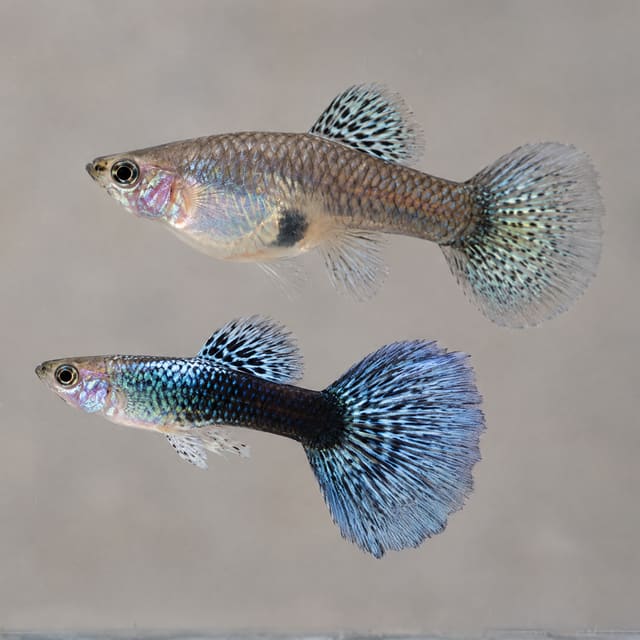
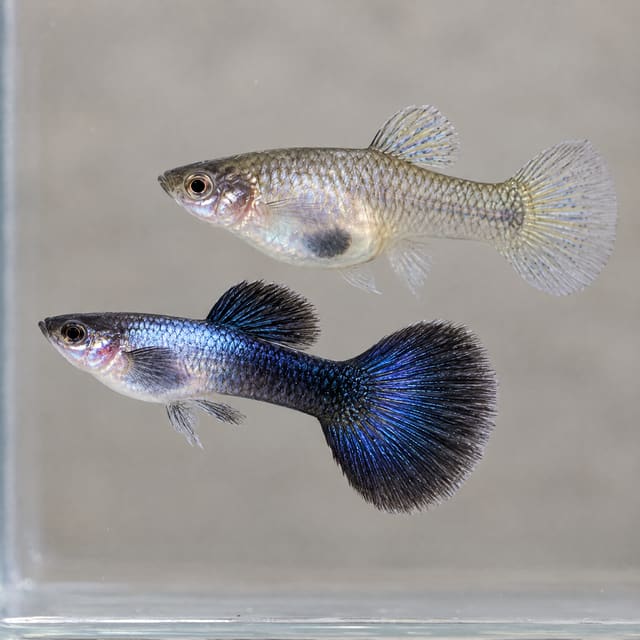
One pair of Blue Tuxedo guppies (Poecilia reticulata), a male and a female, dispatched at about 3.5 cm. The male has a silver-white front, navy rear half and a broad electric-blue tail. Peaceful and easy in hard, slightly alkaline water at 22–28°C, in 60 litres or more.
Adult size is the maximum length this species reaches at full maturity (scientific sources). The livestock you receive will be younger and smaller. Product-photo provenance and any image-specific limitations are stated on the listing.
Poecilia reticulata
Each quantity is one pack containing 2 fish. Discounts count packs. Selected: 1 pack (2 fish).
One pair of Blue Tuxedo guppies (Poecilia reticulata), a male and a female, dispatched at about 3.5 cm. The male has a silver-white front, navy rear half and a broad electric-blue tail. Peaceful and easy in hard, slightly alkaline water at 22–28°C, in 60 litres or more.
Adult size is the maximum length this species reaches at full maturity (scientific sources). The livestock you receive will be younger and smaller. Product-photo provenance and any image-specific limitations are stated on the listing.
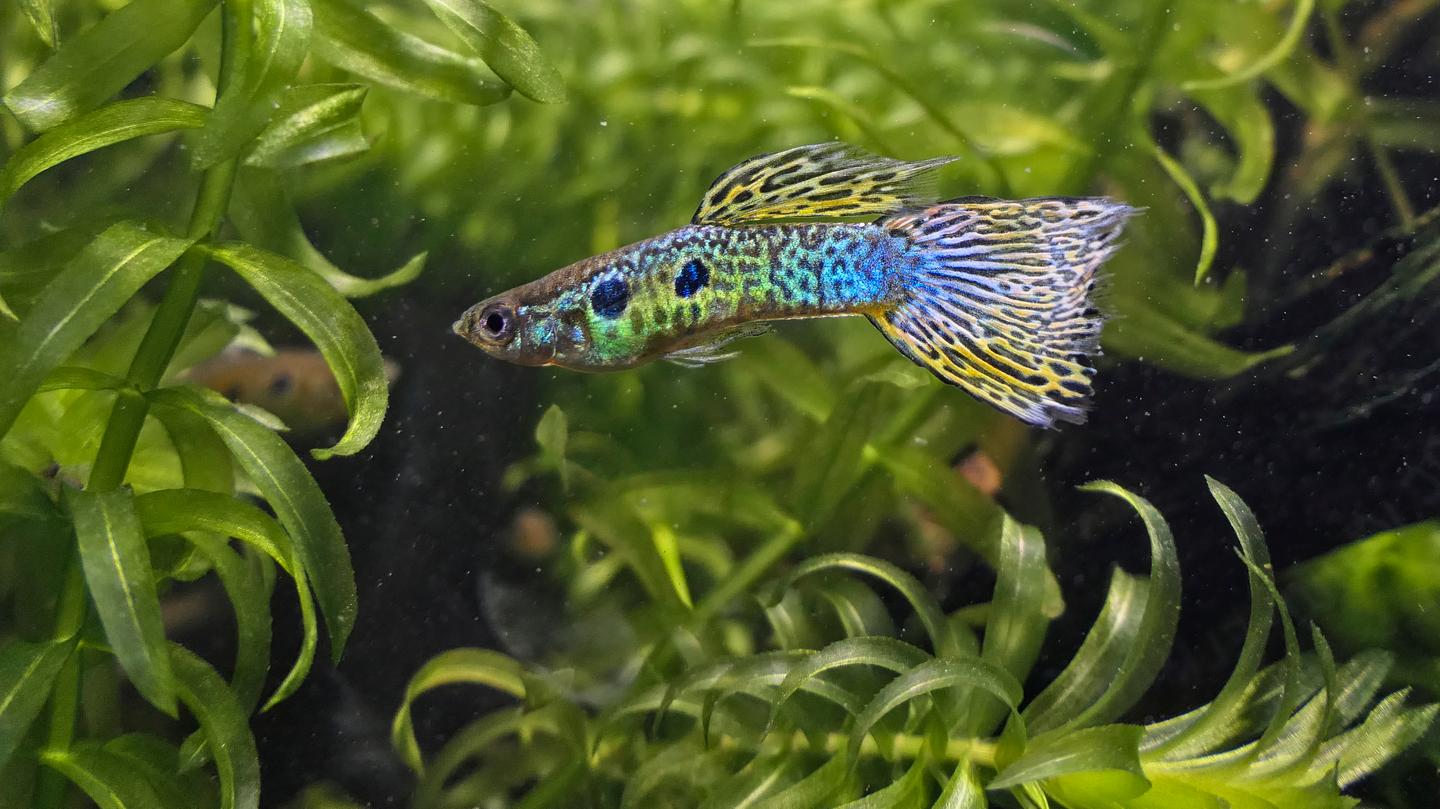
Guppies are social livebearers suited to a prepared beginner, not a fish-per-litre formula. Use a mature filtered aquarium, tested neutral-to-alkaline mineral-bearing water, deliberate sex and population planning, open swimming room, cover and a separation option.
Read the full care guidance when planning conditions for your aquarium.
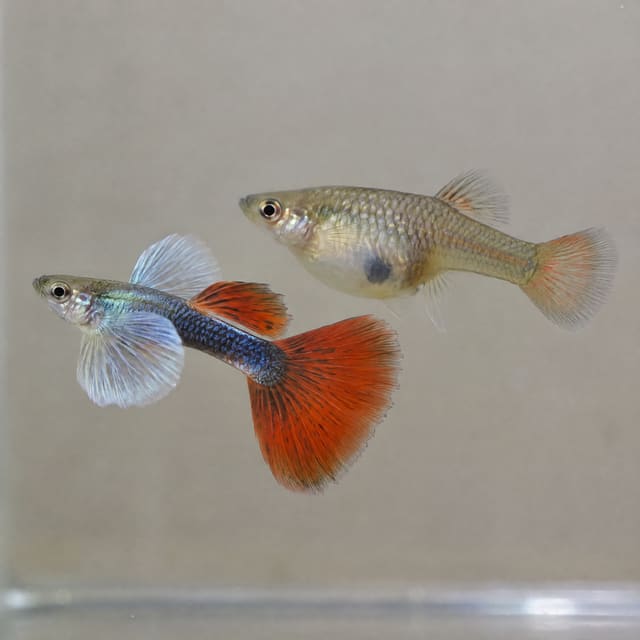
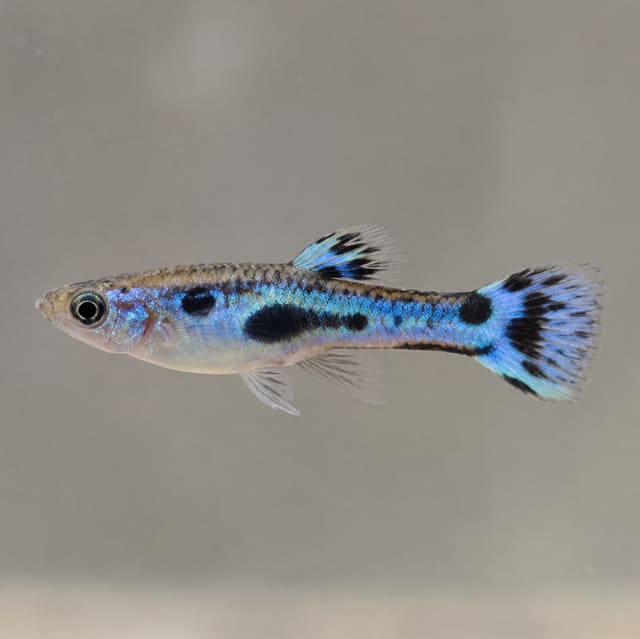
The Blue Tuxedo is a fancy guppy, one of the many selectively bred colour lines of Poecilia reticulata, and it is the male that catches the eye. In the photographs on this page the male has a pale, silver-white head and front body. A dark mark sits just behind the gill cover, and from roughly the middle of the body back to the base of the tail the colour turns a deep navy blue. That dark rear half against the pale front is the tuxedo in the name.
Behind the navy body sits a broad, fan-shaped tail in bright electric blue. Look closely and you can see the fine rays running through it, with the colour thinning slightly to a paler, almost silvery fringe along the trailing edge. The dorsal fin on the back is tall and blue as well, and the small pelvic fins under the belly carry blue tips. Side-on, the effect is three blocks of colour: silver at the front, navy in the middle, bright blue behind.
Against green plants or dark wood the tail stands out strongly, which makes this a good fish for a planted community tank where you want a splash of blue that is not another neon tetra.
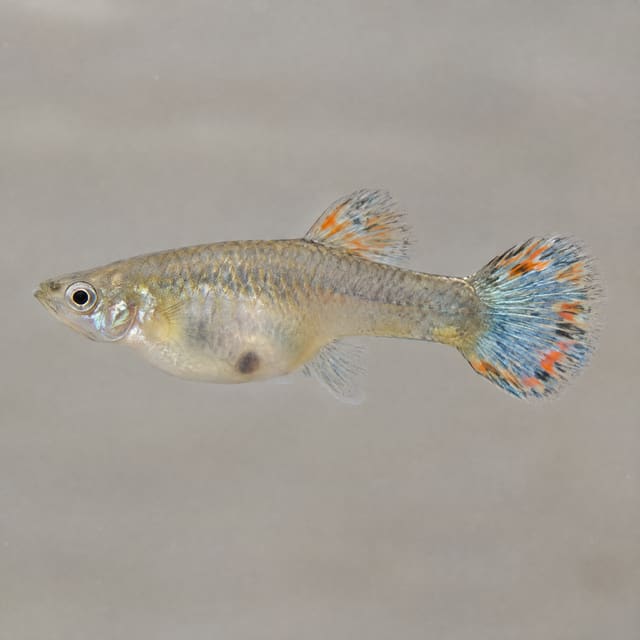
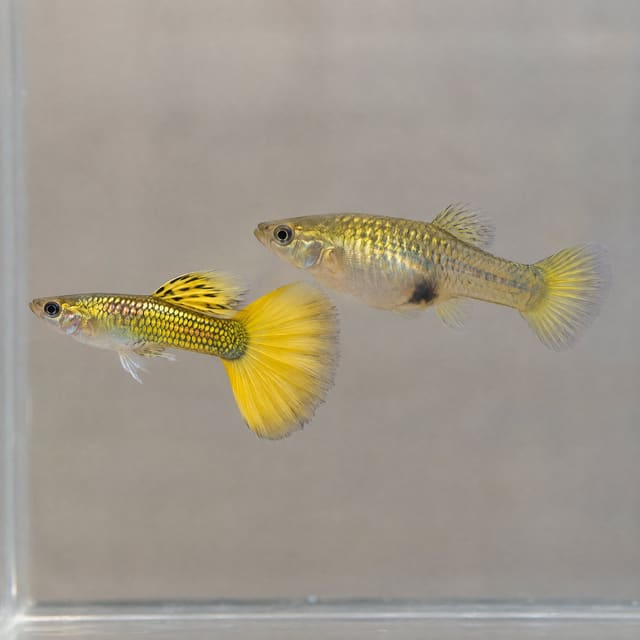
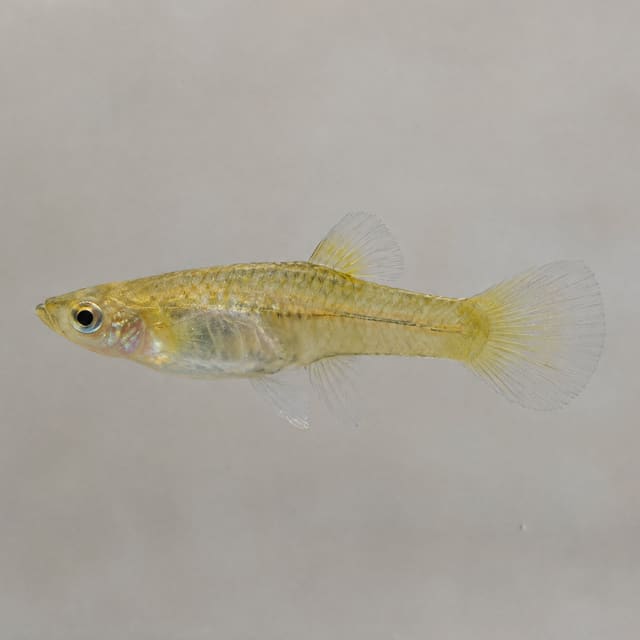
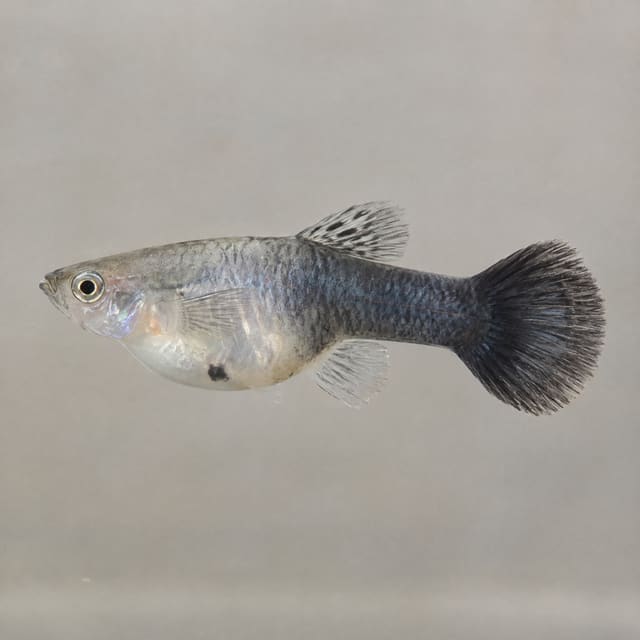
Every pair has one fish with a show tail and one without, and that is normal for guppies. Male guppies carry a gonopodium: the anal fin, under the rear of the belly, is modified into a narrow, stick-like rod used in mating. The female keeps an ordinary fan-shaped anal fin. Seriously Fish describes females as larger, plumper and generally duller in colour than males, while noting that some bred varieties show strong colour in the female's tail.
So expect the female in your pair to be the bigger, plainer fish, possibly with some blue showing in her tail. How much colour she carries varies from fish to fish, and we would not promise a female who looks like the male. Once she is carrying young, a darkened gravid spot near her vent becomes easier to see.
There is a sound reason why the male does the showing off. Wikipedia notes that the genes responsible for male guppy ornament are linked to the Y chromosome and are heritable, so much of a male's colour pattern passes from father to son. When the first young males in your tank start to colour up, look to their father for a clue to what they may become.
One quantity of this listing is one pair: a male and a female Blue Tuxedo guppy. A quantity of two sends two pairs, three sends three pairs, and so on. The size option on the listing, 3.5 cm, is the dispatch size. It describes the fish as they leave us, not the size they finish at.
Guppies keep growing once they are home. FishBase records a maximum of 5.0 cm standard length for males and 6.0 cm standard length for females, and Seriously Fish gives the same 60 mm figure as the species maximum. Standard length runs from the snout to the base of the tail, so a male with a tail this size looks longer in the tank than the number suggests. Those are top figures from the scientific record rather than a target. FishBase gives 2.8 cm total length as a common size for males, and the female is normally the larger of the two.
Fancy guppies are a bred strain, and individual fish differ. Tail width, the exact point where the navy rear begins, the depth of the blue and the amount of colour in the female all vary a little from one fish to the next. The male in the photographs shows the pattern clearly, but no two guppies are printed from the same plate, and keen breeders enjoy that variation when they raise their own young and pick out the best males.
A pair is the simplest way to try the strain, and it suits a keeper who wants a little colour in a community tank. The thing to think about is the ratio of males to females. Seriously Fish advises keeping several females to each male, because males are vigorous in their constant pursuit of females, and the OATA care sheet recommends two females to each male, with at least three guppies kept together. With one female in the tank she takes all of the male's attention.
There are two easy ways to spread that attention. You can order extra pairs and add more females on top, or you can add females from another listing such as our Female Guppy Mix. Bear in mind that females from other colour lines bring their own genes with them, so their young will not necessarily look like Blue Tuxedos. If keeping the strain pure matters to you, stick to Blue Tuxedo females.
Be honest with yourself about this before ordering. A male and a female guppy kept together will breed, and the female can go on producing broods for months from stored sperm even if the male is later moved. If you want blue colour without young, a pair is the wrong choice; a tank of males alone produces no fry at all. If you are happy to see a few young appear and let nature take its course in a well-planted community tank, a pair is ideal.
All fancy guppies, the Blue Tuxedo included, belong to a single species. Wilhelm Peters described Poecilia reticulata in 1859 from fish collected in Venezuela, and Seriously Fish gives the type locality as a river near Caracas. FishBase places it in the livebearer family Poeciliidae, subfamily Poeciliinae, and still lists Poecilia reticulata Peters, 1859 as the accepted name. Historical names for the species include Lebistes poecilioides, which is why you may still meet the word Lebistes in older books.
The English name honours Robert John Lechmere Guppy, who, according to Wikipedia, sent specimens from Trinidad to the Natural History Museum in London. FishBase gives the native range as Venezuela, Barbados, Trinidad, northern Brazil and the Guianas, and Seriously Fish adds Antigua and Barbuda and the Netherlands Antilles to the list of places in north-eastern South America and the southern Caribbean where it occurs naturally.
Wild guppies are not fussy about where they live. FishBase describes them in warm springs and their outflows, weedy ditches and canals. Seriously Fish calls the species incredibly adaptable, found in almost every kind of habitat from high-altitude streams to turbid swamps, and adds that it does best where there is lush growth of algae, marginal vegetation or aquatic plants. Wikipedia notes they are more abundant in smaller streams and pools than in large, deep or fast-flowing rivers. Some populations live in brackish water, and Wikipedia reports that guppies can tolerate salinity up to 150% of normal seawater. That last figure is a record of what the species can survive, not a suggestion for your aquarium; a Blue Tuxedo needs no salt.
A wild male guppy looks very different from the fish on this page. Research on Trinidadian guppies, summarised on Wikipedia, shows males evolving duller colours with fewer, smaller spots where predators are plentiful, both in the wild and in laboratory trials. Females, meanwhile, are drawn to brightly coloured males, especially those with orange spots on the flank. Wikipedia also notes that wild guppies run to about two generations a year. That tug between being seen by females and being seen by predators, played out over generation after generation, is one reason the guppy is used as a model organism in ecology, evolution and behaviour studies.
In the aquarium there are no predators to pay for bright colour, and breeders have spent generations selecting long fins and solid colour blocks. Wikipedia lists a dozen recognised tail shapes among fancy guppies, from veil and fan tails to double swords and lyre tails. The Blue Tuxedo male in the photographs carries a broad fan, a lot of fin for a fish this small, which is worth keeping in mind when you choose its tank mates and set the filter flow.
The guppy's toughness has also caused problems. FishBase reports that it has been widely introduced outside its range, mainly for mosquito control, and that several countries report harm to native fish. Seriously Fish counts introduced or feral populations in around fifty countries, the UK among them. The species is assessed as Least Concern on the IUCN Red List (assessed May 2020), so there is no conservation reason to release anything. The OATA advice is plain: never release aquarium animals or plants into the wild, because it is illegal.
Guppies are small, but a pair becomes a family surprisingly quickly, so plan the tank for what it will hold in a few months rather than on the day the fish arrive. Seriously Fish suggests a base of at least 45 × 30 cm, about 41 litres, and the OATA care sheet gives 45 litres as the minimum for the smaller livebearers. We recommend 60 litres or more for this pair. The extra volume makes the water steadier, leaves room for the additional females we suggested above, and gives you breathing space while you decide what to do with the first broods.
The equipment list is short but none of it is optional. OATA describes a filter as always essential, and you will also need a heater to hold the temperature steady all year round, a gravel or sand substrate, live plants or decorations for shelter, a light to give the fish a regular day and night, and a water test kit for weekly checks. A new filter needs time to build up the bacteria that process waste, so test the water before you order: ammonia and nitrite should both read zero.
Seriously Fish describes guppies as unfussy about decor but notes that a planted tank with floating vegetation is appreciated and that strong currents should be avoided. That advice matters more than usual with a Blue Tuxedo male. A tail that wide is a lot of fin to push through moving water, so set the filter outlet so it does not blast across the whole tank. Pointing it at the glass, lowering the flow setting or using a spray bar along the back are all simple fixes. If the male is being pushed about or hangs in one corner, the flow is too strong.
Give the pair open water at the front, where the male can display, and planting towards the back and sides. Fine-leaved plants and a raft of floating plants do two jobs. They break up sightlines so the female can get out of the male's way for a while, and they give newborn fry somewhere to hide from the adults. Seriously Fish points out that adult guppies eat their young, so cover makes a real difference if you want some fry to survive in the main tank.
Smooth decor is kinder to long fins than sharp rock or rough ornaments. Bogwood, rounded stones and plants are all fine. Keep a cover on the tank to cut evaporation and help the heater hold the temperature.
A regular light period helps the fish keep a normal routine, and a timer makes it easy. Avoid a spot in direct sunlight or next to a radiator, where the temperature can creep up on a warm day, and choose a stand that can take the full weight of the filled tank. A 60-litre aquarium weighs a good deal more than 60 kg once the glass, gravel and decor are added.
Guppies are hard-water fish, and that is the single most important thing to know about their water. Seriously Fish says the species may manage in soft or acidic conditions for a while, but long-term it should be kept in moderately hard or harder water. Test your tap water before you order. If it comes out very soft, talk to us before buying rather than after.
This also matters when you plan a mixed community. A tank set up around the guppy's needs is a hard, slightly alkaline tank, so choose companions whose published ranges overlap comfortably with the table below rather than sitting at the edge of it.
These are the values we recommend for a Blue Tuxedo pair, with the published ranges behind them:
| Value | Our routine range | Published ranges |
|---|---|---|
| Temperature | 22–28°C | FishBase 18–28°C; Seriously Fish 17–28°C; OATA 20–28°C |
| pH | 7.0–8.0 | FishBase 7.0–8.0; OATA 7.0–8.0; Seriously Fish 7.0–8.5 |
| General hardness | 9–18 dGH | FishBase 9–19 dH; OATA 8–18 dGH; Seriously Fish 8–30 dGH |
| Carbonate hardness | 5–15 dKH | OATA 5–15 dKH |
| Ammonia and nitrite | Zero | OATA: zero mg per litre |
| Nitrate | As low as possible | OATA: no more than 20 mg per litre above your tap water |
The lower temperatures in the FishBase and Seriously Fish ranges describe what the species tolerates, not what a fancy guppy should live at. Keep the heater set comfortably inside 22–28°C and leave it there; steady matters more than chasing an exact number.
Guppies breed readily, and a tank that starts with two fish can hold many more within a few months. As numbers rise, so does the waste load, so keep an eye on nitrate and be ready to step up water changes or rehome some of the youngsters.
The sources do not agree completely on what wild guppies eat, which tells you how adaptable the species is. FishBase lists zooplankton, small insects and detritus. Seriously Fish describes wild fish as mainly insect-eaters. Wikipedia lists algal remains, diatoms, invertebrates, zooplankton, detritus, plant fragments and aquatic insect larvae, and says that algal remains usually make up the largest share. Put together, that is an omnivore that picks at almost anything small enough to swallow.
Tank-bred guppies, as Seriously Fish puts it, are far removed from their wild ancestors and accept most foods offered. That makes feeding easy, but variety still matters. A good routine looks like this:
Overfeeding is the most common mistake with a pair this small. Two fish need very little, and uneaten flakes rot in the gravel, push up nitrate and cloud the water. If food is still drifting about after a few minutes, cut the next portion down.
Watch both fish at feeding time. The male spends much of his day following the female, so it is worth checking that both fish actually eat rather than assuming they do. Spreading a small pinch across the surface, rather than dropping it in one spot, gives both fish a fair go and lets any other community fish eat without crowding the pair.
Once fry appear, the adults will treat them as food too, which Seriously Fish warns about directly. Regular feeding will not stop that, so plan cover or a separate tank if you want young to grow on.
Seriously Fish sums up the guppy as a very peaceful fish, and that matches its reputation in the shop. A Blue Tuxedo will not bother other species. Its only interest outside feeding is the female, and the main risks run the other way: fish that nip long fins, and fish big enough to swallow a guppy.
Seriously Fish suggests a quiet community tank with other livebearers, rasboras, Corydoras, small loricariids and tetras. Those groups share the guppy's small size and calm manner, but check each species' own water needs before buying, because guppies want harder, slightly alkaline water and their companions should share that preference.
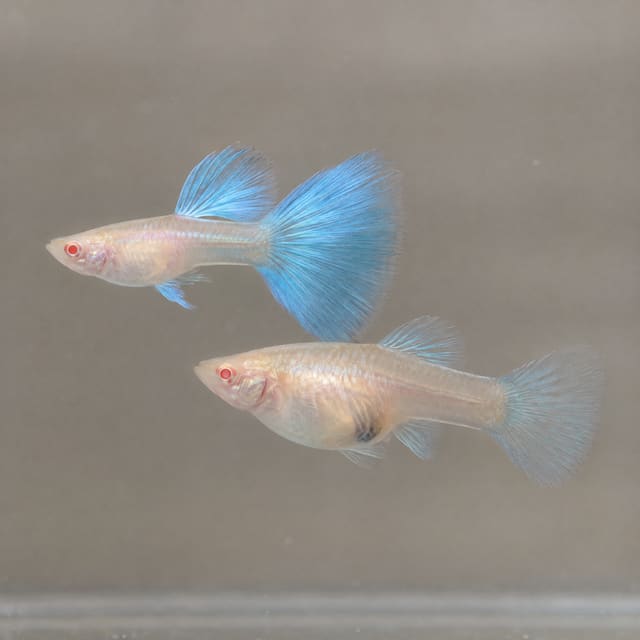
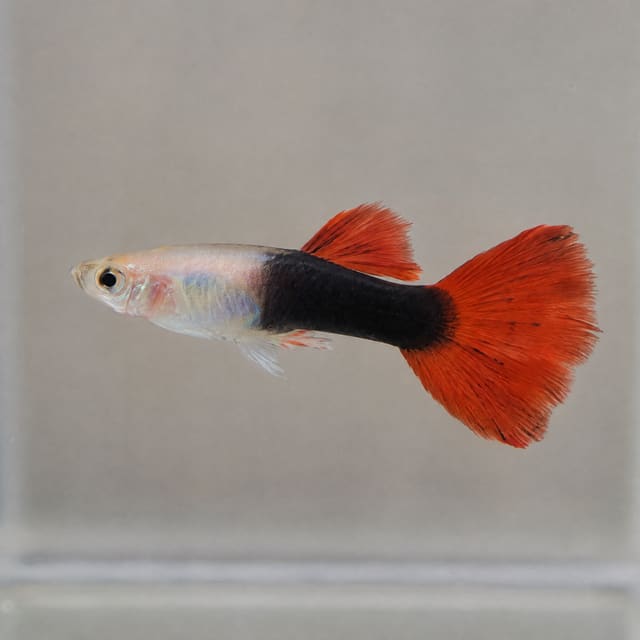
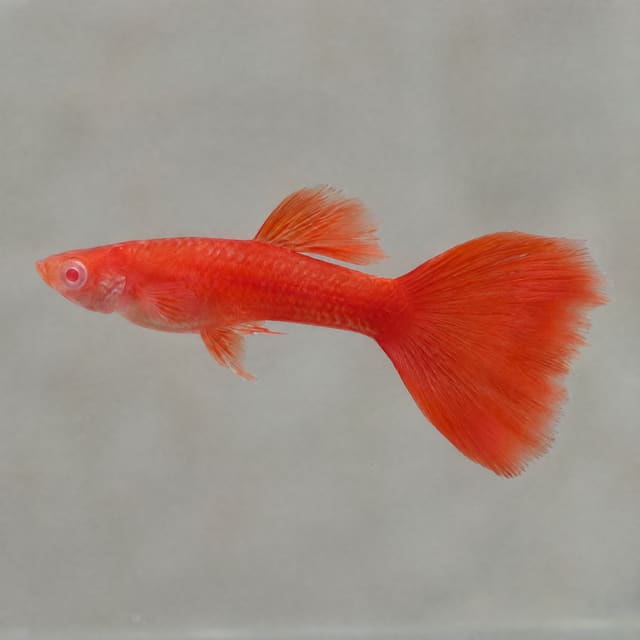
Guppies of different colour lines get on perfectly well together, and many keepers enjoy a mixed tank. Blue Tuxedos sit nicely alongside other blue strains such as the Albino Sky Blue Guppy Pair, and the tuxedo pattern in another colour can be seen in our Red Tuxedo Male Guppy. The catch, again, is breeding. Guppies of any strain cross freely, so a mixed tank produces mixed young. Keep the Blue Tuxedos in their own tank if you want the fry to carry the pattern.
Guppies are social, and Wikipedia reports that shoaling guppies spend less time and energy on anti-predator behaviour and more time feeding than fish kept alone. A pair on its own will be fine, but a small group with extra females is more relaxed, spreads the male's attention and gives a better display. Wikipedia also describes an intriguing piece of research on female choice: females that watched a male courting another female later spent more time near that male than near a solitary one. Guppy courtship is very much a social affair.
Fancy guppies are popular for good reason, but the strains are not as tough as the wild species. Seriously Fish puts it bluntly: many commercially bred guppies are not very hardy because of inbreeding and over-production, and are prone to disease and premature death. That is all the more reason to give a new pair good water and a calm start.
The OATA care sheet lists the signs to look for: clear, bright eyes, undamaged fins, intact scales and no ulcers or bumps. In practice, look for a male whose tail edges are clean rather than ragged or split, and a female who is alert, eats readily and moves easily through the tank.
OATA advises watching for changes in swimming, changes in colour, loss of fin tissue and white spots. Any of those is a reason to test the water first, since water quality is the first thing to rule out, and look more closely second. Wikipedia lists these as common diseases of aquarium guppies:
If you spot any of these, test the water, carry out a partial water change if the readings are off, and get advice before reaching for medicine. Many treatments are dosed by tank volume, and getting the volume wrong is easy.
Wikipedia gives a typical lifespan of around two years for wild guppies, and the OATA care sheet says guppies can live for several years in the aquarium. Clean, stable, hard water and a varied diet give your pair the best chance.
If the pair is joining an established community, a separate quarantine tank is good practice. A couple of weeks on their own lets you watch the new fish closely, feed them without competition and catch any problem before it reaches your other fish.
Put a male and a female guppy together and you should expect young. Guppies are livebearers: the female gives birth to free-swimming fry rather than laying eggs, and Seriously Fish describes the species as breeding very easily.
The published figures vary, so here they are side by side.
You will usually see it coming. As pregnancy advances the female's belly fills out and the gravid spot near her vent grows larger and darker.
Female guppies can store sperm. Seriously Fish says that females can go on producing young for six months or more with no male present, and Wikipedia reports stored sperm fertilising eggs for up to eight months. In practice that means two things. A female can keep producing broods long after the male has gone. And if a female has shared a tank with other guppies before she reached you, her first broods may not all be pure Blue Tuxedo.
Adult guppies eat their young, Seriously Fish warns, so if you want fry to survive, you need either thick cover or a separate tank. Dense fine-leaved and floating plants let a few fry slip through in the main aquarium. For more, move the heavily pregnant female to a separate, heated and filtered tank with plenty of plants, and return her once she has given birth.
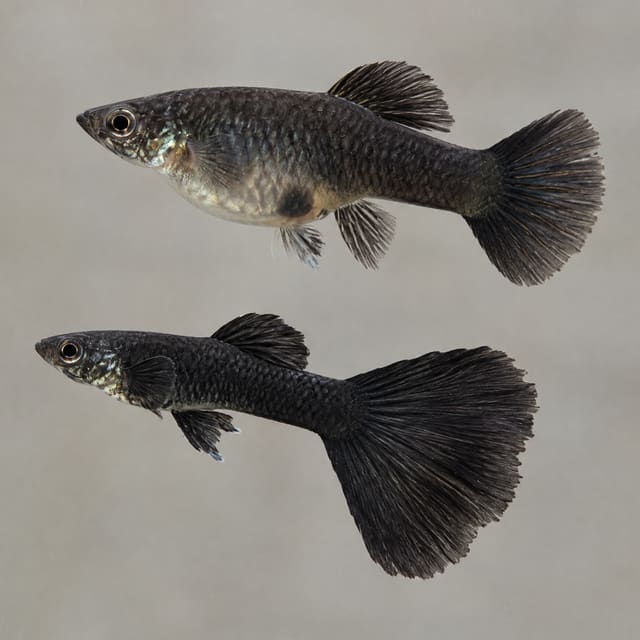
Because the genes for male ornament sit on the Y chromosome, a Blue Tuxedo male passes much of his pattern to his sons. If you want to keep the line, raise the young apart from other guppy strains and choose the best-marked males to breed on. Male colour develops as the young mature, and FishBase puts male maturity at around two months, so it pays to wait before deciding which to keep. The Half Black Blue Big Tail Guppy Pair is another dark-backed blue pair if you want a second line to compare against yours, kept separately.
A breeding pair can outgrow a small tank. Plan where the extra young will go: a second tank, a fellow keeper, or a local aquatic shop that takes home-bred fish. What you must never do is let them go in a pond or stream. OATA states that releasing aquarium animals into the wild is illegal.
Have the aquarium fully ready before the parcel is on its way. The filter should be running and mature, the water tested, and the heater holding the tank at the temperature range on this page. Please read our delivery and live-arrival information before ordering, so you know how the day works.
Your guppies travel in oxygen-filled bags inside insulated packaging, with heat packs when the weather calls for them, via a tracked courier licensed to carry live animals. We email the confirmed delivery date and tracking details. Someone must be at the delivery address to take the parcel in, because live animals cannot be left unattended.
Start a continuous video before you open anything, while the parcel is still sealed. Open it in the same take and show both fish in the still-sealed bag. If a fish arrives dead, dying or clearly compromised, email hello@tropicalfishco.co.uk on the day of delivery with your order number and that video. Photos alone do not meet the policy. The resolution is a replacement with your next order or a refund for the affected fish, subject to the guarantee terms.
Keep the lights low for the rest of the day and leave the fish to settle. Over the first week, watch breathing, appetite and behaviour. A male who holds his fins up and follows the female about, and a female who explores and eats, are both good signs. Clamped fins, gasping at the surface or hiding without coming out to feed are reasons to test the water and get in touch.
Hold back on extra purchases until the pair is feeding well and the readings have stayed steady for a week or two.
These are the sources used for the care and species information on this page.
No reviews for this item yet. Bought one? Honest reviews only, good or bad.
What customers say about ordering from us
Easy website plenty of info on fish your buying great to pick a time slot
TRACEY DURRANT · 7 Oct 2026
Got some lovely fish thank you
Kevin Mackie · 7 Oct 2026
Reviews of our shop, collected by Judge.me, an independent third-party review collector. Newest first.
Moved by UK carriers licensed to handle live animals
Hand-packed with oxygen bags, poly box, heat pack
Email photos the same day; an optional unboxing video helps us review problems faster — claim terms apply
Klarna & PayPal Pay in 3 at checkout



22–26°C · pH 6–7.8 · 75L