Easy
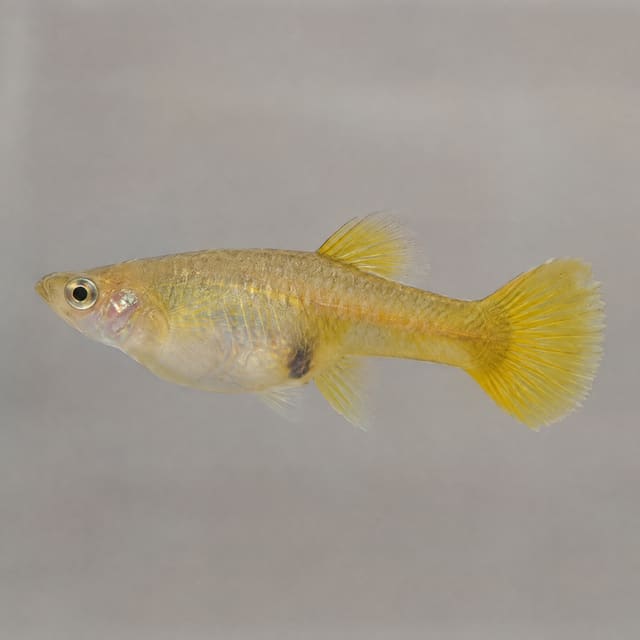
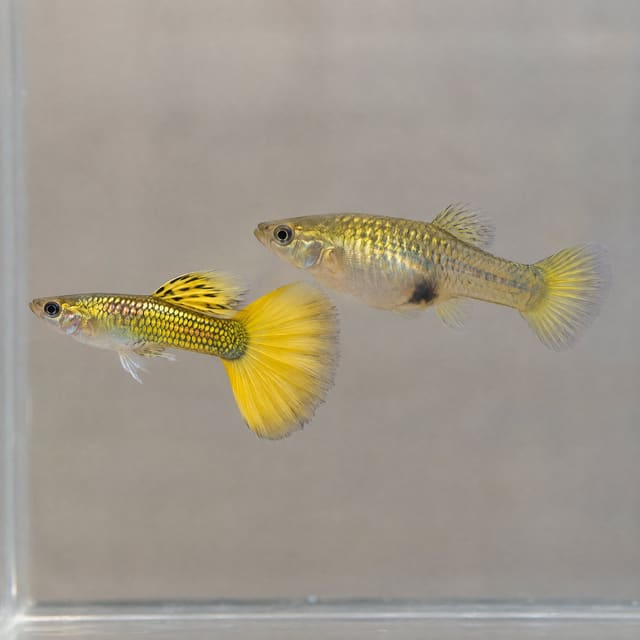
One pair of Yellow Tuxedo guppies (Poecilia reticulata), a male and a female, packed at about 3.5 cm. The male is pale in front and velvet black behind, with a long golden dorsal and a broad yellow tail. Peaceful and easy in hard, alkaline water: 22–28°C, pH 7.0–8.0, 9–18 dGH, in 60 litres or more.
Adult size is the maximum length this species reaches at full maturity (scientific sources). The livestock you receive will be younger and smaller. Product-photo provenance and any image-specific limitations are stated on the listing.
Poecilia reticulata
Each quantity is one pack containing 2 fish. Discounts count packs. Selected: 1 pack (2 fish).
One pair of Yellow Tuxedo guppies (Poecilia reticulata), a male and a female, packed at about 3.5 cm. The male is pale in front and velvet black behind, with a long golden dorsal and a broad yellow tail. Peaceful and easy in hard, alkaline water: 22–28°C, pH 7.0–8.0, 9–18 dGH, in 60 litres or more.
Adult size is the maximum length this species reaches at full maturity (scientific sources). The livestock you receive will be younger and smaller. Product-photo provenance and any image-specific limitations are stated on the listing.
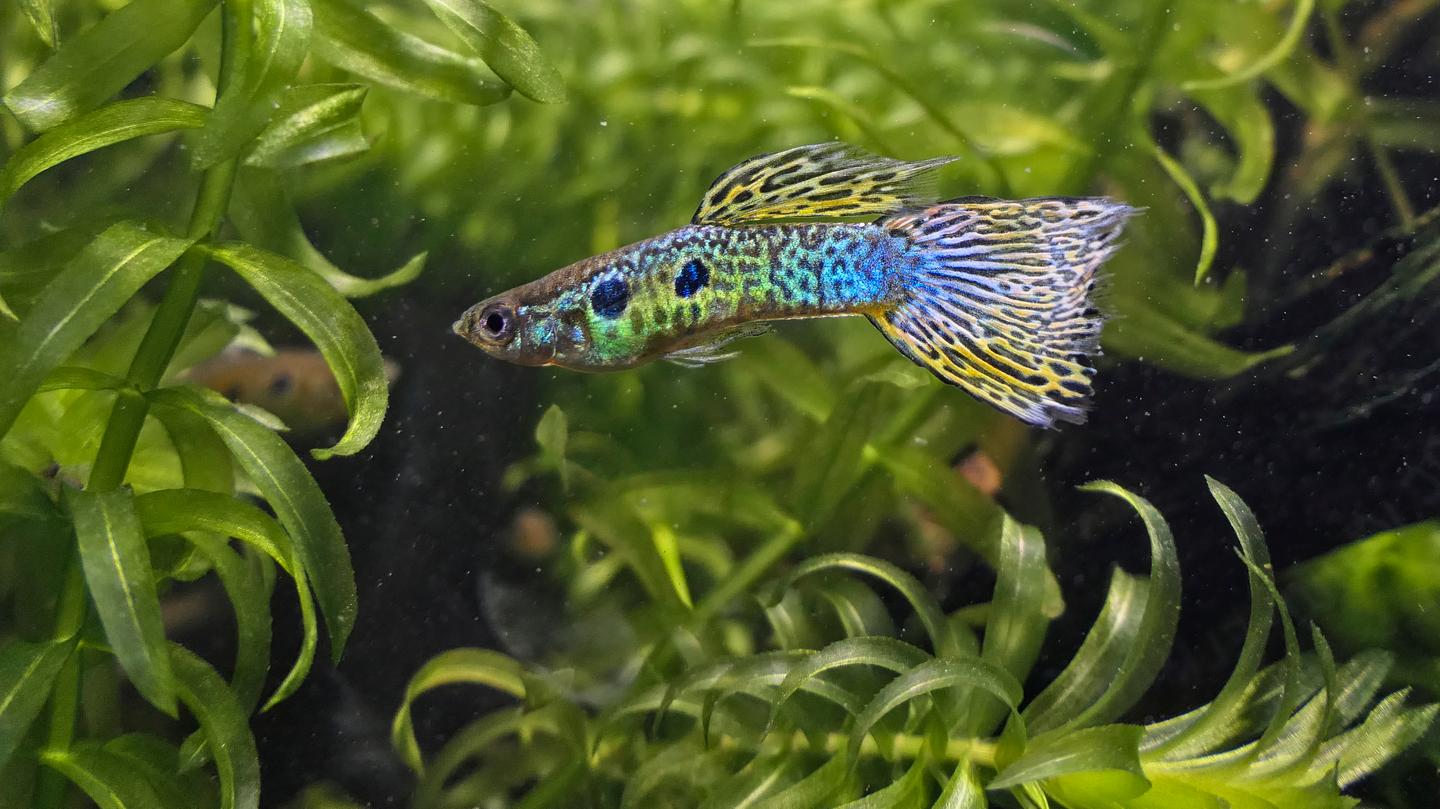
Guppies are social livebearers suited to a prepared beginner, not a fish-per-litre formula. Use a mature filtered aquarium, tested neutral-to-alkaline mineral-bearing water, deliberate sex and population planning, open swimming room, cover and a separation option.
Read the full care guidance when planning conditions for your aquarium.
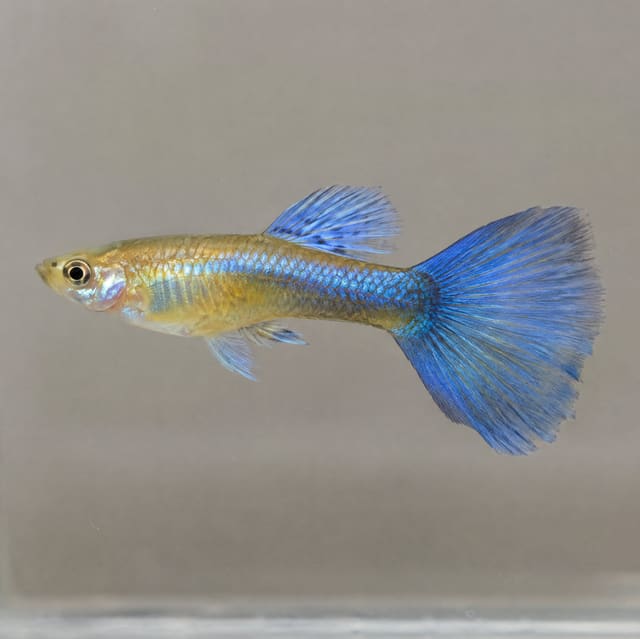
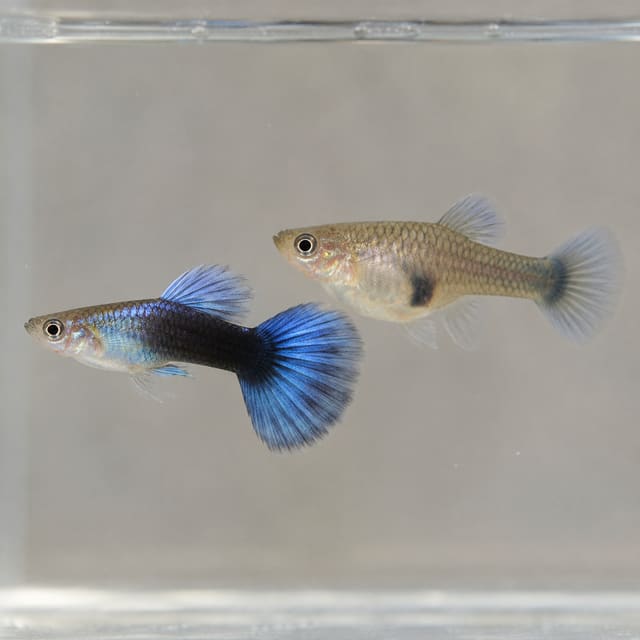
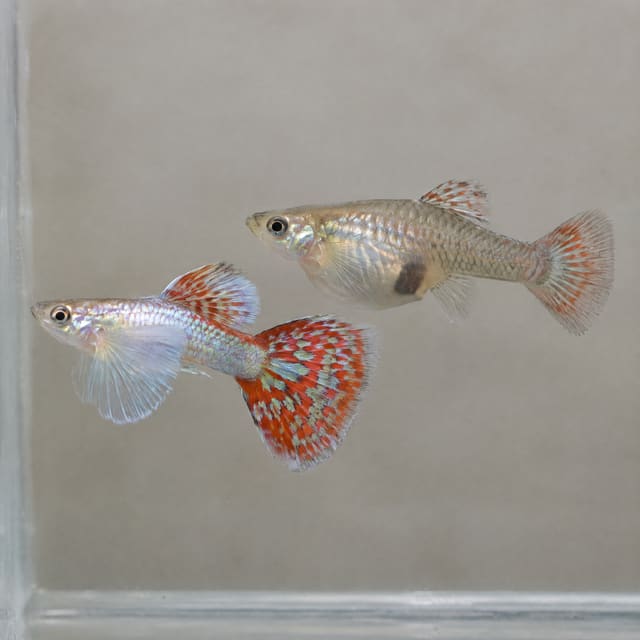
The Yellow Tuxedo is a fancy strain of the common guppy, Poecilia reticulata, and its name describes the male in two halves. "Tuxedo" is the dark back end. On the male in our photographs, the body from about its midpoint to the root of the tail is a deep, velvety black, with a crisp line where it meets the pale front, rather like a dinner jacket worn over a white shirt. "Yellow" is the finnage: a long golden dorsal and a broad tail in pale yellow to gold, with a faint green cast where the light comes through.
The forward half is the quiet part of the fish. The head and front body are pale and slightly translucent, silver-cream with a pinkish flush over the gill cover. Just behind the head, above the pectoral fin, sits a small orange patch. Put together, the pale front, black rear and yellow fins make the fish look as though it has been assembled from three different guppies, and that contrast is the whole appeal of the strain.
The dorsal fin is long and flag-like. It rises from the black part of the back and sweeps backwards, low over the root of the tail, so from the side it almost merges with the caudal fin. The tail is a wide triangle that broadens towards its trailing edge, with fine rays visible all the way out. In both photographs the tail is roughly as long as the body in front of it. The pelvic fins are small and pale, and nearly disappear against the light front half.
The orange mark behind the head is easy to overlook next to the black and gold, but it is worth knowing about. Wikipedia's account of guppy behaviour reports that females are drawn to brightly coloured males, especially ones carrying orange spots on the flank. In the wild, that orange is part of how a male guppy wins a mate. On this strain it is only a small mark, but now you know where to look for it.
No two fancy guppies are identical, even in a well-kept line. Between individuals of the Yellow Tuxedo you can expect small differences in how far forward the black reaches, how rich the yellow is and the exact outline of the tail. The photographs show one male; yours will share the pattern rather than match him line for line.
One order quantity of this listing is a pair: a male and a female Yellow Tuxedo guppy, bagged together. If you order two quantities you receive two pairs. There is a single size option, 3.5 cm, which is the size the fish are graded at when we pack them. It is not the adult size. Both fish keep growing after arrival, and once mature the female will be the larger of the two by a clear margin.
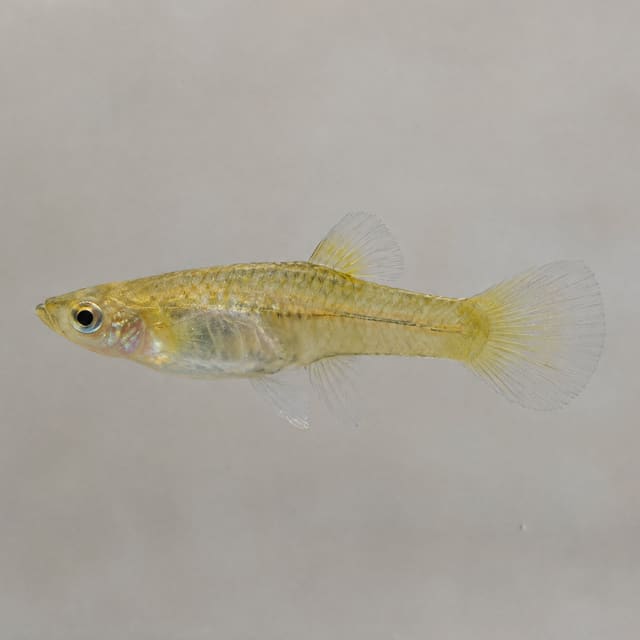
Both photos on the listing show the male, so it helps to know what to expect from his partner. Guppies are a classic example of males and females looking different. FishBase records a maximum of 5.0 cm standard length for males and 6.0 cm for females, describes males as about half the size of females, and notes that it is the male who carries the colourful tail. Seriously Fish describes females as larger, plumper and duller, adding that aquarium-bred females can show intense colour in the tail fin.
In practice the female in your pair is the heavier, rounder fish with the shorter, plainer tail. Some yellow in her tail would fit that description from Seriously Fish. She is not pictured, so we describe her only in these general terms.
Size and colour can mislead with young fish, so look underneath. Behind the belly, the male's anal fin has been reshaped into the gonopodium, a slim, pointed organ that FishBase describes as the means of internal fertilisation. The female's anal fin remains a small, ordinary fan. Once you have seen the two side by side you will pick out the male at a glance.
Standard length, the SL figure FishBase uses, runs from the snout to the base of the tail fin and leaves the tail out. A male Yellow Tuxedo carries a tail about as long as his body, so in the tank he will look considerably longer than his SL figure suggests. Our care specification records 6 cm as the adult size, which is the FishBase maximum for a female, measured the same way.
The pair arrives as two fish. What happens after that depends on you. Guppies breed readily, so before long you may well be deciding whether to raise young, add more females or both. The sections below cover each of those choices.
Many people looking up guppies go straight to FishBase, the global database of fish species, for reference figures. These are its values for Poecilia reticulata, the species every fancy guppy belongs to, the Yellow Tuxedo included:
| FishBase field | Value for Poecilia reticulata |
|---|---|
| Valid name | Poecilia reticulata Peters, 1859 |
| Family and order | Poeciliidae, Cyprinodontiformes |
| Environment | Freshwater and brackish; benthopelagic; non-migratory |
| Temperature range | 18–28°C, tropical |
| pH range | 7.0–8.0 |
| Hardness (dH) | 9–19 |
| Maximum length | 5.0 cm SL male; 6.0 cm SL female |
| Common length | 2.8 cm TL, male |
| Native latitude | 14°N to 2°N |
| IUCN status | Least Concern |
The 18–28°C FishBase gives is the span recorded for the species, not a target for an aquarium. Seriously Fish quotes a similar 17–28°C, and OATA, the UK's ornamental fish trade association, 20–28°C. For a fancy pair we keep to 22–28°C, with the heater set near 25°C. That leaves a margin at both ends and keeps well away from the cool end of the species' recorded range.
pH 7.0–8.0 and a hardness of 9–19 dH describe water that is neutral to alkaline and moderately hard to hard. The dH figure is German degrees of general hardness, the same unit aquarium test kits call dGH. Our recommended 9–18 dGH sits inside the FishBase band, and Seriously Fish advises moderately hard or harder water for keeping guppies over the long term.
The common length of 2.8 cm for males is a total length, tail included, and is a fair guide to the size most male guppies are seen at. The maxima of 5.0 and 6.0 cm are standard lengths and represent the largest recorded fish, not a size every guppy reaches.
Two of the environment terms are worth translating. Benthopelagic describes a fish that moves between the bottom and the open water above it rather than living strictly at one level. Non-migratory means guppies do not make seasonal journeys between habitats.
FishBase gives the native range as Venezuela, Barbados, Trinidad, northern Brazil and the Guianas, which explains that latitude band. Seriously Fish's list adds Tobago, Antigua and Barbuda and the Netherlands Antilles, and names the Guayre River at Caracas as the type locality. Within that range FishBase finds adults in warm springs and their outflows, weedy ditches and canals, turbid lowland ponds and clear upland streams. Seriously Fish adds that guppies do best where there is algae and plenty of vegetation, and that some populations live in brackish water.
The English name honours Robert John Lechmere Guppy, who sent specimens from Trinidad that Albert Günther described in 1866 as Girardinus guppii. The species already had a name, though: Wilhelm Peters had called it Poecilia reticulata in 1859. After spells as Lebistes, the original name was restored by Rosen and Bailey in 1963, and it is the accepted name today.
Guppies have since spread a long way from home. Seriously Fish counts introduced populations in around 50 countries, many released to eat mosquito larvae as a malaria control, and FishBase flags the species as a potential pest. That is the reason for a firm rule: no aquarium fish, plant or tank water should ever be released into the wild.
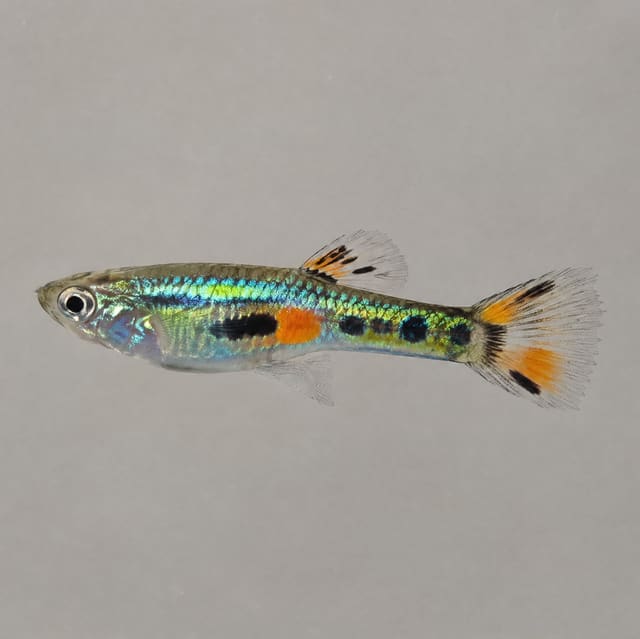
People sometimes ask how the common guppy differs from Endler's guppy, and whether a strain like the Yellow Tuxedo might be one. It is not. The Yellow Tuxedo is a fancy form of Poecilia reticulata, the species described by Peters in 1859 and covered throughout this guide.
Endler's guppy is a separately described species, Poecilia wingei. FishBase credits the name to Poeser, Kempkes and Isbrücker in 2005 and gives its distribution as the Campoma and Buena Vista lagoons in Venezuela. The species is named after Øjvind Winge, a Danish biologist. It is a much smaller fish: FishBase gives a maximum of just 2.0 cm standard length for the female, against 6.0 cm for a female common guppy. FishBase also notes the strong difference between colourful males and plain females, and records the species as Endangered on the IUCN Red List, assessed in 2021.
So when you see the two names side by side, remember they are different species with different sizes and very different conservation status. The common guppy is listed as Least Concern and has introduced populations in around 50 countries; FishBase gives the wild range of Endler's guppy as two Venezuelan lagoons.
If an Endler-type fish is what you are after, our Santa Maria Endler Guppy Males are sold as a reticulata × wingei hybrid, and the listing explains what that means. For the Yellow Tuxedo, everything on this page applies to Poecilia reticulata.
Seriously Fish gives a minimum base of 45 × 30 cm for guppies, about 41 litres. OATA asks for at least 45 litres for small livebearers. For a Yellow Tuxedo pair we suggest 60 litres or more. A pair tends to become a family, the ratio advice below means you will probably add females, and a larger body of water holds its temperature and quality more steadily.
Seriously Fish recommends a planted tank, notes that floating plants are appreciated, and says to avoid strong currents. All three suit this strain. Plan the tank in three zones:
Direct the filter return so that it does not blast across the open front. A spray bar or an outlet angled against the glass keeps the water moving without pushing a long-tailed male around. Leave out sharp-edged ornaments; a tail like this is easily snagged.
Look at the studio photograph: the yellow fins glow against black. A dark background or dark substrate does a similar job in the aquarium and makes the gold read strongly. A plain, pale set-up still works perfectly well for the fish; it is purely a question of how you want them to look.
OATA treats a filter as essential and lists a heater, lighting, gravel or sand, and plants or decor as part of a basic set-up. Set the heater around 25°C and check a thermometer daily. Buy a liquid test kit for ammonia, nitrite, nitrate, pH and hardness at the same time as the tank; you will use it every week.
We recommend 22–28°C, pH 7.0–8.0 and 9–18 dGH, all inside the FishBase, Seriously Fish and OATA ranges set out above. Test your tap water first. If it is already neutral to alkaline and moderately hard, the job is easy. If it is soft or acidic, speak to us before ordering, and make any adjustment slowly and the same way every time.
Two hardness figures turn up on test kits, and guppy keepers need both. General hardness, GH or dGH, measures dissolved minerals such as calcium and magnesium; it is the number the 9–18 dGH recommendation refers to. Carbonate hardness, KH, measures the carbonates that buffer the water against changes in pH. OATA suggests 5–15 dKH for guppies and mollies. A healthy KH is what stops pH sliding downwards between water changes, so if your pH keeps drifting below 7, test the KH before anything else.
OATA's care sheet for guppies and mollies sets these targets:
| Measure | Target |
|---|---|
| Ammonia | Zero |
| Nitrite | Zero |
| Nitrate | No more than 20 mg/l above your tap water |
| Carbonate hardness | 5–15 dKH |
| Testing | At least once a week |
| Partial water change | About 25% at least once a week |
Have the tank running and mature, with ammonia and nitrite both reading zero, before you order. Each week, siphon the gravel as you take out old water, replace it with dechlorinated water at tank temperature, and clean the filter only in water taken from the tank. Salt is not part of the routine: although FishBase lists guppies from brackish water too, the OATA sheet does not call for it, and a freshwater tank at the values above is all the pair need.
Keeping to the same days each week matters more than the exact schedule; the aim is steady conditions with no sudden swings.
Wild guppies eat a wide range of small foods. FishBase lists zooplankton, small insects and detritus. Seriously Fish calls wild fish mainly insectivorous. Wikipedia's account goes further and reports that algal remains form the largest part of the wild diet in most cases, with diatoms, invertebrates, insect larvae and plant fragments alongside. Read together, the message is a mixed diet of very small foods, part animal and part plant.
OATA recommends feeding once a day and giving only what the fish finish within a few minutes, and suggests a flake or granule that contains algae. Seriously Fish notes that tank-bred guppies take most foods. For a single pair, a good daily feed is surprisingly small: a few crumbs of flake each, rubbed fine between your fingers.
In a community tank, watch at feeding time that the long-finned male gets a fair share before quicker fish clear the surface. Scattering food across the surface rather than into a single spot gives both fish of the pair a chance.
Food left on the gravel, cloudy water, rising nitrate readings and swollen-looking fish all point the same way. Cut back first and investigate second. Uneaten food breaks down into waste, which works straight against the OATA targets above.
If young appear and you decide to raise some, they need food small enough for a tiny mouth, several times a day: powdered fry food or flake crushed to dust. Little and often is the rule, with extra attention to water changes, because small fish in a small volume of water foul it quickly.
Seriously Fish describes guppies as very peaceful, and a Yellow Tuxedo pair will fit into a calm community of small fish that share their taste for hard, alkaline water. Two things shape the choices: how many females the male has to share his attention between, and which tank mates might go for those long fins.
Seriously Fish recommends several females to each male, and OATA suggests keeping at least three guppies together, two females to every male. That makes a single pair a starting point rather than a finished group. Over the first few weeks, watch how the female copes. If she is constantly followed, hides most of the day or loses interest in food, give the male more females to divide his time between.
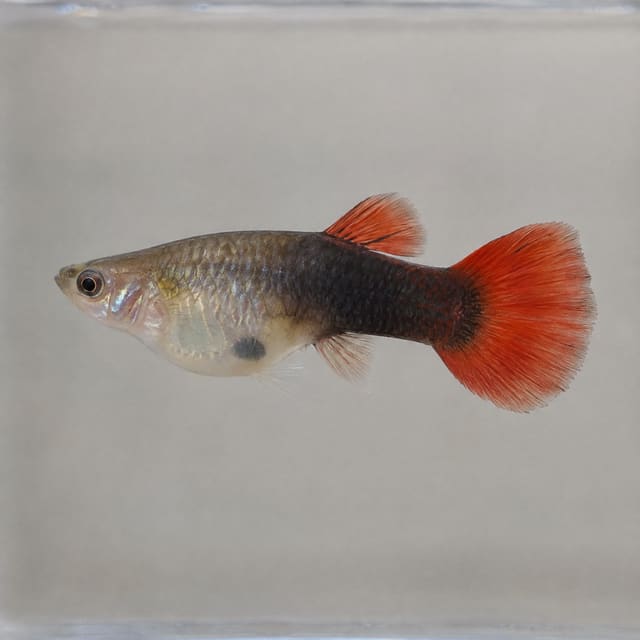
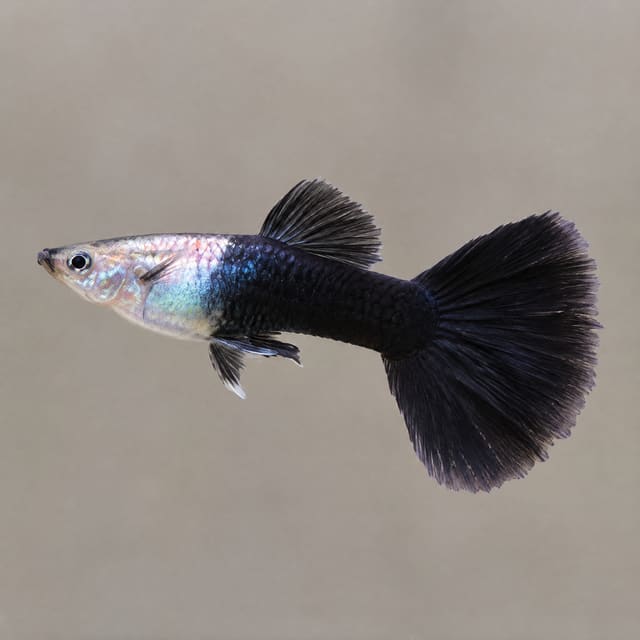
For extra females, our Yellow Female Guppy keeps the yellow theme, and the Red Tuxedo Female Guppy carries a tuxedo pattern in a different colour. Bear in mind that all guppy strains are one species and will interbreed, so young from mixed strains will be a mixture too. If keeping the Yellow Tuxedo look is the aim, keep this line separate. If you enjoy the tuxedo pattern in general, the Male Tuxedo Black Guppy shows another version of it.
Seriously Fish names other livebearers, rasboras, Corydoras, loricariid catfish and tetras as suitable company. Pick small, peaceful species from those groups that are happy in the same water values. Mollies are an easy match on water, since OATA covers them on the same care sheet as guppies; note that it asks for at least 80 litres for the larger sailfin mollies.
Adult guppies eat their own young, according to Seriously Fish, and most other community fish will join in. In a busy tank, the fry that survive are mostly the ones that reach thick plants, which acts as a natural brake on numbers. If you want to raise a brood, the next section explains how.
Guppies give birth to live young. The male fertilises the female internally with his gonopodium, and some weeks later she releases fully formed fry that swim straight away. A healthy pair in a settled tank will very probably breed, so it is worth deciding early what you want to happen.
FishBase gives maturity at 2 months for males and 3 months for females. Wikipedia says males can mature in 7 weeks or less and that females give birth from about 10 to 20 weeks of age. For gestation, FishBase and Seriously Fish both say four to six weeks, OATA gives 24 to 30 days, and Wikipedia gives 20 to 60 days at 25 to 27.8°C. Put simply, a healthy female may produce a new brood every four to six weeks.
Brood sizes vary widely. FishBase gives 20 to 40, OATA 20 to 80 and Seriously Fish 5 to 100. Wikipedia describes 30 to 60 as typical, with a recorded range of 2 to 200. Take the extremes for what they are: records rather than targets.
Female guppies store sperm. Seriously Fish says a female can produce young for 6 months or more without a male present, and Wikipedia gives up to eight months. Taking the male out stops new matings but not the broods already on the way.
Seriously Fish recommends removing fry if you want them to survive and notes that dense vegetation helps. The simplest set-ups are:
Breeding boxes that hang inside the main tank are another option for a short stay. Keep the female in one only briefly, if at all; a cramped box is no place for a heavily pregnant fish.
If you want to carry the Yellow Tuxedo on for a few generations, keep it simple. Raise the young in their own tank, and as they grow, pick out the males with the cleanest split between pale front and black rear and the best yellow fins. Keep them with females from the same line and move the rest on or into a separate tank. Write down which fish you kept and when broods appeared. A few notes save a great deal of guesswork later.
Wikipedia notes that male ornamental genes in guppies are carried on the Y chromosome and are heritable. That gives a well-kept line a good chance of continuing, but we cannot promise what any brood will look like. The one certain way to lose the pattern is to mix the pair with other strains, since every guppy strain will interbreed with every other.
The best health care for guppies is unglamorous: stable warmth, the OATA water targets met every week, a varied diet and peaceful company. Fancy strains need that more than most. Seriously Fish cautions that many commercially produced guppies have been weakened by inbreeding and over-production and are prone to disease, which is a good reason to keep conditions consistent rather than to avoid them.
Spend a couple of minutes each day watching the pair, ideally at feeding time when both are out. Check that:
On a long-tailed male, check the tail for nicks or splits; they point to trouble from tank mates or decor. Find the cause, whether a nipping fish or a sharp edge, and the fin has a chance to recover in clean water. Fraying that appears with no obvious cause should send you to the test kit before anything else.
The guppy is the host of Gyrodactylus turnbulli, a tiny monogenean flatworm that clings to the gills and fins. It carries its offspring already developed inside it and passes from fish to fish by direct contact. Infected guppies may swim erratically with the dorsal fin held flat. In warm water each generation can mature within a few days, so numbers rise quickly. If you suspect it, ask for advice and use a recognised aquarium treatment exactly as directed.
If the pair are joining an established tank, give them a few weeks in a separate mature tank first, and do the same for any guppies you add later. Quarantine protects the fish you already have and lets you watch newcomers closely.
Wikipedia states that wild guppies typically live for around two years. OATA says guppies and mollies can live several years in a well-matured set-up, which is one more reason to keep conditions steady.
Read our delivery and live arrival guarantee details before you order. These are the essentials.
Have the aquarium fully ready before the parcel comes: filter running, water tested and the temperature steady. Someone has to be at the delivery address to take the box, because live animals cannot be left. We send the confirmed delivery date and the tracking by email.
Your pair travel in oxygen-filled bags inside insulated packaging, with heat packs when the conditions call for them, carried by a tracked courier licensed to transport live animals.
Before you cut the tape, start a continuous video. Keep recording as you open the box, and show the fish inside the bag while it is still sealed. If either fish is dead, dying or clearly compromised on arrival, email hello@tropicalfishco.co.uk on the day of delivery with your order number and the video. Photographs on their own do not satisfy the policy. We then replace the affected fish with your next order or refund them, subject to the guarantee terms.
Keep the lighting subdued for the first evening and let the pair find their own way around. Offer a small feed the following day. For the rest of the week, keep watching their breathing, their appetite and how they behave, and note how the male treats the female as he settles. Leave filter maintenance and any rearranging until the week is over, and keep up the normal water testing so nothing drifts while they settle in.
These are the sources behind the facts in this guide.
No reviews for this item yet. Bought one? Honest reviews only, good or bad.
What customers say about ordering from us
Easy website plenty of info on fish your buying great to pick a time slot
TRACEY DURRANT · 7 Oct 2026
Got some lovely fish thank you
Kevin Mackie · 7 Oct 2026
Reviews of our shop, collected by Judge.me, an independent third-party review collector. Newest first.
Moved by UK carriers licensed to handle live animals
Hand-packed with oxygen bags, poly box, heat pack
Email photos the same day; an optional unboxing video helps us review problems faster — claim terms apply
Klarna & PayPal Pay in 3 at checkout



22–26°C · pH 6–7.8 · 75L