Easy
Golden Male Endler Guppy (Poecilia endler)
20–28°C · pH 7–8
£5.99
Photo coming soon
The size, price and care details on this page are for this listing.
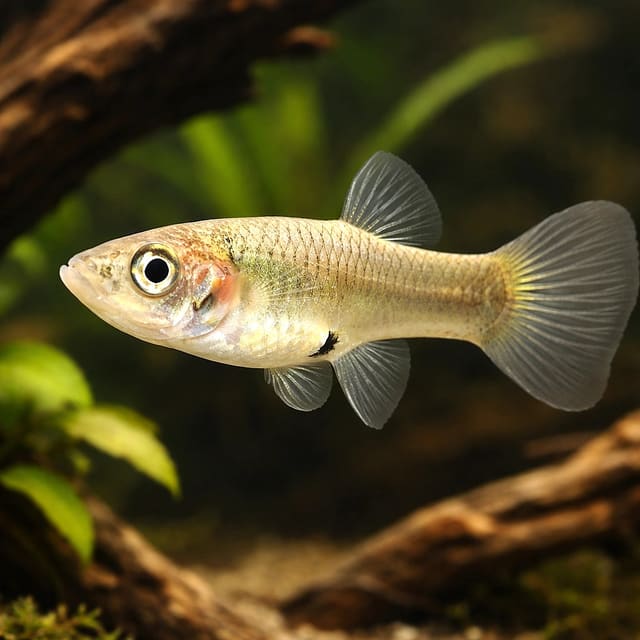
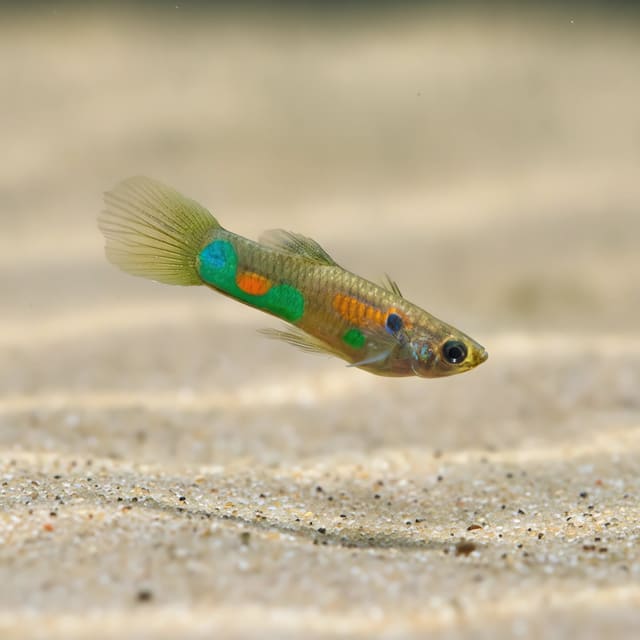
One live female Endler guppy from a gold-yellow colour line. Endler's livebearer, Poecilia wingei, is a tiny Venezuelan livebearer: FishBase records females to 2.0 cm SL. Keep it in a planted tank of 40 litres or more, in warm, alkaline, moderately hard water, away from guppies.
Adult size is the maximum length this species reaches at full maturity (scientific sources). The livestock you receive will be younger and smaller. Product-photo provenance and any image-specific limitations are stated on the listing.
Poecilia wingei
Shoaling fish: kept in a group they feel safer, stay calmer and show their best colour.
Minimum of 2 per order.
One live female Endler guppy from a gold-yellow colour line. Endler's livebearer, Poecilia wingei, is a tiny Venezuelan livebearer: FishBase records females to 2.0 cm SL. Keep it in a planted tank of 40 litres or more, in warm, alkaline, moderately hard water, away from guppies.
Adult size is the maximum length this species reaches at full maturity (scientific sources). The livestock you receive will be younger and smaller. Product-photo provenance and any image-specific limitations are stated on the listing.
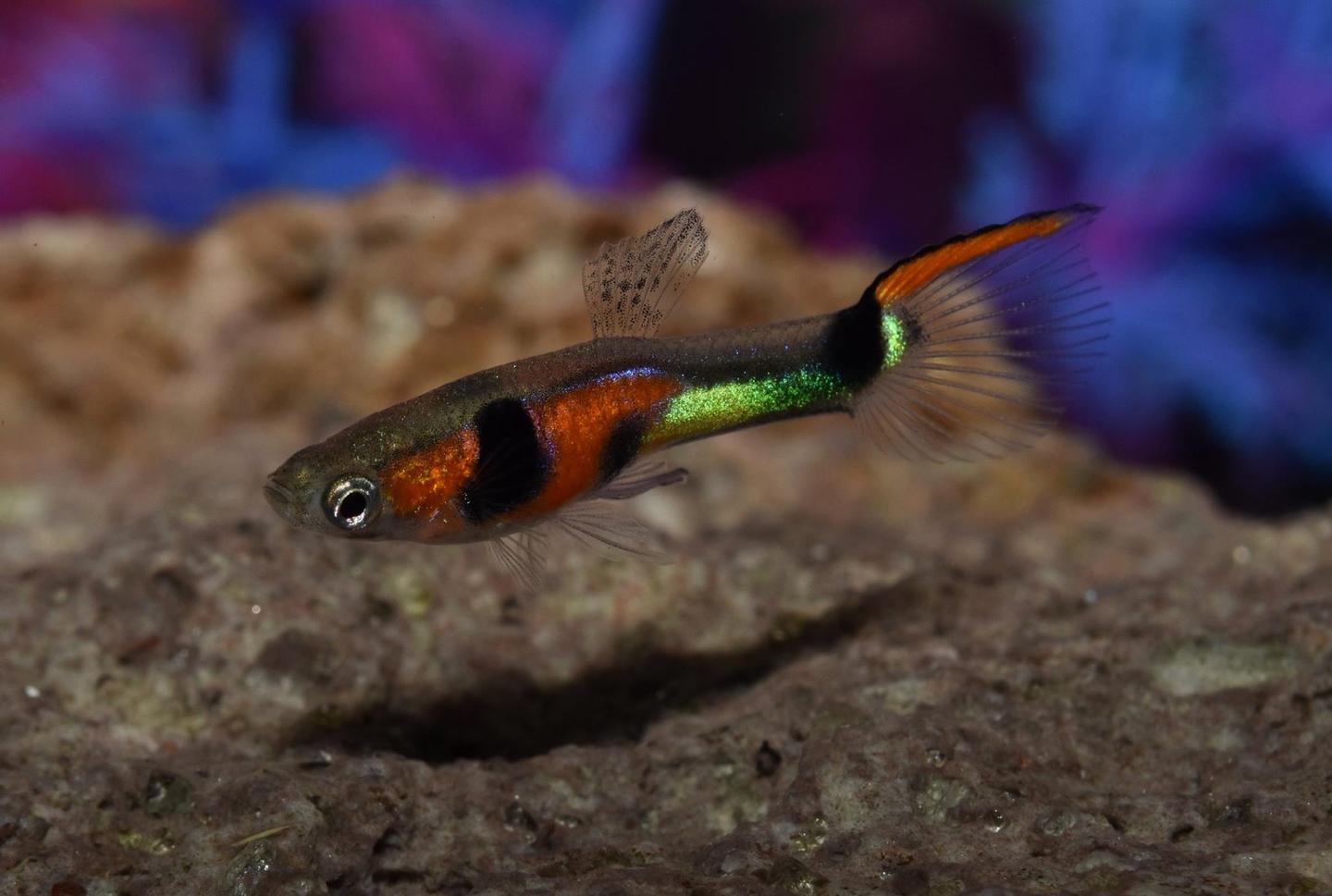
Endler's livebearer is a small, social, rapidly reproducing Venezuelan fish. Start with a mature filtered aquarium, a deliberate sex and population plan, stable tested medium-hard water, open swimming room and cover. Our conservative house screen is an aquarium at least 60 cm long and a group of five or more where capacity allows.
Maintain these water conditions for optimal health and vibrant colors
Add this listing to your basket and you get one live female Endler guppy from a colour line sold as gold yellow. The sex is part of the listing's name, so a female is what you receive. If you want several, order the number of fish you need; each unit is a single female.
Endlers are among the smallest livebearers kept in home aquariums. FishBase records a maximum of 2.0 cm standard length for females, measured from the snout to the base of the tail, so the fish looks a little longer in the tank once the tail fin is added. Seriously Fish gives 25 mm standard length, and OATA, the UK ornamental aquatic trade association, says Endler guppies grow to around 2.5 cm. Whichever figure you take, you are buying a fish about the length of a fingertip, and that shapes everything from the filter you use to the food you choose and the company it keeps.
Females are the quiet backbone of any Endler tank. Males carry the colour, but a tank needs more females than males to stay calm: OATA recommends at least three Endlers kept together, two females to every male, and Seriously Fish advises several females so that the males' attention is spread out. Seriously Fish also notes that females can act quite territorially, which is another reason to keep a few rather than one. Buying females separately is the simplest way to get that balance right.
| At a glance | Detail |
|---|---|
| Accepted name | Poecilia wingei Poeser, Kempkes & Isbrücker, 2005 |
| Family | Poeciliidae, the livebearers |
| Wild home | Lagoons and streams of the Paria Peninsula, north-eastern Venezuela |
| Female size | 2.0 cm SL maximum (FishBase); about 2.5 cm (Seriously Fish, OATA) |
| Temperature | 24 to 30 °C (Seriously Fish) |
| pH | 7.0 to 8.5 |
| Hardness | 15 to 35 dGH, a moderately hard to hard water fish |
| Smallest sensible tank | 45 × 30 cm base, about 41 litres |
| Diet | Omnivore that needs some plant matter |
| Wild status | Endangered on the IUCN Red List |
| What you receive | One female per unit |
This fish has collected several names, and they cause confusion. "Endler guppy" and "Endler's livebearer" are the names aquarists use. You will also see shops label it Poecilia endler, but that is a trade label rather than a scientific name. The accepted name, given by FishBase, is Poecilia wingei, described by Poeser, Kempkes and Isbrücker in 2005, and that is the name we now use in the title.
Both halves of the name honour scientists. According to Wikipedia, the species epithet wingei honours Øjvind Winge, the Danish biologist who worked extensively on the genetics of Poecilia, including this fish. The common name comes from Dr John Endler, who found the fish again in 1975 after it was first collected from Laguna de Patos, Venezuela, by Franklyn F. Bond in 1937. Endler's fish were the first to reach the aquarium hobby.
Whether the Endler is a separate species from the common guppy, Poecilia reticulata, has been argued for years. Wikipedia sets out both sides. In 2009, Schories, Meyer and Schartl used molecular data to argue that P. wingei is distinct from the guppy at species level, and Seriously Fish follows that view. In 2014, a study led by Herdegen looked at guppy populations in north-eastern Venezuela and disputed that conclusion. FishBase currently treats Poecilia wingei as a valid species, which is why we use it.
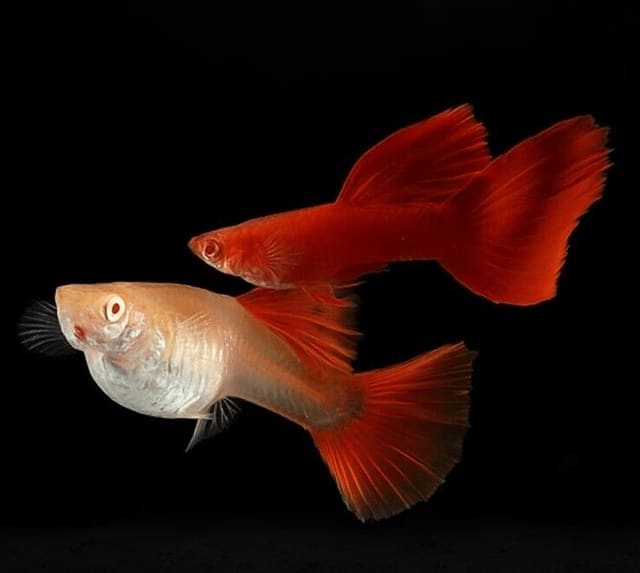
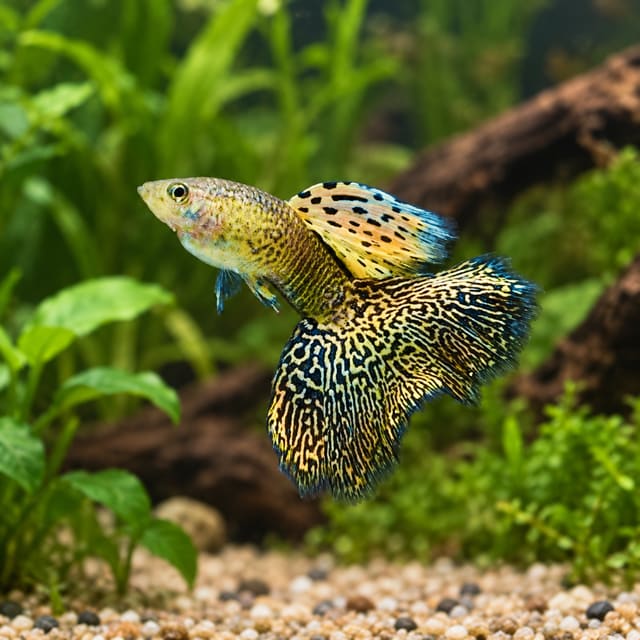
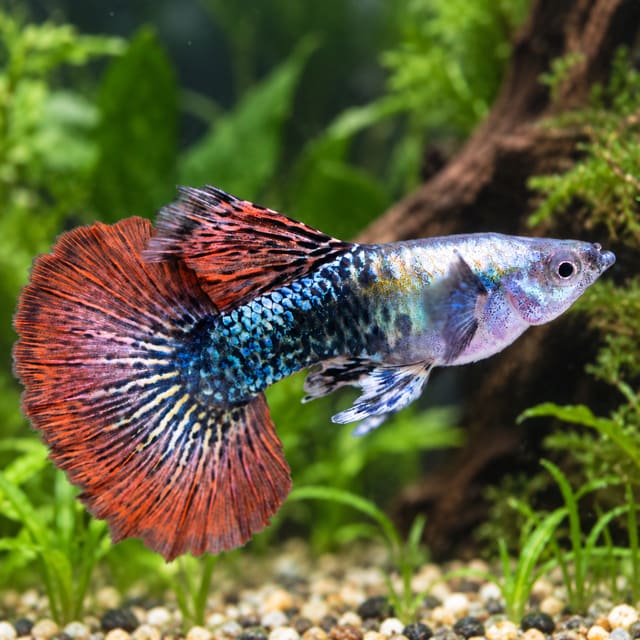
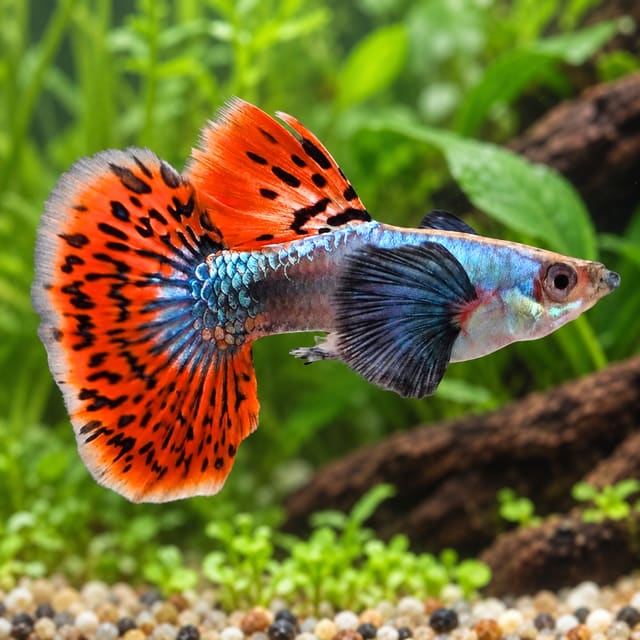
There is no doubt about one thing: Endlers and guppies cross easily. Wikipedia and Seriously Fish both say the two produce fertile young, and Wikipedia explains that breeders who want pure lines avoid this because it dilutes the gene pool. Dedicated hobbyists keep registry records to document pure Endlers, and Wikipedia notes that undocumented fish sold in shops as Endlers are assumed to carry some degree of guppy ancestry. Many colourful lines in the trade began this way, and hybrid Endlers are sold under names such as peacock, snake, tiger, paradise, fancy and sword.
So, to be straight with you: this listing is a female from a gold-yellow Endler colour line, kept and cared for as Poecilia wingei. It is not sold with registry records proving pure wild-type ancestry, and if that matters for a conservation or breeding project, buy from a registry breeder. For a planted display tank, or for building a group of small, active livebearers, the care is exactly the same either way.
Wikipedia also records that in the wild, released guppies hybridising with Endlers are one of the threats to the species. That is a good reason never to let either fish, or their young, escape into open water anywhere.
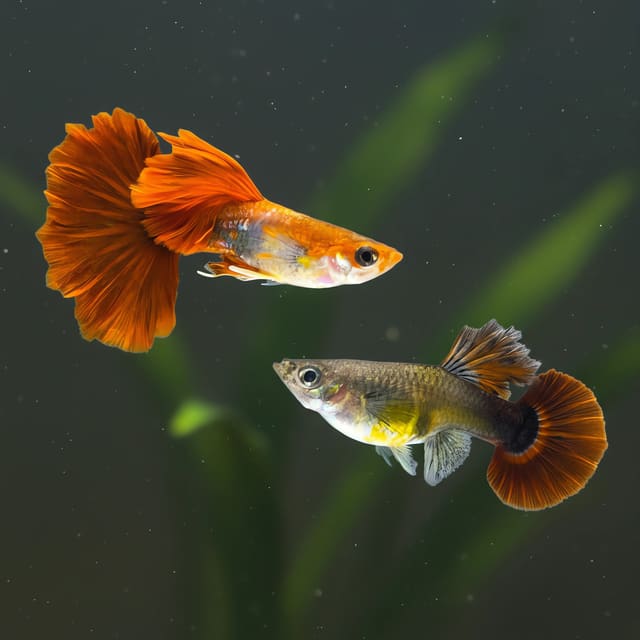
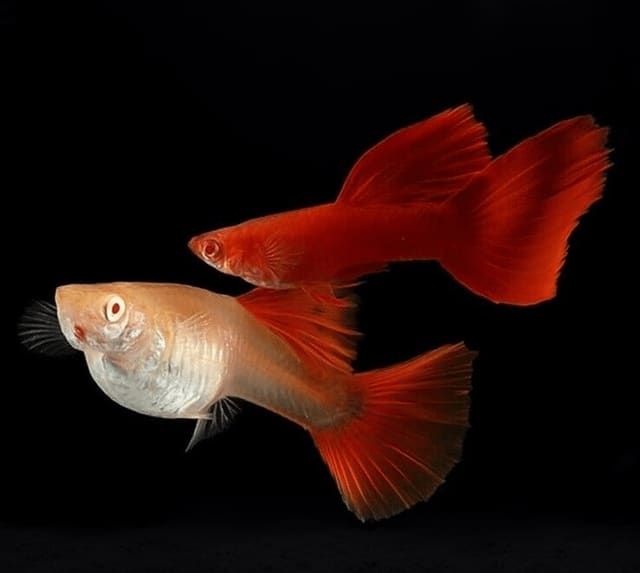
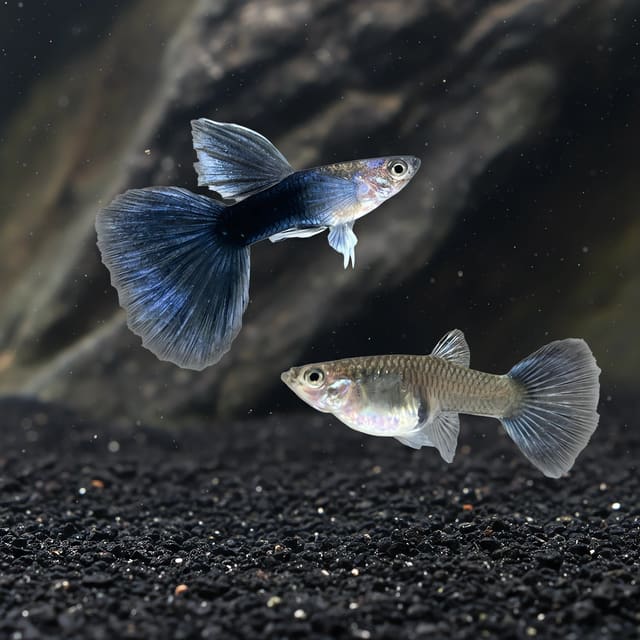
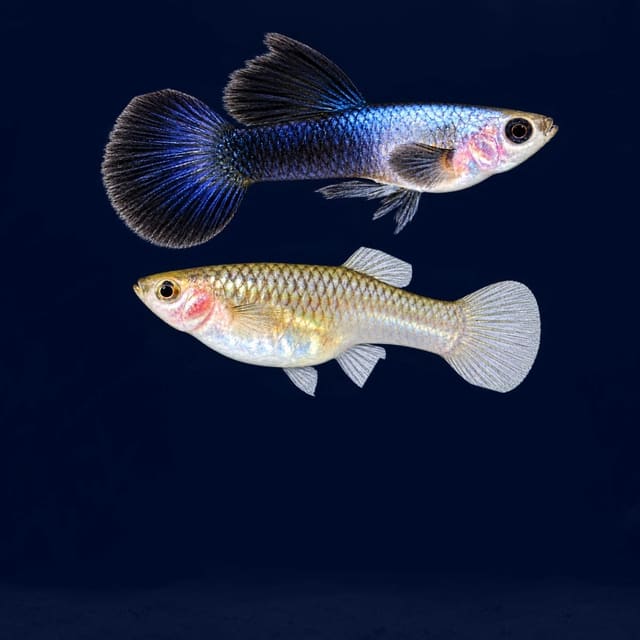
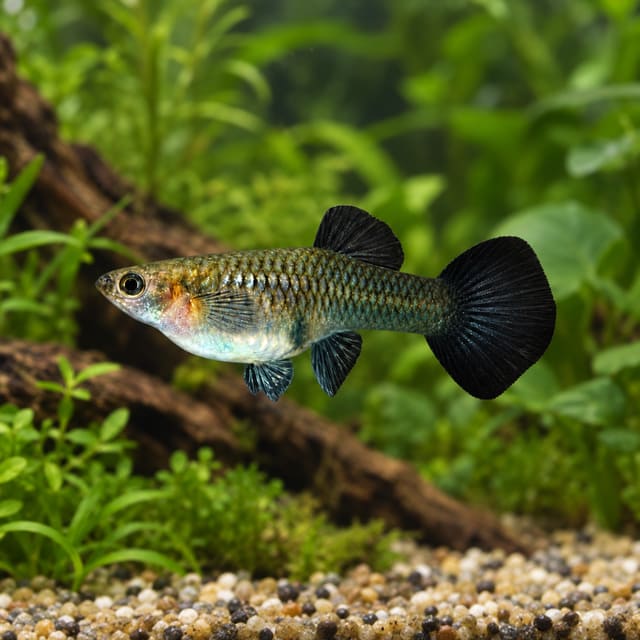
Male and female Endlers look like two different fish. FishBase describes the species as showing distinct sexual dimorphism, with polychromatic males and uniform females. Seriously Fish says males are smaller and far more colourful than females, and that females are much plumper. Wikipedia adds that full-grown females can be as much as twice the size of males.
Wikipedia describes wild-type females as spending their whole lives in fairly plain colouring, ranging from pale silver to a dull, dark gold depending on their surroundings. It also notes that a female can shift her colouring somewhat when moved from a light environment to a dark one, or the other way round. That matters when you look at a female Endler in your own tank: a pale gravel bed and bright lights can make her look washed out, while dark substrate and plant shade usually let whatever colour she has show.
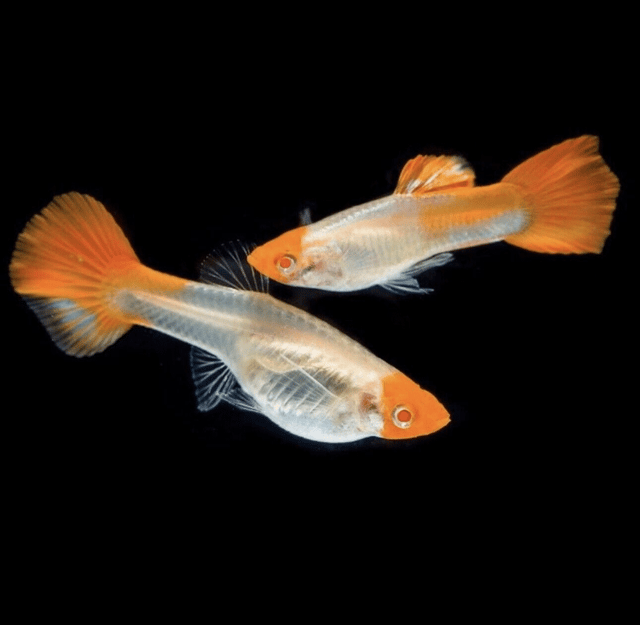
"Gold yellow" is the name of the colour line this female comes from. The trade gives names to Endler lines by the colour bred into them, and a female from a gold-yellow line is the female half of that line. Do not expect her to rival the males of her own line for brightness. Female Endlers are built for producing broods, not for display, and the name describes the family she belongs to rather than a showpiece pattern. If you want gold colouring on show, remember it is the males that carry it; among our listings, the gold-named males are the Golden Male Endler Guppy.
Very young fish are harder to sex, but Seriously Fish puts the start of male colouring at three to five weeks, so males stand out early.
Wild Endlers come from a very small corner of the world. Wikipedia places the species on the Paria Peninsula in Venezuela. FishBase lists the Campoma and Buena Vista lagoons, and Seriously Fish describes a range running from those lagoons to Carúpano in north-eastern Venezuela.
The fish's history is tied to particular sites. The type locality, Laguna de Patos, was, according to Seriously Fish, originally a brackish lake formed when a sandbar cut it off from the sea. A municipal rubbish dump was later built alongside it. Seriously Fish says the fish are now thought to be extinct at that site because the water has become polluted, while Wikipedia describes the original population as threatened by runoff from the dump. Other populations are known: Wikipedia describes the Campoma population, found in Laguna Campoma and its connected streams and given the name Poecilia wingei in 2005, and a separate El Tigre population from a stream not connected to the lagoon. Wikipedia notes that hobby fish from these populations are known by their locality names, such as Campoma and El Tigre.
In the wild the species is in trouble. FishBase shows it as Endangered on the IUCN Red List. Wikipedia explains that it was added to the Red List as endangered because people are moving into its habitat, releasing invasive species, polluting the water and destroying the places it lives, and that hybridisation with released guppies is another serious risk.
Seriously Fish describes the wild diet as varied: zoobenthos, the tiny animals living on and in the lake bed, along with detritus. FishBase rates it as a freshwater, benthopelagic fish, one that uses the water near the bottom as well as higher up.
What does that mean for a keeper in Britain? Three things. First, keeping and breeding Endlers well helps the fish carry on as an aquarium animal while its wild home is under pressure. Second, a warm, well-planted tank with plenty of fine surfaces to graze matches how the species feeds. Third, never release Endlers, guppies or their young; the same behaviour that threatens the fish in Venezuela causes harm anywhere a tropical livebearer is tipped out.
Endlers are tiny, but they are busy fish, and a slightly larger tank is always easier to keep stable. Seriously Fish suggests a minimum base of 45 × 30 cm, about 41 litres. OATA recommends at least 45 litres for a small group of the smaller livebearers, which includes Endlers. Either figure gives you room for a group of females and a few males without crowding.
Seriously Fish strongly recommends a planted set-up and floating plants. For Endlers, plants are not just scenery. Wikipedia explains that newborn fry spend their first hours on the bottom of the tank while they use up their yolk sacs, and that this is when they are most at risk from predators, including their own mothers and other females. Fine-leaved plants, mosses and low clumps over the substrate give those fry somewhere to hide, and floating plants give adults a shaded refuge near the surface.
Seriously Fish adds that powerful filtration is not necessary in a species tank. A gentle sponge filter or a small internal filter on a low setting suits these fish well. Put a sponge over any intake you use, so that newborn fry and small adults are not drawn in.
OATA says a heater is needed to hold a suitable temperature all year round, and that is certainly true in a British home. Seriously Fish gives 24 to 30 °C for Endlers, and the OATA sheet covering Endlers gives 20 to 28 °C. Setting the heater between 24 and 26 °C keeps you well inside both ranges.
| Parameter | Seriously Fish (Endler profile) | OATA (guppies, mollies and Endlers) |
|---|---|---|
| Temperature | 24 to 30 °C | 20 to 28 °C |
| pH | 7.0 to 8.5 | 7.0 to 8.0 |
| General hardness | 15 to 35 dGH | 8 to 18 dGH |
| Carbonate hardness | not given | 5 to 15 dKH |
Seriously Fish calls the Endler a moderately hard water fish. It says the species may survive for a while in softer, more acidic water, but that is a tolerance, not a target. Aim for a pH between 7.0 and 8.0 and general hardness somewhere in the middle of the two sources, around 15 to 18 dGH, and keep it there. The care specs on this listing use the Seriously Fish figures, as that profile is written for Endlers alone.
Find out what comes out of your tap before you set the tank up. Your water company publishes hardness figures, or a test kit will tell you in minutes. Hard, alkaline tap water often needs nothing more than dechlorinating. If yours is soft, ask us or your local aquatic shop how to raise hardness safely and consistently before your fish arrive.
OATA's targets are zero ammonia and zero nitrite, with nitrate no more than 20 mg per litre above your tap water. It strongly recommends a 25 per cent partial water change at least once a week and testing at least weekly. In a small tank that routine matters even more, because waste builds up quickly in a small volume of water.
Seriously Fish describes the Endler as an omnivore that will eat most foods offered but should have some vegetable matter in its diet. OATA's advice for the group of livebearers that includes Endlers is a good flake or granule with a high algae content, fed once a day and only as much as the fish can eat within a few minutes. OATA also points out that Endlers may need smaller frozen foods, such as cyclops, than their larger guppy and molly relatives.
Mouth size is the thing to think about. A standard flake broken into big pieces is too much for a fish of this size to tackle. Rub flakes between finger and thumb before they go in, choose micro-granules rather than standard granules, and pick the smallest frozen foods: cyclops, daphnia and baby brine shrimp suit them well.
Overfeeding is the biggest danger in a small tank. Food that sinks and rots fouls the water far faster in 40 litres than in 200. If the food is still drifting about after a few minutes, the next feed should be smaller.
Feeding females well pays off. Seriously Fish describes female Endlers as almost always gravid, so a female is usually carrying a brood, and a varied diet with some plant matter keeps her in good condition between births.
Endler fry are easy to feed. Seriously Fish says they are quite large at birth and accept brine shrimp nauplii or powdered flake straight away. Wikipedia adds powdered fry food and crushed flake, and notes that fry also graze the layer of algae and microorganisms that forms on aquarium plants. Little and often is the rule for fry: tiny amounts several times a day, with any leftovers siphoned out.
For the first day or two after your female arrives, keep feeding light. A fish that has just travelled may ignore food at first. Offer a little once a day and remove what is left; appetite usually returns as she settles in.
Endlers are peaceful fish, but they are small and they need the right company. Seriously Fish does not recommend them for a general community tank. It suggests small, peaceful companions instead, naming dwarf corydoras, small rainbowfish and peaceful tetras as examples. OATA adds a simple rule: never keep Endlers with any species large enough to eat them.
Seriously Fish is clear that Endlers should not be kept with guppies because the two crossbreed. If you keep a colour line like this gold-yellow one and want its young to look like their parents, keep fancy guppies in a different tank altogether.
Seriously Fish describes male Endlers as peaceful towards each other, while females may behave quite territorially, which is why several females should be kept. Keeping plenty of females also spreads the males' constant courting across the group, so no single female is worn down. OATA recommends at least three Endlers together, two females for each male. Those two pieces of advice point the same way: build the female side of the group first.
A few practical set-ups:
If you need more females in the future without the gold-yellow name, our Female Endler Guppy listing sells females of this species too.
Buy a female Endler and, sooner or later, you are likely to see fry. Seriously Fish says females are almost perpetually gravid, and that a female can produce a brood every 23 to 24 days. Wikipedia gives roughly every 23 days. Brood sizes are modest by livebearer standards: Seriously Fish gives five to 25 young, depending on the female's age and size, and Wikipedia gives anything from one to 30, possibly more.
Endlers grow up quickly. Seriously Fish says males show colour at three to five weeks and females can produce young of their own at about two months old. Wikipedia describes males colouring up from three to four weeks, with the full depth of colour developing over several months and continuing to intensify through the first six months of life. A couple of females can turn into a busy tank within one season, so plan ahead.
The hours after birth are the dangerous ones. Wikipedia explains that new fry spend their first hours on the bottom of the tank using up their yolk sacs, that this is when they are most vulnerable, and that the chief predators are their own mothers and other female Endlers. Males seem less interested. In practice, survival depends on cover:
Giving birth takes a lot out of a female Endler. Wikipedia notes that the birth process can be stressful, that some females do not survive long after large broods, and that those that struggle often turn grey and gradually waste away. You can reduce the strain with steady, clean water, a varied diet with some vegetable matter, enough cover to rest in, and enough females in the group that no single one is chased constantly by males.
Before your Endlers start breeding freely, think about where the young will go. Local aquatic shops and aquarium clubs are the usual homes for surplus livebearers. Never release them into ponds, streams or drains. If you want your gold-yellow line to stay recognisable, keep it away from guppies and from Endler males of very different colours, and expect mixed young whenever lines are crossed.
A fish this small gives you less warning when something is wrong, so it pays to look closely at the group every day, ideally at feeding time when everyone comes out.
OATA's care sheet describes healthy Endlers, guppies and mollies as having clear, bright eyes, undamaged fins and intact scales, with no ulcers or bumps, normal swimming and steady breathing. A healthy female Endler will usually look rounded, move confidently around the plants and pick at food and plant surfaces.
OATA lists clamped fins, flicking against gravel or decor, and shimmying, a side-to-side shaking on the spot, as signs of disease. When you see any of them:
Given good conditions, OATA says these small livebearers can live several years in a well-matured aquarium with good water quality.
Please read our delivery and live-arrival page before you buy. Set the tank up in advance: the filter should be running, the water tested and the temperature brought into the right range before the box reaches you. Live animals need a person at the address to receive them, so choose a day when someone will be in.
Your Endler is sealed in an oxygen-filled bag and packed in an insulated box, and heat packs go in when the weather calls for them. A tracked courier licensed to carry live animals takes it to you. We email the confirmed delivery date and tracking details so you know when to expect it.
To make a live-arrival claim, you need a continuous video of the unboxing. Begin filming while the parcel is still sealed, keep the camera running as you open it, and show the fish inside the bag before the bag is opened. If your fish has died, is dying or is clearly in a bad way, email hello@tropicalfishco.co.uk on the day of delivery, quoting your order number and attaching that video. A photo on its own does not meet the policy. When a claim is accepted, the affected fish is replaced with your next order or refunded, subject to the guarantee terms.
Leave the lights low for the rest of the day. Through the first week, keep an eye on her breathing, her appetite and how she behaves. A female that explores the plants, breathes steadily and picks at food within a day or two is settling well. Keep feeds small, test the water midweek, and wait until she has settled before adding more fish. Remember that she may already be pregnant, so do not be surprised by fry, and give the plants a quick look each morning.
These sources back the facts on this page and are good places to learn more about Endlers.
No reviews for this item yet. Bought one? Honest reviews only, good or bad.
What customers say about ordering from us
Easy website plenty of info on fish your buying great to pick a time slot
TRACEY DURRANT · 7 Oct 2026
Got some lovely fish thank you
Kevin Mackie · 7 Oct 2026
Reviews of our shop, collected by Judge.me, an independent third-party review collector. Newest first.