Easy
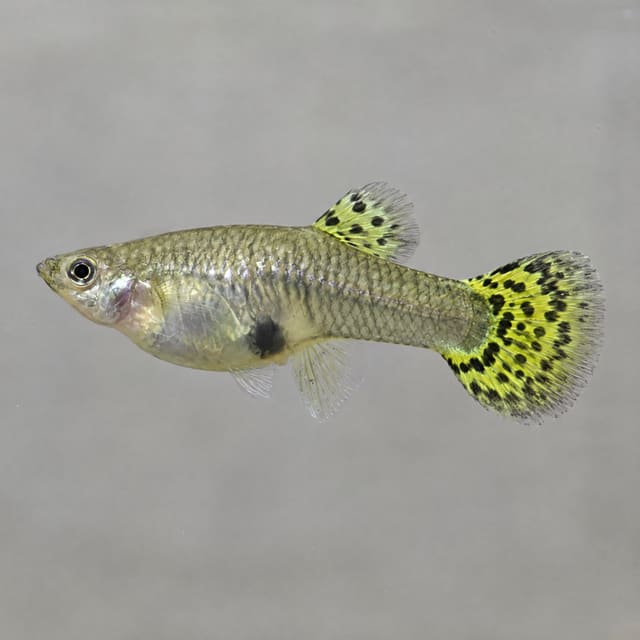
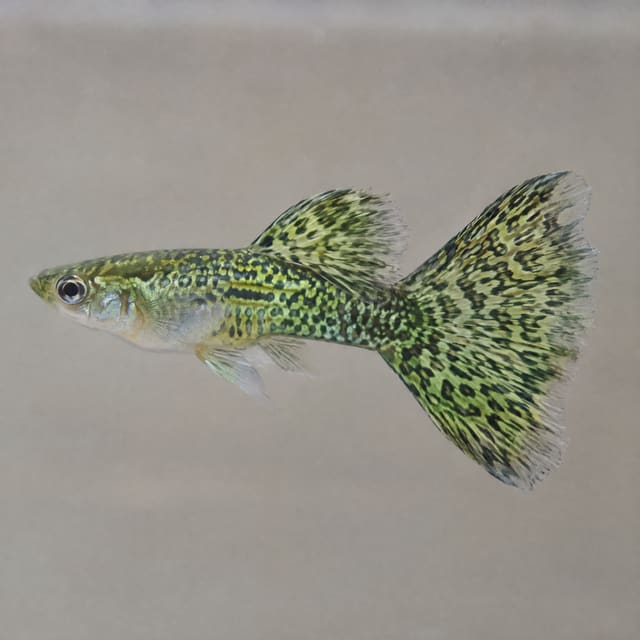
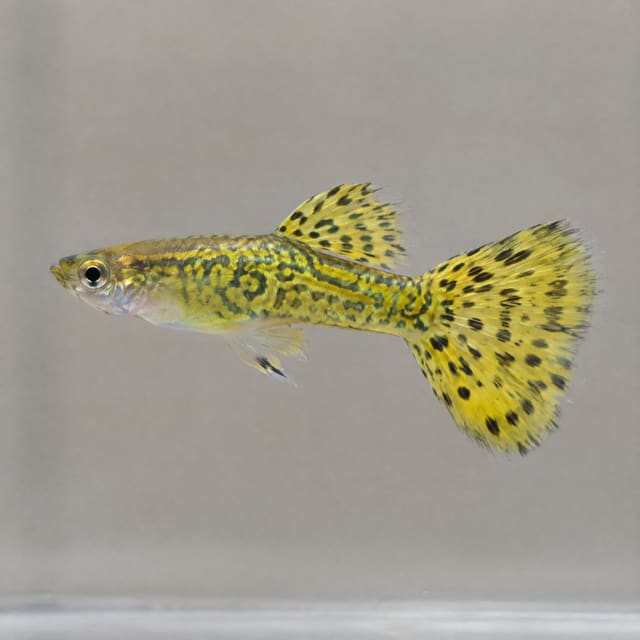
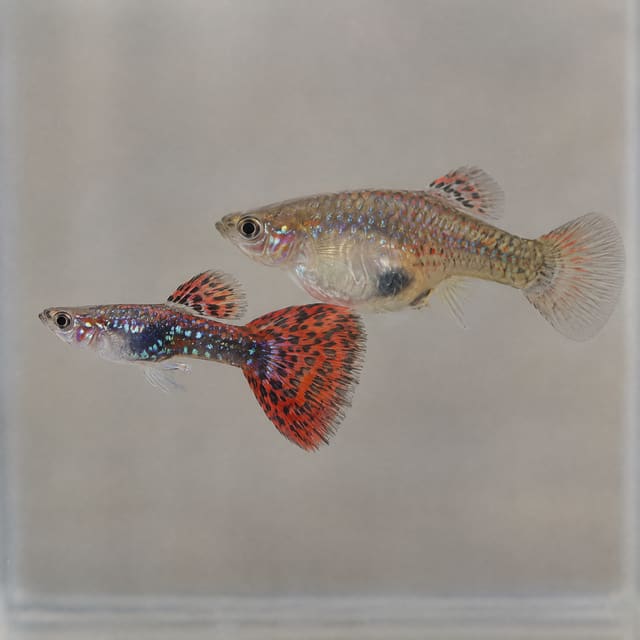
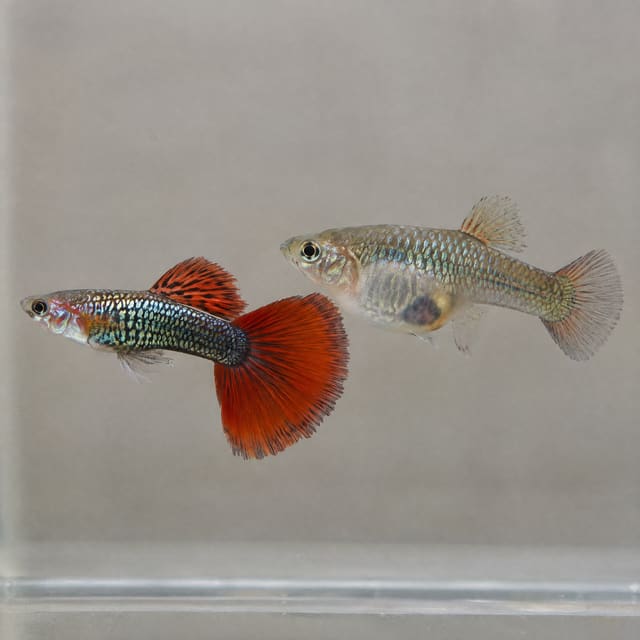
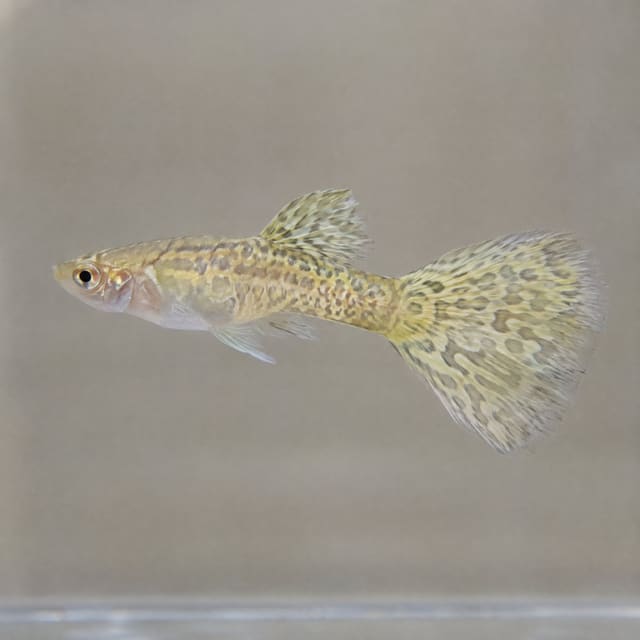
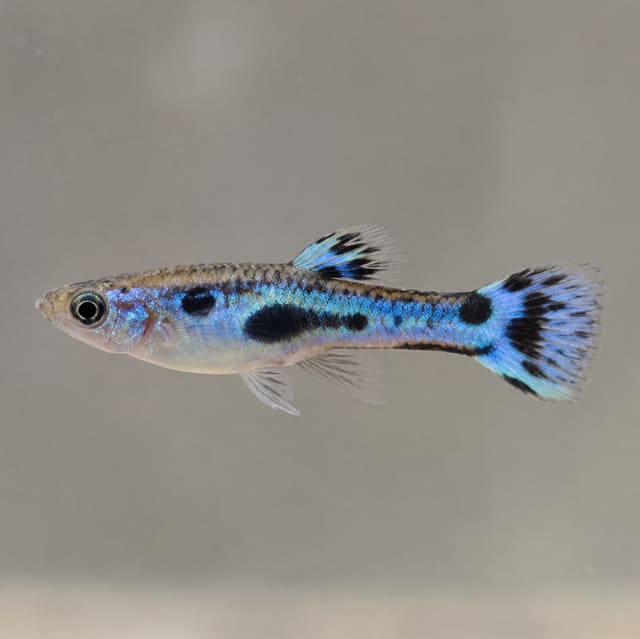
A pair of Green Cobra guppies (Poecilia reticulata): one male and one female, about 3.5 cm when sent. The male wears a yellow-green snakeskin network, two dark flank spots, a blue sheen near the tail and black-laced yellow fins. Easy and peaceful at 22–28°C, pH 7.0–8.0 and 9–18 dGH in 60 litres or more.
Adult size is the maximum length this species reaches at full maturity (scientific sources). The livestock you receive will be younger and smaller. Product-photo provenance and any image-specific limitations are stated on the listing.
Poecilia reticulata
Each quantity is one pack containing 2 fish. Discounts count packs. Selected: 1 pack (2 fish).
A pair of Green Cobra guppies (Poecilia reticulata): one male and one female, about 3.5 cm when sent. The male wears a yellow-green snakeskin network, two dark flank spots, a blue sheen near the tail and black-laced yellow fins. Easy and peaceful at 22–28°C, pH 7.0–8.0 and 9–18 dGH in 60 litres or more.
Adult size is the maximum length this species reaches at full maturity (scientific sources). The livestock you receive will be younger and smaller. Product-photo provenance and any image-specific limitations are stated on the listing.
Guppies are social livebearers suited to a prepared beginner, not a fish-per-litre formula. Use a mature filtered aquarium, tested neutral-to-alkaline mineral-bearing water, deliberate sex and population planning, open swimming room, cover and a separation option.
Read the full care guidance when planning conditions for your aquarium.
This listing sells Green Cobra guppies, Poecilia reticulata, as a pair. Each unit you add to the basket is one male and one female, so a quantity of one brings two fish and a quantity of three brings six. The only size option is 3.5 cm, which is the size we send them at. It is not a promise about adult size, and the two fish will not stay matched for long: female guppies grow bigger than males.
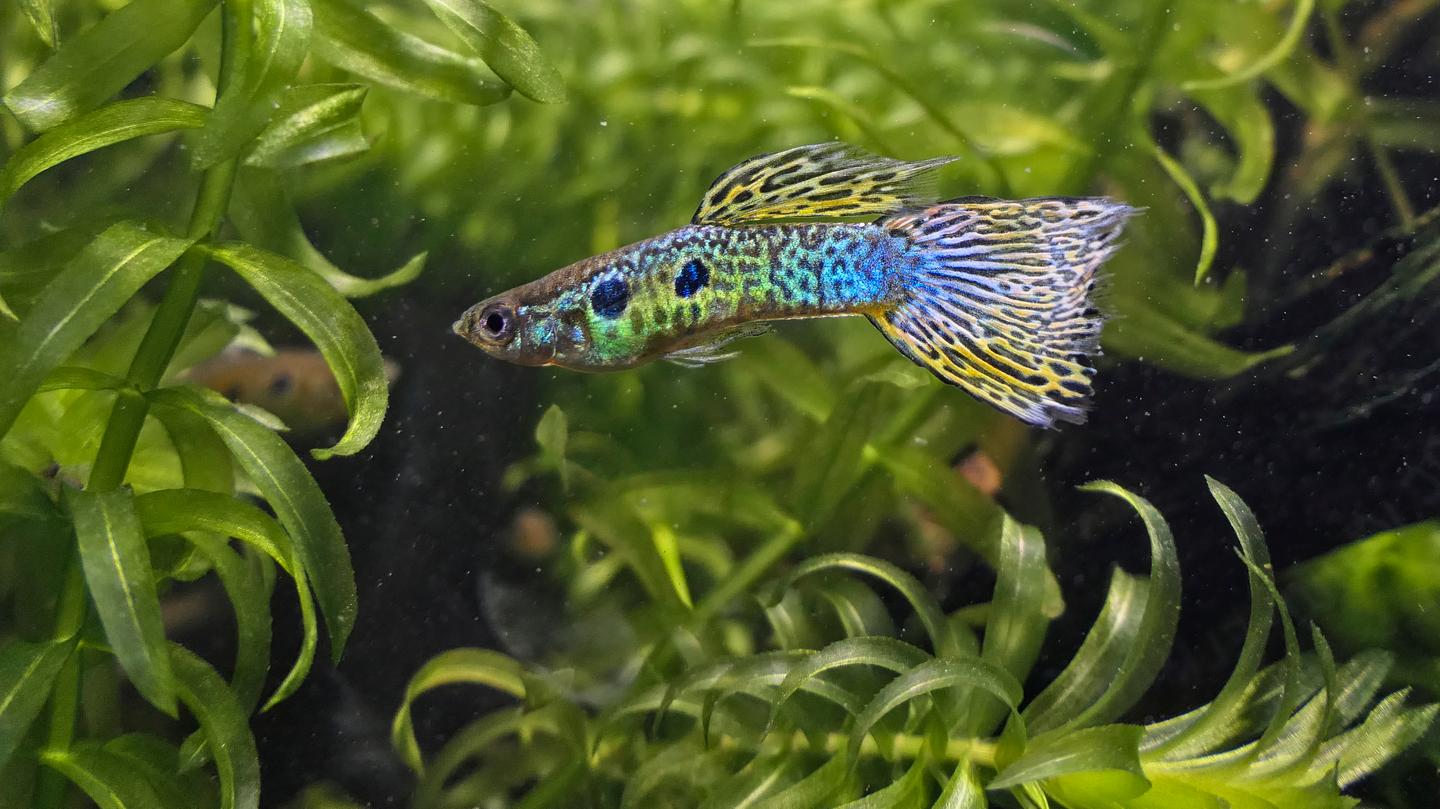
Both of our photos show a male. The female is not pictured, and that is worth knowing before you buy, because she will look quite different from him. In guppies the bold pattern belongs mainly to the male; the female is the larger, plainer fish. The section below explains why.
Fancy guppies are bred, not printed, so expect your male to show the Green Cobra pattern and colours without being an identical twin of the fish in our pictures. The density of the network, the size of the flank spots and the spread of the tail differ a little from one fish to the next.
Look closely at the male in our photos and the name makes sense. His body is covered in a dense network of fine dark lines and blotches laid over a yellow-green base, a little like the scales of a snake. Two large, round blue-black spots sit in the middle of his flank. Towards the rear the body flushes with iridescent blue, which carries on into the lilac-blue base of the tail. The dorsal fin is bright yellow, laced with black lines, and the tail repeats that yellow-and-black lacework out to its edge. The head and back are a quieter olive-brown, which makes the patterned flank stand out all the more.
The species name already hints at this sort of pattern. Seriously Fish explains that reticulata is Latin for reticulated, meaning having a network-like pattern. Breeders have taken that network and pushed it much further than it goes in the wild.
Wikipedia notes that the genes for male guppy ornaments are carried on the Y chromosome and are heritable, and that guppies have 23 pairs of chromosomes, including one pair of sex chromosomes. Males are XY and females XX, so a gene that sits on the Y chromosome passes from father to son and never reaches a daughter.
A 1999 study by Phang, Khoo and Ang in Zoological Science looked at this in snakeskin guppies from Singapore farms. It reported that the snakeskin pattern on the body and on the tail is controlled by two closely linked genes, Snakeskin-body and Snakeskin-tail, that both are Y-linked and so passed from father to son, and that females do not carry them. The females in that study showed only a pale yellow background colour on body and tail. The same paper found that a separate recessive gene, which they called bar, can turn the snakeskin body network into vertical bars near the base of the tail; about nine in ten of their Yellow Snakeskin males showed the typical network. The authors also noted that snakeskin-like and variegated patterns were popular among guppies farmed in Singapore for export.
That study worked on a yellow snakeskin line, not on this green strain, so treat it as an explanation rather than a guarantee. It does explain why the Green Cobra female in your pair will not look like the male in the photos.
Seriously Fish describes female guppies as larger, plumper and duller than males, adding that aquarium varieties may show colour in the tail fin. Wikipedia describes wild females as grey. So expect a plainer, bigger-bodied fish, perhaps with some colour in her tail, and with a normal triangular anal fin rather than the male's rod-shaped gonopodium. She is the half of the pair that carries the next generation, and her size and plain colouring are exactly what a healthy guppy female should look like.
Guppy strain names can be confusing, and the same few words turn up in many of them. A quick guide to what this listing is and is not:
Green Moscow guppies are a popular search, and the shared word "green" can cause confusion. The Moscow strains are a different line from the Green Cobra. What we sell on this page is the Green Cobra, and the male's patterned body, flank spots and laced yellow fins in our photos are what you should expect. If you are looking for a Moscow guppy specifically, this is not that fish.
Snakeskin is the name used for guppies with a reticulated, snake-scale marking of this kind; the 1999 study described above calls it delicate snakeskin-like reticulations. Our green snakeskin delta male is another green snakeskin-patterned guppy in our range, sold as a single male.
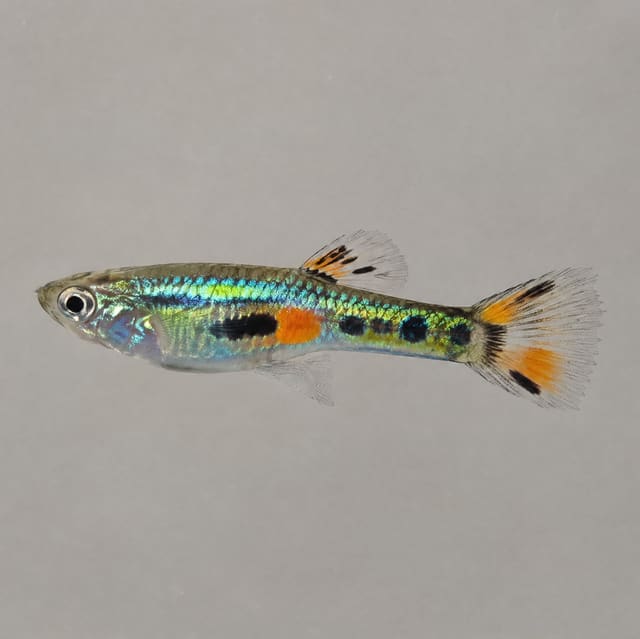
Some searches pair the word cobra with Endler. Endler's livebearer, Poecilia wingei, is a separate, smaller fish: OATA gives it an adult size of about 2.5 cm, against about 5 cm for traditional guppies. The Green Cobra is a true guppy, Poecilia reticulata. The two are close relatives, though. Wikipedia records that guppies and Endler's livebearers have been hybridised to produce fertile offspring, which has led to the suggestion that Endler's might be a subspecies of the guppy. Deliberate crosses are kept in the hobby too; our Santa Maria Endler Guppy Males, for example, are listed as guppy × Endler hybrids. If you want your Green Cobra fry to stay Green Cobra, do not house the pair with Endlers.
Older books may call the guppy Lebistes reticulatus. Wikipedia explains that Regan used that name in 1913 and that Rosen and Bailey restored Poecilia reticulata in 1963. The English name honours Robert John Lechmere Guppy, who sent specimens from Trinidad to the Natural History Museum in London. It is the same species throughout.
A Green Cobra male is about as far from a wild guppy as a show budgie is from a wild one, but the wild fish explain a great deal about how he behaves.
FishBase gives the native range as Venezuela, Barbados, Trinidad, northern Brazil and the Guianas, and Seriously Fish adds Antigua and Barbuda and the Netherlands Antilles. The fish was first described from Venezuela in 1859. Seriously Fish describes it as incredibly adaptable, found from high-altitude streams to turbid swamps and ditches, and doing best where algae, marginal vegetation or water plants grow thickly. FishBase records it in fresh and brackish water.
Wikipedia summarises one of the best-known stories in evolutionary biology. In the streams of Trinidad, guppies live alongside predators such as the pike cichlid Crenicichla alta, the killifish Anablepsoides hartii and the acara Aequidens pulcher. Where predation is intense, male guppies evolve to be duller, with fewer and smaller spots, both in the wild and in laboratory experiments. Females in those high-predation places also evolve a weaker preference for brightly coloured males, and the fish school more tightly.
Where predators are few, colour pays. Wikipedia reports that female guppies prefer brightly coloured males, especially those with orange spots on the flank, and that the orange comes from carotenoids, so its intensity is affected by what the male eats and by his parasite load. The preference may be a way for females to pick healthy males that forage well. Wikipedia also notes that thyroid hormones influence how a male's colour pattern is expressed.
Fancy strains such as the Green Cobra are what happens when people, not predators, do the choosing. Wikipedia notes that fancy strains are selectively bred and much more lavishly ornamented than their wild ancestors, often with larger bodies.
Guppies were spread widely for mosquito control. Seriously Fish counts established feral populations in about 50 countries. FishBase says the effect on mosquitoes was rare to non-existent, and Wikipedia records harm to native fish in many places. OATA is clear that releasing aquarium fish or plants into the wild is illegal. If your pair produces more young than you can keep, pass them to another keeper, a club or a shop.
The published minimums are modest. Seriously Fish suggests a tank with a base of at least 45 × 30 cm, roughly 41 litres, and OATA says at least 45 litres for a small group of the smaller guppies and mollies. We recommend 60 litres or more. A pair is rarely the end of the story: you will probably want another female or two to ease the pressure on the first one, and a pair that is well fed and kept in clean water will start producing fry within weeks. Extra volume buys you time when numbers rise.
OATA lists a filter as always essential, along with a heater, gravel or sand, live or plastic plants and decorations that offer shelter, and it warns against sharp ornaments that might tear fins. Plant the back and sides thickly, add a little floating cover, and leave open water in front where the male can show off his tail in the light. The wild habitats Seriously Fish describes are thick with vegetation, and in the aquarium that cover gives the female somewhere to rest and gives newborn fry a place to hide.
Lighting is a matter of taste. The blue on the male's rear body looks metallic in our photos, and a tank lit from above, with the fish swimming at your eye level, is the easiest way to enjoy colour like that. Keep the filter return gentle, so he is not battling a current with his fins.
OATA advises placing the aquarium away from sunny windows, draughts, radiators, noise and vibration.
To show how the numbers work in practice, here is one way to stock a 60-litre tank around this pair. Start with the pair alone for the first couple of weeks. Then add two more Green Cobra females, giving one male to three females, comfortably above the two-to-one ratio OATA recommends. Once those have settled, a few Corydoras catfish for the lower levels would complete it; Seriously Fish lists Corydoras among the guppy's suitable companions. Stop there. Every brood the females produce adds more mouths, and a tank that looks lightly stocked in the spring can be crowded by the autumn if fry survive. Leaving that margin is far easier than rehoming fish at short notice.
Guppies want warm, hard and slightly alkaline water. The main references give:
We recommend 22–28°C, pH 7.0–8.0 and 9–18 dGH. Those figures fit inside the FishBase, Seriously Fish and OATA ranges. The lowest temperatures in the FishBase and Seriously Fish ranges are the edge of what this widespread species copes with, not a target for a fancy strain. Pick a temperature in the mid-twenties and keep it steady.
Check your tap water's pH, GH and KH before ordering. If it falls well outside these numbers, contact us before you buy, not after the fish have arrived.
OATA's water quality targets are zero ammonia, zero nitrite and nitrate no more than 20 mg/l above your tap water. Its routine is a 25% partial water change every week with a gravel siphon, a test at least once a week, and filter media rinsed only in old tank water so the bacteria that keep ammonia at zero are not killed off by tap water. Stick to that routine and the rest of guppy keeping is straightforward.
Wikipedia mentions that guppies can withstand very salty water, up to 150% of seawater, and suggests a small amount of salt in the aquarium. Read that as proof of a tough species rather than an instruction; OATA's care values for guppies do not include salt.
Feeding guppies is easy to do and easy to overdo. These are small fish with small stomachs, and OATA's advice on portion size is there to stop uneaten food fouling the water.
FishBase lists zooplankton, small insects and detritus as the natural diet. Wikipedia adds algal remains, diatoms, plant fragments and aquatic insect larvae from studies of wild fish, and notes that algae are less nutritious than invertebrates. Seriously Fish calls wild guppies primarily insectivorous, while captive-bred fish will take most foods offered. In short: an omnivore that does best with plenty of small animal food.
Watch the female at feeding time. She is larger and should be eating well, especially as she carries young; if the male's attentions keep her away from food, spread the food over a wider area so she can feed in peace.
Wikipedia's point about carotenoids applies to the orange spots of wild guppies: their intensity depends partly on diet. Our Green Cobra male does not carry the orange flank spots of a wild fish, so do not expect food to change his pattern. A varied diet is about condition, fin quality and breeding health rather than about repainting him.
Newborn guppies are small enough to need a finer food than their parents. Powdered flake, rubbed between finger and thumb, or a commercial fry food, offered in small amounts several times a day in a rearing tank, will see them through until they can manage adult flake.
With other species the guppy is a gentle fish; Seriously Fish describes it as very peaceful. With his own kind the Green Cobra male is relentless. FishBase notes that male guppies continuously chase females, and that is what you will see: the male trailing the female, flaring his fins at her and trying again and again.
OATA recommends keeping at least three guppies together, two females to each male, so that no single female takes all the attention. Seriously Fish advises several females per male. Wikipedia notes that guppies usually live in large groups in the wild and should not be kept on their own. A single pair is a fine start, but most keepers will want to add one or two more females once the first two have settled.
The obvious choice is our Green Cobra Female Guppy, which keeps every female in the tank from the same strain. If you would rather balance the numbers the other way and keep more than one patterned male, add our Green Cobra Male Guppy only alongside extra females, so the ratio stays in the females' favour.
Seriously Fish lists other livebearers, rasboras, Corydoras, loricariid catfish and tetras as compatible, provided they are happy in the guppy's harder, alkaline water. It names tiger barbs and serpae tetras as fish to avoid, because they nip fins, and the Green Cobra male's laced tail and dorsal are exactly what fin-nippers target. Avoid any fish large enough to swallow a guppy.
Expect fry to disappear in a busy community tank. FishBase notes that guppies give no parental care and that parents may eat their own young, and Seriously Fish says adults consume fry. If you want to raise Green Cobra young, plan for it, which brings us to breeding.
Put a male and female guppy together and you will get fry. Seriously Fish calls the species incredibly prolific, and that is not an exaggeration.
The figures differ because guppies differ, and because they were measured in different fish and conditions. What they agree on is the shape of it: a new brood roughly monthly, dozens of fry at a time, and youngsters breeding within a few months.
The young are born live, and the adults will eat them. Seriously Fish advises removing fry after birth if you want them to survive. OATA suggests moving a heavily pregnant female into a breeding net, so the fry can be separated as they arrive. A spare heated and filtered tank is kinder for longer-term rearing, because the female can give birth in peace and the young can grow without competition. In a heavily planted main tank, with moss and floating plants, a few fry may make it on their own.
A rearing tank does not need to be elaborate. A small aquarium with a heater set to the same temperature as the main tank, a gentle air-driven sponge filter that has no strong intake to pull in tiny fish, a clump of moss or floating plants and water taken from the main tank is enough. Feed small amounts of powdered food several times a day, and keep on top of water quality with small, frequent water changes, because fry are crowded into a little water and their food spoils it quickly. Once the young are large enough not to fit in an adult guppy's mouth, they can go back into the main aquarium.
This is where the genetics in the section above becomes practical. If the Green Cobra pattern is inherited like the yellow snakeskin pattern studied by Phang, Khoo and Ang, the sons will get their snakeskin genes from their father on the Y chromosome, and the daughters will grow up plain, just like their mother.
To keep a line going, grow the young on, keep the best-patterned sons and keep the daughters of the same strain as future mothers. Do not mix in females or males of other strains, or Endler's livebearers, if you want the Green Cobra look to carry on. And because a female stores sperm for months, a female that has been with another strain's male can still produce his offspring long after he has gone.
If you would rather not breed at all, keep the pair in a community tank and let nature thin the fry. Any young that grow up there should be passed on to another keeper or a shop, never released.
The guppy as a species is famously tough, but fancy strains are another matter. Seriously Fish warns that many commercially bred guppies are not very hardy because of inbreeding and over-production, and that they can be prone to disease. Wild-type guppies, it notes, are seldom offered at all. With a fancy strain, prevention matters far more than cure.
OATA describes a healthy fish as having clear, bright eyes, undamaged fins, intact scales, no ulcers or lumps, normal swimming and steady breathing. Use feeding time for a quick check: both fish should come up eagerly, the male's tail and dorsal fin should be spread rather than folded, and the female should look full-bodied without being swollen in an odd way. The Green Cobra male's busy pattern can hide small marks, so look at him in good light now and again.
OATA picks out clamped fins, flicking or rubbing against gravel and decor, and shimmying, a swaying on the spot, as signs of illness. Fast breathing, a fish that sits apart from the other, frayed or splitting fins and a loss of appetite also mean something needs attention.
Start with the water. Run the tests for ammonia, nitrite and nitrate, and if anything reads high, do a partial water change straight away. Get advice before using any medicine, so you treat the right problem with the right product.
A long, lacy tail is easy to damage. Keep sharp decor out of the tank, as OATA advises, keep fin-nippers out of the community, and keep nitrate down so a small nick heals rather than spreads.
If you already have a stocked aquarium, a separate quarantine tank for a few weeks is sensible for any new arrivals, these included. It gives the newcomers a calm start and protects the fish you already own.
Wikipedia says wild guppies usually live around two years, though it varies greatly. OATA says guppies can live several years in a well-matured aquarium with good water. Wikipedia also notes that females keep breeding until 20–34 months of age. A well-kept Green Cobra pair should give you a couple of years at least, and several generations of young along the way.
Please read the delivery and live arrival information before ordering. These steps take a few minutes and make all the difference on the day.
Your aquarium needs to be ready before the fish are on their way: the filter running, the water tested and the temperature set within the range above. There must be somebody at the delivery address to take the parcel in, as live animals cannot be left unattended. We will email you the confirmed delivery date and tracking, so you can plan to be in.
The pair are packed in oxygen-filled bags inside insulated packaging, with heat packs when the conditions call for them, and sent with a tracked courier licensed to carry live animals.
We strongly recommend an unboxing video when practical: it helps us resolve arrival concerns faster, investigate packing or transit issues and reduce recurrence. Video is optional and clear photos are accepted. Never delay necessary animal care to record evidence. If filming, start while the parcel is still sealed, open it in the same recording, and show the fish inside the bag before the bag is opened. Should either fish arrive dead, dying or clearly compromised, send clear photos or an optional video and your order number to hello@tropicalfishco.co.uk on the day of delivery. Under the guarantee terms, the affected fish is replaced with your next order or refunded.
Leave the lights low and resist the urge to keep checking. Give a light feed the following day and make sure both fish take some. Through the first week, keep an eye on their breathing, their appetite and how they behave. A male who is soon chasing his female again and a female who feeds and explores are both good signs.
Remember that a female guppy can arrive already pregnant, since females store sperm. Fry within the first few weeks would be no surprise, so decide in advance whether you will save them.
Every fact about the species on this page comes from the sources below. Each is worth reading if you want to go further.
No reviews for this item yet. Bought one? Honest reviews only, good or bad.
What customers say about ordering from us
Easy website plenty of info on fish your buying great to pick a time slot
TRACEY DURRANT · 7 Oct 2026
Got some lovely fish thank you
Kevin Mackie · 7 Oct 2026
Reviews of our shop, collected by Judge.me, an independent third-party review collector. Newest first.
Moved by UK carriers licensed to handle live animals
Hand-packed with oxygen bags, poly box, heat pack
Email photos the same day; an optional unboxing video helps us review problems faster — claim terms apply
Klarna & PayPal Pay in 3 at checkout



22–26°C · pH 6–7.8 · 75L