Easy
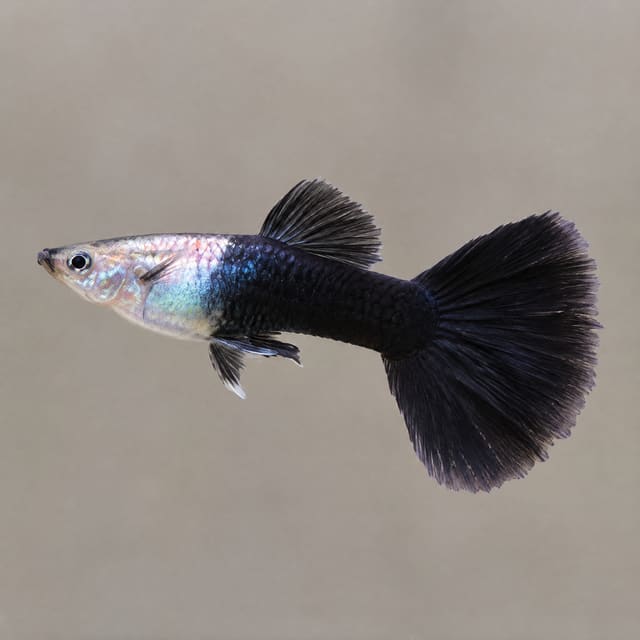
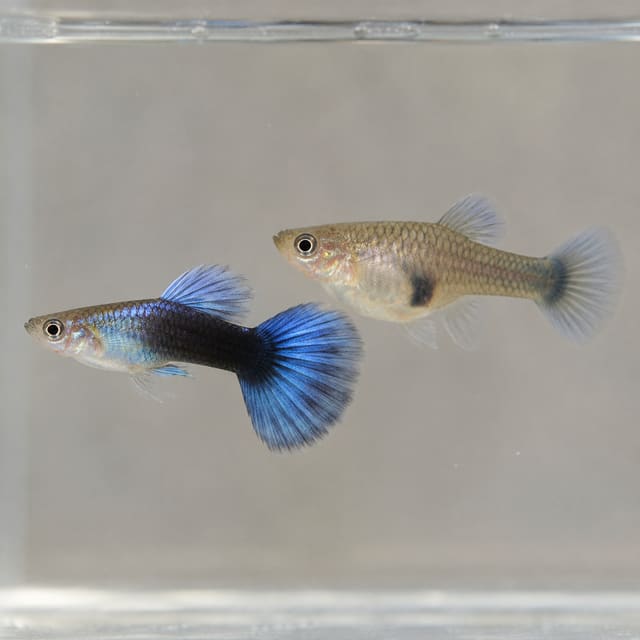
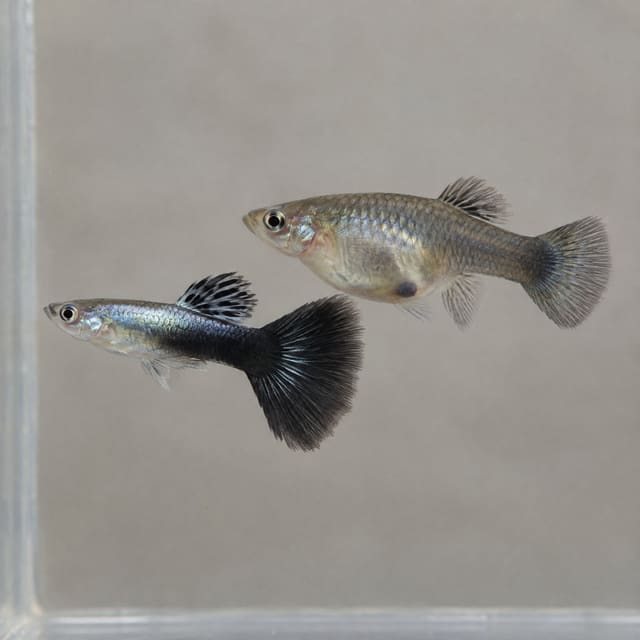
One male and one female Full Black guppy (Poecilia reticulata), dispatched at about 3.5 cm. The male is black from head to tail; the female is olive-bronze with a black tail and dorsal fin. Peaceful and easy in a mature tank of 60 litres or more at 22–28°C, pH 7.0–8.0 and 9–18 dGH.
Adult size is the maximum length this species reaches at full maturity (scientific sources). The livestock you receive will be younger and smaller. Product-photo provenance and any image-specific limitations are stated on the listing.
Poecilia reticulata
Each quantity is one pack containing 2 fish. Discounts count packs. Selected: 1 pack (2 fish).
One male and one female Full Black guppy (Poecilia reticulata), dispatched at about 3.5 cm. The male is black from head to tail; the female is olive-bronze with a black tail and dorsal fin. Peaceful and easy in a mature tank of 60 litres or more at 22–28°C, pH 7.0–8.0 and 9–18 dGH.
Adult size is the maximum length this species reaches at full maturity (scientific sources). The livestock you receive will be younger and smaller. Product-photo provenance and any image-specific limitations are stated on the listing.
Guppies are social livebearers suited to a prepared beginner, not a fish-per-litre formula. Use a mature filtered aquarium, tested neutral-to-alkaline mineral-bearing water, deliberate sex and population planning, open swimming room, cover and a separation option.
Read the full care guidance when planning conditions for your aquarium.
Order one Full Black Guppy Pair and you receive one pair of Poecilia reticulata: one male and one female, at the 3.5 cm size shown on the size option. Put two in the basket and two pairs arrive, four fish in all. That 3.5 cm is how big the fish are when they leave us, not how big they end up. Male guppies stay small and slim; females grow larger and finish noticeably bigger and heavier than their partner.
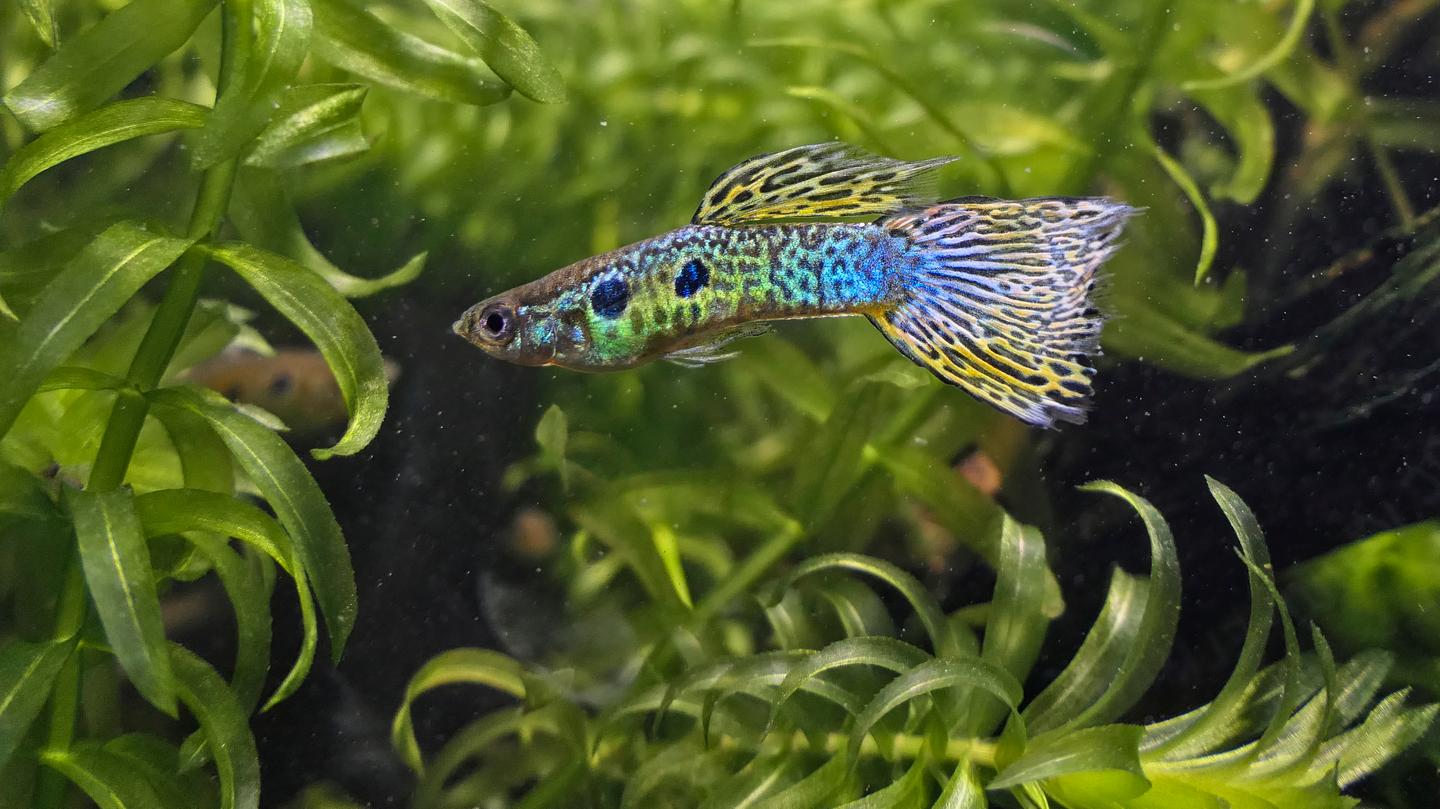
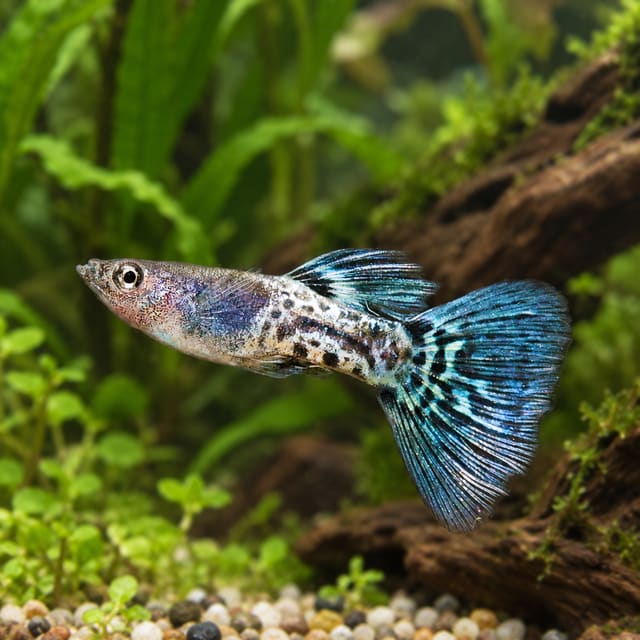
The Full Black is a fancy, aquarium-bred strain of the ordinary guppy, selected over many generations for dark colour. In our photos the male is black from snout to tail tip, with a tall dorsal fin and a wide, fanned tail that is longer than his body is deep. The female beside him is the more natural-looking fish: an olive-bronze body, a silvery belly and a jet-black tail and dorsal fin. Fancy guppies are living animals rather than printed patterns, so the pair you receive will show the strain's colours but will not be an exact copy of the fish in the pictures. Depth of black and the spread of the male's tail vary a little from fish to fish.
| Quick facts | Full Black Guppy Pair |
|---|---|
| Scientific name | Poecilia reticulata Peters, 1859 (fancy strain) |
| Family | Poeciliidae, the livebearers |
| What one order contains | One pair: one male and one female |
| Size when dispatched | About 3.5 cm |
| Largest recorded adults (FishBase) | Males 5.0 cm SL, females 6.0 cm SL |
| Temperature we recommend | 22–28°C |
| pH | 7.0–8.0 |
| General hardness | 9–18 dGH |
| Aquarium | 60 litres or more, mature and cycled |
| Temperament | Peaceful livebearer |
| Care level | Easy |
SL stands for standard length, measured from the tip of the snout to the base of the tail, so the tail itself is not included. The FishBase maximums are the largest fish ever recorded, not what a typical pair reaches in a home aquarium. FishBase gives a common length of 2.8 cm TL (total length, tail included) for males, which is a better guide to what most male guppies look like day to day.
Where we quote a number in this guide we say where it comes from. FishBase, Seriously Fish, Wikipedia and the Ornamental Aquatic Trade Association (OATA) do not always agree to the last degree or decimal, so where they differ we show the spread and explain which figures we keep to.
You will not need a magnifying glass to sex this pair. The male is the black, flag-tailed fish; the female is the bigger, rounder one with the bronze body. There are still a few details worth knowing, partly because they help you check what has arrived and partly because they tell you a lot about how guppies live.
Look underneath the male, just behind the pelvic fins. Instead of a fan-shaped anal fin he has a gonopodium, which Seriously Fish describes as a modification of the anal fin used in reproduction and stick-like in appearance. Guppies fertilise internally, and the gonopodium is how the male does it. OATA's care sheet makes the same point from the other side: the female's anal fin is triangular, the male's is the narrow rod.
In the Full Black strain the male's body, head and fins are all dark. Under aquarium lighting the body has a faint sheen rather than a dead, flat black, and in both of our photos there is a small silvery patch at the throat and lower jaw. His dorsal fin is long and sweeps back over the start of the tail, and the tail itself is broad and finely rayed, opening like a fan when he displays. FishBase notes that male guppies are about half the size of females with a colourful tail; in this strain "colourful" simply means black.
The female is where you can see the guppy's wild ancestry. Her flanks are olive to bronze, and each scale is edged slightly darker, so the side of the fish carries a fine net pattern. That is the network that gave the species its name: Seriously Fish explains that reticulata comes from the Latin for reticulated, having a network-like pattern. Behind her gill cover our photos show a warm, rosy patch, and her belly is pale and silvery. The strain colour appears in her fins: a jet-black, rounded tail, a black dorsal fin and dark pelvic and anal fins.
Wikipedia describes wild female guppies as grey, with all the colour carried by the males. Seriously Fish adds that aquarium varieties of female may show colour in the tail fin, which is exactly what the Full Black female does. So a plain-bodied female with a black tail is the correct partner for this strain, not a second-rate fish.
Expect the gap between them to widen as they grow. Wikipedia gives males as 1.5–4 cm long and females as 3–7 cm, while FishBase records maximums of 5.0 cm SL for males and 6.0 cm SL for females. Both fish leave us at about 3.5 cm, but a well-fed female will soon be the larger fish by some way, especially when she is carrying young.
The guppy was first described scientifically by Wilhelm Peters in 1859, from fish collected in Venezuela; Seriously Fish gives the type locality as the Guayre River at Caracas. The name history after that is tangled, and you will still meet the old names in second-hand books. According to Wikipedia, De Filippi named fish from Barbados Lebistes poecilioides in 1861, and Albert Günther coined Girardinus guppii in honour of Robert John Lechmere Guppy, who had sent specimens from Trinidad to the Natural History Museum in London. Regan moved the species to Lebistes reticulatus in 1913, and Rosen and Bailey restored Poecilia reticulata in 1963. The scientific name went back to Peters; the English name stayed with Mr Guppy. Older common names include millionfish and rainbow fish.
The genus name is just as descriptive as the species name. Seriously Fish traces Poecilia to the Greek poikilos, meaning variable or variegated, which is a fair summary of a fish now bred in hundreds of colour forms.
Seriously Fish lists the natural range as Venezuela, Guyana, Suriname, French Guiana, Trinidad and Tobago, Barbados, Antigua and Barbuda and the Netherlands Antilles; FishBase also includes northern Brazil. FishBase records the species in fresh and brackish water, in a tropical climate, and lists habitats from warm springs and effluents to weedy ditches and canals. Seriously Fish calls it an incredibly adaptable species found in almost every biotope, from high-altitude streams to turbid swamps and ditches, and notes that it does best where there are lush growths of algae, marginal vegetation or aquatic plants.
That background explains a lot about why guppies cope so well in aquariums. They are used to warm, hard, well-planted water and to living in big groups. A dark fancy strain such as the Full Black looks nothing like a wild fish from a Trinidad stream, but underneath the colour it is the same animal with the same needs.
Guppies have been moved far beyond their home range. Seriously Fish says feral populations are now established in roughly 50 countries, and Wikipedia records introductions on every continent except Antarctica, often for mosquito control. FishBase is blunt about the results: the mosquito-control releases had rare to non-existent effects on mosquitoes, and Wikipedia notes negative impacts on native fish in many places. The wild species is assessed as Least Concern on the IUCN Red List, according to FishBase.
The lesson for anyone keeping guppies in Britain is simple. OATA states that you must never release aquarium animals or plants into the wild, and that it is illegal. A pair of guppies can turn into a lot of guppies (more on that below), so plan now where surplus youngsters will go: another keeper, a local club or an aquatic shop.
On paper a single pair of small fish needs very little room. Seriously Fish suggests a minimum base of 45 × 30 cm, about 41 litres, and OATA asks for at least 45 litres for a small group of the smaller guppy and molly species. We recommend 60 litres or more for this pair, for two practical reasons. First, both OATA and Seriously Fish advise keeping more than one female for each male, so most buyers end up adding fish. Second, a healthy female will give birth roughly every four weeks according to FishBase, and in a planted tank some of those fry survive. A 60-litre aquarium gives you room to cope with both without the water quality sliding.
OATA's list is short and sensible: a filter, which it calls always essential, a heater, gravel or sand, live or artificial plants, and decorations that give shelter. It also warns against sharp ornaments that could damage fins. That warning matters more than usual with a Full Black male, whose dorsal fin and broad tail are his whole appeal. Choose smooth wood and rounded stone, and run a finger over any ornament before it goes in.
Keep the filter return gentle enough that the male can cruise and hold his position without being pushed about. A spray bar, an outlet aimed at the glass, or plants placed in front of the return all help soften the flow. A good heater with a thermostat keeps the temperature steady inside the range in the next section.
Plants do three jobs in a guppy tank. They echo the vegetated margins that Seriously Fish describes in the wild, they give the female somewhere to rest away from the male's constant attention, and they hide newborn fry. Fine-leaved stem plants, mosses and a few floating plants are the classic choices for fry cover. Leave an open band of water across the front and middle for swimming and feeding.
A black guppy against a black background and dark gravel can almost vanish. Our first photo shows the opposite approach: bright green planting behind the pair, with warm-coloured wood and pale gravel, so the male's silhouette stands out sharply. If you prefer a dark scape, put light-leaved plants behind the swimming area so the black fins have something to show against.
OATA advises keeping aquariums away from direct sunlight, draughts, radiators and other heat sources, loud noise and vibration. Stand the tank on furniture built to take the weight, near a socket, and somewhere you will see it every day. Daily glances are the cheapest health check there is.
Most importantly, set the tank up and let the filter mature well before you order. The fish should go into an established aquarium where ammonia and nitrite already read zero, never into a tank filled the same week.
People often search for the FishBase temperature range, pH and hardness for Poecilia reticulata, so here are those figures side by side with the other main references. They agree more than they differ: guppies want warm, hard, slightly alkaline water.
| Source | Temperature | pH | Hardness |
|---|---|---|---|
| FishBase | 18–28°C | 7.0–8.0 | 9–19 dH |
| Seriously Fish | 17–28°C | 7.0–8.5 | 8–30 dGH |
| OATA | 20–28°C | 7.0–8.0 | 8–18 dGH, 5–15 dKH |
| Wikipedia | 25.5–27.8°C preferred | not given | hard water |
| What we recommend | 22–28°C | 7.0–8.0 | 9–18 dGH |
The cool ends of the FishBase and Seriously Fish ranges, 18°C and 17°C, describe what the species tolerates across its huge distribution. For a fancy strain in a heated home aquarium we work to 22–28°C, which sits inside every published range, and the middle of that band is a comfortable place to aim. Avoid swings: a stable 25°C is far better for the fish than a tank that wanders between 22°C and 28°C every few days.
Seriously Fish puts it plainly: this is a hard water fish, and although it may tolerate softer or more acidic conditions for a short time, that is not where it thrives. Test your tap water for general hardness (GH), carbonate hardness (KH) and pH before you order. If your water is much softer or more acidic than the figures above, talk to us before buying rather than after the fish arrive.
OATA's targets are the ones to live by. Ammonia and nitrite should both read zero, and nitrate should be no more than 20 mg/l above the level in your tap water. To keep it there OATA strongly recommends a 25% partial water change every week, using a gravel siphon, and testing at least once a week for ammonia, nitrite, nitrate, pH and hardness. When the filter needs a clean, rinse the media in water taken out of the tank, never under the tap, so the beneficial bacteria survive.
Weekly changes also matter more once fry start to appear. A pair can become a dozen fish in a couple of months, and every extra mouth adds to the waste the filter has to deal with.
You may read that guppies like a little salt. Wikipedia mentions a level of one tablespoon per 19 litres and records that guppies can withstand salinity up to 150% of normal seawater. That second figure is a record of how tough the species is, not a target. Nothing in OATA's care values calls for salt, so in an ordinary planted freshwater tank there is no need to add any.
Guppies are not fussy eaters, which is one reason they suit beginners. The skill is in feeding the right amount and adding variety, not in finding something they will accept.
Wild guppies are omnivores with a strong taste for small animals. FishBase lists zooplankton, small insects and detritus. Wikipedia gives a longer list from studies of wild fish: algal remains, diatoms, invertebrates, zooplankton, detritus, plant fragments and aquatic insect larvae. It also notes that fish in upstream, nutrient-poor waters eat more invertebrates, while those in richer downstream waters eat more diatoms, and that algae are less nutritious than invertebrates. Seriously Fish describes wild populations as primarily insectivorous but says captive-bred fish will accept most foods offered.
OATA recommends a good-quality flake or granule with a high algae content as the staple, supplemented with live or frozen foods such as daphnia, bloodworm and tubifex. Guppies have small mouths, so choose a fine flake or a micro-granule that both fish can manage. Rotate two or three frozen foods through the week to cover the invertebrate side of the wild diet.
On quantity, OATA's rule is to feed what the fish can eat within a few minutes, once a day. Watch them eat. If food is still drifting about or settling on the gravel after a few minutes, you gave too much, and the leftovers will rot and push up ammonia. Two small fish need a surprisingly small pinch.
Scatter food across the surface rather than dropping it in one spot, so the female can feed without having to compete with the male head to head. A well-fed female is the one producing the next generation, so her condition is worth watching; a thin female that hangs back at feeding time is a sign to feed in two places or add hiding spots.
Guppies are born as live young rather than hatching from eggs, but their mouths are tiny. Crush the adult flake to powder between finger and thumb, or offer a fine fry food, and feed them little and often in a separate rearing tank or breeding net.
Seriously Fish calls the guppy a very peaceful fish, and towards other species that is true. Towards his own females the male is anything but restful. FishBase notes that males continuously chase females, and you will see the Full Black male showing off his fins to his partner and following close behind her for much of the day.
That constant attention is why both OATA and Seriously Fish recommend more females than males. OATA advises keeping at least three guppies together, with two females to each male, to reduce stress on the females; Seriously Fish says several females to each male. Wikipedia adds that guppies are usually found in large groups in the wild and should not be kept as single fish.
A pair is a good way to start, but we would suggest adding one or two more females once the pair has settled. If you are not worried about keeping the line pure, our Female Guppy Mix is an easy way to do that. If you want every fry to have a chance of carrying the black colouring, add females from black-finned stock instead, because the female you add is the mother of the next generation.
If you would like a tank of dark guppies, the Black Male Guppy and Male Tuxedo Black Guppy are other dark strains in our range, but remember that every extra male needs extra females to keep the ratio in their favour.
Seriously Fish lists other livebearers, rasboras, Corydoras, loricariid catfish and tetras as suitable companions, so long as they share the guppy's preference for harder, alkaline water. It names tiger barbs and serpae tetras as unsuitable because they nip fins, and the Full Black male's long dorsal and broad tail make him an obvious target. Anything large enough to swallow a guppy is also off the list. Remember too that adult fish, including the guppies themselves, eat fry; FishBase notes that guppies give no parental care and that parents may consume their offspring.
Guppies and Endler's livebearers (Poecilia wingei) look alike at a glance, but they are listed under separate scientific names. OATA gives Endlers an adult size of about 2.5 cm against about 5 cm for traditional guppies. Wikipedia records that the two have been hybridised to produce fertile offspring, which is why some scientists suggest Endler's may be a subspecies of the guppy. If you keep the Full Black with Endlers such as our Black Fire Endler Guppy Pair, expect hybrid fry. Keep them in separate tanks if the line matters to you.
Wikipedia describes a striking defensive trick in wild guppies: when threatened, their irises darken rapidly from silver to black, which draws a predator's strike towards the head rather than the middle of the body. It also reports that wild guppies living with many predators school more tightly. In the aquarium, watch for changes in behaviour instead. A female that hides constantly, or a male that stops displaying, is telling you something has changed.
A male and a female guppy in the same tank will breed. There is no special conditioning needed; it is simply what guppies do. Knowing the timings helps you decide whether to raise the young or let nature take its course.
Guppies are livebearers. The male fertilises the female internally with his gonopodium, and she gives birth to live young rather than laying eggs. FishBase gives a gestation of four to six weeks and says a female produces young about every four weeks. Wikipedia gives a wider spread of 20 to 60 days at 25–27.8°C, and OATA quotes a pregnancy of 24–30 days.
The sources vary because broods vary. FishBase gives 20–40 young per birth. Seriously Fish says 5–100 fry. OATA quotes 20–80. Wikipedia says broods are typically 30–60, with anything from two to 200 possible. Brood size varies a great deal between females and between births, so treat any single figure as a rough guide.
This is the fact that catches people out. FishBase notes that female guppies can store sperm. Seriously Fish says a female can produce young for six months or more without a male present, and Wikipedia says stored sperm can go on fertilising eggs for up to eight months. If you take the male out to stop breeding, expect the female to keep producing fry for months.
Adults eat fry. Seriously Fish advises removing young after birth if you want them to survive, and OATA suggests a breeding net for the heavily pregnant female so the fry can be separated as they are born. A separate small, filtered and heated rearing tank is the more relaxed option. In a densely planted main tank some fry may survive among the mosses and floating plants without any help.
FishBase gives sexual maturity at about two months for males and three months for females. Wikipedia says males mature in seven weeks or less, females begin producing offspring at 10–20 weeks of age and go on breeding until 20–34 months, and young fry take roughly three or four months to reach maturity. Wikipedia also records two generations a year in the wild. In practice, fry from the first brood can themselves be breeding within three or four months.
Wikipedia explains that fancy guppy strains are the result of selective breeding. If you want to keep the Full Black look going, grow the young on, then choose the darkest, best-finned males and the females with the blackest tails as your next breeders, and keep them away from other strains. If you would rather not raise fry at all, a planted community tank will take care of most of them for you, and you can rehome any that survive through a club or a shop. Never release them outdoors.
Guppies are hardy as a species, but the fancy strains need a little more care than their wild cousins. Seriously Fish warns that many commercially bred guppies are not very hardy because of inbreeding and over-production, and that they can be more prone to disease. That is not a reason to avoid them. It is a reason to keep water quality high and to look at your fish properly every day.
OATA's checklist is a good one to learn: clear, bright eyes; undamaged fins; intact scales; no ulcers or lumps; normal swimming; and steady breathing. With the Full Black male, the fins are the thing to watch. His tail should open and close smoothly, without splits, ragged edges spreading inwards, or a pinched, folded look. On the female, check that the black tail is held open and that her bronze flanks are smooth, with no raised scales.
OATA lists clamped fins, flicking against gravel or ornaments, and shimmying as signs of illness. The reverse of OATA's healthy list is worth watching for too: dull or cloudy eyes, split fins, raised scales, ulcers or lumps, odd swimming, fast breathing and refusing food. One advantage of an all-black fish is that pale marks show up clearly against the dark body, so you may spot a problem sooner on the male than on a lighter strain.
Whenever you see one of these signs, test the water first. Poor water quality is the first thing to rule out, and a partial water change is a safe first response. If symptoms persist, get advice before reaching for medication, because treatments differ and some affect plants and filter bacteria.
Three things put a Full Black male's fins at risk: sharp ornaments (OATA specifically warns against them), fin-nipping tank mates, or poor water letting a small tear go bad. Smooth decor, peaceful companions and weekly water changes deal with all three.
If you already keep fish, the safest approach is to settle new guppies in a separate quarantine tank for a few weeks before they join an established community. It protects both your existing fish and the newcomers.
Wikipedia says the total lifespan of wild guppies varies greatly but is typically around two years. OATA says guppies live several years in a well-matured set-up with good water quality. Females continue breeding until 20–34 months of age, according to Wikipedia. So plan on a couple of years at least, and longer with good water and a sensible diet.
Please read our delivery and live arrival information before you order. Live fish are a different kind of parcel, and a little preparation makes the first hour far easier for you and for them.
Your guppies travel in oxygen-filled bags inside insulated packaging, with heat packs when conditions call for them, via a tracked courier licensed to carry live animals.
Before you open anything, start a continuous video with the parcel still sealed. Open it in the same take and keep filming until the fish can be seen in their still-sealed bag. If a fish arrives dead, dying or clearly compromised, email hello@tropicalfishco.co.uk on the day of delivery with your order number and that video. Photos alone do not meet the policy. The resolution is a replacement with your next order or a refund for the affected fish, subject to the guarantee terms.
Keep the lights low for the rest of the first day and leave the pair alone to explore. Offer a small feed the next day and check that both fish eat. Over the first week watch three things: breathing, appetite and behaviour. Steady breathing, interest in food, and a male that soon goes back to displaying are all good signs. A female who spends the first day tucked into the plants is nothing to worry about on its own; one who is still hiding and refusing food after several days needs a closer look at the water.
Because female guppies store sperm and can already be carrying young, it would not be unusual to find fry in the tank within a few weeks of arrival. Have a plan ready, whether that is a breeding net, a spare tank or thick planting.
These are the sources behind the facts and figures on this page. They are worth reading in full if you want to know more about the species.
No reviews for this item yet. Bought one? Honest reviews only, good or bad.
What customers say about ordering from us
Easy website plenty of info on fish your buying great to pick a time slot
TRACEY DURRANT · 7 Oct 2026
Got some lovely fish thank you
Kevin Mackie · 7 Oct 2026
Reviews of our shop, collected by Judge.me, an independent third-party review collector. Newest first.
Moved by UK carriers licensed to handle live animals
Hand-packed with oxygen bags, poly box, heat pack
Email photos the same day; an optional unboxing video helps us review problems faster — claim terms apply
Klarna & PayPal Pay in 3 at checkout



22–26°C · pH 6–7.8 · 75L