Easy
Blue Moscow Male Guppy (Poecilia reticulata)
22–28°C · pH 7–8 · 45L
£6.49
Photo coming soon
The size, price and care details on this page are for this listing.
The Poecilia reticulata male rainbow (Poecilia reticulata) is a male guppy from Venezuela, Barbados, Trinidad, northern Brazil and the Guianas that reaches 6 cm standard length. It suits a prepared beginner keeping 5+ in a mature, filtered aquarium at least 60 cm long; the Tropical Fish Co care guide uses 22–28°C, pH 7.0–8.0 and 8–18 dGH from overlapping species and group guidance. Sold individually as one male fish.
Adult size is the maximum length this species reaches at full maturity (scientific sources). The livestock you receive will be younger and smaller. Product-photo provenance and any image-specific limitations are stated on the listing.
Poecilia reticulata
Shoaling fish: kept in a group they feel safer, stay calmer and show their best colour.
The Poecilia reticulata male rainbow (Poecilia reticulata) is a male guppy from Venezuela, Barbados, Trinidad, northern Brazil and the Guianas that reaches 6 cm standard length. It suits a prepared beginner keeping 5+ in a mature, filtered aquarium at least 60 cm long; the Tropical Fish Co care guide uses 22–28°C, pH 7.0–8.0 and 8–18 dGH from overlapping species and group guidance. Sold individually as one male fish.
Adult size is the maximum length this species reaches at full maturity (scientific sources). The livestock you receive will be younger and smaller. Product-photo provenance and any image-specific limitations are stated on the listing.

Guppies are social livebearers suited to a prepared beginner, not a fish-per-litre formula. Use a mature filtered aquarium, tested neutral-to-alkaline mineral-bearing water, deliberate sex and population planning, open swimming room, cover and a separation option.
Maintain these water conditions for optimal health and vibrant colors
The Poecilia reticulata male rainbow is a selectively bred male guppy (Poecilia reticulata), a freshwater livebearer in the family Poeciliidae. FishBase records its native range as Venezuela, Barbados, Trinidad, northern Brazil and the Guianas, while the species has also been introduced far beyond that range. This male reaches 5 cm standard length. It suits a prepared beginner who can provide a mature, filtered aquarium, stable mineral-bearing water, a planned social group and a way to respond if chasing or fin damage develops.
Eschmeyer’s Catalog of Fishes treats Poecilia reticulata as the accepted name. Guppies are peaceful, social fish, but “easy” means manageable care rather than permission to use an uncycled bowl. Plan for five or more guppies in a mature aquarium at least 60 cm long, where sex mix, filtration, other livestock and repeated water tests all support the group.
Keep the aquarium at 22–28°C, pH 7.0–8.0 and 8–18 dGH. Our complete guppy care guide uses 22–28°C as its routine display range. The pH and hardness figures are the overlap between the Seriously Fish species profile and OATA’s guppy-and-molly guidance. OATA’s figures are group guidance, not a species-specific optimum, so stability within the practical range matters more than chasing one exact reading.
| Suits | Not suited to |
|---|---|
| A prepared beginner with a mature, filtered aquarium | An uncycled bowl or aquarium without a filter |
| A planned group of five or more guppies | A plan to keep one guppy alone |
| Neutral-to-alkaline, moderately hard or harder water | Long-term soft or acidic conditions |
| A quiet community screened for fin-nipping | Tiger barbs, serpae tetras or other fin-nipping fish |
| Open swimming room, plants and gentler flow | Strong current or sharp furnishings that threaten long fins |
One purchase supplies one male rainbow guppy. The recorded dispatch grade is 3–4 cm, while 5 cm standard length is the adult planning figure for this male. Dispatch length describes the fish sent, not a smaller permanent aquarium requirement, so prepare the full group aquarium before the fish arrives.
Sex is guaranteed only when the exact product or selected option explicitly states male or female. This Poecilia reticulata male rainbow listing is sold as male. A male-only guppy group avoids new mixed-sex mating, although displaying, pursuit and fin damage can still occur between individuals. If this fish will join females, plan for courtship pressure and possible fry before combining the group.
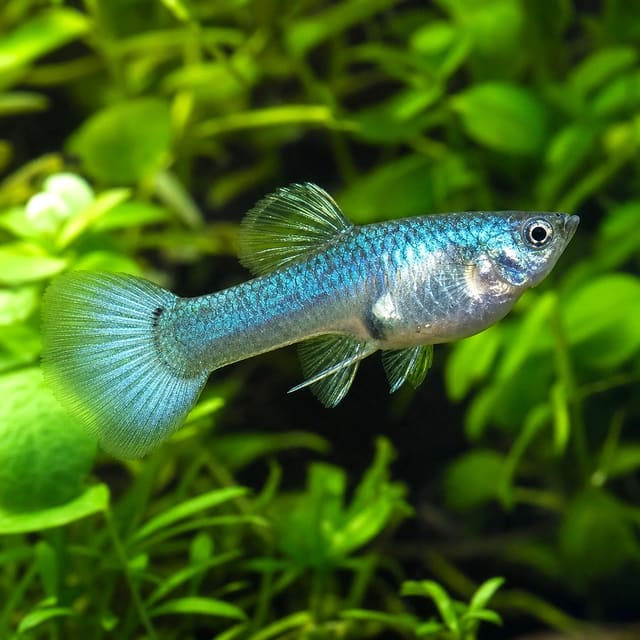
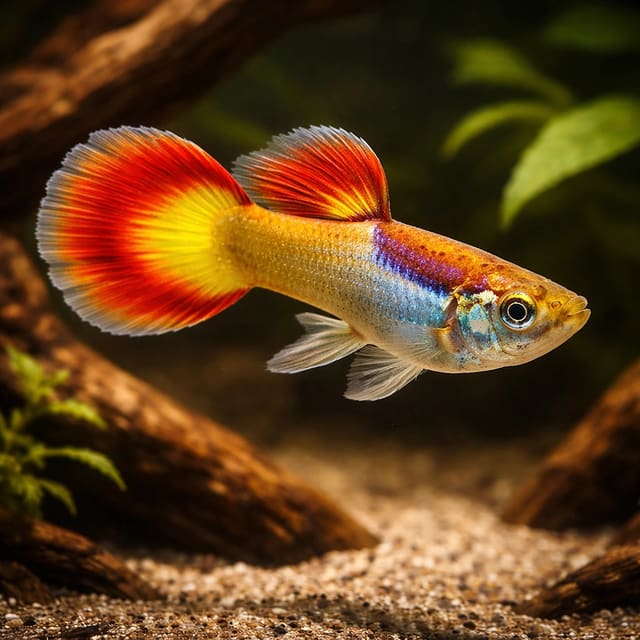
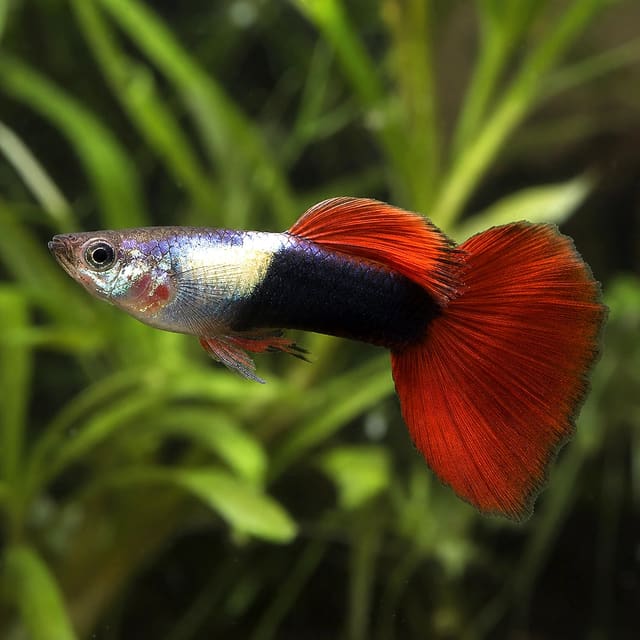
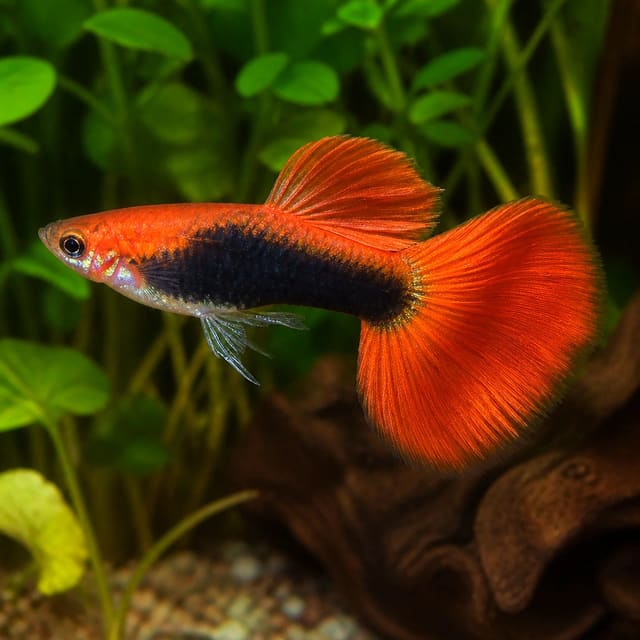
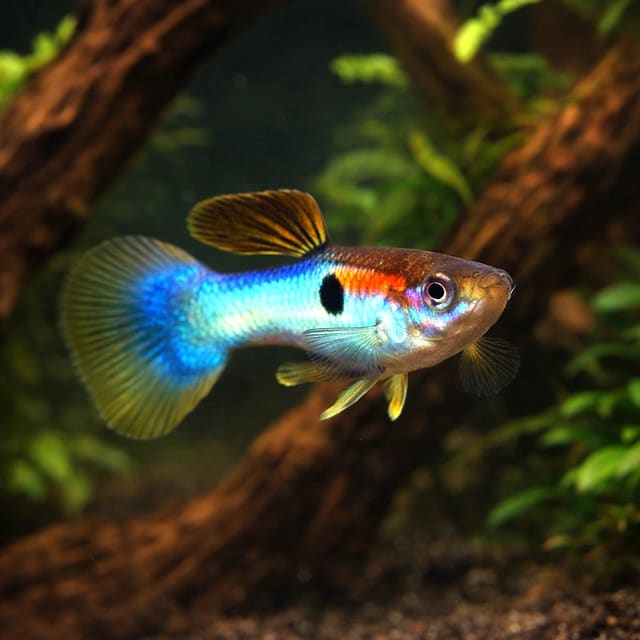
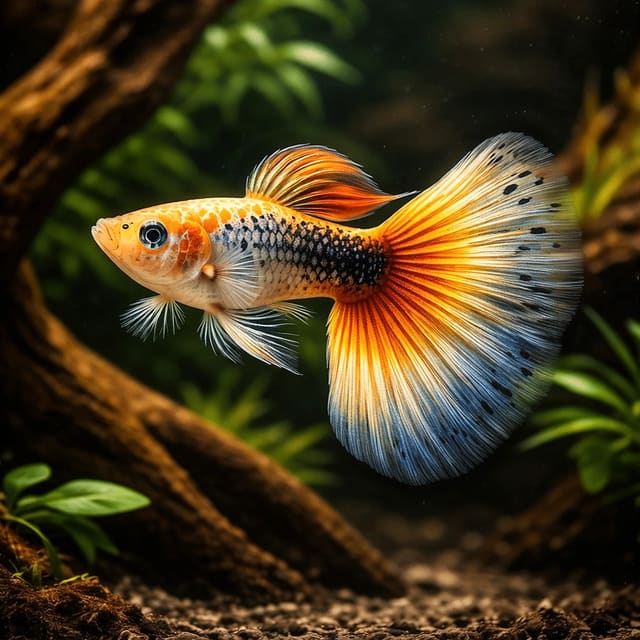
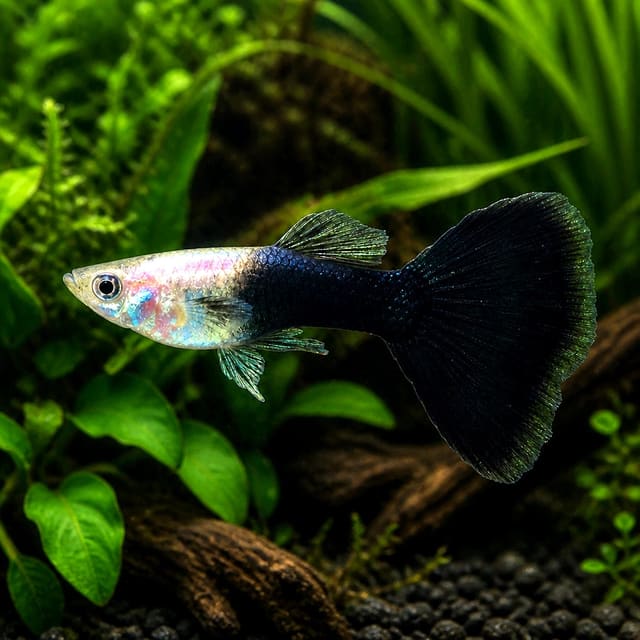
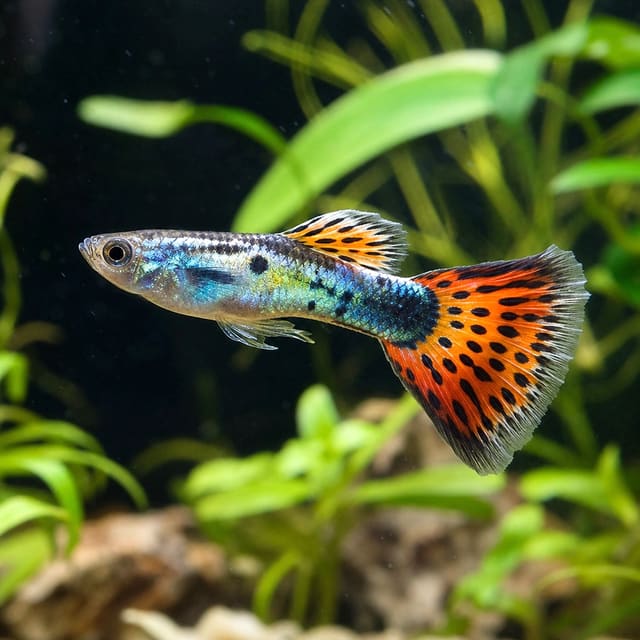
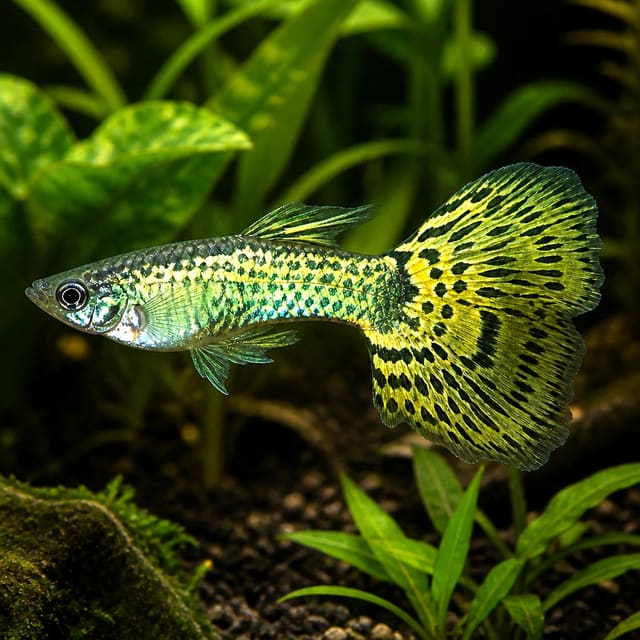
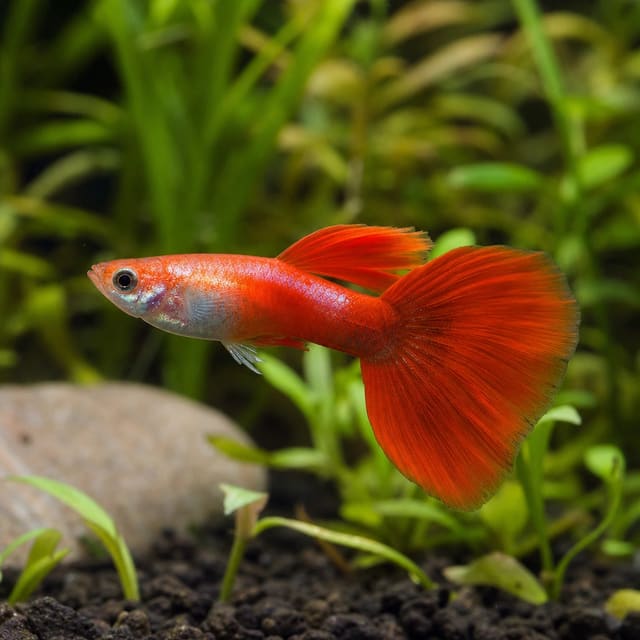
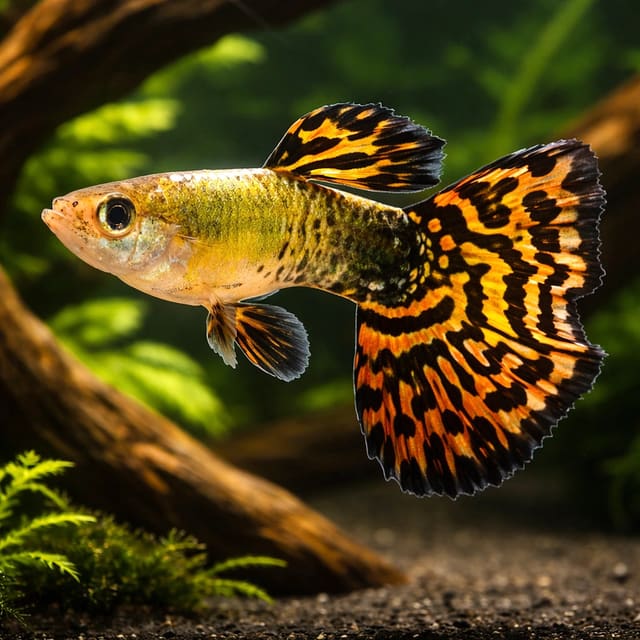
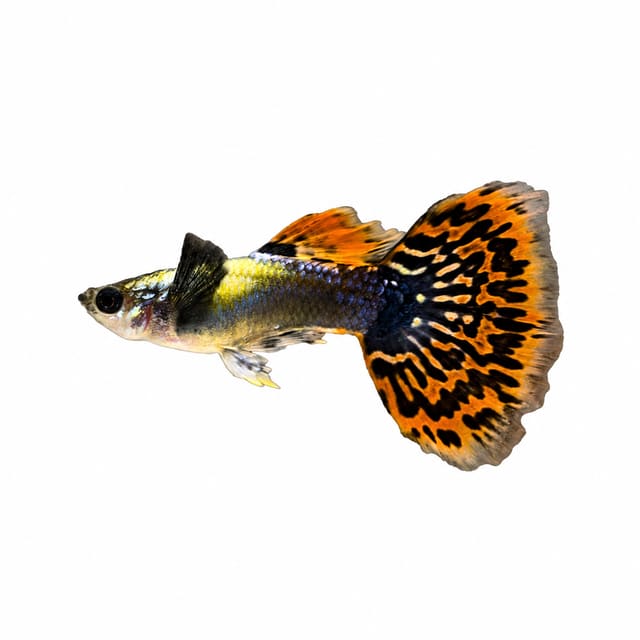
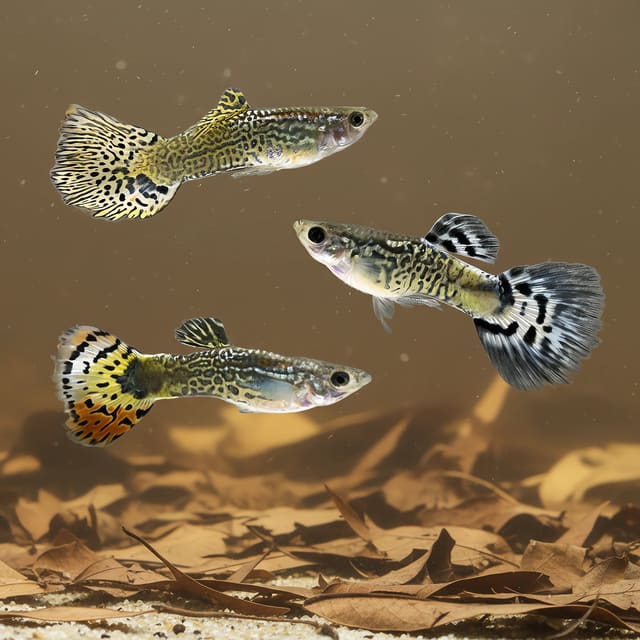
The word “rainbow” identifies the selected aquarium variety rather than a separate species. Domestic guppy patterns and fin shapes vary between individuals, and the colour visible at one moment can be affected by pose and surroundings. The gallery images are representative of this type of animal rather than photographs of the exact animal supplied, so colours can look slightly different from the live animal.
If you are comparing patterns or building a deliberate group, use the guppy collection to compare separately named fish. Treat every product as one animal unless its own offer explicitly describes a pack, pair or group.
Plan permanently for a 5 cm standard-length male guppy and a social group of five or more. FishBase records 5 cm standard length for male or unsexed Poecilia reticulata. Seriously Fish uses a different species planning reference of 6 cm standard length and an aquarium measuring 45 × 30 × 30 cm, approximately 41 litres. Our more conservative screen is a mature, filtered aquarium at least 60 cm long for one small guppy group.
Standard length excludes the tail fin. That matters for a domestic male with broad finnage: do not treat the 5 cm body measurement as the entire space used while turning, displaying or moving through plants. Aquarium length, usable footprint and uninterrupted swimming room are more useful than a litres-only rule. A nominal volume can have very different dimensions, and décor or other livestock can reduce the space that remains for the group.
A larger aquarium gives more water volume and usually more scope for cover and separation, but it does not create an automatic entitlement to add more fish. Existing livestock, adult dimensions, sex mix, biological filtration and water-test results still set the limit. Persistent pursuit, hiding, missed feeding or damaged fins means the layout or group plan needs intervention rather than another guppy.
Measure the aquarium’s internal length and footprint before deciding. If it is shorter than 60 cm, do not rely on a nominal litre label as a substitute. Set up the adult-group aquarium from the outset instead of planning to move the fish only after it grows.
Keep the water at 22–28°C, pH 7.0–8.0 and 8–18 dGH. Use a thermostatically controlled aquarium heater whenever the room cannot hold that temperature, and check the water with an independent aquarium thermometer rather than relying only on the heater dial. Test the aquarium and source water because tap-water chemistry varies between regions and can change.
Guppies are hard-water fish. Seriously Fish advises long-term maintenance in moderately hard or harder water even though the species may manage in softer or more acidic conditions. Do not move readings rapidly to reach a target. Compare the measured aquarium water with the intended range, then make any necessary change gradually and with a measured purpose.
| Reading | Action |
|---|---|
| Temperature below 22°C | Check the thermometer and heater operation, then restore the range gradually. |
| Temperature above 28°C | Confirm the reading independently and correct the cause without a sudden change. |
| pH outside 7.0–8.0 | Test the source water and avoid adding livestock until the cause is understood. |
| Hardness below 8 dGH | Assess the actual mineral content before choosing any measured adjustment. |
| Ammonia or nitrite detected | Stop additions, investigate filtration and feeding, and act to restore zero. |
OATA advises zero ammonia and nitrite, with nitrate not exceeding 20 mg/L above the normal tap-water level. These waste readings are not optional extras: they show whether the biological filter and maintenance routine are coping with the livestock and food entering the aquarium.
Read our water-chemistry guide before trying to alter a reading, then use the water matcher to compare measured aquarium values with the care range. Although FishBase records guppies from freshwater and brackish environments, do not add salt simply because the species can occur in brackish water. Any salt or mineral addition needs a measured purpose and a compatibility check for every fish, invertebrate and plant.
Use a mature biological filter and confirm zero ammonia and zero nitrite before adding this guppy. The RSPCA’s aquarium guidance explains that fish release toxic ammonia, which an established filter converts first to nitrite and then to safer nitrate. A running filter is not automatically mature; repeated test results show whether its bacterial population is processing waste.
If this is your first setup, follow the steps to prepare and mature a tropical aquarium before arranging livestock. Add fish gradually because every addition increases waste and feeding. OATA warns that increasing the population too quickly can cause new tank syndrome when the bacteria cannot process the extra ammonia and nitrite.
Match replacement water gradually for temperature and chemistry. A large swing can stress fish even when the final reading lies inside the normal range. Do not replace all biological media together, because that can remove much of the bacterial population responsible for waste processing.
During the first week after any addition, test more readily if feeding response, breathing or swimming changes. At the end of the first month, review the test trend, filter flow, body condition and whether every guppy reaches food. If nitrate rises faster than expected or waste accumulates before the weekly change, reassess stocking, feeding and filtration rather than merely increasing food or adding another fish.
Use an appropriately sized, nutritionally complete omnivore flake or granule as the staple. FishBase records wild guppies eating zooplankton, small insects and detritus, while Seriously Fish describes wild fish as primarily insectivorous and notes that domestic aquarium fish accept most foods. Add safe compatible algal and invertebrate variety so the diet is broader than one treat food.
OATA advises feeding once a day and offering only what the fish can eat within a few minutes. That schedule is guppy-and-molly group guidance. Portion for the actual group, watch that every fish feeds, and remove leftovers before they break down into toxic waste. Food that remains on the substrate is a water-quality problem, not extra provision for later.
| What you see | What to do |
|---|---|
| Food remains after a few minutes | Remove it and reduce the next portion. |
| One fish repeatedly misses food | Spread an appropriate portion across more than one feeding point and check for pursuit. |
| Food is too large to take easily | Use an appropriately sized complete food rather than expecting the fish to struggle with it. |
| Interest in food suddenly falls | Test water and assess breathing, swimming, fins and social pressure before changing the diet. |
| Nitrate or solid waste rises quickly | Review portion size, leftovers, stocking and filter performance. |
Frozen or live invertebrate foods can provide compatible variety, including appropriately sized daphnia or bloodworm. Handle and store prepared foods correctly, and use biosecure aquarium foods rather than collecting wild material. An algal component can form part of an omnivore diet, but the staple should remain nutritionally complete and appropriate to the animal’s recorded mixed feeding biology.
Do not use appetite alone as permission to continue feeding. Guppies may approach repeatedly, while the filter must still process every uneaten particle and all resulting waste. Consistent body condition, active feeding by every group member and stable water tests are better measures of whether the routine is working.
Keep five or more guppies where aquarium capacity, sex planning, filtration and other livestock allow. FishBase’s aquarium note uses a group of five or more, and this is also our conservative house policy. A group number is a starting screen rather than a promise that every combination will remain calm.
This fish is male. A male-only group avoids new mixed-sex mating, but males can still display, chase or damage fins. Provide open swimming space, planted cover and visual breaks, then watch whether every fish can feed and move away from pursuit. Repeated cornering, hiding, missed meals or damaged fins calls for separation or a change to the group and layout.
| Group plan | Decision to make |
|---|---|
| Male-only guppies | Monitor display, pursuit and long-fin damage even without females. |
| Mixed-sex guppies | Plan for courtship pressure, mating and possible fry before combining them. |
| Adding to an existing group | Check total space, filtration, water tests and feeding access before the addition. |
| Community aquarium | Include the needs and full social group of every other species in the stocking plan. |
For a mixed-sex group, OATA suggests two females to each male to reduce stress on females or other inhabitants. Do not treat that ratio as a guarantee against pursuit or as a fixed stocking formula. More fish require more usable room and biological capacity, and guppies are livebearers that can increase the population.
Female guppies can retain viable sperm after earlier mating and may later produce fry without a male remaining in the aquarium. Decide in advance how fry would be housed, fed and responsibly rehomed. Dense plants may increase fry survival, which also increases the need for water quality, space and a population plan. Do not rely on adults or tank mates eating young as a welfare or population-control method.
Keep a mature separation option ready rather than improvising with an unfiltered container after chasing or illness begins. Separation should preserve the same suitable temperature and tested water quality while preventing further injury.
Prepare and test the mature aquarium before the fish travels. Tropical Fish Co hand-bags livestock in pure oxygen, uses an insulated box and adds a heat pack when the weather calls for it. Read the delivery and Live Arrival Guarantee policy before arrival so the required receiving, filming and acclimatisation steps are clear.
Film every delivery from the sealed parcel onward, not only when a problem is expected. The continuous sequence shows the sealed parcel, its opening and the fish while still inside the sealed bag. Keep the fish bag closed during the floating period, then release the fish without adding transport water to the aquarium.
Before release, confirm that the aquarium remains within 22–28°C, pH 7.0–8.0 and 8–18 dGH, with zero ammonia and zero nitrite. These checks follow the established guppy-care routine rather than replacing the arrival steps. Do not use the new fish to test whether an immature filter can cope.
After release, assess swimming, balance, breathing and fin position. OATA advises watching for hanging at the surface, sitting on the bottom, erratic swimming, altered breathing, colour change, hiding, spots, growths, damage or loss of appetite. If a change persists, test the water immediately and follow the health response plan rather than assuming it is harmless travel stress.
A settled guppy should swim steadily, breathe regularly, hold open undamaged fins, maintain a normal body profile and feed consistently. Warning signs include surface gasping, sitting on the bottom, erratic movement, loss of balance, clamped or damaged fins, spots, fluffy growths, wounds, unusual hiding, marked colour change or a sudden loss of appetite.
These signs are not diagnoses. The RSPCA’s fish-health guidance supports checking water quality and seeking qualified help when behaviour or appearance changes. Test ammonia, nitrite, nitrate, pH and temperature immediately. Inspect filter flow, heater operation, recent maintenance, food, new arrivals and social behaviour, and record the signs with dates or photographs.
Do not choose salt, heat or medication from one symptom. A white mark, unusual breathing or poor appetite can have different causes, while an unsuitable treatment can delay the right response or harm other animals and plants. Follow lawful product labels and veterinary direction.
Quarantine new fish separately when facilities allow. The MSD Veterinary Manual recommends at least 30 days of isolation, with longer quarantine where indicated. A quarantine system still needs biologically supported filtration, suitable temperature, repeated testing and dedicated equipment; a small uncycled container is not a safe substitute.
Review the main aquarium at the same time. Illness management is incomplete if the original problem was ammonia, unstable heat, chronic pursuit, damaged fins or poor feeding access and that cause remains unchanged.
A quiet community can work when every animal shares suitable water, has enough adult space and does not nip or pursue the guppy. Seriously Fish describes Poecilia reticulata as very peaceful and names other livebearers, rasboras, corydoras and small loricariids as possible community companions. Treat those as kinds to screen, not universal approvals.
Avoid tiger barbs, serpae tetras and other fin-nipping species. The guppy’s broad fins make fin-nipping a direct concern, and both Seriously Fish and OATA advise against keeping guppies with fish likely to nip them. An aquarium does not become suitable merely because its temperature overlaps; behaviour and the space required by both social groups must also fit.
Other livebearers may share a preference for mineral-bearing water, but that does not settle adult size, group requirements or reproduction. Rasboras cover many species with different needs. Corydoras and small loricariids also require their own appropriate group, aquarium footprint, food and water assessment.
Individual temperament and compatibility still need to be assessed. Watch the actual fish during feeding and normal movement. If this male is repeatedly cornered, misses food, clamps its fins or develops fin damage, separate the animals and revise the plan rather than waiting for the interaction to resolve itself.
Match this guppy against the exact species and adult group already in the aquarium. The honest answer for an unnamed fish or invertebrate is conditional: compatibility depends on overlapping water values, adult size, feeding, behaviour, available footprint and a safe separation plan. Ask us for a stocking and compatibility assessment when the full aquarium dimensions, test results and livestock list are known.
| Proposed companion | Decision |
|---|---|
| Tiger barb or serpae tetra | Avoid because the species profile identifies these as fin-nipping examples. |
| Other livebearer | Consider only after checking adult size, social group, sex plan, water and total population. |
| Rasbora | Identify the species first and screen water, group size and feeding. |
| Corydoras or small loricariid | Check the exact species, its own group, bottom area, food access and overlapping water. |
| Small shrimp or young invertebrates | Use caution because small shrimp or young may be eaten. |
“Adult invertebrate” is too broad to function as a compatibility promise. Invertebrates vary in size, water requirements and vulnerability, while FishBase records guppies eating zooplankton and small insects. Identify the invertebrate and assess whether it or its young can be swallowed before combining it with guppies.
Keep documented guppy and Endler’s livebearer lines apart. The formal description of Poecilia wingei establishes Endler’s livebearer as a distinct species, and Eschmeyer’s Catalog lists that name as valid. The Tropical Fish Co guppy guide records that laboratory research confirms hybridisation between P. reticulata and P. wingei. House documented lines separately and do not represent hybrid descendants as pure examples of either parent species.
Finally, never release guppies, fry, plants, invertebrates, aquarium water or pathogens outdoors. Rehome livestock responsibly and dispose of aquarium water so organisms cannot reach ponds, drains connected to surface water or natural watercourses.
It reaches 5 cm standard length. FishBase records that maximum for male or unsexed Poecilia reticulata; standard length excludes the tail fin, so leave room for the male’s broad finnage.
Use a mature, filtered aquarium at least 60 cm long for one small guppy group. Seriously Fish gives an approximately 41-litre reference, but Tropical Fish Co applies the more conservative 60 cm house screen.
Plan for five or more guppies where aquarium capacity, sex mix, filtration, test results and other livestock allow. FishBase’s aquarium note and the Tropical Fish Co care guide both use five or more.
Yes, it suits a prepared beginner and has an easy store care rating. It still needs a mature filter, zero ammonia and nitrite, stable mineral-bearing water, a planned social group and weekly maintenance.
Use an appropriately sized complete omnivore flake or granule staple with safe algal and invertebrate variety. OATA’s guppy-and-molly guidance advises one daily portion eaten within a few minutes.
Keep it at 22–28°C, pH 7.0–8.0 and 8–18 dGH. These are the Tropical Fish Co routine range and the overlap of Seriously Fish species values with OATA guppy-and-molly guidance.
Seriously Fish describes the guppy as very peaceful, but males can display and chase. Monitor persistent pursuit, hiding, missed feeding or damage, and avoid tiger barbs, serpae tetras and other fin-nipping species.
Possible fish include screened livebearers, rasboras, corydoras and small loricariids. Match exact water, adult size, group and feeding needs; small shrimp or young may be eaten. Avoid tiger barbs, serpae tetras and other fin-nipping species.
Start filming the sealed parcel before opening it, keep one continuous take through the fish in the sealed bag, then float the bag for 20–30 minutes before releasing. Tropical Fish Co uses oxygen-filled bags and an insulated box.
No reviews for this item yet. Bought one? Honest reviews only, good or bad.
What customers say about ordering from us
Easy website plenty of info on fish your buying great to pick a time slot
TRACEY DURRANT · 7 Oct 2026
Got some lovely fish thank you
Kevin Mackie · 7 Oct 2026
Reviews of our shop, collected by Judge.me, an independent third-party review collector. Newest first.