Easy
Blue Moscow Male Guppy (Poecilia reticulata)
22–28°C · pH 7–8 · 45L
£6.49
Photo coming soon
The size, price and care details on this page are for this listing.
The Guppy male red (Poecilia reticulata) is a peaceful poeciliid livebearer native to Venezuela, Barbados, Trinidad, northern Brazil and the Guianas that reaches 5 cm. It suits a prepared beginner and should be kept in a group of five or more; Tropical Fish Co’s routine target, set within the overlap of FishBase species values and OATA’s group guidance, is 22–28°C, pH 7.0–8.0 and 9–18 dGH. Sold individually as one male fish at a 3–4 cm dispatch size.
Adult size is the maximum length this species reaches at full maturity (scientific sources). The livestock you receive will be younger and smaller. Product-photo provenance and any image-specific limitations are stated on the listing.
Poecilia reticulata
Shoaling fish: kept in a group they feel safer, stay calmer and show their best colour.
Minimum of 2 per order.
The Guppy male red (Poecilia reticulata) is a peaceful poeciliid livebearer native to Venezuela, Barbados, Trinidad, northern Brazil and the Guianas that reaches 5 cm. It suits a prepared beginner and should be kept in a group of five or more; Tropical Fish Co’s routine target, set within the overlap of FishBase species values and OATA’s group guidance, is 22–28°C, pH 7.0–8.0 and 9–18 dGH. Sold individually as one male fish at a 3–4 cm dispatch size.
Adult size is the maximum length this species reaches at full maturity (scientific sources). The livestock you receive will be younger and smaller. Product-photo provenance and any image-specific limitations are stated on the listing.

Guppies are social livebearers suited to a prepared beginner, not a fish-per-litre formula. Use a mature filtered aquarium, tested neutral-to-alkaline mineral-bearing water, deliberate sex and population planning, open swimming room, cover and a separation option.
Maintain these water conditions for optimal health and vibrant colors
The Guppy male red is a colour variety of Poecilia reticulata, a small freshwater livebearer in the Poeciliidae family. FishBase records its native range as Venezuela, Barbados, Trinidad, northern Brazil and the Guianas. For a male or unsexed fish, FishBase gives a maximum of 5 cm standard length. This is the adult body length excluding the tail fin, so the fish’s total length including its long tail is greater.
This peaceful, social fish can suit a prepared beginner who has a mature, filtered aquarium and is ready to test the water every week. Easy care does not mean that a guppy can safely cycle a new aquarium. Start with zero detectable ammonia and nitrite, keep its mineral-bearing water stable, and plan the full group before adding any fish.
Use a mature aquarium at least 60 cm long for one small group, with open swimming room, planted or artificial cover and a gentle flow that does not push the fish around. Keep a group of five or more where aquarium capacity, filtration, the sex plan and other livestock allow. Our complete guppy care guide explains the store’s conservative planning policy in greater depth.
Choose this fish for a calm, mature community aquarium with stable neutral-to-alkaline water. Tropical Fish Co’s routine target, set within the overlap of FishBase species values and OATA’s group guidance, is 22–28°C, pH 7.0–8.0 and 9–18 dGH. A heater is needed whenever the room cannot hold the water inside that range; check the water with an independent aquarium thermometer rather than relying only on the heater dial.
Space must be assessed by aquarium length, footprint, filtration and existing livestock rather than by a fish-per-litre calculation. Tropical Fish Co uses an aquarium at least 60 cm long as the starting screen for one small guppy group. A nominal 60-litre aquarium can be a candidate, but only if it has the required length, is mature and filtered, and has enough usable room after decor and other animals are considered.
| Suits | Not suited to |
|---|---|
| A prepared beginner with a mature, tested aquarium | An uncycled bowl or unfiltered container |
| A planned group of five or more | Keeping one guppy alone |
| Neutral-to-alkaline, moderately hard or harder water | Long-term soft or acidic conditions |
| A quiet community with compatible peaceful fish | Fin-nipping species such as tiger barbs or serpae tetras |
| Open swimming room with plants or other cover | Strong current or sharp decor that can damage long fins |
| A keeper with a separation and population plan | A mixed-sex group with no plan for fry |
Before deciding, measure the aquarium’s internal length, test its temperature, pH and hardness, and include every resident in the stocking assessment. Persistent pursuit, blocked access to food or damaged fins means the social plan needs changing even when the aquarium meets the starting measurements.
Sold individually, each purchase supplies one male Guppy male red at a 3–4 cm dispatch size. That measurement describes the fish when supplied, not its eventual adult length. Plan the aquarium around the recorded 5 cm adult body length and around the space required by the complete social group.
Sex is guaranteed only when the exact product or selected option explicitly states male or female. This Guppy male red listing is sold as male.
One male is not a complete social group. Add this fish only as part of a planned guppy group that meets the five-or-more house policy and fits the aquarium after all existing animals are counted. A male-only group avoids new mixed-sex mating, but males may still display, chase or compete. A mixed-sex group requires advance planning for courtship pressure and possible fry.
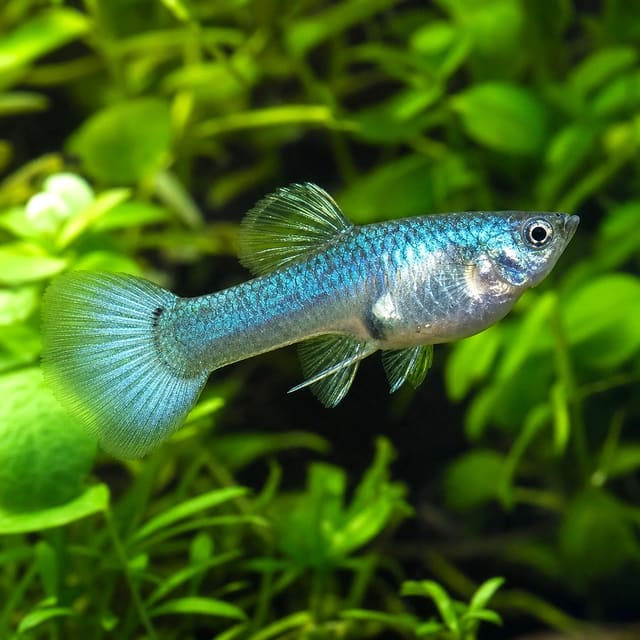
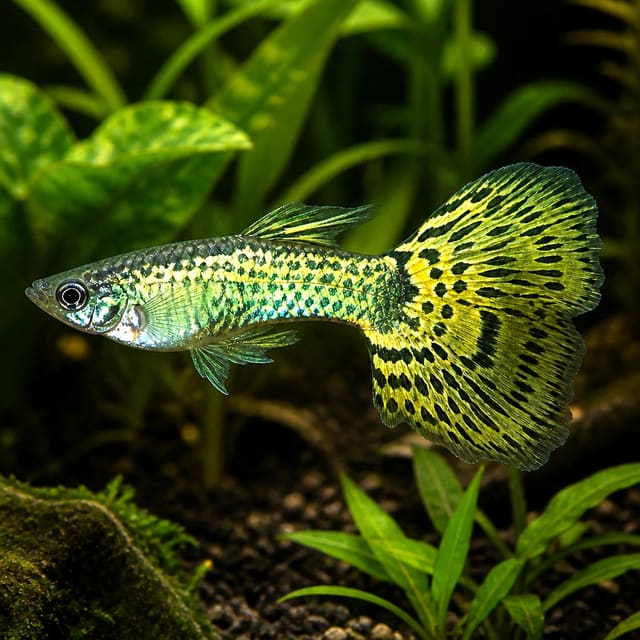
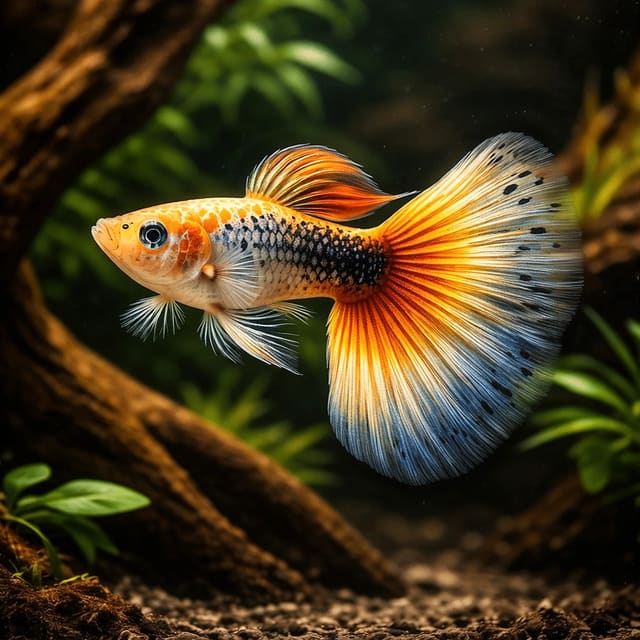
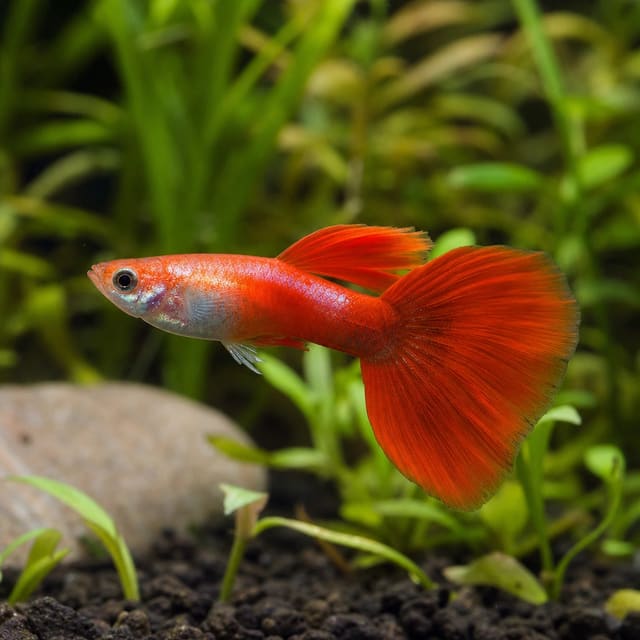
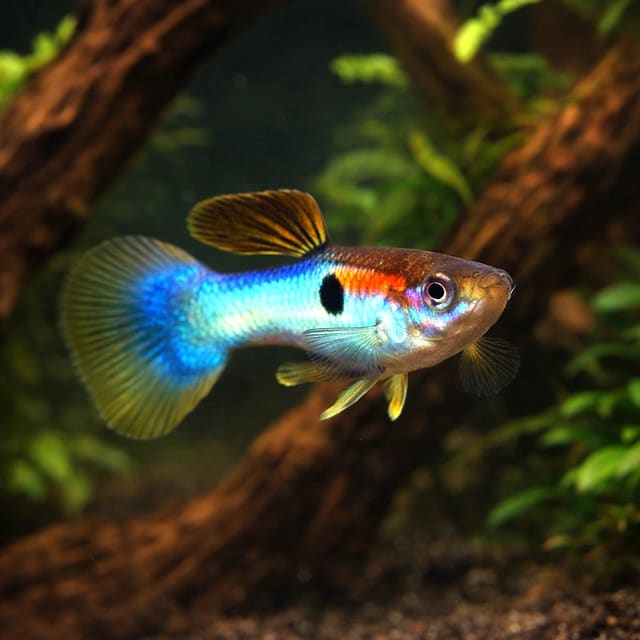
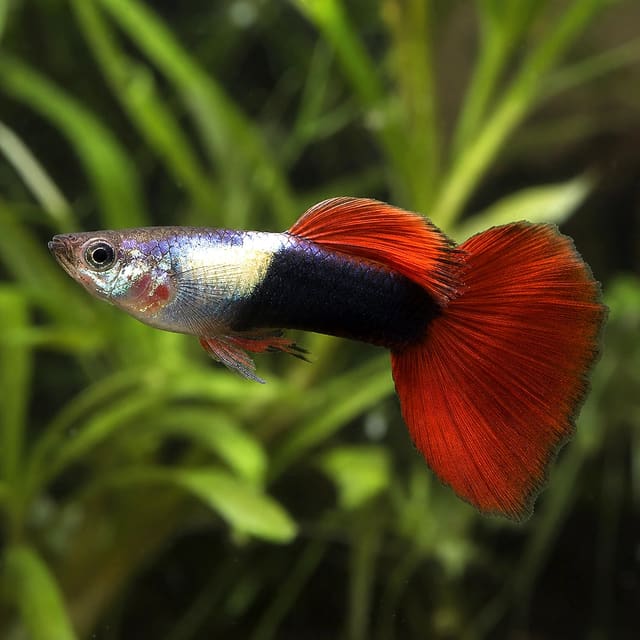
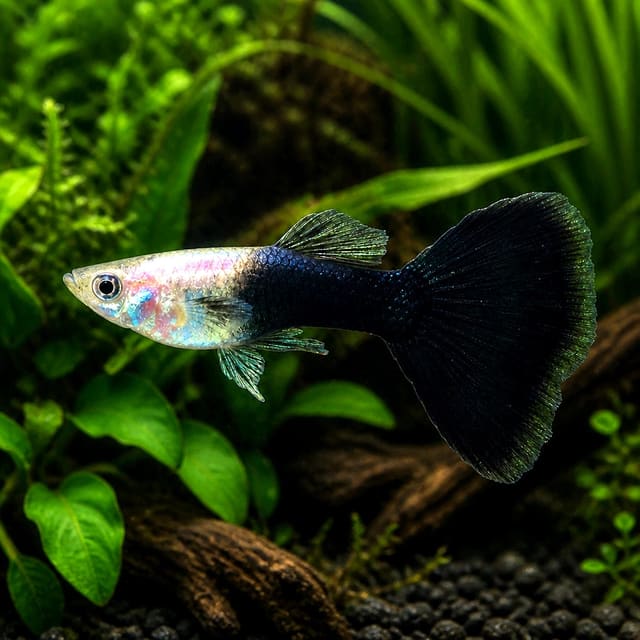
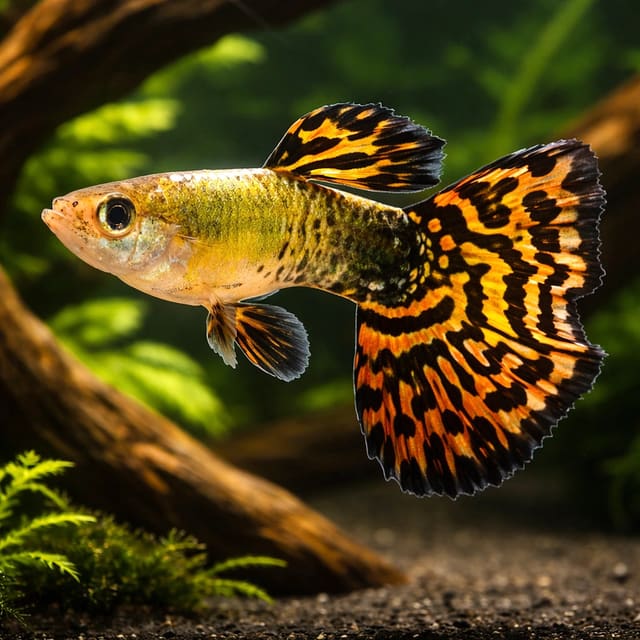
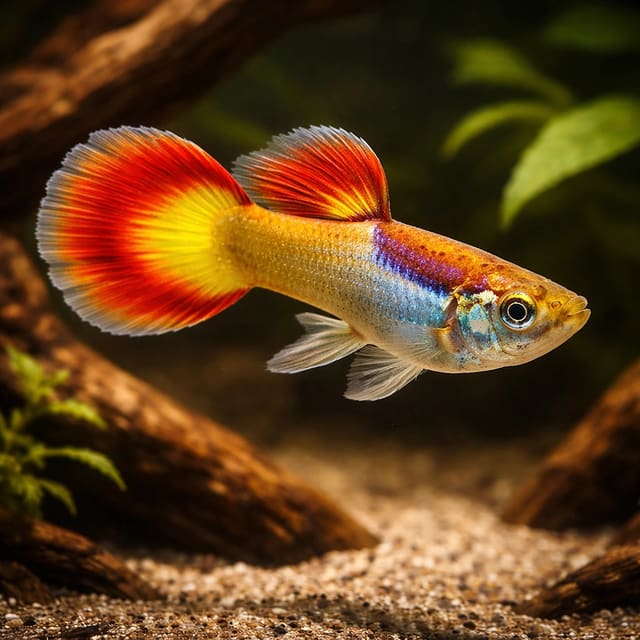
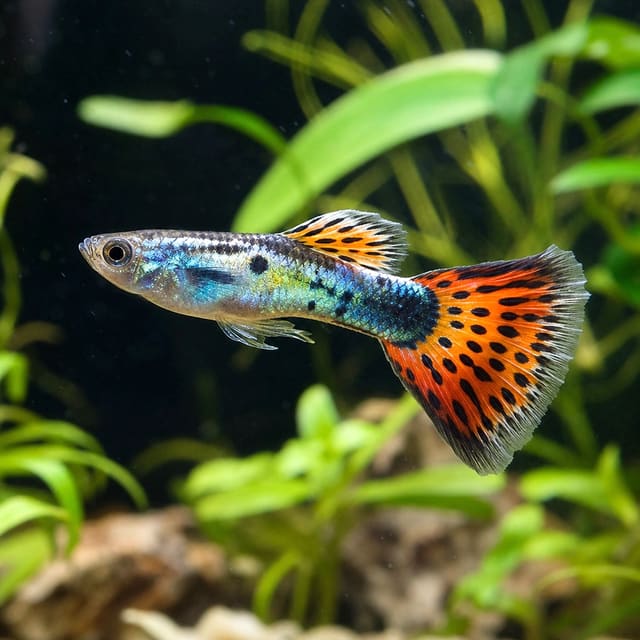
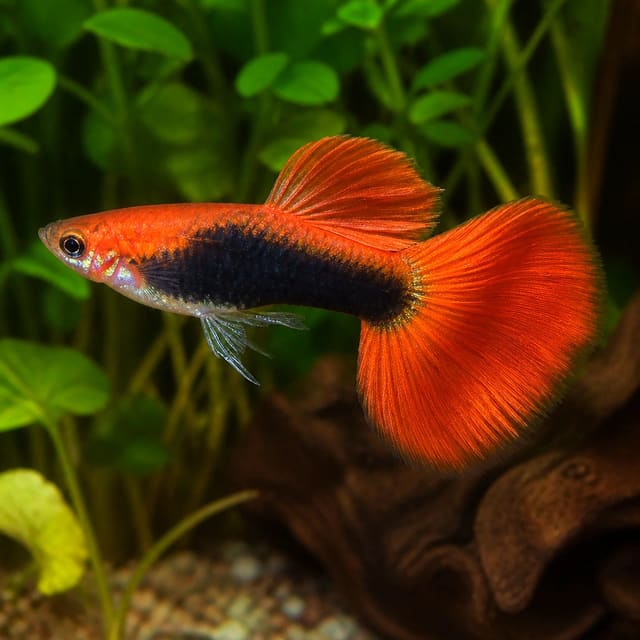
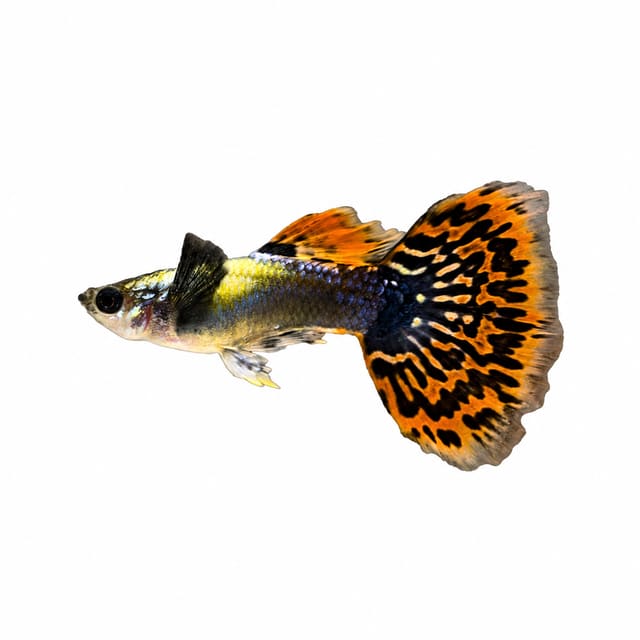
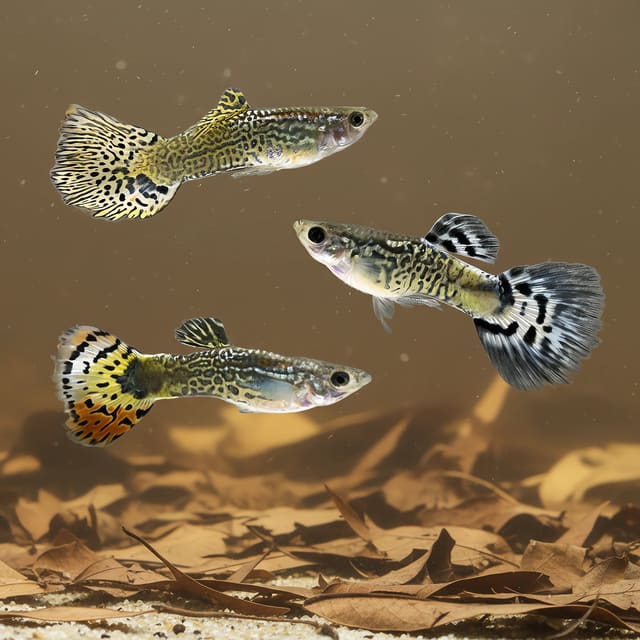
The gallery images are representative of this type of animal rather than photographs of the exact animal supplied, so colours can look slightly different from the live animal.
The image shows the characteristic red presentation of this named variety, but individual markings, sheen and fin colour can vary. Expect red colouring, but not an identical pattern on every fish. Other guppy varieties can be viewed in the current guppy collection.
Plan for an adult body length of 5 cm. FishBase gives 5 cm standard length for a male or unsexed Poecilia reticulata; standard length stops at the base of the tail and therefore does not include the decorative caudal fin. A dispatch size of 3–4 cm must not be used as the permanent space calculation.
The red mix name describes the colour of this variety rather than a separate species. Aquarium guppies have been developed in many colours and fin forms, while the accepted scientific name remains Poecilia reticulata, as listed by Eschmeyer’s Catalog of Fishes. Colour intensity and the exact distribution of red markings can differ between individual fish.
Seriously Fish gives a 45 × 30 cm base with a volume of about 41 litres. Tropical Fish Co applies the more conservative FishBase aquarium-length note of at least 60 cm for a small group because length, social behaviour and swimming room are not captured by litres alone.
Measure the internal dimensions rather than relying only on the manufacturer’s nominal volume. Substrate, decor and the unfilled space at the top reduce actual water volume, while dense furnishings may reduce usable swimming length. Leave open horizontal water, add cover and sight breaks around it, and observe whether every fish can move, feed and rest without being persistently displaced.
Keep this guppy at 22–28°C, pH 7.0–8.0 and 9–18 dGH. This routine target is set within the overlap of FishBase species values and OATA’s guppy-and-molly group guidance: FishBase records 18–28°C, pH 7.0–8.0 and 9–19 dH, while OATA gives 20–28°C, pH 7.0–8.0 and 8–18 dGH. Tropical Fish Co narrows the routine temperature to 22–28°C.
Use an aquarium heater whenever the room cannot maintain 22–28°C. Place an independent aquarium thermometer where it can be read easily, and check the water itself. A heater dial is a control setting rather than a measurement of the actual aquarium temperature.
Test pH and hardness in the source water as well as the aquarium. UK tap water varies by area and may change when supplies are blended. The aquarium water chemistry guide explains what each value means, while the water matcher can compare measured values with the target range.
Do not add aquarium salt simply because wild guppies can occur in brackish environments. Salt changes the conditions for every fish, invertebrate and plant, so it requires a measured purpose and a compatibility assessment. Stability within the routine freshwater range is the everyday objective.
Use a fully matured biological filter before adding guppies. The RSPCA explains that fish release toxic ammonia and that beneficial filter bacteria convert it first to nitrite, which is also toxic, and then to safer nitrate. A new aquarium needs demonstrated biological processing, not simply time with the equipment switched on.
Confirm zero detectable ammonia and nitrite before adding the fish. OATA advises keeping nitrate no more than 20 mg per litre above the normal tap-water level. Test repeatedly so that a single favourable result is not mistaken for an established pattern. Increase livestock slowly because feeding and waste increase the load that the bacterial population must process.
If this is your first setup, follow the steps for preparing and maturing a tropical aquarium before livestock arrives. A mature aquarium should hold its temperature, process routine waste and return consistent test results while the filter runs continuously.
Plants and sight breaks can help a pursued fish move out of view, but furnishings cannot compensate for crowding or persistent aggression. Watch how the group uses the layout. If one fish remains trapped in a corner, cannot reach food or is repeatedly driven from cover, change the social plan as well as the decor.
Use an appropriately sized, nutritionally complete omnivore flake or granule as the staple. FishBase records wild guppies feeding on zooplankton, small insects and detritus, while Seriously Fish describes wild fish as primarily insectivorous and notes that aquarium strains accept most foods offered. Add compatible invertebrate and algal variety without allowing one treat food to replace the complete staple.
OATA advises feeding once a day and offering only what the fish can consume within a few minutes. Watch the complete group rather than judging the portion by the fastest fish. Spread or place the food so that less assertive individuals can reach it, then remove uneaten food before it breaks down and increases the load on the filter.
Frozen or live daphnia, small bloodworm or tubifex are examples in OATA’s care guidance, but use only suitable aquarium foods handled and stored safely. Varying the food can broaden intake; it does not justify overfeeding. Extra uneaten food becomes waste, and toxic ammonia or nitrite can rise when the biological filter cannot process the added load.
Keep guppies socially rather than as a single fish. Tropical Fish Co uses a conservative group of five or more where aquarium capacity, filtration, water tests, sex planning and other livestock allow. FishBase also gives an aquarium group of five or more, while OATA advises at least three. Neither number overrides the aquarium’s usable space or the behaviour of the actual group.
This product supplies one male. Count him as one member of the planned group, not as a complete group on his own. A male-only group avoids new mixed-sex mating, but display and chasing can still become persistent. Provide sight breaks, check every fish at feeding time and keep a mature separation option ready.
| Group plan | What to prepare for |
|---|---|
| Male-only | No new mixed-sex mating, but males may still chase, display or damage fins. |
| Female-only | No new mating within the group, although a female may retain sperm from an earlier mating. |
| Mixed sex | Courtship and fry are possible; OATA suggests two females per male to reduce pressure. |
No ratio guarantees calm behaviour or manageable reproduction. Before mixing sexes, decide where fry could be housed, how extra biological load would be managed and how young fish would be rehomed responsibly. Adults eating fry is not a population-management plan.
Guppies and Endler’s livebearers should not be treated as the same species. Poecilia wingei was formally described separately and Eschmeyer’s Catalog of Fishes lists it as valid. Keep documented lines apart if maintaining their identity is an important goal.
Change 25% of the water at least once every week, as OATA strongly recommends. Treat replacement tap water with a suitable conditioner before it enters the aquarium so chlorine or chloramine does not harm the fish or filter bacteria. Match new conditions gradually and confirm the aquarium temperature after the change.
Test ammonia and nitrite at least weekly and keep both at zero. Record nitrate, pH and temperature as well, because a sequence of results shows whether the aquarium is stable more clearly than an isolated reading. Siphon solid waste from accessible substrate, inspect the filter for reduced flow and remove decaying food or plant material.
When filter media needs cleaning, rinse it lightly in water removed from the aquarium during maintenance. Never rinse it under the tap because chlorine or chloramine may kill beneficial bacteria. Check the filter for blockages.
A settled guppy should swim steadily, breathe regularly, hold open undamaged fins, maintain a normal body profile and feed consistently. Hiding, clamped fins, surface gasping, unusual balance, spots, wounds, colour change or sudden loss of appetite require investigation. The RSPCA’s fish health guidance supports checking water quality and seeking veterinary help for these warning signs.
Test ammonia, nitrite, nitrate, pH and temperature first, then inspect the filter, heater, recent additions, maintenance and social behaviour. Do not select salt, extra heat or medication from one symptom. A separate quarantine system should have mature filtration, dedicated equipment and repeated testing. The MSD Veterinary Manual advises at least 30 days of isolation, with longer where indicated. For diagnosis and treatment in the UK, use the OATA fish-vet directory.
Complete the aquarium, social and compatibility checks before dispatch. Confirm that ammonia and nitrite are zero, as OATA’s guppy-and-molly guidance advises, and that the water sits at 22–28°C, pH 7.0–8.0 and 9–18 dGH. Make sure someone can receive the parcel because live fish must not be left unattended, and open and inspect it on the day it arrives.
Tropical Fish Co hand-bags fish in pure oxygen, uses an insulated poly box and adds a heat pack when the weather calls for one. A licensed live-animal courier carries the parcel. Read the current delivery and Live Arrival Guarantee policy for the reporting requirements that apply to the order.
After release, follow the Tropical Fish Co guppy care guide by observing swimming, breathing, fin position, balance and feeding, and test the aquarium promptly if the fish’s condition or behaviour causes concern.
Keep observing whether the new male can feed, move through open water and use cover without persistent pursuit. Check the established fish as well, because a new social arrangement can alter behaviour across the group. If chasing prevents normal feeding or causes hiding or fin damage, use the prepared separation option and reassess the group.
This is a very peaceful fish suited to a quiet community aquarium, but no species name guarantees that two animals will live safely together. Seriously Fish names other livebearers, rasboras, corydoras, small loricariids and tetras as possible companions. Treat these as kinds to assess, not as universal approvals.
Avoid fin-nipping species such as tiger barbs and serpae tetras. Long guppy fins can attract nipping, and damage can occur even when temperature and chemistry overlap. Strongly territorial or substantially larger fish also need careful screening for intimidation and predation risk.
Adult invertebrates are too varied to promise as one compatible category. Small shrimp or young may be eaten, so assess the exact species, its adult size, refuge needs and the guppy’s feeding behaviour. A betta and guppy combination is not a sensible default because territorial display and long-fin interactions vary between individuals.
After adding any companion, watch feeding access, body position, hiding and fins. Persistent pursuit, cornering, missed meals or damage is a reason to separate and revise the plan, not a reason to add more animals in the hope that pressure will disappear.
Peaceful describes the normal temperament; it does not mean that every group will remain free of pursuit or competition. Males may display and chase one another, while mixed-sex groups can place sustained courtship pressure on females. Observe the result in the actual aquarium rather than relying only on the label.
| What you see | What to do |
|---|---|
| Brief display with normal feeding | Continue observing and confirm every fish can leave the interaction. |
| One fish repeatedly cornered | Separate safely and reassess group space, sex mix and sight breaks. |
| Clamped or torn fins | Check water immediately, isolate where appropriate and identify the aggressor or fin-nipping companion. |
| One fish misses meals | Change feeding access and investigate competition rather than increasing the total portion. |
| Unexpected fry | Assess capacity, filtration and responsible rehoming without using predation as population control. |
Decor can interrupt lines of sight, but it must leave open swimming room and cannot make an unsuitable stocking level safe. If a fish remains excluded after the layout is adjusted, change the group arrangement. A mature spare aquarium or divided system is more useful than an emergency uncycled container.
Recheck compatibility whenever the aquarium changes. Growth, a new sex balance, fry, altered decor or a new companion can change feeding and territorial pressure. Continue weekly water testing because crowding and increased feeding also raise the biological load.
Never release guppies, fry, plants, snails or aquarium water outdoors or into a surface-water drain, pond or natural waterway. FishBase records introductions far beyond the guppy’s native range and notes harmful or neutral effects on native fish rather than reliable mosquito control. Rehome livestock responsibly and dispose of aquarium water where organisms cannot reach natural watercourses.
Guppy male red reaches 5 cm standard length for a male or unsexed fish according to FishBase; measure the body without the tail and plan space around the adult fish rather than its 3–4 cm dispatch size.
Guppy male red should have a mature, filtered aquarium at least 60 cm long under Tropical Fish Co’s conservative policy; OATA advises at least 45 litres for a small group of smaller livebearers, but litres alone do not set a safe stocking level.
Guppy male red should be kept in a group of five or more where capacity, filtration and the sex plan allow; FishBase gives five or more, while OATA’s guppy-and-molly guidance advises at least three.
Guppy male red can suit a prepared beginner under Tropical Fish Co’s easy-care assessment, but it needs a mature filtered aquarium, zero detectable ammonia and nitrite, stable mineral-bearing water and weekly maintenance.
Guppy male red should receive an appropriately sized complete omnivore flake or granule as its staple, with safe invertebrate and algal variety; OATA advises feeding once daily only what the fish consume within a few minutes.
Keep this male guppy at 22–28°C, pH 7.0–8.0 and 9–18 dGH; Tropical Fish Co sets this routine target within the overlap of FishBase species values and OATA’s guppy-and-molly group guidance.
This fish is very peaceful; avoid fin-nipping companions such as tiger barbs and serpae tetras because they can damage its long fins.
It may share a quiet community aquarium with compatible livebearers, rasboras, corydoras, small loricariids and tetras when their water, adult size, social space and feeding needs overlap; assess the exact species and keep a separation plan.
It is hand-bagged in pure oxygen, placed in an insulated poly box with a heat pack when the weather calls for one, and carried by a licensed live-animal courier; someone must receive it, start filming before opening the sealed parcel, float the bag for 20–30 minutes and never pour bag water into the aquarium.
No reviews for this item yet. Bought one? Honest reviews only, good or bad.
What customers say about ordering from us
Easy website plenty of info on fish your buying great to pick a time slot
TRACEY DURRANT · 7 Oct 2026
Got some lovely fish thank you
Kevin Mackie · 7 Oct 2026
Reviews of our shop, collected by Judge.me, an independent third-party review collector. Newest first.