Easy
Tiger Male Guppy (Poecilia reticulata)
22–28°C · pH 7–8
£5.99
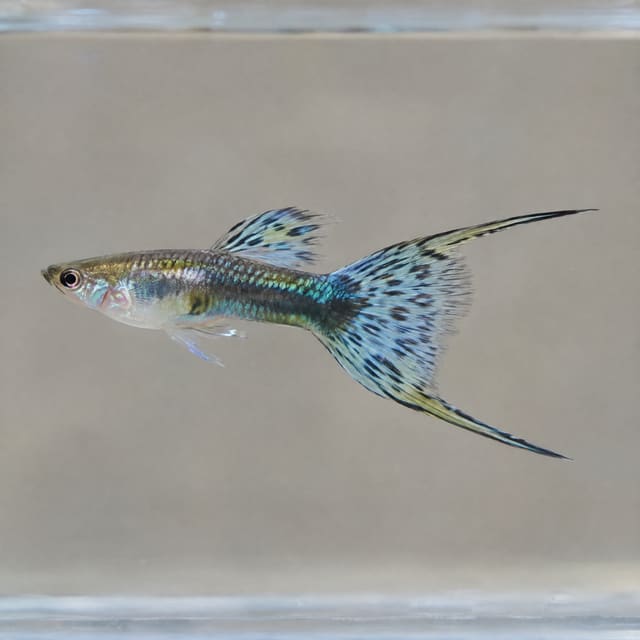
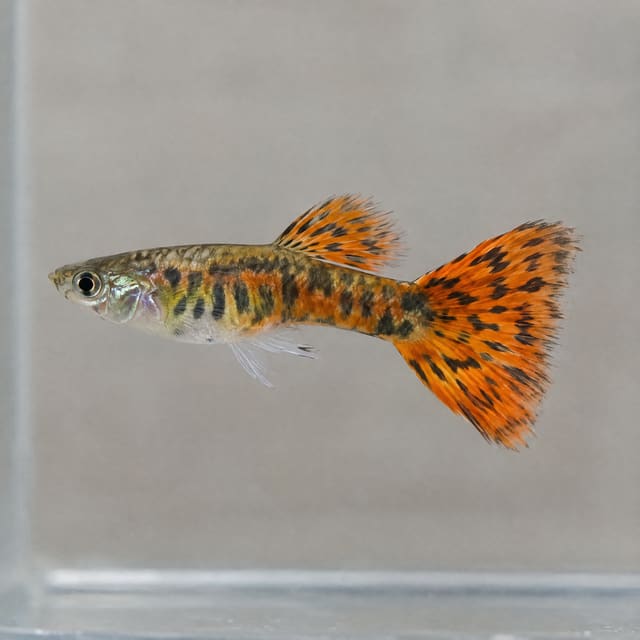
The Lyretail Male Guppy is an aquarium-bred form of Poecilia reticulata whose tail ends in long upper and lower points around a broad fan. Keep a small group of males in 45 litres or more of hard, alkaline water at 22–28°C, pH 7.0–8.0 and about 9–18 dGH, away from fin-nippers. Sold individually as one live male.
Poecilia reticulata
Quantity discounts are pricing offers, not a group-size recommendation. Check the full care guidance and your existing animals before choosing a quantity.
Minimum of 2 per order.
The Lyretail Male Guppy is an aquarium-bred form of Poecilia reticulata whose tail ends in long upper and lower points around a broad fan. Keep a small group of males in 45 litres or more of hard, alkaline water at 22–28°C, pH 7.0–8.0 and about 9–18 dGH, away from fin-nippers. Sold individually as one live male.
Guppies are social livebearers suited to a prepared beginner, not a fish-per-litre formula. Use a mature filtered aquarium, tested neutral-to-alkaline mineral-bearing water, deliberate sex and population planning, open swimming room, cover and a separation option.
Read the full care guidance when planning conditions for your aquarium.
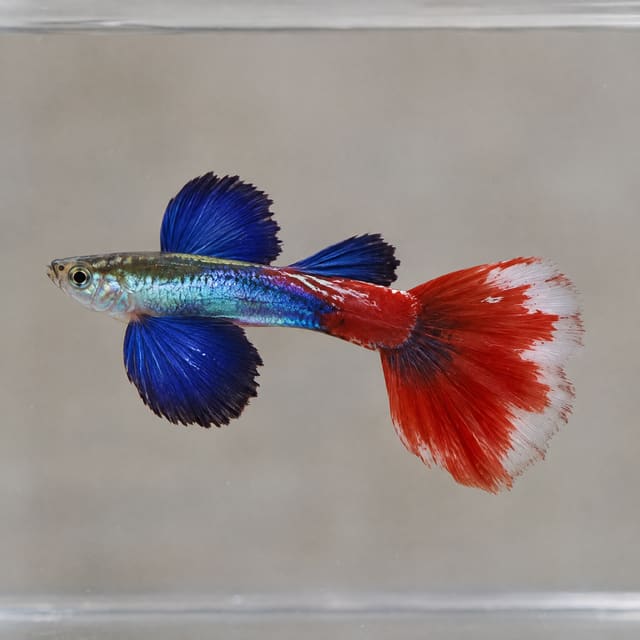
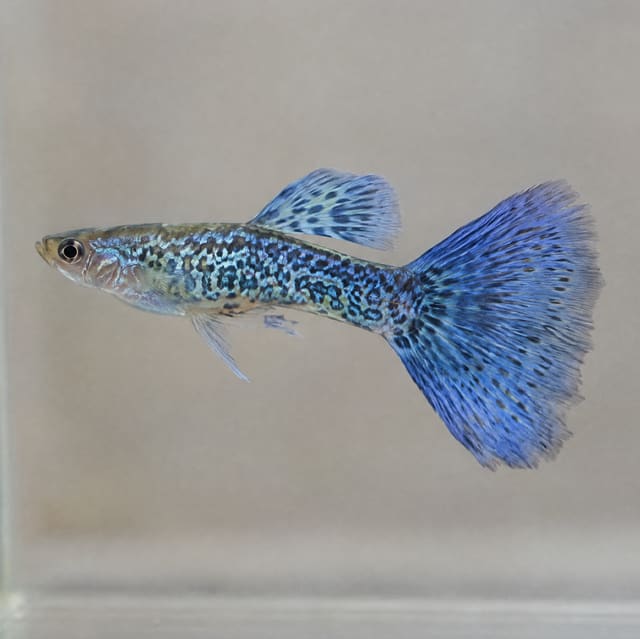
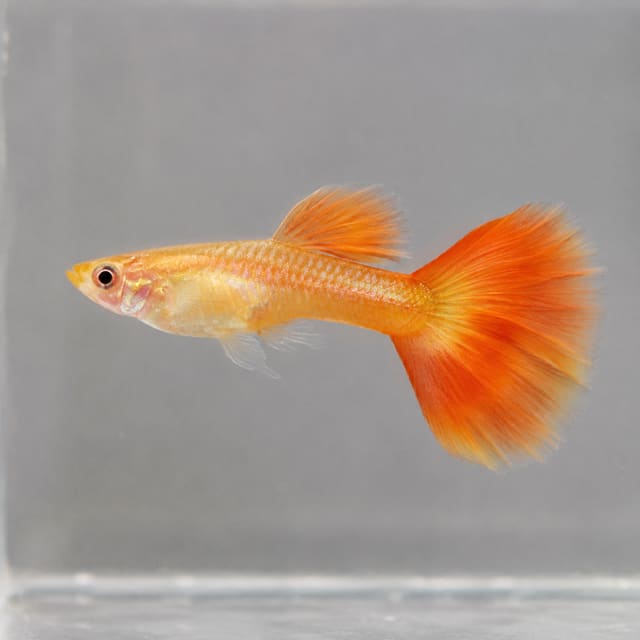
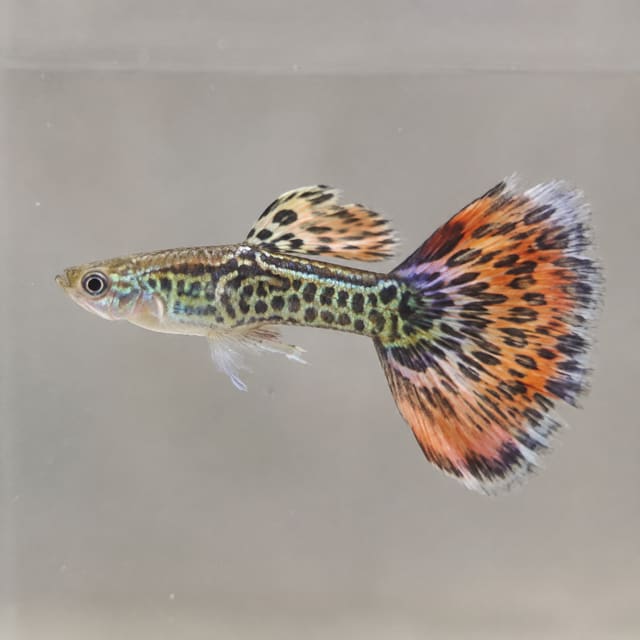
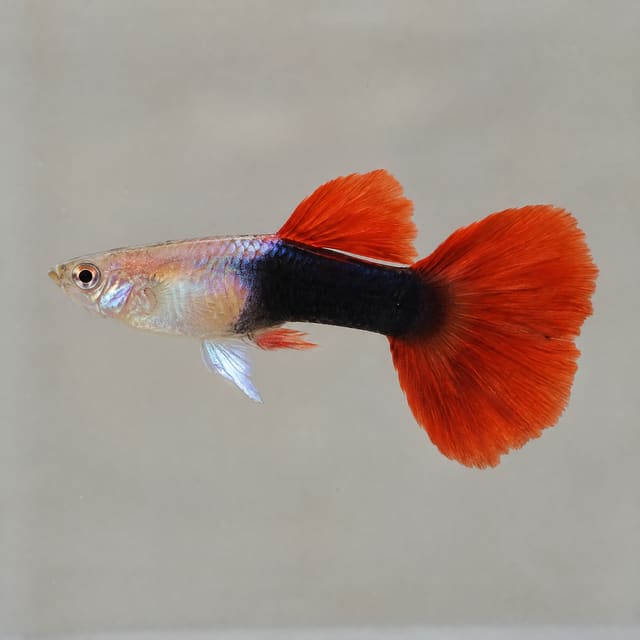
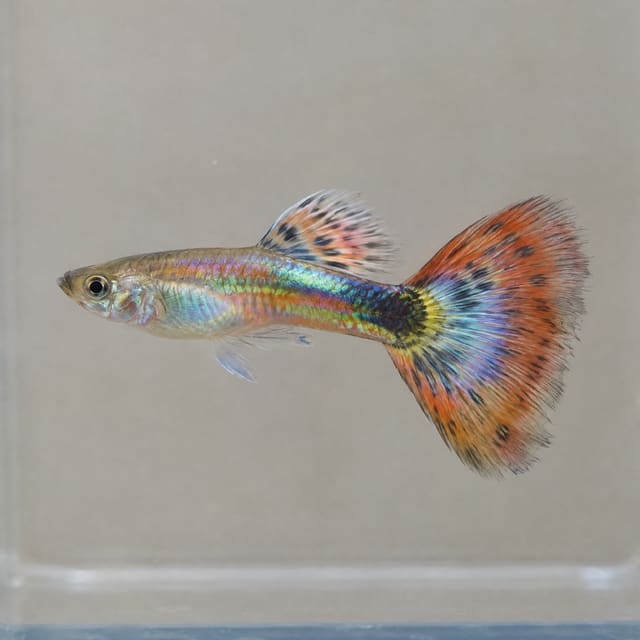
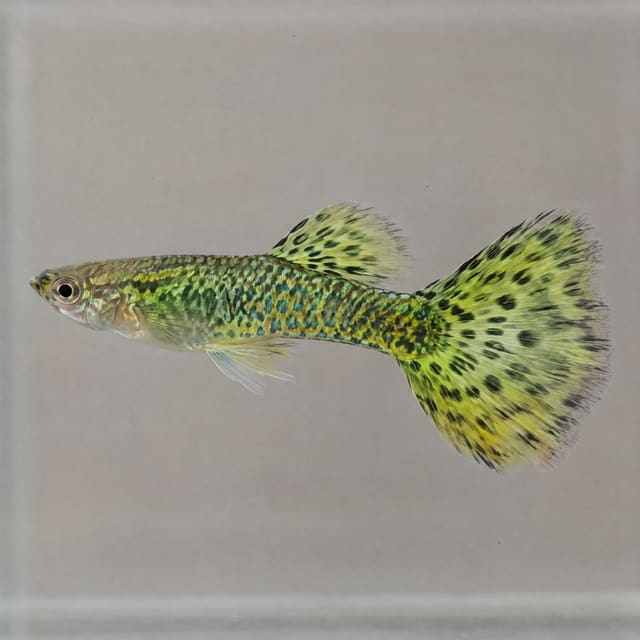
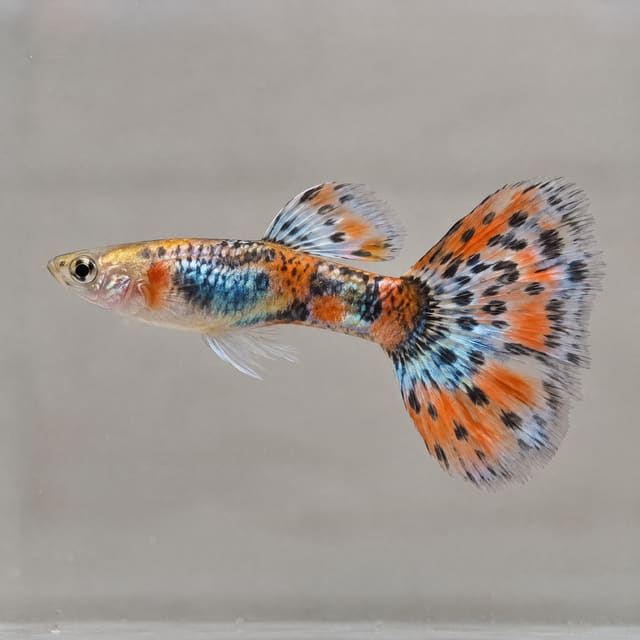
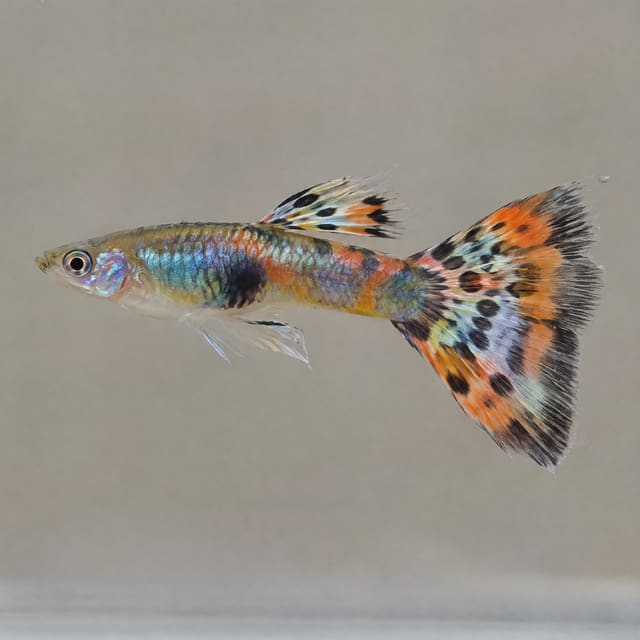
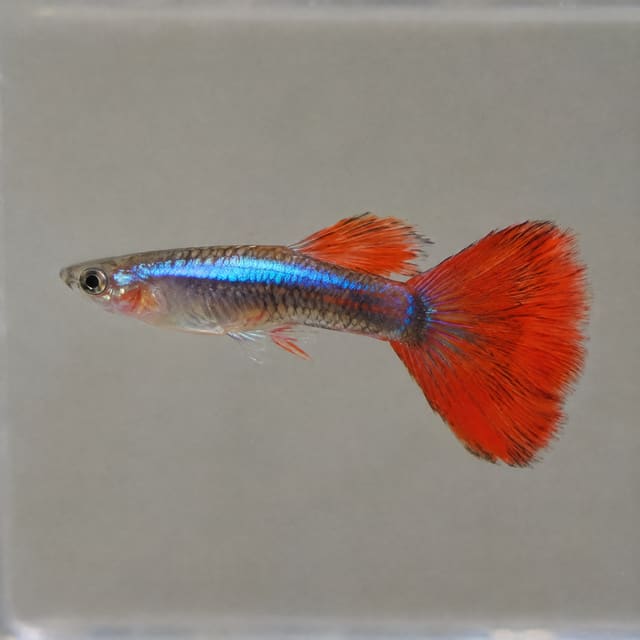
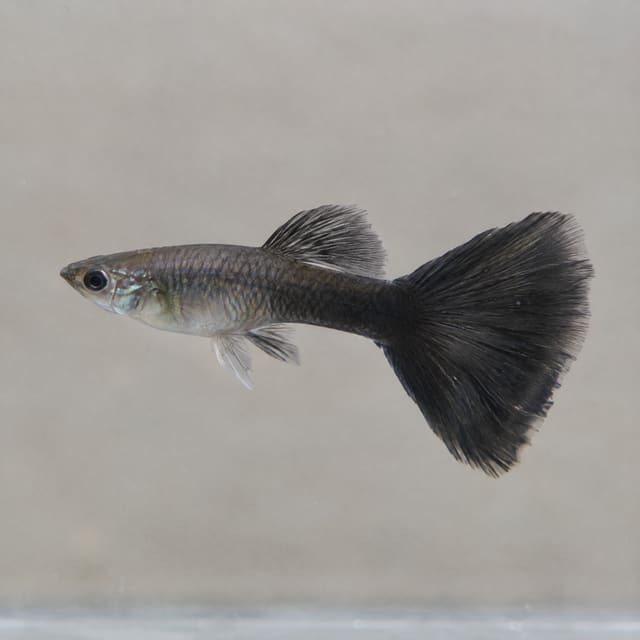
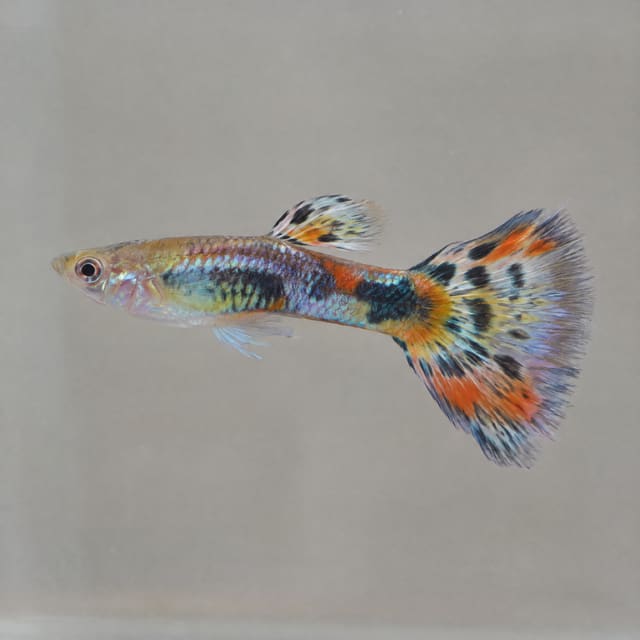
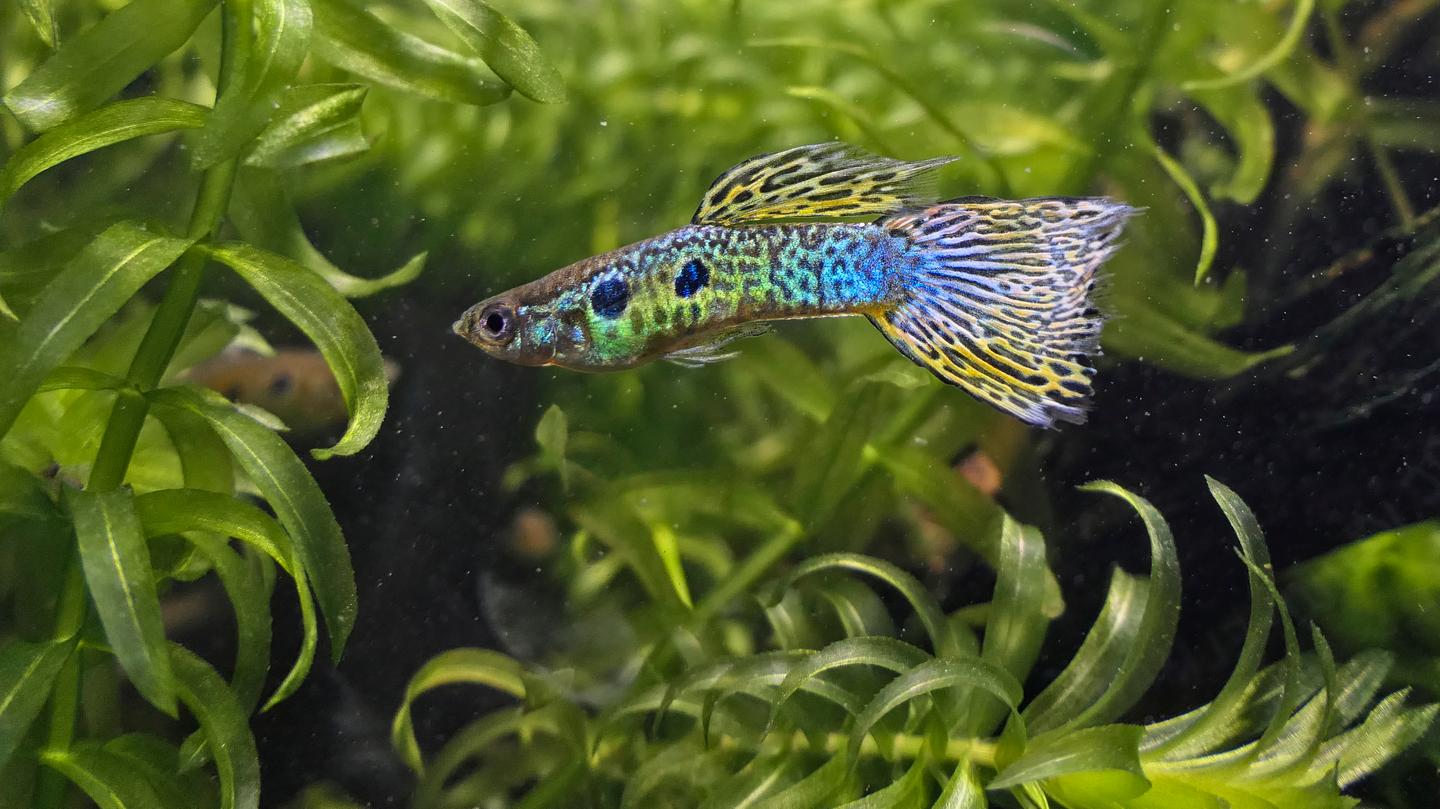
The Lyretail Male Guppy is an aquarium-bred ornamental form of the guppy, Poecilia reticulata, the livebearer whose wild ancestors come from north-eastern South America and the southern Caribbean. In a lyretail guppy the top and bottom edges of the tail are drawn out into long, curving points around a fuller fan, so the tail takes the outline of a lyre. The male in our photographs has a blue-green body with orange spots near the tail and an orange tail and dorsal fin marked with black spots.
Like every guppy, this is a peaceful, active fish for a community aquarium with moderately hard to hard water. Males carry the long fins and bright colour; females are larger and plumper and are not part of this listing.
Guppy tail names are used differently by breeders and by the trade. Aquarium Glaser points out that breeders' terminology differs from trade names: a fish traded as a "Calico Lyretail" is, in breeder language, a multicoloured double sword.
| Name | What it usually means |
|---|---|
| Lyretail (trade name) | Long upper and lower tail points framing a broad central fan |
| Double sword (breeder term) | Long extensions at the top and bottom of the tail; breeders class many traded lyretails here |
| Colour name | Body and fin colour, which is separate from the tail shape |
Our guide to guppy types and tails explains the main tail shapes, and the guppy strain finder helps you compare colour lines.
One purchase quantity supplies one live male lyretail guppy. Colour and pattern vary between individuals and batches, so the photographs show the tail form and the typical colouring, not the individual you will receive. Males are easy to tell from females at sale size: Seriously Fish notes that males have a gonopodium, a stick-like modified anal fin used for mating, while OATA describes the female anal fin as triangular.
Prepare the tank before you order and read our delivery and live arrival information, so your guppies go straight into a matured, tested aquarium.
Seriously Fish gives a minimum base of 45 × 30 cm, about 41 litres, for guppies. OATA's guppy and molly care sheet asks for at least 45 litres for a small group of the smaller species, and FishBase suggests a tank of at least 60 cm. Bigger is better: a long tank gives the males room to display and dilutes the waste of a growing group.
Mature the filter before any fish go in. The RSPCA explains that cycling takes at least two weeks and that fish should only be added once ammonia and nitrite have risen and fallen back to zero.
Seriously Fish says guppies are unfussy but appreciate a planted tank with floating vegetation, and that strong currents should be avoided. OATA also asks for a gentle current for guppies and warns against sharp or rough ornaments that could damage long fins.
| Feature | Why it helps |
|---|---|
| Live plants along the back and sides | Cover, grazing surfaces and calmer fish |
| Floating plants | Shade the surface; Seriously Fish notes guppies appreciate them |
| Smooth wood and rounded stones | Structure without edges that tear long fins |
| Open water at the front | Room for males to swim and display |
| A spray bar or gentle outlet | Keeps flow soft, as OATA advises for guppies |
A heater is needed all year, and OATA recommends a lid. Keep the aquarium away from draughts, radiators and direct sunlight, and run the lights on a regular day and night cycle.
Guppies are hard-water fish. Seriously Fish says they may survive soft, acidic water for a while, but long-term care should use moderately hard or harder water. The four sources below differ in their outer limits, so we plan on the range where they all overlap.
| Source | Temperature | pH | General hardness |
|---|---|---|---|
| Seriously Fish | 17–28°C | 7.0–8.5 | 8–30 dGH |
| FishBase | 18–28°C | 7.0–8.0 | 9–19 dH |
| OATA (guppies and mollies) | 20–28°C | 7.0–8.0 | 8–18 dGH, 5–15 dKH |
| RSPCA | 22–28°C | Not stated | Not stated |
| Where all agree | 22–28°C | 7.0–8.0 | 9–18 dGH |
FishBase adds that guppies need fairly warm temperatures of about 23–24°C. Stability inside the range matters more than any single number, so set the heater once and leave it.
OATA sets ammonia and nitrite at zero mg/l and nitrate at no more than 20 mg/l above your tap-water level. If your tap water is very soft, guppies are a poor long-term match unless you raise the hardness; check your supply with our water matcher before you buy.
Guppies are small but eat eagerly, and a group produces steady waste. Seriously Fish uses a filter turnover of four to five times the tank volume per hour; for a 41-litre tank that is roughly 165–205 litres per hour. Choose a filter that reaches that flow through a spray bar or a gentle outlet, so the current stays soft for the long tails.
Our guppy care guide covers set-up and maintenance for every guppy we sell.
Wild guppies are mainly insectivorous, but Seriously Fish notes that tank-bred guppies are far removed from wild stock and accept most foods. FishBase lists zooplankton, small insects and detritus in the wild diet. OATA recommends a quality flake or granule with a high algae content, supplemented with small live or frozen foods such as daphnia or small bloodworm.
Watch the males at feeding time. Long fins make them slightly slower, so spread food across the surface to stop faster tank mates taking it all.
OATA's method is to switch the aquarium lights off, float the sealed bag for 10 minutes to equalise temperature, then add small amounts of tank water to the bag over up to 20 minutes. Release the fish and leave as much bag water behind as possible.
| Checkpoint | What to do |
|---|---|
| Before arrival | Confirm zero ammonia and nitrite and the heater at temperature |
| Day of arrival | Lights off for the rest of the day; no food until the next day |
| Days two to four | Small feeds and a daily check of fins, breathing and swimming |
| Day seven | Full water test and your first routine water change |
OATA advises adding fish slowly so the filter bacteria can keep up and monitoring water quality closely for the first week.
A healthy lyretail male has clear, bright eyes, fully spread fins, intact scales and steady breathing. Seriously Fish warns that many commercially bred guppies are weakened by inbreeding and overproduction and are prone to disease, so good water quality and a calm tank matter even more for fancy forms.
| If you see | Do this first |
|---|---|
| Clamped fins or a folded tail | Test the water and check the temperature |
| Split or ragged tail edges | Look for fin-nipping tank mates and sharp ornaments |
| Flicking against objects or shimmying | Test ammonia and nitrite; seek advice before treating |
| White spots or fluffy growths | Test the water and seek fish-health advice |
| Hanging at the surface or hiding | Check filter flow, temperature and recent changes |
These signs come from OATA's list for guppies and mollies. Test first, then act on the result rather than guessing.
A group of lyretail male guppies is the simplest set-up: no fry, plenty of colour and long fins on show. If you add females, OATA recommends two females for every male, and Seriously Fish advises several females per male, because males pursue females persistently.
| Set-up | What to expect |
|---|---|
| Males only | No fry, constant display; watch for any male that is chased persistently |
| Males with two or more females each | Regular broods; the chasing is spread across several females |
| One male, one female | Not recommended; the female gets no rest from the male |
Remember that females can store sperm. Seriously Fish notes they can keep producing young for six months or more without a male, so a female bought from a mixed tank may give birth even in a males-only group. Our female guppy guide covers choosing females if you want a breeding group.
Guppies are very peaceful. Seriously Fish suggests a quiet community with other livebearers, rasboras, Corydoras, small loricariid catfish and tetras, and warns against fin-nippers such as tiger barbs and serpae tetras. OATA also advises keeping guppies away from fin-nipping species such as barbs.
| Suits | Avoid |
|---|---|
| Other peaceful livebearers in the same hard water | Tiger barbs, serpae tetras and other fin-nippers |
| Small, calm rasboras and tetras that share 22–28°C | Fish large enough to swallow a guppy |
| Small bottom-dwellers that tolerate hard water | Soft-water specialists that need pH below 7 |
Use our livebearers range for companions that share the same water, and compare other male guppies such as the Double Sword Male Guppy, the Metallic Blue Neon Male Guppy, the Green Snakeskin Delta Male Guppy and the Dumbo Ear Male Guppy to build a colourful males-only group.
Guppies give birth to live young. The sources differ on the details: Seriously Fish gives a gestation of four to six weeks with 5–100 young per brood, while OATA gives 24–30 days and 20–80 fry. Pregnant females show a darkened gravid spot behind the anal fin.
Never release guppies or their young into ponds, rivers or drains. Seriously Fish records feral populations in around fifty countries, including the UK, and FishBase notes adverse ecological effects where guppies have been introduced. Browse all our guppies, the guppy and livebearer category or the male guppy category to complete your group.
Yes. Seriously Fish notes that keeping only one sex avoids unwanted fry. Keep a small group of males rather than a single fish.
At least three, the minimum OATA gives for guppies, and ideally five or more as FishBase suggests, in a tank of at least 45 litres.
Fin-nippers such as tiger barbs and serpae tetras, which damage the long tail, and any fish large enough to swallow a guppy.
Moderately hard to hard, alkaline water. The overlap of Seriously Fish, FishBase, OATA and RSPCA guidance is 22–28°C, pH 7.0–8.0 and about 9–18 dGH.
FishBase gives a common length of about 2.8 cm total length for males. Females are larger; OATA puts traditional guppies at about 5 cm.
The names overlap. Aquarium Glaser notes that breeders class some traded lyretails as double swords. Our lyretail has long upper and lower tail points around a broad fan; compare the photographs of each listing.
Quality flake or micro-granules with some algae content, plus small frozen foods such as daphnia two or three times a week. Feed once a day, only what is eaten within a few minutes.
Usually fin-nipping tank mates, sharp ornaments or poor water quality. Test the water, check the decor and remove any fin-nipper.
No reviews for this item yet. Bought one? Honest reviews only, good or bad.
What customers say about ordering from us
Easy website plenty of info on fish your buying great to pick a time slot
TRACEY DURRANT · 7 Oct 2026
Got some lovely fish thank you
Kevin Mackie · 7 Oct 2026
Reviews of our shop, collected by Judge.me, an independent third-party review collector. Newest first.
Moved by UK carriers licensed to handle live animals
Hand-packed with oxygen bags, poly box, heat pack
Email photos the same day; an optional unboxing video helps us review problems faster — claim terms apply
Klarna & PayPal Pay in 3 at checkout