Easy
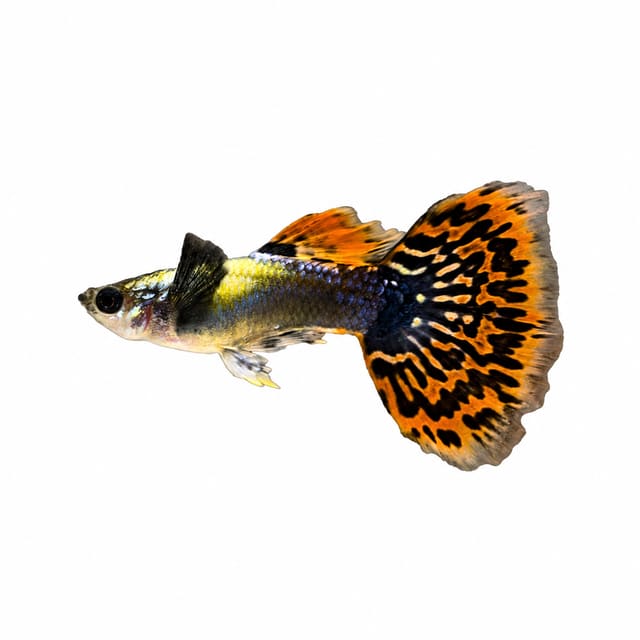
Elephant Ear Male Guppy (Poecilia reticulata)
22–28°C · pH 7–8 · 41L
£3.99

One male Dumbo Ear guppy (Poecilia reticulata) per quantity, picked at random from an assorted colour mix and bred for oversized pectoral fins. Males reach about 5 cm body length. Keep a group in a mature, planted tank at 22–28 °C, pH 7.0–8.0 and moderately hard water.
Adult size is the maximum length this species reaches at full maturity (scientific sources). The livestock you receive will be younger and smaller. Product-photo provenance and any image-specific limitations are stated on the listing.
Poecilia reticulata
Shoaling fish: kept in a group they feel safer, stay calmer and show their best colour.
Minimum of 2 per order.
One male Dumbo Ear guppy (Poecilia reticulata) per quantity, picked at random from an assorted colour mix and bred for oversized pectoral fins. Males reach about 5 cm body length. Keep a group in a mature, planted tank at 22–28 °C, pH 7.0–8.0 and moderately hard water.
Adult size is the maximum length this species reaches at full maturity (scientific sources). The livestock you receive will be younger and smaller. Product-photo provenance and any image-specific limitations are stated on the listing.
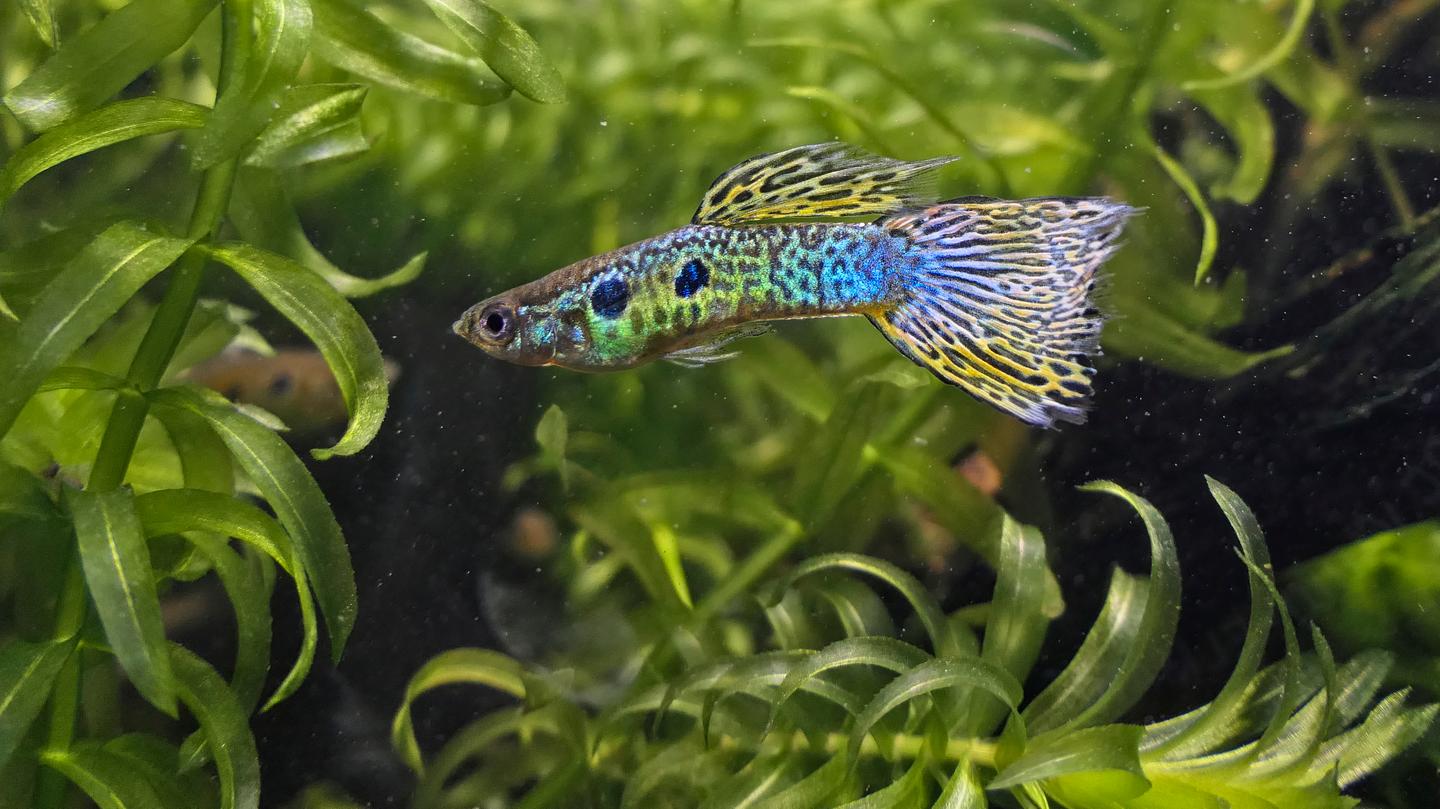
Guppies are social livebearers suited to a prepared beginner, not a fish-per-litre formula. Use a mature filtered aquarium, tested neutral-to-alkaline mineral-bearing water, deliberate sex and population planning, open swimming room, cover and a separation option.
Maintain these water conditions for optimal health and vibrant colors
This listing is for male Dumbo Ear guppies, and each quantity is one fish. Add three to your basket and three males are packed for you. There are no females on this listing.
"Dumbo Ear" is the hobby's name for guppies bred for oversized pectoral fins. Those are the paired fins just behind the gill covers, one on each side of the head. On most guppies they are small and easy to miss. On a Dumbo Ear male they are noticeably broader, and they spread sideways when the fish hangs in the water, rather like a cartoon elephant's ears. The same enlarged-fin look turns up under other trade names: our own range includes guppies listed as Elephant Ear and Big Ear. Those names describe the fins. Every one of these fish is the same species, Poecilia reticulata.
The word Mix tells you how your fish is chosen. This is not one fixed colour strain. The males come from an assorted group and each is picked at random, so body colour, tail colour, pattern and tail shape differ from fish to fish. We can't choose a colour for you, match a particular fish from the gallery, or promise that two males in the same order will look alike. If one exact colour matters to you, a named strain is the better choice. If you like a front glass where no two males match, a mix makes sense.
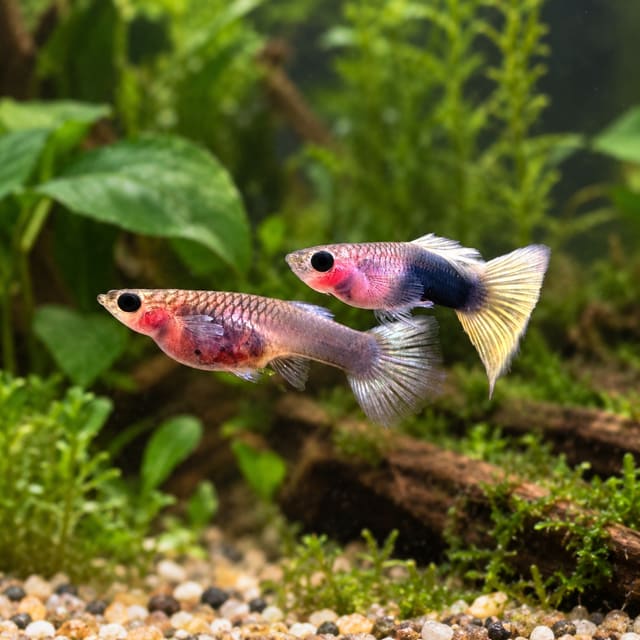
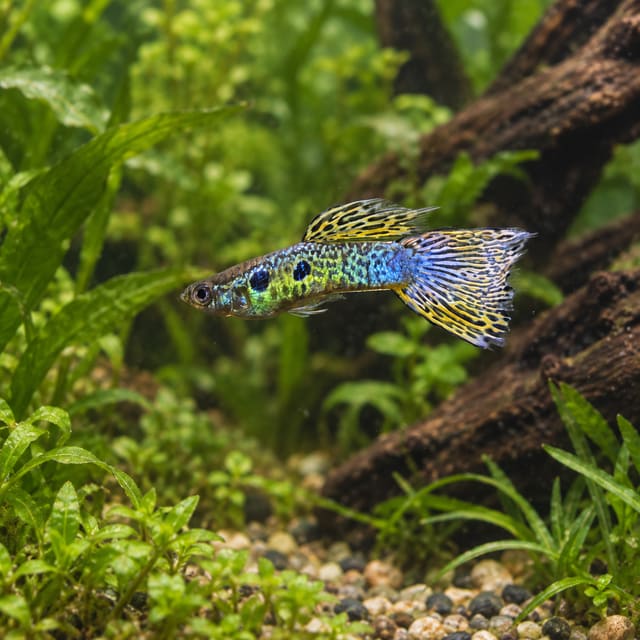
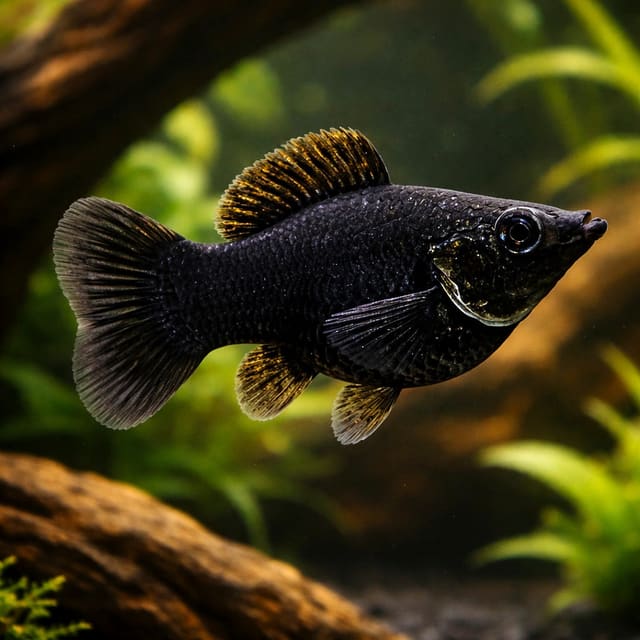
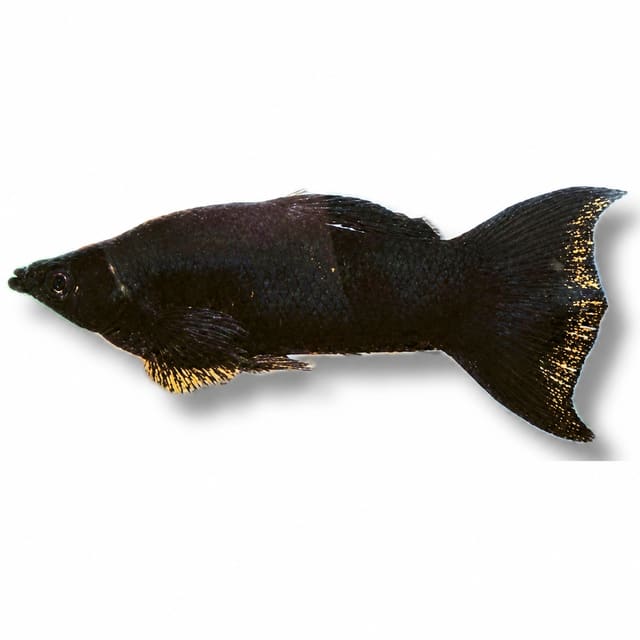
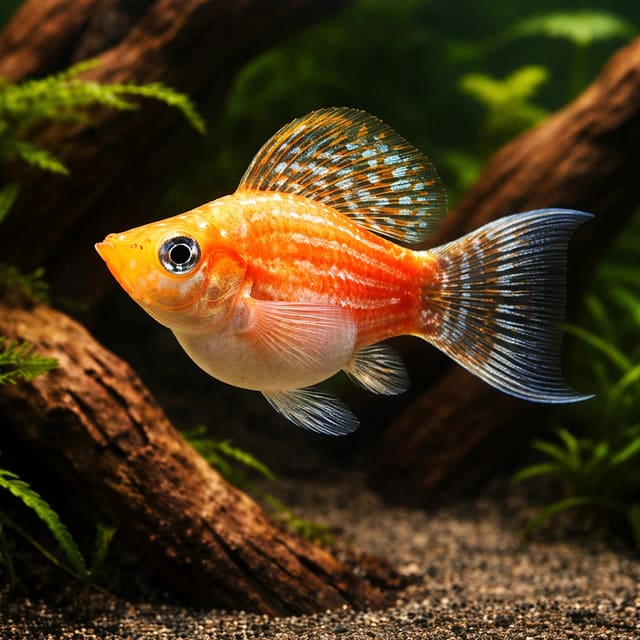
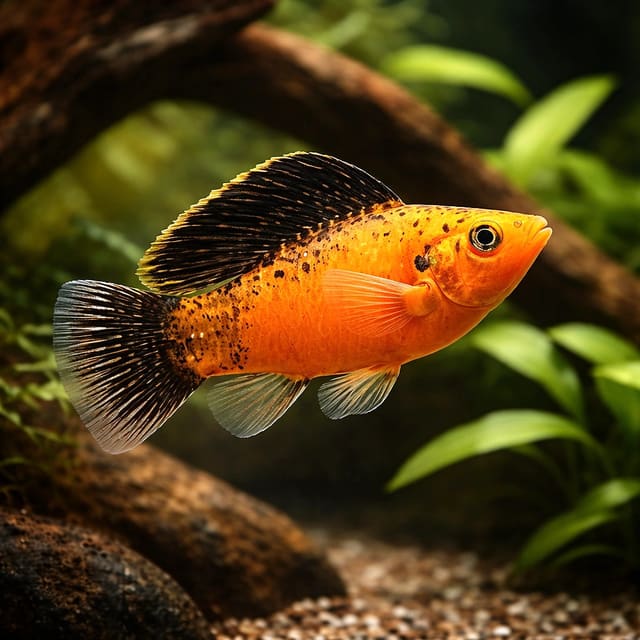
All four pictures show the same style of male: a metallic blue body with a gold-green sheen behind the head, a deep blue dorsal fin, pale enlarged pectorals and a wide tail running from dark blue at the base to bright red at the edge. One picture shows two of these males together. Take them as an example of how a Dumbo Ear male carries his fins, not as a portrait of the fish you will receive. The two-fish scene still means one fish per quantity.
You can confirm the sex yourself once he has settled. In a male guppy the anal fin, the small fin on the underside behind the belly, is reshaped into a gonopodium: a narrow, rod-like organ used to fertilise females internally. Seriously Fish calls it stick-like, which is exactly how it looks from the side. A female keeps an ordinary fan-shaped anal fin, has a rounder belly and, in wild-type fish, a plain grey body. Males are the smaller, brighter and longer-finned sex.
A Dumbo Ear male is a good fit for someone with a cycled, moderately hard-water community tank who wants movement and colour without a growing population of fry, because a male-only group cannot breed. He is a poor fit for a soft, acidic tank, for a tank with known fin-nippers, and for anyone hoping to choose the exact colour.
Strip away the fins and colour and a Dumbo Ear is a guppy, Poecilia reticulata, described by Peters in 1859 and placed in the livebearer family Poeciliidae. Mollies share its genus, Poecilia, and the OATA care sheet covers the two together. The common name has a story of its own. Albert Günther named specimens Girardinus guppii in honour of Robert John Lechmere Guppy, who had sent fish from Trinidad to the Natural History Museum in London. That scientific name did not last, but "guppy" did. It is also known as the millionfish or rainbow fish.
The species is native to north-eastern South America and the southern Caribbean. FishBase lists Venezuela, Barbados, Trinidad, northern Brazil and the Guyanas, and Seriously Fish adds Antigua and Barbuda and the Netherlands Antilles. Within that range guppies are remarkably adaptable. FishBase describes them in warm springs and their outflows and in weedy ditches and canals, while Seriously Fish says the species turns up in almost every kind of water, from high-altitude streams to turbid swamps. Wikipedia notes that they are more abundant in small streams and pools than in large, deep or fast-flowing rivers, and some populations live in brackish water.
What links those places is cover. Seriously Fish points out that guppies do best where there are lush growths of algae, marginal vegetation or aquatic plants. That is a useful clue for the aquarium: a bare tank with a strong current is close to the opposite of the water this species comes from.
Guppies have been carried around the world, often in the hope that they would control mosquitoes, and Wikipedia records introductions on every continent except Antarctica. FishBase is blunt about the result: it reports rare to non-existent effects on mosquitoes and negative ecological impacts in several countries. The lesson for keepers is simple. A guppy, however hardy, should never be tipped into a pond, stream or drain. If you ever need to rehome fish, a local aquatic shop or fishkeeping club is the right route.
The wild species is listed as Least Concern by the IUCN, from an assessment dated May 2020 that FishBase cites. FishBase also calls the guppy one of the most popular aquarium fishes, with many standardised varieties. The Dumbo Ear is one of those domestic lines, selected by breeders for big pectoral fins. You will not find it in a Trinidad stream.
Fancy guppy names usually stack several labels together, which is why they can read like a string of adjectives. One part normally describes the tail. Wikipedia lists the recognised tail shapes as veil, triangle, fan, flag, double sword, upper sword, lower sword, lyre, spade, spear, round and pin. Another part describes pattern, such as snakeskin or grass, or a colour line such as Moscow, while tuxedo describes a half-black body. "Dumbo Ear" is a different kind of label altogether: it describes the pectoral fins and says nothing about tail shape or colour. On a mixed listing like this one, tail shape and colour are left to chance, and you find out which you have when you unpack him.
FishBase gives a maximum of 5.0 cm standard length for male guppies and 6.0 cm for females, with a common length of 2.8 cm total length. Standard length runs from the tip of the snout to the end of the body where the tail fin begins, so it leaves the tail out. Wikipedia gives a typical range of 1.5–4 cm for males and 3–7 cm for females, and Seriously Fish quotes 6 cm standard length for the species without splitting the sexes. Put together, most males stay under 5 cm of body, and 5 cm is the top of the range rather than something to expect.
The tail changes how big he looks. A fancy male with a broad tail can appear much longer than his body measurement, because the fin adds visible length behind the body. When planning a tank, work from body size and how the fish swims rather than from how dramatic the fins look in a photograph.
Guppies mature early. FishBase records males maturing at about two months and females at about three, which helps explain why mixed groups breed so readily. On lifespan, Wikipedia says wild guppies typically live around two years, although the figure varies a great deal, and the OATA care sheet says guppies can live several years in a well-matured aquarium with good water quality. Neither number is a promise. Stable water, sensible stocking and a varied diet give a male the best chance of a full life, and those are all things you control.
| Measure | Figure | Reference |
|---|---|---|
| Maximum male length | 5.0 cm standard length | FishBase |
| Maximum female length | 6.0 cm standard length | FishBase |
| Typical male length | 1.5–4 cm | Wikipedia |
| Male maturity | About 2 months | FishBase |
| Lifespan | Around 2 years in the wild; several years in a well-kept aquarium | Wikipedia; OATA |
Published minimums for guppies vary. Seriously Fish suggests a tank with a base of at least 45 × 30 cm, roughly 41 litres. OATA asks for at least 45 litres for a small group of the smaller livebearers. FishBase gives a recommended minimum aquarium length of 60 cm and suggests groups of five or more. We take the most generous of those as our starting point: a cycled tank at least 60 cm long and around 60 litres. That gives a small group of males room to swim, display and get away from one another, and a larger body of water is slower to swing in temperature and quality than a small one. Treat it as a starting point rather than a stocking formula, because filtration, the other fish in the tank and the behaviour of your particular males all change what a tank can hold.
The filter needs a population of beneficial bacteria before fish go in. Run the tank, feed that bacterial colony with an ammonia source, and test until ammonia and nitrite both read zero and nitrate is appearing. That process takes weeks rather than days, so start it well before you order. Fish added to a tank that is still cycling are exposed to ammonia and nitrite, both of which OATA wants held at zero.
Seriously Fish calls guppies unfussy about décor but says a planted tank with floating vegetation is appreciated, which fits the weedy ditches and vegetated margins the species comes from. Plants give a male somewhere to rest out of the main flow and break up sight lines when another male is showing off. Floating plants soften the light at the surface. Leave a clear stretch of water at the front and middle so the fish can swim and you can see them.
Choose décor with the fins in mind. A Dumbo Ear male carries broad pectorals as well as a large tail, so rough rock edges, spiky artificial plants and tight gaps are worth leaving out. Smooth stone, wood without splinters and real plants are kinder to fins.
One straightforward arrangement: fine gravel or sand, a single piece of smooth wood towards one end, taller stem plants along the back and sides, a clump of floating plants at the calmer end of the tank, and open water across the front two-thirds. Put the heater where the filter flow passes it so warmed water is carried round the tank, and the thermometer at the opposite end where you will see it every time you feed. It is not elaborate, and it doesn't need to be; what matters is shelter at the edges, swimming room in the middle and nothing sharp for a long fin to catch on.
Seriously Fish advises against strong currents for guppies, and there is a further reason to be gentle with this strain. A 2013 study in the Journal of Experimental Biology tested wild-type female Trinidadian guppies and found that fish making heavy simultaneous use of their pectoral fins had a higher swimming cost and a lower critical swimming speed. Nobody has run that experiment on Dumbo Ears, so take it as a pointer rather than proof, but it sits comfortably with keeping the flow soft around a fish whose pectorals are noticeably larger than normal.
In practice that means a filter rated for the tank, with its outlet aimed along the back glass or spread by a spray bar so there are calm areas at the front and among the plants. Filtration still has to be adequate; gentle flow is about where the water goes, not about fitting a smaller filter. A reliable heater with a thermostat and a thermometer you can read at a glance complete the basics, and a cover glass cuts evaporation and heat loss.
Guppies are hard-water fish. Seriously Fish says so plainly and recommends moderately hard or harder water, noting that they may survive soft, acidic conditions in the short term. FishBase gives pH 7.0–8.0, hardness of 9–19 dH and a temperature range of 18–28 °C. Those FishBase figures are what many people look for when they search for guppy water values, so here they are beside the other references we checked.
| Reference | Temperature | pH | General hardness |
|---|---|---|---|
| FishBase | 18–28 °C | 7.0–8.0 | 9–19 dH |
| Seriously Fish | 17–28 °C | 7.0–8.5 | 8–30 dGH |
| OATA care sheet | 20–28 °C | 7.0–8.0 | 8–18 dGH, with KH 5–15 dKH |
| Our working range | 22–28 °C | 7.0–8.0 | 8–18 dGH |
Our working range sits inside all three. We don't plan around the cool end that FishBase and Seriously Fish allow; those are limits the species tolerates, and Wikipedia puts the guppy's preferred water at 25.5–27.8 °C. A heater set in the mid-twenties sits inside every range in the table and leaves a little headroom for hot summer days.
General hardness (GH) measures dissolved calcium and magnesium. Carbonate hardness (KH) measures the carbonates that buffer the water and hold pH steady; when KH runs very low, pH can drop sharply between water changes. pH itself is the acidity reading. For a guppy you want all three moderate to high and, above all, steady.
Tap water differs a great deal from one part of the UK to another, so test yours rather than going by what a neighbour or a forum says. GH, KH and pH kits tell you whether your water already suits guppies. If GH sits roughly within 8–18 dGH and pH is 7 or above, leave it alone; a steady value is worth more than repeated chemical adjustment chasing a perfect number. If your water is very soft and acidic, talk to us or a local shop before buying, because guppies are hard-water fish and soft, acidic water does not suit them long term.
OATA's targets for guppies and mollies are clear: ammonia and nitrite at zero, and nitrate no more than 20 mg per litre above your tap water's own level. It recommends testing ammonia, nitrite, nitrate, pH and hardness at least once a week and changing about 25% of the water weekly. Treat new water with a dechlorinator and bring it close to tank temperature before it goes in. Rising nitrate is a common early sign of an overstocked or overfed tank, so the weekly test doubles as an early warning.
Guppies are famous for tolerating salt. Some wild populations live in brackish water, and Wikipedia notes they can withstand salinity up to 150% of normal seawater. That tells you how tough the species is; it is not a care instruction. None of the freshwater values above call for salt, and in a freshwater community tank there is no reason to add it as routine.
Wild guppies eat whatever small food their stream offers. FishBase lists zooplankton, small insects and detritus. Wikipedia gives a longer list that includes algal remains, diatoms, invertebrates, aquatic insect larvae and plant fragments. Seriously Fish describes wild fish as mainly insectivorous but says today's tank-bred guppies are far removed from their ancestors and accept most foods offered.
For a male in a home aquarium, that becomes a good-quality small flake or micro-granule as the staple, ideally one with a high algae content as OATA recommends, plus frozen or live foods for variety. OATA names daphnia and bloodworm; small brine shrimp and cyclops are similar-sized choices. Pick foods sized for small fish and crush larger flakes between your fingers before they go in.
OATA's guidance is to feed once a day, giving what the fish eat within a few minutes. Go by the clock rather than by how keen the fish look. Food lying on the substrate after a few minutes means you are giving too much; take it out before it breaks down and cut the next portion.
Watch your Dumbo Ear male at feeding time and check he gets a fair share. If faster fish reach the food first, spread it across the surface or feed at two points at once so he is not left at the back of the queue. A male that ignores food for more than a day or two after settling is worth a water test and a closer look at his fins and breathing.
Guppies are social and should not be kept as a single fish. FishBase suggests groups of five or more; OATA's minimum is three. We work to five or more wherever the tank and your plans allow. Because this listing is for males, the simplest set-up is a male-only group: several Dumbo Ear males, or Dumbo Ears alongside other fancy males such as our Elephant Ear male guppies or Cobra Multicolor Elephant Ear males. With no females in the tank there are no fry, which suits anyone who wants colour without a population to manage.
Male guppies are not shy. Wikipedia describes the courtship display, in which a male bends his body into an S-shape and quivers rapidly, and Seriously Fish warns that males can be vigorous in their constant pursuit of females. In a male-only tank, keep an eye on how the males treat one another. Short displays are part of guppy life. One fish being chased constantly, kept away from food or showing torn fins is not, and it means the group or the layout needs to change. More planting, extra sight breaks and rehoming a persistent chaser are the usual fixes.
If you would rather keep a mixed group, both OATA and Seriously Fish recommend more females than males, with OATA suggesting two females to each male so that no single female takes all of the attention. Our female Elephant Ear guppies are the obvious companions for a Dumbo Ear male. Go in knowing that a mixed group will breed, as the breeding section below explains, and have a plan for the young before you start.
Seriously Fish describes guppies as very peaceful and suggests a quiet community with other livebearers, rasboras, corydoras, small loricariids and tetras. It also names the fish to avoid: fin-nippers such as tiger barbs and serpae tetras. A male with a big tail and broad pectorals gives a nipper more to aim at, so take that warning seriously. Any fish large enough to swallow a guppy is out of the question.
Water decides the rest. Whatever you choose has to thrive in the same neutral-to-alkaline, moderately hard water at 22–28 °C, and stay small and calm enough to leave a long-finned male in peace. Check each species on its own terms before buying, because a fish that suits a soft-water community will not necessarily suit a guppy tank.
OATA lists the signs of a healthy guppy as clear, bright eyes, undamaged fins, intact scales, no ulcers or bumps, normal swimming and steady breathing. Those are worth checking on the day a fish arrives and every time you feed. The same care sheet lists the warning signs: clamped fins held tight to the body, flicking or rubbing against gravel and décor, and shimmying, a side-to-side shaking on the spot.
Fancy guppies deserve a little extra care. Seriously Fish notes that many commercially bred guppies are not very hardy because of inbreeding and over-production, and are prone to disease and early death, and it recommends buying good-quality fish. We take that seriously. It is why we suggest quarantine for new arrivals and a careful eye during the first fortnight, and why the water advice above is so specific: a stable, clean, hard-water tank is the best protection a fancy guppy has.
On a Dumbo Ear, the fins are the quickest health check. Look along the pectorals and tail for split edges, ragged margins or fins held closed. OATA counts undamaged fins among the basic signs of health, so damage is always worth investigating. Test the water first, then watch the group for a chaser and check the décor for anything sharp.
If you already keep fish, the safest way to add any newcomer is a separate, cycled quarantine tank for a few weeks before he joins the main display. It protects both sides: your existing fish from anything a newcomer might carry, and the new male from competition while he settles. Without a quarantine tank, add new fish to a quiet, well-maintained aquarium and watch closely.
Change one thing at a time and keep notes. Test results, the tank temperature and what you fed in the last day are the first things any good fish shop will ask about, so have them ready before you ring or email. A water test is the cheapest first step, and it rules out the most basic cause before anything else is tried.
Guppies are livebearers. The female carries fertilised eggs internally and gives birth to free-swimming young, and the male's gonopodium is what makes internal fertilisation possible. A male-only tank cannot breed. Add females and it happens quickly.
The figures vary between references, which is normal for a fish bred this widely. FishBase gives a gestation of four to six weeks and broods of 20–40 young roughly every four weeks. Seriously Fish also gives four to six weeks, with a much wider brood size of 5–100. Wikipedia gives gestation of 20–60 days at 25–27.8 °C and typical broods of 30–60, with females first producing young at 10–20 weeks of age.
First, females store sperm. Seriously Fish says excess viable sperm can be kept in the female's oviduct for a long time, so she can still produce young for six months or more with no male present; Wikipedia gives up to eight months. A female from a mixed tank may already be carrying young when she arrives.
Second, adult guppies eat their own young. Seriously Fish notes that removing fry after birth is the way to make sure they survive. If you want to raise some, have a separate grow-on tank ready rather than hoping they will hide.
We can't promise it. Accounts of how the enlarged-pectoral trait is passed on disagree, and we have not found a published study that settles the question. In a mix, colour and pattern in any young are just as unpredictable. If you breed from a Dumbo Ear male, expect variety and have a home lined up for the young before they arrive, whether that is a grow-on tank, a local fishkeeping club or a shop willing to take them. Our mixed female guppies are another option for a breeding group if fin type in the offspring doesn't matter to you.
Get the aquarium ready before you order. The filter should be running on a cycled tank, the water tested and the temperature steady inside the guppy range. Live fish can't wait while a tank is set up, and someone must be at the delivery address to take the parcel in. Please read our delivery and live-arrival information before ordering. The confirmed delivery date and tracking details are sent to you by email.
Your male travels in an oxygen-filled bag inside insulated packaging, with heat packs when the weather calls for them, carried by a tracked courier licensed to transport live animals.
Start a continuous video before you open the box, while the parcel is still sealed, and keep filming as you open it so the fish can be seen in the still-sealed bag in the same take. If a fish has arrived dead, dying or clearly compromised, email hello@tropicalfishco.co.uk on the day of delivery with your order number and that video. Photos alone do not meet the live-arrival policy. Subject to the guarantee terms, we will replace the affected fish with your next order or refund it.
Keep the lights low for the rest of the first day. Over the following week, watch his breathing, appetite and behaviour. Steady breathing, open fins and interest in food are what you want to see. A male that hides constantly, clamps his fins or ignores food deserves a water test and a closer look, since OATA lists clamped fins among the early warning signs. Keep feeding light while he settles, and hold off on adding more fish until the newcomers are clearly eating and the water tests stay clean.
These are the references we used for the care figures and species facts on this page.
No reviews for this item yet. Bought one? Honest reviews only, good or bad.
What customers say about ordering from us
I have a small group of long finned mountain minnows. So was delighted to be able to order ten of this variety to increase the genetics in my tank . The ones I recieved are healthy but it’s to early to give a verdict on wether they are of a long finned type since they are small currently.
Gordon Walker · 23 Sept 2026
100% success travel and "installation". Pleased with quality of purchase. The Siamese fighter a bit "shy" so have not yet seen him at his best yet but looking good. Happy customer. GG
George E Garratt · 21 Sept 2026
Reviews of our shop, collected by Judge.me, an independent third-party review collector. Newest first.