Easy
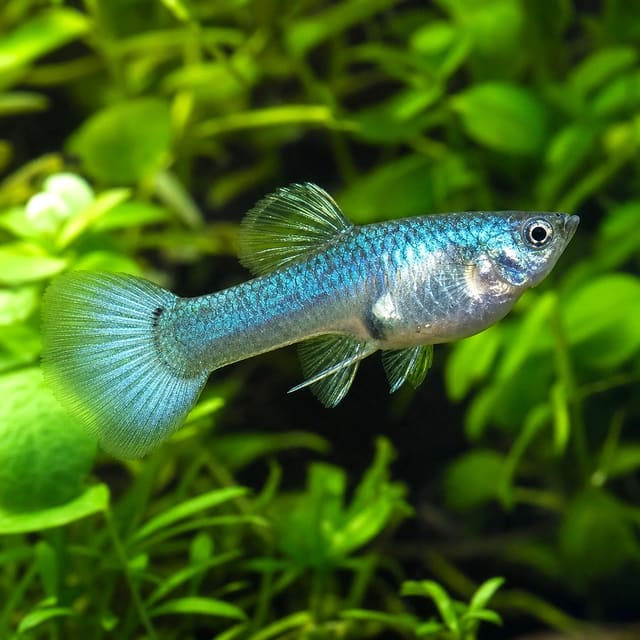
Blue Moscow Male Guppy (Poecilia reticulata)
22–28°C · pH 7–8 · 45L
£6.49
Female Red Blond Guppy (Poecilia reticulata) is supplied as one female fish in the 3–4 cm dispatch grade. She suits a mature, planted 60 cm aquarium with hard, neutral-to-alkaline water, a deliberate guppy group and companions that will not nip fins or exclude her from food.
Adult size is the maximum length this species reaches at full maturity (scientific sources). The livestock you receive will be younger and smaller. Product-photo provenance and any image-specific limitations are stated on the listing.
Poecilia reticulata
Shoaling fish: kept in a group they feel safer, stay calmer and show their best colour.
Minimum of 2 per order.
Female Red Blond Guppy (Poecilia reticulata) is supplied as one female fish in the 3–4 cm dispatch grade. She suits a mature, planted 60 cm aquarium with hard, neutral-to-alkaline water, a deliberate guppy group and companions that will not nip fins or exclude her from food.
Adult size is the maximum length this species reaches at full maturity (scientific sources). The livestock you receive will be younger and smaller. Product-photo provenance and any image-specific limitations are stated on the listing.

Guppies are social livebearers suited to a prepared beginner, not a fish-per-litre formula. Use a mature filtered aquarium, tested neutral-to-alkaline mineral-bearing water, deliberate sex and population planning, open swimming room, cover and a separation option.
Maintain these water conditions for optimal health and vibrant colors
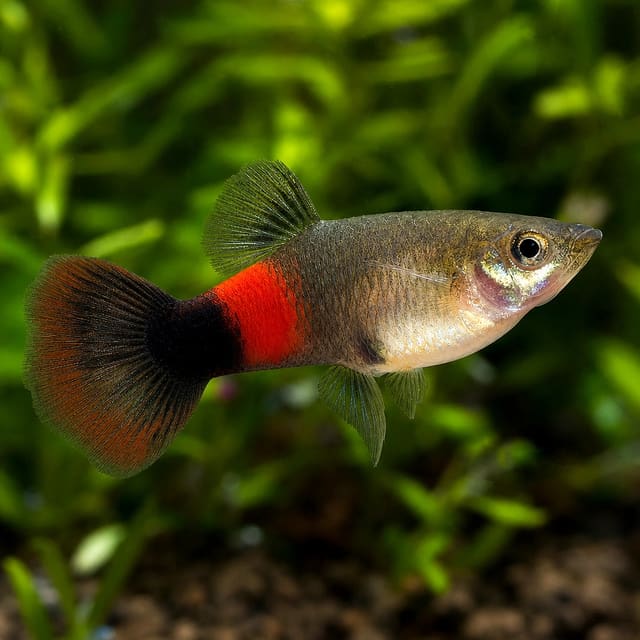
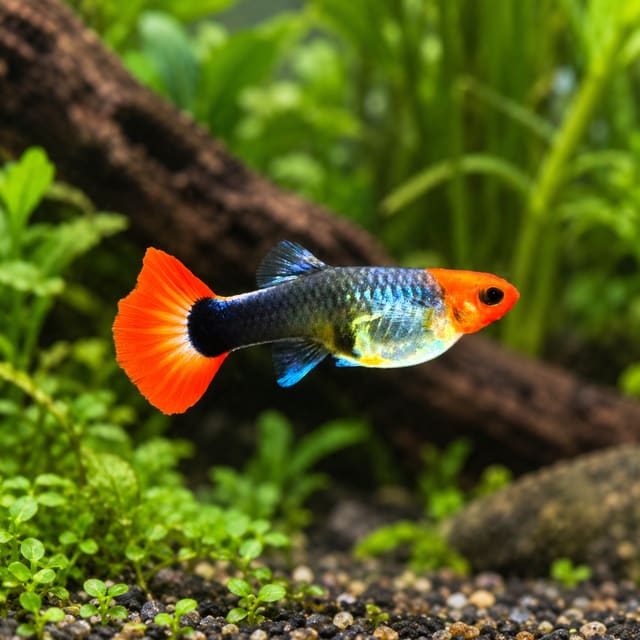
The Female Red Blond Guppy (Poecilia reticulata) is a peaceful, social livebearer with warm red-orange colour over a pale blond body. This exact product is sold as female, and one purchase supplies one live fish. This female is supplied in a 3–4 cm dispatch grade. That supplied size is not the adult maximum: the store’s guppy guide uses up to 6 cm standard length for females, and standard length excludes the tail fin.
Sex is guaranteed only when the exact product or selected option explicitly states male or female. This Poecilia reticulata female red blond listing is sold as female. The female wording is an offer fact for this product; it is not inferred from colour, body shape or the photograph. A rounded abdomen or dark patch is not proof that an individual fish is pregnant.
| Suits | A prepared beginner or experienced keeper with mature filtration, tested hard water and a population plan |
|---|---|
| Routine water | 22–28°C under store guidance; pH 7.0–8.0 and 8–18 dGH from OATA’s broad guppy-and-molly guidance |
| Aquarium plan | A mature aquarium at least 60 cm long under Tropical Fish Co’s conservative guppy policy |
| Social plan | Five or more guppies where space, filtration, sex mix and other livestock allow |
| Temperament | Peaceful, but still vulnerable to fin nipping, food competition and persistent pursuit |
| Food | A complete omnivore flake or granule with safe algal and invertebrate variety |
The Red Blond wording describes a selected aquarium colour form, not a separate species and not a promise that every female will show an identical shade. Domestic females can carry visible colour, particularly in the fins, while maturity, condition, lighting and natural variation affect the impression. Choose this offer because the sex, species and care plan fit the aquarium; choose the colour only after those decisions are settled.
Guppies are often labelled easy because they accept prepared food and are familiar community fish. Easy should mean that their needs are understandable, not that they can cycle a new aquarium, live alone in a bowl or tolerate unsuitable water. A good starting home has zero detectable ammonia and nitrite, stable mineral-bearing water, usable swimming length, planted cover, a secure lid and a realistic response if fry, illness or social pressure appears.
This female can be part of a female-only or mixed-sex plan. A female-only group avoids new mating within the group but cannot prove that no fry will appear, because a female may store sperm after an earlier mating. A mixed-sex group brings courtship and repeated population pressure; OATA’s broad guidance suggests two females per male, but no ratio replaces observation. In either plan, every fish must be able to feed, move away from pursuit and maintain condition.
Before ordering, measure the aquarium rather than trusting its marketing volume, test the water that will actually be used, count all existing adult fish and decide where an isolated or recovering fish could be kept. The complete Guppy Care Guide develops those decisions, while the guppy collection shows other current offers without implying that two varieties are automatically suitable companions.
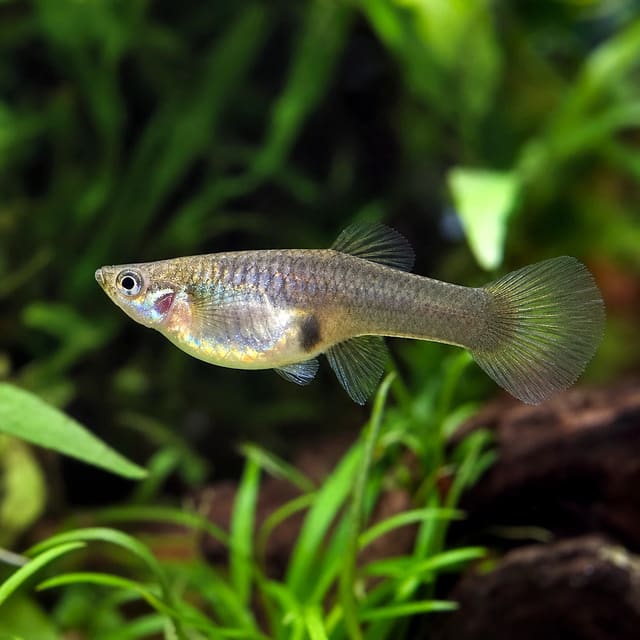
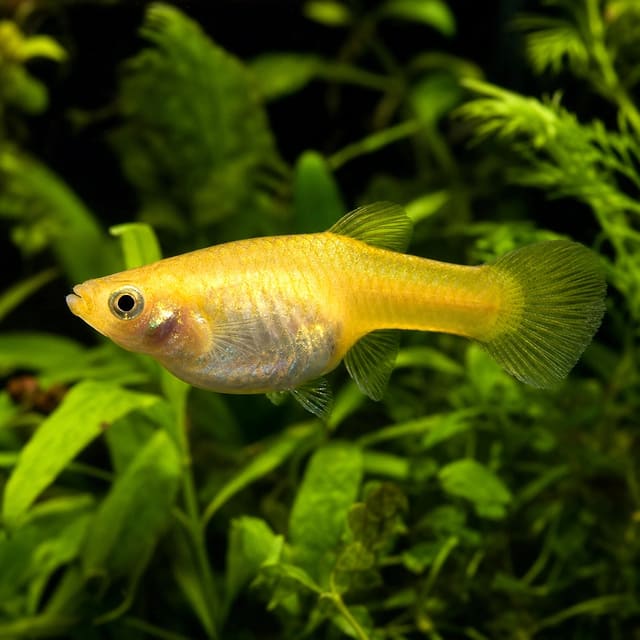
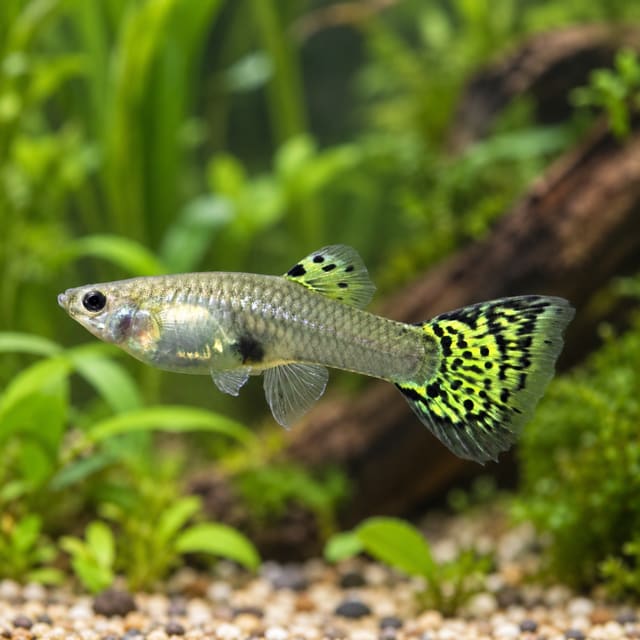
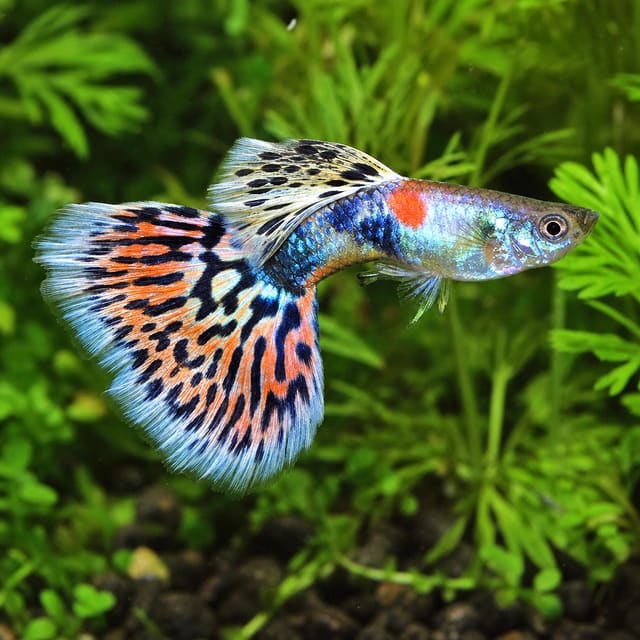
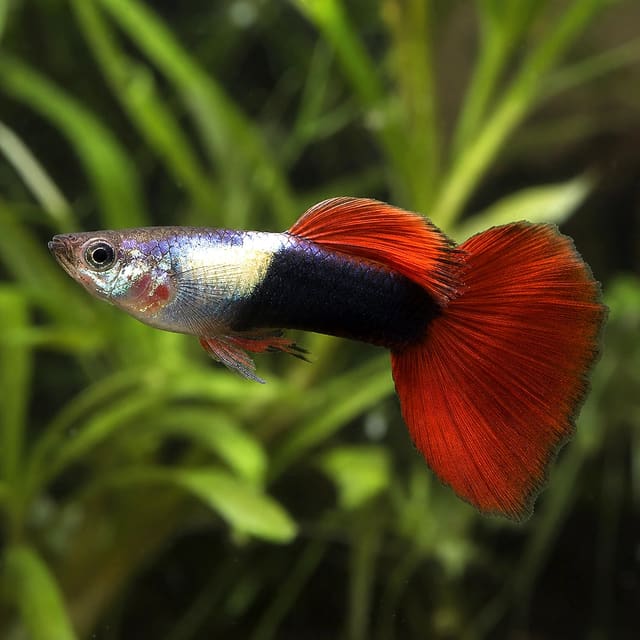
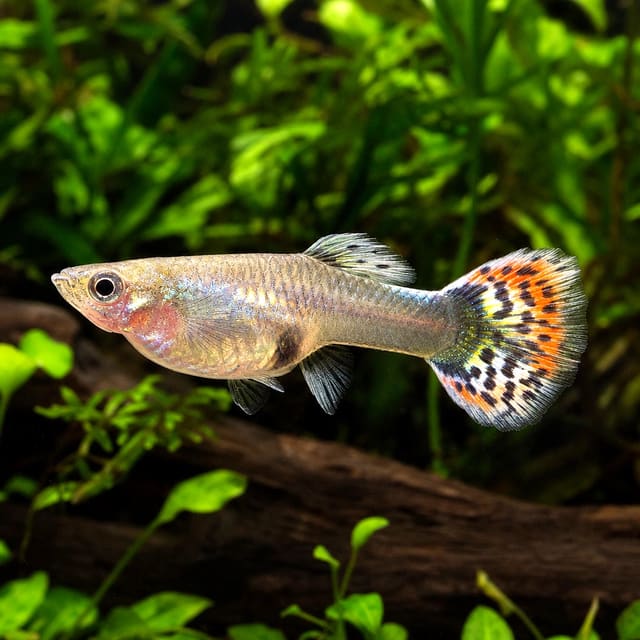
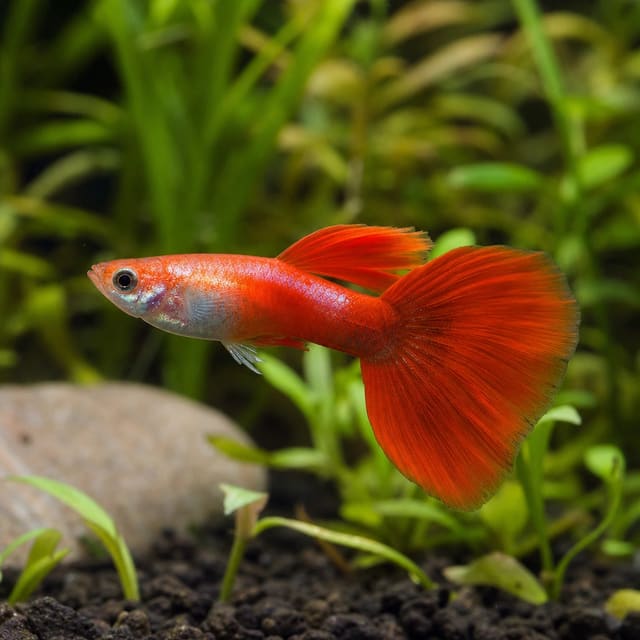
Gallery images have been digitally enhanced to improve image quality. Natural colour, pattern, size and maturity can vary between live animals. The gallery image shows a red-blond female-form guppy in a planted aquarium, but it does not establish pregnancy, exact adult colour or pedigree for the individual supplied.
First, confirm the water match: this guppy needs stable mineral-bearing water, not a plan that depends on repeatedly forcing unsuitable source water into range. Second, confirm the social plan: decide whether the established group is female-only or mixed, count the adult fish already present and allow for fry even when no male is being bought today. Third, confirm the fallback: a mature separation space, quarantine equipment and a responsible rehoming route should exist before they are needed.
These checks matter more than colour. A red-blond female can be a rewarding, visible community fish when she can swim freely, reach food and leave another fish’s attention. The same animal is a poor purchase for an immature aquarium, aggressive companions or a keeper who cannot accommodate possible young. Choosing well at the beginning protects both this fish and the animals already in the aquarium.
Poecilia reticulata is native to parts of northeastern South America and the southern Caribbean and has also been introduced widely elsewhere. Domestic Red Blond fish are selected aquarium forms, not a separate wild species. Their colour label helps distinguish an offer, but it does not change the need for hard water, social company, mature filtration and population planning.
That distinction also protects expectations. The fish supplied is guaranteed female because this exact product says so; the listing does not promise pregnancy, one exact shade, a particular tail pattern or a verified pedigree. Use the species identity for husbandry, the female offer for group planning and the gallery only as a representative view of the trade appearance.
Tropical Fish Co uses a conservative screen of a mature, filtered aquarium at least 60 cm long for one small guppy group. That house policy brings together FishBase’s secondary 60 cm aquarium note, its group of five or more, and the broader OATA floor of 45 litres for a small group of the smaller livebearers. It is a purchasing screen rather than a fish-per-litre formula. A longer aquarium can still be unsuitable if it is uncycled, crowded, softly acidic or filled with incompatible livestock.
The species profile gives a 45 × 30 cm base and approximately 41 litres. OATA’s combined guppy-and-molly sheet gives at least 45 litres for a small group of the smaller species. Those figures provide context, but the store uses the 60 cm length because horizontal swimming room, sex mix and population growth matter. Nominal litres do not describe internal length, displacement by substrate, existing livestock, filter maturity or whether one fish is being chased.
Measure the internal aquarium length and consider the usable footprint after wood, rocks and dense plants are installed. Leave an open route where the group can swim and feed, then place cover so a female can move out of another fish’s line of sight. A layout that looks full of shelter can still fail if it creates dead ends or blocks every open route. Stabilise decor before adding fish and protect small fish or fry from filter intakes.
Prepare the aquarium before the animal is dispatched. The first tropical aquarium guide explains the cycling work that must happen before livestock arrives. A clear tank is not automatically mature: the biological filter must contain enough beneficial bacteria to process ammonia into nitrite and then the less toxic nitrate. Verify that performance with repeated tests rather than counting elapsed days.
Add livestock gradually. OATA warns that stocking too quickly can exceed the bacterial population’s ability to process the extra waste and feeding, producing new tank syndrome. After an addition, test more frequently and do not add another fish while results or behaviour are unsettled. More water can improve stability, but no volume turns rapid stocking into safe practice.
For this store’s practical UK plan, use 22–28°C. OATA’s broad guppy-and-molly guidance gives pH 7.0–8.0 and 8–18 dGH, with zero ammonia and zero nitrite. The species profile spans 17–28°C, pH 7.0–8.5 and 8–30 dGH and states that long-term maintenance should be in moderately hard or harder water. FishBase’s 18–28°C, pH 7.0–8.0 and 9–19 dH values describe recorded environments, not a second home-aquarium target.
Test both source water and aquarium water. UK supplies vary by region and can change when providers blend sources. A current water-company report is useful background, but it cannot show what is happening inside the aquarium today. The water-chemistry guide explains what each reading means, and the water matcher can compare measured values with the routine range. Neither replaces a test kit or the need to investigate an unexpected result.
Hardness matters separately from pH. Guppies may manage for a time in softer or more acidic conditions, but the species profile advises moderately hard or harder water for long-term care. If the tap supply is far outside the intended range, solve that match before purchase or choose an animal suited to the available water. Avoid repeatedly dosing to chase a midpoint; rapid correction can create more instability than a steady result within the appropriate range.
FishBase records the species from freshwater and brackish habitats, but that does not create a routine need for aquarium salt. Salt changes the environment for every fish, plant and invertebrate in the system. Do not add it as a general tonic or because guppies occur across a wide salinity range. Any mineral or salt adjustment needs a measured purpose and a compatibility check for the complete aquarium.
Use a thermostatically controlled aquarium heater where the room cannot hold the water in range. Verify the actual water with an independent thermometer; a heater dial is a setting, not a measurement. Keep the aquarium away from direct sunlight, radiators, cold draughts, vibration and sudden movement. Check seasonal temperature changes, especially during hot weather when the heater cannot cool an overheating aquarium.
The species profile appreciates a planted aquarium with floating vegetation and advises avoiding strong currents. OATA likewise recommends plants, shelter, open swimming space and a gentle current for small long-finned guppies. Use planting and smooth decor to break long sight lines while preserving a clear feeding and swimming area. Avoid sharp or rough ornaments that could damage fins.
Observe the result rather than assuming more decor is always better. Cover should allow a pursued fish to leave view without trapping her in a corner. Floating plants should not seal the entire surface or obstruct gas exchange. Dense cover can increase fry survival, which is helpful only when extra filtration, nursery space and responsible rehoming are already planned.
Choose filter flow by watching the fish as well as the label on the equipment. The species-profile example for approximately 41 litres uses four to five turnovers per hour, but actual flow changes with media, pipework, head height and maintenance. Fish should be able to cross the aquarium, feed and rest without being pinned into one low-flow pocket. Check the outlet and intake daily during the settling period.
Use an appropriately sized, nutritionally complete omnivore flake or granule as the staple. Safe compatible algal and invertebrate variety can broaden the diet without turning one treat into the whole feeding plan. OATA’s broad sheet names high-algae flake or granule and small live or frozen foods such as daphnia, small bloodworm or tubifex. The species profile notes that domestic guppies accept most foods offered.
Portion for the fish in front of you. Watch that this female reaches food and that faster companions do not take every first bite. Spread a small portion across more than one feeding point when needed, and remove persistent leftovers before they decay. OATA advises only what the group can eat within a few minutes, while the store guide avoids one rigid daily schedule for every age, food and filtration system. The useful rule is complete nutrition, measured portions and no accumulating waste.
Wild guppies eat foods including small insects, zooplankton and detrital or plant-associated material depending on habitat. That is ecological context, not an instruction to collect pond organisms or dirty material. Use biosecure aquarium foods, store them correctly and discard anything spoiled. Judge the plan by steady body condition, normal behaviour, reliable water quality and access for every fish—not by how much food disappears.
OATA strongly recommends a partial water change of 25% at least once every week. It also advises testing at least weekly, treating replacement tap water with conditioner and monitoring more closely during initial setup and after fish are added. The percentage and timing belong together: this is a 25% change performed at least weekly, not an instruction to change an unlimited percentage.
OATA’s broad guidance sets ammonia and nitrite at zero and nitrate at no more than 20 mg/l above the normal tap-water level. Compare like with like by recording the aquarium and source-water results. Test before maintenance when you want to understand the end-of-week condition, then prepare dechlorinated replacement water and avoid sudden changes in temperature or chemistry.
Check the filter for reduced flow or blockage. If biological media needs cleaning, rinse it lightly in aquarium water removed during the partial change; do not run it under the tap. Keep the media wet, avoid replacing all of it at once and restart equipment promptly. Confirm that the filter and heater are operating before leaving the aquarium.
Remove obvious waste and dead plant material without trying to sterilise a mature aquarium. Keep dedicated aquarium buckets and siphons away from household cleaners. Wash hands before and after maintenance, rinse away soap residue and never start a siphon by mouth. Record water readings, maintenance and unusual behaviour so slow changes are visible.
This product is sold as female, but female does not mean fry-free. Guppies are livebearers, and females can retain viable sperm after earlier mating. An individual may therefore produce young after entering a female-only aquarium. The gallery body shape cannot confirm pregnancy, and this listing makes no pregnancy or breeding-outcome promise.
Plan before fry appear. A nursery needs mature biological filtration, stable suitable water, protected intakes, food sized for small mouths and repeated tests. A small uncycled container is not a safe shortcut, and adult predation is not a responsible population-control strategy. If young fish cannot be housed and rehomed well, revise the social plan before purchase.
Mixed-sex groups need particular observation because male pursuit can be persistent. OATA suggests two females per male; the species profile advises several females to each male. Those ratios spread attention but do not guarantee low pressure. Watch whether every female can feed and rest, and keep a cycled separation option for repeated cornering, hiding, weight loss or fin damage.
A settled guppy should swim steadily, breathe regularly, hold open undamaged fins, maintain a normal body profile and feed consistently. Warning signs include hanging at the surface, sitting on the bottom, erratic swimming, darker or paler colour, unusual hiding, changed aggression, faster or slower gill movement, spots, fluffy growth, lost scales, damaged fins, weight change or loss of appetite. One sign alone does not name a disease.
When something changes, test ammonia, nitrite, nitrate, pH and temperature promptly. Inspect filter flow, heater operation, recent maintenance, feeding, new arrivals and social behaviour. Record dates and take clear photographs or video without repeatedly chasing the fish. Accurate observations help a fish-health professional distinguish water-quality, injury, infection and social problems.
Use a separate, mature quarantine system with dedicated equipment rather than a bare emergency container that has no biological support. The MSD Veterinary Manual recommends at least 30 days of isolation, with longer periods where indicated. That is professional veterinary guidance, not a reason to copy drug doses. Use lawful labelled products in the UK and obtain qualified advice for diagnosis and treatment.
Prepare and test the aquarium before dispatch and arrange for someone to receive the parcel. Begin a continuous unboxing video for every delivery while the outer parcel is still sealed. Keep the box visible, show it being opened in one take and show the fish inside the sealed bag before anything is disturbed. The current delivery and Live Arrival Guarantee page carries the current reporting terms and instructions.
Transport can temporarily change behaviour, so judge the direction of recovery as well as the first moment. Breathing and balance should settle, and interest in the environment and food should emerge. Continuing distress should not be dismissed as ordinary transit stress. Follow the current reporting terms promptly and use measured water results when asking for help.
Observe the new female at the same points each day without turning the aquarium into a constant disturbance. Note where she swims, whether fins remain open, how quickly breathing settles, whether she reaches food and whether any resident follows or displaces her. A short written log makes change easier to recognise than memory alone, particularly when several people care for the aquarium.
Pair behaviour with measurements. Record temperature, ammonia and nitrite during the settling period, and add nitrate, pH and hardness on the normal testing day. If a result is unexpected, repeat the test correctly before making a large intervention. Check the filter outlet, intake and heater at the same time. A stopped filter, temperature drift or detectable waste compound needs practical correction before a disease label is considered.
Look at the complete group during feeding. Confirm that the newcomer receives food, but also check whether an established fish has lost access to its usual feeding place. Spread an appropriate portion when one fish monopolises the surface, then remove what remains. Do not increase the total amount simply because the group becomes more excited around food.
Social pressure is often clearest away from the brief feeding rush. Watch whether the female can cross the aquarium, use cover and rest without being continually followed. Repeated cornering, hiding for most of the day, clamped fins or falling body condition needs a response. Additions to planting can help interrupt sight lines, but persistent pressure may require the mature separation plan rather than another rearrangement.
Normal transport recovery should move in a positive direction. The fish should gain steadier balance, calmer breathing and interest in its surroundings. Colour alone is a weak measure because lighting, stress and angle change its appearance. Use colour together with posture, respiration, appetite, swimming control and fin condition.
Keep the first-week record after the fish settles. It becomes a personal baseline for this animal and this aquarium, making later changes more obvious. The aim is not to create paperwork; it is to notice a welfare problem while water quality, equipment or social conditions can still be corrected promptly.
Guppies are social fish. OATA’s broad floor is at least three, while FishBase’s aquarium note gives five or more; Tropical Fish Co uses five or more as its conservative house policy where aquarium length, filtration, tests, sex plan and other livestock allow. Five is a starting group policy, not a magic number and not permission to add fish to an already full aquarium.
A female-only group prevents new mating inside that group, but it does not remove every social or reproductive risk. Females can still compete for food or space, and sperm stored after an earlier mating can result in fry. Observe each fish rather than assuming that a same-sex label settles compatibility. The ability to separate a bullied, injured or unwell fish remains part of the plan.
A mixed-sex group adds courtship and population pressure. OATA suggests two females to each male, while the species profile advises several females per male because pursuit can be vigorous. No ratio guarantees that one female will not be singled out. Persistent chasing, cornering, hiding through meals, weight loss or fin damage requires action rather than another fish.
The species profile reports success in quiet community aquariums with other livebearers, rasboras, corydoras, small loricariids and tetras. Treat those as kinds to assess, not universal approvals. Exact species have different adult sizes, group numbers, temperatures and hardness needs. Some platies, mollies or corydoras may pass the full screen in an appropriately sized aquarium, while another species from the same broad group may not.
Do not keep guppies with fin-nipping species. The species profile names tiger barbs and serpae tetras as examples, and OATA warns against barbs that may nip fins. Large fish that can swallow a guppy are also unsuitable. A calm label is not enough if the animal’s mouth size, feeding speed or water requirements make the match unsafe.
Long fins and visible colour can attract attention from territorial or display-oriented fish. A betta–guppy combination is not a sensible default because display, territorial and fin interactions vary between individuals. More planting cannot guarantee safety. Similarly, adult invertebrates are too broad a category for a promise; small shrimp or young may be eaten even when the adult fish is generally peaceful.
Introduce change slowly and watch the established residents as well as the newcomer. Check feeding, resting places and movement through the whole aquarium. A fish that hides constantly, emerges only after food is gone or remains pinned to one edge is not thriving just because there is no open fight. Retest water if behaviour changes, because deteriorating quality can affect several animals at once.
Red Blond, Moscow, Cobra, Tuxedo and other trade labels describe selected appearance within Poecilia reticulata. They do not create separate care needs, prove pedigree or guarantee a breeding result. The two related products shown elsewhere on the page are shopping alternatives, not tank-mate recommendations and not a balanced group.
Endler’s livebearer is the distinct species Poecilia wingei, although guppies and Endlers can hybridise. If maintaining a documented line matters, house lines separately and never represent hybrid descendants as pure examples of either parent species. This concern is about responsible lineage, not a reason to call every domestic fish a verified pure strain.
Compatibility is an observed condition, not a permanent label. Recheck the group after fish mature, after fry appear, after layout changes and whenever appetite or behaviour shifts. The right plan keeps water, adult space, social needs, feeding access and a practical fallback aligned over time.
Plan for a female reaching up to about 6 cm standard length. Standard length measures the body without the tail fin, so domestic finnage changes the overall impression. The 3–4 cm figure is the dispatch grade for this offer, not the adult maximum.
Tropical Fish Co uses a mature, filtered aquarium at least 60 cm long for one small guppy group. The species profile gives about 41 litres with a 45 × 30 cm base, and OATA gives at least 45 litres for a small group of smaller livebearers, but litres alone cannot account for sex mix, other livestock, filtration, tests or fry.
The store’s conservative policy is five or more where capacity and the sex plan allow; OATA’s broad guidance gives at least three. A female-only group avoids new mating within the group but cannot rule out fry from stored sperm. A mixed-sex plan needs more females than males and close observation of pursuit.
She can suit a prepared beginner with a fully cycled aquarium, zero detectable ammonia and nitrite, stable hard water and a planned social group. Easy does not mean suitable for an uncycled bowl or maintenance-free. The keeper still needs weekly tests, partial water changes and a response plan for illness, chasing or fry.
Use an appropriately sized complete omnivore flake or granule as the staple, with safe compatible algal and invertebrate variety. Feed measured portions the group can finish without leaving food to decay, and check that every fish reaches food. Wild diet records are context, not a recipe for collecting natural material.
Use the store’s routine 22–28°C range. OATA’s broad guppy-and-molly guidance gives pH 7.0–8.0 and 8–18 dGH, with zero ammonia and nitrite. Test the actual source and aquarium water, make changes gradually and do not add salt merely because wild guppies can occur in brackish habitats.
Guppies are generally peaceful, and females do not develop the elaborate fins typical of many males, but individuals can still compete and mixed groups can bring persistent pursuit. They should not live with fin-nipping species. Intervene if a fish is repeatedly cornered, excluded from food, losing condition or showing damaged fins.
The species profile names other livebearers, rasboras, corydoras, small loricariids and tetras for quiet community aquariums. Each exact species must still match hard water, adult size, group needs, space and feeding. Avoid fin nippers, predators large enough to swallow a guppy and any companion that forces one animal outside its normal care range.
Tropical Fish Co hand-bags fish with pure oxygen, uses an insulated box and adds a heat pack when weather requires it, then uses a tracked licensed live-animal courier. Someone must receive the parcel. Begin a continuous unboxing video while it is sealed, show the fish in the sealed bag and contact the store the same day with the order number if there is a problem.
Yes. A female guppy can store viable sperm after an earlier mating and may later produce fry even when the current group contains no male. This is a possibility rather than a pregnancy promise for the fish supplied. Plan mature nursery capacity, suitable food, protected filtration and responsible rehoming before purchase.
These public pages support the identity, aquarium guidance and welfare decisions above:
Use routine aquarium guidance for daily decisions, distinguish the store’s conservative policy from broad group figures, and take diagnosis or treatment questions to a qualified fish-health professional.
No reviews for this item yet. Bought one? Honest reviews only, good or bad.
What customers say about ordering from us
Easy website plenty of info on fish your buying great to pick a time slot
TRACEY DURRANT · 7 Oct 2026
Got some lovely fish thank you
Kevin Mackie · 7 Oct 2026
Reviews of our shop, collected by Judge.me, an independent third-party review collector. Newest first.