Easy
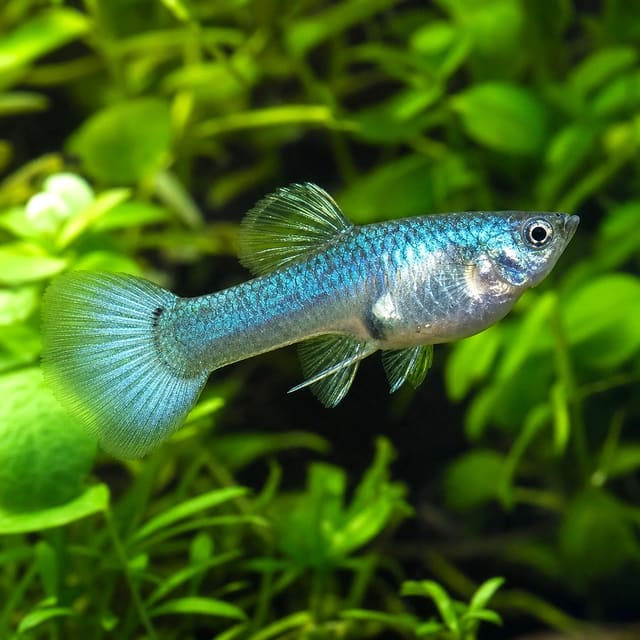
Blue Turquoise Female Guppy (Poecilia reticulata)
22–28°C · pH 7–8
£4.99
The Mosaic Elephant Ear Guppy (Poecilia reticulata) sold here is one female fish, supplied at about 3–4 cm, for a mature, filtered aquarium at least 60 cm long with hard, neutral-to-alkaline water. Keep her with other guppies and peaceful companions that leave fins alone, and plan for fry, because a female guppy can give birth months after mating.
Adult size is the maximum length this species reaches at full maturity (scientific sources). The livestock you receive will be younger and smaller. Product-photo provenance and any image-specific limitations are stated on the listing.
Poecilia reticulata
Shoaling fish: kept in a group they feel safer, stay calmer and show their best colour.
Minimum of 2 per order.
The Mosaic Elephant Ear Guppy (Poecilia reticulata) sold here is one female fish, supplied at about 3–4 cm, for a mature, filtered aquarium at least 60 cm long with hard, neutral-to-alkaline water. Keep her with other guppies and peaceful companions that leave fins alone, and plan for fry, because a female guppy can give birth months after mating.
Adult size is the maximum length this species reaches at full maturity (scientific sources). The livestock you receive will be younger and smaller. Product-photo provenance and any image-specific limitations are stated on the listing.

Guppies are social livebearers suited to a prepared beginner, not a fish-per-litre formula. Use a mature filtered aquarium, tested neutral-to-alkaline mineral-bearing water, deliberate sex and population planning, open swimming room, cover and a separation option.
Maintain these water conditions for optimal health and vibrant colors
The Mosaic Elephant Ear Guppy is a domestic strain of the guppy, Poecilia reticulata, and each purchase supplies one female fish at about 3–4 cm. She belongs in a mature, filtered aquarium at least 60 cm long with hard, neutral-to-alkaline water, living with other guppies and calm companions that leave fins alone. Before ordering, decide what you would do with fry: a female guppy can give birth long after her last contact with a male.
“Mosaic” and “Elephant Ear” are hobby trade labels for a selected colour pattern and fin appearance. Like Moscow, Cobra or Tuxedo, they describe how a line has been bred to look. They do not make a separate species, and they do not change what the fish needs: water, space, food and company are the same as for any guppy.
| Suits | A prepared beginner or experienced keeper with a cycled aquarium at least 60 cm long |
|---|---|
| Supplied | One female guppy per purchase, about 3–4 cm on dispatch |
| Adult size | Up to about 6 cm standard length (body without the tail); females are the larger sex |
| Water we recommend | 22–28°C, pH 7–8, general hardness 8–18 dGH |
| Company | A group of guppies; we suggest starting with five or more |
| Temperament | Very peaceful; keep away from fin-nipping fish |
| Diet | Omnivore: quality flake or granule plus small live or frozen foods |
| Breeding | Livebearer; a female may already carry sperm from an earlier mating |
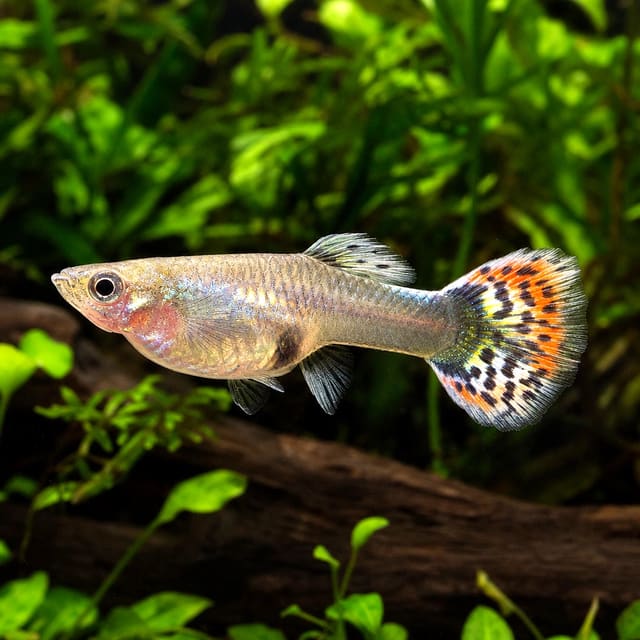
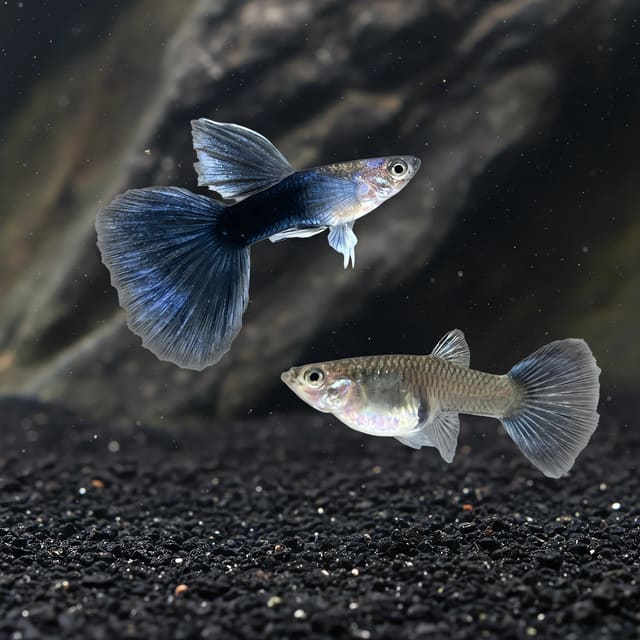
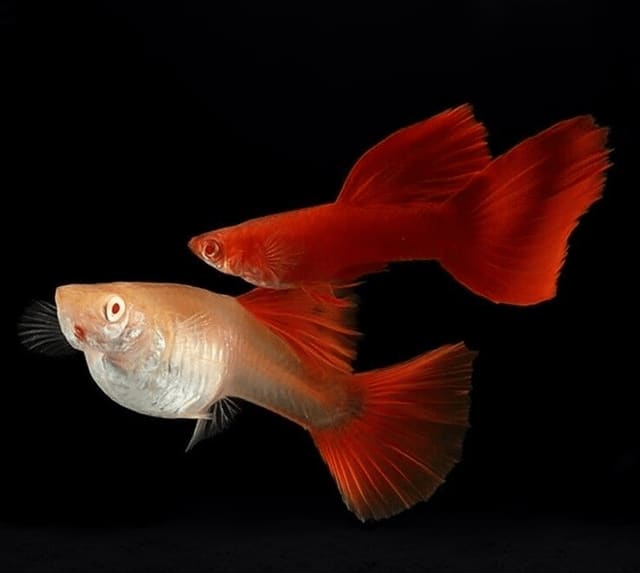
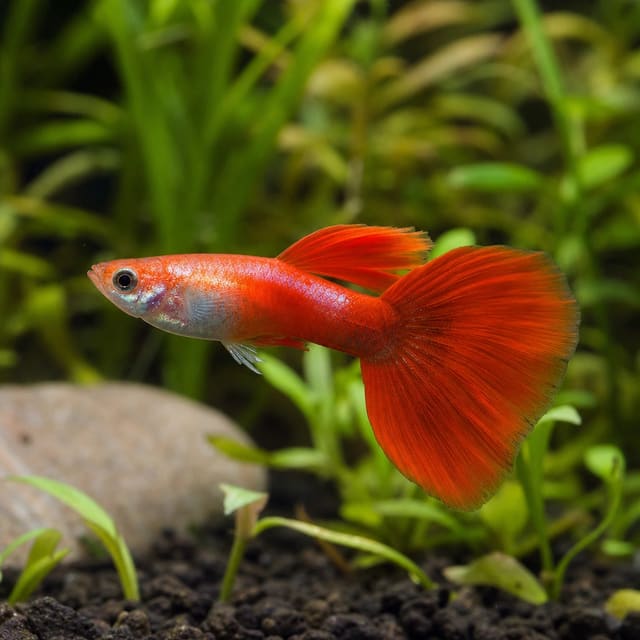
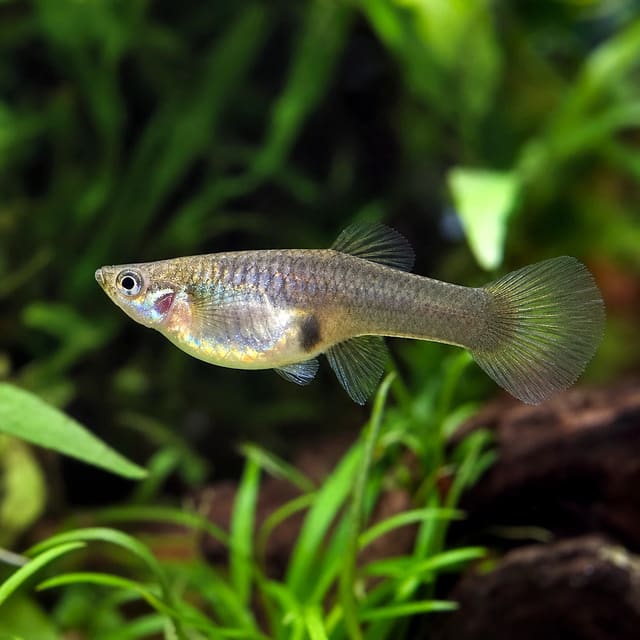
In the wild type, male guppies are the more colourful sex with the longer fins, and Seriously Fish notes that selective breeding has taken both to extremes. Females are larger and plumper, and although they are generally duller, aquarium-bred varieties can show intense colour in the tail fin. A few females give a group body and calm, and buying one changes the questions to answer before she arrives.
Sex is guaranteed only when the exact product or selected option explicitly states male or female. This Poecilia ret. female mosaic elephant ears listing is sold as female. Each purchase is one fish, so order the number you need for the group you are planning.
Wild guppies are native to Venezuela, Barbados, Trinidad, northern Brazil and the Guianas. FishBase’s species summary describes them in warm springs, weedy ditches and canals, very small streams and densely vegetated lakes, usually where predation pressure is low, and in habitats ranging from turbid lowland ponds to clear mountain streams. The species is listed as Least Concern by the IUCN and is one of the most popular aquarium fishes, with many standardised varieties. Aquarium strains such as this one are far removed from their wild ancestors in colour and finnage, but they share the same basic biology.
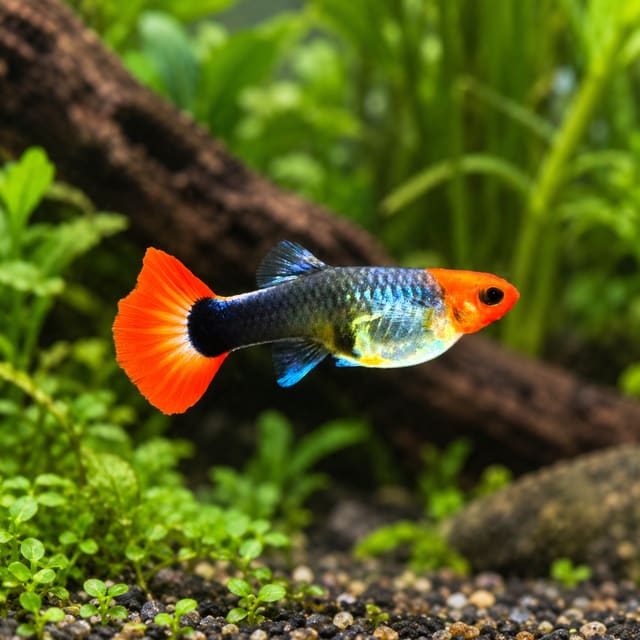
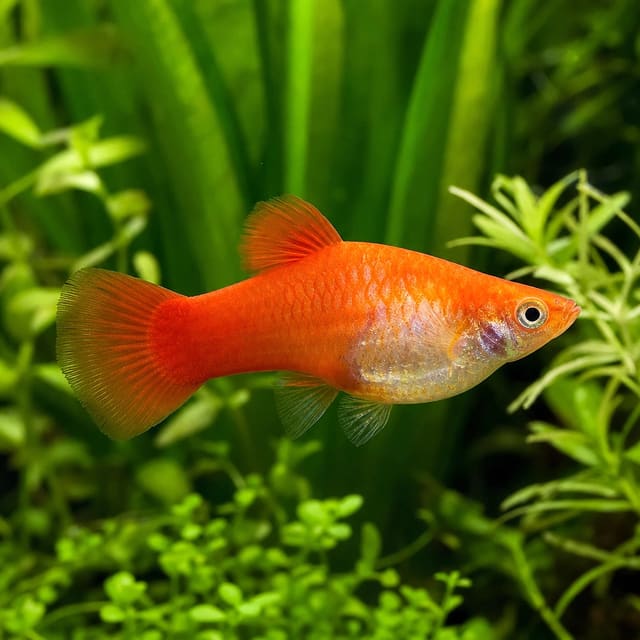
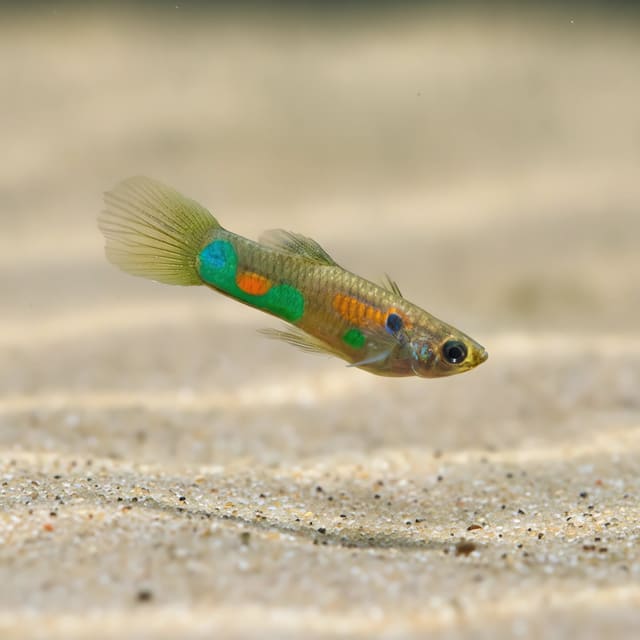
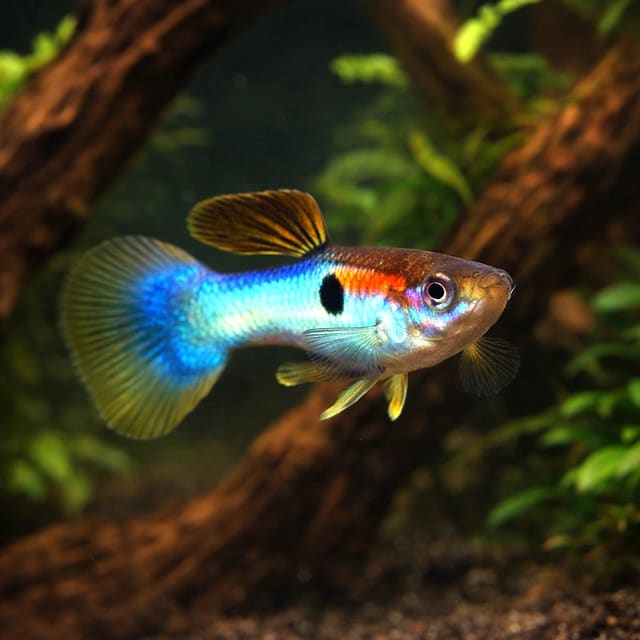
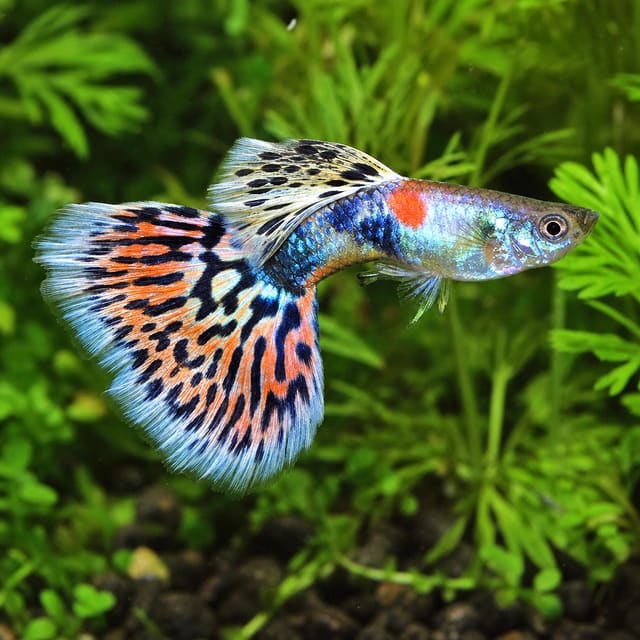
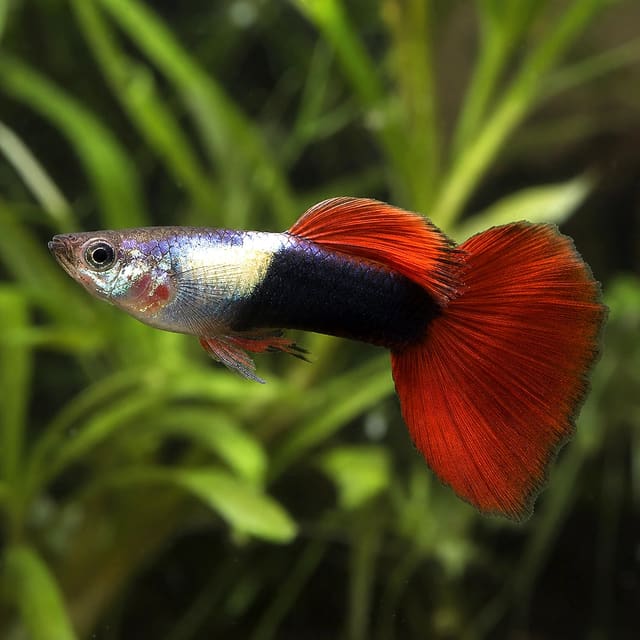
Every fish in a selected strain is a little different in pattern, colour intensity and fin shape. Gallery images have been digitally enhanced to improve image quality. Natural colour, pattern, size and maturity can vary between live animals. A female supplied at 3–4 cm may not yet have reached her full adult size or colour.
For the species in more depth, including its naming history and the reasoning behind our house recommendations, read our complete guppy care guide.
Guppies are small, but a group needs swimming length, steady water and room for any fry a female produces. Four references give slightly different starting points:
| Reference | Starting point for a small group |
|---|---|
| FishBase aquarium note | Minimum aquarium length of 60 cm, with guppies kept in groups of five or more |
| OATA guppy and molly sheet | At least 45 litres for a small group of the smaller livebearers, larger where possible |
| Seriously Fish profile | A base of 45 × 30 cm, roughly 41 litres |
| Tropical Fish Co house plan | At least 60 cm long, fully cycled and tested, for one small group |
We follow the most cautious of these, the 60 cm length, because length gives a group room to swim and gives a female space away from persistent males. Litres alone cannot show whether a tank is suitable: the footprint, the filter, existing fish, the sex mix and any fry all change the answer.
Measure the internal dimensions to confirm the real water volume, and resist turning that number into a fish-per-litre rule. Watch the group itself: if one fish is chased, misses food or hides constantly, the tank needs a change of plan rather than another fish.
The RSPCA’s aquarium environment advice is clear that no fish should be kept without a well set up and maintained filter. Fish release ammonia, which is toxic; a working biological filter grows beneficial bacteria that turn ammonia into nitrite, also toxic, and then into nitrate, which is safer. OATA adds that ammonia and nitrite should both read zero before any fish goes in, and that numbers should rise slowly, because the bacteria need time to catch up each time stock and feeding increase. Stocking too many fish too quickly causes ‘new tank syndrome’, when ammonia and nitrite climb high enough to make fish ill or kill them.
If this is your first aquarium, our step-by-step guide to setting up and maturing a first tropical tank covers the whole process before any livestock is ordered. Confirm that the tank is cycled with repeated water tests rather than by counting weeks.
Seriously Fish suggests a filter that turns the water over four to five times an hour: for a tank of about 41 litres that is a filter rated around 165–205 litres per hour, with roughly 50 W of heating to hold its temperature range in a room at about 20°C. Larger tanks scale up accordingly. Guppies do best without strong currents, so choose and position the filter so that the flow never pins, tires or buffets the fish, and make sure the intake cannot endanger small fish or fry.
In most UK homes a guppy tank needs a thermostatic heater. Check the water itself with a separate aquarium thermometer rather than trusting the heater dial or the room temperature, and look at it daily when you feed.
Seriously Fish describes Poecilia reticulata as a hard-water fish: it may manage in soft or acidic water, but long-term keeping should be in moderately hard or harder water. Different references publish different ranges because they measure different things, from wild records to practical aquarium advice.
| Reference | Published values |
|---|---|
| Tropical Fish Co routine range | 22–28°C |
| OATA guppy and molly sheet | 20–28°C; pH 7.0–8.0; general hardness 8–18°dH; carbonate hardness 5–15°dKH; zero ammonia and nitrite; nitrate no more than 20 mg per litre above tap-water level |
| Seriously Fish species profile | 17–28°C; pH 7.0–8.5; 8–30 dGH |
| FishBase wild records | 18–28°C; pH 7.0–8.0; 9–19 dH |
We recommend 22–28°C, pH 7–8 and a general hardness of 8–18 dGH. The pH and hardness figures come from OATA’s combined guppy and molly sheet, which is broad guidance for a group of livebearers, and they sit comfortably inside the wider Seriously Fish ranges. The FishBase figures describe where the species has been recorded in the wild, and the cooler ends of the FishBase and Seriously Fish ranges fall outside our routine range; they are not targets for a home aquarium.
UK tap water is not one chemistry. Supplies differ from region to region and can be blended or changed by the water company, so read a recent report for your area and test the water you actually use. Treat every top-up and water change with a conditioner that removes chlorine and chloramine, and make changes gradually so temperature and hardness do not swing.
Suppose your tap water tests at pH 7.6 with a general hardness of 12 dGH, and the aquarium holds 25°C. All three readings sit inside the values we recommend, so the job is to keep them steady with matched water changes. If the same test showed pH 6.4 and 3 dGH, your supply is softer and more acidic than a guppy needs for long-term keeping, and a community built around soft-water fish would suit it better than guppies.
Guppies also occur in brackish water, and FishBase notes a wide salinity range. That is not a reason to add aquarium salt. Leave salt and mineral products out unless you have a measured reason and have checked that every fish and plant in the tank will tolerate them.
Our guide to which aquarium water values to test and why explains ammonia, nitrite, nitrate, pH and hardness in plain terms. Once you have readings, the water parameter matcher compares your aquarium with a fish’s stated range, which is a quick way to see whether your tap water suits a hard-water fish such as this one before you order.
A guppy aquarium works best with open water for swimming and feeding, and planted areas for cover. Seriously Fish calls the species unfussy, but notes that a planted tank with floating vegetation is appreciated and that strong currents should be avoided. OATA recommends gravel or sand, live plants for cover and, where live plants are not used, artificial plants and ornaments that give shelter without injuring long fins.
More decoration is not automatically better. A 2025 guppy study found that physical enrichment improved several behavioural and stress-hormone measures, but high enrichment also brought more biting. Add structure, watch how the group uses it and rearrange if one fish is still cornered or kept from food.
Dense cover also raises fry survival. That can be welcome in a deliberately managed breeding set-up, but it means more young fish needing space, filtration and homes, so plants are not a substitute for a population plan. Keep the front of the aquarium clear enough to count the group and see each fish at feeding time.
Guppies are omnivores. In the wild they feed on zooplankton, small insects and detritus, according to FishBase, and Seriously Fish describes wild fish as mainly insectivorous. Aquarium-bred strains are far removed from their ancestors and accept most foods, so the aim is a balanced routine rather than a special diet.
Watch the whole group at feeding time and make sure a newcomer or a shyer fish is not being crowded out, rather than assuming the group’s appetite covers her.
A healthy female is naturally deeper-bodied than a male, and her belly looks fuller after a meal or as she matures. A rounded abdomen is not a reliable sign of pregnancy on its own, so keep portions steady rather than feeding more because she looks heavy. A thin, pinched belly or a female that stops eating is the more urgent signal.
If fry appear and you decide to raise them, they need food small enough for their mouths and especially careful water testing, because extra food in a small nursery quickly affects water quality.
Prepare and test the aquarium before dispatch so she goes straight into stable, cycled water. Fish are hand-bagged in pure oxygen and packed in an insulated poly box, with a heat pack when the weather calls for it, and we email the tracking number and your confirmed delivery date so you know when to be in. Our delivery and Live Arrival Guarantee page sets out coverage, packing and claim terms in full.
OATA advises increasing fish numbers slowly, because the filter bacteria must grow each time stock and feeding rise. One female is a small addition, but if you are building a group, add fish in stages and test between additions. Watch how any males react: constant pursuit of the newcomer means the group needs more females, more cover or a different plan.
Watch quietly rather than handling or rearranging. OATA describes a healthy fish as having clear, bright eyes, undamaged fins, intact scales, no ulcers or bumps and normal swimming. Test ammonia and nitrite over the first days, as the filter adjusts to one more fish and a little more food.
If breathing, balance or swimming worries you, test the water straight away and follow the reporting steps promptly. Continuing distress should not be written off as travel stress.
That routine follows the OATA guppy and molly care sheet, which stresses that good husbandry is essential because guppies and mollies can be stressed by even small amounts of ammonia.
These are warning signs rather than a diagnosis. Test ammonia, nitrite, nitrate, pH and temperature first, then look at the filter, heater, recent maintenance, food, any new arrivals and how the group is behaving. Record what you see with dates or photographs. The RSPCA’s fish health and welfare advice covers normal and worrying signs, and OATA’s directory of UK fish vets helps you find a professional diagnosis. Avoid choosing salt, heat or medication from one symptom; in the UK, use lawfully labelled products and follow veterinary direction.
Seriously Fish warns that many mass-produced guppies are less hardy because of inbreeding and over-production, and more prone to disease. That is a good reason to quarantine any new fish, including this one, before she joins an established community. The MSD Veterinary Manual recommends at least 30 days in a separate system with its own equipment, biologically supported filtration and regular testing, and longer where problems are suspected.
Guppies are livebearers, so a female gives birth to live young rather than laying eggs. FishBase records that females mature at about three months of age and males at about two, so a young mixed group can start breeding quickly. Seriously Fish calls breeding very easy, which is exactly why it needs planning.
A female guppy can keep viable sperm after mating and use it for later broods. Seriously Fish reports females producing young for six months or more with no male present, and peer-reviewed research documents storage over several months. Even in an all-female tank, she may give birth later if she met a male before sale.
Keepers often watch for a gravid spot, a darkened area just behind the anal fin, together with a fuller outline. Treat these as hints rather than certainties: a rounded abdomen or dark patch is not a reliable sign of pregnancy on its own, and colour varies between domestic strains. Seriously Fish gives broods of roughly 5 to 100 young after a gestation of about four to six weeks, but timing and numbers vary between females and conditions.
| Your plan | What it means in practice |
|---|---|
| Leave any fry in the main aquarium | Adult guppies will eat the young, and other fish may too; predation is not a population plan or a welfare plan. |
| Raise fry deliberately | Use a separate, cycled nursery with biological filtration, a heater and repeated testing that keeps ammonia and nitrite at zero; dense floating plants improve survival. |
| Keep numbers level | Arrange responsible rehoming before fry arrive, and keep the aquarium’s capacity in mind as young fish grow. |
| Keep a mixed-sex group | Expect regular broods; OATA’s two females per male spreads male attention but does not limit breeding. |
Avoid confining a female in a small, uncycled container to give birth; it is not a safe shortcut. If you move fry, move them to water that already matches the main aquarium.
Guppies have been introduced far beyond their native range, often for mosquito control. FishBase records rare to non-existing effects on mosquitoes and negative to perhaps neutral effects on native fishes. Never release guppies, fry, plants, snails or aquarium water into a pond, drain, stream or any natural water. Rehome surplus fish responsibly and dispose of old water and substrate where nothing can reach a watercourse.
Seriously Fish describes the guppy as a very peaceful fish that does well in a quiet community aquarium with other livebearers, rasboras, corydoras, small loricariids and tetras. Treat that list as a set of candidates: each companion still has to share hard, neutral-to-alkaline water, leave long fins alone and fit the aquarium once both groups are counted.
Fin-nippers are the clearest mismatch. Seriously Fish names tiger barbs and serpae tetras, and OATA advises against keeping guppies with any species that might nip their fins, such as barbs. Large or predatory fish that could swallow or injure a guppy are also unsuitable.
| Group plan | What to expect with this female |
|---|---|
| All-female group | No new mating in your tank, though she may carry stored sperm; females can still compete for food and space. |
| Mixed sexes | Courtship and likely fry. OATA suggests at least three fish with two females to each male, and Seriously Fish advises several females per male; no ratio removes pressure completely. |
| One female with several males | She would carry the attention of every male, which the ratio advice is designed to avoid. |
Peer-reviewed research shows that male harassment can change where females spend their time. Give her space and planted refuges, check that she feeds and keeps condition, and keep a cycled separation tank available. Repeated chasing, cornering, hiding or fin damage needs action, not another fish.
If you are building a larger group, the guppy collection shows other strains and sexes; check each listing for its exact sex and sale unit before settling your ratio.
Endler’s livebearer, Poecilia wingei, was formally described as a separate species in 2005 and is listed as valid in Eschmeyer’s Catalog of Fishes. Laboratory research confirms that guppies and Endler’s livebearers can hybridise through first- and second-generation crosses. Keep the two in separate aquariums if you want either line to stay true, and never pass on hybrid offspring as either pure species.
Female guppies are the larger sex. Seriously Fish records a standard length of up to 60 mm, measured without the tail, and FishBase gives 5 cm for males, so plan for an adult female of about 5 to 6 cm plus her tail fin.
Use a mature, filtered aquarium at least 60 cm long for one small group. That is our house plan, based on the 60 cm minimum in FishBase's aquarium note. OATA's guppy and molly guidance gives at least 45 litres for a small group of the smaller livebearers, and Seriously Fish suggests a base of 45 × 30 cm, so treat those figures as floors rather than targets.
Keep her in a group. OATA advises at least three guppies, with two females to each male in a mixed group, and FishBase's aquarium note gives groups of five or more, which is the starting group we recommend. That can be all female, or mixed with several females to each male if you are ready for fry.
Yes, for a prepared beginner. Guppies are peaceful and undemanding once the aquarium is cycled, but they are not suited to a new tank that still shows ammonia or nitrite. Decide the sex mix of the group and what you will do with fry before you buy.
Guppies are omnivores. OATA recommends a good-quality flake or granule with a high algae content, plus small live or frozen foods such as daphnia or small bloodworm, fed once a day in an amount the fish can eat within a few minutes.
We keep guppies at 22–28°C. OATA's guppy and molly guidance gives pH 7.0–8.0 and a general hardness of 8–18 dGH, with zero ammonia and nitrite. Seriously Fish describes the species as a hard-water fish, so avoid soft, acidic water for long-term keeping.
No. Seriously Fish describes the guppy as a very peaceful fish, and guppies are far more likely to have their own fins nipped than to nip others. Males do chase females persistently, so give a female planted refuges and enough companions to share that attention.
Seriously Fish lists other livebearers, rasboras, corydoras, small loricariids and tetras for a quiet community aquarium, as long as each species shares hard, neutral-to-alkaline water and leaves fins alone. Avoid fin-nippers such as tiger barbs and serpae tetras, and remember that small shrimp and newborn fry may be eaten.
She is hand-bagged in pure oxygen and packed in an insulated poly box, with a heat pack when the weather calls for it, then carried by a licensed live-animal courier with tracking. Someone must be at home to receive the parcel. Film one continuous unboxing video from the sealed parcel to the fish still in the sealed bag, then float the bag for 20–30 minutes before release; the Live Arrival Guarantee needs that video.
These public sources support the care, identity and welfare guidance on this page.
No reviews for this item yet. Bought one? Honest reviews only, good or bad.
What customers say about ordering from us
Easy website plenty of info on fish your buying great to pick a time slot
TRACEY DURRANT · 7 Oct 2026
Got some lovely fish thank you
Kevin Mackie · 7 Oct 2026
Reviews of our shop, collected by Judge.me, an independent third-party review collector. Newest first.