
Easy
Guppy male (Poecilia reticulata male mix)
22–28°C · pH 6.8–8.5 · 40L
£3.99
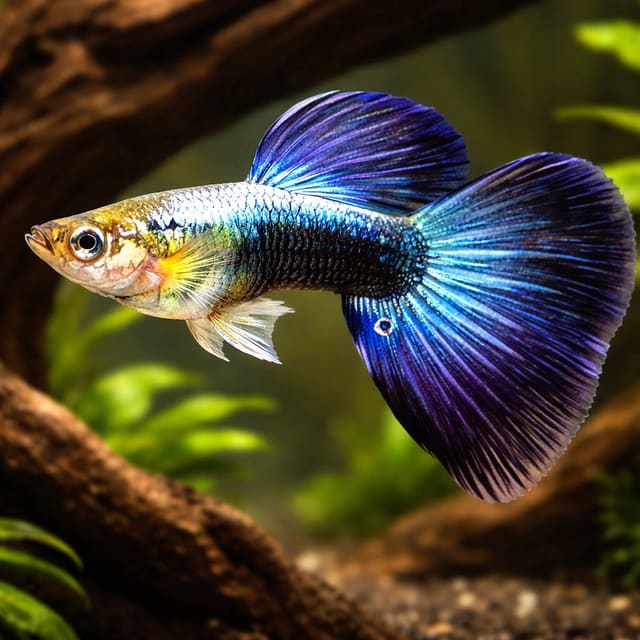
One live Metallic Blue Neon Male Guppy (Poecilia reticulata) per selected quantity, offered in the supplier's approximate 3-4 cm or XL size grade.
Poecilia reticulata
Save when buying multiple fish. Each quantity is one fish; sex and pair formation are not guaranteed unless the selected variant explicitly states them.
Confirm your email, then we’ll send an availability message for this exact item if it returns within 180 days.
This request is only for this product—no newsletter or other promotions. A mail-provider retry may very rarely duplicate the same availability message. Unconfirmed addresses are removed after 48 hours. See our privacy policy.
One live Metallic Blue Neon Male Guppy (Poecilia reticulata) per selected quantity, offered in the supplier's approximate 3-4 cm or XL size grade.
22–28°C · pH 6.8–8.5 · 40L

22–28°C · pH 7–8 · 60L
20–28°C · pH 7–8 · 45L
22–28°C · pH 6.8–8.5 · 40L
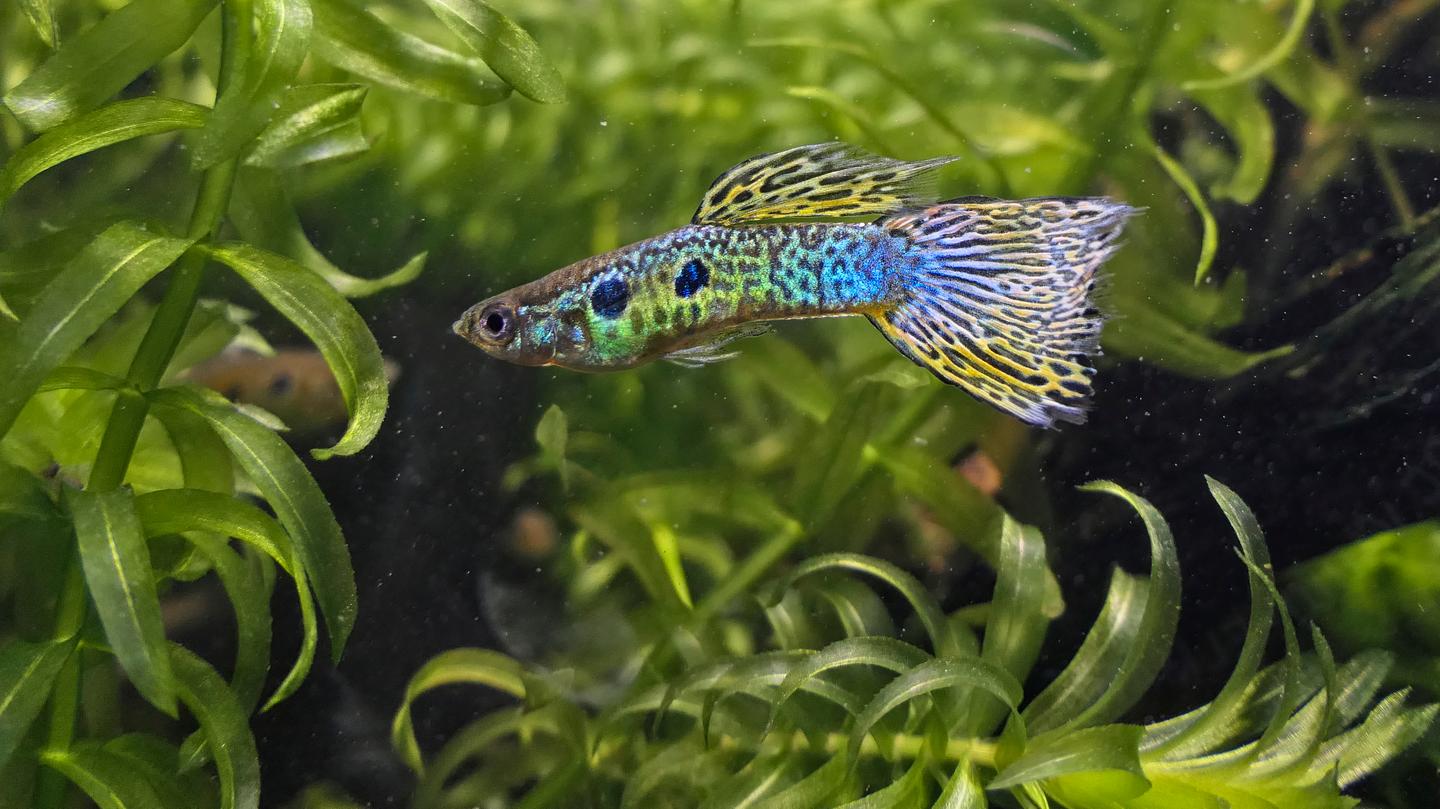
Guppies are social livebearers suited to a prepared beginner, not a fish-per-litre formula. Use a mature filtered aquarium, tested neutral-to-alkaline mineral-bearing water, deliberate sex and population planning, open swimming room, cover and a separation option.
Maintain these water conditions for optimal health and vibrant colors
Each selected quantity supplies one live Metallic Blue Neon Male Guppy in your chosen supplier size option: 3-4 cm or XL. The XL label is a supplier grade rather than a published centimetre range. This is a fancy male Poecilia reticulata selected for its reflective blue body colour and broad, flowing fins; it is not a pair and no female is included.
This small livebearer is peaceful, active and social. One male can be the right purchase when it will join a suitable established guppy group. For a new male-only display, plan a complete group of at least five compatible guppies in a mature aquarium with mineral-rich water, useful swimming length, planted edges and more than one feeding point.
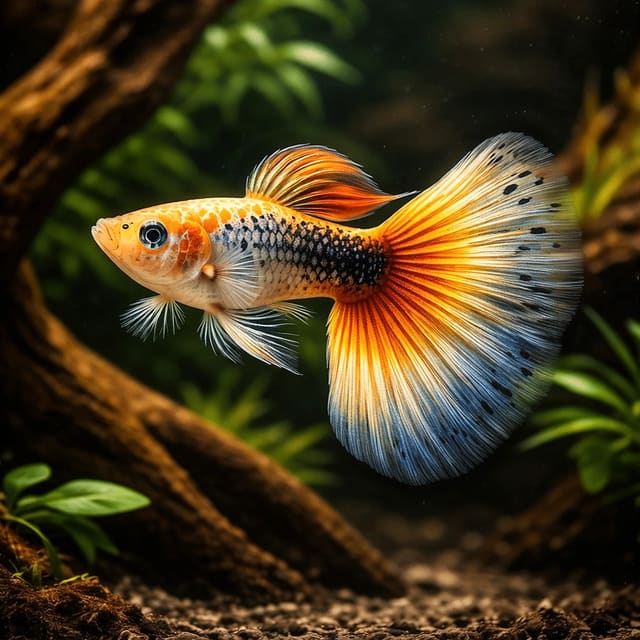
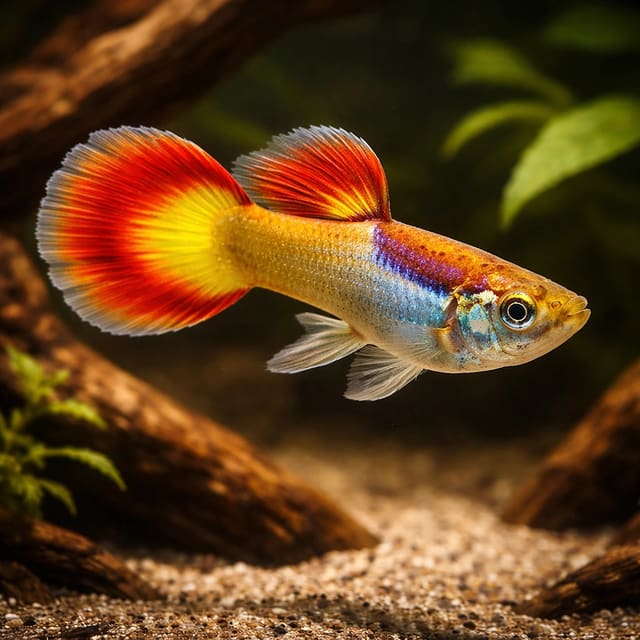
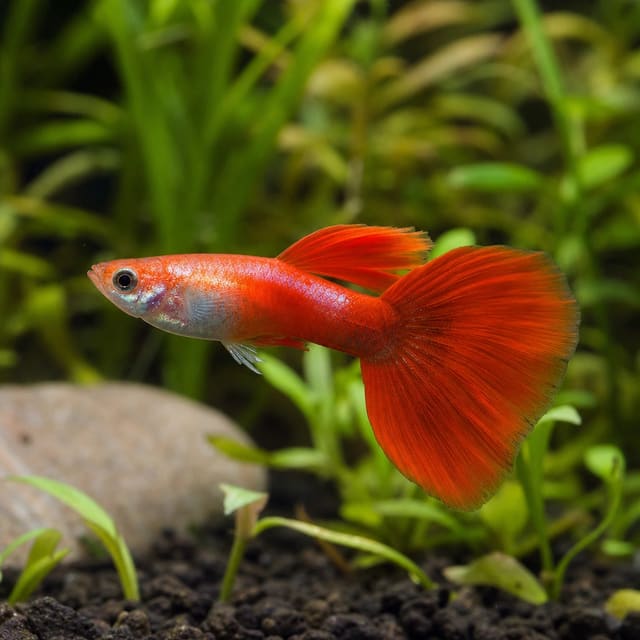
The four gallery photographs are representative views based on the supplier identity reference. They show the intended metallic blue neon trade form, but they are not portraits of the exact fish that will be dispatched. Blue coverage, reflective intensity, body markings, dorsal shape and tail shape vary naturally between individuals.
| At a glance | Evidence-led guidance |
|---|---|
| Scientific name | Poecilia reticulata |
| Family | Poeciliidae |
| Trade form | Metallic Blue Neon Male Guppy |
| Sale unit | One live male fish per selected quantity |
| Size choices | Supplier options 3-4 cm and XL; XL has no stated centimetre range |
| Published male maximum | 5.0 cm standard length in FishBase |
| Care level | Easy to Moderate |
| Temperament | Peaceful and social; males may display and chase |
| Social baseline | Group of five or more; 60 cm minimum aquarium length in FishBase |
| Practical new-group aquarium | Around 60 litres and at least 60 cm long for five small fancy males |
| Water target | 22-26 C, pH 7.0-8.0 and 9-19 dGH |
| Diet | Varied omnivore |
Quantity one supplies one male. Quantity two supplies two males. A gallery scene shows two fish for appearance context, but it does not change the sale unit. No female, pair or breeding set is included with either size option.
The product offers two supplier size grades. The 3-4 cm option has an approximate stated range; XL is the supplier's larger grade without a confirmed numeric range. Select by the visible option at checkout and assess your aquarium for adult guppy needs rather than treating either dispatch label as a final size.
The listing identifies sex, species and trade form. It does not promise one fixed shade of blue, one tail outline or the exact markings in a photograph. Age, ancestry, lighting, background, food, health and the time allowed to settle all influence how a male looks.
| Selected option | What is supplied | What the label does not promise |
|---|---|---|
| 3-4 cm | One male in the supplier's approximate 3-4 cm grade per quantity | An exact millimetre measurement or final adult length |
| XL | One male in the supplier's larger XL grade per quantity | A numeric centimetre range, exact age or breeding maturity |
| Any quantity | The selected number of individual male fish | A female, pair, matched colour set or fish pictured individually |
This fish remains Poecilia reticulata, the guppy. Metallic Blue Neon is an aquarium trade description for the reflective blue appearance of this male form; it is not a separate species. NCBI Taxonomy confirms the accepted species, while FishBase places it in the livebearer family Poeciliidae.
The words describe appearance rather than a scientific colour measurement. Under aquarium light, reflective scales can move from silver-blue to turquoise, deep blue or blue-purple as the fish changes angle. The effect can look strongest against dark planting or wood and less intense immediately after transport.
The supplier has not supplied a named breeder, formal strain standard, genotype, pedigree or inheritance record. This page therefore describes the visible trade form conservatively. It does not claim a genetically fixed line or guarantee how colour would pass to offspring.
The gallery shows a streamlined male with a pale silver-gold front body, darker metallic blue across the rear body and broad blue to violet dorsal and caudal fins. That is useful identification context for the form being offered.
One fish may carry brighter turquoise across the shoulder, another deeper navy toward the tail. Fin rays, dark body coverage, head colour and tail width can differ. This variation is normal for live fancy guppies and is not evidence that the wrong species has been supplied.
Transported guppies can temporarily look pale, keep their fins closer to the body or spend time near cover. Stable water, low lighting and quiet settling usually reveal a more representative appearance. Severe loss of balance, uncontrolled breathing or continuing deterioration is not ordinary colour settling and needs prompt attention.
FishBase records a maximum published male or unsexed length of 5.0 cm standard length. Standard length excludes the tail fin, so a broad-tailed fancy male can appear longer overall. Use adult potential when judging tank mates, filter intakes and swimming space.
A supplier grade is a practical stock category, not a precise biological stage shared by every fish. The 3-4 cm and XL options may differ in body length, maturity and fin development, but the listing does not assign an exact age to either.
A well-conditioned male remains streamlined without looking pinched behind the head. Check the abdomen, spine, fin carriage and appetite. Compare the new fish with its own recent condition; a male should not be expected to have the deeper body profile of a mature female.
FishBase recommends aquarium keeping in groups of five or more. A purchased male may join an established compatible guppy group, but unrelated community fish do not replace guppy social company. Avoid using one male to begin a permanently solitary display.
A group of males provides colour and activity without pregnancy or repeated broods. Male-only does not mean behaviour-free: males may follow, display to or briefly chase one another. A complete group, visual breaks and distributed food reduce the chance that all attention falls on one fish.
Short displays are different from persistent exclusion. Act if one male is repeatedly driven away from food, trapped in one area, losing weight or developing damaged fins. Have a divider or separate mature aquarium available; changing one ornament may not resolve a settled hierarchy.
| Order situation | Responsible starting point | Observation priority |
|---|---|---|
| One male joining a group | Suitable established guppy group in a mature aquarium | Quarantine route, water match and fair feeding access |
| Starting a male-only display | At least five compatible males in around 60 litres and 60 cm length | Open swimming room, planted edges and no persistent exclusion |
| Adding an XL male | Recheck total adult stocking and hierarchy | Existing smaller males can still reach food and retreats |
| Mixed-sex aquarium | Strong female majority and a plan for repeated broods | Female pursuit, population growth and juvenile capacity |
FishBase gives a 60 cm minimum aquarium length. For a new group of five small fancy males, around 60 litres and at least 60 cm of swimming length is a practical starting point. A larger aquarium gives more stable water and more routes around social pressure.
A tall, narrow aquarium can hold the same litres as a longer tank while offering less useful swimming distance and surface area. Check footprint, oxygenation, filtration and the needs of all adult occupants, not just the number printed on the aquarium box.
One ordered male does not require a separate new 60-litre tank if it is joining a mature setup that already supports a suitable guppy group. The decision depends on total adult stock, water chemistry, available swimming room and whether the group remains socially workable.
Maintain 22-26 C for long-term care. FishBase records a broader 18-28 C envelope, but the endpoints should not be treated as preferred everyday targets. Warmer water increases metabolism while holding less oxygen, so temperature changes the aquarium's whole operating margin.
FishBase records pH 7.0-8.0 and 9-19 dH. Many stable hard-water UK aquariums can suit guppies well, while very soft acidic aquascapes are a poor long-term match. Test the actual aquarium instead of guessing from location or tap-water reputation.
Ammonia and nitrite must remain at 0 mg/l. Keep nitrate low and stable with sensible stocking, measured feeding, plant growth where used and regular partial water changes. Test promptly after a filter interruption or whenever breathing and behaviour change.
| Parameter | Practical target | How to use it |
|---|---|---|
| Temperature | 22-26 C | Stable long-term target within the broader published envelope |
| pH | 7.0-8.0 | Neutral to alkaline; stability matters more than abrupt correction |
| General hardness | 9-19 dGH | Mineral-rich water for long-term guppy condition |
| Ammonia | 0 mg/l | Any detectable amount requires investigation and action |
| Nitrite | 0 mg/l | Any detectable amount is unsafe |
| Nitrate | Low and stable | Control through stocking, feeding and maintenance |
Use the water matcher to compare measured conditions before ordering. A temperature match alone is not enough.
Provide reliable filtration and surface movement without making the fish fight one concentrated jet. Broad dorsal and caudal fins create drag. The male should be able to feed, rest and cross the aquarium without being pushed continuously.
Leave a clear path through the front or middle of the aquarium. Plants and wood can frame that space rather than filling it completely. Active guppies benefit from both open water and nearby cover.
Plant the sides and rear or use fine branching structure to interrupt sight lines. Several routes are better than one tight cave where a subordinate fish can be cornered. Check that decor has no sharp edges that can catch a broad tail.
Use a filter-intake guard where needed, cover narrow equipment gaps and fit a secure lid. Guppies investigate the upper water layer and can jump, particularly during introduction or chasing.
A fish can be peaceful yet unsuitable if it needs very soft acidic water. Choose companions that genuinely overlap with pH 7-8 and moderate-to-hard mineral levels, then compare adult size, activity, group size and feeding behaviour.
Other male guppies are the clearest social companions. Selected Endlers, small platies and calm hard-water community fish may work when their own space and group needs are met. Peaceful bottom dwellers still need suitable hardness, substrate, floor area and food access.
Avoid persistent fin nippers and boisterous fish that repeatedly target a flowing tail. A species does not need to be predatory to make a fancy male unsuitable. Observe individuals closely after introduction.
Do not house this small male with large predators or aggressive cichlids. Judge compatibility at the other fish's adult size, not its shop size. A larger XL guppy remains a small, broad-finned livebearer rather than a defence against predation.
| Compatibility group | Examples or situation | Decision rule |
|---|---|---|
| Often suitable | Other male guppies | Complete social group, adequate footprint and no persistent exclusion |
| Often suitable | Selected Endlers and small platies | Water, adult stocking and activity genuinely overlap |
| Use caution | Calm hard-water community and bottom fish | Respect each species' group, substrate, floor and feeding needs |
| Avoid | Persistent fin nippers and rough, boisterous fish | Repeated tail targeting causes chronic stress and injury |
| Avoid | Large predators and aggressive cichlids | High pursuit, stress and predation risk |
| Avoid | Very soft acidic specialists | Long-term water requirements conflict |
Compare other blue forms in the guppy collection, including the Blue Neon Female Guppy, Green Moscow Male Guppy and Blue Cobra Male Guppy. Product links help with appearance choices; they do not override the social and water checks above.
FishBase records zooplankton, small insects and detritus. Primary diet studies also report organic detritus, aquatic macroinvertebrates, algae and diatoms. Together, these sources support a varied omnivorous aquarium diet rather than one rich food used every day.
Choose a quality micro flake or small guppy or tropical granule as the nutritional base. Include an appropriate plant-rich component and rotate measured frozen or live foods such as daphnia, cyclops or baby brine shrimp.
Offer an amount the group can finish promptly. Guppies are eager feeders and can make excess food look necessary. Leftovers break down into water-quality pressure instead of improving growth or colour.
Feed at more than one point and watch the quietest male swallow food. An XL male may reach floating food first, while a smaller new arrival can be displaced. Adjust placement and particle size so every fish receives a fair share.
| Food role | Examples | Practical use |
|---|---|---|
| Complete staple | Quality micro flake or small guppy granule | Regular nutritional foundation |
| Plant-rich component | Balanced algae- or spirulina-containing food | Part of the omnivorous rotation |
| Frozen or live variety | Daphnia, cyclops or baby brine shrimp | Measured addition rather than the whole diet |
| Group management | Small portions at separated points | Helps smaller or quieter males feed |
| Avoid | Large leftovers and one rich food every day | Reduces waste and nutritional imbalance |
A male-only aquarium is a practical way to keep several bright guppy forms without pregnancy and juvenile management. It still needs a complete group, sufficient swimming length and observation of displays or chasing.
Male courtship can place sustained pressure on a single female. If maintaining a mixed-sex group, use a strong female majority, more cover and enough space, and plan for population growth. The female guppy guide explains the additional decisions.
FishBase describes sperm storage and repeated live broods. A female may therefore produce young after moving away from males. There is no parental care, and adults may eat fry; responsible breeding needs a deliberate juvenile plan rather than accidental overcrowding.
Neither size option includes a female or breeding guarantee. Choosing XL does not turn the product into a breeding pair. Buy separate females only after planning group ratios, fry capacity and long-term homes.
A filled tank is not necessarily a cycled tank. Confirm established biological filtration, stable temperature, 0 mg/l ammonia, 0 mg/l nitrite and suitable pH and hardness before placing a live-fish order.
Decide whether the approximate 3-4 cm grade or the supplier's XL grade suits the existing group. A larger label can affect hierarchy and feeding access, but both options require planning for the same adult species and social needs.
Know whether this male is joining an established group or forms part of an order that will create at least five guppies. Do not count unrelated tetras, rasboras or bottom dwellers as guppy social companions.
Read the current livestock delivery and Live Arrival Guarantee information. Choose a date when the parcel can be received promptly and prepare the aquarium before dispatch, not after the fish arrives.
Dim the aquarium lights, verify temperature and chemistry, and keep unnecessary activity away. Have a quarantine or observation route ready. This makes it easier to respond without improvising if the new male is stressed or the established group is too interested.
Use the current livestock acclimation instructions supplied with the order and keep transport water out of the aquarium. The acclimation timer can help organise the process but does not replace observation.
Keep lighting low and feeding light. Let the male locate open water and cover. Temporary caution or paleness can follow transport; uncontrolled breathing, loss of balance or immediate persistent harassment needs prompt action.
Watch every feed and check the dorsal, tail and pectoral edges. Confirm that the male can move across the aquarium, rest and eat. Test water whenever breathing, posture, appetite or swimming changes.
| Time | Action | What to observe |
|---|---|---|
| Before arrival | Test water, dim lights and prepare observation space | 22-26 C, 0 ammonia and 0 nitrite |
| During acclimation | Follow the supplied method and exclude transport water | Controlled breathing and normal orientation |
| First evening | Keep activity and feeding light | Ability to settle without immediate fin targeting |
| Days 2-3 | Offer small foods at separated points | Appetite, feeding access and fin carriage |
| First week | Maintain routine and act early on exclusion | Stable condition and normal group use |
Look at breathing, swimming control, colour trend, fin carriage and food access. A bright male is easy to notice, but use behaviour and body condition alongside colour when judging health.
Set the schedule from nitrate production, stocking and feeding. Match replacement water closely enough to avoid abrupt temperature or chemistry shifts. Frequent consistency is safer than waiting for a large correction.
Maintain reliable flow and preserve mature filter media. Rinse reusable media in removed aquarium water when appropriate and avoid replacing all biological material at once.
Social balance can change as males mature or new fish are added. Recheck feeding points, sight breaks and space after any addition instead of assuming a previously calm aquarium will remain unchanged.
Check ammonia, nitrite, temperature, physical snag points and tank-mate behaviour. Clean water supports recovery but will not stop a persistent nipper or remove a sharp decoration.
Measure temperature, pH, hardness, ammonia and nitrite. Guppies kept long term in unsuitable very soft water may lose condition. Sudden swimming problems also require assessment for injury or disease.
Confirm that the fish can reach food and is not being excluded by larger males. Persistent weight loss, abnormal faeces or continuing appetite loss needs isolation where appropriate and informed diagnosis rather than repeated random treatments.
Test water immediately and check temperature, oxygenation and gill condition. Add aeration when oxygen may be limited, but also identify the cause. Surface gasping across several fish is an aquarium emergency.
| Observation | First checks | Possible action |
|---|---|---|
| Clamped or ragged fins | Water quality, nipping and sharp decor | Correct the cause; separate if damage continues |
| Pale colour after travel | Breathing, balance, temperature and settling | Dim lights and observe; escalate if other signs appear |
| Hollow body | Food access, appetite, faeces and group pressure | Provide fair feeding and investigate persistent decline |
| Shimmying | pH, hardness, temperature, ammonia and nitrite | Stabilise conditions without abrupt chemistry changes |
| Rapid breathing | Oxygen, temperature, ammonia, nitrite and gills | Increase aeration and identify the underlying cause |
All four customer-facing images are representative views based on the supplier identity reference. They communicate the metallic blue neon appearance and aquarium context; they do not show the exact individual that will be packed.
One gallery scene contains two males. Every selected quantity still supplies one male in the chosen size option. The image is useful for showing the form in a social setting, not for defining quantity.
A plant scene illustrates how blue colour can contrast with greenery. Plant leaves vary greatly in real size, so use the supplier size labels and adult species guidance rather than estimating length from the picture.
The small Petra reference remains retained privately for provenance because it carries a visible supplier watermark and limited resolution. It has not replaced or removed any of the four clean live gallery images.
The Blue Neon Female Guppy offers a female blue-neon choice, while the Blue Cobra Male Guppy has a different patterned male trade form. Availability and exact appearance vary by listing.
Compare the Green Moscow Male Guppy or the broad-pectoral Dumbo Ear Male Guppy. Keep group and water needs central rather than choosing solely by colour.
Use the complete guppy care guide, the UK guppy guide and the guppy types guide to compare social plans, sex ratios and fancy forms.
FishBase supports the species identity, family, water envelope, published size, social baseline, diet and reproductive biology used on this page. NCBI Taxonomy independently confirms the accepted species.
Primary studies indexed by PubMed report varied wild feeding involving detritus, aquatic invertebrates, algae and diatoms. See the studies on diet composition in wild guppies and comparative larvivorous feeding. The evidence supports variety; it does not mean a home aquarium should be fed uncontrolled wild foods.
Peer-reviewed research describes guppy shoaling interaction rules and the effect of male courtship pressure on females. These findings support groups and careful mixed-sex planning, but no study can guarantee the behaviour of every retail fish in every aquarium.
No source supplied a breeder name, locality certificate, pedigree, genotype or formal Metallic Blue Neon strain standard. Those claims have deliberately not been invented. Care ranges are practical targets, not promises that a fish will tolerate abrupt movement anywhere inside them.
Eligible UK livestock orders are covered by the Live Arrival Guarantee when the current delivery terms and reporting steps are followed. Review those terms before ordering and arrange prompt receipt of the parcel.
Eligible first-time customers can use WELCOME10 for 10% off under the current promotion terms. Enter the code at checkout; eligibility and exclusions are determined by the live checkout rules.
Price and stock can differ between 3-4 cm and XL. Use the live variant selector for the current position rather than relying on descriptive text or an older search result.
The listing keeps sale unit, size choices, social planning, water requirements, feeding and arrival guidance together so the fish can be chosen for an aquarium that is already suitable.
One live Metallic Blue Neon Male Guppy is supplied per selected quantity in the chosen supplier size option.
The supplier options are approximately 3-4 cm and XL. No exact centimetre range has been supplied for XL.
No. Quantity one supplies one male fish. The two-fish scene is representative social context only.
No. It is a fancy aquarium trade form of Poecilia reticulata, the guppy.
No. Blue coverage, reflective intensity, markings, dorsal shape and tail shape vary naturally. The images represent the offered form rather than the exact dispatched fish.
FishBase records a maximum published male or unsexed length of 5.0 cm standard length, excluding the tail fin.
A permanent solitary setup is not recommended. One ordered male should join a suitable established guppy group.
FishBase recommends groups of five or more. A new group of five small fancy males should start around 60 litres with at least 60 cm of aquarium length.
Use a stable 22-26 C as the practical long-term target.
Aim for pH 7.0-8.0 and 9-19 dGH, with 0 mg/l ammonia and 0 mg/l nitrite.
Yes. A complete male-only group avoids fry, although males may still display or chase and need space and cover.
That is not the recommended default because one female may receive concentrated courtship pressure. Mixed-sex groups need a strong female majority and a plan for fry.
Use a complete micro flake or small guppy granule, an appropriate plant-rich component and measured frozen or live variety.
Avoid persistent fin nippers, large predators, aggressive cichlids and very soft acidic specialists.
Not necessarily. XL is a supplier size grade, not a guarantee of age, maturity, fertility or breeding condition.
Eligible UK livestock orders are covered when the current delivery terms and reporting requirements are followed.
Eligible first-time customers can enter WELCOME10 for 10% off, subject to the live promotion and checkout terms.
No reviews yet. Bought this fish? You'd be the first — honest reviews only, good or bad.
