Easy
Blue Moscow Male Guppy (Poecilia reticulata)
22–28°C · pH 7–8 · 45L
£6.49

Photo coming soon
The size, price and care details on this page are for this listing.
The Blue Neon Female Guppy (Poecilia reticulata) is a poeciliid livebearer from Venezuela, Barbados, Trinidad, northern Brazil and the Guianas that reaches 5 cm. It suits a prepared beginner keeping five or more; the Tropical Fish Co care guide and Seriously Fish overlap at 22–28°C, pH 7.0–8.0 and 8–18 dGH. Sold individually at a 3–4 cm dispatch size.
Adult size is the maximum length this species reaches at full maturity (scientific sources). The livestock you receive will be younger and smaller. Product-photo provenance and any image-specific limitations are stated on the listing.
Poecilia reticulata
Shoaling fish: kept in a group they feel safer, stay calmer and show their best colour.
Minimum of 2 per order.
The Blue Neon Female Guppy (Poecilia reticulata) is a poeciliid livebearer from Venezuela, Barbados, Trinidad, northern Brazil and the Guianas that reaches 5 cm. It suits a prepared beginner keeping five or more; the Tropical Fish Co care guide and Seriously Fish overlap at 22–28°C, pH 7.0–8.0 and 8–18 dGH. Sold individually at a 3–4 cm dispatch size.
Adult size is the maximum length this species reaches at full maturity (scientific sources). The livestock you receive will be younger and smaller. Product-photo provenance and any image-specific limitations are stated on the listing.
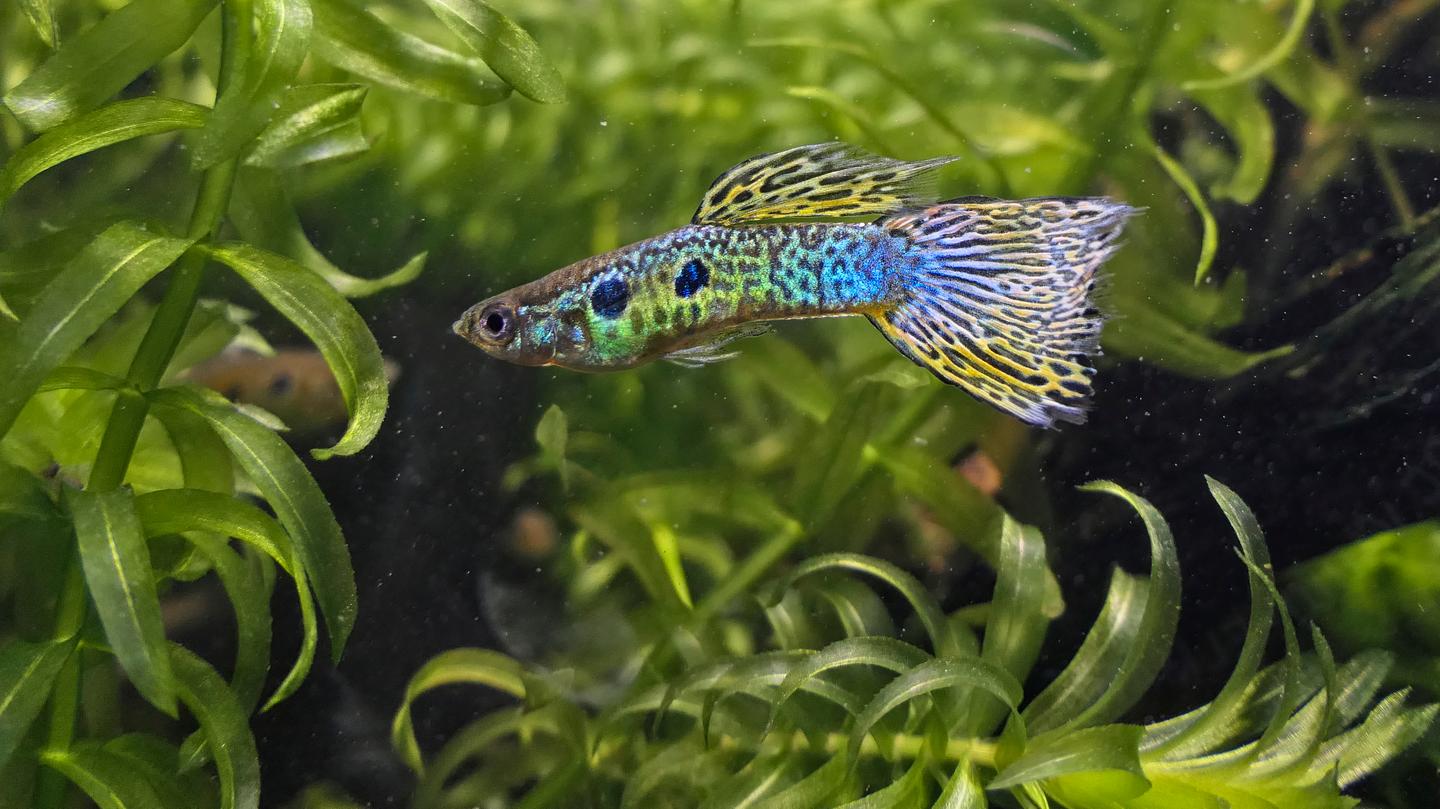
Guppies are social livebearers suited to a prepared beginner, not a fish-per-litre formula. Use a mature filtered aquarium, tested neutral-to-alkaline mineral-bearing water, deliberate sex and population planning, open swimming room, cover and a separation option.
Maintain these water conditions for optimal health and vibrant colors
The Blue Neon Female Guppy (Poecilia reticulata) is a peaceful poeciliid livebearer from Venezuela, Barbados, Trinidad, northern Brazil and the Guianas. This female form reaches 5 cm standard length and suits a prepared beginner who can provide a mature, filtered aquarium, mineral-bearing water and an appropriate social group. FishBase describes the species in freshwater and brackish habitats, including small streams, densely vegetated lakes and springs, ponds, canals and ditches.
Blue Neon is a selected aquarium colour label rather than a separate species or wild locality. The fish remains Poecilia reticulata, and its blue colour does not change the need for stable water, social planning or protection from fin-nipping companions. Our complete Guppy Care Guide rates guppies as easy for a prepared keeper, not as fish for an uncycled bowl or an aquarium chosen through a fish-per-litre formula.
| Suits | Not suited to |
|---|---|
| A mature, filtered aquarium at least 60 cm long | An uncycled or unfiltered container |
| A planned group of five or more guppies | Permanent solitary housing |
| Neutral-to-alkaline, moderately hard water | Long-term soft or acidic conditions |
| A quiet community screened for compatible needs | Tiger barbs, serpae tetras or other fin-nipping species |
| Open swimming room with plants or other cover | Strong current that impedes normal swimming |
Plan for a female reaching 5 cm standard length. Standard length measures the body without the tail fin, so visible tip-to-tip length may be greater. Domestic tail length varies, so a long tail adds to the overall length without changing that body measurement. Use 5 cm throughout aquarium planning rather than treating the dispatch measurement as a permanent size.
Our conservative house screen is a mature, filtered aquarium at least 60 cm long for one small guppy group, with five or more fish where the sex plan, filtration, water tests and other livestock allow. Seriously Fish gives a 45 × 30 cm base and approximately 41 litres, while FishBase gives a minimum aquarium length of 60 cm, so meet the 60 cm length even when a shorter aquarium holds 41 litres. Length, footprint and mature filtration therefore matter alongside nominal volume.
Keep the water at 22–28°C, pH 7.0–8.0 and 8–18 dGH. These routine values are the overlap of the Tropical Fish Co species guide and the Seriously Fish profile; OATA’s guppy-and-molly guidance also gives pH 7.0–8.0 and 8–18 dGH. Hold ammonia and nitrite at 0 mg/l.
One purchase supplies one Blue Neon Female Guppy at a 3–4 cm dispatch size. This measurement describes the fish sent, not its adult length, so assess the aquarium against the 5 cm adult female size. The fish is sold individually rather than as a pair, trio or complete social group.
Sex is guaranteed only when the exact product or selected option explicitly states male or female. This Blue Neon Female Guppy listing is sold as female.
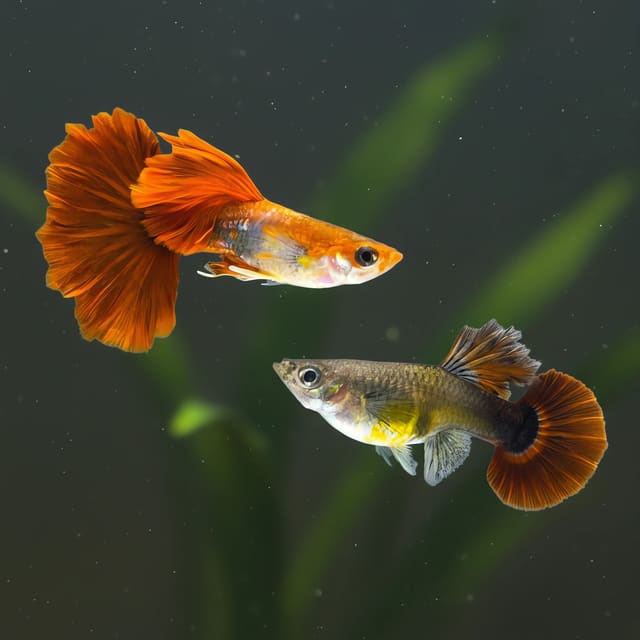
A mature male guppy has a narrow modified anal fin called a gonopodium, while a mature female has a broader, triangular anal fin. Domestic females can show strong colour in the tail, so colour alone is not a reliable sexing method. Plan for the possibility that this female has already mated and may later produce fry.
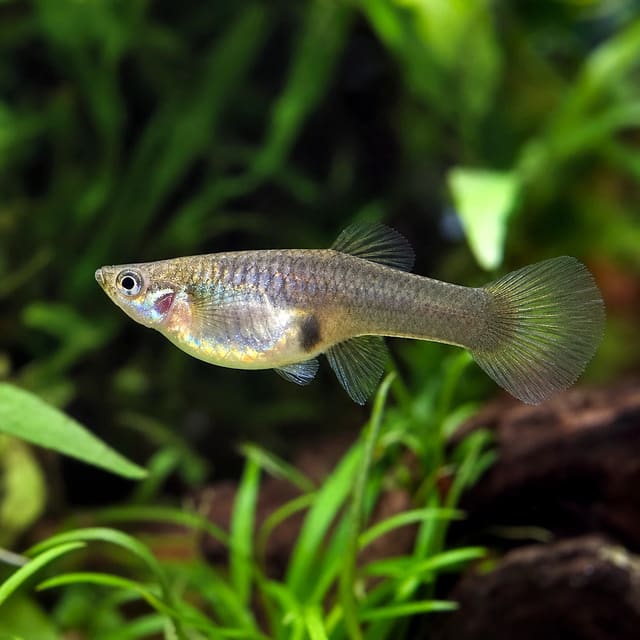
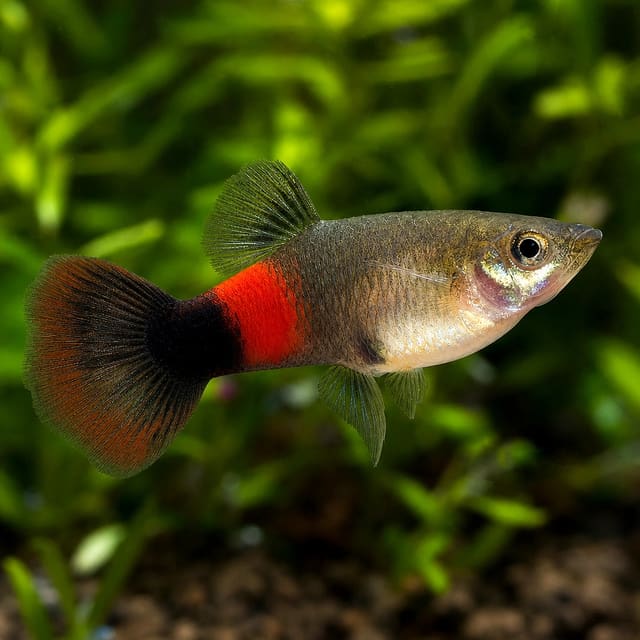
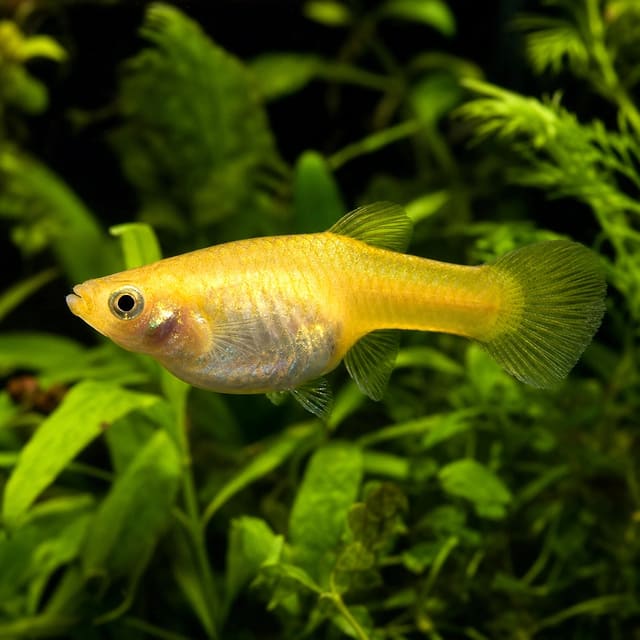
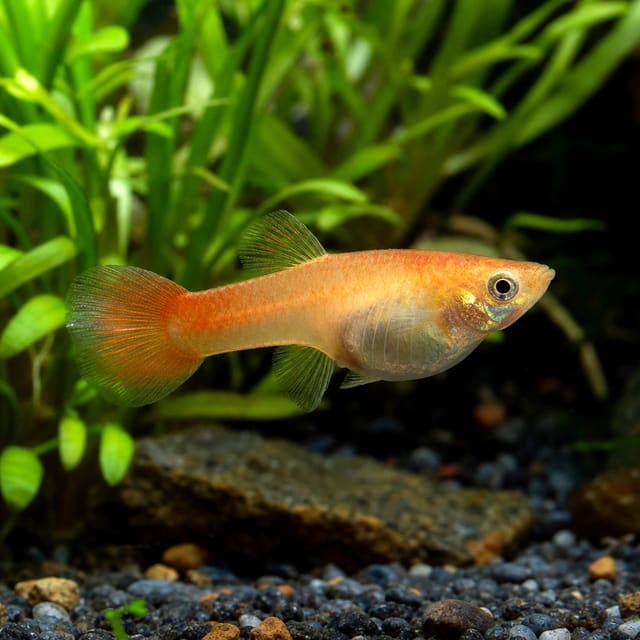
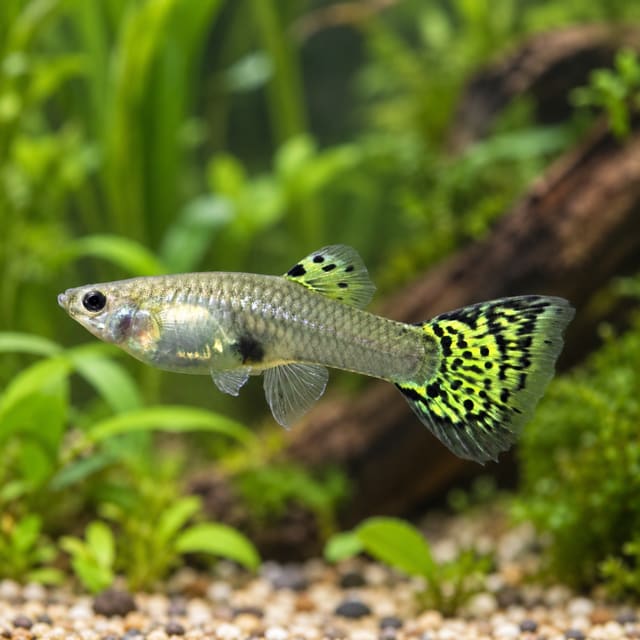
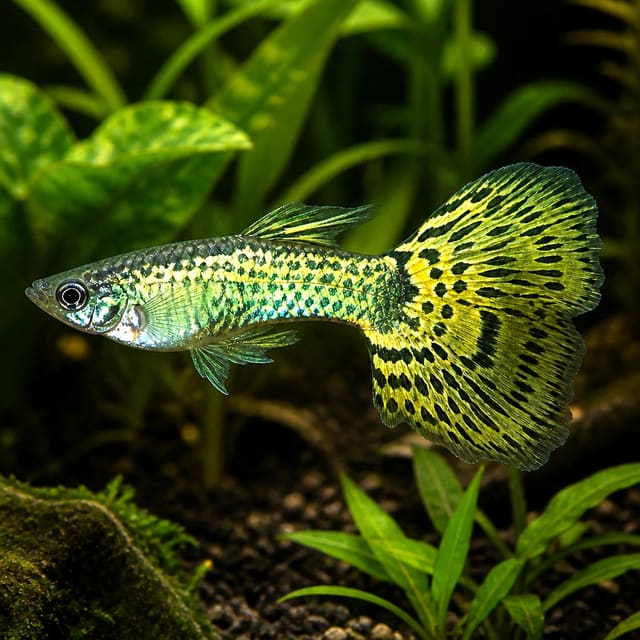
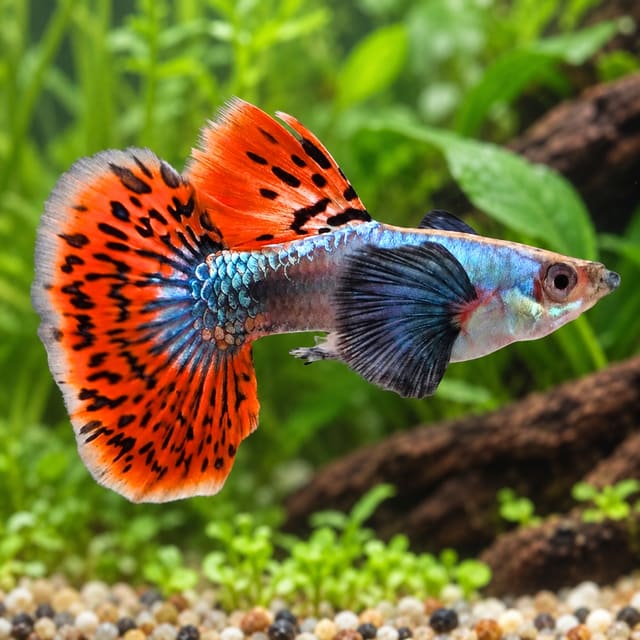
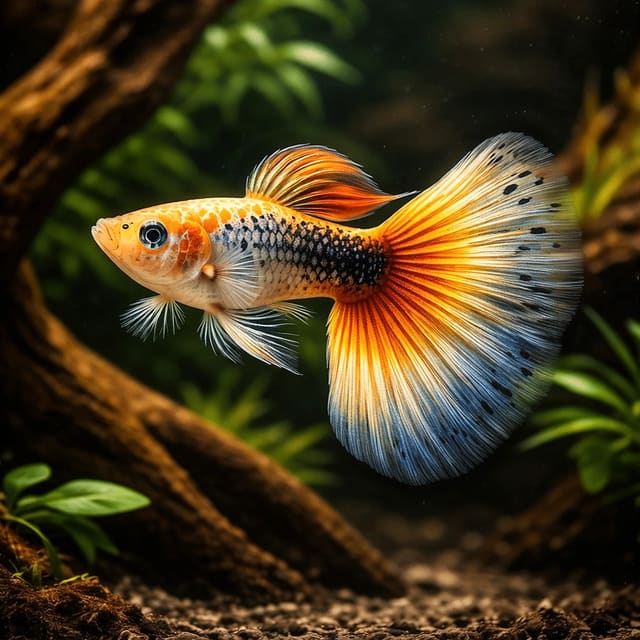
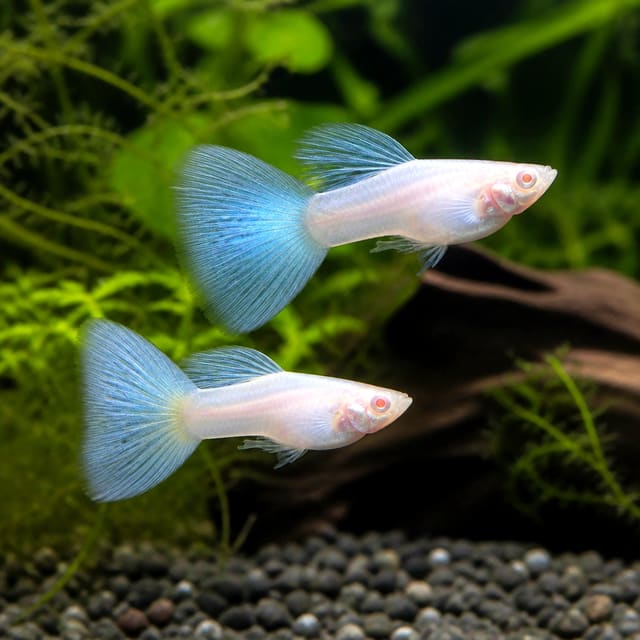
The gallery images are representative of this type of animal rather than photographs of the exact animal supplied, so colours can look slightly different from the live animal.
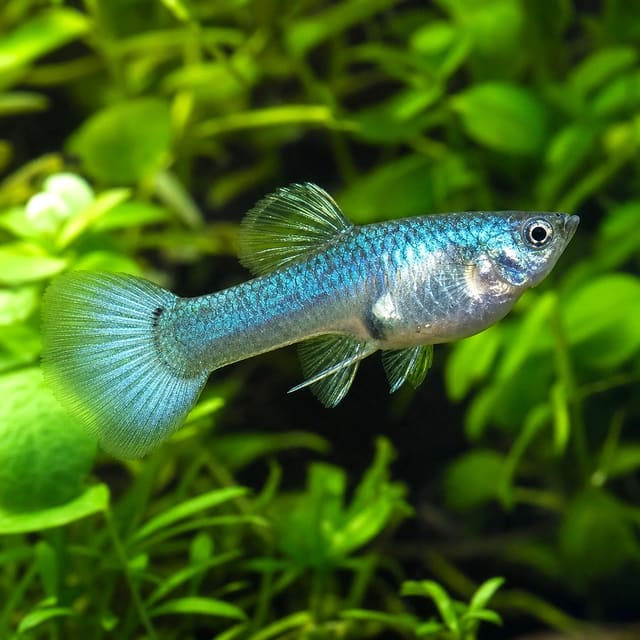
The pictured fish has a pale silver-gold flank and broad iridescent blue fins, but use Blue Neon as a colour direction rather than an exact pattern promise. Compare other guppy identities and stated sexes through the guppy collection, then plan every addition around the final group, filtration and adult space.
Use a mature, filtered aquarium at least 60 cm long, with enough unobstructed swimming room for the complete guppy group. Larger aquariums provide more stable temperature and water quality, but litres alone do not determine a safe population. Consider the internal footprint, adult fish, sex mix, existing livestock, biological filtration and test results together.
Prepare the aquarium before adding livestock. The first tropical aquarium guide explains how to establish the system before fish arrive. Clear water is not a cycling test: confirm 0 mg/l ammonia and 0 mg/l nitrite, then add fish slowly so the biological filter can adjust to increased feeding and waste.
Provide plants or suitable ornaments for cover while retaining open water for normal movement. OATA advises gravel or sand and ideally live plants for cover; when live plants are not used, add safe artificial plants and suitable ornaments for shelter. Avoid rough or sharp furnishings that could damage fins.
Seriously Fish notes that floating vegetation is appreciated and strong currents should be avoided. Set the filter outlet so the fish can swim and feed without being continually pushed across the aquarium. Observe the result rather than judging flow only from the filter setting.
| Before adding the fish | What to confirm |
|---|---|
| Biological filtration | Established and running continuously |
| Water tests | Ammonia 0 mg/l and nitrite 0 mg/l |
| Usable space | At least 60 cm long under our house screen |
| Layout | Open swimming room plus cover |
| Flow | No strong current that obstructs normal swimming |
A working biological filter is essential. The RSPCA explains that fish release toxic ammonia and that filter bacteria convert it first to nitrite, which is also toxic, and then to the safer nitrate. Test the aquarium instead of relying on water clarity or elapsed time.
Keep ammonia and nitrite at 0 mg/l. OATA advises that nitrate should not exceed 20 mg/l above the normal tap-water level. Test at least weekly and repeat a test promptly when behaviour, breathing, feeding or appearance changes. A result above zero for ammonia or nitrite calls for immediate attention to stocking, feeding, decaying material and filter performance.
OATA’s guppy-and-molly sheet strongly recommends, at least once a week, a 25% partial water change. Treat replacement tap water with conditioner before adding it, and keep its temperature close to the aquarium so maintenance does not create a sudden change.
Check the filter for blockages during maintenance. If reusable media needs cleaning, rinse it lightly in aquarium water removed during the partial change. Do not rinse it under the tap, because chlorine or chloramine may kill the beneficial bacterial population.
Maintain 22–28°C, pH 7.0–8.0 and 8–18 dGH. This is the overlap between the Tropical Fish Co Guppy Care Guide and the Seriously Fish species profile; OATA’s group guidance matches the pH and general-hardness range and also gives 5–15 dKH. Use stable values inside the range rather than repeatedly adjusting the aquarium towards a particular decimal.
Test the actual source water and aquarium. The aquarium water chemistry guide explains what the principal readings mean, while the water matcher helps compare measured temperature, pH and hardness with the stated range.
Set the aquarium within 22–28°C only after checking that every resident shares that range. Use a thermostatically controlled aquarium heater when the room cannot maintain the chosen temperature, and check the water itself with an independent thermometer rather than relying solely on the heater dial.
Seriously Fish describes the guppy as a hard-water fish whose long-term maintenance should be in moderately hard or harder water. Do not treat survival in soft or acidic water as proof that the conditions are suitable. Measure pH, general hardness and carbonate hardness before deciding whether adjustment is necessary.
Condition new tap water before it enters the aquarium. Avoid abrupt changes and do not add salt simply because the species also occurs in brackish environments. Any mineral or salt addition needs a measured purpose and a compatibility check for every animal and plant sharing the system.
Use an appropriately sized, nutritionally complete omnivore flake or granule as the staple. FishBase describes wild guppies feeding on zooplankton, small insects and detritus, while Seriously Fish notes that aquarium strains accept most foods offered. A complete prepared food gives a repeatable daily ration, with suitable algal and invertebrate variety supporting the broader omnivorous diet.
OATA’s guppy-and-molly guidance says guppies should only be fed what they can eat within a few minutes, once a day. Match each piece to the fish’s mouth and distribute it so every member of the group can feed. Remove leftovers before they decay, because uneaten food breaks down and releases toxic waste into the water.
Guppies will also benefit from small live or frozen foods such as daphnia, small bloodworm or tubifex. Use safe aquarium foods rather than collecting food from uncontrolled outdoor water. Variety should complement the complete staple rather than replace it with one rich treat.
| Feeding decision | Practical action |
|---|---|
| Staple | Complete omnivore flake or granule sized for the fish |
| Frequency | Once daily under OATA’s group guidance |
| Portion | Only what is eaten within a few minutes |
| Variety | Modest suitable algal and invertebrate foods |
| Leftovers | Remove them before they break down |
Watch individuals during feeding. Repeatedly missing food, losing condition or being displaced by another fish calls for a change to food distribution, group layout or compatibility rather than simply adding a larger portion.
Keep five or more guppies where aquarium capacity and the sex plan allow. FishBase gives an aquarium group of five or more, while OATA suggests at least three guppies or mollies. Tropical Fish Co uses the more conservative five-or-more policy because this gives a clear starting screen without turning the number into automatic permission to stock a particular aquarium.
Plan the whole group before adding this individually sold female. OATA suggests two females for each male in a mixed-sex group to reduce stress on females and other inhabitants. That ratio does not replace space, cover or observation, and more fish should not be added when filtration or usable room is already limited.
A settled fish should swim steadily, breathe regularly, hold intact fins open and show consistent interest in food. Watch whether every guppy can reach food and move away from unwanted attention. Persistent pursuit, hiding, missed feeding or fin damage means the group or layout needs intervention.
A female-only group prevents new mating within that group, but a female may have encountered a male previously. Seriously Fish explains that females can retain viable sperm and later produce young even when no male is present. Plan spare capacity and responsible rehoming before treating a female group as certain to remain the same size.
| Group plan | Continuing responsibility |
|---|---|
| Female-only | Monitor competition and remain prepared for possible fry |
| Mixed sex | Keep two females to each male and watch courtship pressure |
| Existing group | Check adult capacity, health and feeding access before adding another fish |
Combine daily observation with a written weekly maintenance check. OATA strongly recommends a 25% partial water change at least once every week, and advises testing the water at least once a week and checking the filter for blockages. Regular checks reveal gradual changes before they become visible emergencies.
Use results together. A fish hanging at the surface may be showing a water-quality or breathing problem, while reduced feeding can accompany environmental, social or health changes. Test first, inspect recent maintenance and observe the whole group rather than choosing a treatment from one sign.
After every addition, pay particular attention to feeding access, pursuit, fins and water tests. Added feeding and waste require the biological filter to increase its capacity, so a previously stable aquarium still needs monitoring after its population changes.
Prepare and test the mature aquarium before the delivery. Keep someone at the address to receive the parcel because live fish must not be left unattended. The delivery and Live Arrival Guarantee policy contains the full receiving conditions.
The fish is hand-bagged in pure oxygen and placed in an insulated poly box, with a heat pack when the weather calls for it. A licensed live-animal courier carries the parcel, and tracking plus the confirmed delivery date are sent by email so someone can receive it.
Before release, confirm the aquarium remains within 22–28°C, pH 7.0–8.0 and 8–18 dGH, with 0 mg/l ammonia and nitrite. Complete these tests before the delivery day so the fish can be released once the bag has floated. Continue observing swimming, breathing and balance after release, and test the aquarium if behaviour changes.
Act when a guppy develops persistent surface hanging, bottom sitting, erratic swimming, unusual hiding, changed breathing, appetite loss, white spots, fluffy growths, damaged fins, missing scales, ulcers or an unexplained change in body condition. These signs identify a need for investigation rather than a particular diagnosis.
The RSPCA’s fish health guidance supports checking water quality and seeking veterinary help when a fish is unwell. Test ammonia, nitrite, nitrate, pH and temperature immediately. Inspect the filter and review recent additions, maintenance, food and social behaviour.
A separate, biologically supported quarantine system allows observation without exposing established livestock. The MSD Veterinary Manual recommends at least 30 days of quarantine, with longer isolation where indicated. The quarantine aquarium still needs stable temperature, filtration, testing and suitable cover.
Do not choose salt, heat or medication solely from one outward sign. Treatments can affect fish, invertebrates and biological filtration, and different problems can produce similar behaviour. Obtain a diagnosis and follow lawful product directions or veterinary instructions.
Seek prompt help when the fish is deteriorating, cannot swim normally, struggles to breathe, develops wounds or fails to improve after environmental problems are corrected. OATA maintains a UK fish-vet directory for qualified diagnosis and treatment.
Choose companions only after checking overlapping temperature, pH and hardness, adult size, fin behaviour, territorial behaviour, feeding competition and the space needed by both social groups. No community label makes a pairing automatic, so assess the exact species and keep a practical separation plan.
Seriously Fish describes Poecilia reticulata as very peaceful and places it in quiet community aquariums with other livebearers, rasboras, corydoras, small loricariids and tetras. Those categories still contain animals with different water and group requirements. Use them as candidates for screening, not universal companions.
Do not keep this guppy with tiger barbs, serpae tetras or other species that may nip its fins. Both Seriously Fish and OATA warn against fin-nipping companions. Put that exclusion ahead of a general community reputation because persistent nipping can cause injury and continual stress.
A betta and guppy combination is not a sensible default because display, territorial and long-fin interactions vary between individuals. Small shrimp or young may be eaten, while “adult invertebrates” is too broad a category for a general promise. Screen the exact animal’s water needs, adult dimensions and vulnerability.
| Candidate | Decision |
|---|---|
| Other livebearers | Screen exact water, size, social and reproductive needs |
| Rasboras, corydoras, small loricariids or tetras | Consider only after exact-species checks |
| Tiger barbs or serpae tetras | Avoid because of fin-nipping risk |
| Bettas | Not a sensible default; individual interactions are uncertain |
| Small shrimp or young | May be eaten |
Include reproduction in every compatibility decision. Guppies are livebearers, and males may pursue females persistently. In mixed-sex groups, OATA suggests two females to each male, but the ratio still needs enough space, cover, filtration and feeding access for the individuals involved.
This female may later produce fry after earlier contact with a male. Seriously Fish describes long-term viable sperm retention in females, so removing males from the destination aquarium does not make possible fry irrelevant. Decide before purchase how additional fish would be housed or responsibly rehomed.
Dense planting can provide cover and improve the chance that fry survive, but survival also increases the future population and biological load. Plants therefore support a planned setup; they do not replace decisions about capacity and rehoming.
Keep Endler’s livebearer separate when preserving a documented line matters. The formal description of Poecilia wingei and Eschmeyer’s current entry treat it as a distinct species. Laboratory research confirms that P. reticulata and P. wingei can hybridise, so never represent hybrid descendants as pure examples of either species.
A Blue Neon Female Guppy reaches 5 cm standard length, measured without the tail fin. Plan adult space around that size rather than the smaller size supplied.
Use a mature, filtered aquarium at least 60 cm long under the Tropical Fish Co house screen. Seriously Fish gives a 45 × 30 cm base and approximately 41 litres, but length, footprint, group size and filtration must be considered together.
Plan for five or more guppies where aquarium capacity and the sex plan allow. FishBase gives a group of five or more, while OATA advises at least three.
It suits a prepared beginner who can provide a mature filtered aquarium, 0 mg/l ammonia and nitrite, stable mineral-bearing water, a planned social group and regular maintenance.
Feed a complete omnivore flake or granule sized for its mouth, with suitable algal and invertebrate variety. OATA advises feeding once daily and only what the fish can eat within a few minutes.
The Tropical Fish Co care guide and Seriously Fish overlap at 22–28°C, pH 7.0–8.0 and 8–18 dGH. Keep ammonia and nitrite at 0 mg/l and avoid sudden changes.
Seriously Fish describes it as very peaceful. Protect its fins by avoiding tiger barbs, serpae tetras and other fin-nipping species, and continue watching feeding access and pursuit within the guppy group.
Seriously Fish names other livebearers, rasboras, corydoras, small loricariids and tetras for a quiet community, but each exact species must share the water range and pass adult-size, behaviour, space and feeding checks.
The Tropical Fish Co policy uses pure oxygen, an insulated poly box, a weather-dependent heat pack and a licensed live-animal courier. Receive the parcel in person, film continuously from the sealed box, then float the bag for 20–30 minutes before releasing the fish.
No reviews for this item yet. Bought one? Honest reviews only, good or bad.
What customers say about ordering from us
I have a small group of long finned mountain minnows. So was delighted to be able to order ten of this variety to increase the genetics in my tank . The ones I recieved are healthy but it’s to early to give a verdict on wether they are of a long finned type since they are small currently.
Gordon Walker · 23 Sept 2026
100% success travel and "installation". Pleased with quality of purchase. The Siamese fighter a bit "shy" so have not yet seen him at his best yet but looking good. Happy customer. GG
George E Garratt · 21 Sept 2026
Reviews of our shop, collected by Judge.me, an independent third-party review collector. Newest first.