Easy
Blue Moscow Male Guppy (Poecilia reticulata)
22–28°C · pH 7–8 · 45L
£6.49
Photo coming soon
The size, price and care details on this page are for this listing.
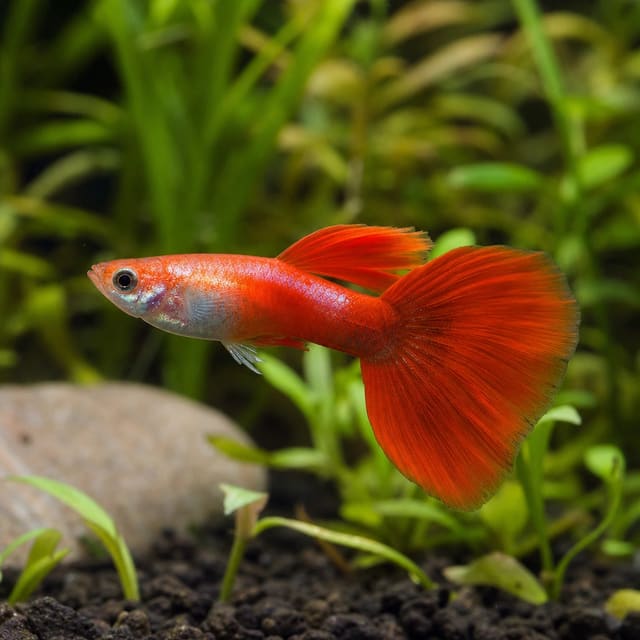
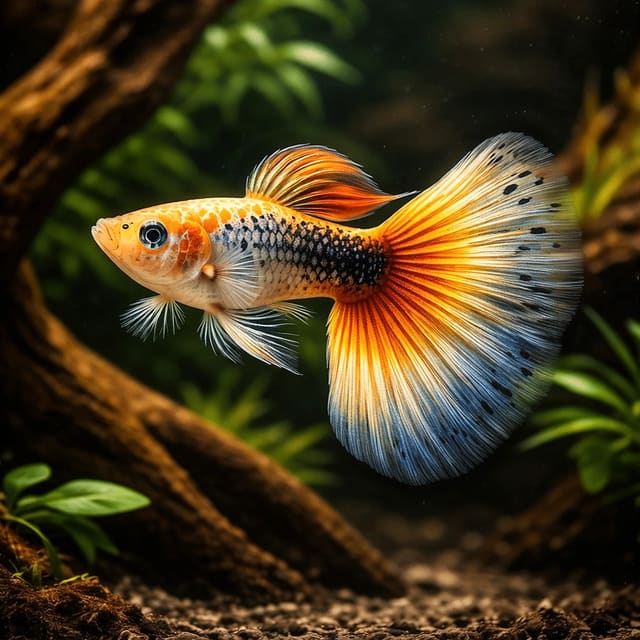
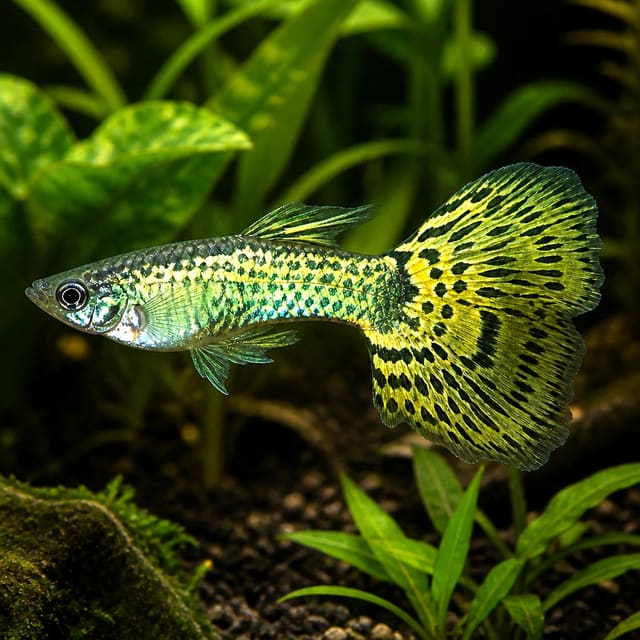
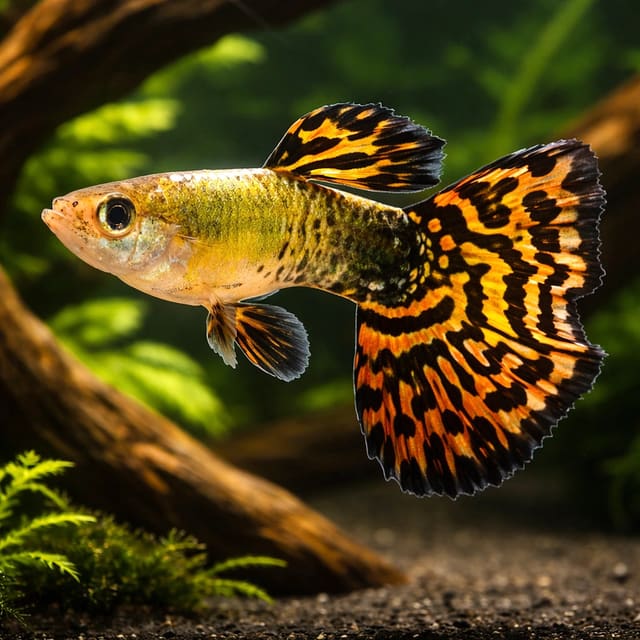
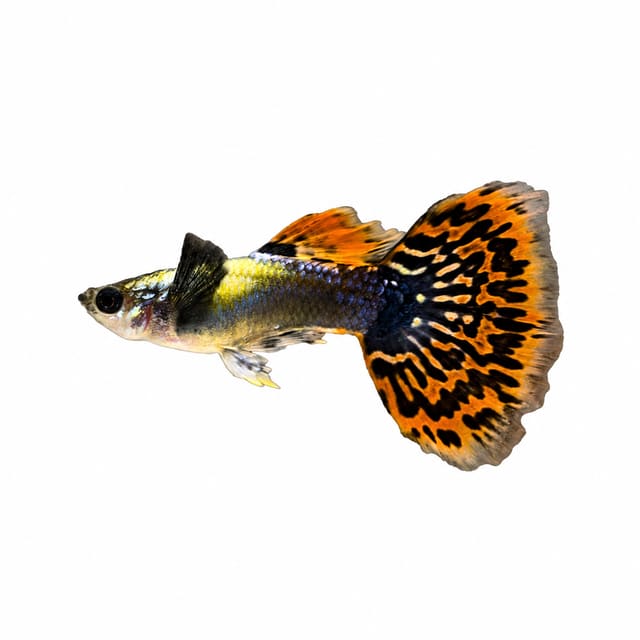
Poecilia reticulata male red cobra is the Red Cobra Male Guppy (Poecilia reticulata), a Poeciliidae livebearer from Venezuela, Barbados, Trinidad, northern Brazil and the Guianas that reaches 6 cm standard length. It suits a prepared beginner who can provide a mature aquarium, a group of 5 or more, 22–28°C and pH 7.0–8.0. Sold individually in 3–4 cm and XL sizes.
Adult size is the maximum length this species reaches at full maturity (scientific sources). The livestock you receive will be younger and smaller — pick a size above for the actual shipping size. Product-photo provenance and any image-specific limitations are stated on the listing.
Poecilia reticulata
Shoaling fish: kept in a group they feel safer, stay calmer and show their best colour.
Minimum of 2 per order.
Poecilia reticulata male red cobra is the Red Cobra Male Guppy (Poecilia reticulata), a Poeciliidae livebearer from Venezuela, Barbados, Trinidad, northern Brazil and the Guianas that reaches 6 cm standard length. It suits a prepared beginner who can provide a mature aquarium, a group of 5 or more, 22–28°C and pH 7.0–8.0. Sold individually in 3–4 cm and XL sizes.
Adult size is the maximum length this species reaches at full maturity (scientific sources). The livestock you receive will be younger and smaller — pick a size above for the actual shipping size. Product-photo provenance and any image-specific limitations are stated on the listing.

Guppies are social livebearers suited to a prepared beginner, not a fish-per-litre formula. Use a mature filtered aquarium, tested neutral-to-alkaline mineral-bearing water, deliberate sex and population planning, open swimming room, cover and a separation option.
Maintain these water conditions for optimal health and vibrant colors
The Red Cobra Male Guppy (Poecilia reticulata) is a small Poeciliidae livebearer from Venezuela, Barbados, Trinidad, northern Brazil and the Guianas. FishBase records males or unsexed fish at up to 5 cm standard length, so plan this male around a 5 cm adult body length. It suits a prepared beginner who can provide a mature, filtered aquarium, stable mineral-bearing water, companionship and a clear response plan for chasing or illness.
Red cobra is a selected colour and pattern label within the guppy species, not a separate species. The accepted scientific name remains Poecilia reticulata, as catalogued by Eschmeyer’s Catalog of Fishes. Wild guppies occupy varied habitats including warm springs, weedy ditches, canals, small streams and vegetated lakes. FishBase records a wild diet of zooplankton, small insects and detritus.
| Suits | Not suited to |
|---|---|
| A prepared beginner with a mature filtered aquarium | An uncycled or unfiltered container |
| A planned social group of 5 or more | Permanent solitary keeping |
| A quiet community screened for compatible water and behaviour | Fin-nipping species |
| Neutral-to-alkaline, moderately hard or harder water | Long-term soft or acidic conditions |
This is a peaceful community fish, but peaceful does not mean maintenance-free. Stable water, enough swimming room, measured feeding and close observation are what make it manageable for a first-time keeper.
Use a mature, filtered aquarium at least 60 cm long for one small guppy group. Our complete Guppy Care Guide adopts that conservative length and a group of 5 or more where the sex plan, filtration, test results and other livestock allow. Seriously Fish describes a 45 × 30 cm base and about 41 litres, while OATA recommends at least 45 litres for a small group of smaller livebearers. Length, footprint and usable swimming room still matter when a nominal volume meets either reference.
Plan this male around the FishBase adult figure of 5 cm standard length. Seriously Fish uses 6 cm standard length in its broader species profile. Standard length excludes the tail fin, so the selected finnage should not be added to the 5 cm body figure as though it were part of that measurement.
Keep the aquarium at 22–28°C, pH 7.0–8.0 and 9–18 dGH. These routine values are the overlap of FishBase, Seriously Fish, the Tropical Fish Co range and OATA’s guppy-and-molly guidance. OATA’s figures are group guidance, not a species-specific optimum.
A larger aquarium can make temperature and water quality more stable, but it does not create a fixed stocking allowance. Existing fish, fry, filtration, behaviour and test results can make two aquariums with the same labelled volume very different propositions.
One purchase supplies one male fish in the size chosen on the live size selector. The labels are 3–4 cm and XL. The size you select is the size supplied, not the adult size. XL is a dispatch grade rather than a second adult-size claim, so continue to plan the aquarium around a 5 cm standard-length male.
Sex is guaranteed only when the exact product or selected option explicitly states male or female. This Poecilia reticulata male red cobra listing is sold as male.
A single purchase does not create the recommended social group. Check the aquarium’s length, mature filtration, water tests, existing occupants and sex plan before deciding how many fish it can support. Adding several animals together also increases the load on the biological filter, so do not treat the group recommendation as permission to exceed the aquarium’s capacity.
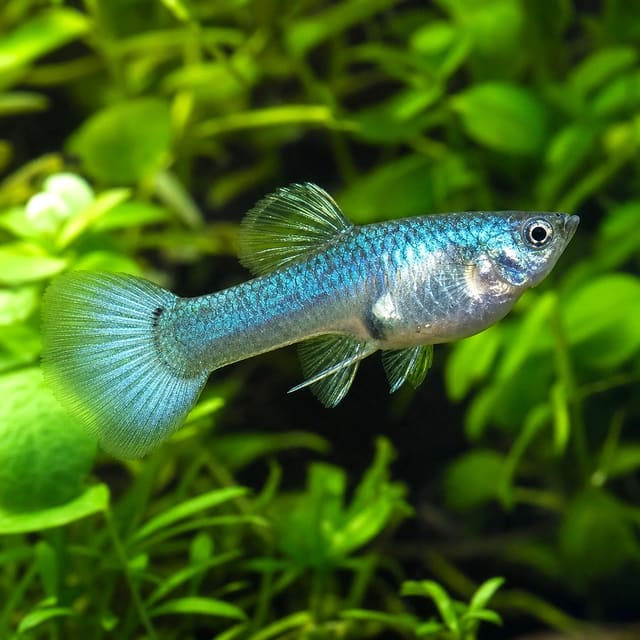
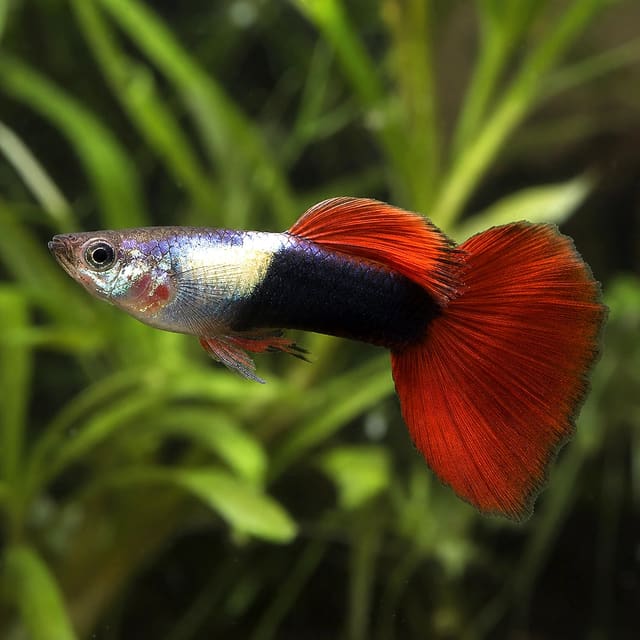
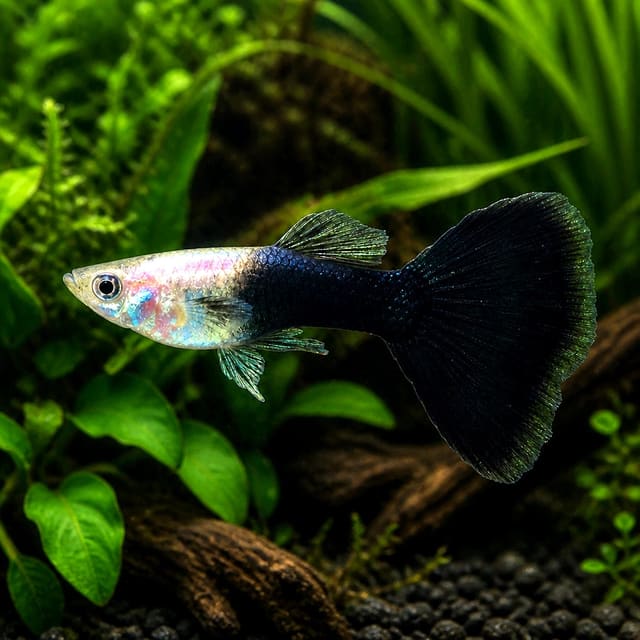
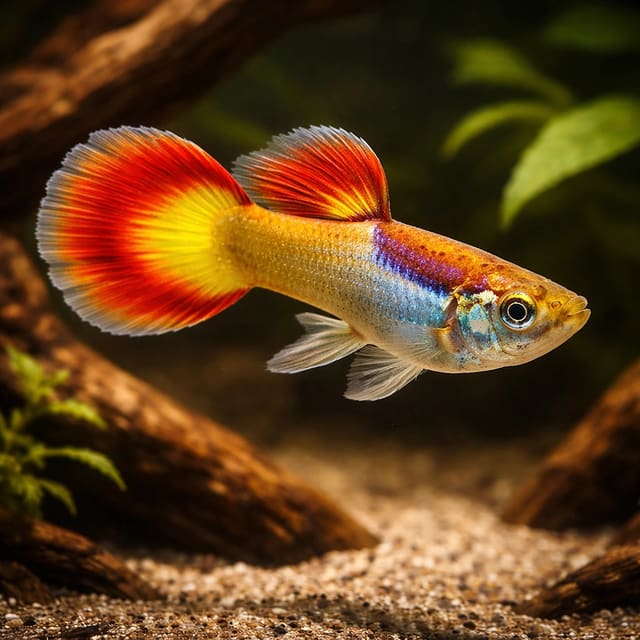
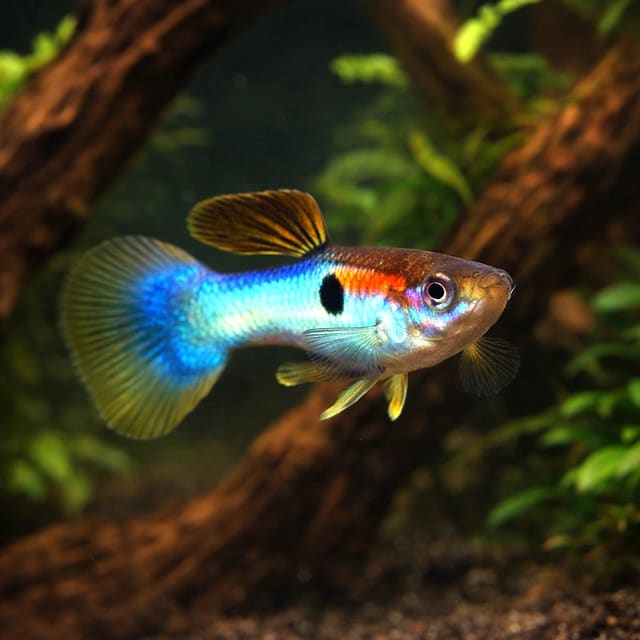
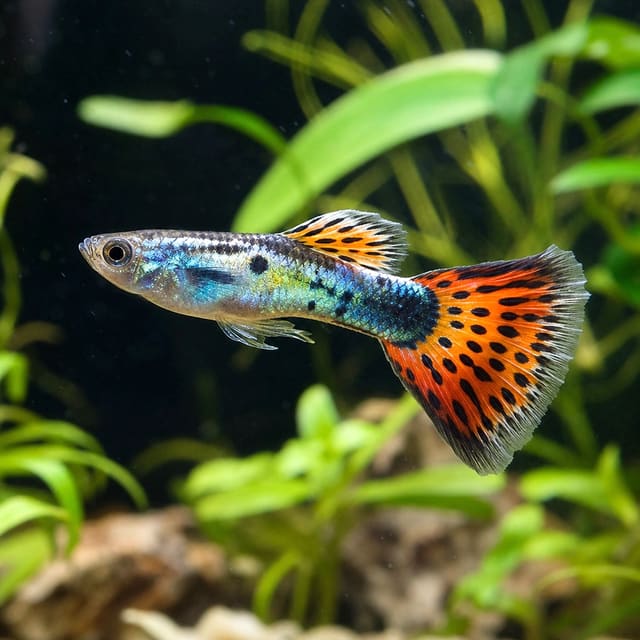
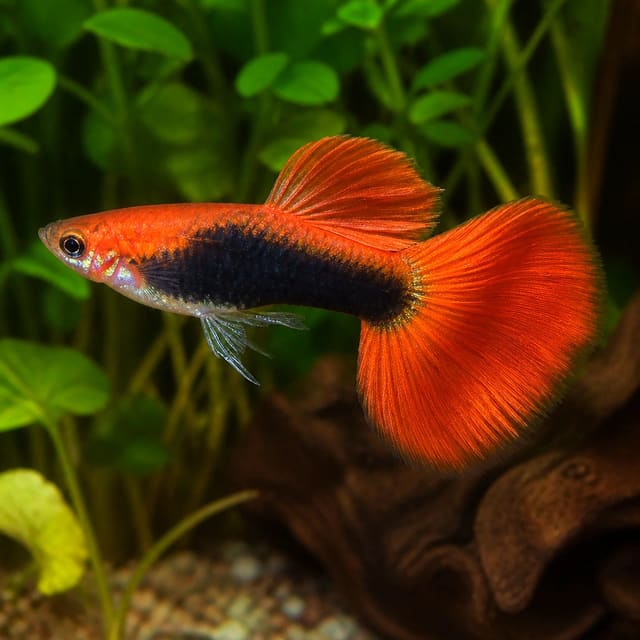
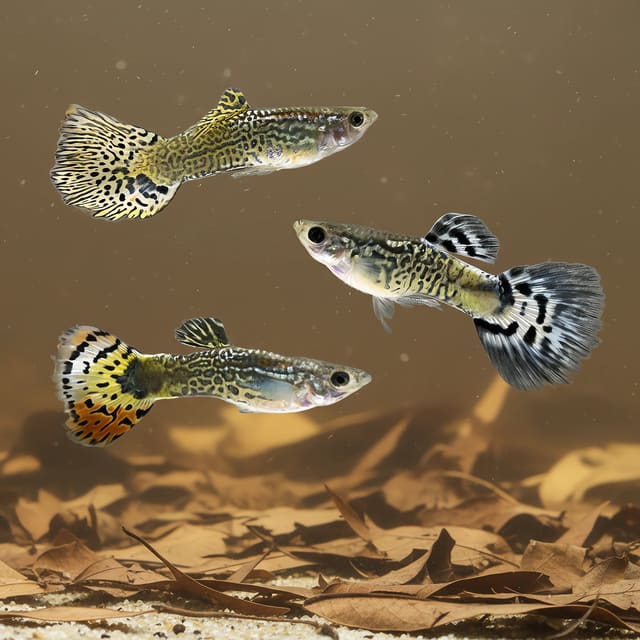
The red cobra label describes a selected appearance within Poecilia reticulata. Pattern placement, colour intensity and finnage can vary between individual fish. Some gallery images have been digitally enhanced to improve image quality. They show the listed type of animal rather than guaranteeing the exact markings of the individual supplied, so natural colour and pattern can vary.
To compare other strain and sex labels without treating them as automatic companions, browse the guppy collection. Every additional fish still has to pass the same space, water, social and population checks.
Prepare a biologically mature aquarium before adding this guppy. A mature filter contains beneficial bacteria that process toxic ammonia into nitrite and then nitrate; elapsed time alone does not show that this process is working. Test the aquarium and wait for repeated results of zero ammonia and zero nitrite before livestock enters.
If this is your first setup, follow the steps in our first tropical aquarium guide before arranging the fish’s arrival. Add livestock gradually because every extra fish and every increase in feeding creates more waste for the filter bacteria to process.
Keep the water at 22–28°C, pH 7.0–8.0 and 9–18 dGH. Test the aquarium rather than relying on a regional description such as hard or soft water. Our water chemistry guide explains the values, while the water matcher helps compare measured results with this care range.
Do not add salt merely because guppies can occur in brackish water. Any deliberate mineral or salt addition needs a measured purpose and a compatibility check for every fish, invertebrate and plant sharing the aquarium.
A reading of zero ammonia and zero nitrite is the starting requirement, not a substitute for continued checks. Test again after increasing the group or feeding because both changes increase the waste entering the biological filter. If either ammonia or nitrite appears, stop further additions, inspect filter operation and correct the water-quality problem before changing the stocking plan.
Compare pH and hardness in the aquarium with the source water used for changes. A suitable result that remains stable is more useful than repeatedly adjusting water towards an exact midpoint. When replacement water differs noticeably, make the change gradually and measure the aquarium afterwards rather than assuming the conditioner has altered mineral content or pH.
Use a well-set-up biological filter in every guppy aquarium. The RSPCA explains that filtration is vital because fish release toxic ammonia and beneficial bacteria convert it through nitrite into the safer nitrate. A filter is therefore part of the life-support system, not simply a way to make the water look clear.
Seriously Fish suggests a turnover of four to five times the aquarium volume per hour for its approximately 41-litre example, equivalent to a filter rated around 165–205 litres per hour. That is a planning reference for that example, not permission to create a current that overwhelms the fish. Watch whether the guppy can swim, feed and rest normally throughout the aquarium.
A planted aquarium with floating vegetation is appreciated, but dense cover has consequences. It can help fry survive and can conceal persistent pursuit from the keeper. Arrange plants so you can still see whether every fish reaches food, holds open fins and uses the aquarium normally.
Check the practical result after every layout change. If one fish remains cornered, misses meals or struggles against the flow, change the structure or separate the fish rather than adding more decoration and hoping the behaviour resolves itself.
For the Seriously Fish example, a rating between 165 and 205 litres per hour represents four to five turnovers of about 41 litres. The printed rating remains only one part of the decision because media, blockages and the position of the outlet affect the flow experienced inside the aquarium. Check several areas rather than watching the fish only beside the outlet.
Normal use of open water, ready access to food and the ability to rest away from the main current indicate that the layout is functioning. A fish that is repeatedly pushed aside, avoids a large part of the aquarium or cannot hold position needs a gentler flow pattern. Redirect the outlet or revise the equipment arrangement while maintaining essential biological filtration.
Plan a group of 5 or more where aquarium capacity and the sex plan allow. FishBase recommends aquarium keeping in groups of 5 or more, and Tropical Fish Co uses the same conservative house recommendation. OATA advises at least three guppies or mollies and suggests two females to each male in a mixed-sex group to reduce stress on females or other inhabitants.
This fish is sold as male, but buying one male does not determine the sex composition of the whole aquarium. Decide whether the intended group will be male-only or mixed sex before adding fish, and include the likelihood of courtship, pursuit and fry in that decision.
| Group plan | Decision to make |
|---|---|
| Male-only | Avoids new mixed-sex mating, but pursuit and fin damage still require monitoring. |
| Mixed sex | OATA suggests two females per male; plan space and responsible homes for possible fry. |
| Adding to a group | Recheck water tests, filtration capacity, feeding access and the behaviour of existing fish. |
Do not use colour alone to assess sex. Seriously Fish describes the male’s gonopodium as a narrow, stick-like modification of the anal fin. That anatomical feature is more useful for mature fish than brightness, because selected aquarium varieties can make both appearance and finnage more variable.
Observe the social result rather than assuming a ratio guarantees calm behaviour. Repeated pursuit, cornering, hiding, missed meals, clamped fins or damage means intervention is needed. Keep a mature separation option ready so one fish can be removed without placing it in an uncycled container.
Count does not replace observation. A group that reaches the recommended number can still fail if one individual cannot feed, rest or move away from pursuit. Watch the group during feeding and at quieter times, paying particular attention to a fish that remains apart, loses body condition or repeatedly uses only one corner.
When adding this male to an established group, reassess the whole social arrangement rather than considering only the new fish. Confirm that the aquarium can carry the added waste, that all fish can reach food and that the selected sex mix fits the population plan. If chasing becomes persistent, use the prepared separation aquarium while changing the group or layout.
For a mixed-sex plan, possible fry are part of the capacity calculation from the beginning. Plants and floating cover can increase fry survival, so providing more shelter may increase rather than reduce the need for future space, filtration and responsible rehoming.
Use an appropriately sized, nutritionally complete omnivore flake or granule as the staple. Wild guppies eat zooplankton, small insects and detritus, while Seriously Fish notes that aquarium strains accept most foods offered. Add safe compatible invertebrate and algal variety without allowing one treat food to replace a complete staple.
OATA’s guppy-and-molly schedule is to feed once a day, offering only what the fish can eat within a few minutes. That timing is group guidance. Watch the actual fish: every individual should reach food, and no visible food should remain to break down in the aquarium.
Daphnia, small bloodworm or tubifex are examples OATA gives for live or frozen variety. Match every item to the fish’s mouth and use foods intended for aquarium animals. Do not collect insects, detritus or other material from wild water to imitate natural feeding.
Reduced appetite is an early reason to check the fish and the aquarium. Test the water, observe whether another fish blocks access and inspect for changes in breathing, swimming, colour, fins or body condition. Adding more food does not solve exclusion or poor water quality and can make both worse.
Begin with an amount the group can finish within a few minutes and watch where it goes. If food reaches the substrate or remains after the fish lose interest, reduce the next portion and remove the excess. If one fish misses food while others finish quickly, distribute the same measured portion across more than one place rather than increasing the total without checking.
Use changes in feeding response as a reason to investigate, not as a diagnosis. A fish that suddenly stops competing for food may be experiencing poor water quality, social exclusion or a health problem. Test ammonia and nitrite, compare its breathing and swimming with its normal behaviour, and check whether another fish controls the feeding area.
Make a partial water change of 25% at least once every week. OATA recommends this routine alongside regular testing at least once per week. Use a siphon to remove solid waste from the substrate where needed.
Treat replacement tap water with a suitable conditioner before adding it to the aquarium. Match temperature and chemistry gradually, and avoid a sudden swing to the opposite edge of the accepted range. Record the results if that helps reveal a slow change that is hard to notice from one test alone.
Do not replace all mature media at the same time unless the equipment instructions make a specific part unsafe to retain. The aim is to remove obstruction while preserving the bacteria that process fish waste.
After maintenance, check temperature, filter operation and fish behaviour. A sudden change in swimming, breathing or position following a water change is a reason to test immediately. Recheck ammonia and nitrite after any filter interruption, unexplained cloudiness or rise in stocking and feeding.
Weekly care is also the right time to inspect the aquarium’s practical capacity. If waste accumulates rapidly, nitrate trends upwards, food is missed or fish cannot avoid pursuit, do not respond by adding more guppies to reach a preferred visual group size. Correct the limiting factor first.
Record ammonia, nitrite, nitrate, pH and temperature in a consistent way if the aquarium is changing or carrying a new group. A sequence of results can show rising nitrate, changing pH or repeated filter interruption before the pattern becomes obvious from appearance alone. Compare readings taken under similar conditions so feeding and water-change timing do not obscure the trend.
If nitrate repeatedly approaches OATA’s limit of no more than 20 mg/l above the normal tap-water level, review waste removal, feeding and stocking rather than merely resetting the number with one larger change. Continue gradual, conditioned water changes and identify why waste is accumulating. Ammonia or nitrite requires immediate action because both should remain at zero.
Look for steady swimming, regular breathing, open undamaged fins, intact scales, a normal body profile and consistent feeding. The RSPCA’s fish health guidance supports using behaviour, appearance and water checks together rather than treating one sign as a diagnosis.
Warning signs include hanging at the surface, sitting on the bottom, erratic swimming, unusual hiding, clamped or damaged fins, faster or slower gill movement, white spots, fluffy growths, wounds, loss of balance, body-condition change or reduced interest in food.
Do not select salt, heat or medication from one symptom alone. Different problems can look similar, while unnecessary treatment can add stress or affect other animals and the biological filter.
Quarantine new fish in a separate, biosecure aquarium with dedicated equipment, mature filtration and repeated testing. The MSD Veterinary Manual recommends at least 30 days of isolation, with longer periods where indicated. Keep the quarantine water inside the same suitable ranges and test it as carefully as the main aquarium.
A separation aquarium must be mature, filtered and matched to the same suitable water range before a fish needs it. An empty but uncycled container is not a safe response to chasing or illness. Keep dedicated equipment with the quarantine system so nets, siphons and other wet items do not carry material between aquariums.
During the isolation period, record feeding, swimming, breathing, fins and body condition alongside water results. A change in one fish while ammonia and nitrite remain zero gives a different starting point from several fish changing after a filter problem. These observations help a fish vet assess the situation without turning one visible sign into a guessed treatment.
Have the mature aquarium tested and ready before the parcel arrives. Someone must be at the delivery address to receive live fish, and the parcel must be opened and inspected on the same day.
The fish is hand-bagged in pure oxygen and placed in an insulated poly box, with a heat pack when the weather calls for it. These steps and the reporting terms are set out in the delivery and Live Arrival Guarantee policy.
If condition causes concern, contact us the same day with the order number and continuous unboxing video. The video should show the sealed parcel, the uninterrupted opening and the fish inside the sealed bag before release.
Confirm that temperature remains at 22–28°C and that ammonia and nitrite are zero before release. Continue watching swimming, breathing, fins and balance after introduction. If distress continues, test the aquarium promptly rather than assuming every change is normal after transport.
This is a very peaceful fish suited to a quiet community, but no species name guarantees compatibility. Seriously Fish names other livebearers, rasboras, corydoras, small loricariids and tetras as possible companions. Treat that as a shortlist for further checks, not a universal approval for every species carrying one of those group names.
A companion that fits 22–28°C but needs acidic or very soft water does not pass the screen. Likewise, matching chemistry does not excuse fin damage, persistent pursuit or inadequate space. Compatibility is the combined result of water, adult needs, behaviour and the actual aquarium.
Mixed-sex guppy groups also create a population decision. Fry increase the biological load and space requirement, so include them before adding another social species. Existing occupants, rather than the nominal tank volume alone, determine how much usable capacity remains.
Small shrimp or their young may be eaten, so do not promise safety for invertebrates as a broad class. Screen the exact species and size, provide an alternative plan and observe what happens in the aquarium.
Start with water. A proposed companion must have a usable overlap with 22–28°C, pH 7.0–8.0 and 9–18 dGH rather than merely touching one boundary. Next compare adult size, diet and behaviour, including whether either animal may swallow the other or prevent it from feeding. Only then assess whether the aquarium has room for both complete social groups.
For example, a named community group such as tetras still requires an exact-species check. Serpae tetras fail because Seriously Fish identifies them as fin nippers, while another tetra is only a candidate after its water, adult size, group requirement and behaviour have been assessed. The group name alone never overrides a documented avoid.
After introduction, watch feeding access, refuge use, pursuit and fin condition. A pairing that looked suitable on paper must be changed if the animals show persistent chasing, damage or exclusion. Use the mature separation option rather than waiting for repeated injury.
Avoid fin-nipping species. Seriously Fish specifically names tiger barbs and serpae tetras as examples, while OATA says guppies should not be kept with species that might nip their fins. The rule applies whether or not damage has already occurred.
Do not move a known fin nipper into the caution category after adding extra plants. Cover can break sight lines, but it does not turn an incompatible behaviour into a safe default. If fins become damaged or one fish is repeatedly chased, separate the animals and reassess the plan.
Keep guppies separate from Endler’s livebearers when preserving a documented line matters. The formal description of Poecilia wingei establishes it as a distinct species, and Eschmeyer’s Catalog of Fishes lists that name as valid. The Tropical Fish Co guppy guide notes that laboratory research confirms hybridisation between P. reticulata and P. wingei.
If documented identity is important, house the lines separately and do not represent hybrid descendants as pure examples of either parent species. If identity is not the objective, the animals must still pass the water, adult-size, social, space and behaviour screen before sharing an aquarium.
This male guppy reaches 5 cm standard length according to FishBase. Standard length excludes the tail fin, and selected domestic finnage can vary.
Poecilia reticulata male red cobra should have a mature, filtered aquarium at least 60 cm long under Tropical Fish Co’s conservative policy. OATA gives at least 45 litres for a small group, while Seriously Fish describes a 45 × 30 cm base of about 41 litres.
Plan a group of 5 or more where aquarium capacity and the sex plan allow; FishBase and Tropical Fish Co use 5 or more, while OATA advises at least three.
Poecilia reticulata male red cobra can suit a prepared beginner with a mature filtered aquarium, zero ammonia and nitrite, stable suitable water and a plan for companionship, chasing and possible fry.
Use an appropriately sized complete omnivore flake or granule as the staple, with safe compatible invertebrate and algal variety. OATA advises feeding once daily only what the fish can eat within a few minutes.
Keep it at 22–28°C, pH 7.0–8.0 and 9–18 dGH; these values are the overlap of FishBase, Seriously Fish, OATA and the Tropical Fish Co routine range.
It is described as very peaceful, but persistent chasing or fin damage still requires separation. Avoid fin-nipping species, including tiger barbs and serpae tetras.
Other livebearers, rasboras, corydoras, small loricariids and tetras may suit a quiet community after water, adult size, space and behaviour checks. Small shrimp or their young may be eaten.
Start filming before the sealed parcel is opened, continue through opening and the fish inside the sealed bag, then float the bag for 20–30 minutes before releasing. It is hand-bagged in pure oxygen and placed in an insulated poly box, with a heat pack when needed.
No reviews for this item yet. Bought one? Honest reviews only, good or bad.
What customers say about ordering from us
Easy website plenty of info on fish your buying great to pick a time slot
TRACEY DURRANT · 7 Oct 2026
Got some lovely fish thank you
Kevin Mackie · 7 Oct 2026
Reviews of our shop, collected by Judge.me, an independent third-party review collector. Newest first.