Moderate
Banded Rainbowfish (Melanotaenia trifasciata)
27–29°C · pH 6.5–8 · 108L
£7.99

Bleher's Rainbowfish (Chilatherina bleheri) is an active shoaling fish from Papua, Indonesia. Keep six or more in a mature 200L+, 120cm-long aquarium at 23–27°C, pH 7.0–8.0 and 8–15 dGH.
Adult size is the maximum length this species reaches at full maturity (scientific sources). The livestock you receive will be younger and smaller — pick a size above for the actual shipping size. Product-photo provenance and any image-specific limitations are stated on the listing.
Chilatherina bleheri
Shoaling fish: kept in a group they feel safer, stay calmer and show their best colour.
Confirm your email, then we’ll send an availability message for this exact item if it returns within 180 days.
This request is only for this product—no newsletter or other promotions. A mail-provider retry may very rarely duplicate the same availability message. Unconfirmed addresses are removed after 48 hours. See our privacy policy.
Bleher's Rainbowfish (Chilatherina bleheri) is an active shoaling fish from Papua, Indonesia. Keep six or more in a mature 200L+, 120cm-long aquarium at 23–27°C, pH 7.0–8.0 and 8–15 dGH.
Adult size is the maximum length this species reaches at full maturity (scientific sources). The livestock you receive will be younger and smaller — pick a size above for the actual shipping size. Product-photo provenance and any image-specific limitations are stated on the listing.
Maintain these water conditions for optimal health and vibrant colors
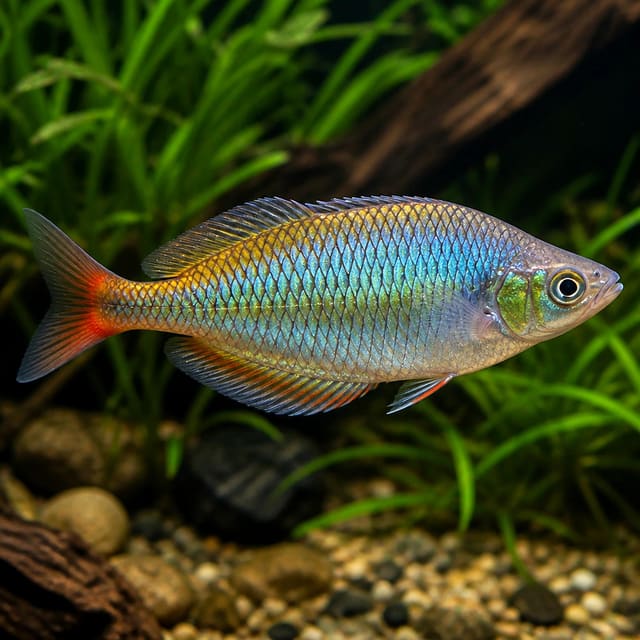
Bleher's Rainbowfish (Chilatherina bleheri) is a peaceful, active shoaling fish from Papua, Indonesia, on western New Guinea. It is best planned for as a group of six or more in a mature aquarium of at least 200 litres and 120 cm in length, with open swimming space, secure cover and stable, moderately hard water. Adult males can develop a striking transition from blue-green or silvery tones at the front of the body to yellow, orange and red towards the rear. Females, juveniles and newly settled fish are normally much more restrained in colour.
This listing is for one Bleher's Rainbowfish in the selected size. Choose the available size option before adding the fish to your basket. Size is a guide to body length at dispatch, not an age, sex or colour grade. The images show an idealised adult colour pattern, not the exact fish sent; dispatched fish may be younger, paler, differently patterned or a different sex. Fine image details, including individual spots, should not be treated as diagnostic markings or a promise about the fish supplied. Natural variation is expected in a living animal and is particularly noticeable in rainbowfish.
The figures above are a planning range, not permission to make sudden changes. A fish already living in stable water should be moved gradually and according to the arrival instructions. Stability, oxygenation and water quality matter more than chasing a particular pH number with rapid chemical adjustment.
Chilatherina bleheri is a distinct species in the rainbowfish family Melanotaeniidae. It was formally described by ichthyologist Gerald R. Allen in 1985. The accepted scientific name is important because common names vary between shops and countries. “Bleher's Rainbowfish”, “Bleher's Rainbow Fish” and “Bleheri Rainbowfish” usually refer to this species, while the scientific pairing Chilatherina bleheri identifies it more precisely.
It should not be confused with every other fish sold as a rainbowfish. Members of Melanotaenia, Glossolepis and other Chilatherina species may share the same active swimming style and some colours, but they are not interchangeable. Adult size, body depth, colour development and distribution differ. If you are matching an existing group, compare the scientific name rather than relying on an image or a general trade label.
The word “Bleher's” honours explorer and fish collector Heiko Bleher. The species name is sometimes typed without the apostrophe, and the spelling “bleheri” is frequently used as a common-name shortcut. Those variants can help people recognise the fish, but they do not indicate different forms, grades or subspecies. This listing concerns the single accepted species Chilatherina bleheri.
Bleher's Rainbowfish is a freshwater fish. It is neither a brackish-water fish nor a marine species. Its care is based on clean, well-oxygenated freshwater with mineral content, swimming space and social company. It is more useful to think of it as an athletic group fish than as a small decorative fish for a short aquarium.
FishBase records a maximum size of 12 cm standard length for Chilatherina bleheri. Standard length is measured to the base of the tail, so the fish's complete nose-to-tail length is greater. Females and some individuals can remain smaller, but aquarium planning should use the credible adult maximum rather than the smallest shop size or the size of a juvenile image.
Body length alone does not describe the space this species needs. Bleher's Rainbowfish spends much of its time moving through open water and interacting with its group. A 120 cm aquarium gives the fish a meaningful horizontal swimming run and allows subordinate individuals to move away from display activity. A tall but short aquarium may contain the same volume yet provide less useful swimming distance.
For that reason, this guide recommends approximately 200 litres and at least 120 cm of length as a practical minimum for a group. This is more cautious than older advice based on juveniles in a 100-litre aquarium. Specialist care sources vary, with some recommending substantially larger aquariums for adults; choosing more length and volume improves flexibility for group dynamics, tank mates, planting and water stability. The minimum is a starting point, not a target to crowd.
Do not select a smaller aquarium simply because the fish offered today is 3–4 cm. Rainbowfish grow, and a group purchased at the same time needs adult accommodation. If an upgrade is planned, it should be ready before the current aquarium becomes restrictive. Buying for the aquarium you already have is safer than depending on a future move.
A mature Bleher's Rainbowfish has the laterally compressed, deepening body associated with many rainbowfish, a relatively small terminal mouth, conspicuous scales and two separate dorsal fins. Mature males usually develop the most intense colour. The front half can show silvery blue, blue-green, olive or greenish tones, while the rear can become yellow, orange or red. The anal, dorsal and tail fins may also carry warm colour. Lighting, background, food, social display and camera processing can change how those colours appear in an image.
Females are usually slimmer and more subdued, commonly showing silvery, olive or greenish tones with less red. Juveniles often look pale compared with promotional images of mature males. A healthy young fish that has just travelled may temporarily display muted colour or hold its fins close. Colour normally becomes easier to judge after the fish has settled into stable conditions, but no particular final colour can be guaranteed.
Male display is part of normal social behaviour. Males may intensify their colours, hold their fins prominently and position themselves alongside rivals. This can look dramatic without being the same as sustained damaging aggression. The keeper should still watch whether one fish is being continually chased, prevented from feeding or confined to a corner. Sufficient group size, visual structure and swimming room help spread attention.
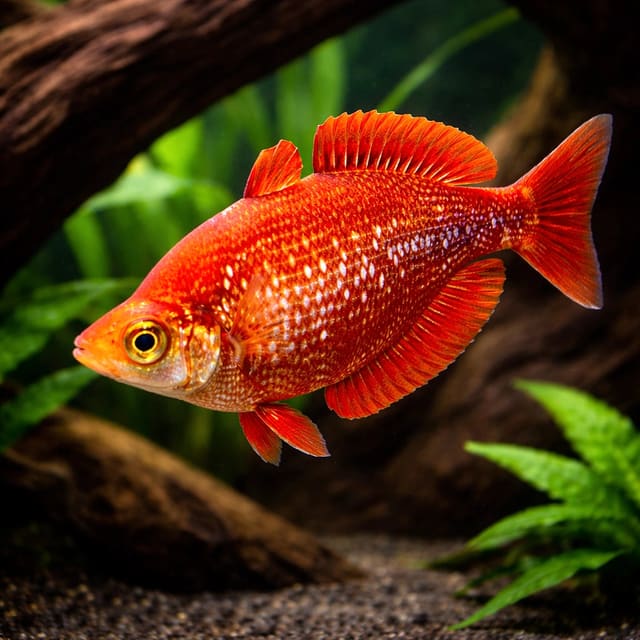
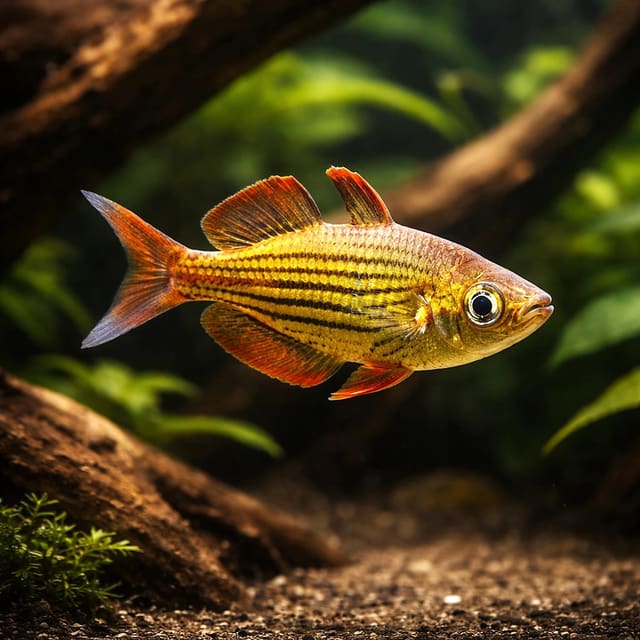
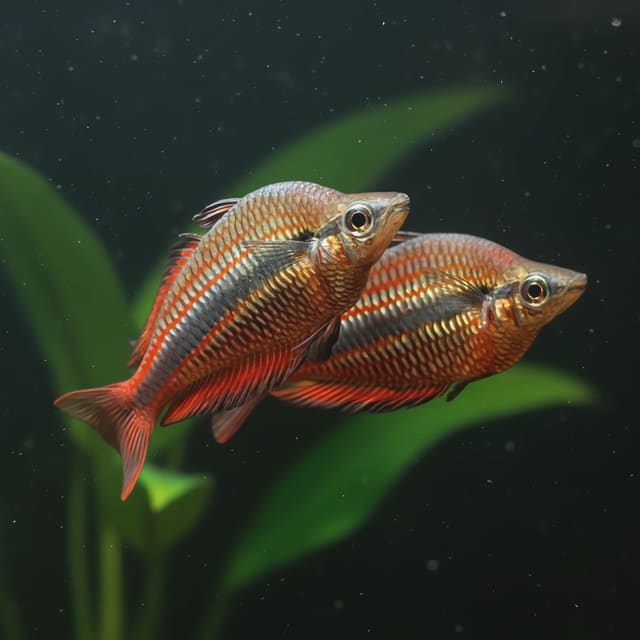
Images are useful for species recognition, but they are not a promise that a juvenile will arrive looking like a fully developed male under display lighting. The images on this page should be read as idealised representations of the species' adult colour potential, not as evidence for every fine marking. The selected size option describes the fish offered more accurately than the apparent scale of an image.
Bleher's Rainbowfish has a restricted natural distribution. Authoritative species accounts place it around Lake Holmes in the lower Mamberamo system of Papua, Indonesia, on western New Guinea. Lake records use both Danau Bira and Danau Biru spellings. Older aquarium texts may use historical regional terms such as Irian Jaya. “Northern New Guinea” is too broad to communicate this fish's narrow known range, and Papua New Guinea is a separate country to the east. The more accurate aquarium description is Papua, Indonesia, on western New Guinea.
Published habitat accounts describe clear, warm freshwater with aquatic vegetation and marginal plant growth. Aquarium care should not attempt to reproduce a wild site by collecting material or guessing at exact seasonal conditions. The useful lessons are that the fish benefits from clean water, oxygen, planted cover around the edges and open water for group swimming.
FishBase reports the species as Endangered. That status refers to wild populations and their limited distribution; it does not mean that every aquarium fish has been taken from the wild. A retailer should not claim a specific captive-bred origin without batch-level supplier evidence, and this page therefore makes no unsupported origin promise. Keepers can still act responsibly by maintaining the fish well, preventing release into natural waterways and never treating a living animal as disposable.
Do not release aquarium fish, eggs, water, plants or other livestock into ponds, rivers or drains. Rehoming through an experienced aquarium keeper or retailer is the appropriate route if circumstances change. Release risks the animal's welfare and can affect native ecosystems.
Each size option on this listing is sold as one fish. A quantity of six therefore means six individual fish in the selected size, subject to availability. The size bands are approximate because fish are measured and sorted as living animals, not manufactured objects. Small variation within or close to the stated band is normal.
Choose fish that are not likely to fit into the mouth of existing tank mates. At the same time, avoid adding a single small fish to an established group of much larger, highly competitive rainbowfish without a careful introduction plan. Similar body size can make feeding and social integration easier, although aquarium layout and the temperament of existing fish still matter.
Sex cannot be reliably promised from size alone, especially in juveniles. If the aim is simply a colourful community shoal, start with an adequate group and allow natural variation. If the aim is a precisely sexed breeding group, ask for current batch-specific information before ordering rather than assuming every strongly coloured image represents the stock available.
Adding only one Bleher's Rainbowfish is not recommended as a substitute for a group. A lone fish cannot express normal shoaling choices and may become withdrawn or overly focused on unrelated tank mates. A group of six is a practical minimum; more can work in a suitably larger aquarium with adequate filtration and swimming room.
Start with horizontal swimming room. Use an aquarium at least 120 cm long for an adult group, with about 200 litres or more of volume. Larger aquariums are preferable where a bigger shoal or additional active fish are planned. Keep a broad open lane through the middle and upper water instead of filling every part of the tank with hardscape.
Plant the margins. Rooted plants, taller background plants and floating cover at one side can provide security and visual breaks. Leave enough clear surface and open water for swimming and feeding. Select plants that suit the aquarium's light, substrate and water hardness; the fish does not require one particular plant species.
Fit a secure lid. Active rainbowfish can jump, especially when startled, feeding or adjusting to a new environment. Cover cable gaps and other openings without blocking ventilation or equipment. Check the lid after maintenance rather than assuming it has returned to the correct position.
Use effective filtration and aeration. Filtration should process the aquarium's biological load while leaving some calmer zones. Surface movement supports gas exchange. If warmer water, heavy stocking or medication reduces available oxygen, additional aeration may be needed. Never interpret rapid breathing as normal athletic behaviour without checking water quality, temperature and oxygen.
Cycle the aquarium before purchase. A newly filled tank is not automatically biologically ready. Confirm that the filter can process ammonia and nitrite, and use reliable water tests. Bleher's Rainbowfish should not be used to cycle an aquarium. A mature, stable system also makes feeding and observation easier during the first week.
Keep maintenance predictable. Regular partial water changes help control nitrate and dissolved waste. The correct schedule depends on stocking, feeding, plant growth, source water and measured results, so a fixed percentage cannot replace testing. Match replacement water for temperature and avoid sudden swings in mineral content or pH. Use a suitable conditioner where the supply contains chlorine or chloramine.
A sensible target range is 23–27°C, pH 7.0–8.0 and approximately 8–15 dGH. These values align with FishBase and established aquarium references, while allowing for normal variation in a stable system. They replace the less accurate idea that this species should routinely be kept in very soft, acidic water.
General hardness describes dissolved calcium and magnesium rather than cleanliness. A clear aquarium can still have unsuitable water chemistry, and a hard-water aquarium can still suffer from ammonia or nitrite. Test temperature, pH, general hardness, ammonia, nitrite and nitrate with suitable equipment, especially before adding fish and whenever behaviour changes.
Do not force the pH to an exact decimal with repeated doses. Sudden movement from 7.4 to 7.0 can be more stressful than a stable reading inside an appropriate range. If source water is far outside the target, plan a controlled method before ordering. Mixing water, remineralising purified water or altering carbonate hardness requires consistent measurement; it should not be improvised after the fish arrives.
Temperature also changes oxygen demand and metabolism. Keep the heater appropriately guarded and sized, and verify it with a separate thermometer. Position filtration so warmed water circulates through the aquarium. During unusually hot weather, increase gas exchange and observe the fish rather than adding ice or making abrupt temperature changes.
Ammonia and nitrite should remain at zero in a functioning aquarium. Any detectable reading requires prompt investigation. Nitrate should be managed through stocking, feeding, plant growth and water changes rather than allowed to accumulate because the fish appears outwardly colourful.
Bleher's Rainbowfish is generally peaceful, but “peaceful” does not mean motionless or suitable with every species. It is a fast, confident feeder and an active group swimmer. Slow, timid fish may be outcompeted even when there is no biting. Very long-finned fish can also be stressed by constant movement around them.
Keep at least six Bleher's Rainbowfish together. In a larger aquarium, a bigger group can produce more natural interaction and spread display behaviour. A mixture of sexes is often suggested, but sex may not be apparent in young fish and exact ratios cannot be guaranteed. Space and group size are more reliable planning tools than trying to identify every juvenile from colour.
Potential companions include peaceful fish that enjoy similar moderately hard, warm water and are large enough not to be treated as prey. Other appropriately sized rainbowfish, robust peaceful community fish and suitable bottom-dwellers may work where the aquarium is large enough. Compatibility is always conditional: compare adult size, water chemistry, swimming speed, diet and temperament rather than selecting by appearance alone.
Avoid aggressive or predatory fish, persistent fin-nippers and species requiring distinctly soft, acidic or much cooler water. Very small fish and fry may be eaten. Dwarf shrimp young are also at risk, and even adults should not be assumed safe merely because the rainbowfish is described as peaceful.
Watch the group at feeding time and during the hour after lights come on. Healthy social display should not leave one fish unable to feed, visibly injured or permanently isolated. If pressure is one-sided, reassess the group size, sex balance where known, cover, line of sight and available swimming length. Adding random fish without identifying the cause can increase competition rather than solve it.
Bleher's Rainbowfish is an omnivore and should receive a varied diet. Use a quality staple flake, small granule or slow-sinking food sized for the fish's mouth, then rotate suitable frozen or live foods such as brine shrimp, daphnia, cyclops or appropriately sized insect larvae. A plant-containing or spirulina-based food can add variety but should not be the only diet.
Feed amounts the group can consume without leaving waste. One large daily portion can let dominant fish take most of the food and allow uneaten material to reach the substrate. Smaller measured feeds make it easier to observe each fish. Adjust frequency and quantity for fish size, temperature, stocking and body condition rather than following a universal scoop size.
Distribute food along the swimming area so subordinate fish have access. Check that new or smaller individuals actually swallow food; activity near the surface is not proof that every fish has eaten. If one animal is losing weight, investigate competition, mouth size, water quality and possible illness rather than simply adding more food to the whole aquarium.
Live food should come from a trusted aquarium source. Wild-collected food and feeder fish can introduce pollutants, parasites or disease and are unnecessary for routine care. Frozen food should be stored and handled according to its instructions. Remove significant uneaten food before it decomposes.
Colour-enhancing food cannot turn every juvenile or female into the adult male shown in reference images. Genetics, sex, maturity, social context, health, light and background all influence colour. Nutrition supports normal development; it should not be used to make an unrealistic colour guarantee.
Prepare the aquarium before delivery. Confirm stable temperature, zero ammonia and nitrite, suitable hardness and a secure lid. Reduce avoidable disturbance around the tank and make sure existing fish are healthy. Do not schedule major filter cleaning, substrate replacement or a large change in water chemistry for the same day.
Follow the live-fish arrival and acclimation instructions supplied with the order because the correct method depends on journey time, bag conditions and the difference between transport and aquarium water. Keep the lights low while the fish settles. Avoid tipping transport water into the display aquarium where the stated method allows the fish to be transferred separately.
A newly arrived rainbowfish may be pale, stay close to cover or breathe faster for a short period after handling. Persistent gasping, rolling, inability to remain upright, obvious injury or a rapid decline is not a normal colour-adjustment issue. If there is a delivery problem, follow the current delivery and Live Arrival Guarantee instructions exactly, including their current same-day reporting and continuous unboxing-video requirements, because the terms can change.
During the first week, keep feeding light and observe from a distance as well as at the glass. Check whether the new fish joins the group, maintains balance and eats. Test water if breathing, posture or behaviour changes. Avoid adding multiple unrelated batches in quick succession, as that makes social and health problems more difficult to identify.
Quarantine is the most reliable way to reduce disease transfer between established fish and new arrivals. A quarantine aquarium needs a cycled filter, heater, cover and suitable water; it is not an unfiltered container. Equipment should not be moved back to the main aquarium without appropriate cleaning and biosecurity.
Observe body shape, fins, breathing, swimming, appetite and social position. A healthy fish should not be judged by bright colour alone. Warning signs include clamped fins, repeated flashing, white spots, frayed fins, sores, swelling, hollowing of the belly, unusually rapid breathing or separation from the group.
Many signs are not specific to one disease. Test water and review recent changes before choosing treatment. Medication added without a diagnosis can harm the biological filter, plants or sensitive tank mates and can delay the correct response. Seek experienced aquatic veterinary or fish-health advice where signs are serious, persistent or spreading.
Maintain a simple record of test results, water changes and new livestock. This makes gradual drift visible and helps distinguish a recurring aquarium problem from an individual injury. Check equipment rather than assuming it is working: heaters can stick, thermometers can disagree and filter flow can fall as media becomes blocked.
Plan for the adult group for its full life rather than treating the smallest sale size as permanent. The aquarium should continue to provide swimming length, clean water and appropriate companions as the fish deepens in body and becomes more competitive at meals.
Species-specific scientific studies of reproduction are sparse. Aquarium accounts describe Bleher's Rainbowfish as an egg-scatterer whose conditioned adults may spawn among fine-leaved plants or synthetic spawning mops. Males can display more intensely during courtship, and aquarium breeders report repeated spawning rather than parental care of a nest.
Adults do not protect the eggs and may eat eggs or fry. Breeders commonly move spawning media to a separate, mature rearing aquarium or remove the adults according to their chosen method. Any breeding setup must be stable and appropriately filtered; simply placing eggs in fresh tap water is not a complete rearing plan.
There is not enough species-specific scientific evidence to promise an incubation period, egg count or exact breeding recipe for C. bleheri. The newly free-swimming fry described in aquarium practice require appropriately tiny first foods, followed by larger foods as they grow. Water quality can deteriorate quickly when fine fry food is overused, making measured feeding and gentle maintenance essential.
Breeding should be planned before eggs appear. Prepare suitable food cultures, a covered rearing aquarium and a route for responsibly housing the offspring. Producing fry without space for juveniles can create an avoidable welfare problem.
This species can be an excellent choice if you want an active, visible group fish and can provide a mature 200-litre-plus aquarium at least 120 cm long. It suits keepers prepared to maintain stable, moderately hard water, feed a varied diet and buy a proper social group rather than one specimen.
It is not the right choice for a small or short aquarium, a very soft acidic biotope, an uncovered tank, or a community built around slow and easily outcompeted fish. It is also a poor impulse purchase if the aquarium has not completed its biological cycle or if there is no room for the fish at its adult size.
Before ordering, answer five questions: Is the aquarium at least 120 cm long? Is its usable volume about 200 litres or more? Are temperature, pH and hardness suitable and stable? Can you keep six or more? Will every existing species remain compatible at adult size? If any answer is uncertain, resolve it before purchase.
Mistake 1: using the sale size as the adult size. A fish offered at 3–4 cm is a juvenile size option, not a miniature form of the species. Chilatherina bleheri has a documented maximum of about 12 cm standard length. Build the stocking plan around the adult group and its swimming behaviour before choosing the smallest option.
Mistake 2: comparing litres but ignoring length. Two aquariums can hold a similar amount of water while offering very different swimming runs. For this species, a 120 cm horizontal length is an important part of the recommendation. A short, deep cube does not become equally suitable merely because its calculated volume reaches the same number.
Mistake 3: buying one fish to “see how it does”. Bleher's Rainbowfish is social. One individual is not a trial version of a proper group, and its behaviour in isolation does not show how a settled shoal will behave. Confirm that there is space and budget for at least six before ordering the first fish.
Mistake 4: matching a mature male image exactly. Juveniles, females, subordinate males and recently transported fish can all be paler than a displaying adult male. An image supports broad species recognition; it cannot guarantee sex, maturity, precise markings or a particular shade of red. Judge the arrival by identity, size band, condition and behaviour, allowing time for normal settling.
Mistake 5: treating “peaceful” as universal compatibility. This species is not normally selected for aggression, but it is fast and competitive at meals. A slow fish can lose condition without ever showing a bite mark. Compare activity, adult size and water requirements, and watch every fish feed after the community changes.
Mistake 6: changing stable water to chase a number. A target range helps with planning, but repeated rapid adjustment can be harmful. Test the source water before purchase. If hardness or pH needs long-term modification, establish a repeatable method and verify it over time rather than adding corrective chemicals after the fish arrives.
Mistake 7: adding livestock to an uncycled aquarium. Clear water is not proof that a biological filter is ready. Confirm ammonia and nitrite processing before ordering. Fish should not be exposed to toxic waste while a new filter develops its bacterial community.
Mistake 8: assuming more food solves every thin fish. A subordinate animal may miss food even when excess reaches the substrate. Observe who eats, distribute small portions and check mouth size. If weight loss continues, investigate water quality and health rather than increasing waste for the whole aquarium.
This care guide distinguishes documented species facts from practical aquarium recommendations. Taxonomy, maximum recorded size, distribution and broad water parameters were checked against FishBase and the GBIF taxonomic backbone. Identity, discovery history, sex differences, colour and habitat context were checked against the Australia New Guinea Fishes Association's species account. Aquarium size recommendations were compared across multiple specialist care sources and made deliberately cautious for an active adult shoal.
Source information was last checked on 4 August 2026. Aquarium advice can differ because tank dimensions, stocking and local water vary. The recommendations here use the adult size and social behaviour of the species as the starting point and favour extra swimming room over a bare minimum.
No reviews for this item yet. Bought one? Honest reviews only, good or bad.
What customers say about ordering from us
I have a small group of long finned mountain minnows. So was delighted to be able to order ten of this variety to increase the genetics in my tank . The ones I recieved are healthy but it’s to early to give a verdict on wether they are of a long finned type since they are small currently.
Gordon Walker · 23 Sept 2026
100% success travel and "installation". Pleased with quality of purchase. The Siamese fighter a bit "shy" so have not yet seen him at his best yet but looking good. Happy customer. GG
George E Garratt · 21 Sept 2026
Reviews of our shop, collected by Judge.me, an independent third-party review collector. Newest first.