Easy
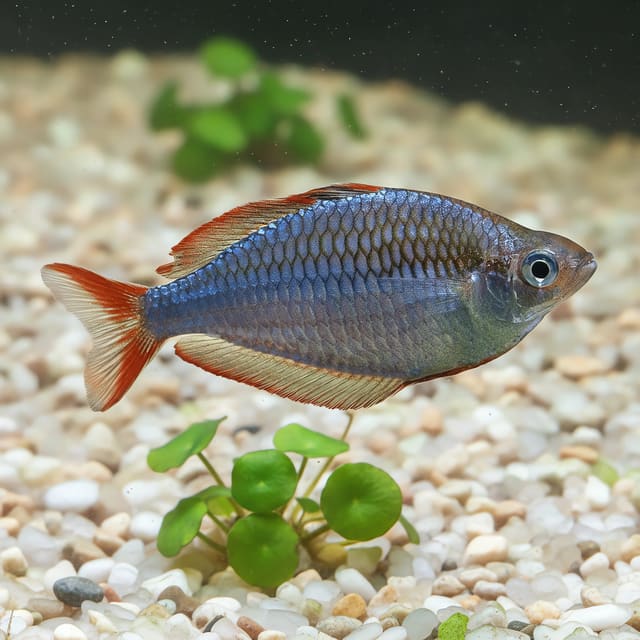
Neon Dwarf Rainbowfish (Melanotaenia praecox)
23–27°C · pH 6.8–7.5 · 54L
£5.99

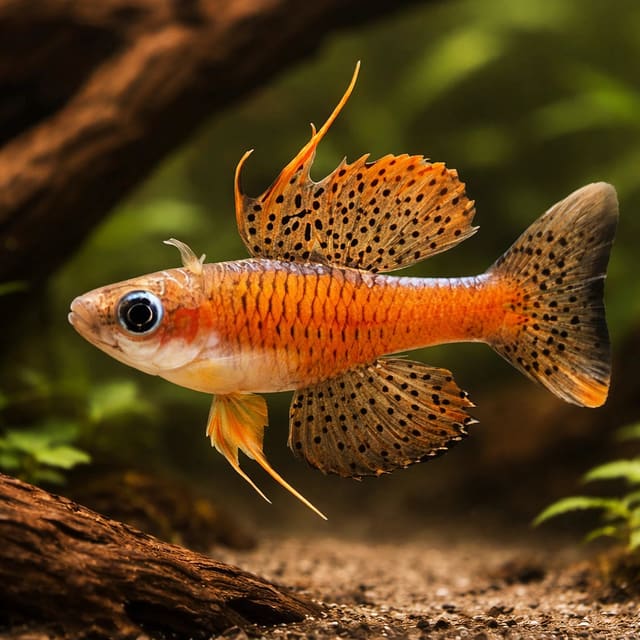
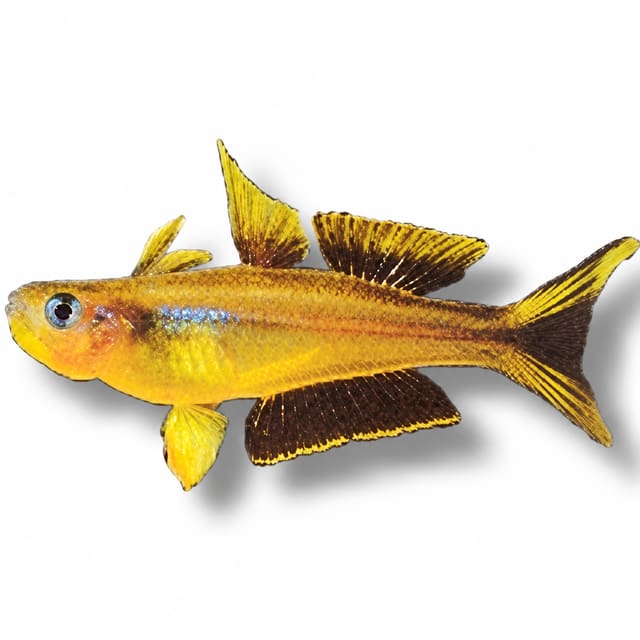
The Threadfin Rainbowfish (Iriatherina werneri) is a peaceful rainbowfish from central-southern New Guinea and northern Australia that reaches 4 cm standard length. It suits experienced keepers with a mature planted aquarium; keep at least six, ideally ten or more, at 22–30°C and pH 5.0–8.0. Sold individually in the size labels 2–2.5 cm, 2.5–3 cm and M 5–6 cm/F 3–4 cm.
Adult size is the maximum length this species reaches at full maturity (scientific sources). The livestock you receive will be younger and smaller — pick a size above for the actual shipping size. Product-photo provenance and any image-specific limitations are stated on the listing.
Iriatherina werneri
Shoaling fish: kept in a group they feel safer, stay calmer and show their best colour.
The Threadfin Rainbowfish (Iriatherina werneri) is a peaceful rainbowfish from central-southern New Guinea and northern Australia that reaches 4 cm standard length. It suits experienced keepers with a mature planted aquarium; keep at least six, ideally ten or more, at 22–30°C and pH 5.0–8.0. Sold individually in the size labels 2–2.5 cm, 2.5–3 cm and M 5–6 cm/F 3–4 cm.
Adult size is the maximum length this species reaches at full maturity (scientific sources). The livestock you receive will be younger and smaller — pick a size above for the actual shipping size. Product-photo provenance and any image-specific limitations are stated on the listing.
Maintain these water conditions for optimal health and vibrant colors
Threadfin Rainbowfish, Iriatherina werneri, is a small freshwater member of the rainbowfish family Melanotaeniidae. It is also known in the aquarium trade as the Featherfin Rainbowfish, a name that reflects the extended fins seen on adult males. Those fins and the display behaviour between males make a settled group especially engaging, but neither the photographs nor a dispatch size should be used to infer the sex of an individual fish.
FishBase records a maximum of 4 cm standard length and places the species in central-southern New Guinea and northern Australia. Plan around that adult measurement rather than treating a dispatch size as a final size. Its small body does not make it a casual choice: this is a delicate fish with particular feeding, flow and companion requirements.
A mature, densely planted aquarium with gentle movement suits its behaviour and feeding needs. The fish is peaceful, yet a general mixed community can work against it if faster fish take the food first or nip elongated fins. It is therefore better suited to a keeper prepared to select companions carefully, offer very small foods and watch how every member of the group feeds.
This is not a recommended beginner’s fish. A keeper who can maintain stable water, recognise subtle changes in feeding or behaviour and manage a gentle but effective filter will be better placed to meet its needs. If you are comparing related fish before deciding, browse our rainbowfish collection and assess each species on its own adult size, social requirements and temperament.
One purchase supplies one animal in the selected size. The size labels are 2–2.5 cm, 2.5–3 cm and M 5–6 cm/F 3–4 cm. Use the live size selector to choose the required label.
The size you select is the size supplied, not the adult size. A size label describes the animal at dispatch, while the species measurement used for long-term planning is the recorded maximum of 4 cm standard length. Select enough individual fish to form the intended group, then check that the aquarium has the space and biological capacity for the whole group.
Sex is guaranteed only when the selected option explicitly states male or female. This Threadfin Rainbowfish listing has no sex-guaranteed option.
Adult males can develop longer unpaired and pelvic fins and are described as larger and more colourful than females, but those biological differences are not a promise about the animal supplied. Group planning should therefore begin with the number of fish, their social needs and the aquarium’s capacity rather than an assumed sex ratio.
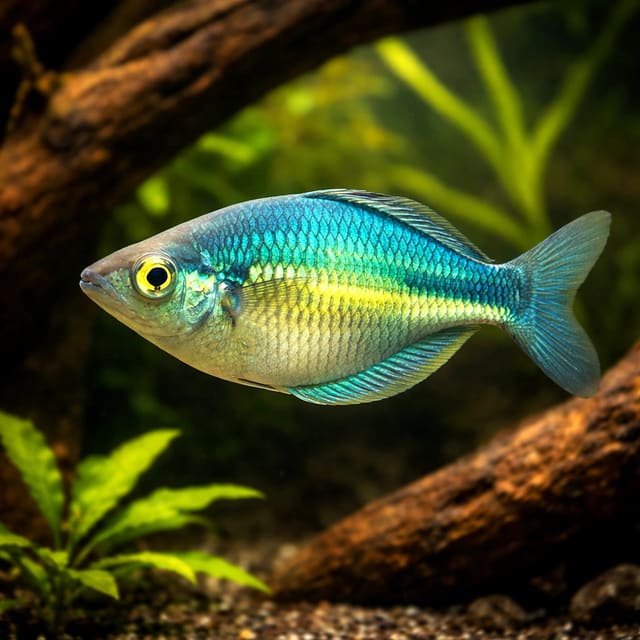
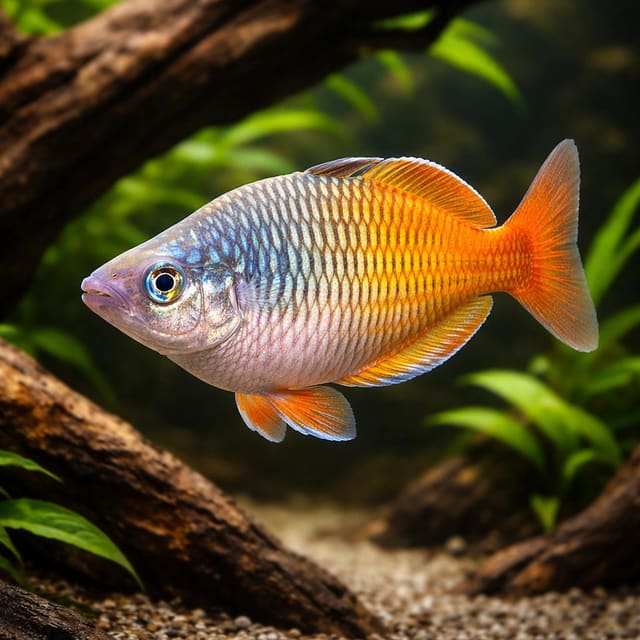
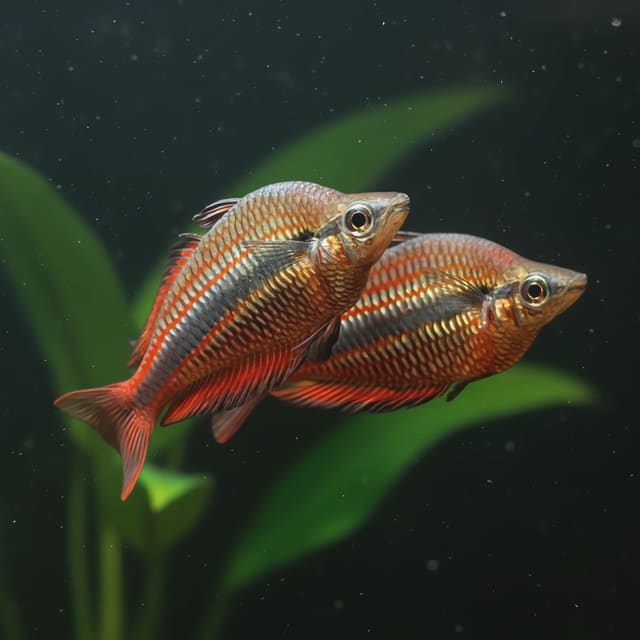
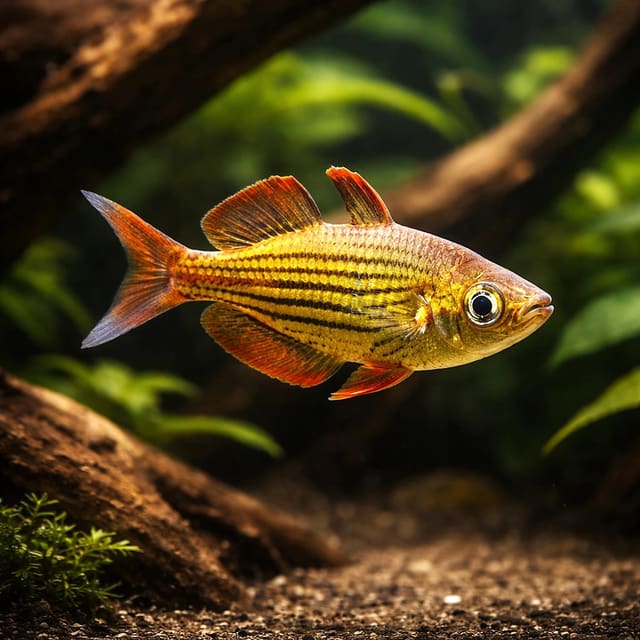
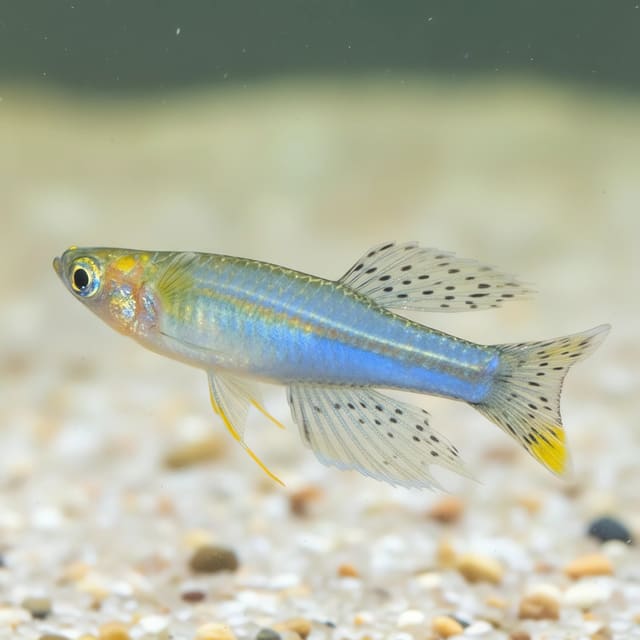
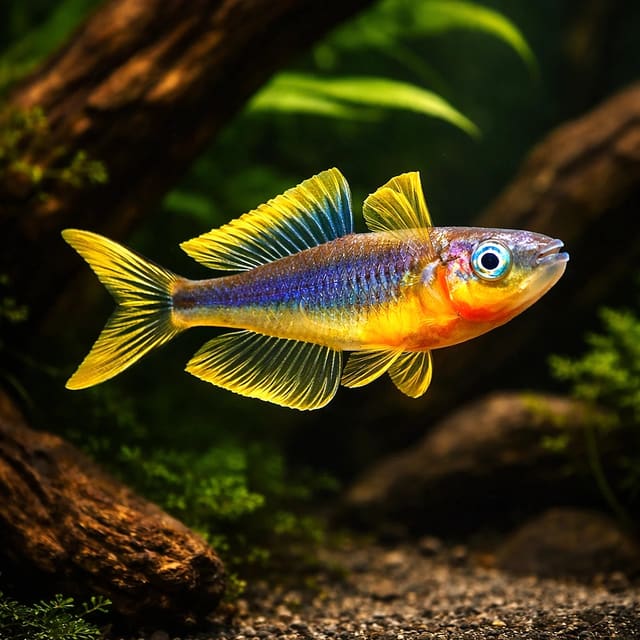
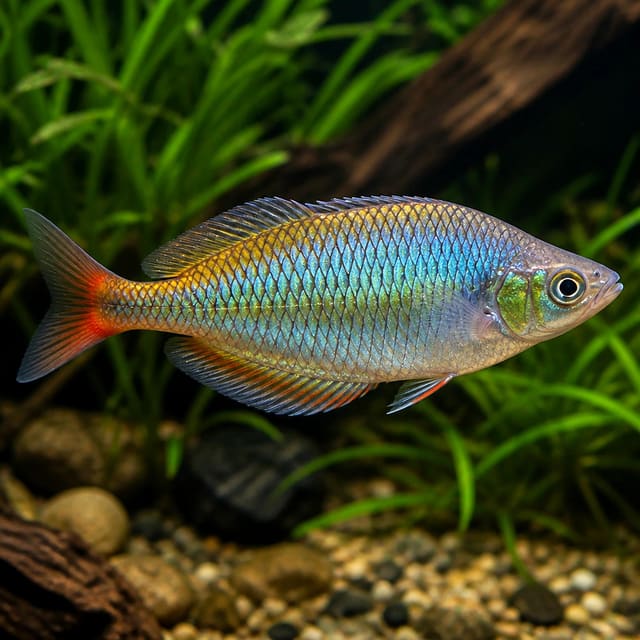
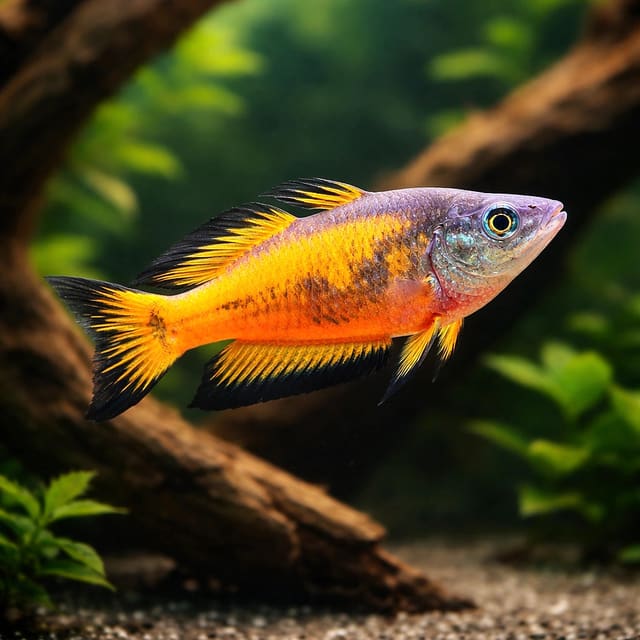
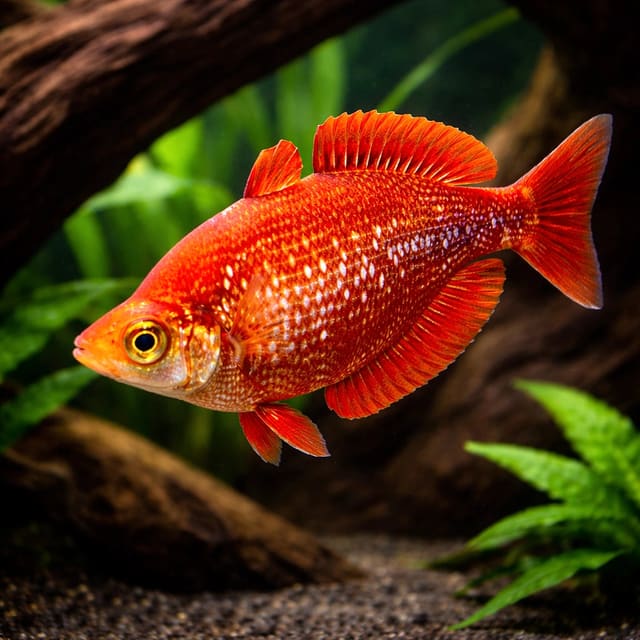
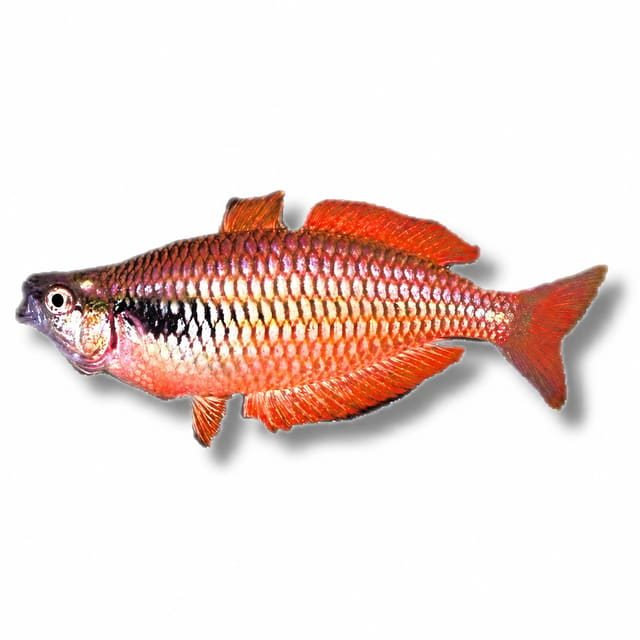
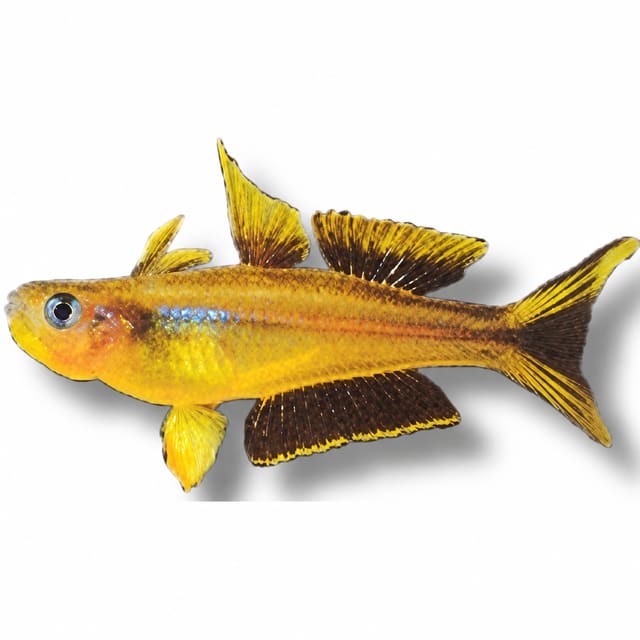
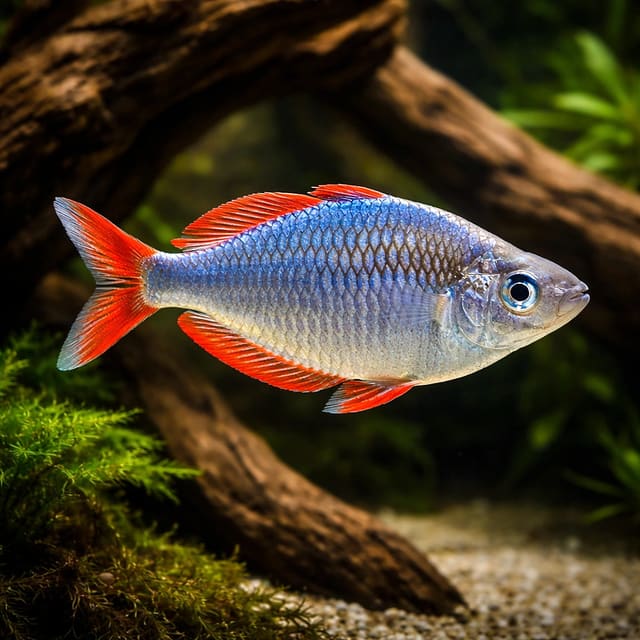
The gallery images are representative, based on reference photographs of this species, so colours can look slightly different from the live animal.
Review our current delivery and Live Arrival Guarantee policy before ordering. It explains how the fish is transported, what to do when the parcel arrives and the steps attached to a claim.
The aquarium must combine enough base area for a proper group with dense planting, gentle movement and reliable access to fine food. Seriously Fish recommends a base of at least 60 × 30 cm, approximately 54 litres, as the smallest aquarium that should be considered for this species. A longer or larger aquarium can give the group more room while making it easier to separate planted shelter from calmer feeding areas.
| Suits | Not suited to |
|---|---|
| A mature aquarium with dense planting | A biologically immature aquarium |
| A group of at least six, ideally ten or more | Solitary long-term keeping |
| Gentle water movement | A fast current that makes the fish struggle |
| Calm companions that leave fine food accessible | Fin nippers, bullies and feeding competitors |
| An experienced keeper who can maintain stable water | A first aquarium for a beginner |
The minimum footprint and volume are starting points, not reasons to crowd the aquarium. A group of ten occupies more biological and feeding capacity than a group of six, while existing residents also add waste and competition. Count every intended inhabitant before deciding whether the smallest footprint is sensible for the complete plan.
Build the aquarium around dense planting and calm movement. Plant cover gives the group places to retreat without forcing it into a bare, brightly lit space. Floating plants can diffuse overhead light, while driftwood roots or branches add shaded structure and a more natural feel. Keep enough clear water between planted areas for the fish to move as a group.
| Area | Purpose |
|---|---|
| Dense planting | Provides cover for a delicate shoaling fish |
| Floating cover | Diffuses light and creates sheltered water beneath |
| Open route | Leaves room for group movement and observation |
| Calm feeding area | Helps small food remain accessible without being swept away |
A fast current is a poor match because this fish mostly comes from sluggish waters and may struggle against strong movement. Position the filter outlet so circulation reaches the aquarium without driving the group continually into one corner or forcing it to swim hard just to remain in place. Plants and wood can help break up the flow, but they must not prevent effective circulation through the filter.
For an aquarium of approximately 54 litres, the species profile suggests looking at a filter rated around 110–160 litres per hour where gentle movement is required. Treat that rating as a guide for this tank size and assess the result inside the furnished aquarium: outlet direction, plant density and wood all change how the current reaches the fish.
The same profile estimates roughly 100–125 W of heating for a tank of this size when the room is around 20°C. Heater choice must still be based on the actual aquarium volume, room conditions and the temperature selected within the stated range. Place and operate equipment so the chosen temperature remains steady throughout the occupied aquarium.
Keep at least six Threadfin Rainbowfish together, with ten or more preferred. This species shoals naturally, and adequate numbers can make the fish less nervous while producing a more coherent display. Males may show stronger colours and display behaviour as they compete for female attention, although the offer does not promise the sex of any individual.
A species-only aquarium can be an effective choice, but “alone” in this context means without other species, not keeping one Threadfin Rainbowfish by itself. A solitary individual or an undersized group conflicts with its shoaling behaviour. If a larger group is planned, use the aquarium’s footprint, filtration and established biological capacity to decide whether to go beyond the smallest stated setup.
Group quality is not measured only by the number purchased. Watch whether all fish join normal group movement and reach food. A fish that repeatedly hangs back at feeding time needs attention even when the numerical minimum has been met. Check whether current, plant placement or competition is preventing access before simply adding more food.
Plan the group and aquarium together rather than buying one fish as a trial resident. This species should enter a mature setup designed for its needs, not be used to test whether a new aquarium or an uncertain community arrangement will work.
A biologically mature filter is essential before Threadfin Rainbowfish enter the aquarium. The species can be susceptible to swings in water chemistry, so a newly filled tank with running equipment is not enough. Follow our first tropical aquarium guide to prepare and mature the setup before livestock arrives.
The RSPCA explains why biological filtration matters: fish release toxic ammonia, beneficial bacteria convert it to nitrite, which is also toxic, and further bacteria convert nitrite to the safer nitrate. That bacterial community needs a well-set-up, maintained filter in which to function.
Gentle flow does not mean weak husbandry. The filter still has to process the waste produced by the complete group while avoiding a current that makes the fish struggle. Use outlet direction, plants and hardscape to soften the water movement rather than treating filtration and flow as the same decision.
Overstocking or adding fish too quickly can produce new tank syndrome when there are too few nitrifying bacteria for the increased waste. Prevent that problem by maturing the filter first, checking the aquarium’s present load and allowing biological capacity to guide the pace of additions.
Maintain 22–30°C, pH 5.0–8.0 and general hardness of 1–12 dGH for Threadfin Rainbowfish. These species-level aquarium ranges are broad enough to accommodate different local water, but stability still matters. Select a point within each range that can be maintained consistently and that also overlaps with the needs of every intended companion.
The wide water ranges are boundaries for planning, not a reason to move conditions around. Choose a stable point within 22–30°C, pH 5.0–8.0 and 1–12 dGH that also suits any proposed companions. The aquarium must be biologically mature before these delicate fish are introduced because swings in water chemistry can affect them.
Use our water chemistry guide to understand what each test measures, then enter measured values into the water matcher when comparing the aquarium with the stated ranges. Test actual water rather than judging it by appearance.
OATA’s group-level rainbowfish guidance sets ammonia at zero mg per litre, nitrite at zero mg per litre and nitrate at no more than 20 mg per litre above the normal tap-water level. It also recommends testing at least weekly and completing a 25% water change at least once a week.
| Check | Action point |
|---|---|
| Temperature | Keep within 22–30°C without swings |
| pH | Keep within 5.0–8.0 |
| General hardness | Keep within 1–12 dGH |
| Ammonia | Maintain zero mg/l |
| Nitrite | Maintain zero mg/l |
| Nitrate | Do not exceed 20 mg/l above tap-water level |
Treat replacement tap water with a suitable conditioner before it enters the aquarium so chlorine or chloramine does not harm the fish or filter bacteria. A siphon can remove solid waste during the partial change. Keep the routine consistent and record measured results if that helps reveal a developing change before the fish show obvious distress.
Threadfin Rainbowfish have tiny mouths and must receive food in a suitably small form. In nature they feed on floating or suspended phytoplankton, diatoms and zooplankton. In the aquarium, much of the diet should ideally comprise appropriately sized live foods, with small or crushed floating dried foods also accepted.
| Food type | How it fits |
|---|---|
| Daphnia or Moina | Small live foods identified for this species |
| Artemia nauplii | Fine live food suited to the small mouth |
| Microworms or copepods | Additional suitably small live options |
| Crushed floating dried food | Accepted dry option when particles are small enough |
| Freeze-dried Artemia or Daphnia | Additional identified foods in an appropriate particle size |
Offer only what the group can eat within a few minutes, once a day. This schedule follows rainbowfish feeding guidance and limits uneaten food that would otherwise break down and add toxic waste to the water. The short feeding window is not a reason to use large portions; begin with a controlled amount and watch whether every fish can take it.
Food choice and compatibility are linked. A food may be nutritionally appropriate yet still fail if larger or faster companions take it before the Threadfin Rainbowfish can feed. Spread a small portion through an accessible calm area and observe the whole group. If particles are too large to enter the mouth, crush the dry food more finely or choose a smaller live item rather than adding more of the same oversized food.
Reduced interest in food can be an early warning sign. First check whether the problem is particle size, strong current or competition. If the whole group eats poorly, include water-quality testing in the response rather than assuming the food alone is responsible.
Complete the aquarium before the fish arrives. Threadfin Rainbowfish should not be added to a biologically immature setup, so plants, heater and filter must already be operating as part of a stable, mature aquarium. Confirm that the footprint, group plan and gentle-flow arrangement are suitable before committing to a dispatch size.
Increase aquarium stocking slowly because beneficial bacteria need to adjust when fish numbers and feeding rise. The receiving aquarium should nevertheless be planned around a proper Threadfin Rainbowfish group rather than long-term solitary keeping. Account for the aquarium’s existing biological load when deciding how the group will be introduced.
At each early feed, check that all individuals take suitably small food and are not pinned away from it by current or companions. Look for coordinated group movement, normal breathing and intact fins. A fish that repeatedly misses food needs a practical response: reduce competition, soften the current at the feeding area or make the food finer according to the cause you observe.
Keep testing on the established weekly schedule and test sooner if behaviour changes. New livestock increases waste and feeding, so measured water quality is the most useful check on whether the mature filter is coping with the changed load.
Learn the group’s normal appearance and behaviour so a change is easier to recognise. Healthy fish should have clear, bright eyes, intact scales, undamaged fins and appropriate swimming and feeding behaviour. Regular observation is especially important for a delicate species whose long fins and small mouth create clear risks from poor companion choice.
| What you see | What to check first |
|---|---|
| Hanging at the surface or sitting on the bottom | Test water quality and inspect breathing |
| Erratic swimming | Check water values, flow and interactions |
| Darker or paler colour | Look for stress, hiding or changed behaviour |
| Faster or slower gill movement | Test water and check the fish promptly |
| White spots or fluffy growths | Assess the affected fish and water quality |
| Fin or scale loss | Check for nipping, bullying and physical damage |
| Reduced food intake | Check food size, competition, flow and water |
Do not respond to poor feeding by repeatedly adding extra food. Uneaten material can break down and increase waste, making the underlying problem worse. Remove the cause where it can be identified, keep the aquarium within its stated water limits and protect the fish from further competition or fin damage.
If you are concerned about a health change, test the water first and contact us for further guidance. Record the measured temperature, pH, ammonia, nitrite and nitrate alongside the behaviour or appearance change so the next decision can be based on concrete observations.
Threadfin Rainbowfish are very peaceful, but peaceful temperament alone does not make them suitable for every community aquarium. They can be outcompeted for food, and the long fins of mature males may be nipped by other fish. Avoid fin-nipping companions and fish that bully the group or consistently take all of the suitably small food.
The honest decision often depends on the actual aquarium and the behaviour of its residents. A species with a generally peaceful reputation may still be too fast at feeding, too active in a small footprint or unsuitable for the same water. Screen all three factors instead of relying on a broad “community fish” label.
| Observation | Decision |
|---|---|
| All fish feed without chasing | Continue observing individual access |
| Threadfins repeatedly miss food | Separate them from the source of competition |
| Chasing or fin nipping occurs | Separate the incompatible fish |
| One fish hides continually | Check group size, cover, flow and tank mates |
| Water needs do not overlap | Do not combine the species |
A species-only setup removes the general-community feeding and fin-nipping risks while still requiring a group of at least six. It can be the clearer choice when existing residents are active feeders or when the keeper wants to focus the layout, current and feeding routine on Threadfin Rainbowfish.
Examples identified for this species include fishes of comparable size and disposition, particularly Pseudomugil species. Where a geographical theme is not required, the examples also include Microdevario, Danionella, Eirmotus, Trigonostigma, pygmy Corydoras, small loricariids such as Otocinclus, and freshwater shrimp from the genera Caridina and Neocaridina.
These names are conditional possibilities, not universal matches. The aquarium still has to provide overlapping temperature, pH and hardness, sufficient footprint and filtration, gentle movement, and access to food for every resident. Individual behaviour must also pass the non-nipping and non-bullying screen.
| Candidate | Required screen |
|---|---|
| Pseudomugil species | Match water, space, disposition and feeding pace |
| Other named small fishes | Confirm comparable size and calm behaviour |
| Pygmy Corydoras or Otocinclus | Check complete aquarium capacity and water overlap |
| Caridina or Neocaridina shrimp | Match water conditions and the full community plan |
Do not use adult size alone to approve a combination. A similarly small fish may still feed too aggressively or nip fins, while a calm candidate may require water outside the selected conditions. Compare the whole care plan before purchase.
For an aquarium with existing residents, contact us with the tank dimensions, volume, measured water values, current fish numbers and proposed Threadfin Rainbowfish group. That information allows a stocking and compatibility assessment based on the real setup rather than a general tank-mate label.
Threadfin Rainbowfish reaches a recorded maximum of 4 cm standard length. Plan the aquarium around that adult measurement rather than its dispatch size.
Threadfin Rainbowfish needs a mature, densely planted aquarium with gentle current. A base of at least 60 × 30 cm and approximately 54 litres is the smallest setup that should be considered.
Keep Threadfin Rainbowfish in a group of at least six, ideally ten or more. A species-only aquarium can work, but one fish should not be kept as a solitary long-term resident.
Threadfin Rainbowfish is not recommended for beginners because it is delicate and requires stable water, gentle flow, very small food and carefully screened companions.
This fish needs food sized for its tiny mouth. Offer small live foods such as Daphnia, Moina, Artemia nauplii, microworms or copepods, plus suitably small or crushed floating dried food, once daily in an amount eaten within a few minutes.
Maintain 22–30°C, pH 5.0–8.0 and general hardness of 1–12 dGH. Keep ammonia and nitrite at zero mg per litre and nitrate no more than 20 mg per litre above the normal tap-water level.
This fish is very peaceful, but its elongated fins may be nipped by other fish and it can be outcompeted for food. Avoid fin nippers, bullies and boisterous feeding competitors.
Conditional companions include calm fishes of comparable size and disposition, such as Pseudomugil, Microdevario, Danionella, Eirmotus, Trigonostigma, pygmy Corydoras, Otocinclus, and Caridina or Neocaridina shrimp. Match water, space and feeding behaviour before combining them.
Someone must be present to receive the parcel. Film every delivery continuously from the sealed parcel as it is opened, keeping the animal visible inside the sealed bag; then float the bag for 20–30 minutes before releasing the fish, and never pour the bag water into the aquarium.
No reviews for this item yet. Bought one? Honest reviews only, good or bad.
What customers say about ordering from us
I have a small group of long finned mountain minnows. So was delighted to be able to order ten of this variety to increase the genetics in my tank . The ones I recieved are healthy but it’s to early to give a verdict on wether they are of a long finned type since they are small currently.
Gordon Walker · 23 Sept 2026
100% success travel and "installation". Pleased with quality of purchase. The Siamese fighter a bit "shy" so have not yet seen him at his best yet but looking good. Happy customer. GG
George E Garratt · 21 Sept 2026
Reviews of our shop, collected by Judge.me, an independent third-party review collector. Newest first.