Moderate
6 × Forked-Tail Rainbowfish (Popondetta furcata)
24–26°C · pH 7–8 · 54L
£24.99

The Forked-Tail Rainbowfish (Popondetta furcata) is a peaceful freshwater blue-eye from eastern Papua New Guinea that reaches 5 cm. It suits keepers with a mature planted aquarium of at least 60 × 30 cm; Seriously Fish recommends at least 8–10, while the FishBase, Seriously Fish and OATA overlap is 24–26°C and pH 7.0–8.0. Sold as one pack of 10 fish.
Adult size is the maximum length this species reaches at full maturity (scientific sources). The livestock you receive will be younger and smaller. Product-photo provenance and any image-specific limitations are stated on the listing.
Popondetta furcata
The Forked-Tail Rainbowfish (Popondetta furcata) is a peaceful freshwater blue-eye from eastern Papua New Guinea that reaches 5 cm. It suits keepers with a mature planted aquarium of at least 60 × 30 cm; Seriously Fish recommends at least 8–10, while the FishBase, Seriously Fish and OATA overlap is 24–26°C and pH 7.0–8.0. Sold as one pack of 10 fish.
Adult size is the maximum length this species reaches at full maturity (scientific sources). The livestock you receive will be younger and smaller. Product-photo provenance and any image-specific limitations are stated on the listing.
Maintain these water conditions for optimal health and vibrant colors
Forked-Tail Rainbowfish are small, peaceful freshwater blue-eyes from eastern Papua New Guinea that reach 5 cm standard length. They suit attentive keepers prepared to maintain a biologically mature planted aquarium, stable water and a complete shoal. The scientific label retained here is Popondetta furcata. FishBase now lists it as Pseudomugil furcatus and places it in the family Pseudomugilidae.
The fish occurs in lowland eastern Papua New Guinea between Dyke Ackland Bay and Collingwood Bay. FishBase describes rainforest streams with thick vegetative cover and records a peaceful, omnivorous, egg-laying fish. Those details explain the practical aquarium priorities: provide plant cover, preserve swimming room, offer suitably small foods and build the community around calm companions.
FishBase records a maximum of 5 cm standard length for male or unsexed fish. A separate aquarium planning reference uses 6 cm standard length, so allow for a fish approaching 6 cm rather than treating its small appearance as a reason to reduce swimming space.
This is a shoaling species rather than a solitary centrepiece. A group gives each fish the social setting in which it can interact, spread through the swimming area and display without being isolated. The supplied pack of 10 meets the published recommendation to keep at least 8–10 specimens together.
One purchase supplies a pack of 10 Forked-Tail Rainbowfish. Base the aquarium plan on the adult dimensions and the needs of the complete group.
Sex is guaranteed only when the selected option explicitly states male or female. This 10 × Forked-Tail Rainbowfish listing has no sex-guaranteed option.
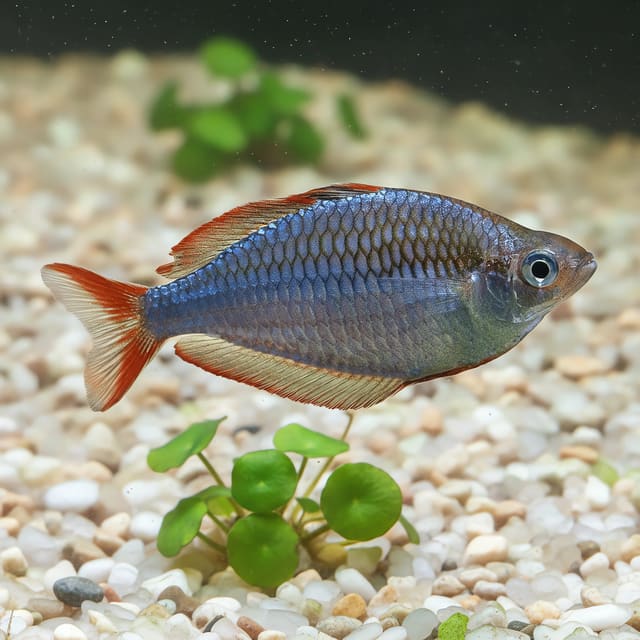
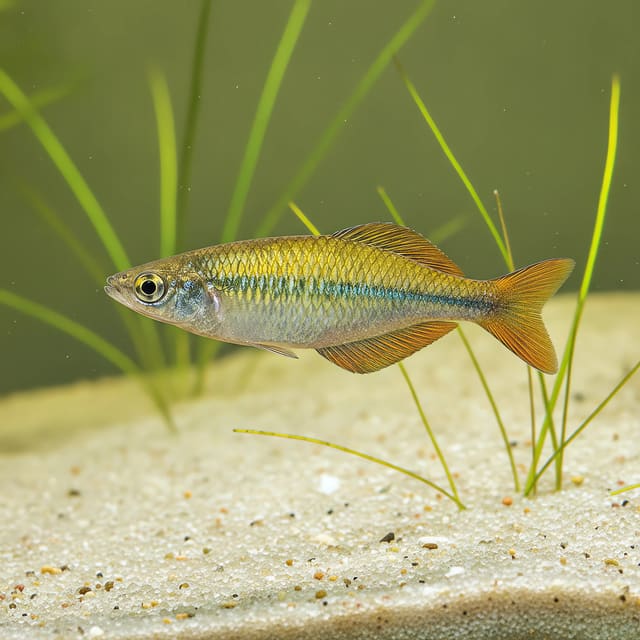
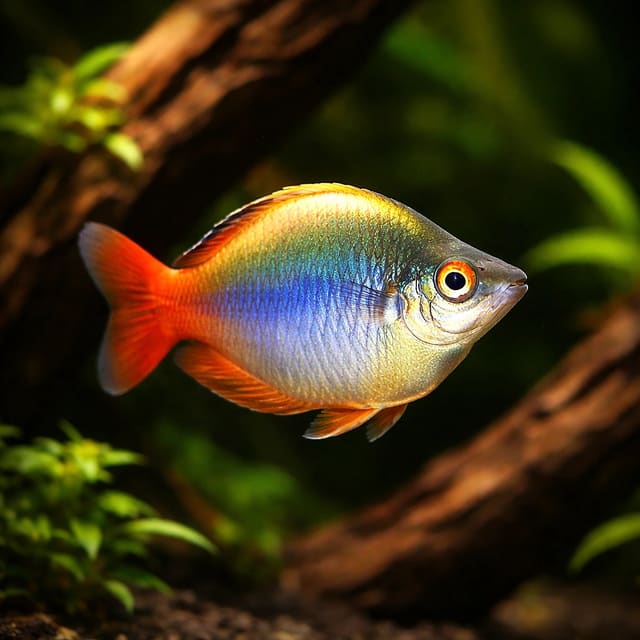
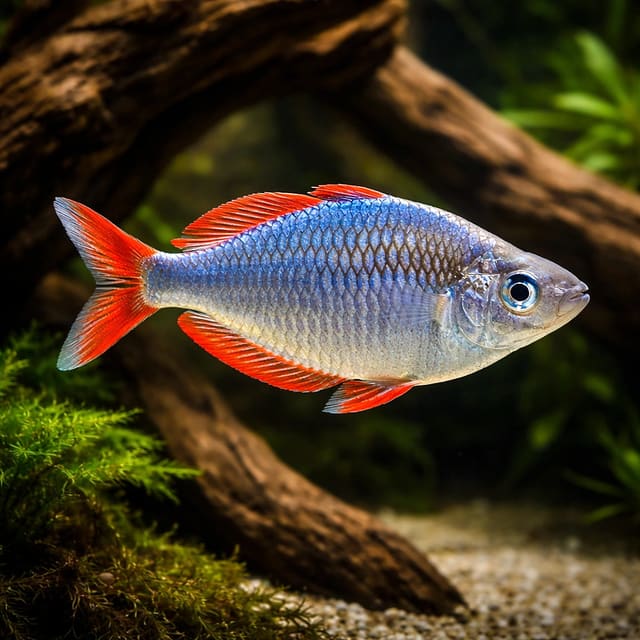
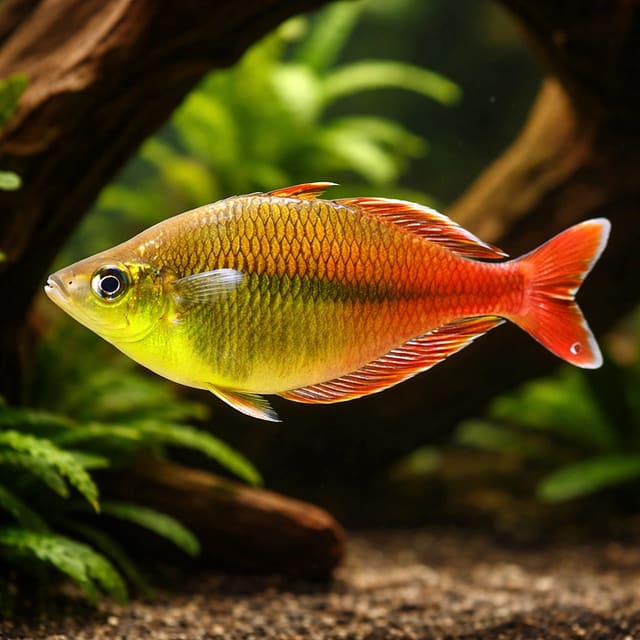
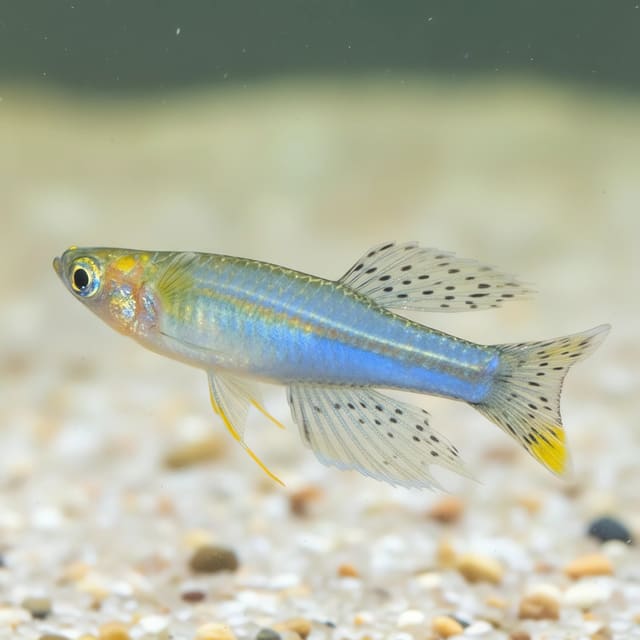
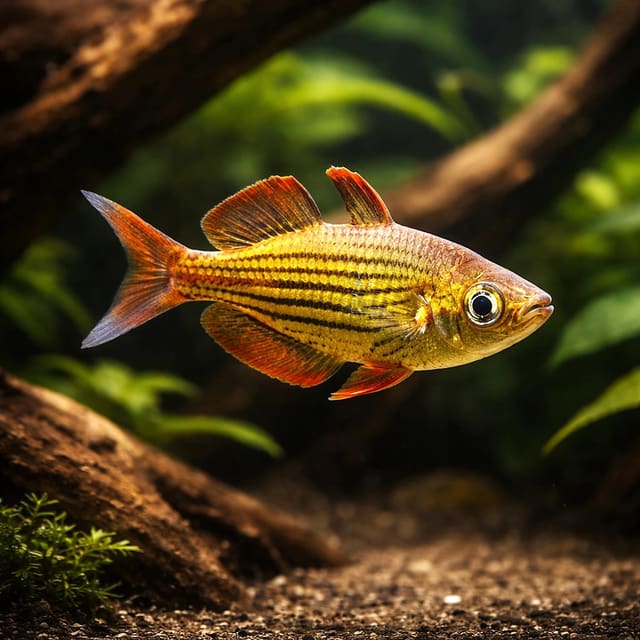
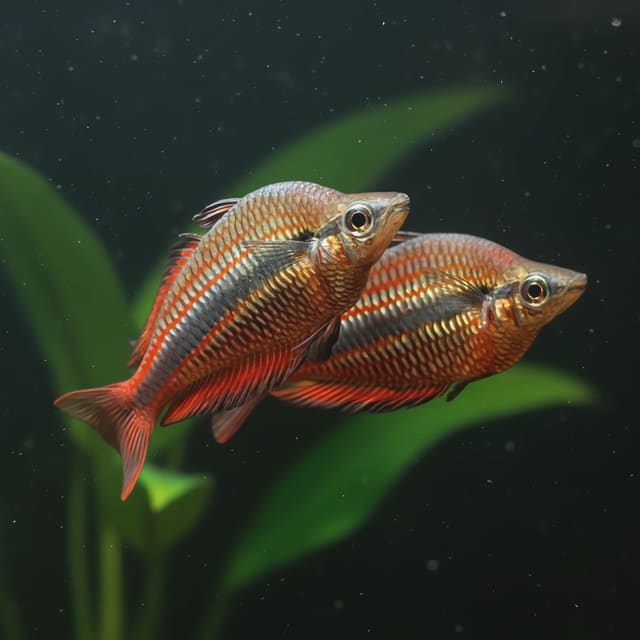
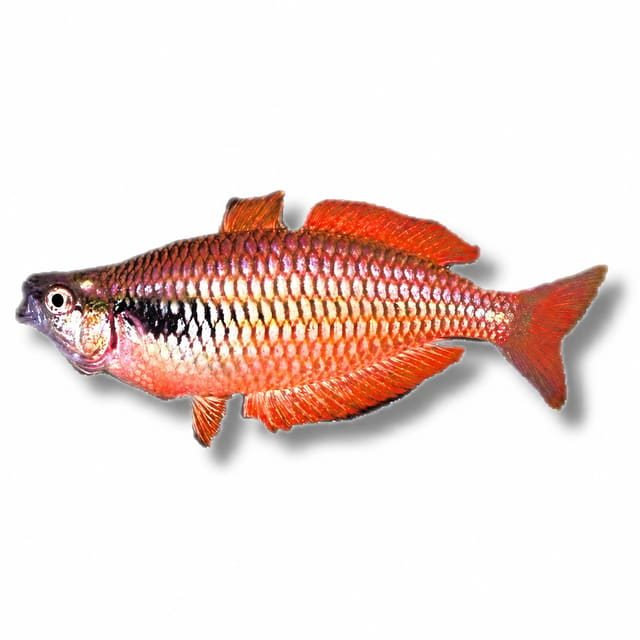
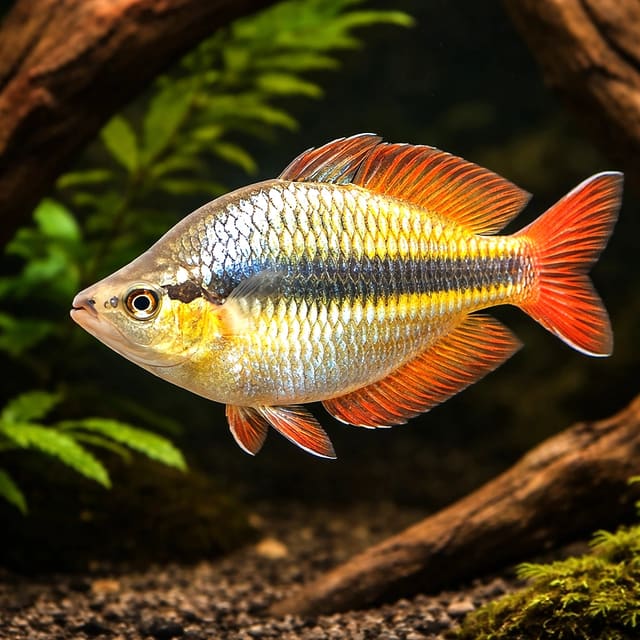
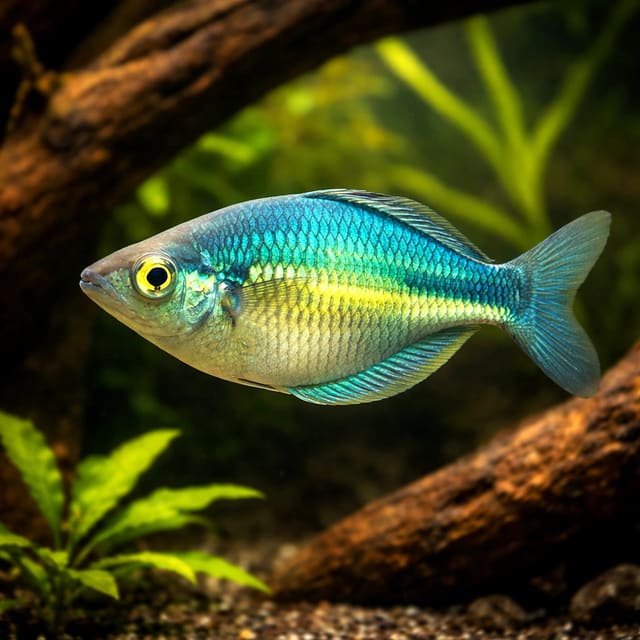
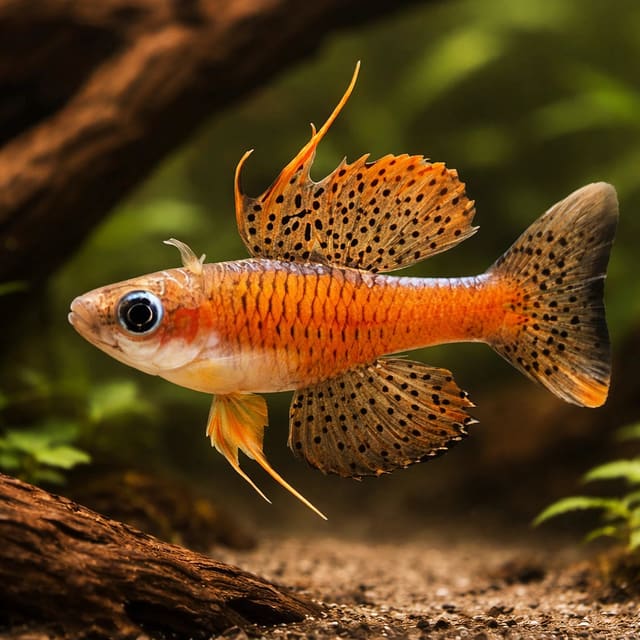
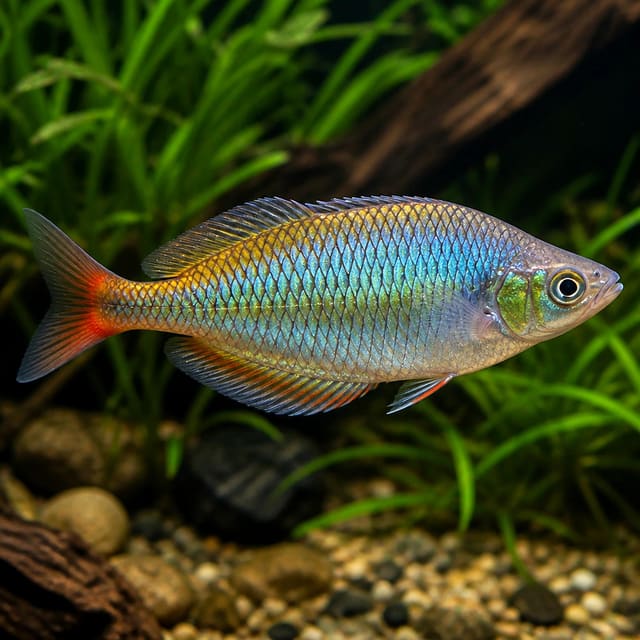
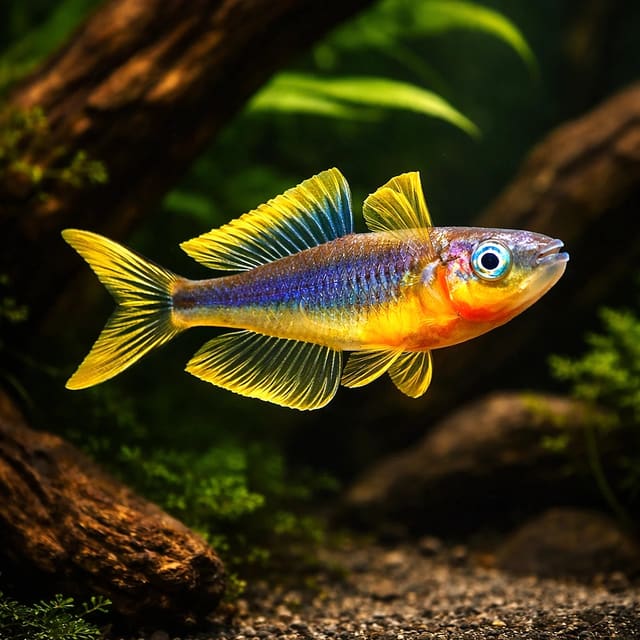
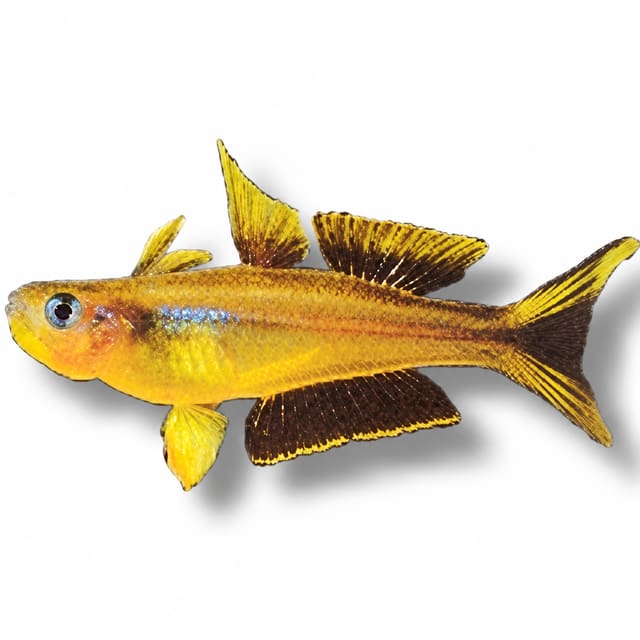
The gallery shows two fish so that their shape, eyes, fins and swimming posture can be seen; the pictured count does not alter the pack quantity. The gallery images are representative of this type of animal rather than photographs of the exact animal supplied, so colours can look slightly different from the live animal.
Ten small fish still add waste and feeding demand at the same time. Check the aquarium’s footprint, biological maturity, water values and existing livestock as one complete decision before introducing the group. The pack already forms a suitable shoal, but it does not reserve capacity for other fish.
Seriously Fish recommends a base of at least 60 × 30 cm, equivalent to approximately 54 litres in the example aquarium, and a group of at least 8–10 fish. Both footprint and volume matter: the long base provides usable swimming room, while water volume supports stability and waste dilution.
| Decision | Working requirement |
|---|---|
| Group | Keep at least 8–10; this pack supplies 10 |
| Aquarium base | At least 60 × 30 cm |
| Example volume | Approximately 54 litres |
| Routine temperature | 24–26°C |
| Routine pH | 7.0–8.0 |
| Routine hardness | 15–30 dGH |
| Filtration | Biologically mature, with oxygenation and some flow |
| Suits | Not suited to |
|---|---|
| A mature planted aquarium with open swimming routes | A biologically immature aquarium |
| A group plan for at least 8–10 fish | Solitary or undersized group keeping |
| A base of at least 60 × 30 cm | A shorter footprint below the recommended minimum |
| Peaceful companions with matching requirements | Predatory, bullying or persistent fin-nipping companions |
Treat approximately 54 litres as the starting point for the Forked-Tail group, not an automatic allowance for a mixed community. Existing fish, decor, swimming space, filter capacity and each species’ adult dimensions may make a larger aquarium necessary.
This fish suits a keeper prepared to test water, maintain a stable biological filter, feed small floating or suspended foods and assess every companion before mixing. A densely planted arrangement with floating cover and open swimming lanes provides a practical balance between security and activity.
Start with an aquarium base measuring at least 60 × 30 cm and an approximate volume of 54 litres. The footprint is the firmest planning measure because Forked-Tail Rainbowfish are active shoaling fish. A tall aquarium with a short base may hold a similar volume but offers less useful horizontal swimming room.
Plant densely around selected areas while preserving clear lanes through which all 10 fish can move. Floating plants can diffuse overhead light, while driftwood roots or branches add structure and a more natural feel. Keep this structure deliberate: a wall of decor across the swimming route defeats the purpose of choosing an adequate footprint.
| Area | What to provide |
|---|---|
| Planted cover | Dense growth where fish can move out of exposed areas |
| Upper space | Open routes for group swimming and feeding |
| Surface shade | Floating plants to diffuse bright light |
| Structure | Branches or driftwood roots without blocking movement |
| Base | Aquarium gravel or sand |
Use an aquarium that is biologically mature before the fish arrive. Forked-Tail Rainbowfish can fare poorly when water chemistry swings, so a newly assembled tank is not ready simply because the heater and filter are running. Beneficial bacteria must already be processing waste reliably.
If this is your first setup, follow our first tropical aquarium guide before choosing an arrival date. It explains how to prepare and mature the aquarium rather than trying to establish filtration after livestock has been added.
The minimum footprint describes the smallest aquarium to consider for this species. If other livestock will share the aquarium, assess their adult dimensions, swimming zones and waste production before adding their needs to the Forked-Tail group. More water can improve stability, but extra volume does not repair incompatible behaviour or unsuitable chemistry.
Place the intended plants, wood and other structure within the planned 60 × 30 cm base, then look for a continuous swimming route rather than judging the aquarium by volume alone. All 10 fish need room to move through open water without being channelled into one narrow gap. If branches or dense planting divide the footprint into cramped pockets, simplify the layout or choose a larger base. Keep cover around selected areas while leaving the main group route unobstructed.
Keep the aquarium at 24–26°C and pH 7.0–8.0. This is the overlap of FishBase, Seriously Fish and OATA’s broad rainbowfish group guidance. Seriously Fish gives 15–30 dGH for aquarium care; FishBase records 5–12 dH from the natural environment, while OATA gives 4–12 dGH for the wider group.
FishBase records 24–26°C and pH 6.0–8.0 from the natural environment, alongside an aquarium preference of 25°C, pH 7.6 and hardness 14. Seriously Fish gives an aquarium range of 24–28°C, pH 7.0–8.0 and 15–30 dGH, while OATA gives 22–27°C, pH 6.5–8.0 and 4–12 dGH.
Test the source water and aquarium before introducing the pack. Our water chemistry guide explains what the principal values mean, while the water matcher helps compare measured results with the working targets.
| Measurement | Routine target |
|---|---|
| Temperature | 24–26°C |
| pH | 7.0–8.0 |
| General hardness | 15–30 dGH |
| Ammonia | 0 mg/l |
| Nitrite | 0 mg/l |
| Nitrate | No more than 20 mg/l above the normal tap-water level |
A reading inside the target is useful only when it remains stable. Do not chase small test variations with abrupt chemical changes. Compare repeated results, investigate a clear trend and make controlled adjustments before the fish are introduced.
Temperature also needs consistency. Position the heater and circulation so warmed water is distributed through the aquarium, then confirm the result with a thermometer. Check the actual temperature rather than relying only on the heater dial.
Record the tap-water values, the mature aquarium values before introduction and the results from the first weekly checks after the pack arrives. If temperature, pH and hardness remain within their targets while ammonia and nitrite stay at 0 mg/l, preserve that routine instead of making unnecessary adjustments. A result outside the target calls for investigation before introduction; after the fish arrive, a trend away from the baseline should prompt a check of maintenance, filtration and recent changes.
A working biological filter is essential. The RSPCA explains that fish release toxic ammonia; filter bacteria convert it first to nitrite, which is also toxic, and then to the safer nitrate. The filter therefore has to be established before the pack is added and maintained without destroying its bacterial population.
Forked-Tail Rainbowfish also benefit from well-oxygenated water and some flow. In an aquarium of approximately 54 litres, Seriously Fish uses a turnover of four to five times the volume each hour, corresponding to a filter rated around 215–270 litres per hour. Treat that rating as a starting point: media condition, head height and obstruction can affect practical flow.
If the filter needs cleaning, do not run it under the tap. Instead, rinse it lightly in the tank water removed during a partial water change, as this reduces the amount of beneficial bacteria lost.
If ammonia or nitrite appears, treat the reading as an immediate water-quality problem. Pause further stocking, check filter flow and look for excess food or other decaying material. Carry out an appropriate conditioned water change and test again so the response is guided by the result.
Never solve weak filtration by adding more flow until the fish struggle to hold position. Restore blocked or dirty media, check the filter’s rating and preserve swimming areas with calmer water while maintaining oxygenation across the aquarium.
Compare the aquarium’s readings from before introduction with the first weekly result and the following routine checks. Ammonia and nitrite must remain at 0 mg/l after all 10 fish are being fed. If nitrate rises towards more than 20 mg/l above the normal tap-water level, review portions, waste removal and water-change practice. Reduced outlet flow calls for a blockage check, while normal flow combined with a failed test points towards biological capacity or excess waste rather than circulation alone.
Forked-Tail Rainbowfish feed chiefly on floating or suspended zooplankton, phytoplankton and invertebrates in nature. In the aquarium, offer suitably small items that remain accessible in the water column rather than large pieces that sink untouched or cannot fit into the mouth.
Suitable choices include small or crushed floating dried food together with live foods such as Daphnia, Moina, Artemia nauplii and microworms. Freeze-dried Artemia and Daphnia can also form part of the rotation. Break dried food down before feeding if the particles are too large for the fish to take cleanly.
| Food decision | Practical action |
|---|---|
| Daily staple | Use a good-quality small or crushed floating dried food |
| Live-food variety | Offer suitably sized Daphnia, Moina, Artemia nauplii or microworms |
| Freeze-dried variety | Use appropriately sized Artemia or Daphnia |
| Portion | Only what the group eats within a few minutes |
| Schedule | Feed once a day |
Distribute the portion across the group rather than dropping it in one dense clump. Watch whether all 10 fish reach the food while it remains floating or suspended. If some fish repeatedly miss the meal, spread the same small portion across a wider surface area instead of increasing the total amount immediately.
Food remaining after a few minutes indicates that the portion, particle size or delivery method needs adjusting. Remove visible excess where practical. Uneaten food breaks down and adds nitrogenous waste, increasing the load on the biological filter.
A strong rush towards food is not a reason to keep adding more. Stop when the measured portion has been consumed and assess body condition and feeding response over time. A sudden reduction in appetite belongs in the health assessment because it can accompany stress, social pressure or deteriorating water quality.
If intact pieces remain after the fish have tried to feed, crush the next portion more finely without increasing its total amount. If suitable food remains after a few minutes, reduce the next daily portion. When one part of the shoal reaches most of the food first, spread the same portion across a wider area so other fish can feed. Changing particle size, quantity and delivery position together makes it harder to identify which adjustment solved the problem.
Prepare the aquarium before delivery day: confirm the temperature, pH, hardness, ammonia and nitrite readings; check that the filter is flowing; and make sure someone can receive the fish. The aquarium should already be biologically mature and able to process the added waste from 10 fish.
These steps follow our delivery and Live Arrival Guarantee policy. Read the policy before delivery because it also explains the applicable arrival documentation and timing requirements.
Look at the whole group first. Count 10 fish, then observe swimming, breathing, orientation and visible fin condition. A fish may initially stay close to cover, but persistent surface hanging, bottom sitting, erratic movement or markedly unusual breathing calls for a water-quality check.
Keep the aquarium environment steady rather than making several changes at once. Check that the temperature remains within 24–26°C and that the filter continues to circulate and oxygenate the water. If behaviour changes after an adjustment, knowing exactly what was altered makes the cause easier to investigate.
At each daily feed, confirm that food reaches the group and is eaten within a few minutes. During the weekly maintenance check, test ammonia and nitrite and confirm both remain at 0 mg/l. Also compare nitrate with the source-water baseline.
If a problem appears, record the measured water values and the behaviour you can see. Concrete observations such as rapid gill movement, repeated hiding or refusal of appropriately sized food are more useful than changing temperature, chemistry and feeding simultaneously.
Use the first day to establish normal swimming and breathing, then use each daily feed to compare appetite and access to food. At every weekly maintenance session, record ammonia, nitrite and nitrate before completing the water change and filter check. Across the first month, look for consistent results rather than reacting to one ordinary movement or colour variation. A repeated change in behaviour paired with a changing water result gives you a clearer action point than either observation alone.
Regular observation is part of routine care because each aquarium develops its own normal pattern. Watch the group at feeding time and during ordinary swimming so that a change in one fish or across all 10 becomes noticeable early.
A group-wide change points first towards a shared environmental cause. Check temperature, ammonia, nitrite, nitrate, filter flow and recent maintenance. If one fish is affected, still check the shared environment before deciding that the issue is isolated.
Correct a measurable husbandry problem directly: restore filter flow, remove uneaten food, condition replacement water and use water changes to manage waste. Avoid adding treatments simply because a fish has changed colour or position; the same outward sign can arise from different causes.
If you are concerned about a health change, test the water and contact us with the results, the number of fish affected and a clear description of what has changed. Photographs or a short video can help show swimming, breathing and external appearance.
Continue to keep the aquarium stable while the cause is assessed. Sudden, repeated changes to temperature or water chemistry can add stress and obscure whether the original action helped.
If all 10 fish begin hanging near the surface or breathing differently, check shared conditions immediately: temperature, ammonia, nitrite, filter flow and oxygenation affect the whole aquarium. If one fish develops fin damage while the rest behave normally, still test the water, then observe whether that fish is being chased or excluded at feeding time. This order prevents a social problem from hiding a water problem and prevents a shared environmental problem from being mistaken for one isolated fish.
Forked-Tail Rainbowfish are peaceful shoaling fish and should be kept in a group of at least 8–10. This pack supplies 10, so keep the group together rather than dividing it between aquariums or using a few as additions to separate communities.
A full group can be less nervous and produce a more natural-looking display. Males may show stronger colours and display behaviour while competing for female attention, but the pack carries no sex guarantee and should not be planned around a particular ratio.
Brief displays and interactions are part of group behaviour. Persistent chasing that prevents another fish from feeding, swimming openly or leaving cover needs attention. First check whether the aquarium provides both planted refuge and open routes. A cramped or obstructed layout can reduce the space available for fish to move away from one another.
| What you see | What to check |
|---|---|
| Group stays hidden | Water values, sudden disturbance, cover and tank-mate pressure |
| One fish misses food | Food distribution and repeated chasing at the surface |
| Fish cannot hold position | Whether filter flow is too concentrated |
| Repeated fin damage | Persistent nipping or bullying by companions |
| Group spreads through the tank | Continue observing normal swimming and feeding |
Do not interpret brighter colour as proof that a fish is male or that the supplied group has a planned sex ratio. Colour and fin development can be observed as appearance, while the offer remains an unsexed pack.
Social needs come before adding variety. Establish adequate space, stable water and reliable feeding for the 10 Forked-Tails before deciding whether the aquarium has capacity for another species.
Seriously Fish describes Forked-Tail Rainbowfish as peaceful and suitable for a well-chosen community with fish of comparable size, disposition and requirements. It names many cyprinids, gobiids, eleotrids and smaller melanotaeniids as potentially suitable groups, but each proposed species still needs its own assessment.
Avoid predatory companions, persistent fin-nippers and fish likely to bully this small peaceful shoal. Be cautious with much larger or highly boisterous fish even when their temperature range overlaps. Shared temperature alone is not enough to establish compatibility.
| Candidate | Decision rule |
|---|---|
| Peaceful fish of comparable size | Consider only when water values and space also match |
| Cyprinid, goby or eleotrid | Assess the exact species rather than relying on the group name |
| Smaller rainbowfish | Compare adult size, hardness and activity before mixing |
| Fin-nipping fish | Avoid |
| Predatory or bullying fish | Avoid |
A mixed community remains a case-by-case stocking decision because temperament, adult dimensions and aquarium layout vary. Contact us with the aquarium dimensions, measured water values and a complete list of existing livestock for a stocking and compatibility assessment.
Do not use the minimum 60 × 30 cm footprint as an automatic mixed-community capacity. It is the smallest base recommended for the Forked-Tail group itself. Any companion adds its own swimming-space, social and filtration demands.
A candidate that matches 24–26°C but falls outside pH 7.0–8.0 or 15–30 dGH fails the water check, so do not move on to stocking calculations. When all three water ranges overlap, compare adult size and behaviour next. Only after those checks pass should you assess whether the aquarium has enough open swimming room, cover and filtration capacity for both complete groups. This sequence prevents one attractive match, such as shared temperature, from outweighing a decisive incompatibility elsewhere.
FishBase records a maximum of 5 cm standard length for male or unsexed Forked-Tail Rainbowfish. Plan the aquarium around that adult figure.
Seriously Fish says an aquarium with a base of at least 60 × 30 cm should be the smallest considered for Popondetta furcata; its example is approximately 54 litres. Use a biologically mature aquarium with dense planting, open swimming routes, oxygenation and some flow.
Keep Forked-Tail Rainbowfish in a group of at least 8–10 specimens. Seriously Fish describes this as a shoaling species and says a group can make the fish less nervous and produce a more natural-looking display.
This fish suits a keeper who can provide a biologically mature planted aquarium, stable water, a complete shoal and appropriately sized food. Do not add it to a biologically immature aquarium because it can be susceptible to swings in water chemistry.
Feed once daily with small or crushed floating dried food and rotate suitably sized Daphnia, Moina, Artemia nauplii or microworms. Offer only what the group consumes within a few minutes.
Keep Forked-Tail Rainbowfish at 24–26°C and pH 7.0–8.0, the overlap of FishBase, Seriously Fish and OATA guidance. Seriously Fish gives 15–30 dGH for aquarium care; keep ammonia and nitrite at 0 mg/l.
Seriously Fish describes this fish as peaceful. Choose companions that will not bully it or persistently nip its fins, and investigate repeated chasing or fin damage rather than treating it as normal community behaviour.
Seriously Fish names many cyprinids, gobiids, eleotrids and smaller melanotaeniids as potentially suitable when the exact species has comparable size, disposition and requirements. Screen every candidate for matching water, adult size, behaviour, space and feeding access before mixing.
Start filming before opening the sealed parcel, then record continuously as it is opened and show the fish still inside the sealed bag. Someone must be present to receive it. Float the bag for 20–30 minutes before releasing the fish, and never pour the bag water into the aquarium.
No reviews for this item yet. Bought one? Honest reviews only, good or bad.
What customers say about ordering from us
I have a small group of long finned mountain minnows. So was delighted to be able to order ten of this variety to increase the genetics in my tank . The ones I recieved are healthy but it’s to early to give a verdict on wether they are of a long finned type since they are small currently.
Gordon Walker · 23 Sept 2026
100% success travel and "installation". Pleased with quality of purchase. The Siamese fighter a bit "shy" so have not yet seen him at his best yet but looking good. Happy customer. GG
George E Garratt · 21 Sept 2026
Reviews of our shop, collected by Judge.me, an independent third-party review collector. Newest first.