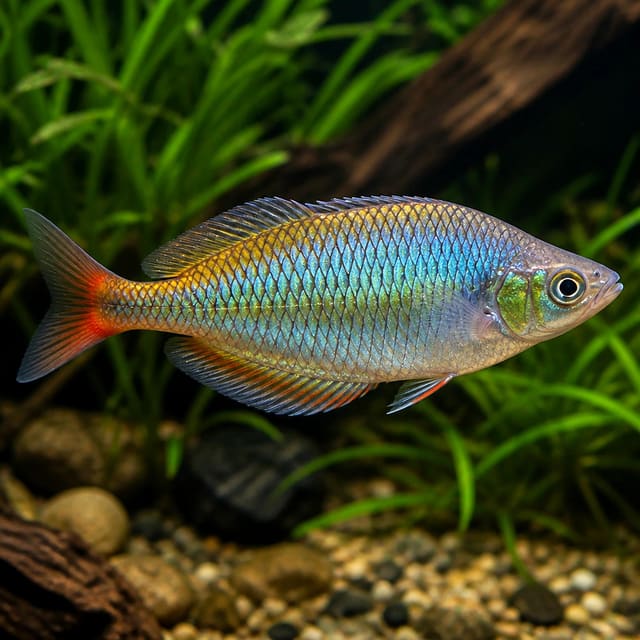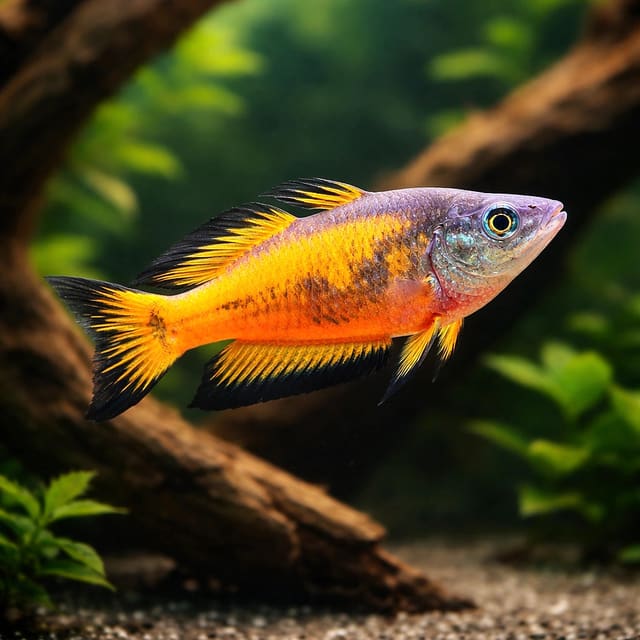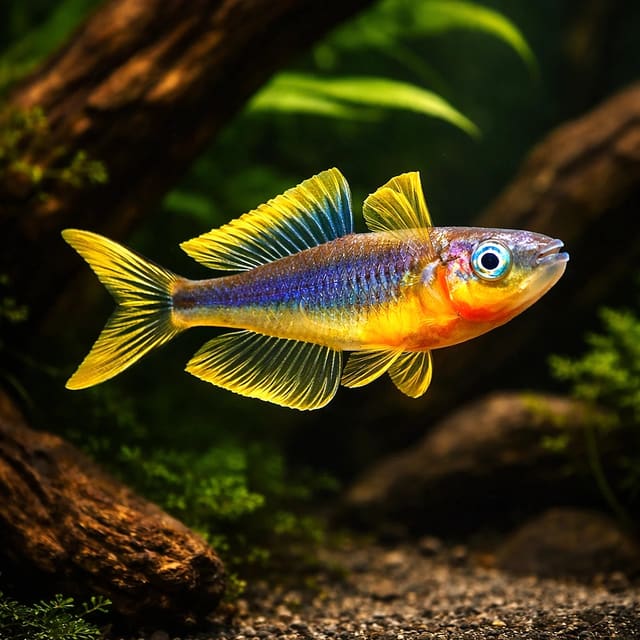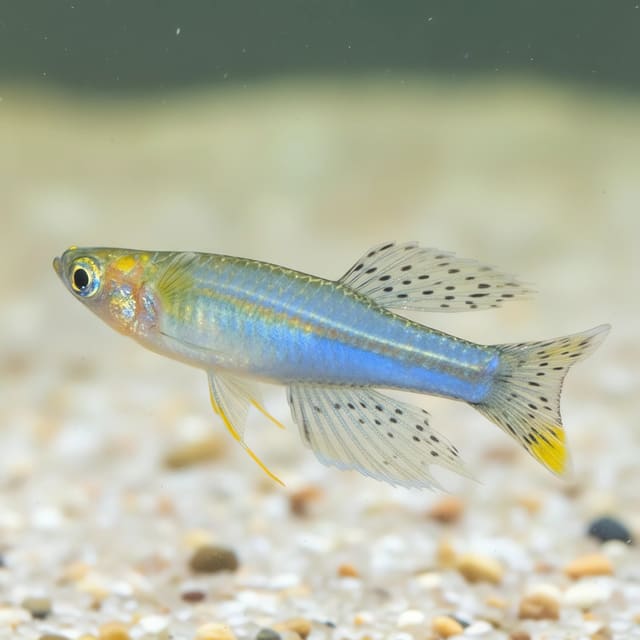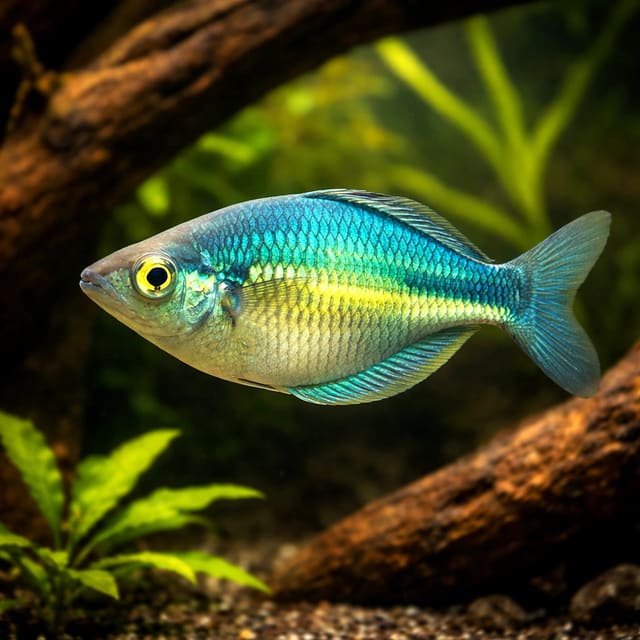
Lake Kutubu Rainbowfish (Melanotaenia lacustris) – 4–6cm+ Size Grades
22–24°C · pH 7–8 · 108L
£8.99

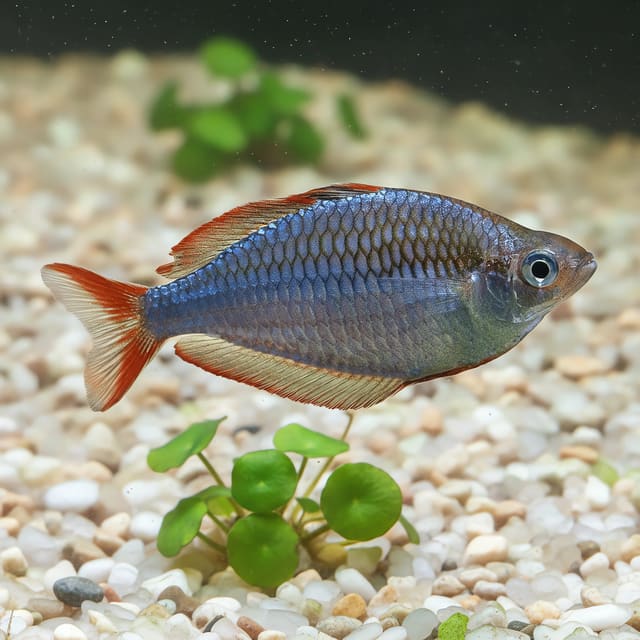
The Neon Dwarf Rainbowfish (Melanotaenia praecox) is a freshwater rainbowfish from the Mamberamo River in northern Irian Jaya, Indonesia, reaching 5 cm standard length. It suits prepared beginners with a planted, filtered aquarium; keep at least six, preferably eight or more, at 23–27°C and pH 6.8–7.5, the overlap of Seriously Fish species guidance and OATA rainbowfish guidance. Sold individually in 2 - 2,5 cm, 2,7 - 3,3 cm, 3,5 - 4 cm, 4-5 cm and XL dispatch sizes.
Adult size is the maximum length this species reaches at full maturity (scientific sources). The livestock you receive will be younger and smaller — pick a size above for the actual shipping size. Product-photo provenance and any image-specific limitations are stated on the listing.
Melanotaenia praecox
Shoaling fish: kept in a group they feel safer, stay calmer and show their best colour.
The Neon Dwarf Rainbowfish (Melanotaenia praecox) is a freshwater rainbowfish from the Mamberamo River in northern Irian Jaya, Indonesia, reaching 5 cm standard length. It suits prepared beginners with a planted, filtered aquarium; keep at least six, preferably eight or more, at 23–27°C and pH 6.8–7.5, the overlap of Seriously Fish species guidance and OATA rainbowfish guidance. Sold individually in 2 - 2,5 cm, 2,7 - 3,3 cm, 3,5 - 4 cm, 4-5 cm and XL dispatch sizes.
Adult size is the maximum length this species reaches at full maturity (scientific sources). The livestock you receive will be younger and smaller — pick a size above for the actual shipping size. Product-photo provenance and any image-specific limitations are stated on the listing.
Maintain these water conditions for optimal health and vibrant colors
The Neon Dwarf Rainbowfish (Melanotaenia praecox) is a freshwater member of the rainbowfish family Melanotaeniidae from the Mamberamo River in northern Irian Jaya, Indonesia. It reaches 5 cm standard length and suits a keeper who wants an active, peaceful shoal in a planted community aquarium. We rate its care level as easy for a prepared beginner who can provide a mature filter, stable water and consistent maintenance.
FishBase records its identity, family and Mamberamo River distribution. Seriously Fish describes it as very peaceful, active and best kept in a shoal of at least 6–8, preferably more.
| Suits | Not suited to |
|---|---|
| A planted, filtered community aquarium | An immature or unfiltered aquarium |
| A group of at least six | Being kept alone or in too small a group |
| Open swimming room between plants | A cramped layout without swimming space |
| Similarly sized, non-timid companions | Timid fish or fish much smaller than itself |
One purchase supplies one Neon Dwarf Rainbowfish from the selected size. Use the live size selector to choose from the labels 2 - 2,5 cm, 2,7 - 3,3 cm, 3,5 - 4 cm, 4-5 cm and XL. The size you select is the size supplied, not the adult size. Plan the aquarium and its companions around the 5 cm adult length rather than the dispatch measurement.
The numeric labels describe the fish's dispatch size. XL is a named grade without a fixed centimetre measurement, so use the label as shown and do not convert it into an assumed length. If you are building the minimum shoal from this offer, set the purchase quantity to at least six animals and check that the aquarium already has the space and biological capacity for the complete group.
Sex is guaranteed only when the selected option explicitly states male or female. This Neon Dwarf Rainbowfish listing has no sex-guaranteed option.
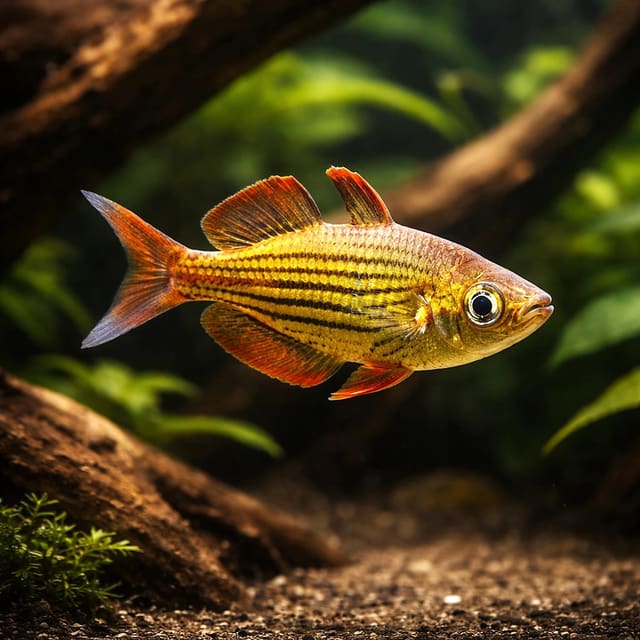
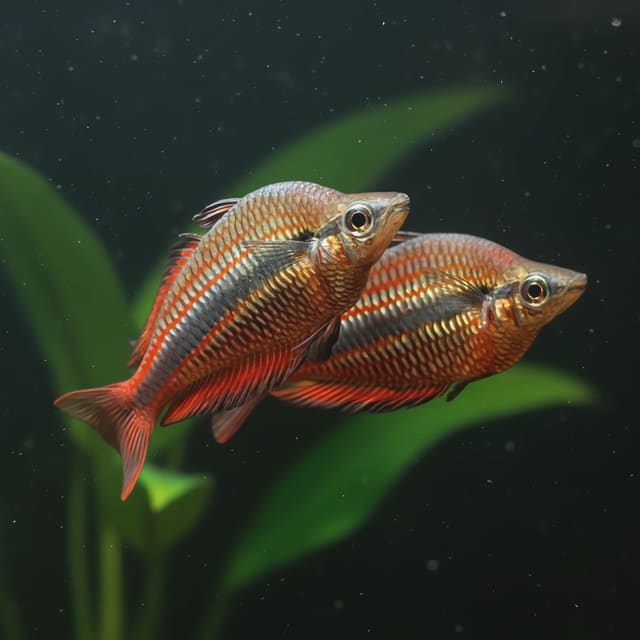
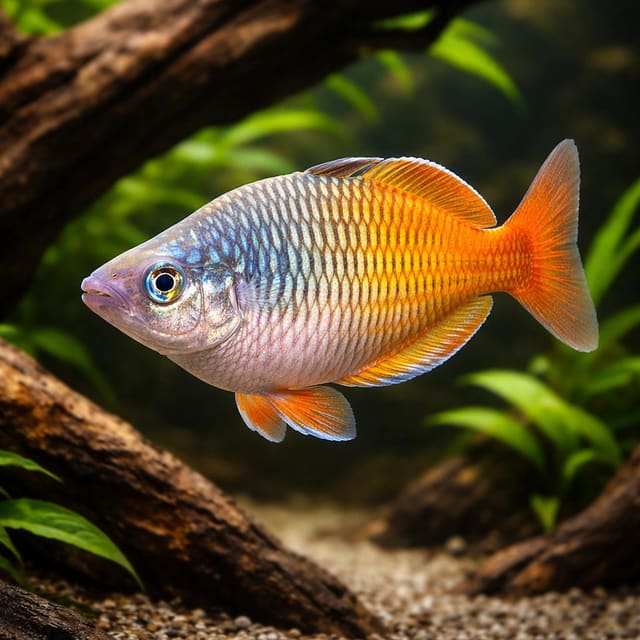
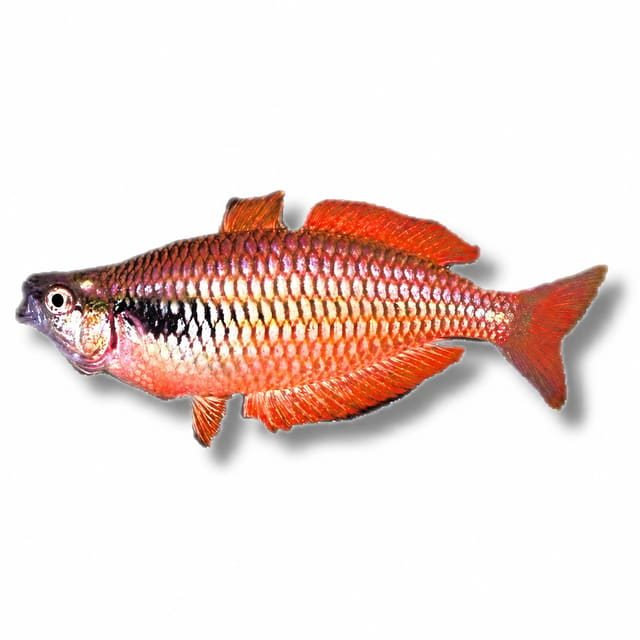
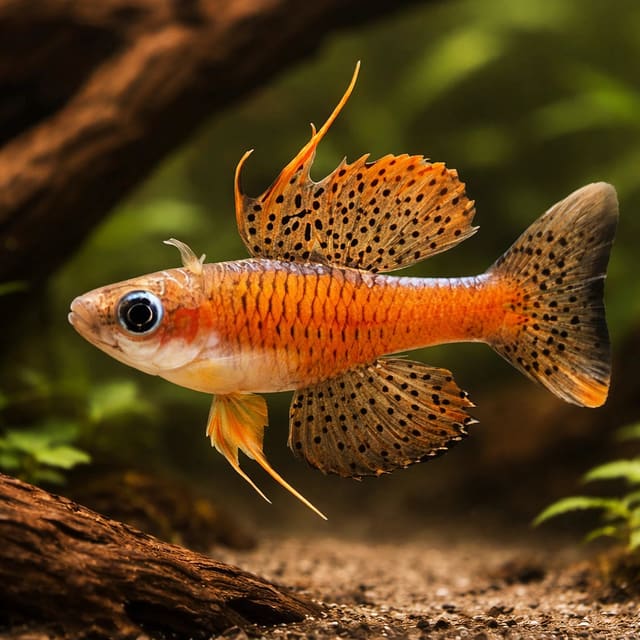
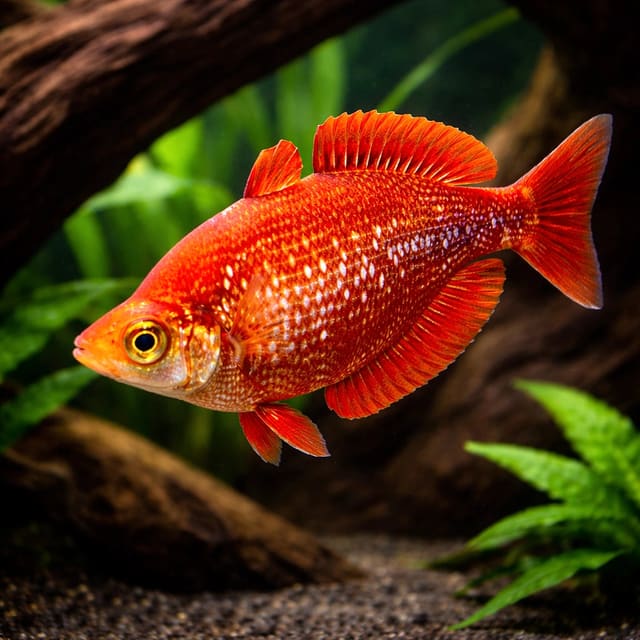
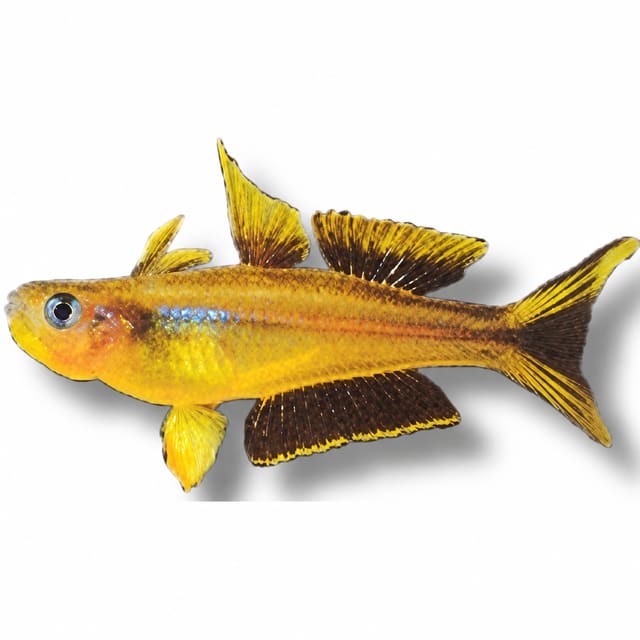
The gallery images are representative, based on reference photographs of this species, so colours can look slightly different from the live animal.
To compare this fish with other members of the family, browse the rainbowfish collection. Compare adult dimensions, activity, group requirements and water needs before choosing between species.
Plan for an adult length of 5 cm standard length, the maximum length FishBase records. Seriously Fish gives a larger length of 8 cm standard length and describes the fish as active despite its small size.
Provide an aquarium at least 80 cm long. FishBase gives 80 cm as the minimum aquarium length, while Seriously Fish gives a minimum base of 60 × 30 cm, a height of 30 cm and a volume of about 54 litres. Meet both recommendations by choosing at least 80 cm of length without dropping below a 60 × 30 cm base or about 54 litres.
A volume figure alone can hide an unsuitable shape. A tall aquarium may contain 54 litres yet offer less horizontal swimming room than this active shoal needs. Start with the 80 cm length, then confirm that the base is at least 60 × 30 cm and that the filled aquarium provides no less than about 54 litres.
Group size changes the practical space decision. Six fish form the minimum shoal recommended for this species, while eight or more is preferable. The minimum dimensions are a starting point for a modest group, not permission to add fish without checking the aquarium's swimming room and biological capacity.
| Planning check | Decision |
|---|---|
| Adult length | 5 cm standard length |
| Aquarium length | At least 80 cm |
| Base and volume | At least 60 × 30 cm and about 54 litres |
| Shoal | At least six; preferably eight or more |
Measure usable swimming room after wood, rocks, plants and equipment are installed. Preserve open horizontal lanes between planted areas so the shoal can move through the aquarium rather than being confined to a small open corner.
Keep the aquarium at 23–27°C, pH 6.8–7.5 and 5–12 dGH. The temperature is the overlap of FishBase's recorded 22–28°C environment, Seriously Fish's 23–28°C aquarium range and OATA's 22–27°C rainbowfish guidance. The pH and general hardness values are the overlap of Seriously Fish's 6.8–7.5 and 5–15 dGH ranges with OATA's 6.5–8.0 and 4–12 dGH ranges.
Aim for ammonia at 0 mg/l and nitrite at 0 mg/l. OATA also advises keeping nitrate no more than 20 mg/l above the normal tap-water level. These waste readings matter because rainbowfish can be stressed by even small amounts of ammonia and nitrite.
Use our water chemistry guide to understand what each measurement means. Enter measured values into the water matcher when comparing an established aquarium with the routine range.
Do not chase a target by making abrupt changes. Choose an aquarium whose normal water can be maintained consistently inside the range, then use regular testing and partial water changes to detect drift. The larger the aquarium, the more stable its temperature and water quality will be, but whatever its size it still needs a working filter and scheduled maintenance.
| Value | Routine instruction |
|---|---|
| Temperature | 23–27°C |
| pH | 6.8–7.5 |
| General hardness | 5–12 dGH |
| Ammonia and nitrite | 0 mg/l |
Use a heavily planted aquarium while preserving broad, open areas for swimming. Seriously Fish recommends dense planting for this species and notes that it shows its best colours in that setting. Separate planted zones with clear horizontal lanes so the shoal can swim and display without plants filling the entire aquarium.
Diffuse bright light with floating plants. The fish does not appreciate bright conditions, and floating cover softens light while leaving the lower planting visible. Position that cover so it does not remove every open lane at the surface or cast the whole aquarium into one dense block of shade.
OATA recommends gravel or sand and live plants to provide cover for rainbowfish. Suitable ornaments can add shelter when live planting is limited, but they should not replace the open space this active species needs. Avoid creating narrow dead ends where the shoal has to turn repeatedly around bulky décor.
The best layout balances two needs rather than maximising only one. Plant cover gives visual shelter and softer conditions; open water provides room for active movement and display. A densely planted back and side area with open space through the middle is one workable arrangement, provided the final swimming lane remains broad and continuous.
| Layout element | Purpose |
|---|---|
| Dense planted areas | Cover and a setting that supports natural colour |
| Floating plants | Diffuse bright light |
| Open horizontal lanes | Swimming and display room |
| Gravel or sand | A suitable aquarium substrate |
Watch how the complete shoal uses the aquarium. If fish repeatedly crowd into one small open patch, thin or move plants and ornaments to restore a longer route without removing all cover.
Use a mature, working biological filter at all times. The RSPCA explains that biological filtration supports beneficial bacteria which convert toxic ammonia first into toxic nitrite and then into safer nitrate. The filter must be established before the fish are added and maintained without destroying that bacterial population.
For an aquarium of about 54 litres, Seriously Fish gives a turnover of four to five times the aquarium volume each hour. That corresponds to a filter rated at approximately 215–270 litres per hour for that volume. If the aquarium is larger, apply the four-to-five-times turnover to its actual volume rather than reusing the 54-litre example.
Change 25% of the aquarium water at least once every week.
When filter media needs cleaning, rinse it lightly in aquarium water removed during the partial water change. Do not rinse it under the tap. Chlorine or chloramine may kill beneficial bacteria established in the media and reduce the filter's ability to process fish waste.
| If you observe | Action |
|---|---|
| Reduced filter flow | Check for a blockage before changing equipment |
| Dirty filter media | Rinse lightly in removed aquarium water |
| Ammonia or nitrite above zero | Pause further stocking and address water quality |
| Rising waste between changes | Review feeding, stocking and the weekly routine |
Never treat clear-looking water as proof that the biological filter is coping. Use test results, normal flow and the fish's behaviour together when judging aquarium stability.
Feed a good-quality flake or granule as the regular dried food, supported by suitably small live or frozen foods. Seriously Fish describes this species as an unfussy omnivore that will accept most dried, frozen and live foods. OATA recommends a good-quality flake or granule for rainbowfish and says they will also benefit from small live or frozen foods such as daphnia, small bloodworm or tubifex.
Feed once a day and offer only what the shoal can eat within a few minutes. Start with a restrained portion, watch the whole group feed, and stop adding food when interest falls. This approach is more reliable than using a fixed pinch for every aquarium because group size and food format differ.
Regular feeds of live food will help the fish show their best colours, but they remain part of a varied diet rather than a reason to increase the daily amount. Substitute them for part of the normal portion instead of adding a second full meal.
Overfeeding leaves uneaten food to break down and release waste into the water. If food remains after the group has stopped feeding, reduce the next portion and test water quality if the aquarium becomes cloudy or the fish behave differently.
| Feeding observation | Next decision |
|---|---|
| Food disappears within a few minutes | Keep the portion steady |
| Food remains after interest stops | Reduce the next portion |
| One fish repeatedly misses food | Spread the portion across the shoal's swimming area |
| Interest in food falls | Test water and check for other health changes |
Keep feeding consistent enough to judge changes in appetite. A sudden reduction in food intake is easier to recognise when the type, timing and portion have not been changing unpredictably.
Prepare the mature aquarium before the parcel arrives, then follow the store procedure in order. The temperature, pH and hardness should already sit within the routine range, with ammonia and nitrite at zero. Do not use arrival day to make major changes to the aquarium layout or biological filter.
Filming from the sealed parcel onward preserves the complete sequence needed for a Live Arrival Guarantee claim. Keep the order number with the video. If anything is wrong, contact us the same day with both items so the concern can be assessed promptly.
Read the current delivery and Live Arrival Guarantee policy before the delivery date. The policy explains that fish are hand-packed in pure oxygen inside an insulated box, with a heat pack when the weather calls for it, and carried by a licensed live-animal courier.
Keep the bag sealed while recording the condition of the fish, then complete the release without transferring transport water into the aquarium. Before the parcel arrives, the aquarium must already have the correct water values and a mature filter.
| Before opening | Before releasing |
|---|---|
| Receive the parcel in person | Float the bag for 20–30 minutes |
| Begin continuous filming | Keep the fish in the sealed bag until floating |
| Show the sealed parcel and outer box | Do not pour bag water into the aquarium |
Add fish only to a mature aquarium with ammonia and nitrite at zero. Beneficial bacteria in the filter must process the extra waste created whenever fish numbers and feeding increase. Prepare and mature a first aquarium with our first tropical tank guide before arranging livestock.
Increase the aquarium population slowly. OATA warns that overstocking, or stocking the aquarium too quickly, can cause new tank syndrome because there may not yet be enough beneficial bacteria to process the added waste. This listing is for a shoaling species, so reconcile gradual stocking with the need for an appropriate group by establishing enough biological capacity before the first group is introduced.
Do not add another species merely because the first group appears calm on the first day. Allow the filter load and behaviour to settle, then use water tests and the space remaining in the aquarium to decide whether any further stocking is appropriate.
Keep notes on temperature, pH, hardness, ammonia and nitrite alongside feeding and behaviour. A simple record distinguishes a one-off observation from a developing pattern and shows whether a change followed feeding, maintenance or additional livestock.
| Checkpoint result | Decision |
|---|---|
| Ammonia or nitrite above zero | Stop further stocking and restore water quality |
| Normal readings and active feeding | Continue the established routine |
| Fish crowd one small area | Review cover, swimming lanes and companions |
| Uneaten food accumulates | Reduce the next daily portion |
Learn the group's normal swimming, colour, breathing and appetite so changes stand out. Healthy fish should have clear, bright eyes, intact scales and undamaged fins, with swimming and feeding behaviour appropriate to the shoal.
Test water quality first when behaviour or appearance changes. Ammonia and nitrite must remain at zero, and the routine temperature, pH and hardness should remain within range. A water test gives an immediate action point without guessing at a disease or applying a treatment that may not fit the problem.
| Change you observe | First response |
|---|---|
| Hanging at the surface, sitting on the bottom or erratic swimming | Test water and check filter flow |
| Colour becomes darker or paler | Check water, group behaviour and recent changes |
| Hiding or aggression changes | Review shoal size, cover and companions |
| Gill covers move faster or slower | Test water promptly and observe the whole group |
| White spots, fluffy growths, damaged fins or lost scales | Record the signs and seek species-appropriate help |
| Reduced appetite or changing body condition | Check water, feeding access and other visible signs |
Look at the whole shoal as well as the individual fish. If several fish change at the same time, examine shared factors such as water quality, filter performance, feeding and a recent stocking change. If one fish changes, still test the shared water before moving to an individual assessment.
Keep portions controlled when appetite changes, and check that every fish can reach food if one loses condition. Continue controlled portions, remove the cause of any water-quality problem and document what the fish is doing. Extra uneaten food increases waste and can make the aquarium less stable.
If you are concerned about a fish's health, test the water and contact us for further guidance. Provide the measured values, aquarium dimensions, group size, companions, recent additions and a clear description of the change so the next decision is based on the aquarium as it is operating.
Keep at least six Neon Dwarf Rainbowfish together, with eight or more preferable. Seriously Fish recommends a shoal of at least 6–8 and notes that the species can be skittish and does far better when kept in a shoal. FishBase gives five or more as an aquarium group and OATA at least five for rainbowfish generally, but plan for Seriously Fish's species recommendation of at least six.
The group is part of the compatibility plan, not an optional addition after other fish have filled the aquarium. Reserve adult swimming space and biological capacity for the complete shoal before choosing companion species. One fish per purchase means a planned minimum group requires a quantity of at least six.
More than six can provide a stronger social group when aquarium space and filtration support it. A larger shoal still needs the aquarium to provide open room and keep ammonia and nitrite at zero.
Conspecific company also encourages males to display their colours. Treat that as a group behaviour rather than a way to identify or guarantee the sex of an individual fish. Build the purchase decision around shoal size, adult dimensions and aquarium capacity.
| Group plan | Assessment |
|---|---|
| One fish | Too small for this shoaling species |
| Five fish | Below the species recommendation |
| Six to eight fish | Meets the species recommendation |
| More than eight | Suitable when space and filtration support the larger shoal |
Choose similarly sized, non-timid fish whose routine water needs overlap 23–27°C, pH 6.8–7.5 and 5–12 dGH. Seriously Fish describes the Neon Dwarf Rainbowfish as very peaceful and names similarly sized rainbowfish, characins, danios, barbs, dwarf cichlids, freshwater gobies and Corydoras as good community candidates.
These names are starting points rather than universal approvals. Check the proposed species at its adult size, compare its activity with an active rainbowfish shoal, and confirm that both can share the same water range and aquarium layout. The aquarium must also retain enough swimming room and filtration capacity for every adult animal.
| Candidate | Decision |
|---|---|
| Similarly sized rainbowfish | Consider after checking adult size, group needs and water |
| Characins, danios or barbs | Consider similarly sized, compatible species after screening |
| Dwarf cichlids or freshwater gobies | Check adult behaviour, space and water before mixing |
| Corydoras | Check species dimensions, group needs and water |
| Timid fish | Avoid mixing with this active shoal |
| Fish much smaller than the rainbowfish | Avoid mixing because the activity and size difference is unsuitable |
OATA advises that active rainbowfish should not be mixed with fish that are timid or much smaller. Avoid those combinations rather than assuming extra planting will make the mismatch safe. Cover can help a fish use the aquarium, but it does not change the adult size or activity of either species.
Observe the community at feeding time and while the shoal crosses open water. Check whether every species can reach food, hold its normal position and use its preferred area without persistent hiding or damaged fins. A peaceful species description does not remove the need to watch the actual aquarium.
For a stocking and compatibility assessment, ask us with the aquarium dimensions, measured water values, filter details, current group sizes and the exact species being considered. That allows the decision to account for adult animals and the complete community rather than comparing common names alone.
It reaches 5 cm standard length. Use that adult figure when planning aquarium space and companions, even when choosing a smaller dispatch size.
Use an aquarium at least 80 cm long and no less than about 54 litres, with a base of at least 60 × 30 cm. FishBase gives the 80 cm minimum length, while Seriously Fish gives the 60 × 30 × 30 cm and approximately 54-litre minimum.
Keep at least six, preferably eight or more. Seriously Fish recommends a shoal of at least 6–8 and notes that the species does far better when kept in a shoal.
We rate it easy for a prepared beginner. OATA describes rainbowfish as usually easy to keep, while this species still needs a mature filter, stable water, a full shoal and consistently high water quality.
Feed a quality flake or granule with small live or frozen foods such as daphnia, small bloodworm or tubifex for variety. Feed once daily and offer only what the shoal can eat within a few minutes.
Keep 23–27°C, pH 6.8–7.5 and 5–12 dGH. These routine values are the overlap of Seriously Fish species guidance and OATA rainbowfish guidance.
Seriously Fish describes it as very peaceful. Keep a proper shoal, choose similarly sized and non-timid companions, and monitor behaviour and fin condition whenever the community changes.
Consider similarly sized rainbowfish, characins, danios, barbs, dwarf cichlids, freshwater gobies and Corydoras after checking adult size, activity, group needs and water. Avoid timid fish and fish much smaller than the rainbowfish.
Be present to receive the parcel, start a continuous unboxing video while the parcel is still sealed, open and inspect it the same day, and float the bag for 20–30 minutes before releasing the fish without pouring the bag water into the aquarium. Tropical Fish Co hand-packs fish in pure oxygen inside an insulated box, with a heat pack when the weather calls for it, for carriage by a licensed live-animal courier.
No reviews for this item yet. Bought one? Honest reviews only, good or bad.
What customers say about ordering from us
I have a small group of long finned mountain minnows. So was delighted to be able to order ten of this variety to increase the genetics in my tank . The ones I recieved are healthy but it’s to early to give a verdict on wether they are of a long finned type since they are small currently.
Gordon Walker · 23 Sept 2026
100% success travel and "installation". Pleased with quality of purchase. The Siamese fighter a bit "shy" so have not yet seen him at his best yet but looking good. Happy customer. GG
George E Garratt · 21 Sept 2026
Reviews of our shop, collected by Judge.me, an independent third-party review collector. Newest first.