
 By Hannah Nielsen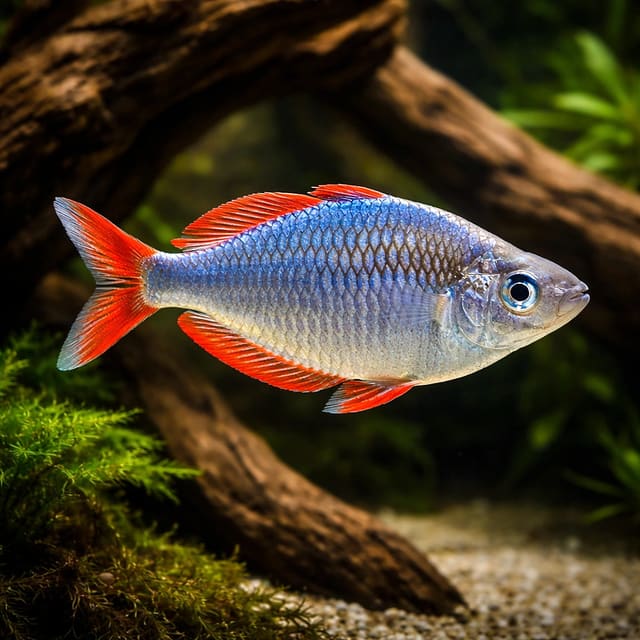
Easy
Neon Dwarf Rainbowfish (Melanotaenia praecox)
23–27°C · pH 6.8–7.5 · 54L
£5.99
Rainbowfish · Buying Guide
Neon rainbowfish (Melanotaenia praecox) care for UK tanks — group size, the tank length they need, water and tank mates. Shop the live shoal.
11 products in stock today
Live prices and stock. Every fish covered by our Live Arrival Guarantee.
23–27°C · pH 6.8–7.5 · 54L

21–25°C · pH 5–7
22–25°C · pH 6–7.4

23–27°C · pH 5.5–7 · 60L
17–27°C · pH 6.5–8
22–26°C · pH 6.4–7.4 · 41L
17–27°C · pH 6.5–8
20–28°C · pH 5–7.5 · 72L

21–25°C · pH 5–7
The shaded band shows the range neon rainbowfish is comfortable in. Match it to your tap water before you buy.
Our trained assistant knows this neon rainbowfish page inside out. Ask it anything — water parameters, tank mates, how many to buy — or have it read the guide aloud while you set up your tank.
Here's the problem with almost every "neon rainbowfish" article online: it's been quietly copy-pasted from a neon tetra care sheet, and the two fish have almost nothing in common except the word "neon". The tetra is a 3 cm South American characin that wants soft, acidic water. The neon rainbowfish — Melanotaenia praecox — is a 5–7 cm rainbowfish from a single river in New Guinea that actively prefers hard, alkaline water [1]. Follow tetra advice and you'll buy too small a tank and worry about water that's already perfect.
I'm Hannah. I photograph schooling fish and planted tanks for the shop, and the neon rainbow is one of the hardest fish in the building to shoot badly once it's settled — that powder-blue flank catches the light like nothing else we stock. This guide is the version I'd write for a customer who's got hard London or Midlands tap water, a tank of 80 litres or more, and wants a colourful active shoal that will still be going strong in four years' time.
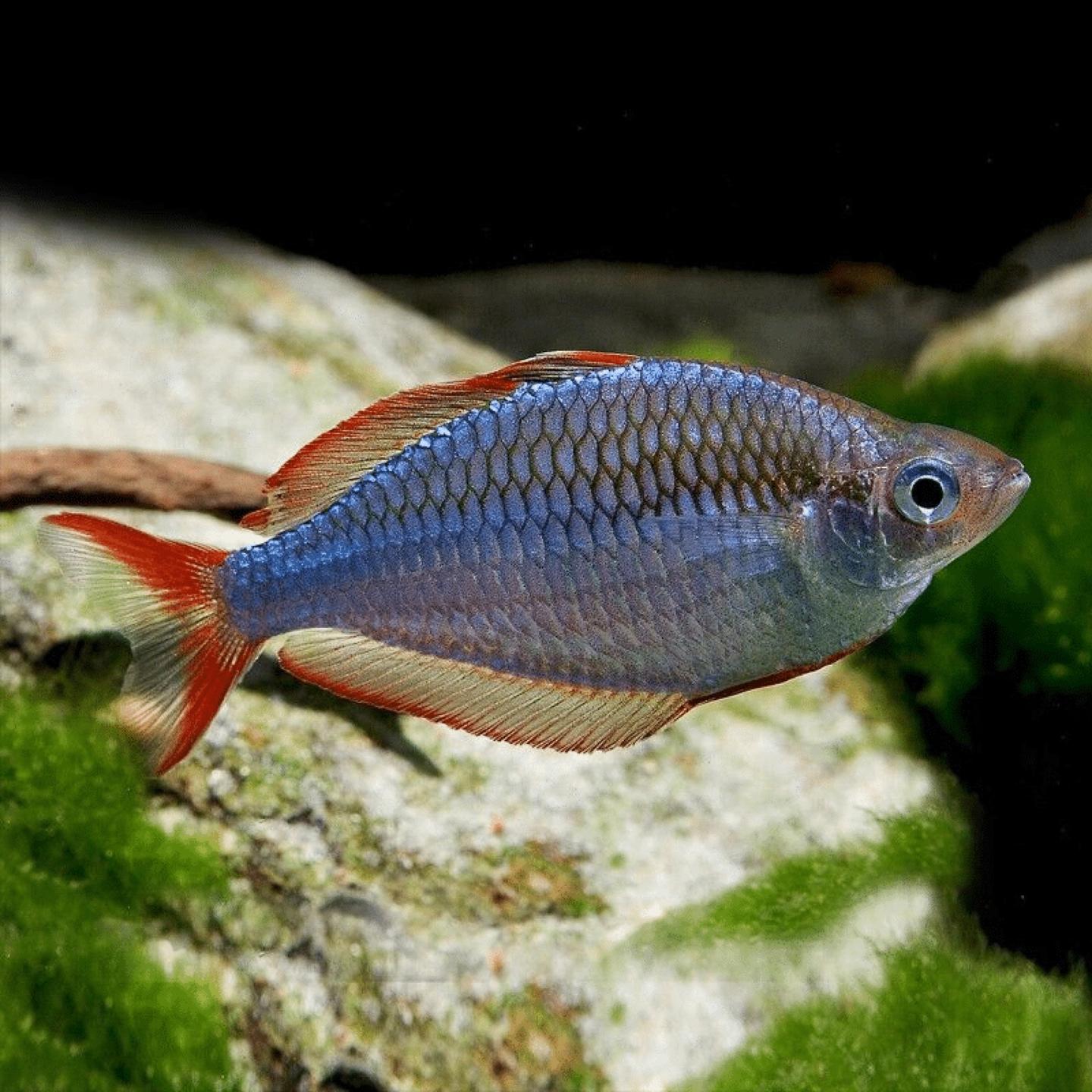
One of our neon dwarf rainbows. Note the iridescent blue flank and the red edging on the fins — this is "settled adult" colour. New arrivals look far paler until they've had a few weeks of good food and stable water. Credit: Tropical Fish Co.
The neon rainbow gets shortlisted against nano tetras far more often than it should, because shoppers see "neon" and assume same fish, same tank. They aren't. The honest split is about tank length and water type.
| Attribute | Neon Rainbowfish | Neon Tetra | Cardinal Tetra | Ember Tetra |
|---|---|---|---|---|
| Adult size | 5–7 cm | 3–4 cm | 3.5–5 cm | 1.5–2 cm |
| Minimum tank | 80 L (≥ 60 cm) | 40 L | 60 L | 30 L |
| Swimming style | Active open-water laps | Mid-water shoal | Mid-water shoal | Gentle hover |
| Best water | Hard, alkaline | Soft–medium | Soft only | Flexible |
| UK hard tap water OK? | ✓ Ideal | Maybe | ✗ | ✓ |
| Lifespan | 4–5 years | 2–3 years | 5–8 years | 3–4 years |
| Colour develops with age | Strongly (blue builds) | Quickly | Quickly | Quickly |
| Beginner-friendly | Yes (needs 80 L) | Yes (mature tank) | Maybe | Yes |
If you have hard UK tap water and a tank of 80 litres or longer, the neon rainbow is the standout — bigger presence, longer life, and the only one of the four whose colour is a genuine slow-burn reward. Drop to a small nano and the ember tetra is the smarter pick.
The rule everyone repeats is "keep them in a group", and that's right — six is the floor, and Seriously Fish recommends at least six to eight, preferably more [2]. Aquarium Co-Op's care guide adds a useful refinement: aim for one to two females per male so the males display to the females and to each other rather than relentlessly bullying one rival [6].
But the number that gets ignored is swimming length. These fish are built for the open channels of a 2,000 km river. Volume alone doesn't satisfy them — a 60 L tall cube and an 80 L long tank hold similar water but only one lets a rainbow stretch into a cruise.
Buying for volume, not length. A 60 cm-long 80 L tank is far better for praecox than a taller 90 L nano-style cube, even though the cube holds more water. Rainbows pace the front glass all day; deny them the run and they sulk in a corner with clamped fins and washed-out colour. When someone tells me their rainbows "won't colour up", the tank shape is the first thing I ask about.
Stocking guide by tank length:
Neon rainbows are peaceful but busy — their ideal companions are calm enough not to mind the constant motion and quick enough not to be out-competed at feeding time. Everything below shares their hard-water, 24–28 °C comfort zone.
For the full beginner-friendly community plan, our first tropical tank guide walks through stocking order and cycling, and the planted-tank fish hub lists everything that shares this temperament in stock this week.
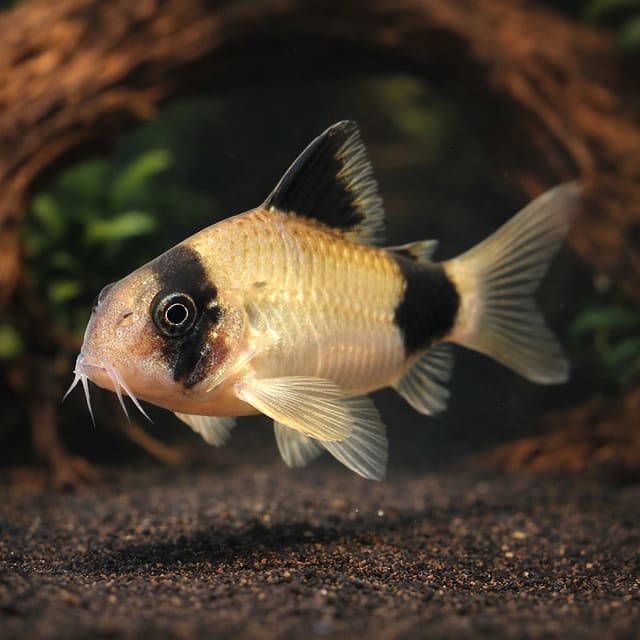
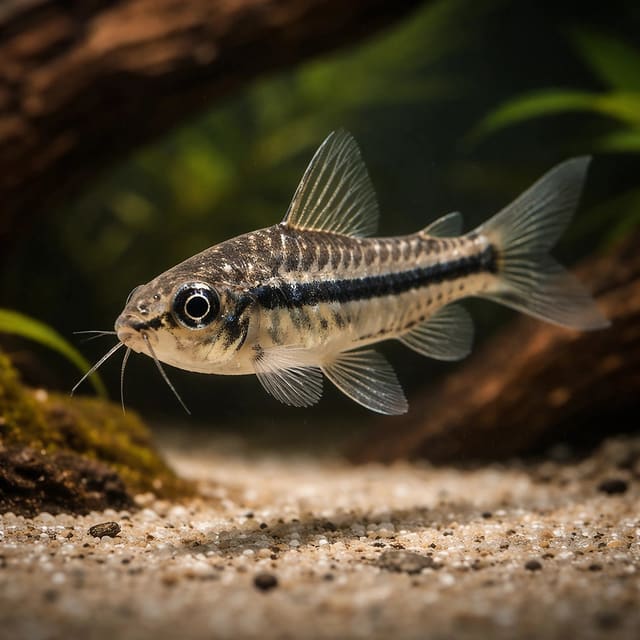
A panda cory from our tanks — one of our most-recommended bottom-dwellers for a rainbow community. They work the substrate while the rainbows cruise above, so the two never compete for space. Credit: Tropical Fish Co.
Praecox are unfussy omnivores — they'll take quality flake, micro-pellets, and frozen foods [1]. The trick to colour is variety, not quantity. Aquarium Co-Op stresses a rounded diet across several food types [6], and in practice that means:
Most of England and Wales has hard, alkaline tap water — Thames Water classes its whole London supply as hard [5]. For cardinal tetras and discus that's a problem to engineer around. For neon rainbows it's a gift: they want 8–15 dGH and a neutral-to-slightly- alkaline pH, so straight dechlorinated tap, matched for temperature, is usually all you need. No RO unit, no peat, no buffering salts.
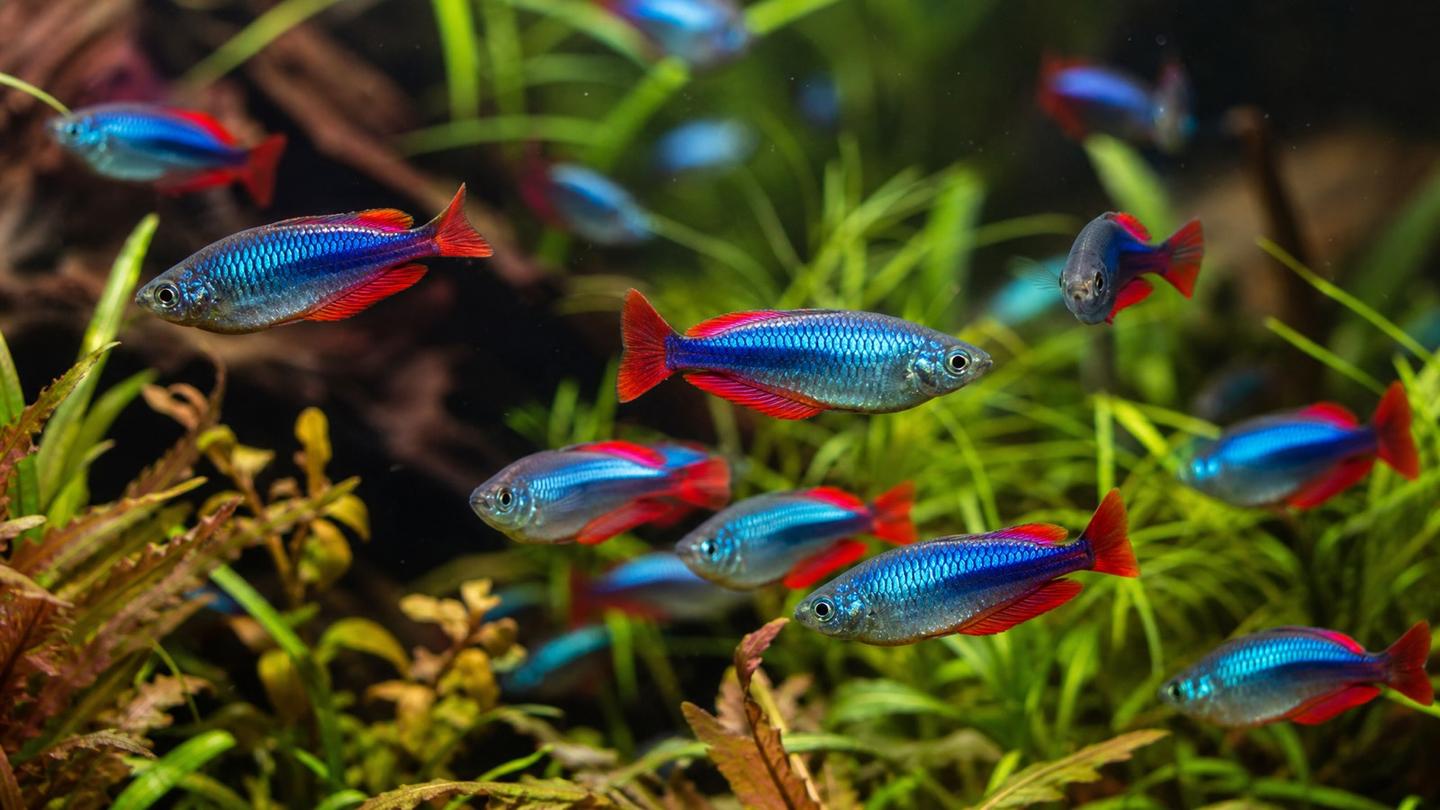
The powder-blue flank is structural colour, not pigment. Microscopic light-reflecting platelets in the skin scatter blue wavelengths back at you, the same physics that makes a kingfisher blue. Because it depends on the angle of incoming light, the identical fish reads dull grey under flat side-lighting and electric blue under bright overhead LEDs against a dark substrate. The red in the fins is the opposite — true carotenoid pigment laid down from the diet. So if your rainbows look flat, the fix is usually lighting and a dark background, not more food; if the reds are weak, that's when diet matters.
You don't need to breed them — but they make it surprisingly achievable if you want to, and it's a rewarding step up from livebearers. Praecox are egg-scatterers: a conditioned pair or trio will spawn over several days into fine-leaved plants such as java moss, or onto a wool spawning mop. Males court by flaring their fins and herding the female to the chosen spot [2].
The eggs are tiny — around 1 mm — and carry adhesive filaments that anchor them to the plant or mop. In a controlled study, eggs incubated at 28 °C began hatching about 120 hours after fertilisation, and the newly hatched larvae were already strong swimmers with a functional gut [3]. The catch is fry size: they're too small for baby brine shrimp at first and need infusoria or a liquid fry food for the opening week. Pull the mop or plant into a separate rearing tank, because the adults will happily eat their own eggs and fry given the chance.
Neon rainbows are robust shippers — their size and adaptable physiology make them far less fragile in transit than a soft-water tetra. We still acclimatise carefully, because the one thing they don't love is a sudden temperature or pH swing:
Expect pale, slightly nervous fish for the first week — that's normal. The blue builds as they relax and feed, and a settled shoal is a completely different animal from the one that came out of the bag.
For the broader beginner picture — cycling, stocking order and your first community — start with our first tropical tank guide. If you're weighing the rainbow against the classic small schoolers, the cardinal tetra guide and the Ember tetra care guide cover the soft-water showpiece and the smaller orange schooler respectively; the Ember guide still calls for about 45 L, a useful 45 × 30 cm footprint and a local-water check.
Shopping by type? Browse the rainbowfish hub for every rainbow in stock, the planted-tank fish hub for the wider community shortlist, or all tropical fish for sale this week.
Visual route into the rest of our UK live-fish range.
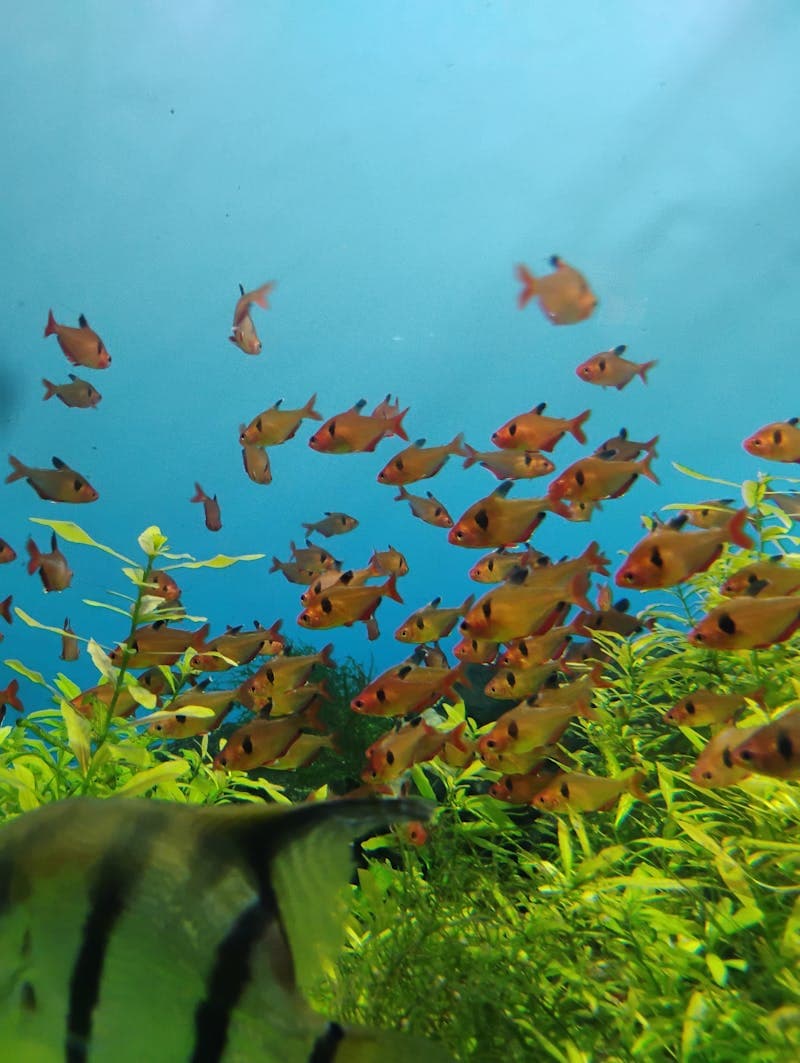
Compare rainbowfish and blue-eyes by species and supplied size. Check group, swimming space and water needs before choosing from current listings.
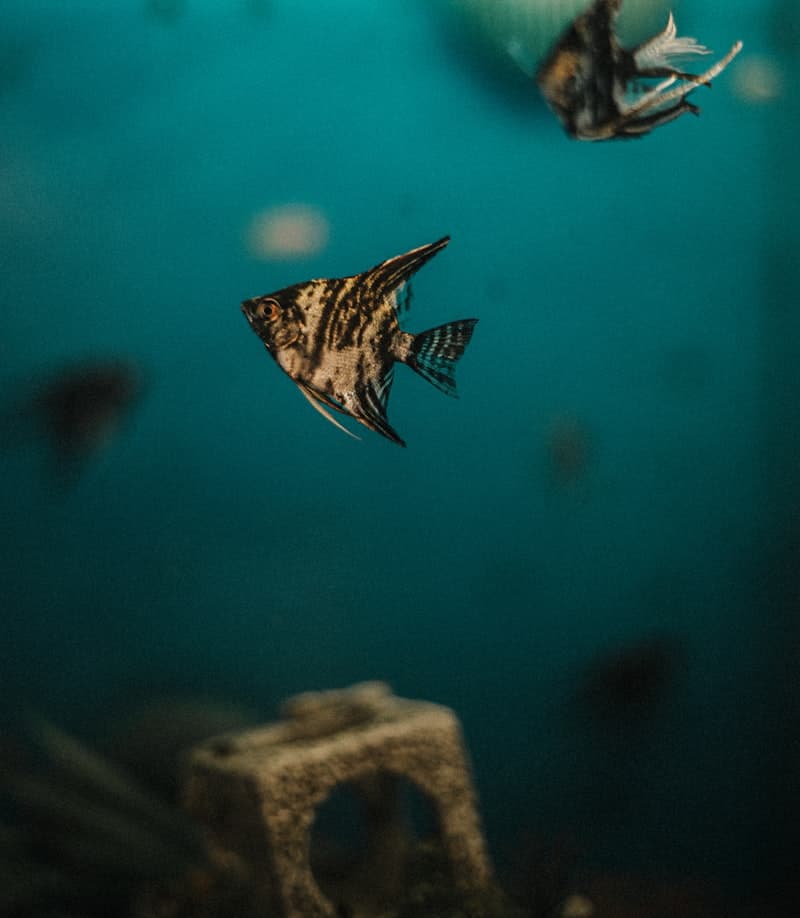
Planted-tank fish for sale UK — peaceful, plant-safe species that showcase aquascaped layouts. Tetras, rasboras, dwarf cichlids, shrimps.
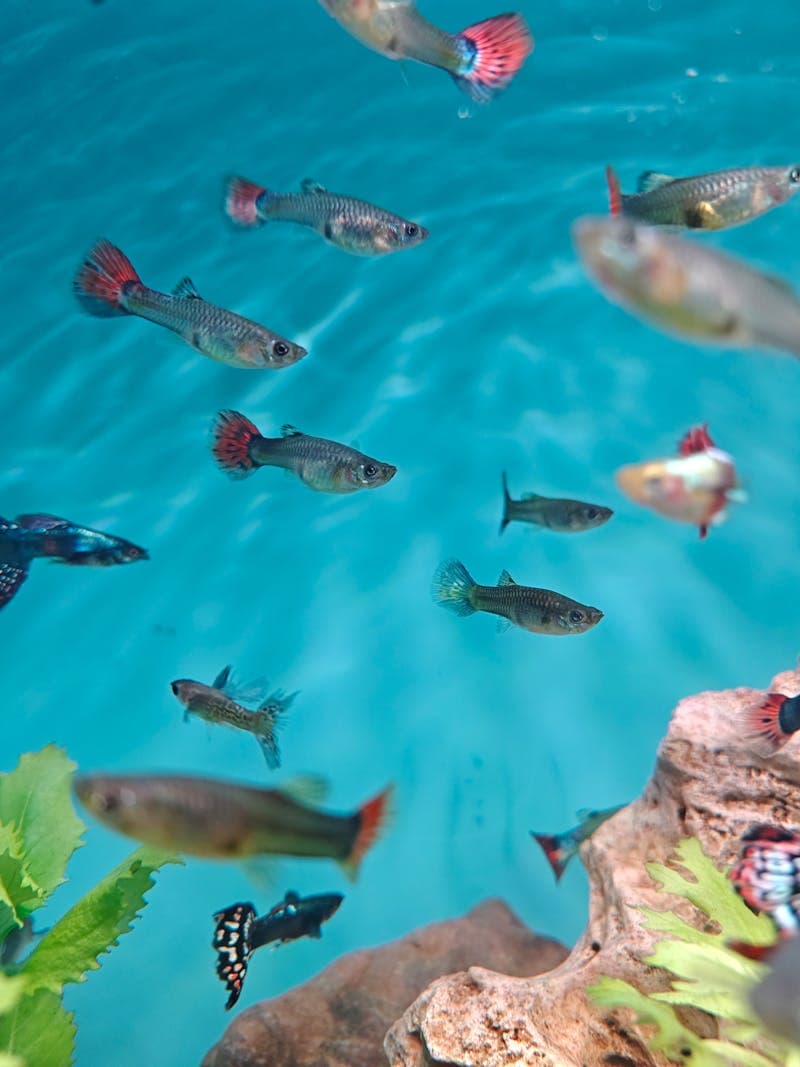
Tropical fish for sale UK — tetras, cichlids, bettas, guppies and corydoras. Specialist delivery backed by our Live Arrival Guarantee.
Material factual claims cite the sources below; store policy and cautious inference are labelled in the article. Sources are grouped by type so you can judge their weight at a glance.
Peer-reviewed study of praecox eggs and hatching — cited on breeding and egg facts.
Source for max size, temperature range, distribution and IUCN status.
Independent cross-check on tank dimensions, group size and sexual dimorphism.
UK hobbyist feature on New Guinea rainbows — cited on trade history and farming volume.
Expert care video — cited on group ratio and feeding variety.
UK tap-water authority — cited on the hard-water tolerance argument.
Fishkeeping moves fast and we want every guide spot-on. If you think something here is wrong, out of date, or could be clearer, tell us — our team reads every message and updates the page.
Suggest an editCompare rainbowfish and blue-eyes by species and supplied size. Check group, swimming space and water needs before choosing from current listings.
Planted-tank fish for sale UK — peaceful, plant-safe species that showcase aquascaped layouts. Tetras, rasboras, dwarf cichlids, shrimps.
Tropical fish for sale UK — tetras, cichlids, bettas, guppies and corydoras. Specialist delivery backed by our Live Arrival Guarantee.
Harlequin rasbora care for UK aquariums: check 60 cm tank length, group size, 5 cm adult size, water, tank mates and lookalike species before buying.
Set up a tropical fish tank in 10 evidence-led steps: choose the tank, install filter and heater, cycle safely, test the water and add fish carefully.
Keep cardinal tetras thriving in UK water: check tank size, group size, tank mates, temperature and cardinal vs neon differences before you buy.
Planted-Tank Photographer & Writer · 10+ years in the hobby
Hannah is a Cambridge-based aquarium photographer and writer whose planted-tank work has appeared in Practical Fishkeeping and the ADA Aqua Journal digital edition. She writes Tropical Fish Co's deep species guides on schooling tetras and planted-tank communities — always accompanied by her own photography, never stock imagery.