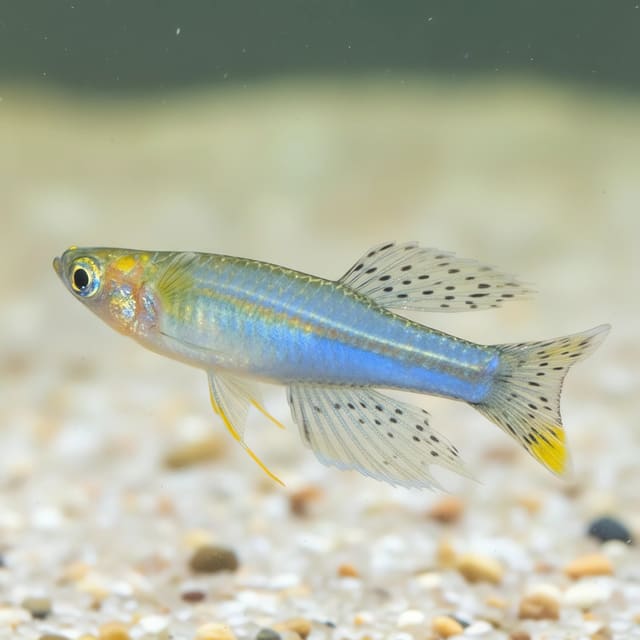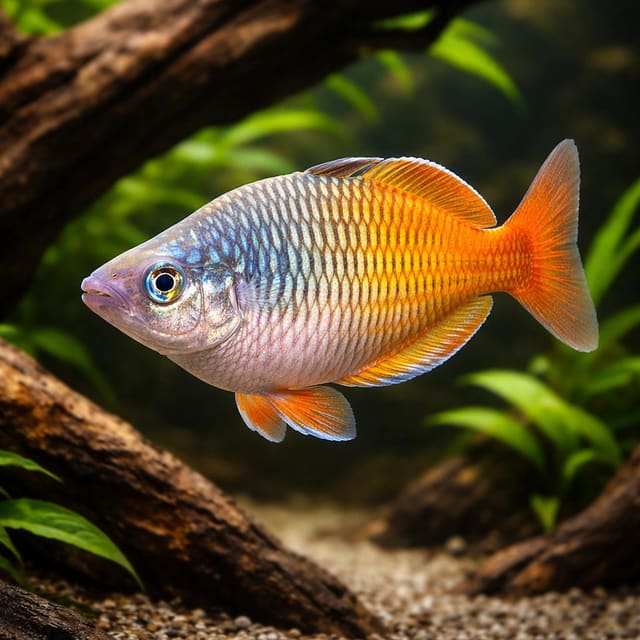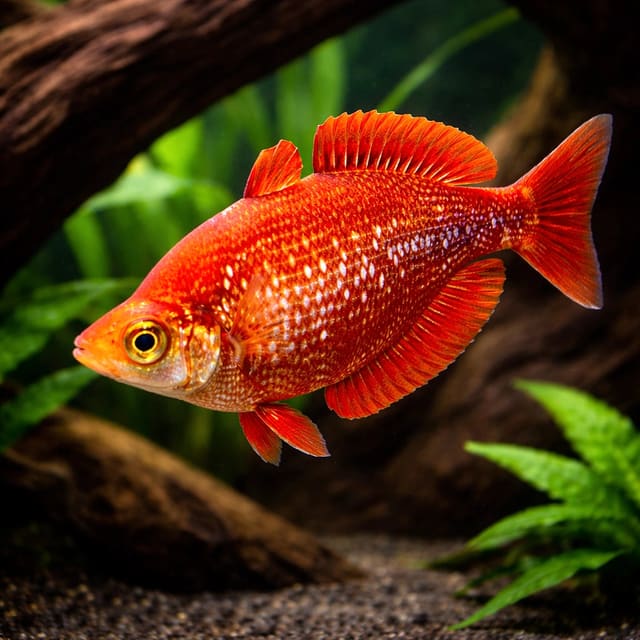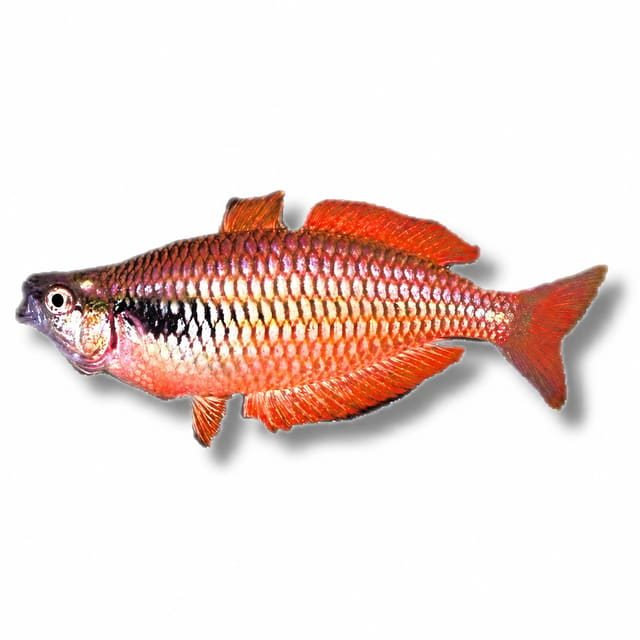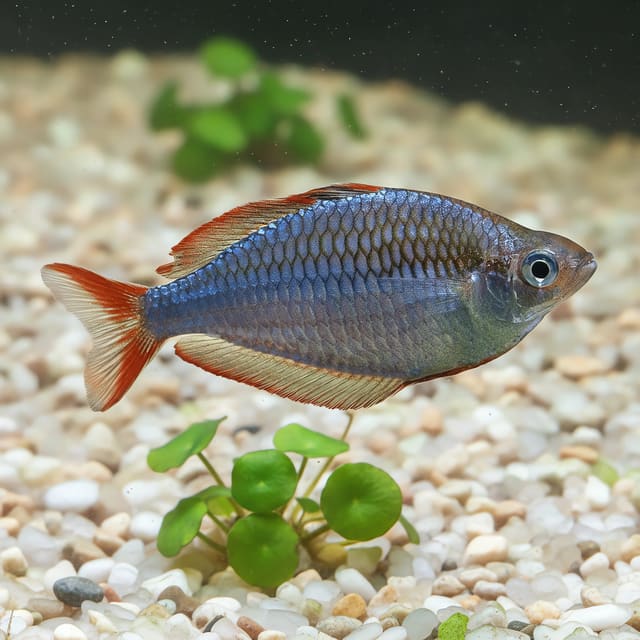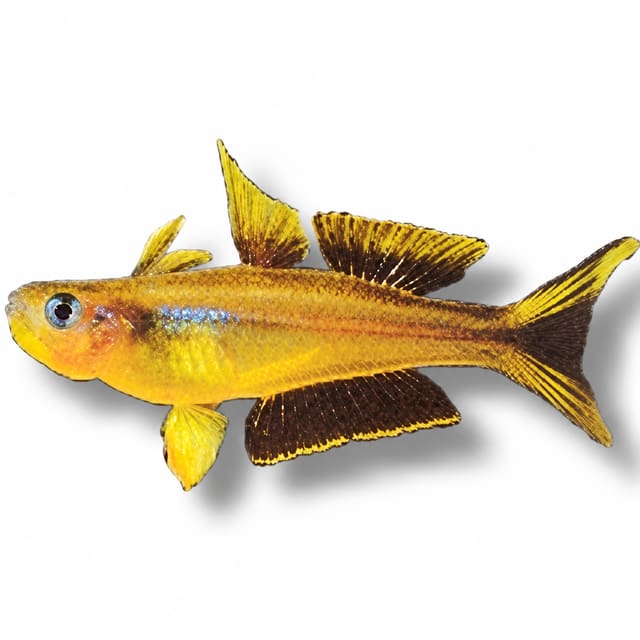
Lake Kutubu Rainbowfish (Melanotaenia lacustris) – 4–6cm+ Size Grades
22–24°C · pH 7–8 · 108L
£8.99

Madagascar Rainbowfish / Zona (Bedotia geayi) is a social freshwater fish for a spacious, mature planted aquarium with open swimming room. One live fish is supplied in your selected size; plan the whole adult group and compare holding-water conditions before purchase.
Bedotia geayi
Shoaling fish: kept in a group they feel safer, stay calmer and show their best colour.
Madagascar Rainbowfish / Zona (Bedotia geayi) is a social freshwater fish for a spacious, mature planted aquarium with open swimming room. One live fish is supplied in your selected size; plan the whole adult group and compare holding-water conditions before purchase.
Madagascar Rainbowfish / Zona (Bedotia geayi) brings the interest of an active social fish to a mature freshwater aquarium. The appeal is in watching a group use open water, move around planted cover and respond to feeding. Choose it when you can provide room for adult fish and their companions, a working biological filter and a routine that keeps the water clean. An attractive empty corner in an already crowded aquarium is not the same as space for a group.
One purchase supplies one live fish of the selected size. The size choices are 2.5–3 cm, 4–5.5 cm, 6–7 cm and XXL. XXL is a grade name, without a stated centimetre measurement here. The size you select is the size supplied, not the adult size. Choose the fish around the aquarium and group you intend to maintain; buying a smaller grade does not remove the need to allow for growth.
Sex is guaranteed only when the selected option explicitly states male or female. This Madagascar Rainbowfish / Zona listing has no sex-guaranteed option.
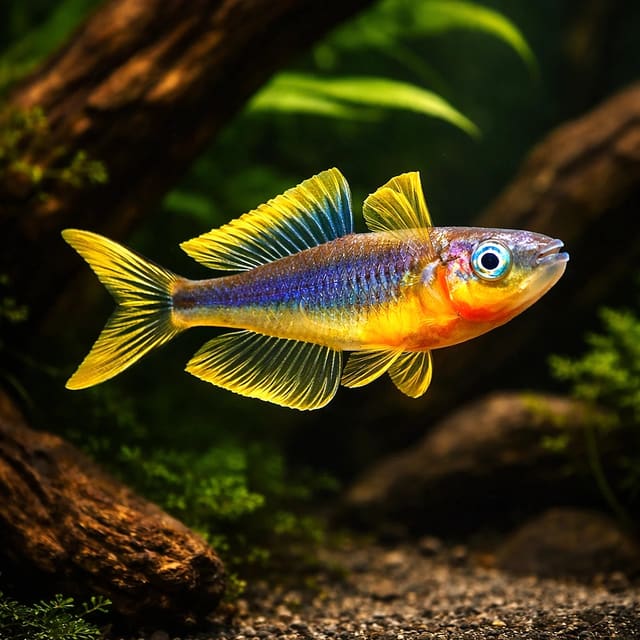
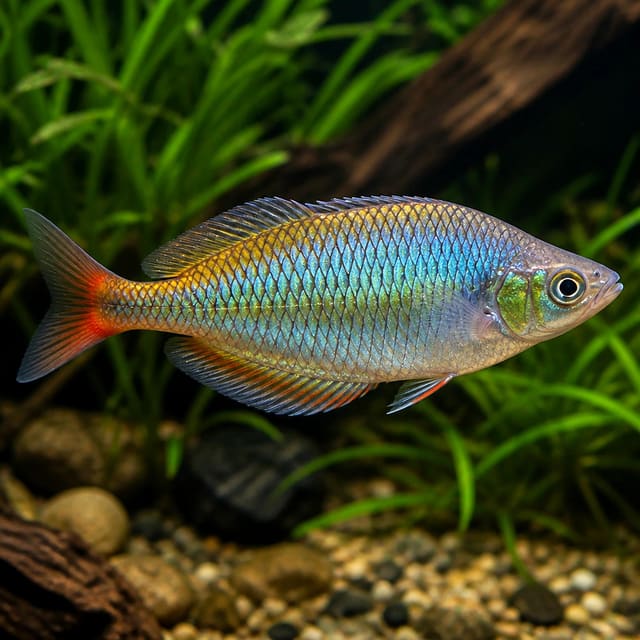
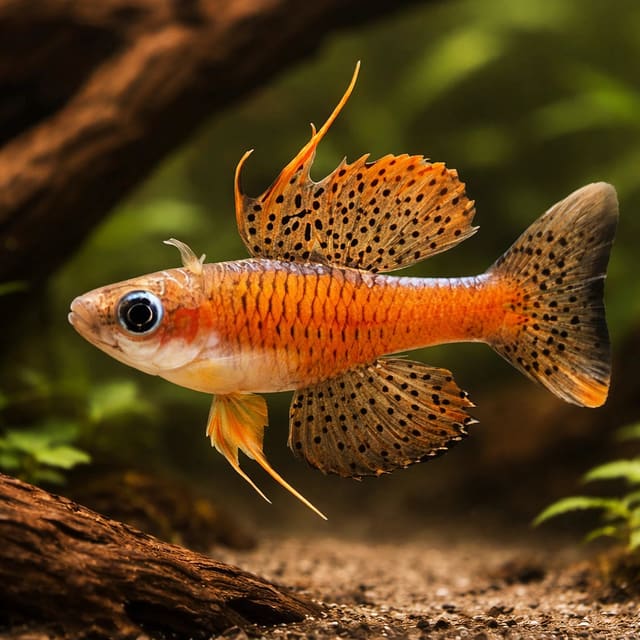
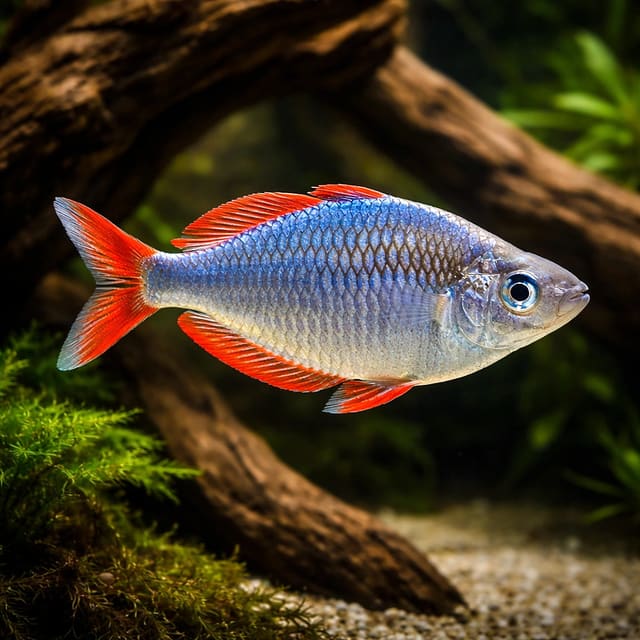
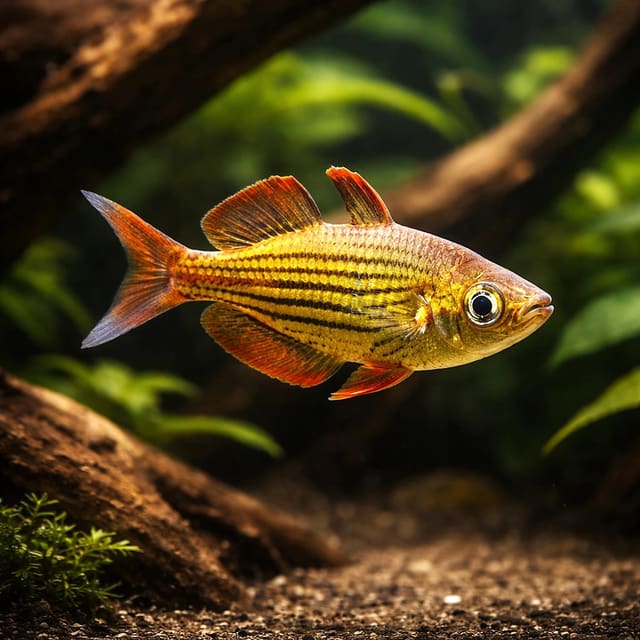
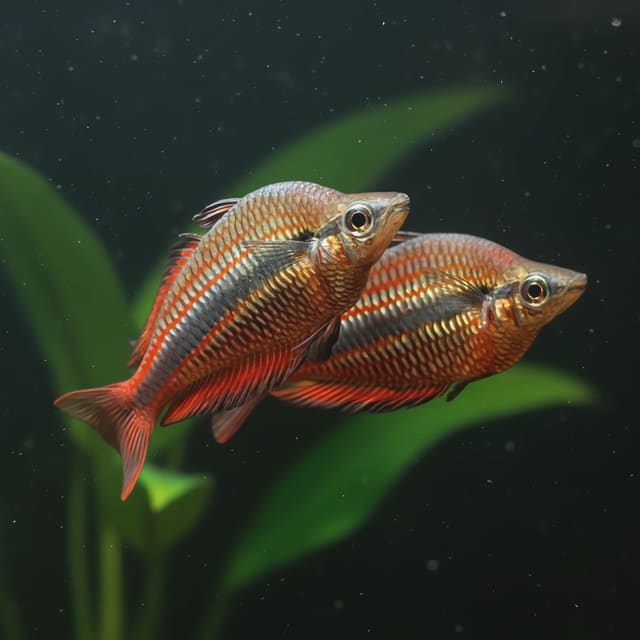
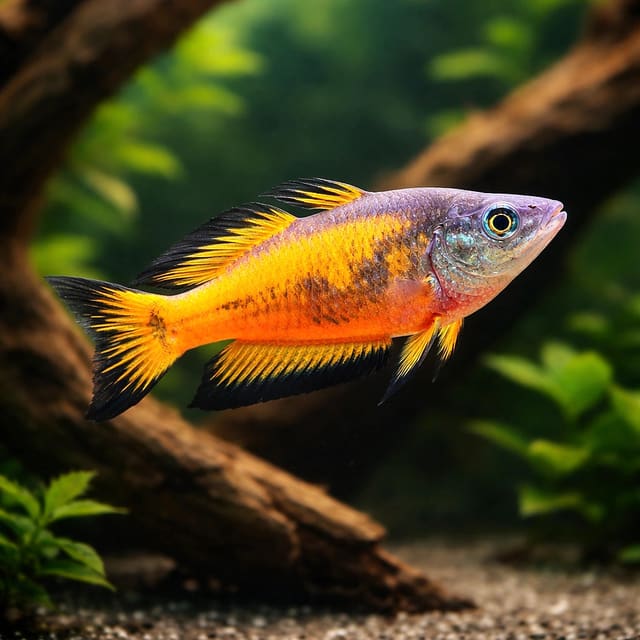
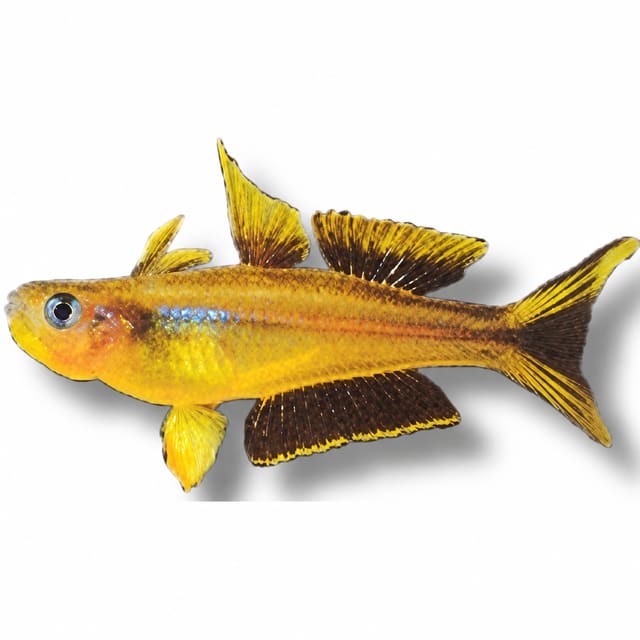
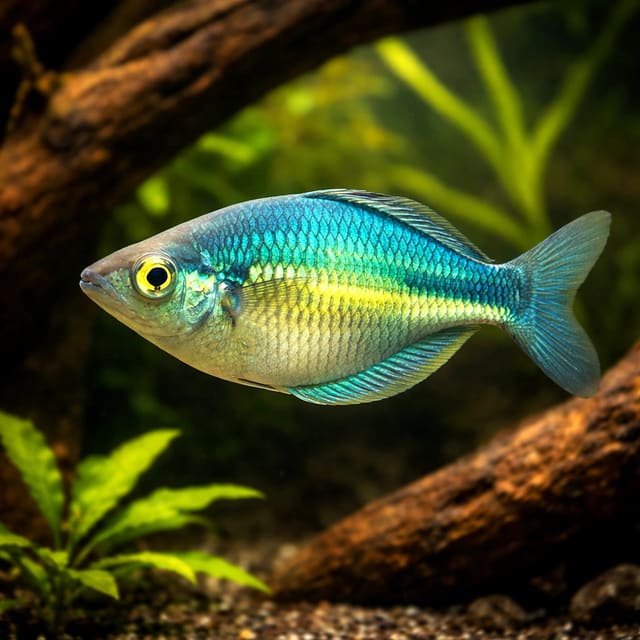
The gallery images are representative of this type of animal rather than photographs of the exact animal supplied, so colours can look slightly different from the live animal.
The first question is whether the aquarium offers useful swimming length as well as enough water. A tall tank filled with wood can have substantial volume but little unobstructed room for a shoal to travel. A layout with plants around the sides and back and a clear central route makes better use of the space. Covered areas still matter: fish should be able to leave the busiest part of the display without becoming trapped behind decorations.
Plan for the adult fish, not the size in the delivery bag. FishBase records Bedotia geayi at 9 cm total length for male or unsexed fish; total length includes the tail. That is a recorded measurement with a stated scope, rather than a promise about the eventual length of every individual. It places this fish in the larger category of OATA's general rainbowfish planning advice, which is discussed in the care tab.
Think about how you want the aquarium to look in use. A rainbowfish group adds movement through the water column, so the other inhabitants need room and confidence to share that activity. Very timid or much smaller fish may be poor choices even when a temperature chart appears to match. Feeding access and the ability to rest away from busy swimmers are part of compatibility too.
This is a better purchase for someone ready to measure and observe than someone looking for a fish that will tolerate neglect. You do not need elaborate decoration or a collection of additives. You do need to know how to test water, recognise a change in behaviour and maintain filtration without removing the beneficial bacteria that process waste. Prepare those routines before the fish arrive.
If your main interest is a social rainbowfish display, compare the separate Neon Dwarf Rainbowfish listing as another choice. Read its own adult size, water and space requirements before deciding which group your aquarium can support. This is a comparison of possible purchases; it does not establish that the two belong together. The wider rainbowfish collection is useful when you want to compare identities and care requirements rather than select from colour alone.
A little planning makes the eventual display easier to enjoy. Write down the aquarium dimensions, its current inhabitants and recent water results, then assess the whole adult community. If the group only fits by assuming that the fish will stay small, that another animal will never grow or that maintenance will compensate for missing swimming room, choose a different plan before ordering.
Bedotia geayi belongs to the Madagascar rainbowfish family Bedotiidae. FishBase associates it with the Mananjary River basin in eastern Madagascar and describes fish in shaded, quieter stream sections. Adults were observed in deeper water and juveniles in shallows, in loose associations of similarly sized fish. That natural history gives a useful reason to combine swimming room with shelter, rather than treating a planted aquarium as decoration alone.
The FishBase species account records a maximum of 9 cm TL for male or unsexed fish. TL means total length, measured with the tail included. Allow room for fish of that scale when placing wood, plants and equipment. The measurement is separate from the size grades sold on this page, and it should not be used as a way to calculate a stocking allowance by adding centimetres of fish together.
Madagascan rainbowfish names can be confusing in older aquarium writing. Keep the scientific name with the common name when seeking advice so the person helping you knows which fish is being discussed. Natural range also describes the species, not a certificate of origin for an individual aquarium fish. The useful aquarium decision remains whether your water, available space and community fit the animal you are buying.
OATA's general rainbowfish sheet recommends at least 120 litres for the larger rainbowfish, meaning species over 8 cm. It also recommends groups of at least five, with more where the aquarium can accommodate them. These are broad rainbowfish guidelines, not experimentally established minimums for Bedotia geayi. Use them as an initial planning screen and assess the full adult group, aquarium length, filtration and other inhabitants before making a final stocking decision.
Choose a spacious aquarium that allows the group to swim along an open route and turn comfortably. More fish can improve the social display only when there is enough space for them. Adding animals to an overcrowded aquarium does not solve nervousness or social pressure. If a small group already has nowhere to move without encountering other fish, extra volume or a different stocking plan is the practical improvement.
Keep planting concentrated enough to offer shelter but arranged so it does not divide the aquarium into narrow dead ends. Plants along the back and sides leave the main viewing area open. Wood can help break up sight lines, but check that its branches do not block the path between sheltered areas. Leave enough access for cleaning behind the hardscape; a beautiful arrangement that traps uneaten food becomes difficult to maintain.
Sand or aquarium gravel can support a practical planted layout. The main aim is a substrate and arrangement you can keep clean without uprooting everything. Place equipment so its inlets and outlets remain accessible as plants grow. Looking at a newly planted tank can be misleading, because the mature plants may occupy much more of the swimming space. Include trimming and access in the original layout.
OATA advises a reasonable water current for active rainbowfish. Arrange the outlet to circulate water and disturb the surface, while keeping sheltered areas that are less exposed to the current. Watch the fish as well as the outlet: they should have choices about where to swim and rest. A forceful jet directed across every route is different from useful circulation through the tank.
Position the aquarium away from direct sunlight, nearby heating and draughts. A thermostatically controlled heater and an independent thermometer help you maintain and check the selected temperature. Keep normal day and night lighting periods and avoid abrupt disturbance around the glass. A secure cover is sensible aquarium equipment, with openings around cables and pipes kept appropriately closed.
Before stocking a new aquarium, use the first tropical tank guide to plan equipment and filter maturation. An aquarium is ready when its biology and water tests demonstrate that it can support the intended load. The number of days since you filled it is not enough information on its own.
Imagine the mature plants and the full adult community before buying equipment or placing decorations. A clear route should continue past the heater, filter intake and any large ornaments. Keep a suitable place to introduce food where you can watch the group rather than dropping it into a dense thicket. This also helps you notice a fish that is repeatedly absent at feeding time.
Think about access from outside the aquarium as well. You need to reach the filter for maintenance, inspect the thermometer and remove waste without shifting the entire layout. Keep dedicated aquarium buckets and cleaning tools ready so regular water changes are straightforward. If routine work requires dismantling half the display, the layout will be difficult to keep consistent over the long term.
There are two different kinds of water information relevant here. FishBase reports the species' environmental range as 20–24°C, pH 7.0–8.0 and hardness 9–19 dH. OATA gives a broad aquarium guide for rainbowfish of 22–27°C, pH 6.5–8.0 and general hardness 4–12 dGH, with carbonate hardness 3–10 dKH. The first describes recorded species environments; the second covers a broad aquarium group. Neither is a reason to move fish abruptly towards an endpoint.
| Information | How to use it |
|---|---|
| Species environmental record | 20–24°C, pH 7–8, 9–19 dH in the FishBase account; useful species context rather than a transfer instruction. |
| Broad aquarium guidance | OATA rainbowfish advice: 22–27°C, pH 6.5–8, GH 4–12 dGH and KH 3–10 dKH; check the actual fish's holding conditions before purchase. |
| Waste readings | Ammonia and nitrite should both measure zero. OATA advises nitrate no more than 20 mg/l above the normal tap-water level. |
Ask for the current holding-water readings and compare them with measurements from your own aquarium. That comparison is especially useful if your water is very soft, hard or unlike the conditions in which the fish have been kept. Discuss any substantial difference before ordering. Taking the lowest figure from one source and the highest from another would create a new range that neither source actually recommends.
Temperature, pH and hardness describe different parts of the environment. A matching pH does not establish matching hardness, and a clear tank does not establish that ammonia is absent. Use the water chemistry guide if these measurements are new to you. Keep the units with your readings so that results remain useful when discussing them with the fishroom.
The water parameter matcher can help you organise comparisons. Follow that with an assessment of the actual livestock, filtration and recent maintenance. A numerical match is one part of choosing an aquarium, and it cannot identify overcrowding, missed feeds or a tankmate that constantly chases the group.
Record readings over time rather than checking only after something goes wrong. Include the date and any significant maintenance alongside the result. If the aquarium changes after a new decoration, a larger feeding routine or extra livestock, that record gives you a useful starting point. Make deliberate adjustments for a known reason, and check the result before introducing another variable.
A biological filter provides surfaces for bacteria that process fish waste. Ammonia is converted to nitrite and then nitrate; ammonia and nitrite are both harmful. The RSPCA aquarium environment guidance explains why a functioning, maintained filter is essential. Clear water and healthy-looking plants do not replace this waste-processing function.
Stock gradually and check the water after additions. More fish and more food increase the load on the filter. A filter that has been managing the current population may need time to cope with a larger one, so do not judge readiness only from the equipment's advertised capacity. The measurements and the actual stocking history tell you more about the aquarium's present condition.
OATA recommends checking aquarium water at least weekly and gives a 25% weekly partial water change as general rainbowfish maintenance guidance. Match the routine to your test trends and actual aquarium load, seeking advice if readings remain unsatisfactory. In a tank holding 120 litres of actual water, 25% is 30 litres; the labelled capacity may be higher than the water volume once substrate and decoration are included.
Treat replacement tap water with an appropriate conditioner for chlorine and chloramine and avoid abrupt temperature changes. Siphon accumulated waste from accessible substrate areas, particularly where food tends to settle. Arrange the job so you can replace water steadily without leaving the filter or heater operating outside the conditions specified by its manufacturer.
Inspect the filter for restricted flow. If media needs rinsing, OATA advises a light rinse in removed aquarium water rather than under the tap, helping preserve the bacterial population. Follow the equipment instructions for moving parts and consumables. Cleaning should restore function; it should not turn every maintenance session into a complete removal of the aquarium's established biological surfaces.
Afterwards, check that the filter has restarted, water is circulating and the temperature equipment is operating normally. It is easy to focus on the water change itself and overlook a disconnected plug or blocked outlet. Observe the group once the tank has settled and note any persistent change. A short final equipment check can prevent a routine task from becoming an avoidable problem.
OATA describes rainbowfish as omnivorous and recommends a good quality flake or granule as the everyday food. Small live or frozen foods, including daphnia, small bloodworm and tubifex, can add variety; brine shrimp may suit fish able to take them comfortably. Choose particle sizes for the fish actually present. A food that fits the largest individual may be awkward for the smallest member of a mixed-size group.
As broad rainbowfish guidance, OATA recommends one daily feed limited to what the fish can finish within a few minutes. Start with a measured portion and watch it being eaten. This makes feeding an opportunity to inspect the fish, not simply a task to complete. You can see who comes forward, whether food reaches different parts of the group and whether a particular fish struggles to take it.
Spread a small portion over an accessible area if a single feeding spot becomes crowded. The aim is to improve access without increasing the total food automatically. In a community aquarium, notice whether other species intercept food before the rainbowfish can take it, or whether the rainbowfish consume everything before slower animals reach it. Adjust placement and suitable food form around the whole community.
Do not treat active swimming as a request for unlimited food. Uneaten food decomposes and adds to the waste the aquarium must handle. If it repeatedly falls behind wood or into dense planting, change how you offer the next portion and remove the surplus. Increasing filtration is not a substitute for recognising a feeding routine that consistently leaves food to decay.
Keep an eye on body condition as well as enthusiasm. A fish that rushes towards food but fails to swallow is showing something different from one that feeds successfully. A fish that stays hidden through repeated feeding opportunities needs attention too. Compare behaviour with the group, check water quality and seek advice if the change continues. Avoid using appetite alone as a diagnosis or automatically adding supplements to solve an unexplained problem.
Give new fish a prepared aquarium and a quiet introduction. Compare holding and aquarium water before transfer, and ask the fishroom for current arrival advice. Avoid unnecessary movement around the bags. The store's general instructions include floating the bag for 20–30 minutes for temperature acclimatisation; ask for guidance where journey conditions or water differences require a different approach.
Keep transport water out of the display and observe the fish closely after release. During the first week, pay particular attention to water tests and whether every fish can find space and food. Initial hiding tells you less than the pattern over subsequent observations. Avoid repeatedly rearranging the aquarium simply because the group does not use the front immediately.
OATA recommends looking for changes in swimming, breathing, colour, appetite, body condition and fins or scales. Rapid breathing, repeated surface hanging, clamped fins, erratic movement or a fish that isolates itself should prompt a check of water quality and equipment. The same visible sign can have different causes, so a description or photograph is useful evidence but does not establish a treatment.
Check whether the whole group is affected or whether one individual is being excluded. If several fish change behaviour together, review the aquarium conditions and any recent additions or maintenance. If one fish repeatedly retreats when another approaches, watch the interaction without disturbing the tank. Both situations deserve attention, but they need different investigation.
Record what you saw, the water readings and any recent changes, then contact an experienced aquatic professional if signs are persistent or severe. Avoid combining unchosen remedies in the aquarium. Maintain clean equipment, rinse soap from hands before aquarium work and use a proper siphon starter rather than siphoning by mouth. When circumstances change and fish must be rehomed, arrange a suitable home; never release aquarium animals or contents into natural waterways.
Rainbowfish are generally easy-going community inhabitants, but a social group needs more than a peaceful label beside each tankmate. OATA warns that active rainbowfish can be unsuitable with timid animals or fish much smaller than themselves. Assess adult size and mouth size, swimming activity, feeding speed, space and shared water conditions together. A combination that appears calm while every fish is small may need a different arrangement as they grow.
Look for non-aggressive fish of an appropriate size that can feed comfortably in an active community. Every animal should have usable swimming or resting space after the full group is added. Plant cover and sight breaks help only if they remain accessible; one narrow refuge claimed by a territorial fish does not provide shelter for everyone else.
Avoid known predators and companions that harass or nip other fish. Be cautious with very small fish, delicate long-finned animals and timid feeders. The risk is not limited to visible bites. An animal that spends most of the day hiding or repeatedly misses food can be doing poorly in a community that looks peaceful from across the room.
The broad rainbowfish recommendation of at least five is intended to support social keeping. Plan the space for the group from the start. Keep enough room for the fish to move away from one another and use different parts of the aquarium. Short interactions during swimming are different from sustained pursuit that prevents a fish from feeding or resting.
Check the least assertive fish during feeding and after the main activity settles. If it is regularly isolated, inspect the layout, total stocking and behaviour of its companions. Do not assume that adding more fish is always the answer. A separation or alternative-home plan is valuable where the aquarium cannot provide relief from persistent harassment.
When assessing a new companion, use its own care information rather than relying on a broad category such as community fish. The names in a related-products list offer browsing ideas, not a tested list of tankmates. Decide on one manageable adult community and give it time to settle before making further additions.
FishBase records 9 cm total length for male or unsexed fish. Total length includes the tail; this is a scoped recorded measurement rather than a guaranteed adult length for every fish.
OATA recommends at least 120 litres for larger rainbowfish over 8 cm. This is broad group guidance: assess swimming length, the full adult group and other inhabitants before choosing the aquarium.
For Bedotia geayi, start from OATA's broad rainbowfish guidance of at least five, with more only where space and filtration support them. A group needs open swimming room and usable shelter.
A prepared keeper who can maintain mature filtration, test the water and plan a social group may be able to provide suitable care. A new, untested aquarium or a crowded tank is unsuitable, whatever the keeper's experience.
Use a quality rainbowfish flake or granule and suitable small live or frozen foods. OATA's general guidance is one daily feed that can be finished within a few minutes; watch that every fish can feed.
FishBase records 20–24°C and pH 7–8 as species environmental values. OATA's broad aquarium rainbowfish guide gives 22–27°C and pH 6.5–8. Compare current holding-water readings with your aquarium before purchase instead of combining the two into a single optimum.
Rainbowfish are generally easy-going, but activity and competition can trouble timid or much smaller companions. Avoid predators and persistent harassers, and check that all fish can feed and rest.
Tropical Fish Co hand-packs livestock in oxygen-filled bags and insulated boxes, using a heat pack when weather calls for it and a licensed live-animal courier. Be present for the confirmed delivery and inspect the parcel that day. A Live Arrival Guarantee claim requires a continuous unboxing video showing the sealed parcel being opened and the fish still in their sealed bags, plus your order number and same-day contact.
The OATA rainbowfish care sheet provides the broad aquarium advice for space, social keeping, feeding, maintenance and community planning. Its general ranges need to be read alongside the species information and your actual aquarium measurements.
Read Tropical Fish Co's delivery and Live Arrival Guarantee policy before the confirmed delivery date. Have the aquarium ready, make arrangements to receive the parcel and prepare to record the unopened parcel through inspection. The continuous video is evidence for an arrival claim; the animal's acclimation and care follow its condition and current advice from the fishroom.
No reviews for this item yet. Bought one? Honest reviews only, good or bad.
What customers say about ordering from us
I have a small group of long finned mountain minnows. So was delighted to be able to order ten of this variety to increase the genetics in my tank . The ones I recieved are healthy but it’s to early to give a verdict on wether they are of a long finned type since they are small currently.
Gordon Walker · 23 Sept 2026
100% success travel and "installation". Pleased with quality of purchase. The Siamese fighter a bit "shy" so have not yet seen him at his best yet but looking good. Happy customer. GG
George E Garratt · 21 Sept 2026
Reviews of our shop, collected by Judge.me, an independent third-party review collector. Newest first.