Easy
Neon Dwarf Rainbowfish (Melanotaenia praecox)
23–27°C · pH 6.8–7.5 · 54L
£5.99

Paska's Blue-Eye Rainbowfish (Pseudomugil paskai) is a compact shoaling fish supplied one per purchase at 2.5–3 cm. Plan each purchase as part of a group in a mature, filtered aquarium, and choose peaceful, non-nipping companions with compatible water needs.
Adult size is the maximum length this species reaches at full maturity (scientific sources). The livestock you receive will be younger and smaller. Product-photo provenance and any image-specific limitations are stated on the listing.
Pseudomugil paskai
Shoaling fish: kept in a group they feel safer, stay calmer and show their best colour.
Paska's Blue-Eye Rainbowfish (Pseudomugil paskai) is a compact shoaling fish supplied one per purchase at 2.5–3 cm. Plan each purchase as part of a group in a mature, filtered aquarium, and choose peaceful, non-nipping companions with compatible water needs.
Adult size is the maximum length this species reaches at full maturity (scientific sources). The livestock you receive will be younger and smaller. Product-photo provenance and any image-specific limitations are stated on the listing.
Maintain these water conditions for optimal health and vibrant colors
Paska's Blue-Eye is a small, colourful freshwater blue-eye from Papua New Guinea. FishBase identifies the scientific name as Pseudomugil paskai and places it in Pseudomugilidae, the blue-eye family. It classifies the species as tropical, freshwater and benthopelagic, and records it only from small creeks near Kiunga in Papua New Guinea's upper Fly River system. The species is listed there as Critically Endangered. Its maximum recorded length is 3.0 cm standard length under the male/unsexed record, while its environmental entry gives 22–26°C, pH 6.5–7.5 and hardness up to 15°dH. These environmental figures help identify the species and its recorded habitat conditions. They are not a routine aquarium target. The OATA rainbowfish profile describes the group as colourful, social and generally easy-going. Its aquarium recommendations are broad group-level guidance, not a species-specific optimum: keep at least five rainbowfish, prefer a larger shoal when space and filtration allow, and use at least 45 litres for a shoal of the smallest species. For rainbowfish generally, a female-heavy group can reduce fighting between males when reliably sexed stock is available.
One purchase quantity supplies one animal. The recurring supplier dispatch grade is 2.5–3 cm, which is the size supplied rather than a separate selectable size option. Dispatch size does not establish the fish's life stage, and the 3.0 cm scientific maximum is an adult-size planning reference rather than a promise that every individual will reach exactly that measurement. Plan the retail unit as one member of a suitable shoal, not as a recommendation to keep one fish alone.
Sex is guaranteed only when the selected option explicitly states male or female. This Paska's Blue-Eye Rainbowfish listing has no sex-guaranteed option.
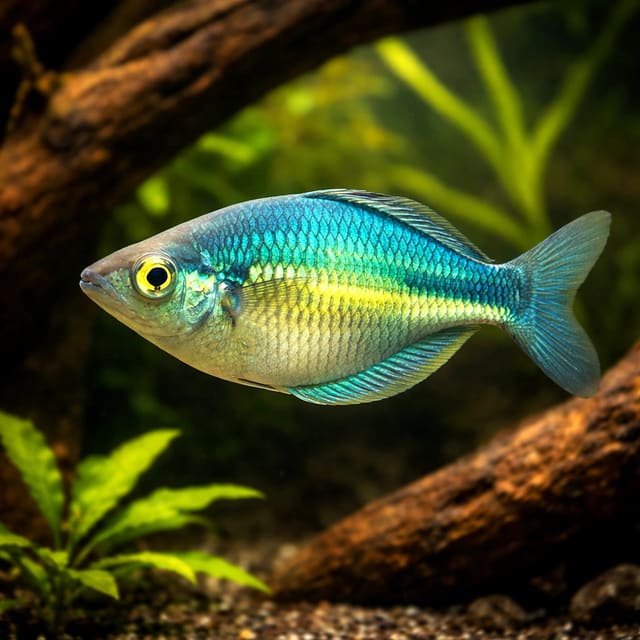
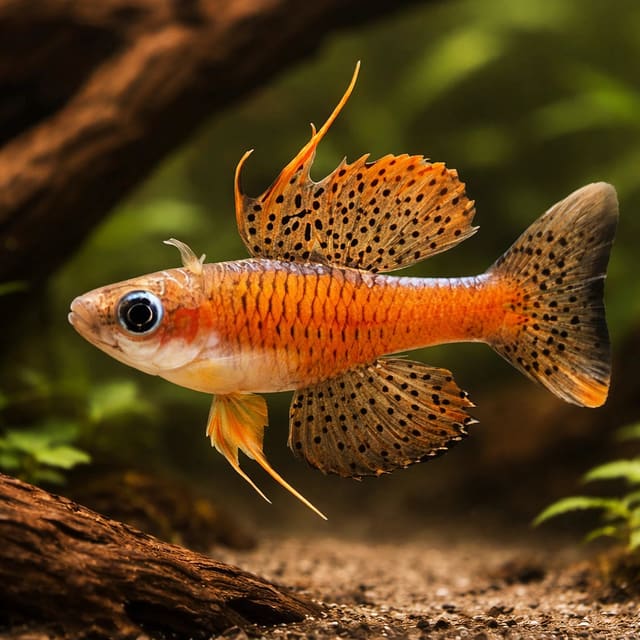
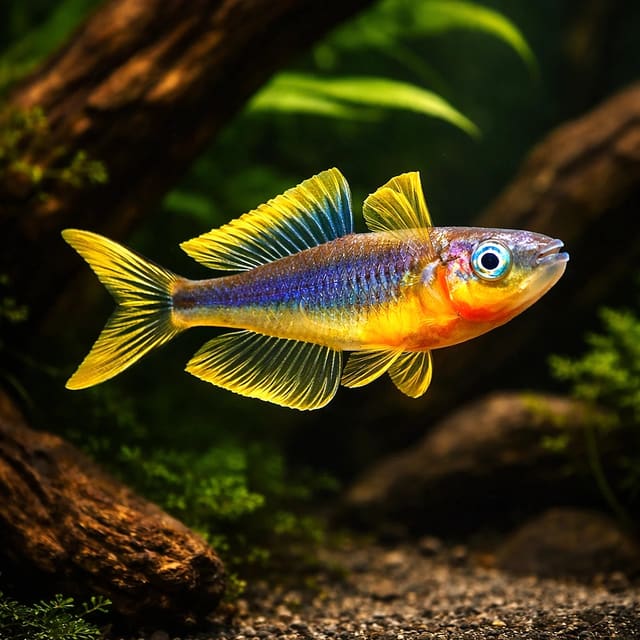
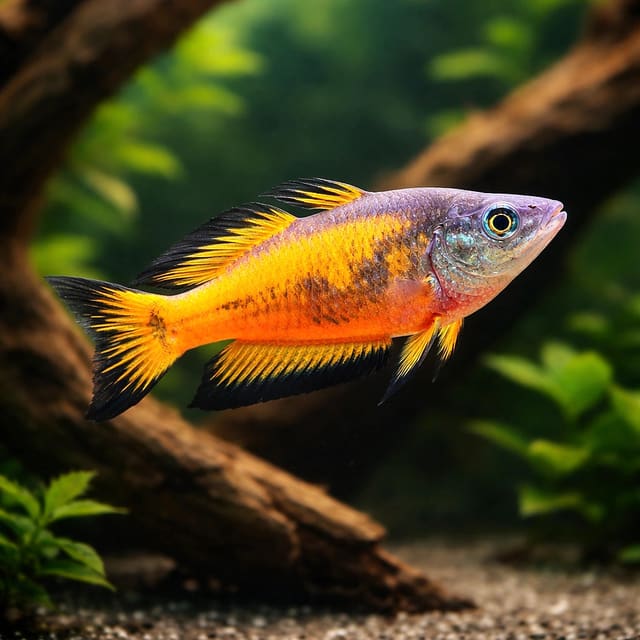
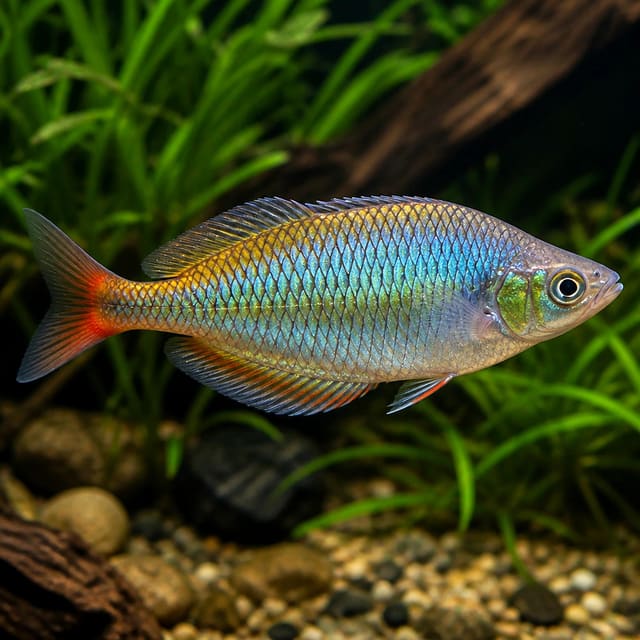
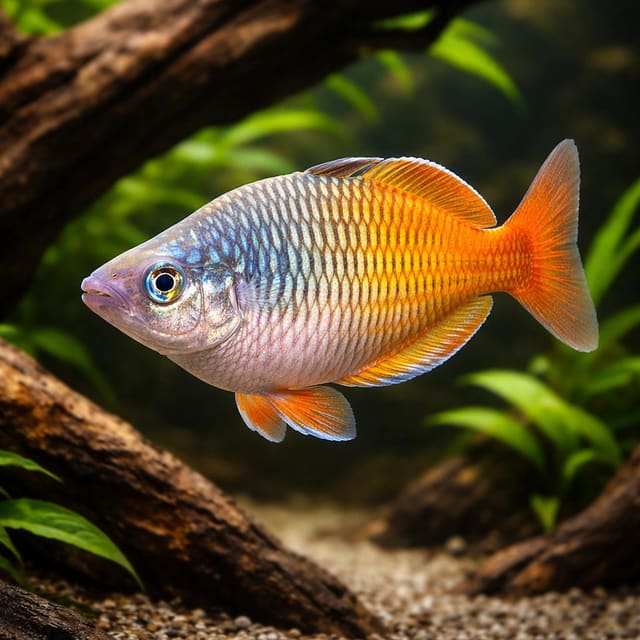
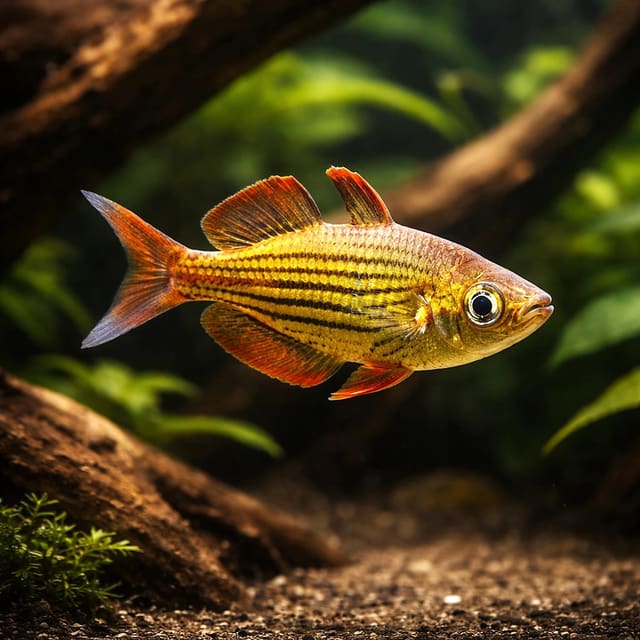
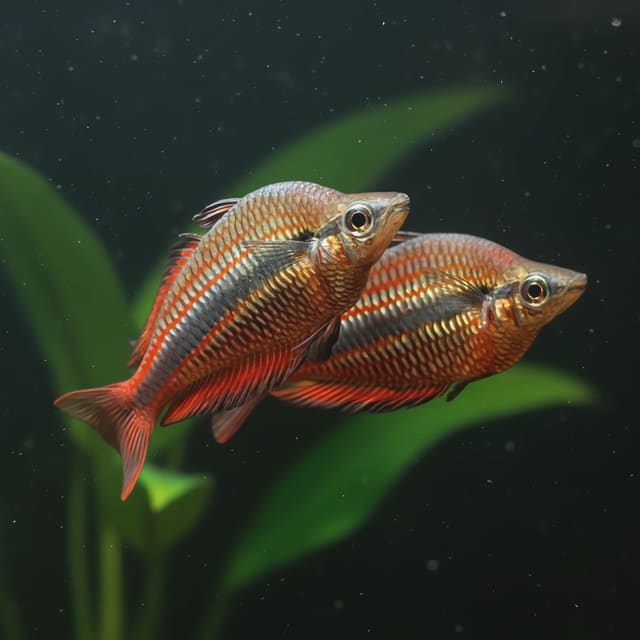
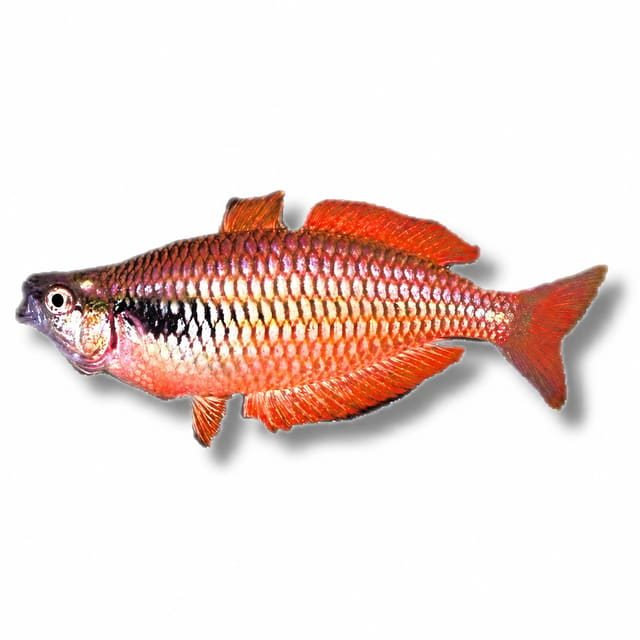
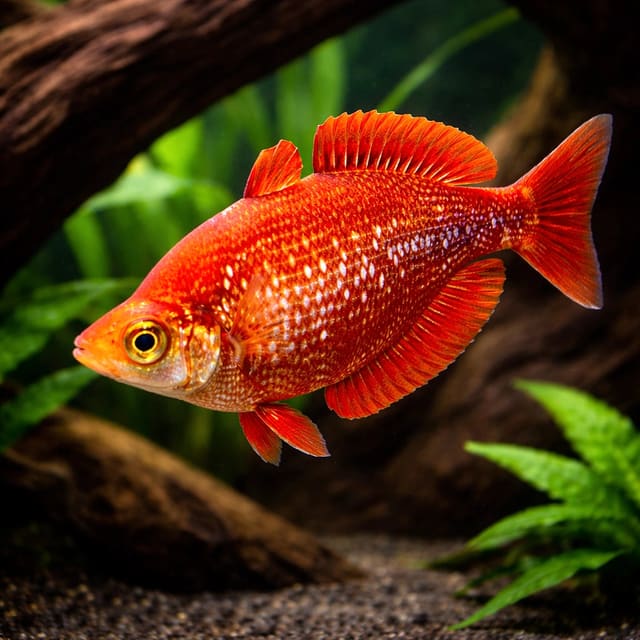
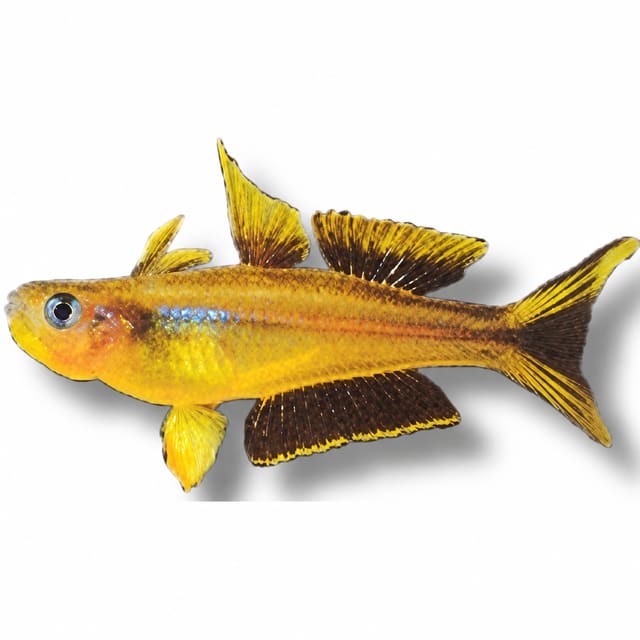
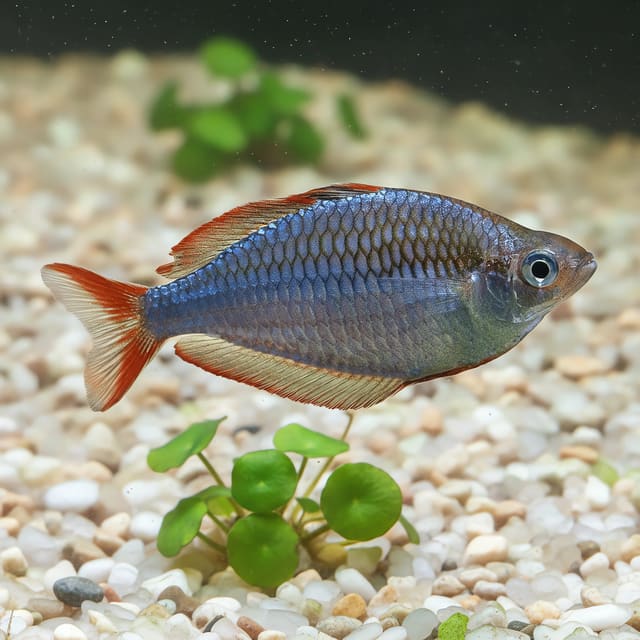
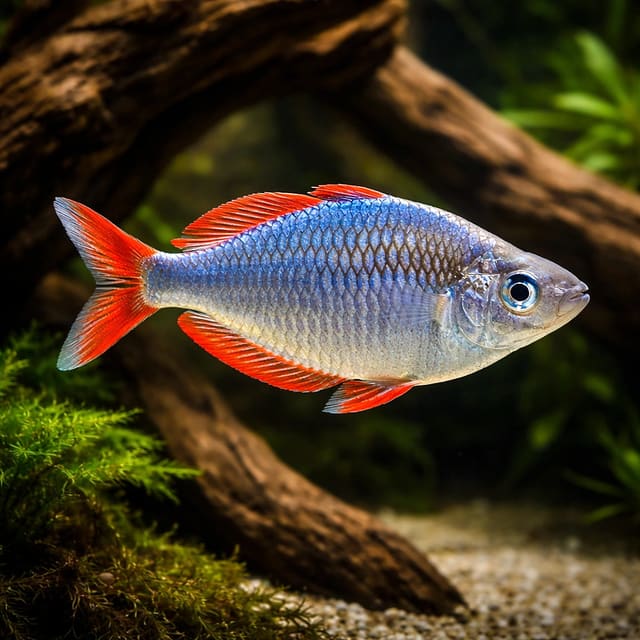
Some gallery photos were digitally enhanced to improve image quality, so colours can look slightly different from the live animal. The pictured fish is representative of the listed animal type and shows an iridescent blue flank, a yellow throat, spotted transparent fins and a yellow-tipped tail over gravel.
Choose Paska's Blue-Eye Rainbowfish when you can provide for a complete shoal rather than fitting one small fish into unused space. Its compact length reduces the physical size of each individual, but social needs, swimming room, filtration capacity and the total feeding load still determine whether the aquarium is suitable. Confirm the aquarium can accommodate all intended group members before buying the first fish.
A larger aquarium usually gives the shoal more usable swimming room and makes temperature and water quality easier to keep stable. The broad 45-litre recommendation is therefore a starting point for the smallest rainbowfish, not a reason to stop considering aquarium shape, existing occupants or filtration capacity. A longer open route can be more useful to an active group than a layout divided by dense ornaments, while planted or artificial cover gives fish somewhere sheltered to withdraw.
This fish suits an aquarist prepared to test water regularly, maintain a dependable filter and observe a small shoal closely. Its modest body size does not make it a suitable shortcut for an immature aquarium. If this will be your first setup, follow our guide to preparing and maturing a tropical aquarium before livestock is introduced.
Explore the rainbowfish collection to compare identities and adult-space requirements. Alternative listings are comparison choices rather than automatic tank-mate recommendations; assess each animal's eventual size, activity, social needs and water requirements separately.
For dispatch arrangements, claim conditions and reporting steps, read our delivery and Live Arrival Guarantee policy. Check the product page for current purchase information.
Start with the space needed by the whole group. Broad rainbowfish guidance recommends at least 45 litres for a shoal of the smallest species, but usable swimming length, existing fish and filter capacity can make a larger aquarium the better choice. Do not treat the supplied 2.5–3 cm grade as the only space calculation. Each purchase adds another fish, another social interaction and another contribution to the aquarium's biological load.
Cover should create shelter without closing every swimming route. Dense decoration across the full aquarium can fragment the available space, while a completely bare arrangement removes the retreat areas recommended for shy fish. Build a connected open area through the centre or front and place most cover around its edges. This arrangement lets the shoal remain active while allowing an individual to withdraw from attention.
Check the arrangement from the fish's scale rather than judging only by the aquarium's total volume. Narrow gaps that look open from outside may offer little room once plants grow or ornaments divide the route. Allow space around rigid decorations so fins are not continually forced against rough surfaces during group movement.
Place shelter where it does not trap uneaten food or prevent you from reaching the substrate. Gravel and sand both suit the group guidance, so select the substrate you can maintain consistently. A siphon must be able to reach exposed waste during the weekly water change without dismantling the fish's main cover each time.
Plan the complete layout before introduction. Major omissions are easier to fix before fish occupy the aquarium, and the capacity check should include the full intended shoal rather than only the first purchase. Once space, cover, open routes and filtration capacity all fit together, the aquarium provides both the security and movement this social fish needs.
A well-established, properly maintained filter is essential for managing fish waste safely. The RSPCA's general aquarium welfare advice explains that fish release toxic ammonia. A working biological filter provides a home for beneficial bacteria that break down waste naturally, converting ammonia into toxic nitrite and then into the safer end product nitrate. This guidance applies to aquarium fish generally and supports filtration, maturation, testing and water stability for this setup.
A filter is more than moving water through a box. Its biological media holds the bacterial community that processes dissolved waste produced by the fish and by decomposing organic matter. That community takes time to establish and must remain protected during maintenance. An aquarium that looks clear can still contain harmful ammonia or nitrite, so judge filter readiness through maturation and testing rather than appearance alone.
A properly maintained filter removes waste from the aquarium and helps keep the environment clean, but filtration does not replace water changes or testing. Nitrate and solid debris still require routine management. Feeding also affects the load: food that is not eaten breaks down in the aquarium and adds waste for the system to process.
Capacity should be assessed before the full group is introduced. A filter supporting a lightly stocked aquarium may need time for its bacterial population to adjust when more fish and food are added. Increase the population gradually so the established biological filter can respond to the additional load, and verify its performance with water tests.
Keep this filtration requirement attached to the aquarium rather than to a single fish. One purchase supplies one animal, but the intended social group determines the real waste load. Planning only for one small body can leave the completed shoal with inadequate biological capacity.
Confirm that the aquarium has enough space and filtration capacity for the complete planned shoal before adding Paska's Blue-Eyes. Test the aquarium and check that its water matches the intended guidance. Ammonia and nitrite must both read zero. Temperature, pH and hardness should be stable within the chosen routine aquarium range rather than moving sharply between tests.
The rainbowfish group care sheet warns that stocking too quickly can cause new tank syndrome. The filter may lack enough nitrifying bacteria for the sudden increase in waste, producing unhealthy ammonia and nitrite levels that can make fish ill or cause deaths. Increase the aquarium population slowly so the bacterial community can adjust as fish numbers and feeding increase.
Use measurements rather than assumptions about established water. Maturation describes the biological filter and aquarium system; it does not mean that temperature or chemistry will automatically suit every fish. Testing connects aquarium readiness with the actual conditions the new group will encounter.
Observe existing occupants before introduction. A fish that is peaceful in general can still be a poor match if it monopolises food, repeatedly chases smaller fish or turns an open swimming route into defended space. Resolve that compatibility decision before adding a small shoaling species.
When adding more than one batch of livestock to an aquarium, leave the filter enough time to demonstrate that it is processing the new load. Continue testing after each increase. This gradual approach protects the shoal from a preventable waste spike and provides a clear baseline for interpreting later behavioural or appetite changes.
For routine aquarium care, OATA's broad rainbowfish guidance gives 22–27°C, pH 6.5–8.0, general hardness 4–12°dH and carbonate hardness 3–10°dKH. It also requires zero ammonia, zero nitrite and nitrate no more than 20 mg/l above the normal tap-water level. These values are broad group-level guidance, not a species-specific optimum.
Choose a stable point within the routine range that also suits the aquarium's other occupants. Stability matters because repeated swings expose the fish to changing conditions even when each isolated reading falls inside a broad interval. Record the aquarium's normal values and investigate a meaningful departure rather than continually adjusting water to chase a single number.
The wild environmental record and the routine aquarium range serve different planning tasks. The species account records 22–26°C, pH 6.5–7.5 and hardness up to 15°dH from its environmental entry. For husbandry, keep the complete group-care set together because it also covers carbonate hardness and nitrogen-waste limits.
Use our aquarium water chemistry guide to understand the purpose of each test. Once you have measured the aquarium, the water matcher can help compare those readings with the stated guidance.
A reading is useful only when it leads to a decision. Record results at consistent intervals, compare them with the aquarium's normal pattern and respond promptly to ammonia, nitrite or a marked change in another value. Avoid interpreting clear water as proof of safe chemistry, because dissolved nitrogen waste is not visible.
Change about 25% of the aquarium water at least once each week. Use a siphon during the change to remove accumulated solid waste from gravel or other accessible substrate areas. This removes debris before it continues breaking down and gives you a regular opportunity to inspect areas around plants, ornaments and feeding zones.
Never rinse biological filter media under untreated tap water. Chlorine or chloramine can kill the established beneficial bacteria that process waste. A light rinse in removed aquarium water clears loose debris while reducing bacterial loss. Do not scrub biological media until it looks new; the bacterial population is part of the filter's function.
Check blockages separately from biological cleaning. A restricted intake or clogged mechanical section may need attention even when biological media does not. Work methodically so you restore dependable operation without unnecessarily disturbing every part of the filter at once.
Water conditioner is required before replacement tap water enters the aquarium because chlorine and chloramine are harmful to the filter's bacterial community as well as to livestock. Follow the product manufacturer's instructions for the actual volume of new water and the disinfectant treatment it is designed to provide.
Testing before maintenance gives you information about how the aquarium performed over the preceding week. Testing again when a problem is suspected helps determine whether an unusual behaviour coincides with a water-quality change. Keep results together so gradual deterioration is easier to recognise than it would be from isolated readings.
The weekly routine manages both dissolved and solid waste. The filter processes ammonia continuously, the siphon removes settled debris and the partial change controls accumulating substances in the water. Each action has a separate role, so a strong filter does not justify skipping water changes, and clean-looking substrate does not replace chemical testing.
Rainbowfish are omnivorous and accept a varied diet of suitable prepared, frozen and live foods. Offer a quality flake or granule as the regular prepared food. Add suitably small live or frozen items such as daphnia, small bloodworm or tubifex for variety. Match each item to the fish's small body and ability to take it cleanly.
Feed once daily and provide only what the fish can finish within a few minutes. This timing creates a practical stopping point: if particles remain after the group has stopped feeding, reduce the next portion. Excess food breaks down and releases toxic waste into the water, increasing the work required from the biological filter and maintenance routine.
Watch the whole shoal during feeding. The relevant question is whether each fish can reach suitable particles, not simply whether food entered the aquarium. In a community setup, larger or more forceful fish may take the first particles. Spread a measured portion across an accessible feeding area so the small rainbowfish have a fair opportunity to feed.
Do not solve feeding competition by adding a large excess. Surplus food can settle among plants, ornaments or substrate, where it decomposes out of sight. Instead, reassess the companion mix, feeding position and particle distribution. A fish that is repeatedly excluded by more active occupants may be in an unsuitable community even when the species share similar water values.
Use appetite as part of routine observation. Learn how readily the group approaches food and how quickly it finishes a normal portion. A reduced intake or loss of interest can be an early sign that something is wrong. When appetite changes, test the aquarium water promptly and compare the fish's behaviour and appearance with its normal baseline.
Establish a clear baseline for the group so later changes are easier to recognise. Healthy fish should have clear, bright eyes; cloudiness or a marked change deserves prompt investigation. Look for intact scales and undamaged fins, with no ulcerations, unexplained bumps or other obvious surface damage.
Choose fish showing appropriate, controlled swimming. A small shoaling fish may change direction quickly, but obvious difficulty maintaining position is different from purposeful group movement. Compare the individual with the rest of the shoal and with its own behaviour after it has settled.
Use the baseline after introduction as well as at selection. Record which areas the group normally uses, how individuals respond at feeding and whether the shoal moves together or divides around the layout. The record does not need to be elaborate; a short note makes gradual changes easier to detect.
Assess several signs together. One fish briefly moving behind cover is not equivalent to a persistent combination of hiding, poor appetite and altered breathing. Conversely, a new lesion or clear loss of normal swimming control deserves prompt action even if the fish still approaches food.
Good observation leads directly to testing and husbandry decisions. When a condition or behaviour changes, check water quality first and review recent feeding, filtration and interactions. This approach helps identify an environmental problem early without guessing at a diagnosis from one visual sign.
Watch for changes from the group's established pattern. Hanging at the surface, sitting on the bottom or erratic swimming all deserve attention when they appear suddenly or persist. Investigate fish becoming markedly darker or paler than their normal appearance rather than treating the change as ordinary colour variation.
When behaviour, breathing, appearance or appetite changes, test the aquarium water promptly. Check ammonia and nitrite first because both should remain at zero, then review temperature, pH, hardness and nitrate against the aquarium's usual readings. A normal reading in one category does not cancel a marked problem in another.
Review interactions when damage, hiding or feeding exclusion appears. Fin loss or missing scales can coincide with unsuitable tank-mate behaviour, while sudden group-wide changes may direct attention towards water quality or another shared environmental factor. Use observation to decide what to examine, not to assign a disease treatment from appearance alone.
Respond according to urgency. Altered breathing, loss of normal swimming control or a serious surface lesion needs immediate attention. A gradual change in appetite or body condition still requires a prompt water test and closer observation because delay can allow the underlying problem to progress.
If you are concerned about the fish's health, contact an OATA retailer for further guidance. Provide the aquarium volume, group size, tank mates, recent test results, temperature, maintenance history and the changes you have observed. Those details are more useful than a colour description alone and help focus the next safe action.
Choose peaceful, non-nipping companions with compatible water needs, and avoid tank mates that are very timid, much smaller or likely to bully the rainbowfish. Rainbowfish are generally easy-going but can be active, so a fish that is peaceful on paper may still be a poor companion if it is easily overwhelmed or repeatedly excluded from food.
Do not treat another rainbowfish listing as automatic evidence of compatibility. Rainbowfish differ in eventual size and activity, and the broad group guidance warns against mixing larger species with very small fish. Compare each candidate separately and choose the combination only when adult size, behaviour, water and feeding access all fit.
Account for the behaviour of the actual aquarium, not just the species labels. Persistent hiding, a sudden increase in aggression, newly damaged fins or repeated exclusion at feeding shows that the arrangement needs investigation. Safety is not guaranteed merely because the fish occupy similar water on a care chart.
Keep the Paska's Blue-Eyes as a social group within the community. One purchase supplies one animal, so build the group deliberately and ensure the filter can adjust to each increase in stocking. The minimum group recommendation does not override aquarium capacity; use a larger aquarium when existing occupants, activity or filtration load leave too little room for the intended shoal.
When several possible communities meet the basic screen, favour the one that gives this small fish dependable feeding access, open movement and nearby shelter. That choice directly addresses the needs established for the shoal without promising that every individual interaction will be trouble-free.
It is Pseudomugil paskai, a small freshwater member of the blue-eye family from Papua New Guinea. FishBase records a maximum length of 3.0 cm standard length and lists the species as Critically Endangered.
One purchase supplies one animal at the recurring 2.5–3 cm dispatch grade. There is no separate size selection, and the supplied measurement does not establish the fish's life stage.
Broad rainbowfish guidance recommends at least 45 litres for a shoal of the smallest species. Use a mature biological filter, open swimming room and plants or other suitable cover.
Plan it as part of a shoal rather than as a solitary fish. Broad rainbowfish guidance says at least five, with more preferred when aquarium space and filtration capacity allow.
Broad group-level aquarium guidance gives 22–27°C, pH 6.5–8.0, 4–12°dH and 3–10°dKH; it is not a species-specific optimum. Keep ammonia and nitrite at zero.
Feed quality flake or granules once daily, varied with suitably small daphnia, small bloodworm or tubifex. Give only what the fish can consume within a few minutes.
Confirm the aquarium is mature, has room and filter capacity for the complete shoal, and matches the planned water guidance. Test first and proceed only when ammonia and nitrite are zero.
Choose peaceful, non-nipping fish with compatible water needs. Avoid companions that are very timid, much smaller, likely to bully the shoal or able to dominate its feeding access.
The following references let you inspect the principal public records behind the identity and husbandry guidance.
The 2.5–3 cm dispatch grade, one-animal retail unit and absence of a sex-guaranteed option are exact offer facts. They are separate from scientific adult-size and aquarium-care records.
No reviews for this item yet. Bought one? Honest reviews only, good or bad.
What customers say about ordering from us
I have a small group of long finned mountain minnows. So was delighted to be able to order ten of this variety to increase the genetics in my tank . The ones I recieved are healthy but it’s to early to give a verdict on wether they are of a long finned type since they are small currently.
Gordon Walker · 23 Sept 2026
100% success travel and "installation". Pleased with quality of purchase. The Siamese fighter a bit "shy" so have not yet seen him at his best yet but looking good. Happy customer. GG
George E Garratt · 21 Sept 2026
Reviews of our shop, collected by Judge.me, an independent third-party review collector. Newest first.