Easy
Neon Dwarf Rainbowfish (Melanotaenia praecox)
23–27°C · pH 6.8–7.5 · 54L
£5.99

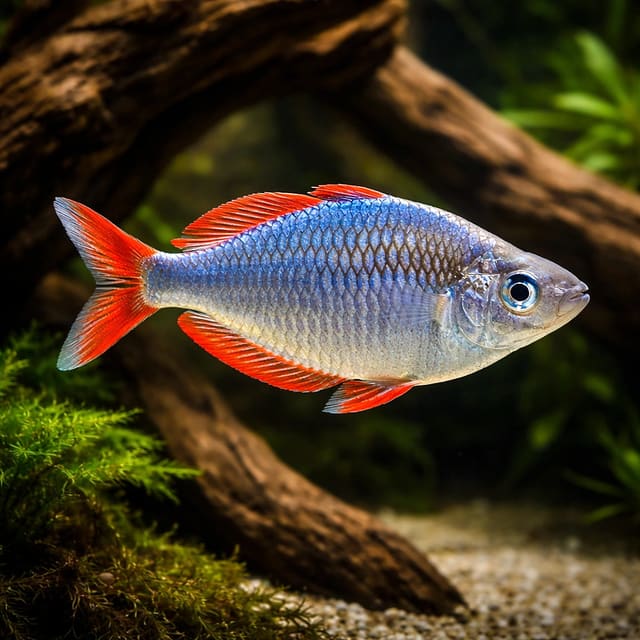
The Lake Kutubu Rainbowfish (Melanotaenia lacustris) is a freshwater rainbowfish from Lake Kutubu and the Soro River in Papua New Guinea that reaches 10 cm standard length. It suits spacious communities: keep at least six with a 120 × 30 cm tank base; 22–24°C, pH 7.0–8.0 and 10–12 dGH form the overlap of the FishBase, Seriously Fish and OATA ranges. Sold individually in 4–5.5 cm and over 6 cm sizes.
Adult size is the maximum length this species reaches at full maturity (scientific sources). The livestock you receive will be younger and smaller — pick a size above for the actual shipping size. Product-photo provenance and any image-specific limitations are stated on the listing.
Melanotaenia lacustris
Shoaling fish: kept in a group they feel safer, stay calmer and show their best colour.
The Lake Kutubu Rainbowfish (Melanotaenia lacustris) is a freshwater rainbowfish from Lake Kutubu and the Soro River in Papua New Guinea that reaches 10 cm standard length. It suits spacious communities: keep at least six with a 120 × 30 cm tank base; 22–24°C, pH 7.0–8.0 and 10–12 dGH form the overlap of the FishBase, Seriously Fish and OATA ranges. Sold individually in 4–5.5 cm and over 6 cm sizes.
Adult size is the maximum length this species reaches at full maturity (scientific sources). The livestock you receive will be younger and smaller — pick a size above for the actual shipping size. Product-photo provenance and any image-specific limitations are stated on the listing.
Maintain these water conditions for optimal health and vibrant colors
Lake Kutubu Rainbowfish (Melanotaenia lacustris) is a freshwater member of the rainbowfish family from Lake Kutubu and its outlet, the Soro River, in Papua New Guinea. FishBase records a maximum of 10 cm standard length. This peaceful, active shoaling fish suits a spacious community aquarium with a long swimming lane, slightly hard alkaline water and at least six of its own kind.
FishBase identifies Melanotaenia lacustris as a member of Melanotaeniidae. It describes the wild fish as an omnivore and the aquarium fish as a peaceful community species. It also records the species as Endangered, so responsible long-term care matters.
| Suits | Not suited to |
|---|---|
| A shoal of at least six | A solitary-fish plan |
| A base of at least 120 × 30 cm | A short aquarium without open swimming room |
| About 108 litres or more | A crowded community at the minimum footprint |
| 22–24°C, pH 7.0–8.0 and 10–12 dGH | Soft, acidic conditions |
| Peaceful, similarly sized and similarly active fish | Very small, timid or much smaller fish |
This is a good choice when you want visible movement through open mid-water and can dedicate enough horizontal room to the whole shoal. Browse the rainbowfish collection if you need to compare this larger, active species with other members of the family.
One purchase quantity supplies one Lake Kutubu Rainbowfish from the option chosen on the live size selector. The size choices are 4–5.5 cm and > 6 cm. The size you select is the size supplied, not the adult size. Both grades therefore require the same long-term aquarium plan; the larger grade is not a separate adult-size form.
FishBase records a maximum of 10 cm standard length, while Seriously Fish uses 12 cm standard length as its aquarium-planning reference. Plan the aquarium around the larger 12 cm figure so the shoal has adequate turning and swimming room without treating that planning figure as a guaranteed final length. Growth rate and final size will vary between individuals.
Sex is guaranteed only when the selected option explicitly states male or female. This Lake Kutubu Rainbowfish listing has no sex-guaranteed option.
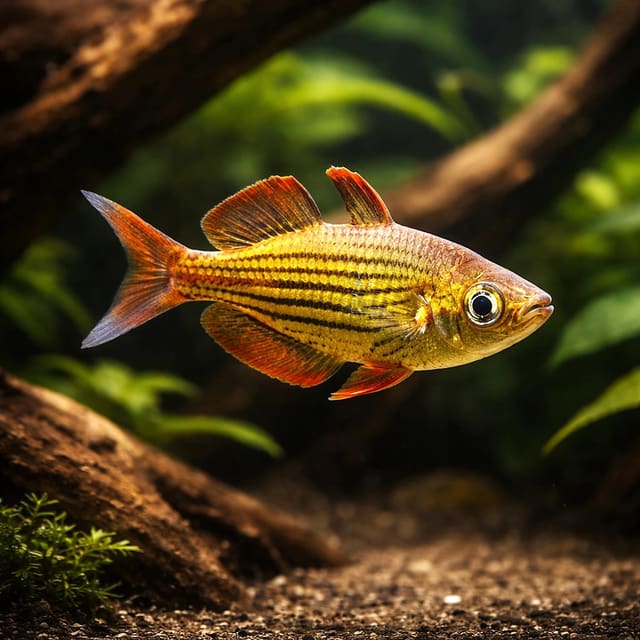
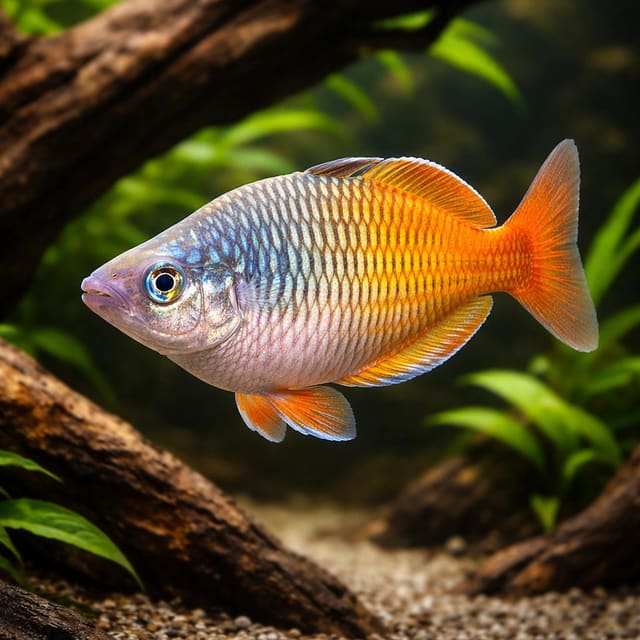
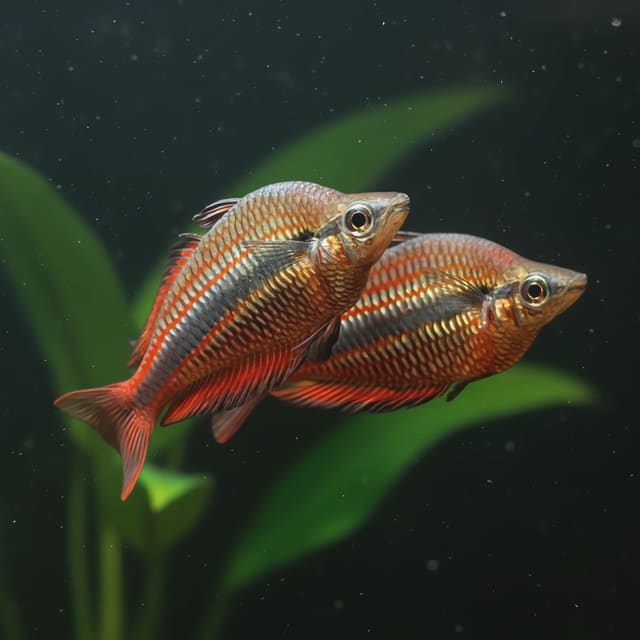
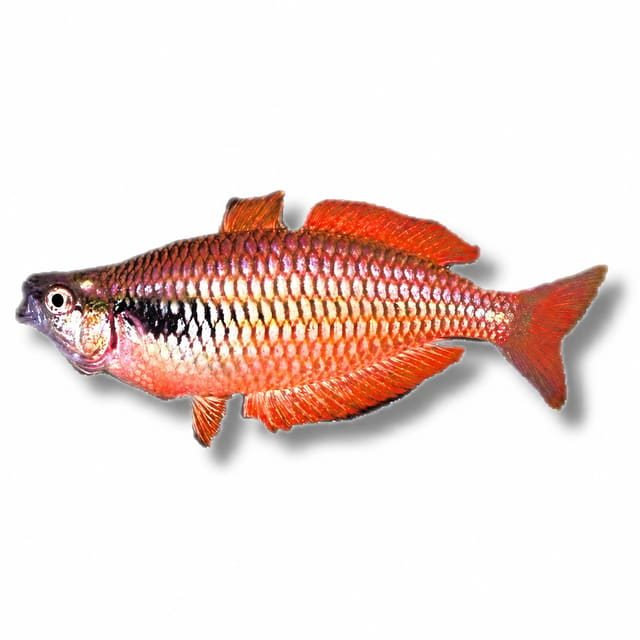
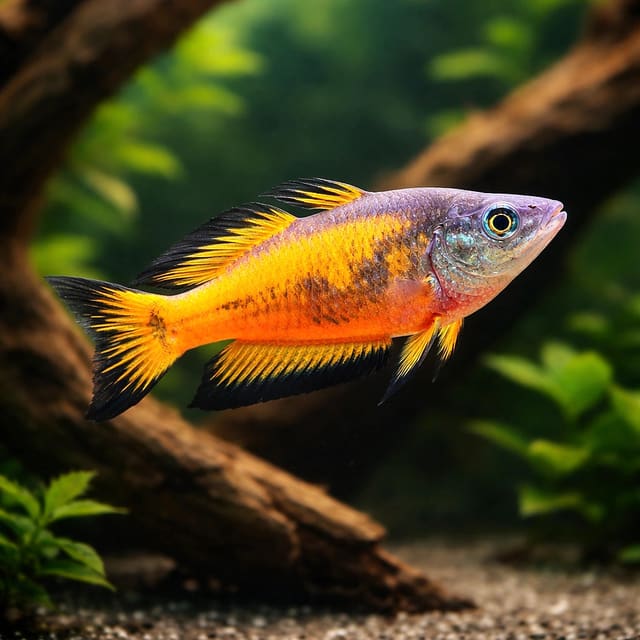
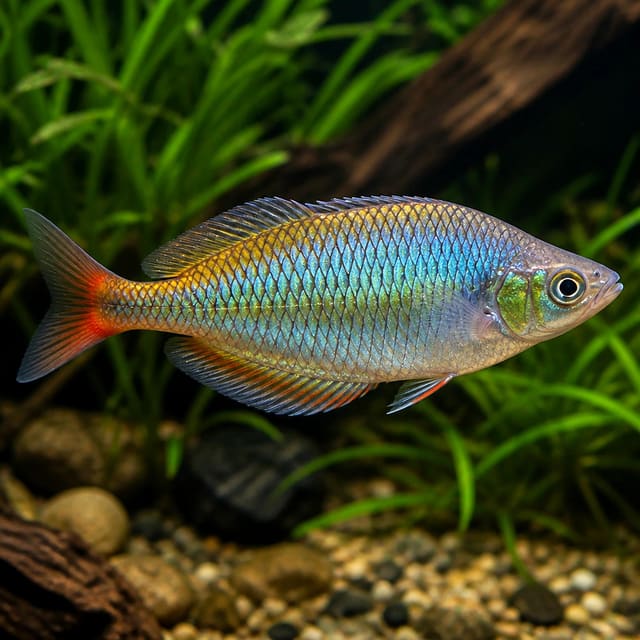
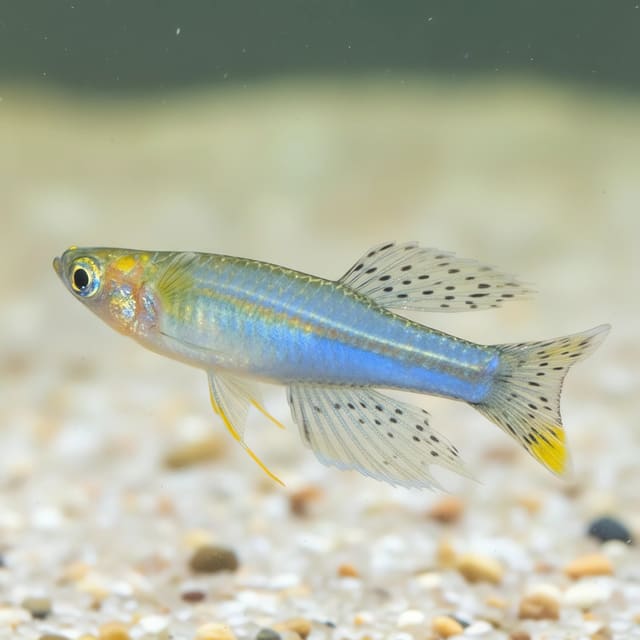
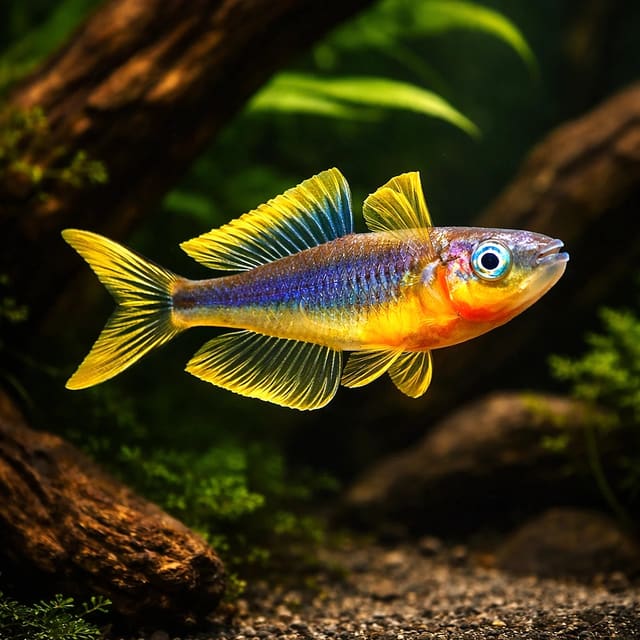
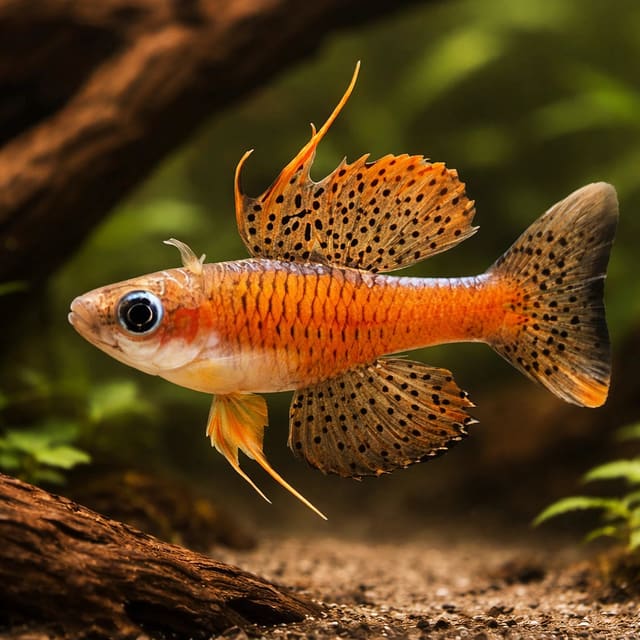
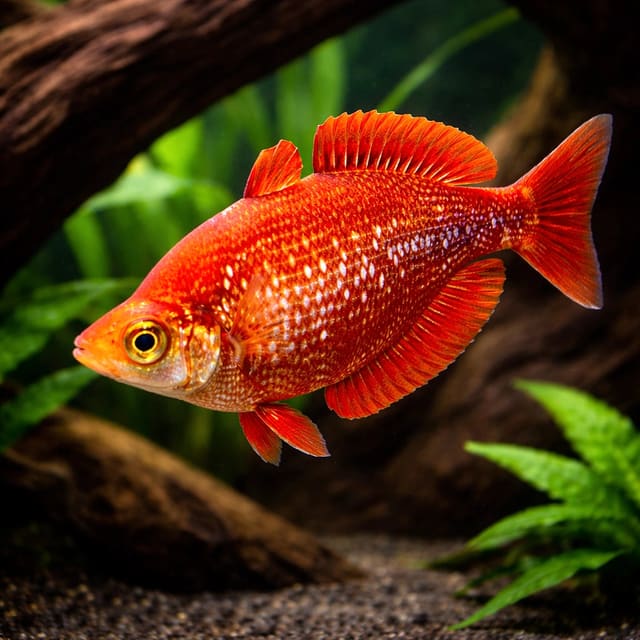
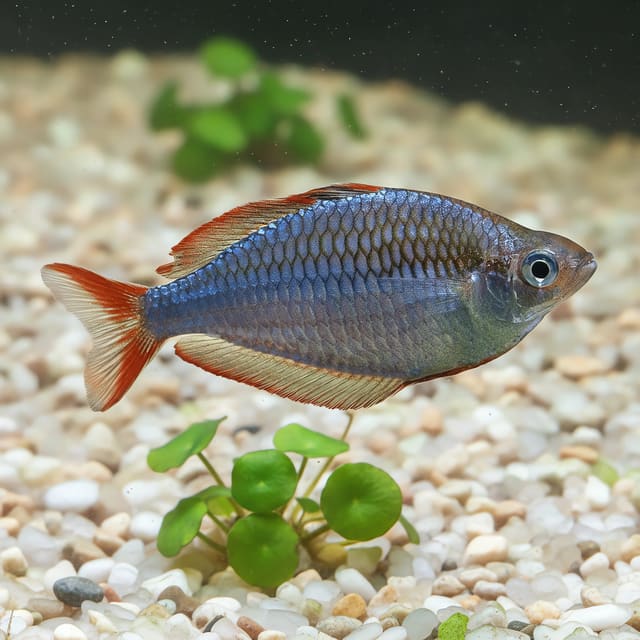
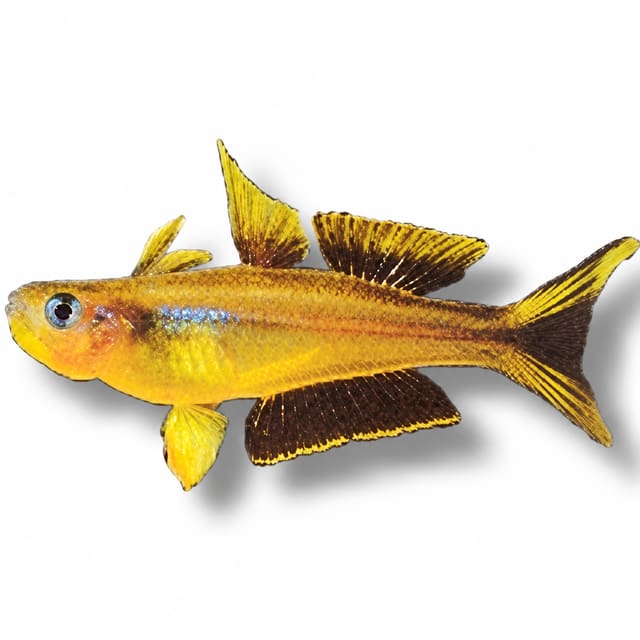
The gallery images are representative, based on reference photographs of this species, so colours can look slightly different from the live animal.
Mature males are described as larger, brighter and deeper-bodied than females, but those adult differences should not be used as a promise about the fish selected. Choose this animal for its species, social behaviour and care requirements rather than for an assumed sex or future colour intensity.
A useful buying check is to separate quantity from grade. For example, selecting six fish from the 4–5.5 cm grade creates the minimum shoal plan; selecting one fish from the > 6 cm grade still supplies one animal and does not meet the social requirement by itself.
Seriously Fish recommends an aquarium measuring at least 120 × 30 × 30 cm, equivalent to about 108 litres, because this is an active species. Treat the 120 cm length and 30 cm width as minimum dimensions rather than assuming that any aquarium holding the same number of litres will work. A taller but shorter tank can match the volume while removing the long swimming lane the shoal needs.
OATA’s broad group guidance for rainbowfish recommends at least 120 litres for larger species over 8 cm. A practical plan is therefore to retain at least the 120 × 30 cm base and choose 120 litres or more where aquarium shape, group size or additional community fish increase the space requirement.
Do not use the minimum dimensions as a stocking formula. A 120 × 30 × 30 cm aquarium establishes the starting space for this species, but it does not automatically accommodate an unlimited group or a crowded mixed community. Six fish require the same uninterrupted swimming length at dispatch size that they will depend on as they develop.
If this is your first aquarium, prepare and mature it before the fish arrive by following our first tropical tank guide. A larger aquarium generally gives more room for the shoal and more water volume in which to manage waste, but it still needs an established biological filter and measured stocking.
Use 22–24°C, pH 7.0–8.0 and 10–12 dGH as practical routine targets. These values form the overlap of the ranges given across the main references: Seriously Fish gives 20–25°C, pH 7.0–9.0 and 10–20 dGH for aquarium care; FishBase records 20–24°C, pH 7.0–8.0 and 9–12 dGH in the natural environment; OATA gives rainbowfish ranges of 22–27°C, pH 6.5–8.0 and 4–12 dGH. The shared targets avoid widening any species range and keep the aquarium away from the soft, acidic conditions in which this fish does poorly.
| Value | Routine target |
|---|---|
| Temperature | 22–24°C |
| pH | 7.0–8.0 |
| General hardness | 10–12 dGH |
| Ammonia | 0 mg/l |
| Nitrite | 0 mg/l |
| Nitrate | No more than 20 mg/l above the normal tap-water level |
Test the source water and aquarium before choosing livestock. Our water chemistry guide explains what the main measurements mean, while the water matcher helps compare measured values with the stated range. Use actual test results rather than assuming that local tap water is hard, alkaline or stable.
Nitrate guidance is relative to the incoming tap water. If the tap-water reading is 15 mg/l, keep the aquarium at no more than 35 mg/l. If it is 25 mg/l, the corresponding upper figure is 45 mg/l. Ammonia and nitrite are different: both should remain at zero rather than being managed against the tap-water baseline.
Make changes gradually. Match replacement water appropriately, treat it for chlorine or chloramine and avoid repeatedly adding products simply to chase one exact pH. Stability within the routine band is more useful than frequent swings caused by unnecessary adjustment.
The RSPCA explains why a working biological filter is essential: fish release toxic ammonia, established bacteria convert it to nitrite and then to the safer nitrate. The filter must be matured before the shoal is introduced and kept running continuously so that this biological process can support the aquarium’s livestock.
For an aquarium of about 108 litres, Seriously Fish gives a turnover of four to five times the aquarium volume per hour and a filter rating of roughly 430–540 litres per hour. Use the manufacturer’s rating as a starting point, then account for media, pipework, blockages and the actual layout. Efficient filtration is required, but water movement should remain low enough that the shoal is not forced to struggle against a concentrated jet.
The water-change calculation is straightforward. Twenty-five per cent of 108 litres is 27 litres, while 25% of 120 litres is 30 litres. Base the real quantity on the aquarium’s working volume after allowing for substrate, decor and the water level. Use a siphon to remove solid waste from the substrate while taking out the measured water.
Good filtration does not replace maintenance. Uneaten food and fish waste still enter the system, and a blocked or heavily loaded filter can lose performance. Equally, a powerful outlet is not a substitute for adequate tank length. Spread or redirect the return if one narrow current makes the fish hold position instead of using the whole swimming lane.
Create a planted aquarium with dense cover in selected areas and broad open water for group swimming. Seriously Fish describes Lake Kutubu Rainbowfish as looking most at home among plants, with dense vegetation balanced by open areas. FishBase also associates its aquarium surroundings with rocks, plants and driftwood cover.
| Zone | Purpose |
|---|---|
| Back and sides | Dense planting and visual shelter |
| Middle or front | Long, uninterrupted swimming lane |
| Lower structure | Securely placed wood or rocks without narrowing the route |
| Equipment area | Protected intake and a diffused return |
Choose plants that can be maintained in slightly hard, alkaline water. Planting every part of the aquarium may look lush but can work against an active shoal by breaking the tank into short corridors. Instead, group taller growth along the back and ends, then inspect the aquarium from end to end to confirm that the fish can cross it without repeatedly turning around obstacles.
Wood and rocks are useful when they provide structure without creating unstable stacks or sharp bottlenecks. Secure each piece before filling the aquarium and leave room around the filter intake for routine cleaning. Other decor is less important than the combination of shelter, open water and suitable water chemistry.
Watch how the group uses the finished arrangement. Regular movement through the full length indicates that the route is functional. If all fish must squeeze through one gap, or if the filter outlet confines them to a quiet corner, move the obstruction or spread the return. Alter the layout itself rather than adding more fish to encourage movement.
The result should offer two choices at once: planted edges for shelter and a broad lane for normal shoaling. That balance supports the species’ active behaviour without leaving the aquarium bare.
Lake Kutubu Rainbowfish is omnivorous. Feed a good-quality flake or granule as the prepared staple and rotate suitable small live or frozen foods such as daphnia, small bloodworm or tubifex. Brine shrimp can provide a larger item. Seriously Fish also describes the species as accepting dried, frozen and live foods.
Offer only what the group can consume within a few minutes, once each day. Spread the food across enough surface area for the shoal to reach it instead of dropping the whole portion into one point. The aim is an orderly meal in which every fish gets access and little or nothing reaches the substrate uneaten.
Variety means changing the type of suitable food, not increasing the total amount. A dried staple on some days and a small live or frozen item on others can provide variety while preserving the once-daily schedule. Appetite alone is not a reliable portion guide because enthusiastic feeding can continue after enough food has entered the aquarium.
Overfeeding creates two problems at once. The fish may receive more food than needed, while uneaten material decomposes and adds toxic waste to the water. Portion control therefore supports both condition and filtration. If several foods are offered in one meal, their combined amount must still disappear within a few minutes.
Keep the food size appropriate to the mouth of the fish being fed. Observe the whole shoal through the meal, because feeding time is also the clearest daily opportunity to notice a fish that hangs back, swims abnormally or loses interest.
Prepare the aquarium before dispatch day. Confirm that the filter is mature, the temperature is stable within 22–24°C and tests show 0 mg/l ammonia and 0 mg/l nitrite. Add livestock gradually because the beneficial bacterial population must adjust whenever fish numbers and feeding increase. Rapid stocking can leave the filter unable to process the extra waste.
Floating helps address the temperature transition, but it does not make unsuitable aquarium water safe. The destination aquarium must already meet the species’ water range and waste limits before the bag is opened.
Plan the introduction around the whole shoal rather than treating each animal as a separate display fish. At the same time, do not add more livestock than the mature filter and aquarium can support. The minimum social group and the instruction to increase stocking gradually must both be considered when scheduling additions.
Use measured observations after release. Normal appearance varies between individuals, and transport can affect immediate behaviour, so compare each fish’s position, breathing and swimming over time. Test the water promptly if fish gather at the surface, sit on the bottom or swim erratically. Do not add food or water-adjusting products simply as a response to unfamiliar behaviour; establish the actual water values first.
Before the arrival date, prepare treated replacement water, a working test kit and unobstructed access to the filter. This prevents avoidable delays if a water-quality response is needed during the first days.
Make observation part of the daily feeding routine and keep the weekly testing and water-change schedule consistent. Look at the shoal before food enters the aquarium, while it feeds and again once the meal has finished. This sequence separates normal feeding excitement from changes that continue when food is absent.
| If you see | Do this |
|---|---|
| Surface hanging, bottom sitting or erratic swimming | Test ammonia, nitrite, nitrate and temperature immediately |
| Faster or slower gill movement | Check water values and filter flow |
| Darker or paler colour than normal | Compare behaviour, group interactions and test results |
| More hiding or a temperament change | Check group pressure, tank mates and the swimming layout |
| White spots, fluffy growths, damaged fins or missing scales | Record the change, test the water and contact us for health guidance |
| Reduced feeding or changing body condition | Check access to food, portion size and water quality |
A single observation should lead to measurement before guesswork. For example, surface hanging may coincide with an ammonia or nitrite problem, a temperature change or disrupted filtration. Testing distinguishes those conditions and gives you a clear first action. Do not begin a disease treatment from appearance alone.
Keep results in a simple dated log. Record temperature, pH, ammonia, nitrite and nitrate at least weekly, along with the amount of water changed. If the figures begin to move, the sequence can show whether the change followed heavier feeding, added livestock, a blocked filter or missed maintenance.
Use the first month to confirm that the practical plan works: every fish reaches the meal, the shoal uses the full swimming lane, ammonia and nitrite remain at zero, and nitrate stays within 20 mg/l of the tap-water baseline. If one fish is consistently displaced, reconsider the group structure and community pressure rather than simply increasing food.
Steady routines make changes easier to recognise. Alter one manageable factor at a time, retest after a water-quality response and preserve the mature biological media whenever the filter is cleaned.
Keep at least six Lake Kutubu Rainbowfish together. Seriously Fish recommends a shoal of six to eight, preferably more, because the species can be skittish and performs better among its own kind. A larger group can strengthen the social display, but it also requires a correspondingly larger aquarium rather than simply fitting more fish into the minimum footprint.
Start group planning with three linked limits: swimming length, filtration capacity and total community load. Six fish establish the lower social threshold. Moving from six to eight may improve the group context, but only when the aquarium still provides an open 120 cm or longer route and the filter can maintain 0 mg/l ammonia and nitrite. Groups beyond eight need additional space and waste capacity.
OATA recommends at least five rainbowfish as a general group rule, while the more specific Lake Kutubu guidance raises the practical starting point to six. Follow the stronger figure for this animal. Keeping one or two fish does not create a smaller version of the same social setup.
Do not purchase a minimum group until the adult plan is ready. Dispatch size affects the size received, not the eventual footprint, group requirement or filtration load. A shoal chosen from the smaller grade still needs the full long-term aquarium from the beginning.
Lake Kutubu Rainbowfish is peaceful, but its rapid movement and relatively large adult size can disturb smaller or slow-moving fish. Avoid very small, timid or much smaller fish, and use caution with slow-moving species that may be unsettled. Shared temperament is not enough; every candidate must also fit the same temperature, pH, hardness, swimming space and activity level.
Seriously Fish names similarly sized rainbowfish, characins, danios, barbs, freshwater gobies and Corydoras among potential companions. Treat these as categories to screen, not automatic matches. Species within each category differ, so compare the exact adult size and water requirements before combining them.
| Screen | Question to answer |
|---|---|
| Water | Can both fish remain within 22–24°C, pH 7.0–8.0 and 10–12 dGH? |
| Adult size | Will the companion remain large enough not to be overwhelmed? |
| Activity | Can it behave normally beside a fast shoal? |
| Space | Does the aquarium meet every species’ adult footprint after all groups are counted? |
A similarly active danio or barb may pass the pace screen but still fail the water or space check. A bottom-dwelling catfish may use another level of the aquarium, but it still contributes waste and has its own temperature, hardness, substrate and social needs. Another rainbowfish group may share broad behaviour, yet maintaining two proper shoals can require substantially more room than the minimum aquarium.
Rift Lake cichlids are mentioned as possible companions because some share suitable water requirements, but that does not make every cichlid compatible. Screen the exact species for behaviour, adult size and space rather than relying on the group name.
Honest uncertainty remains until the complete stocking plan is known. Ask us for a stocking and compatibility assessment with the aquarium dimensions, working volume, measured water values, filter model, existing inhabitants and intended group numbers.
FishBase records a maximum of 10 cm standard length for Melanotaenia lacustris; Seriously Fish uses 12 cm standard length as its aquarium-planning reference.
Use an aquarium measuring at least 120 × 30 × 30 cm, about 108 litres, with dense planting at the edges and a long open swimming lane.
Keep at least six together; Seriously Fish recommends a shoal of six to eight, preferably more, with additional aquarium space for a larger group.
It suits a keeper who can provide a mature filtered aquarium, a group of at least six, a 120 × 30 cm base and stable slightly hard, alkaline water.
Feed quality flake or granules with suitable small live or frozen foods such as daphnia, small bloodworm or tubifex, offering only what the shoal eats within a few minutes once daily.
Keep it at 22–24°C, pH 7.0–8.0 and 10–12 dGH; these routine targets form the overlap of the FishBase, Seriously Fish and OATA ranges.
Seriously Fish describes it as very peaceful, but its rapid movement and relatively large size can disturb smaller or slow-moving fish.
Potential companions include similarly sized rainbowfish, characins, danios, barbs, freshwater gobies and Corydoras, provided the exact species matches its water, adult space and activity needs; avoid very small, timid or much smaller fish.
Someone must be present to receive it. Film every delivery continuously from the sealed parcel as it is opened, showing the fish still in the sealed bag; then float the bag for 20–30 minutes and release the fish without pouring the bag water into the aquarium.
No reviews for this item yet. Bought one? Honest reviews only, good or bad.
What customers say about ordering from us
I have a small group of long finned mountain minnows. So was delighted to be able to order ten of this variety to increase the genetics in my tank . The ones I recieved are healthy but it’s to early to give a verdict on wether they are of a long finned type since they are small currently.
Gordon Walker · 23 Sept 2026
100% success travel and "installation". Pleased with quality of purchase. The Siamese fighter a bit "shy" so have not yet seen him at his best yet but looking good. Happy customer. GG
George E Garratt · 21 Sept 2026
Reviews of our shop, collected by Judge.me, an independent third-party review collector. Newest first.