Easy
Neon Dwarf Rainbowfish (Melanotaenia praecox)
23–27°C · pH 6.8–7.5 · 54L
£5.99

The Boesemann's Rainbow Fish (Melanotaenia boesemani) is a freshwater rainbowfish from Indonesia's Ajamaru Lakes region that reaches 9 cm standard length. It suits keepers with a spacious, mature aquarium: keep 6–8 or more, using the FishBase, Seriously Fish and OATA overlap of 27°C, pH 7.0–8.0 and 10–12 dGH. Sold individually in 3–4 cm, 4–5.5 cm and 6–7 cm dispatch sizes.
Adult size is the maximum length this species reaches at full maturity (scientific sources). The livestock you receive will be younger and smaller — pick a size above for the actual shipping size. Product-photo provenance and any image-specific limitations are stated on the listing.
Melanotaenia boesemani
Shoaling fish: kept in a group they feel safer, stay calmer and show their best colour.
The Boesemann's Rainbow Fish (Melanotaenia boesemani) is a freshwater rainbowfish from Indonesia's Ajamaru Lakes region that reaches 9 cm standard length. It suits keepers with a spacious, mature aquarium: keep 6–8 or more, using the FishBase, Seriously Fish and OATA overlap of 27°C, pH 7.0–8.0 and 10–12 dGH. Sold individually in 3–4 cm, 4–5.5 cm and 6–7 cm dispatch sizes.
Adult size is the maximum length this species reaches at full maturity (scientific sources). The livestock you receive will be younger and smaller — pick a size above for the actual shipping size. Product-photo provenance and any image-specific limitations are stated on the listing.
Maintain these water conditions for optimal health and vibrant colors
The Boesemann's Rainbow Fish (Melanotaenia boesemani) is a freshwater member of the rainbowfish family, Melanotaeniidae, from Indonesia. FishBase places its natural range in the Ajamaru Lakes region of the Vogelkop Peninsula and nearby Aitinjo Lake. It records a maximum length of 9 cm standard length and classifies the species as Endangered in nature. This fish suits a keeper who wants an active shoal and can provide warm, alkaline, moderately hard water, efficient filtration and a long swimming area.
Plan for a mature aquarium measuring at least 120 × 30 × 30 cm, approximately 108 litres. Seriously Fish gives that species-level minimum because this is an active swimmer, while a very large group needs a suitably larger aquarium. Keep 6–8 together, preferably more, rather than planning around one fish. Its rapid movement can unsettle smaller or slow-moving companions, so this is a community choice for carefully matched fish rather than a quiet aquarium of timid species.
Its routine water target is 27°C, pH 7.0–8.0 and 10–12 dGH. These routine values are the overlap of FishBase and Seriously Fish ranges with OATA's wider rainbowfish guidance. The narrow shared temperature means stability matters: establish the aquarium at the intended value before introduction and check that it remains steady.
| Suits | Not suited to |
|---|---|
| A shoal of 6–8 or more | A solitary-fish plan |
| At least a 120 × 30 × 30 cm aquarium | Aquariums below the stated minimum |
| Warm, alkaline, moderately hard water | Soft, acidic conditions |
| Open swimming room with planted cover | A layout filled with decor and little open space |
| Similarly sized, active community fish after screening | Timid, much smaller or very small fish |
Choose it for an aquarium built around the needs of the full shoal, not simply for its colour. The decisive checks are the aquarium footprint, the complete group, the shared water range and the activity level of every proposed companion.
One purchase supplies one Boesemann's Rainbow Fish. The live size selector lists 3–4 cm, 4–5.5 cm and 6–7 cm choices. The size you select is the size supplied, not the adult size. Each is a dispatch length for the individual fish; plan the aquarium around the recorded 9 cm adult length and the space required by the complete shoal.
Use the selector to choose a dispatch size that fits your stocking plan, then assess the whole group rather than treating one smaller fish as suitable for a smaller long-term aquarium. The social requirement applies at every dispatch size. If you are building the group over more than one introduction, increase livestock gradually so the filter's beneficial bacteria can adjust to the extra waste and feeding.
Sex is guaranteed only when the selected option explicitly states male or female. This Boesemann's Rainbow Fish listing has no sex-guaranteed option.
Mature males are recorded as larger, brighter and deeper-bodied than females, but colour, body depth, dispatch size and gallery appearance must not be used to predict the sex of the fish supplied. Plan a mixed or unsexed shoal without relying on a particular ratio from this offer.
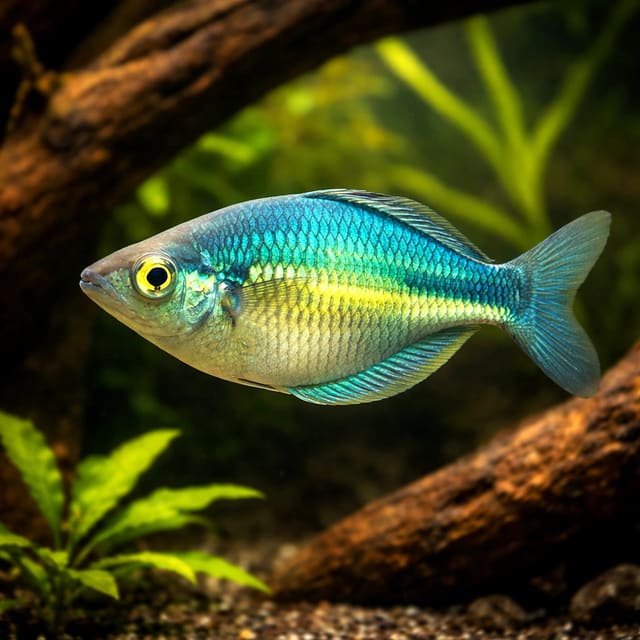
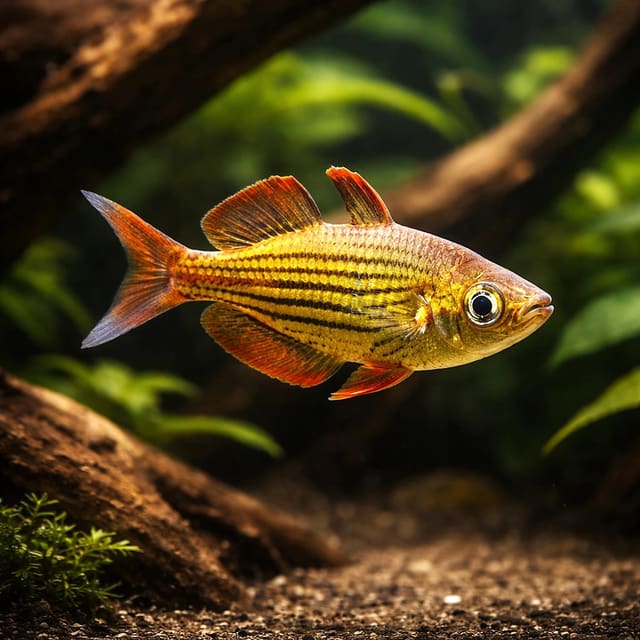
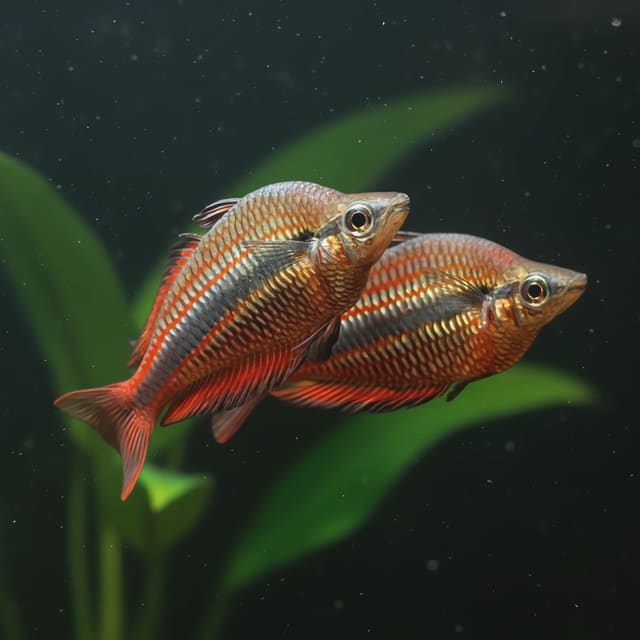
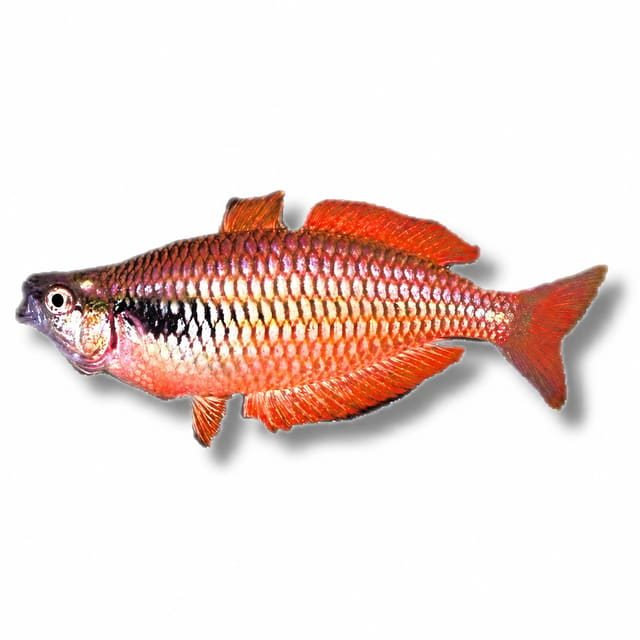
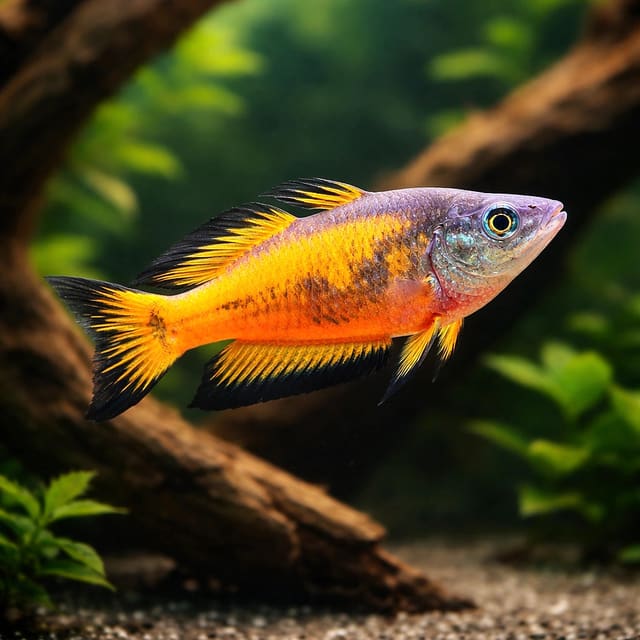
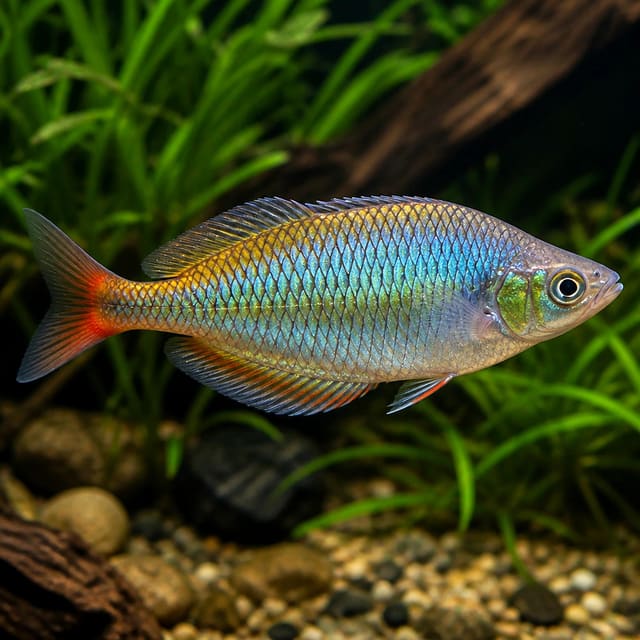
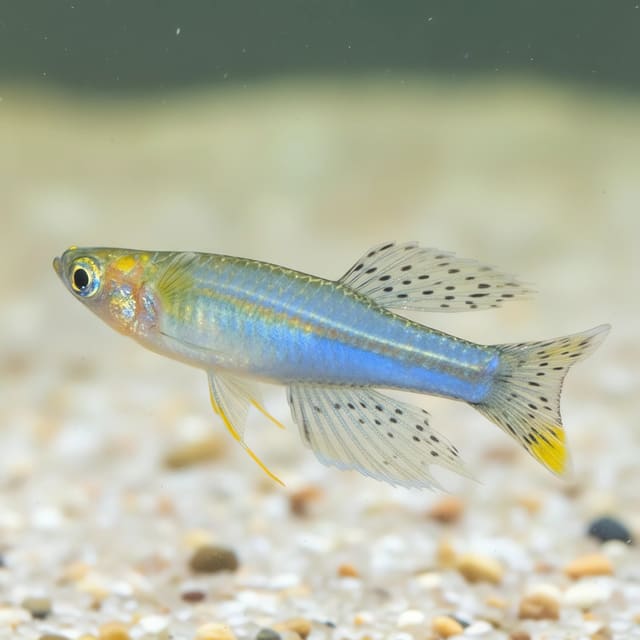
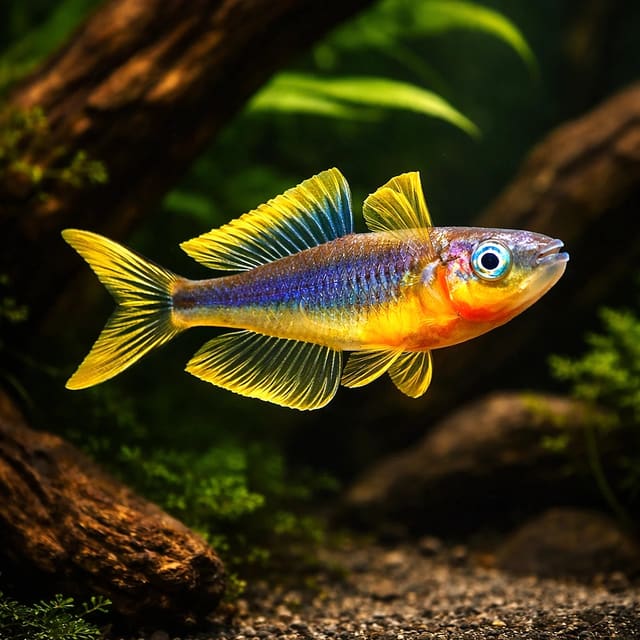
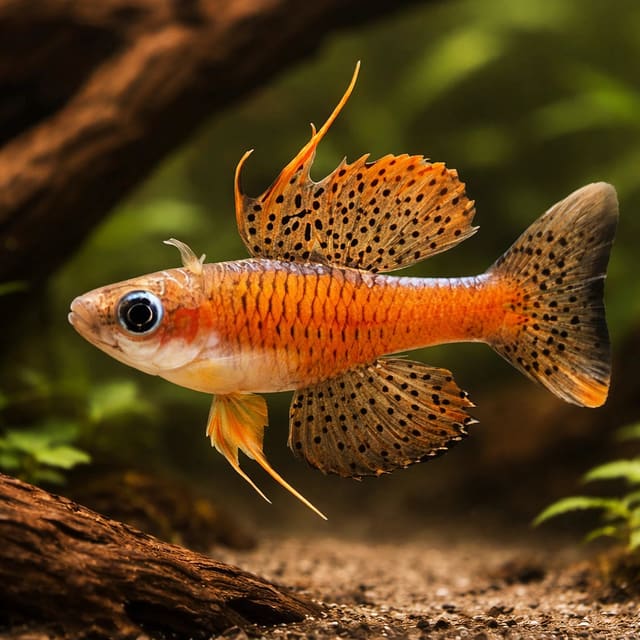
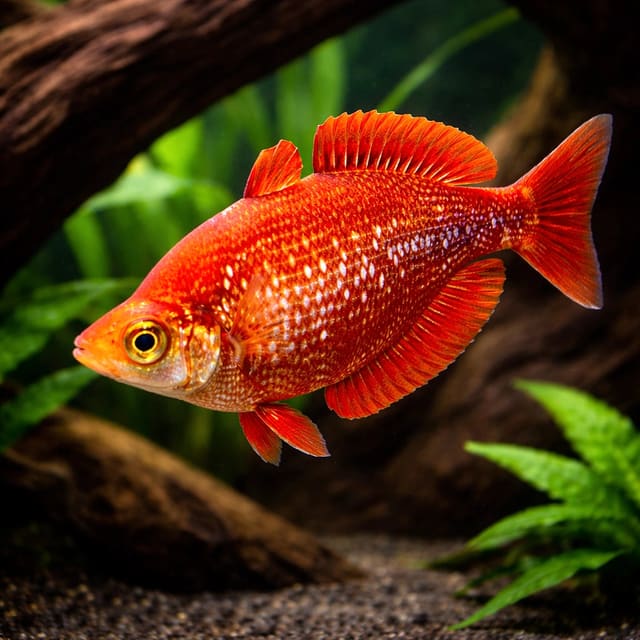
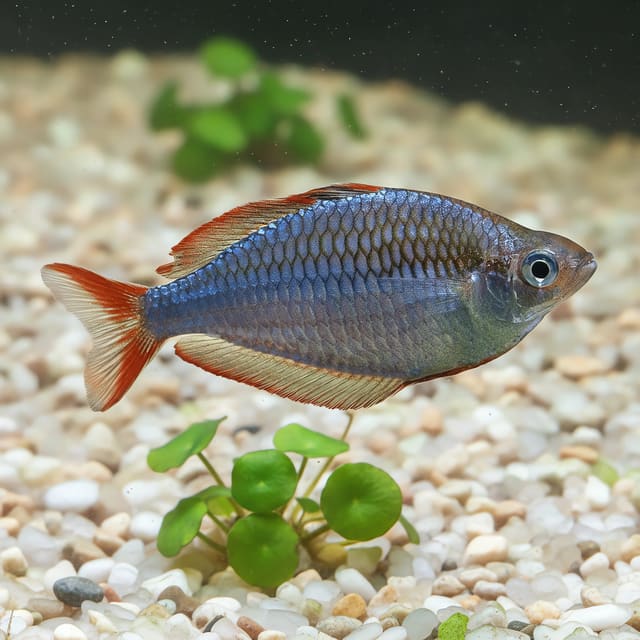
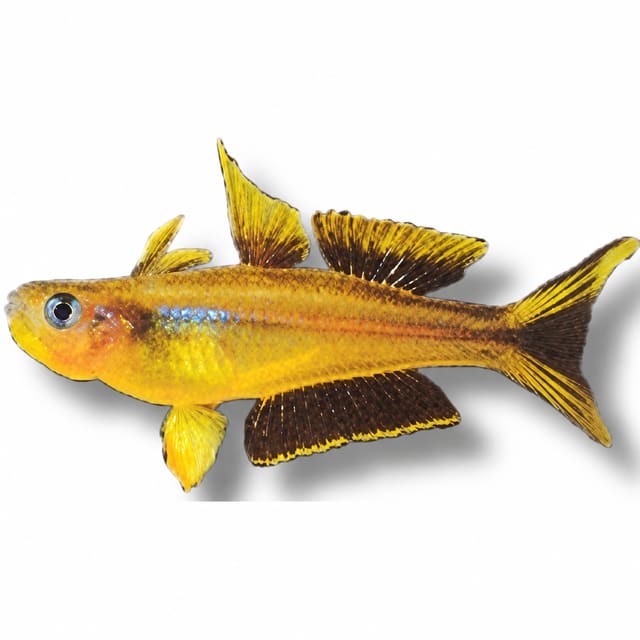
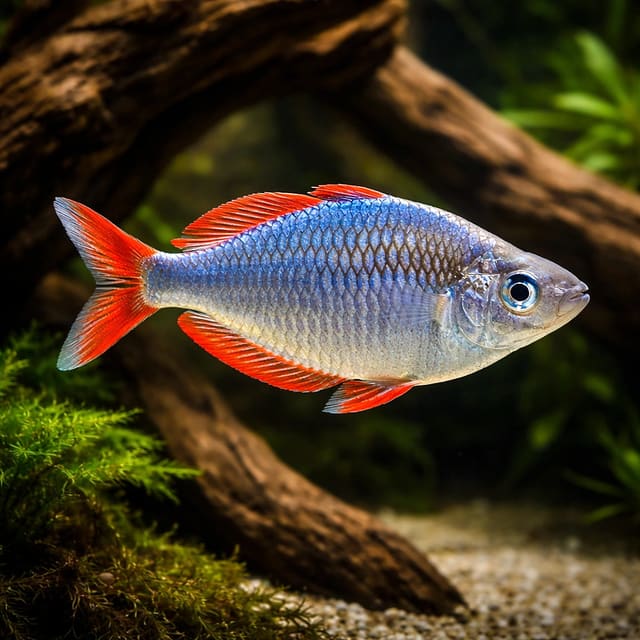
The gallery images are representative, based on reference photographs of this species, so colours can look slightly different from the live animal.
The scenes illustrate the familiar blue-silver and orange presentation associated with the fish, including planted settings, wood, gravel, sand and a plain-background side view. They are representative illustrations rather than views of the exact fish supplied. Seriously Fish notes that the fish offered for sale are almost always juveniles, which are much drabber than adults, and that full colour can take over 12 months to develop even on a good diet. Judge the offer by its identity and selected dispatch length, not by an expectation that an individual will match an illustration precisely.
For another fish with the same broad family appeal, you can also browse our rainbowfish collection. Compare each species on its own adult size, water requirements, group needs and activity rather than assuming all rainbowfish need identical conditions.
Plan around FishBase's recorded maximum of 9 cm standard length. Seriously Fish gives 11 cm standard length.
The minimum footprint matters because this fish is active and needs open swimming areas. Seriously Fish specifies an aquarium measuring at least 120 × 30 × 30 cm, approximately 108 litres. Treat every part of that statement as a minimum: a taller aquarium with less length or front-to-back room is not the same plan, even if its headline volume is similar.
Volume alone cannot show whether the layout works. Dense planting, ornaments and equipment all occupy room, while an active shoal needs clear areas in which to move. A practical assessment therefore combines the external dimensions, the usable swimming area, the intended number of rainbowfish and the number and behaviour of other fish.
The broad OATA recommendation for rainbowfish over 8 cm is at least 120 litres. That is a useful conservative planning point for this 9 cm species, especially in a community, although the exact species profile gives approximately 108 litres with the stated dimensions. Choosing 120 litres or more does not remove the need for the 120 cm length and 30 cm front-to-back measurement.
If an aquarium is approximately 108 litres but less than 120 cm long, it misses the stated species footprint. If it is 120 cm long but heavily filled with decor, revise the layout to restore open water. If it holds a very large shoal or several active companion groups, move beyond the minimum rather than assuming filtration alone solves crowding. Space, water quality and social planning work together; none replaces the others.
Keep the aquarium at 27°C, pH 7.0–8.0 and 10–12 dGH. FishBase and Seriously Fish both give 27–30°C and pH 7.0–8.0 for this species; their hardness ranges overlap at 10–19 dGH. OATA's broad rainbowfish guidance gives 22–27°C, pH 6.5–8.0 and 4–12 dGH. The routine target used here is the overlap across all three: 27°C, pH 7.0–8.0 and 10–12 dGH.
Do not treat 27°C as an invitation to let temperature drift either side of the target. Set up and run the aquarium at that value before introduction, then use a thermometer to check the actual water rather than relying only on the heater dial. Seriously Fish describes this as a strictly tropical species and warns that it will not do well in soft, acidic conditions.
Measure the aquarium and replacement water for pH and general hardness. Our water chemistry guide explains what the main readings mean, while the water matcher helps compare measured values with the target range. Testing first prevents unnecessary adjustment and reveals whether the normal source water is already suitable.
| Reading | Action |
|---|---|
| 27°C | Keep it steady and confirm with a thermometer. |
| pH 7.0–8.0 | Maintain the aquarium within this alkaline-to-neutral range. |
| 10–12 dGH | Keep general hardness within the shared routine range. |
| Ammonia 0 mg/l | Do not add fish if ammonia is detectable. |
| Nitrite 0 mg/l | Do not add fish if nitrite is detectable. |
OATA also advises keeping nitrate no more than 20 mg per litre above the normal tap-water level. Record the tap and aquarium readings rather than judging nitrate without a baseline. A rising aquarium result signals that maintenance, feeding or stocking needs attention.
Avoid making several adjustments at the same time. First establish which value lies outside the target, then make a controlled plan that keeps temperature, pH and hardness stable. Consistent suitable water is the goal; repeated swings created by chasing an exact reading can undermine the stable conditions this fish needs.
Use a well-established filter and keep ammonia and nitrite at 0 mg/l. The RSPCA explains that biological filtration supports beneficial bacteria which convert toxic ammonia to nitrite and then to the safer nitrate. This process must be functioning before the shoal is introduced and must continue without interruption as stocking and feeding increase.
Seriously Fish calls for very efficient filtration and maintenance. For an aquarium of approximately 108 litres, it gives a turnover of four to five times the aquarium volume per hour and a filter rating of about 430–540 litres per hour. Check a filter's intended flow against the aquarium size, while also allowing for the way media, pipework and maintenance affect practical performance.
A larger aquarium provides more stable environmental conditions, but water volume is not a substitute for a working filter. Likewise, a high filter rating does not create extra swimming space or make an overcrowded aquarium suitable. Assess biological capacity and physical room separately.
If ammonia or nitrite appears, treat the reading as a direct husbandry warning. Check the filter for blockage, review recent additions and feeding, and carry out appropriate maintenance with conditioned replacement water. Do not add more fish while either result is above zero. Continue testing so the response is guided by measured improvement.
Observe the fish alongside the tests. Hanging at the surface, sitting on the bottom, erratic swimming, changed breathing or a sudden loss of feeding interest can accompany a problem that needs prompt investigation. Water testing is the first practical check because rainbowfish can be stressed by even small amounts of ammonia and nitrite.
Create planted cover without closing the main swimming area. Seriously Fish recommends areas of dense vegetation together with open areas, while OATA also advises plenty of open space for rainbowfish. Arrange the aquarium so the shoal can move along the length without repeatedly navigating around solid decor.
Plants should suit the same slightly hard, alkaline conditions as the fish. Select them only after checking that they can be maintained at 27°C, pH 7.0–8.0 and 10–12 dGH. This prevents a layout in which the planting plan and fish plan require conflicting water chemistry.
Other decor is not especially important to this species, so avoid filling the aquarium simply to create a theme. The natural distribution tells you where the fish comes from, but it does not require a decorative replica. The husbandry priorities are suitable water, planted cover, open space, an adequate footprint and efficient filtration.
A practical layout check is to view the aquarium from the front and ends. If plants and ornaments divide the tank into short pockets, consolidate the cover and restore a continuous swimming route. If the aquarium appears bare, add cover without reducing the stated minimum dimensions or blocking the route. The aim is a balance rather than either extreme.
A settled shoal should have room to move without being forced into the path of slower companions. If the rainbowfish repeatedly crowd one open area, review whether decor has made the rest of the aquarium unusable. If timid companions remain hidden when the shoal passes, reassess compatibility rather than trying to solve the mismatch by adding more objects. Layout can support compatible fish, but it cannot make incompatible activity levels work together.
Feed once a day and offer only what the fish consume within a few minutes. OATA gives this portion and frequency for rainbowfish, while Seriously Fish records that Boesemann's Rainbow Fish accepts most dried, frozen and live foods. A quality dried product can form the staple, with small live or frozen foods used to add variety.
OATA names good-quality flake or granules as suitable dry foods and lists daphnia, small bloodworm and tubifex as live or frozen choices. It also notes that some of the larger rainbowfish species will prefer bigger items such as brine shrimp. Match each item to the fish's mouth and confirm that the complete shoal can take it comfortably.
| What you observe | What to do |
|---|---|
| Food is eaten within a few minutes | Keep the portion at that level. |
| Food remains after a few minutes | Reduce the next portion and remove uneaten food. |
| Some fish consistently miss food | Spread the same small meal so the shoal can reach it. |
| Interest in food suddenly falls | Test water quality and check for other changes. |
Variety means rotating suitable foods, not increasing the total daily amount. For example, use a quality dried food as the regular base and substitute an appropriately sized live or frozen item on some feeds. Seriously Fish notes that regular feedings of live foods will help to ensure the fish show their best colours, but water quality still depends on controlling the amount offered.
Overfeeding leaves organic material to break down and add toxic waste to the water. It can also make a strong filter appear to compensate for a feeding problem while nitrate and debris continue to rise. Portion control, weekly testing and regular water changes address different parts of the same waste cycle.
Watch the whole shoal rather than the quickest fish. A sudden reduction in appetite, a change in body condition or one fish repeatedly failing to feed deserves attention. Check temperature, ammonia, nitrite and recent changes first. If feeding interest remains reduced or another health sign develops, contact us for guidance after recording the water-test results and what has changed.
At least once every week, change 25% of the aquarium water. OATA strongly recommends this partial water change. Use a siphon to remove solid waste from the gravel or sand where needed, and test the water at least once per week.
Treat replacement tap water with conditioner to remove chlorine or chloramine before it enters the aquarium. Check that its temperature and chemistry will not push the aquarium away from 27°C, pH 7.0–8.0 and 10–12 dGH. A consistent partial change removes waste while protecting the stable conditions required by the fish and biological filter.
If filter media needs cleaning, do not rinse it under the tap. Rinse it lightly in aquarium water removed during the partial change. This reduces the loss of beneficial bacteria that process fish waste. Clean only as needed to restore function rather than treating biological media as something that must be scrubbed spotless.
| Change | First response |
|---|---|
| Surface hanging or bottom sitting | Test water and check filter operation. |
| Erratic swimming | Check temperature, ammonia and nitrite promptly. |
| Faster or slower gill movement | Test water and compare all fish for the same change. |
| Darker or paler colour | Review water, social conditions and recent changes. |
| White spots, fluffy growths or damaged scales | Record the signs and seek guidance. |
| Reduced feeding | Test water and monitor body condition. |
Keep a short log of test results, maintenance and new livestock. A sequence of measurements is more useful than one isolated result because it shows whether nitrate is rising, temperature is drifting or a corrective action is working. This routine also makes it easier to separate a water-quality problem from a compatibility concern.
Be present to receive the parcel and follow the steps in order. The Tropical Fish Co delivery and Live Arrival Guarantee policy explains the packing, receipt, filming and acclimatisation procedure. Fish are hand-bagged in pure oxygen and packed in an insulated poly box, with a heat pack when the weather calls for it.
Film every delivery from the sealed parcel onward. If a Live Arrival Guarantee claim is needed, contact us the same day with the order number and continuous unboxing video. The guarantee requires someone to have received the parcel, the parcel to be opened and inspected on the day it arrives, and the video to show the sealed parcel being opened and the fish still in the sealed bag.
Compare its behaviour with the OATA health indicators: swimming pattern, colour, temperament, breathing, physical appearance, body condition and interest in food. Some change around introduction can occur, but hanging at the surface, sitting on the bottom, erratic swimming, altered breathing, white spots, fluffy growths, fin or scale loss, or continued lack of feeding interest requires prompt attention.
Test ammonia and nitrite if behaviour changes; both should remain at 0 mg/l. Also confirm that the aquarium is still at 27°C and that the filter is operating normally. These checks connect an observable sign to measurable conditions without guessing at a diagnosis.
Additions increase both fish waste and feeding, so continue regular testing while the filter's bacterial population responds. Do not follow one addition immediately with another simply because the first fish appear settled. Use ammonia and nitrite results, available swimming room and the intended final shoal as the decision points.
The arrival sequence handles the transition from parcel to aquarium; the established care routine then takes over. Maintain the same water target, feeding portion, group plan and weekly maintenance rather than introducing several husbandry changes at the same time.
Keep Boesemann's Rainbow Fish in a shoal of 6–8, preferably more. Seriously Fish reports that the species can be skittish and does far better at this group size, while FishBase gives a minimum of five. Use the more specific husbandry recommendation of 6–8 for the aquarium plan and increase the aquarium size when keeping a very large group.
OATA explains the reason at family level: rainbowfish are social, and fish kept alone or in groups that are too small often become stressed. The shoal is therefore part of the care plan, not an optional visual effect. A single fish should not be used as a trial occupant while deciding whether the aquarium can hold the complete group.
Males are encouraged to display their colours in the company of their own species. Mature males are recorded as larger, brighter and deeper-bodied than females, and OATA advises buying more female rainbowfish than males to ensure that males do not fight. Because this offer does not guarantee sex, do not build a stocking plan that depends on receiving a particular ratio.
Displaying between fish is not a reason to ignore persistent social pressure. Watch whether every fish can swim, feed and use the aquarium normally. A change in hiding, aggression, body condition or feeding interest is a reason to review the group, available room and companion activity.
The minimum shoal and minimum aquarium must both be met. Keeping six fish does not automatically make a 108-litre aquarium suitable if its dimensions are wrong, its swimming area is obstructed or it already holds a busy community. Equally, a large aquarium does not meet the social need if only one or two rainbowfish are kept.
Use the 120 × 30 × 30 cm species minimum as the starting structure, then assess the final number of fish. A very large shoal, or a community containing several active groups, calls for more room. Filtration helps process waste but cannot prevent rapid fish from disturbing companions in an undersized or poorly arranged aquarium.
Choose companions that share the water range and are not unsettled by a rapidly moving, relatively large rainbowfish. Seriously Fish describes Boesemann's Rainbow Fish as very peaceful but warns that its movement and size can disturb smaller or slow-moving fish. OATA says active rainbowfish should not be mixed with timid or much smaller fish and advises against mixing larger rainbowfish with very small fish.
Avoid timid, much smaller and very small fish. Treat smaller or slow-moving fish with caution because they may be disturbed even without direct aggression. The issue is not simply whether two names appear on a community list; the aquarium must also provide enough room, suitable water and normal access to food for both.
| Kind of fish | Screening decision |
|---|---|
| Similarly sized rainbowfish | Potentially suitable when water, group space and activity align. |
| Characins | Potentially suitable after checking adult size, water and behaviour. |
| Danios | Potentially suitable when the aquarium supports both active groups. |
| Barbs | Potentially suitable after species-by-species behaviour and water checks. |
| Corydoras | Named as suitable catfish, subject to shared water and sufficient space. |
| Many Rift Lake cichlids | Possible because of water requirements, but screen the exact species and behaviour. |
These are conditional categories, not universal matches. Characins, danios, barbs, Corydoras and cichlids each contain species with different adult sizes and requirements. Check the exact companion rather than extending a statement about one member of a group to all members.
Treat shrimp and snails as a separate decision, and watch them closely after the fish are introduced. For a mixed plan outside the named fish groups, ask us for a stocking and compatibility assessment using the exact aquarium dimensions, water readings and animals already present.
After introduction, watch feeding access, swimming, hiding and physical condition. If a slower fish withdraws or repeatedly loses access to food, the practical pairing is not working even if no injury occurs. Reassess the match rather than adding decor or food in an attempt to compensate for incompatible activity.
Boesemann's Rainbow Fish reaches 9 cm standard length according to FishBase. Plan every aquarium, group and companion choice around that adult figure rather than the selected dispatch size.
It needs an aquarium measuring at least 120 × 30 × 30 cm, approximately 108 litres, according to Seriously Fish. OATA's broader plan for rainbowfish over 8 cm is at least 120 litres, so 120 litres or more is a useful conservative choice without reducing the required 120 cm length.
Keep 6–8 together, preferably more. Seriously Fish gives that group recommendation for Boesemann's Rainbow Fish, and a very large group needs a suitably larger aquarium.
OATA describes rainbowfish as a group as usually easy-going and easy to keep, but this species needs efficient filtration, at least a 120 × 30 × 30 cm aquarium for the shoal, a steady 27°C, pH 7.0–8.0 and 10–12 dGH, and weekly testing and water changes.
Feed a quality dried flake or granule once a day in an amount eaten within a few minutes. Add variety with appropriately sized live or frozen daphnia, small bloodworm, tubifex or brine shrimp, as described by OATA.
Keep it at 27°C, pH 7.0–8.0 and 10–12 dGH. These values are the overlap of the FishBase and Seriously Fish species ranges with OATA's broad rainbowfish guidance.
It is described as very peaceful, but its rapid movement and relatively large size can disturb smaller or slow-moving fish. Avoid timid, much smaller and very small companions, and check that slower fish can still swim and feed normally.
Potential companions include similarly sized rainbowfish, characins, danios, barbs, Corydoras and many Rift Lake cichlids. Every match remains conditional on shared water values, enough adult space and compatible activity and behaviour.
It is hand-bagged in pure oxygen and placed in an insulated poly box, with a heat pack when weather calls for it. Be present to receive it, film continuously from the sealed parcel through opening and the fish in its sealed bag, then float the bag for 20–30 minutes before release.
No reviews for this item yet. Bought one? Honest reviews only, good or bad.
What customers say about ordering from us
I have a small group of long finned mountain minnows. So was delighted to be able to order ten of this variety to increase the genetics in my tank . The ones I recieved are healthy but it’s to early to give a verdict on wether they are of a long finned type since they are small currently.
Gordon Walker · 23 Sept 2026
100% success travel and "installation". Pleased with quality of purchase. The Siamese fighter a bit "shy" so have not yet seen him at his best yet but looking good. Happy customer. GG
George E Garratt · 21 Sept 2026
Reviews of our shop, collected by Judge.me, an independent third-party review collector. Newest first.