Moderate
Fantastic Red Congo Tetra (Phenacogrammus sp.)
108L
£33.49
The Orange Congo Tetra (Phenacogrammus aurantiacus), also sold as the Golden Congo Tetra, is a peaceful African tetra from the Congo, Kouilou and Ogowe basins, with a warm orange body and a broad dark band along each flank. It reaches 10 cm and needs a shoal of five or more in a planted tank at least 100-120 cm long. Sold singly: one live fish per purchase.
Adult size is the maximum length this species reaches at full maturity (scientific sources). The livestock you receive will be younger and smaller. Product-photo provenance and any image-specific limitations are stated on the listing.
Phenacogrammus aurantiacus
Quantity discounts are pricing offers, not a group-size recommendation. Check the full care guidance and your existing animals before choosing a quantity.
The Orange Congo Tetra (Phenacogrammus aurantiacus), also sold as the Golden Congo Tetra, is a peaceful African tetra from the Congo, Kouilou and Ogowe basins, with a warm orange body and a broad dark band along each flank. It reaches 10 cm and needs a shoal of five or more in a planted tank at least 100-120 cm long. Sold singly: one live fish per purchase.
Adult size is the maximum length this species reaches at full maturity (scientific sources). The livestock you receive will be younger and smaller. Product-photo provenance and any image-specific limitations are stated on the listing.
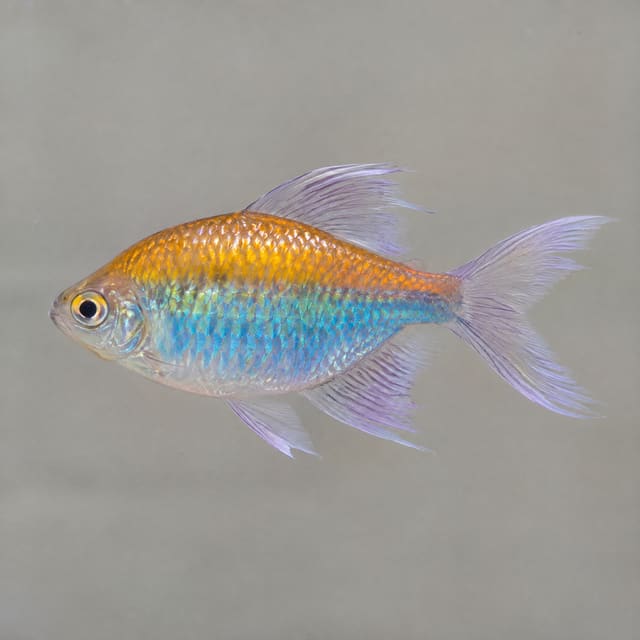
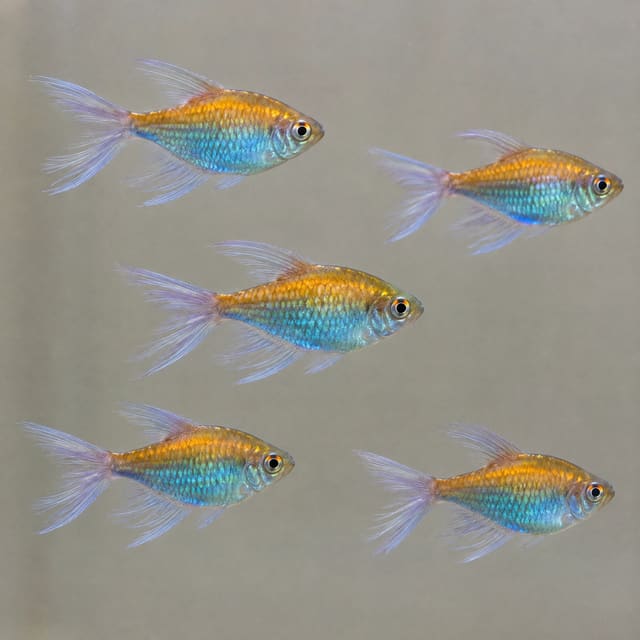
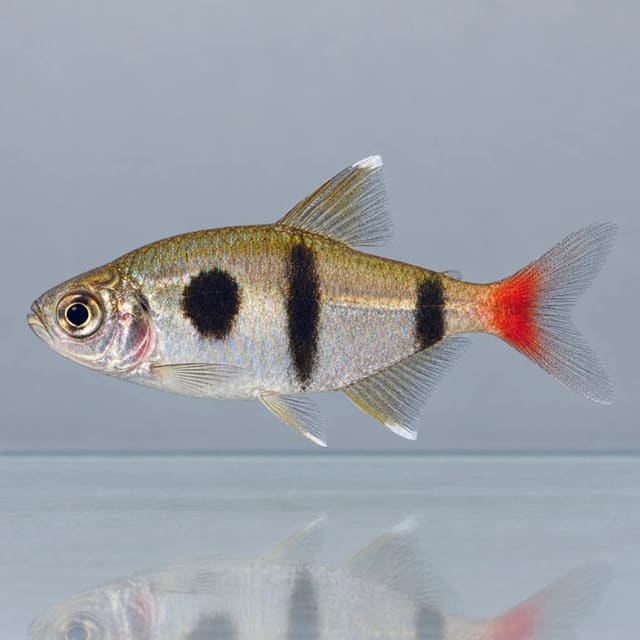
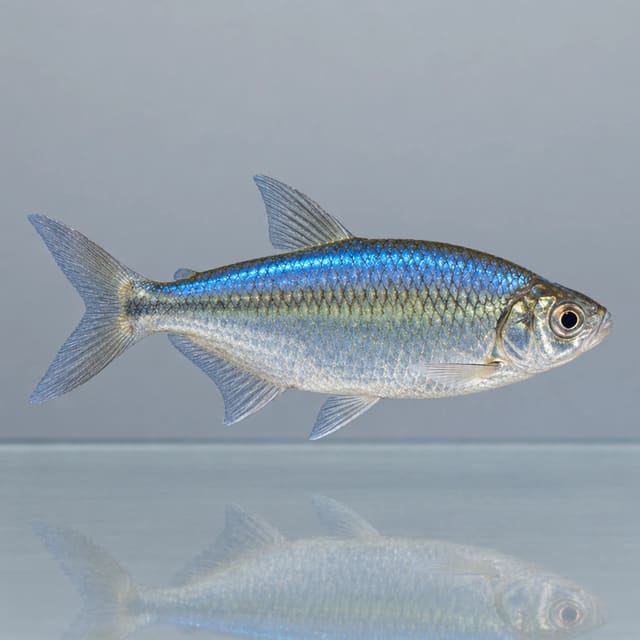
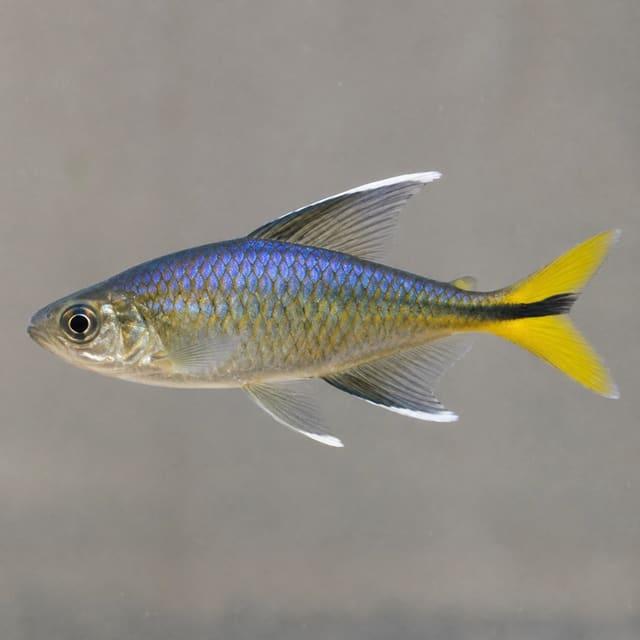
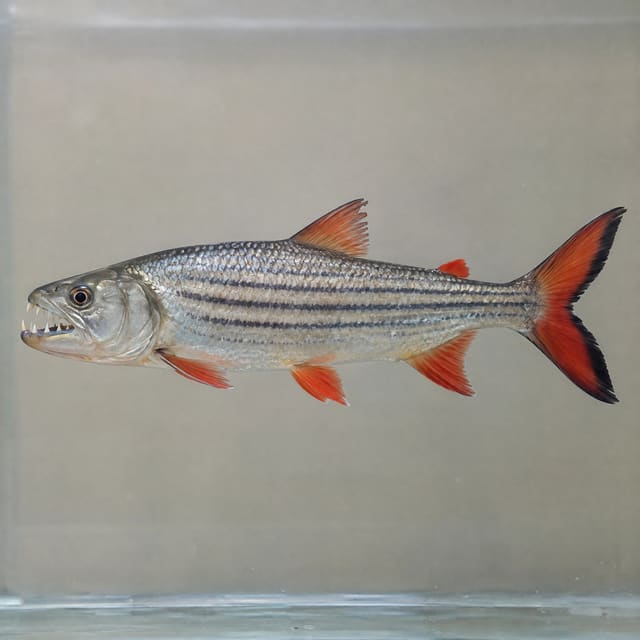
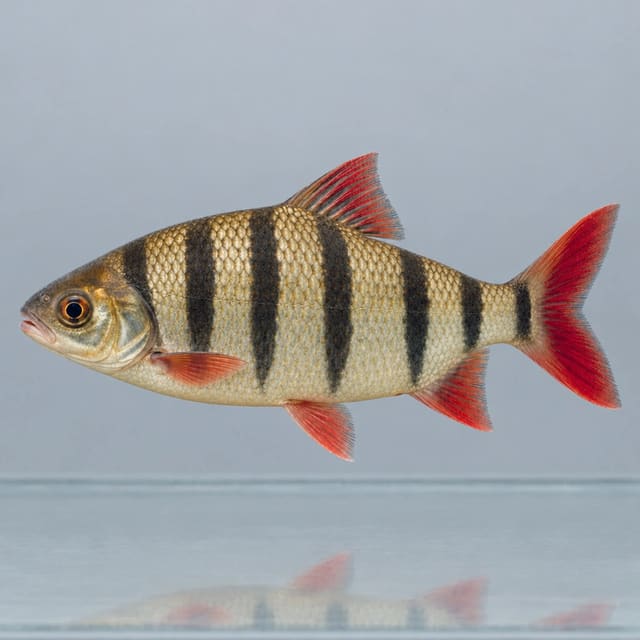
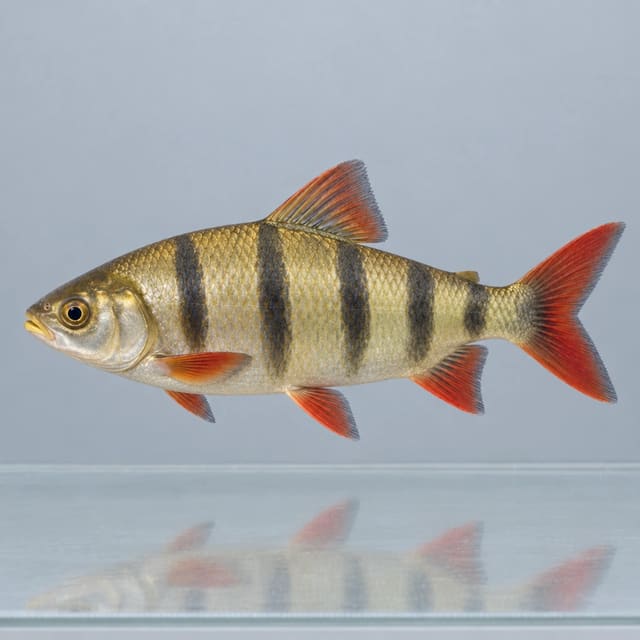
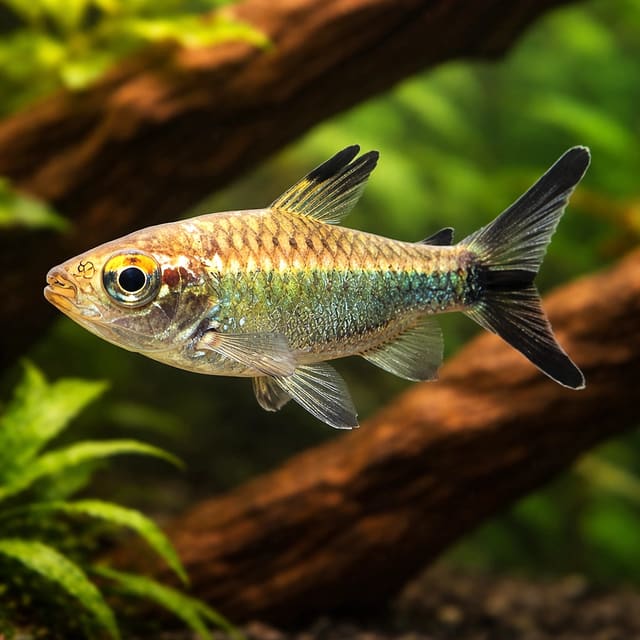
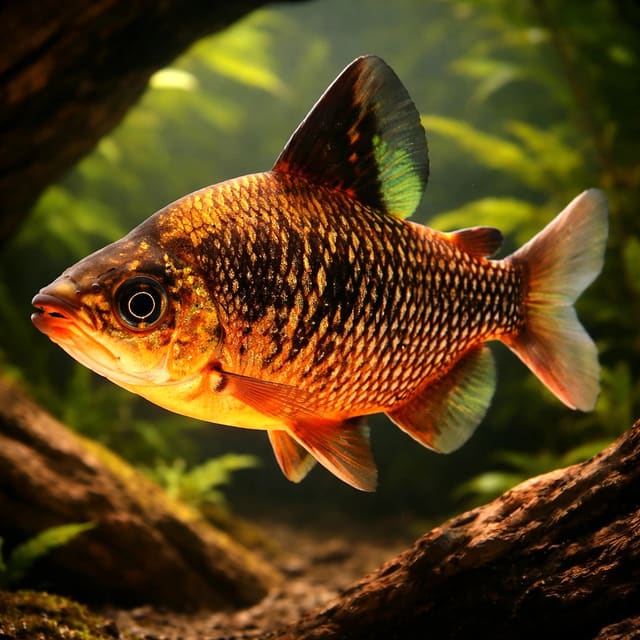
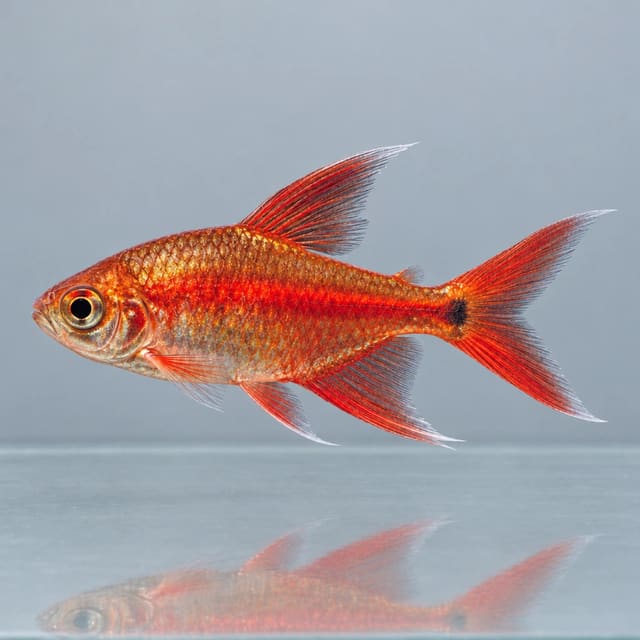
The Orange Congo Tetra (Phenacogrammus aurantiacus) is a golden-orange African tetra with a broad, dark band running the length of each flank. The fish in our photographs glows orange from head to tail, with a blue-black stripe that carries a metallic blue sheen, orange-red fins and pale tips to the fin rays. The species name aurantiacus is Latin for orange, and Aquarium Glaser sells the same fish as the Golden Congo Tetra.
It is a close relative of the classic Congo Tetra, with the same peaceful nature, the same love of open water and the same need for a long, planted aquarium. It suits keepers who want something less often seen than the Congo Tetra but with familiar, well-documented care.
| Feature | Orange Congo Tetra | Congo Tetra, for comparison |
|---|---|---|
| Scientific name | Phenacogrammus aurantiacus Pellegrin, 1930 | Phenacogrammus interruptus (Boulenger, 1899) |
| Body colour | Warm orange to golden, the source of the names Orange and Golden Congo Tetra | See our Congo Tetra photographs |
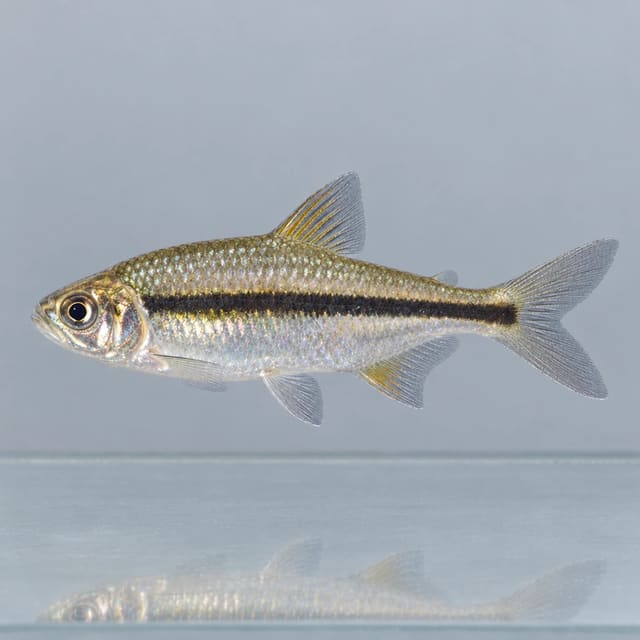
| Flank | A broad dark band from the gill cover to the middle rays of the tail, the feature FishBase uses to diagnose it | Not described this way |
| Maximum size | 10.0 cm TL, 95 mm SL (FishBase) | 8.0 cm TL males, 6.0 cm females (FishBase) |
| Males | Dominant males larger, with a long dorsal fin (Aquarium Glaser) | Males larger, with an extended dorsal fin and tail filaments (Seriously Fish) |
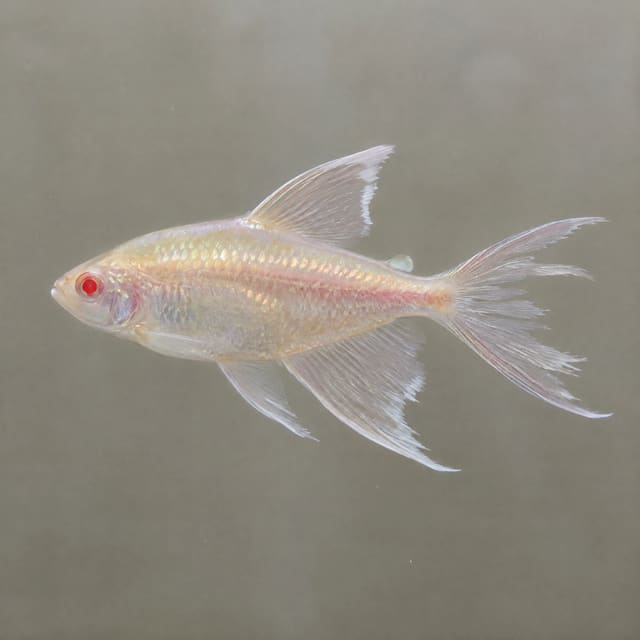
FishBase also gives 20–22 soft rays in the anal fin, and explains the genus name Phenacogrammus as Greek for "deceptive" and "letter" or "signal". See the whole genus, including the Albino Congo Tetra, on our Phenacogrammus Congo tetras page.
FishBase records the Orange Congo Tetra from the Kouilou and Ogowe river basins in the Republic of Congo and Gabon, and from the middle and upper Congo River basin. FishBase classes it as a tropical freshwater fish of the lower and middle water (benthopelagic). The fish described by Aquarium Glaser in 2016 came from the Democratic Republic of the Congo. FishBase lists the species as Least Concern on the IUCN Red List, assessed in 2009.
It is legal to keep in the UK: Phenacogrammus appears without exceptions on the government's checklist of freshwater fish that may be kept in indoor aquaria in England and Wales under the general licence, linked from its guidance on non-native fish.
One purchase supplies one live Orange Congo Tetra, unsexed. The listing has a single option rather than graded sizes; Aquarium Glaser listed imported fish at 4–7 cm, so expect a young fish that still has growing to do, and ask us for the current size if it matters. Order the whole group at once so the fish settle together. The photographs show the species; colour deepens and the fins lengthen as the fish mature and settle, and individuals vary.
Aquarium Glaser also noted that its freshly imported fish arrived with slight fin damage that largely healed once they had settled, which is a good reminder that a calm, mature aquarium is the best start you can give them. Our delivery and Live Arrival Guarantee terms explain dispatch days and what to do if there is a problem on arrival.
No tank size has been published for this species, so we plan from its maximum length and from the Congo Tetra, which is slightly smaller:
| Guidance | Source |
|---|---|
| Adult up to 10.0 cm total length | FishBase, P. aurantiacus |
| Aquarium at least 100 cm long, group of five or more | FishBase, Congo Tetra |
| Base of 120 x 30 cm, about 108 litres, for adults | Seriously Fish, Congo Tetra |
| At least 80 litres for tetras of 5 cm and over | OATA |
A 120 cm aquarium is the comfortable choice for an adult group. Use our stocking calculator to check how many fit alongside your other fish.
For the Congo Tetra, Seriously Fish recommends driftwood branches, floating plants and Anubias, plenty of open swimming water and good circulation, and notes that a shoal lit from the front and above, ideally by daylight, looks its best. The same layout suits the Orange Congo Tetra. Plant the back and sides, keep the centre open, add a few pieces of wood for shade and choose a sandy or fine-gravel floor in a darker shade so the orange stands out. Fit a close-fitting cover too, a sensible precaution with any fast, nervous shoaling fish.
FishBase gives no water values for P. aurantiacus, so we use the ranges published for the Congo Tetra, the best-documented member of the genus, together with OATA's limits for water quality.
| Value | Recommended | Published range |
|---|---|---|
| Temperature | 24–26°C | 23–28°C (Seriously Fish); 23–26°C (FishBase) |
| pH | 6.5–7.0 | 6.0–7.5 (Seriously Fish); 6.0–8.0 (FishBase) |
| Hardness | Soft to medium | 3–18 °dGH (Seriously Fish); 5–19 dH (FishBase) |
| Ammonia and nitrite | 0 mg/l | OATA |
| Nitrate | As low as possible | No more than 20 mg/l above tap water (OATA) |
UK tap water ranges from soft to very hard by region. Test yours, then read our water chemistry guide. Seriously Fish and FishBase both accept hardness up to 18–19 degrees for the Congo Tetra, so moderately hard water is workable if it is kept stable.
Seriously Fish describes Congo tetras as sensitive to water quality, with poor conditions spoiling the males' fins and fading their colour. It suggests a filter turnover of four to five times the tank volume per hour; our filtration guide explains how to choose one. OATA's routine is a 25% water change at least weekly with dechlorinated water, weekly testing, and filter media rinsed only in water taken from the tank.
FishBase records that wild Congo Tetras eat worms, small insects, crustaceans and plant matter, and Seriously Fish describes an unfussy omnivore whose colour benefits from plenty of live and frozen food. OATA's rule for tetras applies: feed once a day, only what is eaten within a few minutes.
| Food | Role |
|---|---|
| Flake or small granule | Daily staple |
| Frozen daphnia or mysis | Several times a week, for colour and condition |
| Live daphnia | An occasional treat that encourages natural foraging |
| Spirulina flakes or algae wafers | Plant matter, two or three times a week |
From our range, Supervit flakes, frozen daphnia, frozen mysis, live daphnia and spirulina flakes give a balanced weekly menu.
Have the aquarium cycled, with zero ammonia and nitrite, before the fish arrive. Follow OATA's floating-bag method: switch the aquarium lights off, float the sealed bag for 10 minutes, add small amounts of tank water over up to 20 minutes, then net the fish into the tank and discard the bag water. Our acclimatisation guide explains each step with pictures.
Leave the lights off for the rest of the day and feed lightly from the next morning. Congo tetras are easily frightened, especially in small numbers, so expect the group to stay near the plants at first. Test the water every couple of days in the first week, and look for any slight fin damage from transport healing over the following days, as Aquarium Glaser observed.
Seriously Fish calls Congo tetras peaceful and suitable for most community tanks, with two warnings: their active swimming and adult size can unsettle very shy fish, and fin-nippers will damage the males' fins. Boisterous tank mates are also a poor choice for such a nervous fish.
| Good companions | Avoid |
|---|---|
| African tetras such as the Yellow-Tailed African Tetra | Fin-nipping species |
| Rainbowfish such as the Boesemani Rainbowfish | Aggressive or boisterous cichlids |
| Corydoras such as the Julii Cory, and the Bristlenose Pleco | Predators large enough to swallow a tetra |
| The Featherfin Synodontis and peaceful dwarf cichlids such as the Kribensis | Tiny, timid fish that its activity may stress |
These follow Seriously Fish's tank-mate list for the Congo Tetra. Our kribensis guide, the tetra species guide and the tank mates tool help you finish the plan, and our community tank fish collection has more ideas.
A healthy Orange Congo Tetra has bright colour, open fins and a steady appetite, and stays with the group. OATA lists the signs that need attention: clamped fins, flicking against decor, shimmying, white spots, fluffy growths, fast breathing, faded colour, hiding and loss of appetite. Test the water first and carry out a partial water change, then seek advice before using any medicine. Never buy a healthy-looking fish from a tank that holds sick fish, as OATA warns that disease can spread from fish that show no signs.
Sexing this species is genuinely difficult. Aquarium Glaser explains that, as in all Congo tetras, males differ from females in the shape of the anal fin, and that dominant males grow a long, extended dorsal fin and become somewhat larger. But non-dominant males look like very large dominant females, and fish judged to be females can later turn out to be young males, so only big, dominant males can be identified with certainty. A larger group gives you the best chance of both sexes.
We have not found a published breeding report for P. aurantiacus. Its relative the Congo Tetra is an egg-scatterer: FishBase records up to 300 eggs, sometimes more, which sink and hatch after about six days, and Seriously Fish describes spawning in a soft-water tank with a mesh base so the eggs fall out of the parents' reach. OATA notes that tetra fry need a dedicated set-up and fine first foods. Browse more African tetras and the full tetras collection for companions and alternatives.
It is Phenacogrammus aurantiacus, described by Pellegrin in 1930, an African tetra from the Congo, Kouilou and Ogowe river basins. It is a close relative of the classic Congo Tetra with a warm orange to golden body and a broad dark band along each flank. Aquarium Glaser sells it as the Golden Congo Tetra.
FishBase records a maximum of 10.0 cm total length (95 mm standard length), slightly larger than the Congo Tetra. Imports are usually smaller; Aquarium Glaser listed fish of 4-7 cm.
A tank at least 100-120 cm long. No tank size has been published for this species, so we follow the Congo Tetra: FishBase gives a minimum length of 100 cm and Seriously Fish a 120 x 30 cm base (about 108 litres) for adults. OATA gives 80 litres or more for tetras over 5 cm.
A group of at least five, as FishBase advises for Congo tetras and OATA for all tetras, and more if your tank allows. Buy them together so the group settles at the same time.
No species-specific values are published, so use the Congo Tetra ranges: 23-28 C, pH 6.0-7.5 and 3-18 dGH (Seriously Fish), or 23-26 C, pH 6.0-8.0 and dH 5-19 (FishBase). We aim for 24-26 C and pH 6.5-7.0 in clean, well-filtered water.
Not easily. Aquarium Glaser explains that males differ in the shape of the anal fin and that dominant males grow a long dorsal fin and become slightly larger, but non-dominant males look like large females. Only big, dominant males can be sexed with certainty.
It is an omnivore like other Congo tetras. Feed a good flake or small granule once a day, with frozen or live daphnia, mysis or bloodworm several times a week and some plant-based food.
No. The Congo Tetra is Phenacogrammus interruptus, a separate species. FishBase identifies the Orange Congo Tetra by the broad dark band along each flank and records it growing slightly larger, to 10 cm. The two share the same care and peaceful temperament.
No reviews for this item yet. Bought one? Honest reviews only, good or bad.
What customers say about ordering from us
Easy website plenty of info on fish your buying great to pick a time slot
TRACEY DURRANT · 7 Oct 2026
Got some lovely fish thank you
Kevin Mackie · 7 Oct 2026
Reviews of our shop, collected by Judge.me, an independent third-party review collector. Newest first.
Moved by UK carriers licensed to handle live animals
Hand-packed with oxygen bags, poly box, heat pack
Email photos the same day; an optional unboxing video helps us review problems faster — claim terms apply
Klarna & PayPal Pay in 3 at checkout