Moderate
Congo Tetra (Phenacogrammus interruptus)
23–28°C · pH 6–7.5 · 150L
£5.99

A larger, active African tetra for spacious shoals, with elegant extended fins, clean water needs and peaceful but fast-feeding behaviour.
Bryconalestes longipinnis
Shoaling fish: kept in a group they feel safer, stay calmer and show their best colour.
Confirm your email, then we’ll send an availability message for this exact item if it returns within 180 days.
This request is only for this product—no newsletter or other promotions. A mail-provider retry may very rarely duplicate the same availability message. Unconfirmed addresses are removed after 48 hours. See our privacy policy.
A larger, active African tetra for spacious shoals, with elegant extended fins, clean water needs and peaceful but fast-feeding behaviour.
Maintain these water conditions for optimal health and vibrant colors
Long-Finned African Tetra (Bryconalestes longipinnis) is a lively West and Central African alestid tetra for aquarists who want constant movement, elegant finnage and a genuine African community fish. It is also seen in older trade material as Brycinus longipinnis or Alestes longipinnis, so those names are useful for matching older books and supplier lists, but the accepted name used here is Bryconalestes longipinnis.
This is not a tiny nano tetra. The supplier sizes on this product are the supplied sizes, not the adult size. FishBase records a maximum size of 16.4 cm total length, and Fishkeeper lists this species around 15 cm. In home aquariums many individuals remain smaller, but the right way to plan is as a medium, energetic shoaling fish that needs length, oxygen, filtration and clean water rather than a compact 60 litre setup.
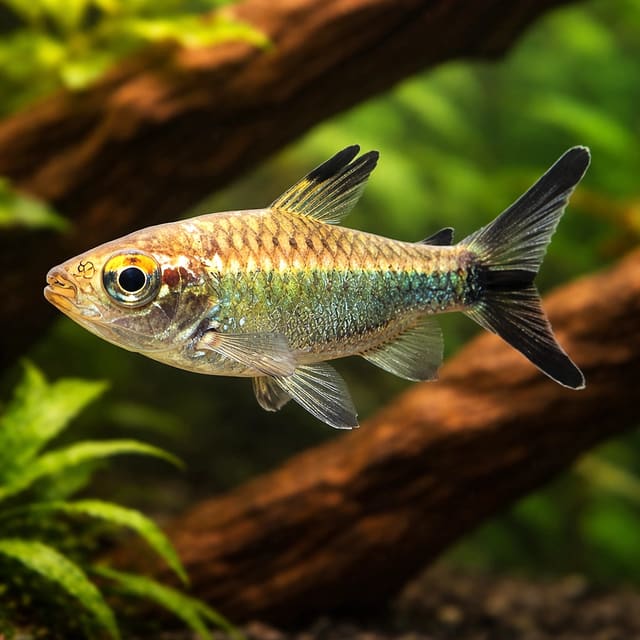
When kept well, the appeal is easy to see: a silvery to warm golden body, a dark caudal marking, extended fins on mature males and quick open-water movement. It suits a roomy, mature aquarium where the group can cruise together and still retreat into planted edges when startled.
| Common name | Long-Finned African Tetra, Longfin Tetra, Long-finned Alestes |
|---|---|
| Scientific name | Bryconalestes longipinnis (older synonym: Brycinus longipinnis) |
| Family | Alestidae, the African tetras |
| Supplied sizes | 3.5-4 cm, 4.5-5 cm and 5.5-7 cm variants when available |
| Adult size | Usually plan for 12-15 cm; maximum reported 16.4 cm TL |
| Minimum aquarium | 100 cm or longer; around 200 litres or larger for a settled shoal |
| Temperature | 22-26 C |
| pH | 6.0-8.0, with stable conditions more important than chasing a number |
| Hardness | 5-19 dGH practical range |
| Temperament | Peaceful, fast, social and boisterous at feeding time |
| Diet | Omnivore; quality flakes/granules plus frozen and live foods |
Bryconalestes longipinnis occurs along the Atlantic side of Africa from the Gambia region down towards the Democratic Republic of the Congo. It is associated with larger river courses, lower river reaches and estuarine mixohaline areas, and it can also enter smaller rivers and streams. That natural range explains why the species is adaptable, but it should not be treated as a rough-and-ready beginner fish: active river fish need oxygen, room and consistently clean water.
The aquarium should reflect that open-water lifestyle. Leave a proper swimming lane along the front or centre of the tank, then use planting, wood, darker substrate and floating cover around the edges to calm the group. Bright bare aquariums can make them skittish, while cramped decor makes the fish look nervous and prevents the shoal from moving naturally.
Use an aquarium at least 100 cm long, and choose a larger tank if you want a good shoal with other robust community fish. A practical starting point is around 200 litres for a group, with more volume giving better stability and easier tank-mate planning. The old 60 litre guidance on this product was too small for the adult fish and has been removed.
Filtration should be mature, well oxygenated and sized for active fish. External canister filtration or a strong internal system can work, provided the output does not blast the fish into one corner. Aim for steady circulation, clean water and open space. Weekly partial water changes are important because this species does not suit aquariums where nitrate and dissolved waste are allowed to build up.
A secure lid is sensible. Long-finned African Tetras are fast midwater fish and may jump when startled, especially during maintenance or when first settling in. Keep the tank covered, dim the lights for introductions and give the shoal time to settle before judging its colour or confidence.
Keep the water warm and stable at 22-26 C. A pH range of 6.0-8.0 and hardness around 5-19 dGH is suitable for most home aquariums, provided changes are gradual. This flexibility is useful for UK tap-water keepers, but it does not replace basic husbandry: ammonia and nitrite must stay at zero, and nitrate should be controlled with regular maintenance.
If your aquarium is newly set up, wait until it is fully cycled before adding this species. A newly imported or recently moved shoal will settle best in a mature tank with stable temperature, good oxygenation and subdued hiding cover. Avoid sudden large parameter swings, untreated tap water or repeated netting once the fish arrive.
This species is an omnivore and usually accepts a broad diet. Use good quality flakes, small to medium granules and slow-sinking foods as staples, then rotate frozen or live foods such as bloodworm, daphnia, brine shrimp, mysis and mosquito larvae. A little algae-based flake or vegetable-inclusive food helps round out the diet.
Feed modest portions that the group clears quickly. Once settled, Long-Finned African Tetras are confident feeders and can intimidate slower fish simply by being fast. Watch the whole aquarium at feeding time; if bottom dwellers or shy cichlids are being outcompeted, use sinking foods in more than one area rather than dumping everything at the surface.
Long-Finned African Tetra is peaceful in the sense that it is not a fin-nipping bully, but it is not a quiet nano community fish. It is quick, robust and social, and it should be kept in a group. Fishkeeper recommends groups of 8 or more, while FishBase gives aquarium keeping in groups of at least 5. For the best display and lower stress, aim for 8 or more when stock and aquarium size allow.
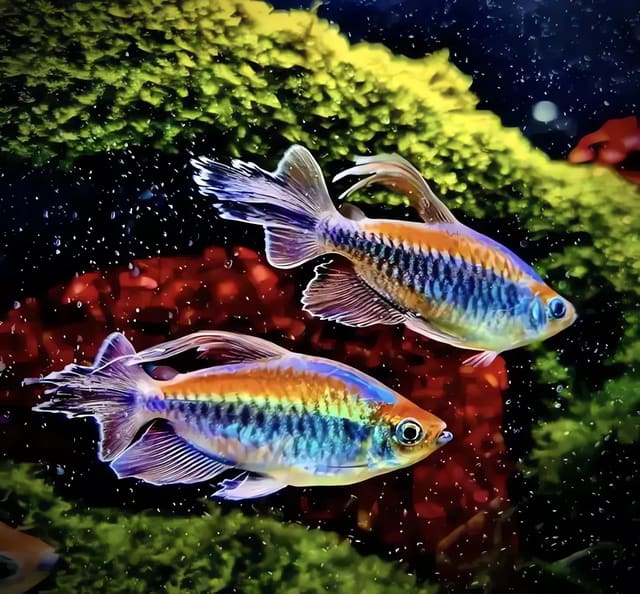
Good companions include similarly sized African characins such as Congo Tetras and African Red Eye Tetras, suitable adult Pelvicachromis cichlids, Synodontis catfish, medium peaceful loaches and other robust community fish that share the water values. Very small fish, fry and tiny shrimp are not safe long-term companions because adult Long-Finned African Tetras may view them as food.
Avoid delicate slow feeders, tiny nano fish, nervous long-finned species and aggressive cichlids. The best community feels active but balanced: the tetras occupy the open water, bottom fish have room to feed, and no species is forced into permanent hiding by the pace of the shoal.
The typical fish shows a streamlined silver to gold body with a dark mark through the tail base and clear to lightly tinted fins. Mature males are reported to develop a longer dorsal fin and can look more dramatic when displaying. Females are usually a little fuller-bodied, especially when conditioned.
Colour can vary with age, sex, mood and aquarium conditions. Darker backgrounds, floating cover, good food and a settled group usually show the fish better than a bright, sparse holding tank. Newly arrived specimens can look pale until they have settled and started feeding confidently.
Breeding is not a beginner project. FishBase notes spawning in pairs or schools, while aquarium accounts describe egg-scattering behaviour in a separate long tank with soft, acidic water, plant cover and high oxygen. Adults should be removed after spawning because they do not guard the eggs. If breeding is your goal, plan a dedicated setup rather than relying on accidental spawning in a community aquarium.
This product has size variants, so choose by supplied size rather than assuming those measurements are the final adult size. Smaller fish settle well when the aquarium is ready, but they still need a tank planned for adult movement and group behaviour.
When this fish is in stock, eligible livestock orders are packed for a specialist live-animal courier service and supported by the Tropical Fish Co Live Arrival Guarantee, subject to the delivery and acclimation instructions. Please prepare the aquarium before ordering, check water parameters, and be ready to acclimate the shoal promptly on arrival.
Peaceful but fast and boisterous at feeding time. Keep in a group and choose robust tank mates that will not be outcompeted.
Always research specific species before adding them to your tank. Consider:
No reviews for this item yet. Bought one? Honest reviews only, good or bad.
What customers say about ordering from us
I have a small group of long finned mountain minnows. So was delighted to be able to order ten of this variety to increase the genetics in my tank . The ones I recieved are healthy but it’s to early to give a verdict on wether they are of a long finned type since they are small currently.
Gordon Walker · 23 Sept 2026
100% success travel and "installation". Pleased with quality of purchase. The Siamese fighter a bit "shy" so have not yet seen him at his best yet but looking good. Happy customer. GG
George E Garratt · 21 Sept 2026
Reviews of our shop, collected by Judge.me, an independent third-party review collector. Newest first.