
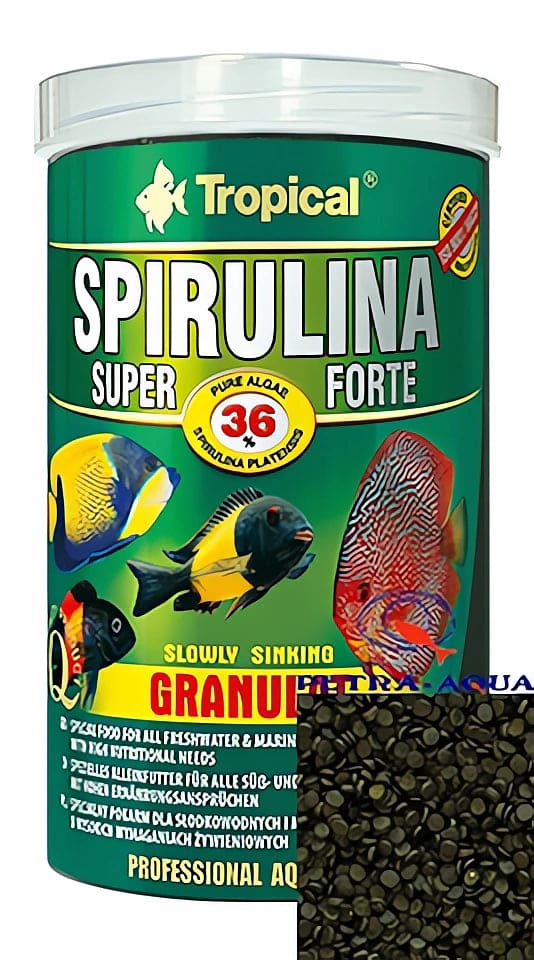
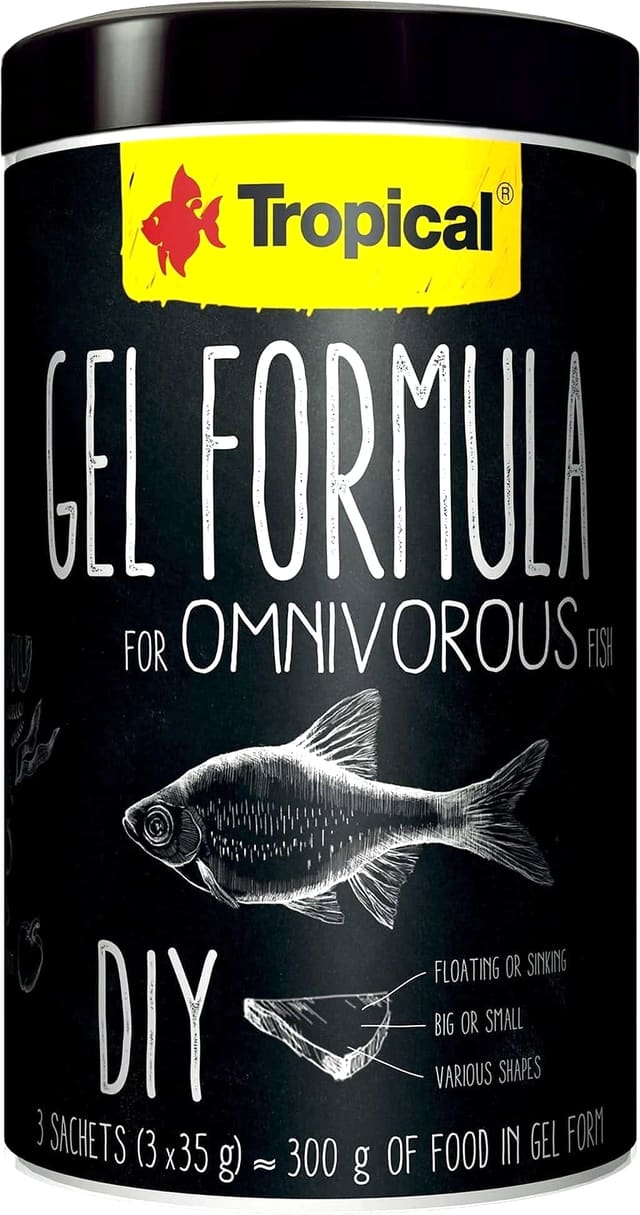
Tropical Super Spirulina Forte Granulat 36%
£66.99

Tropical Spirulina Flakes are dry flake fish food with 6% spirulina for herbivorous and omnivorous freshwater or marine aquarium fish.
Tropical Spirulina Flakes are dry flake fish food with 6% spirulina for herbivorous and omnivorous freshwater or marine aquarium fish.
Tropical Spirulina Flakes are dry flake fish food with 6% spirulina for herbivorous and omnivorous aquarium fish in freshwater and marine setups.
| Product type | Dry flake fish food |
|---|---|
| Available sizes | 250ml/50g and 1000ml/200g |
| Format | Flakes |
| Diet focus | Herbivorous and omnivorous fish |
| Spirulina content | 6% |
| Brand | Tropical |
The formula is made for fish that benefit from plant-rich feeding, including suitable mbuna, rainbowfish, barbs, guppies, mollies and other livebearers. Spirulina supports everyday feeding where colour, condition and digestible plant material matter.
Feed small portions several times per day, using only what the fish clear quickly. Crumble flakes for smaller mouths, remove leftovers, and rotate with other suitable foods when the species needs more protein, sinking food or specialist feeding.
Keep the tub sealed, dry and away from heat between feeds. Choose the pack size that matches your usage rate so the food stays fresh after opening.
Let me tell you about Tropical Spirulina Flakes, a really handy Spirulina Fish Food for everyday feeding. If you’ve been looking for a reliable tropical fish food that fits neatly into a busy fish room, this is one worth knowing. It’s a simple flake, but it’s doing a lot of good work behind the scenes. You get balanced nutrition, colour support, and an easy way to keep your fish fed without making life complicated. And for many keepers, that’s exactly what they want from fish food options.
Now, spirulina isn’t a fish species at all. It’s a cyanobacteria-based ingredient, and in fishkeeping it’s become a proper staple. Tropical Spirulina Flakes use spirulina algae as the key feature, which is why so many aquarists reach for spirulina enriched flakes for aquarium fish when they want something dependable. It’s the sort of food that slots into daily routines beautifully. Here’s the thing. Spirulina itself is harvested from controlled freshwater and alkaline production systems. Not from some random wild river. Not from a lake you’d never want to trust.
It’s grown under controlled conditions for nutrition, and that matters. In nature, related Arthrospira species thrive in warm, mineral-rich, highly alkaline waters. Those are the kind of environments where microscopic algae and plankton form the base of the food chain. So when you’re feeding Spirulina Flakes for Aquarium use, you’re giving your fish a food ingredient that has been developed with consistency in mind. That controlled production is one reason spirulina flakes ingredients are so consistent compared with homemade fish food recipes. And if you’ve ever wondered why spirulina keeps coming up in aquaculture conversations, that’s part of it.
It’s not just about convenience. It’s about a plant-based food source that fits neatly into modern fishkeeping. For anyone searching fish food online, this is the sort of staple that makes sense for a well-run tank. What I love about this food is how practical it is in the aquarium. The flakes are designed for everyday feeding, and they’re suitable for community aquariums, livebearers, herbivores, and colour-loving tropical species. That’s a broad range, and it makes the food very flexible. The flakes themselves are meant to disperse in the water column, which is useful if you keep small fish food eaters or surface feeders.
You can see from the product photos how the flake size and texture behave in water, and that’s genuinely helpful when you’re choosing a food. Because spirulina is the star here, you’re getting support for colour, digestion, and steady nutrition. That’s the real draw. Not flashy promises. Just a sensible everyday dry food with plant-based support built in. If you’ve been comparing spirulina flake food vs standard fish food, this is where spirulina often earns its place. It gives you something a little more targeted than a basic staple, while still being easy to feed.
Tank setup is straightforward, because this is a food product rather than a fish, but the practical side still matters. Tropical Spirulina Flakes are intended for everyday feeding in community aquariums, livebearer tanks, herbivore setups, and mixed tropical systems. The minimum tank size given is forty litres, which is a useful guide for the kinds of aquariums this food is suited to. If your tank is home to peaceful, semi-aggressive, or schooling fish, this food fits right in. The best way to use it is to think in small portions.
You want the fish to eat what you offer within thirty to sixty seconds. That’s the sweet spot. Feed too much, and you’re just creating waste. Feed appropriately, and the flakes do their job neatly. Because they disperse in the water column, they can work well for fish that feed at the surface, but also for those that pick through the water. That makes them especially useful in community tank setups where different fish eat in different ways. There’s no special substrate or decoration requirement here, of course, but the way you feed does matter.
Small portions are the key. If you’ve ever watched fish swarm the surface and then lose interest after the first minute, you’ll know exactly why that timing matters. It keeps things tidy and helps the tank stay balanced. For keepers who want a dependable tropical fish food option, that’s a big plus. As for water parameters, the product information gives a temperature range of twenty-two to twenty-eight degrees Celsius. The pH range is six point five to eight point zero. Those are broad, practical figures, and they suit the sort of tropical setups where this food is most at home.
Since it’s a dry food, it’s convenient for routine feeding, travel, and general care, which is one reason it’s become such a popular fish food online choice. Feeding is simple, and that’s part of the appeal. Offer small portions that are eaten within thirty to sixty seconds. Rotate it with other foods for a balanced diet. That’s the advice straight from the product information, and it’s good advice. Spirulina Fish Food works best as part of a varied routine, not as the only thing in the cupboard.
It’s especially useful for herbivores and omnivores, where the plant-based support can really suit their needs. If you’re feeding bettas, the answer is yes, they can eat spirulina flakes in small amounts. But they shouldn’t replace protein-rich foods. Use them as a supplement one or two times weekly alongside a varied diet. That’s a nice example of how flexible Spirulina Flakes can be. And with goldfish, yes, they can eat spirulina flakes safely as part of a mixed diet too. Feed small portions once or twice daily, and pair them with sinking pellets or gel food to help avoid overfeeding and water quality issues.
That’s really the theme here. Spirulina benefits are strongest when the food is used sensibly. It’s a smart daily rotation food, not a magic fix. But as part of a balanced feeding plan, it’s very useful. Behaviour-wise, you’re not dealing with a fish, but you are dealing with a food that suits a range of fish personalities. It’s suitable for peaceful, semi-aggressive, and schooling fish. That tells you a lot. In a busy community tank, you’ll notice fish taking to it quickly. It’s the kind of food that can be accepted fast, which is always reassuring when you’re trying something new.
If you’ve ever watched fish hesitate at a new food, then suddenly decide it’s dinner after all, you’ll know the feeling. Compatibility is broad, which is another reason this food is so handy. It works well for community aquariums, livebearers, herbivores, and colour-loving tropical species. It’s also especially useful for spirulina flakes for guppy tanks and spirulina flakes for cichlids when you want a dependable, easy-to-feed flake. The product information also mentions that it can be a good fit for spirulina flakes for community tank setups.
That’s because it bridges the gap between a staple dry food and a targeted plant-based supplement. Now, if you’re thinking about species to avoid, the product description doesn’t give a specific avoid list. So the safest advice is to use it where the food type clearly fits. For fish that need more protein-rich feeding, like bettas, spirulina should stay as a supplement rather than the main event. That’s the sensible approach. For goldfish, it can be part of a mixed diet, but again, small portions matter.
The goal is always balance. That’s what keeps the tank healthy and the feeding routine calm. Breeding isn’t something this product covers directly, because it’s food rather than livestock. But in practical fishkeeping terms, spirulina is often valued for daily feeding because it supports growth, digestion, and steady colour. That makes it a useful food to have on hand in tanks where you’re keeping fish in good condition. And because it’s easy to feed, it fits neatly into the kind of routine that breeders and general keepers alike appreciate.
For health, the main thing to watch is overfeeding. That’s always the danger with flake foods. Feed small portions, and don’t let excess food sit around. Since this is a dry food designed to be eaten quickly, it’s best used with a light hand. The product also highlights that spirulina can help reduce waste in mixed tanks when used properly, which is another reason it’s popular. Good feeding habits are the real health boost here. What I like about Tropical Spirulina Flakes is that they feel like a proper fish room staple.
No fuss. No overcomplication. Just a versatile Spirulina Fish Food that does a few important jobs well. It supports colour. It supports digestion. It fits everyday feeding. And it suits a wide range of tropical setups, from community aquariums to livebearer tanks and herbivore systems. If you’re shopping for fish food options and want something practical, this is a strong choice. It’s the sort of food that earns its place because it’s easy to use and easy to trust. And when you buy from Tropical Fish Co, you’re choosing a shop that understands what fishkeepers actually need.
Good products. Clear information. And the kind of care that helps you make sensible choices for your tank.
No reviews for this item yet. Bought one? Honest reviews only, good or bad.
What customers say about ordering from us
I have a small group of long finned mountain minnows. So was delighted to be able to order ten of this variety to increase the genetics in my tank . The ones I recieved are healthy but it’s to early to give a verdict on wether they are of a long finned type since they are small currently.
Gordon Walker · 23 Sept 2026
100% success travel and "installation". Pleased with quality of purchase. The Siamese fighter a bit "shy" so have not yet seen him at his best yet but looking good. Happy customer. GG
George E Garratt · 21 Sept 2026
Reviews of our shop, collected by Judge.me, an independent third-party review collector. Newest first.




22–28°C · pH 7–8 · 41L

21–25°C · pH 5–7
24–29°C

24–27°C · pH 6.5–6.5

22–27°C · pH 6–8 · 72L

23–27°C · pH 5.5–7 · 60L

22–27°C · pH 6–8

22–26°C · pH 6–7.8 · 75L