Moderate
Distichodus Lefini, Tank Bred (Distichodus sp. 'Lefini')
24–26°C · pH 6.5–7.5
£20.39
The Six-Banded Distichodus (Distichodus sexfasciatus) is a Congo basin characin sold as an orange, black-barred juvenile with bright red fins, but it grows into a heavy, plant-eating fish of 40 cm or more in aquariums and up to 76 cm in the wild. It needs a tank of at least 240 × 90 × 60 cm, strong filtration, a heavy lid, a vegetable-rich diet and large, robust tank mates. Sold individually as one live fish.
Distichodus sexfasciatus
The Six-Banded Distichodus (Distichodus sexfasciatus) is a Congo basin characin sold as an orange, black-barred juvenile with bright red fins, but it grows into a heavy, plant-eating fish of 40 cm or more in aquariums and up to 76 cm in the wild. It needs a tank of at least 240 × 90 × 60 cm, strong filtration, a heavy lid, a vegetable-rich diet and large, robust tank mates. Sold individually as one live fish.
Read the full care guidance when planning conditions for your aquarium.
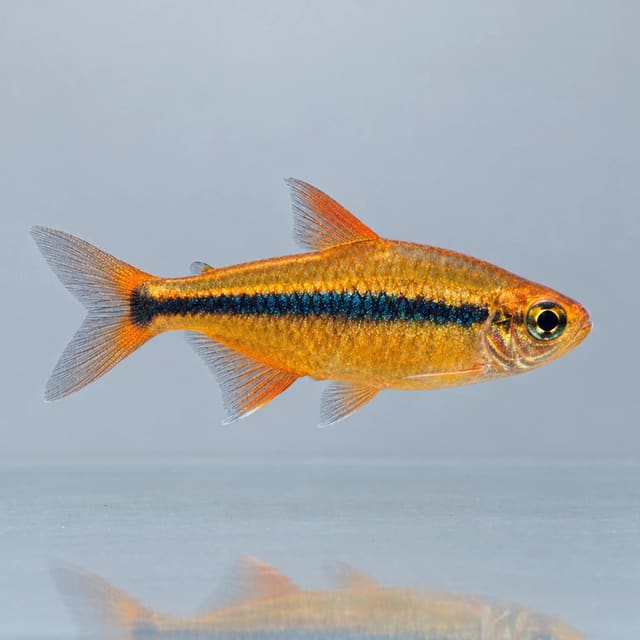
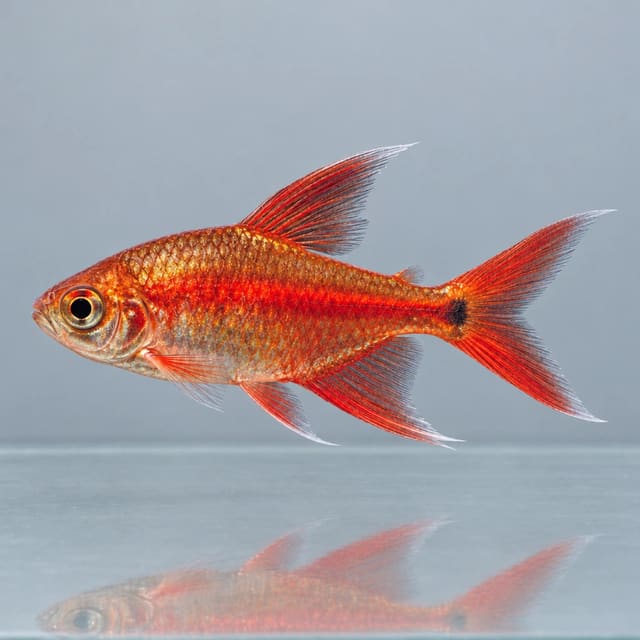
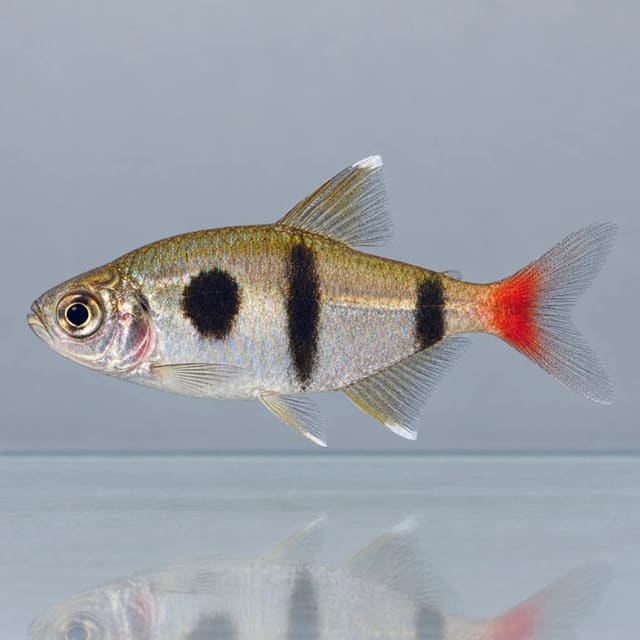
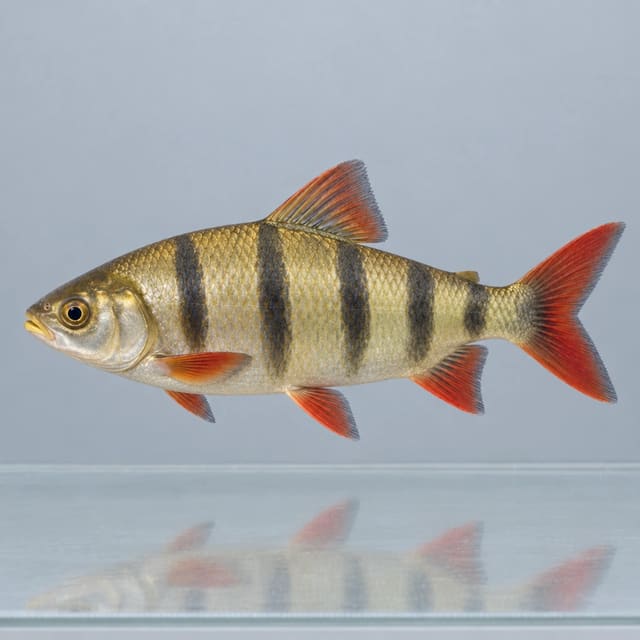
The Six-Banded Distichodus (Distichodus sexfasciatus) is a large African characin from the Congo basin. Young fish are some of the most eye-catching in any shop: an orange-gold body crossed by six bold black bands, with bright red fins. That juvenile look is what most people buy, but this is a fish that becomes a heavy, plant-eating adult of 40 cm or more, and it should be bought only by someone with an aquarium, or a plan for one, that can hold it for life.
FishBase records it across the Congo River basin, from the lower Congo up to the upper Lualaba, and in the Lake Tanganyika basin. In the wild it swims in shoals in the lower water layers of rivers and inshore areas of lakes, eating worms, crustaceans, insects and plant matter. It is listed as Least Concern on the IUCN Red List (assessed 2009), and FishBase notes that it is taken by commercial fisheries as well as for the aquarium trade.
Seriously Fish calls it the most common Distichodus in the hobby and warns that it is often sold as a community fish, which is wrong given its size and temperament. Its advice is plain: do not buy one unless you can house it for life. We agree, and this page sets out exactly what that means, so you can decide with full information.
| Name | What it means |
|---|---|
| Six-banded distichodus | The trade name on this listing and the name Seriously Fish uses |
| Sixbar distichodus | The English name FishBase lists |
| Distichodus sexfasciatus Boulenger, 1897 | The scientific name; sexfasciatus means six-banded |
| Distichodontidae | The family FishBase uses; Seriously Fish files the genus with the citharins (Citharinidae) |
Browse our African tetras and characins for its relatives, our wider range of tetras and characins, and our centrepiece fish for other single-specimen fish for large aquariums.
One purchase quantity supplies one live Six-Banded Distichodus. The only option is "Standard": the fish is not graded into sizes, so it is sent at the size available on the day, which will be a juvenile far smaller than the adult. Seriously Fish records no known external differences between males and females, so sex cannot be chosen.
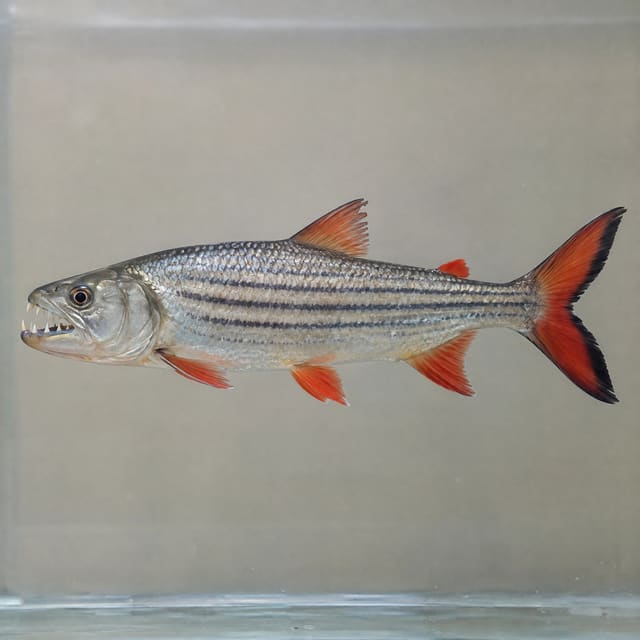
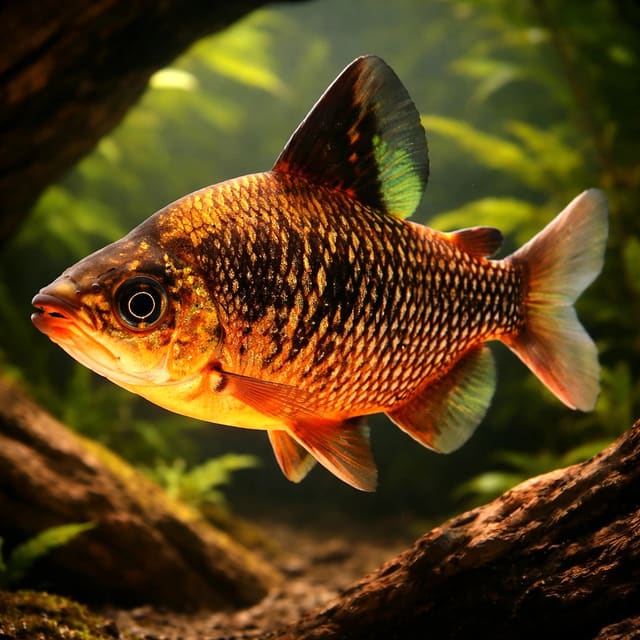
The photographs show the juvenile colour form. Each fish varies a little in the width of its bands and the depth of its red, and colour is paler for a few days after travel.
Seriously Fish notes that juveniles are orange and black with bright red fins, but much of this colour and pattern fades as the fish grows, and that adults are rarely seen for sale. The fish you keep for years will be larger, deeper-bodied and more muted than the one in the photographs. If the bright juvenile colours are the main attraction, a smaller species will suit you better; the Silver Distichodus, which Seriously Fish gives as 200 mm standard length and which develops red fins as it matures, is the more manageable relative.
FishBase gives a maximum of 76 cm standard length, measured without the tail. Seriously Fish gives 75 cm and adds that fish in aquariums are rarely over 40 cm, which is still a very large, deep-bodied fish. The tank has to be planned around that adult, not around the juvenile you buy. Our tank volume calculator turns dimensions into litres, and our stocking calculator helps you judge what else the tank can hold.
| Planning point | Figure | Source |
|---|---|---|
| Adult size | 76 cm standard length in the wild; rarely over 40 cm in aquaria | FishBase; Seriously Fish |
| Minimum aquarium | 240 × 90 × 60 cm, about 1,296 litres, described as the bare minimum | Seriously Fish |
| Filter turnover | Four to five times the tank volume per hour, so roughly 5,200–6,500 litres per hour for 1,296 litres | Seriously Fish |
| Large fish in general | Often more than 500 litres; an indoor heated pond is an alternative | OATA |
| Lid | Tight, heavy cover; an excellent jumper | Seriously Fish; OATA |
OATA's care sheet for very large "tank buster" fish advises buying for the adult size rather than the juvenile size, and reminds owners that these fish can live a long time. If you start a juvenile in a smaller, mature aquarium, have the final aquarium or indoor pond planned, budgeted and ready to set up long before the fish outgrows the first tank. OATA is also clear that aquarium fish must never be released into the wild; if your circumstances change, rehome it to an experienced keeper or a public aquarium.
Seriously Fish says the Six-Banded Distichodus eats most greenery and is a poor choice for a planted aquarium. Build the layout from smooth rocks and large pieces of driftwood over sand or gravel, and leave a long, open swimming area along the front. If you want some green, Anubias and Bolbitis are the plants Seriously Fish suggests, because most fish leave them alone; attach them to wood or rock, and accept that a large distichodus may still damage them. Browse our tough aquarium plants for these epiphytes.
Some water movement is appreciated, which suits the powerful filtration a fish of this size needs anyway. Keep the décor stable: OATA advises securing décor in tanks of large fish so that it cannot be knocked over.
Seriously Fish describes this species as an excellent jumper and calls for a tight, heavy cover. OATA adds that large fish often jump, especially when newly introduced, and recommends a fish-proof lid and protected heaters. Use heater guards or heaters placed in the filter line, close every gap around pipes and cables, and keep the lid weighted or clipped.
FishBase and Seriously Fish give the same ranges for this species, and OATA sets the limits for waste products for all large fish.
| Value | FishBase | Seriously Fish | Our suggested target |
|---|---|---|---|
| Temperature | 22–26°C | 22–26°C | 24–26°C, held steady |
| pH | 6.0–7.5 | 6.0–7.5 | 6.5–7.5 |
| Hardness | 10–20 dH | 10–20 dGH | 10–20 dGH |
| Ammonia and nitrite | Zero (OATA) | Zero | |
| Nitrate | No more than 20 mg per litre above your tap water (OATA) | As low as you can keep it | |
Tap water varies widely across the UK in hardness and mineral content, so test yours rather than assume. Treat every litre with a dechlorinator or conditioner, test pH and general hardness, and enter the numbers into our water matcher. Medium-hard water within the ranges above is easy to hold steady in a large volume; if yours is far outside, our water chemistry guide explains how to adjust it gradually. In an aquarium of more than a thousand litres, plan how you will treat and temperature-match large volumes of new water every week.
A large, plant-eating fish produces a lot of waste. Seriously Fish's turnover figure of four to five times the tank volume per hour means several large external filters or a sump on a tank of this size. The aquarium must be fully cycled, with ammonia and nitrite at zero, before the fish arrives. Our aquarium filtration guide explains how to size and maintain filtration.
Seriously Fish describes the species as omnivorous but stresses that it needs a good proportion of vegetable matter, and FishBase lists plant matter alongside worms, crustaceans and insects in its wild diet. Build every week's feeding around plant foods, with meaty foods as the smaller part.
| Food | Role |
|---|---|
| Spirulina flakes for juveniles, then sinking spirulina granules | Daily plant-based staple, as Seriously Fish suggests |
| Herbivore pellets and frozen herbivore food | Larger, vegetable-rich meals as the fish grows |
| Blanched spinach and frozen peas with the skins removed | Fresh greens from Seriously Fish's list; OATA notes herbivores can eat fresh vegetables |
| Live earthworms, prawn and mussel | Protein, from Seriously Fish's list; a smaller share of the diet |
OATA advises feeding large fish once a day, only as much as they eat within a few minutes. Offer the portion, watch it go, and lift out what remains. A plant-eater that is underfed will turn to anything green in the tank, so a regular supply of vegetables also protects the décor. The fish should look well rounded but never swollen.
Read our delivery and live arrival information before ordering, and have the aquarium running, matured and tested before the fish arrives. Our guide on how to acclimatise new fish covers the method in detail; OATA's steps are below.
OATA advises monitoring water quality closely during the first week. Expect the fish to stay near cover at first and to colour up as it settles.
Seriously Fish describes the Six-Banded Distichodus as somewhat unpredictable. Some fish remain peaceful with similarly sized species, while others become very spiteful as they mature. Juveniles shoal peacefully, but they grow increasingly aggressive towards each other, and Seriously Fish says adults need a very large aquarium to be kept as a group. OATA's general advice for large fish is to avoid housing them with much smaller species.
| Suits (in a very large tank) | Avoid |
|---|---|
| Bichirs, such as the Ornate Bichir or Delhezi Bichir | Much smaller fish of any kind |
| Large cyprinids, such as the Bala Shark | Shy or slow species that will be outcompeted |
| Large characins of similar size | Planted aquariums and delicate plants |
| Large catfish and loricariids (see our common pleco guide) | Several distichodus in an ordinary-sized tank |
For most home aquariums, one Six-Banded Distichodus is the realistic number. A group is possible only in a very large system with plenty of space to spread out. Check every combination for adult sizes, not shop sizes, before you buy.
OATA's checklist for large fish is a good daily routine. Look, especially at feeding time, for changes in:
If anything changes, test the water first, then contact us for advice. Damage to the snout or fins can come from jumping against the lid or from sharp décor, which is one more reason to use smooth rocks and wood.
Seriously Fish knows of no captive breeding of this species, and there are no recorded external differences between males and females. In the wild, FishBase describes it swimming in shoals in the lower water layers of rivers and inshore lake areas. Home breeding is not a realistic goal for a fish of this size.
Very big. FishBase records 76 cm standard length in the wild, and Seriously Fish gives 75 cm, adding that aquarium fish rarely exceed 40 cm. Plan for a heavy-bodied fish of at least 40 cm, not the small juvenile that arrives.
Seriously Fish calls 240 × 90 × 60 cm, about 1,300 litres, the bare minimum for an adult. OATA notes that tank-buster fish often need more than 500 litres and that an indoor heated pond is an alternative. Buy for the adult size.
Yes. Seriously Fish says it eats most greenery and is a poor choice for a planted tank. Tough Anubias and Bolbitis are the only plants worth trying, and even those may be damaged.
No, despite often being sold as one. Seriously Fish describes it as unpredictable: some fish stay peaceful with similar-sized species, while others become very spiteful as they mature. Keep it only with large, robust fish.
A diet rich in plant matter: spirulina flakes or granules, herbivore pellets, blanched spinach and shelled peas, with earthworm, prawn and mussel for protein. Feed once a day, only what it eats within a few minutes.
That is normal growth. Seriously Fish notes that juveniles are orange and black with bright red fins, but much of this colour and pattern fades as the fish grows. Sudden fading in a young fish, with other changes, is worth checking.
Juveniles shoal peacefully, but Seriously Fish says they grow increasingly aggressive towards each other, and adults need a very large aquarium to be kept as a group. Most home aquariums suit one fish.
Seriously Fish knows of no captive breeding, and there are no known external differences between males and females. In the wild, FishBase says it swims in shoals in the lower water layers of rivers.
No reviews for this item yet. Bought one? Honest reviews only, good or bad.
What customers say about ordering from us
Easy website plenty of info on fish your buying great to pick a time slot
TRACEY DURRANT · 7 Oct 2026
Got some lovely fish thank you
Kevin Mackie · 7 Oct 2026
Reviews of our shop, collected by Judge.me, an independent third-party review collector. Newest first.
Moved by UK carriers licensed to handle live animals
Hand-packed with oxygen bags, poly box, heat pack
Email photos the same day; an optional unboxing video helps us review problems faster — claim terms apply
Klarna & PayPal Pay in 3 at checkout