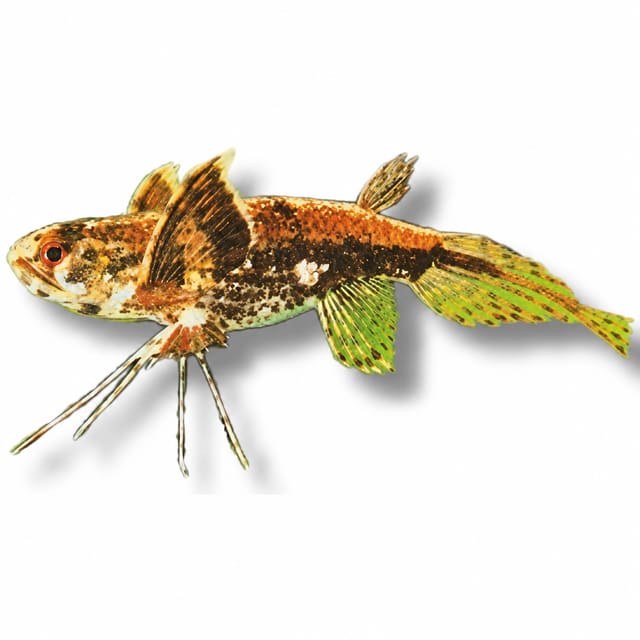
Reticulated Hillstream Loach (Sewellia lineolata)
20–24°C · pH 6–7.5 · 68L
£16.99

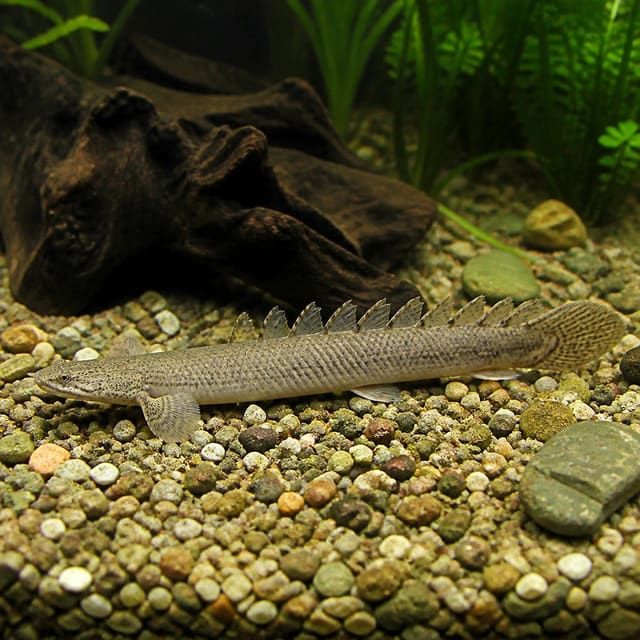
The Delhezi Bichir (Polypterus delhezi) is a freshwater, demersal fish from the middle Congo River basin that reaches 44 cm. It suits keepers prepared for a secure 120 × 45 cm aquarium base and water at 24–30°C, pH 6.0–8.0 and 5–25 dGH. Sold individually in sizes from 5–6 cm to 10–12 cm.
Adult size is the maximum length this species reaches at full maturity (scientific sources). The livestock you receive will be younger and smaller — pick a size above for the actual shipping size. Product-photo provenance and any image-specific limitations are stated on the listing.
Polypterus delhezi
Confirm your email, then we’ll send an availability message for this exact item if it returns within 180 days.
This request is only for this product—no newsletter or other promotions. A mail-provider retry may very rarely duplicate the same availability message. Unconfirmed addresses are removed after 48 hours. See our privacy policy.
The Delhezi Bichir (Polypterus delhezi) is a freshwater, demersal fish from the middle Congo River basin that reaches 44 cm. It suits keepers prepared for a secure 120 × 45 cm aquarium base and water at 24–30°C, pH 6.0–8.0 and 5–25 dGH. Sold individually in sizes from 5–6 cm to 10–12 cm.
Adult size is the maximum length this species reaches at full maturity (scientific sources). The livestock you receive will be younger and smaller — pick a size above for the actual shipping size. Product-photo provenance and any image-specific limitations are stated on the listing.
Maintain these water conditions for optimal health and vibrant colors
The Delhezi Bichir, Polypterus delhezi, is a freshwater, bottom-dwelling fish from Africa. Its common name is also written Barred Bichir, reflecting the patterned appearance associated with the species. This is a substantial carnivorous fish rather than a conventional small community species, so the aquarium must be chosen around its mature dimensions, feeding behaviour and need for secure containment.
FishBase records a maximum of 44 cm total length and places the species in the middle Congo River basin in the Democratic Republic of the Congo and Republic of Congo. It describes the fish as freshwater, demersal and tropical. Treat 44 cm as the decisive planning reference: an individual may remain below the recorded maximum, but buying the aquarium around a smaller hoped-for result risks leaving too little turning and resting room.
| Decision | Plan |
|---|---|
| Adult size | Allow for up to 44 cm total length |
| Aquarium base | At least 120 × 45 cm |
| Approximate volume | About 205 litres |
| Water | 24–30°C, pH 6.0–8.0 and 5–25 dGH |
| Containment | A tight-fitting cover with access to surface air |
| Diet | Appropriately sized meaty live or frozen foods |
Seriously Fish recommends a base of at least 120 × 45 cm and about 205 litres for this species. It also explains that floor space matters more than depth. Those dimensions are a starting point for one fish, not a promise that every aquarium with the same nominal volume will work. Decor, internal measurements, other inhabitants and the fish’s mature body length all affect usable space.
| Suits | Not suited to |
|---|---|
| Keepers prepared for a 120 × 45 cm base and secure cover | Small or open-topped aquariums |
| A mature aquarium maintained within the stated water ranges | Unfiltered or biologically immature aquariums |
| Carefully screened companions too large to swallow | Fish or invertebrates small enough to fit in its mouth |
This bichir suits a keeper prepared to maintain a large, mature aquarium, offer a specialised carnivorous diet and screen every companion by adult size. If those commitments do not fit your plans, browse the current loaches and oddballs collection for animals with different space and feeding requirements.
One purchase supplies one animal of the selected option. Use the live size selector to choose 5–6 cm, 7–10 cm or 10–12 cm. These measurements describe the dispatch grade attached to the option, allowing you to prepare suitable food portions, shelter and protected equipment for the fish arriving at your aquarium.
The size you select is the size supplied, not the adult size. Every option therefore needs the same long-term plan for a fish that FishBase records at up to 44 cm total length. A smaller dispatch grade does not define a permanent small form, and size alone must not be used to infer age, sex or origin.
| Selector choice | What one purchase supplies |
|---|---|
| 5–6 cm | One fish in the 5–6 cm dispatch grade |
| 7–10 cm | One fish in the 7–10 cm dispatch grade |
| 10–12 cm | One fish in the 10–12 cm dispatch grade |
Choose by looking at the aquarium that is ready now as well as the route into the mature setup. The smallest grade needs food pieces it can take readily and equipment openings it cannot enter. A larger grade still needs the same secure cover, suitable water and adult floor-space plan. Check the live selector when choosing a size.
Sex is guaranteed only when the selected option explicitly states male or female. This Delhezi Bichir listing has no sex-guaranteed option.
Some gallery images are representative, based on reference photographs of this species, and none shows the exact animal supplied, so colours can look slightly different from the live animal.
Natural individual variation means the precise pattern should not drive the housing decision. Select the animal only after confirming the aquarium base, water range, cover, diet and companion plan. Those requirements continue after the fish has grown beyond its dispatch grade.
Start with an aquarium base of at least 120 cm long by 45 cm front to back. Seriously Fish pairs that footprint with dimensions of about 120 × 45 × 38 cm and an approximate volume of 205 litres. Measure the aquarium itself rather than relying on a model name: two tanks sold under a similar litre label can have very different base dimensions.
Floor area matters more than extra depth because this is a demersal fish with an elongated body. Length provides room to move between shelter and open areas, while front-to-back width provides turning room. A tall, narrow aquarium may hold the stated volume but still use its litres poorly for a fish recorded at up to 44 cm total length.
About 205 litres is an approximate species husbandry reference, not a guarantee based on volume alone. A 205-litre aquarium with an unsuitable base, unstable decor or crowded stocking can still be a poor choice. Conversely, extra width and length improve the practical layout even when depth is modest.
If using a temporary smaller setup for a small dispatch grade, prepare the final aquarium before growth makes the move urgent. Mature the biological filter in advance, keep all openings secure and move the fish while it can still turn and rest freely. Do not treat the dispatch measurement as permission to postpone the adult plan indefinitely.
Use 24–30°C, pH 6.0–8.0 and 5–25 dGH as the routine aquarium ranges for this species. FishBase separately records 26–28°C as a tropical environmental range. Aim for stable conditions within the aquarium guidance rather than repeatedly moving the water towards a chosen midpoint.
| Measurement | Working range or limit |
|---|---|
| Temperature | 24–30°C |
| pH | 6.0–8.0 |
| General hardness | 5–25 dGH |
| Ammonia | 0 mg/l |
| Nitrite | 0 mg/l |
| Nitrate | Up to 20 mg/l above the normal tap-water level |
OATA’s very-large-fish sheet gives the ammonia, nitrite and nitrate limits as broad group guidance; use the species values above for temperature, pH and hardness. Ammonia and nitrite must remain at zero because both indicate that waste is exceeding the biological system’s ability to process it.
Our water chemistry guide explains what the principal aquarium measurements mean. Once you have actual results, use the water matcher to compare them with the 24–30°C, pH 6.0–8.0 and 5–25 dGH ranges.
A result inside each numerical range is only one part of the decision. The aquarium must also be mature, filtered, large enough and stocked sensibly. Stable suitable water in an undersized or insecure enclosure does not solve the space or escape risks.
Use a mature biological filter and size it for the aquarium’s full inhabitants and feeding load. The RSPCA explains that a working biological filter houses bacteria that convert toxic ammonia to nitrite and then to the safer nitrate. Clear water alone does not show that this biological process is coping.
For an aquarium of about 205 litres, Seriously Fish uses a turnover of four to five times the volume each hour and gives a filter rating of approximately 820–1,025 litres per hour. Treat the manufacturer’s flow figure as a selection reference: media, pipework and accumulated debris can affect performance, so water tests remain the practical check on the complete system.
| Routine | Action |
|---|---|
| Water testing | Check at least once each week |
| Partial water change | At least once each week, change 25% |
| Replacement water | Treat tap water for chlorine or chloramine |
| Filter inspection | Check for blockages and reduced flow |
| Media cleaning | Rinse lightly in removed aquarium water |
OATA recommends the weekly testing and, at least once a week, a 25% partial water change for very large fish. Siphon out solid waste during the water change, especially where pieces of meaty food can settle. Match replacement water closely enough to keep temperature and chemistry changes gradual.
Do not run established biological media under the tap because chlorine or chloramine may damage the bacterial population. Avoid cleaning every mature filter component aggressively at the same time. Preserve working biological surfaces while removing the debris that blocks flow.
Prepare the filter before the fish arrives. Our first tropical aquarium guide covers maturation before livestock is introduced. After adding the bichir, test more frequently whenever feeding rises, another fish is added or the filter has undergone substantial maintenance. The goal is consistent zero ammonia and zero nitrite under the aquarium’s normal load.
Fit a tight cover before introducing this fish. Seriously Fish describes the Delhezi Bichir as an excellent escape artist, so inspect the complete perimeter rather than checking only the main lid panel. Openings around filter hoses, cables and pipework must not leave a route large enough for the fish to use.
Keep access to atmospheric air beneath the cover. Bichirs use an accessory breathing organ, and the species must be able to reach the surface. Leave an air space under the lid and maintain a clear route from the bottom. A surface visit can be part of normal behaviour; a persistent change in breathing still calls for water and health checks.
| Feature | Practical choice |
|---|---|
| Substrate | Soft material across the resting area |
| Wood | Stable pieces that form broad hiding places |
| Rocks | Smooth pieces arranged securely |
| Plants | Optional rather than essential |
| Surface | An open route to air beneath the cover |
Arrange driftwood and smooth rocks to form more than one useful refuge without creating tight traps. Check every opening against the fish’s eventual body width, not just its dispatch size. A cavity that suits a small fish may become unsafe if the same animal can later enter but not turn around.
Keep a clear lane between hiding places, feeding areas and the surface. This gives the fish a choice between cover and open movement while making uneaten food easier to find. Plants can be included for the aquascape, but they are not required for the species and must not form a solid barrier across the surface route.
Recheck the cover after maintenance. A lid moved for feeding, a cable rerouted during cleaning or a filter pipe adjusted by a few centimetres can create a new opening. Test every panel for secure seating while retaining the air space the fish needs.
The Delhezi Bichir is carnivorous. Seriously Fish recommends meaty live or frozen foods such as prawns, earthworms, mussel and bloodworm. Dried foods are often refused, although some individuals may accept pellets. Build the routine around foods the fish reliably takes rather than assuming every specimen will convert to a prepared diet.
| Food | How to use it |
|---|---|
| Prawn | Offer a suitably sized meaty portion |
| Earthworm | Use as part of a varied carnivorous diet |
| Mussel | Portion so it can be eaten promptly |
| Bloodworm | Choose an amount suited to the fish’s size |
| Pellets | Use only where the individual accepts them |
OATA’s large-fish guidance recommends feeding only what can be eaten within a few minutes, once a day. Begin with a modest portion and watch the fish take it. If food remains, remove it and reduce the next portion rather than leaving protein-rich material to break down in the aquarium.
Use appropriately sized pieces. A 5–6 cm dispatch-grade fish and a much larger individual cannot be expected to handle the same portion. The useful size is one the fish can find, take and swallow without a large remnant falling behind decor.
Feed where observation is possible and give the bichir a fair chance to reach its meal. Its nocturnal tendency and reliance on smell make a consistent feeding place useful. When companions are present, watch the bichir rather than judging success by whether the aquarium as a whole consumed the food.
Review appetite alongside body condition and water results. A portion that worked when the fish was smaller may become insufficient as it grows, while repeated leftovers indicate that the amount, food type or feeding context needs adjustment. Keep variety within the listed meaty choices instead of depending on one accepted item indefinitely.
Complete the aquarium before arranging the fish’s arrival. The base should meet the planned requirement, the cover should fit tightly, shelter should be stable and the biological filter should already maintain zero ammonia and zero nitrite under load. Set temperature within 24–30°C and confirm that pH and hardness sit within 6.0–8.0 and 5–25 dGH.
Read our delivery and Live Arrival Guarantee policy before checkout. The policy page is the place for dispatch days, delivery arrangements and the steps attached to the guarantee.
OATA advises increasing aquarium populations slowly because the beneficial bacteria in a mature filter need to respond when fish numbers and feeding increase. Do not combine the bichir’s introduction with several other additions. Staggering changes makes the waste load easier to manage and makes the cause of any developing problem easier to identify.
During the first month, keep maintenance predictable. Continue the weekly 25% partial water change, remove settled food and check that filter flow has not fallen. Compare behaviour with the fish’s emerging normal routine rather than reacting to one period of daytime resting. Persistent changes in feeding, breathing, balance or appearance deserve a water-quality check and closer assessment.
Learn the fish’s ordinary pattern of resting, surfacing, feeding and movement. Seriously Fish describes the species as nocturnal and reliant on smell because its vision is poor, so quiet daytime behaviour can fit its normal rhythm. A sustained departure from that individual baseline is more useful than one isolated observation.
| Change | First checks |
|---|---|
| Faster or slower breathing | Temperature, ammonia, nitrite and filter flow |
| Erratic swimming or poor balance | Water results, injury and recent disturbance |
| Darker or paler colour | Behaviour, water quality and physical condition |
| More hiding or aggression | Companions, shelter access and feeding |
| Reduced food intake | Food acceptance, competition and water quality |
| Spots, growths or damaged scales | Full-body condition and recent changes |
OATA recommends watching swimming behaviour, colour, temperament, breathing, appearance, body condition and feeding. If one of these changes, test the water immediately rather than waiting for the next routine test. Ammonia or nitrite above zero requires prompt action to protect the fish and restore biological control.
Look for combinations. A fish resting during the day but feeding normally, moving steadily after dark and showing intact skin presents a different picture from a fish that has lost balance, breathes abnormally and refuses suitable food. Record the time, test results, recent maintenance, feeding and companion behaviour so the pattern is clear.
Do not apply a disease label from colour or hiding alone. Correct measurable environmental problems first, keep conditions stable and contact us for guidance when a concerning change persists or several signs appear together. Clear photographs and a concise timeline help distinguish an injury, water-quality event, feeding issue or developing health problem.
Do not trust a Delhezi Bichir with a tankmate it can fit in its mouth. Seriously Fish describes the species as relatively peaceful otherwise, but small companions are still unsafe. Assess the mature body size of both animals, because a pairing that appears workable at dispatch size can change as the bichir grows.
| Companion profile | Direction |
|---|---|
| Small enough to fit in the mouth | Avoid because it may be eaten |
| Much smaller fish | Avoid under OATA’s large-fish guidance |
| Too large to swallow and relatively peaceful | Assess water, space and feeding case by case |
| Another bottom-oriented fish | Check shared shelter and feeding access |
| Another bichir | Assess size difference and total adult space |
Seriously Fish names other Polypterus, Synodontis, Datnoides, knifefish, larger Ctenopoma, medium to large characins and African Butterfly Fish as possible companions. Treat those examples as candidates for the full screen, not as universal approvals. Aquarium dimensions, adult size and individual behaviour still decide the result.
Compatibility remains uncertain for an individual combination. Have a practical way to separate fish if one is swallowed, injured, denied shelter or repeatedly prevented from feeding. Calm behaviour during the first hours does not settle the long-term question.
Start the plan with the needs of the one fish supplied per purchase. Adding another bichir is not simply a change in quantity: it adds an adult body, another carnivorous feeding load and further demand for floor space and shelter. Recalculate the aquarium rather than placing two fish into a setup chosen for one.
Other Polypterus species are among the companions identified by Seriously Fish, but size still matters. Do not combine a small dispatch-grade Delhezi Bichir with a much larger fish capable of swallowing it. Similar current length reduces one obvious risk but does not settle adult dimensions, feeding access or individual behaviour.
| Question | Required decision |
|---|---|
| Can either fish swallow the other? | Do not proceed where the answer is yes |
| Can both turn and rest freely? | Increase the usable base if space is crowded |
| Can each reach a refuge? | Arrange stable, separate shelter choices |
| Can each reach surface air? | Keep more than one route clear |
| Can each take food? | Observe both animals at every early feed |
| Can the filter process the load? | Confirm zero ammonia and nitrite after feeding |
Observe introductions closely without forcing the animals to share one cave or feeding point. Persistent displacement from shelter, repeated injury or failure to feed means the arrangement is not working. Separation must be possible without waiting for a second aquarium to mature after trouble begins.
Use the same process for a bichir combined with another large species. Check adult length, mouth size, water values, activity, floor-space use and feeding method. A fish being too large to swallow only passes the first screen; it does not guarantee compatible behaviour or enough room.
Where a proposed community has several large animals, ask us for a stocking and compatibility assessment with the aquarium’s internal dimensions, measured water, filtration and full species list. Those details are more useful than the nominal litre label alone.
It is the freshwater, demersal Barred Bichir from the middle Congo River basin, recorded by FishBase at up to 44 cm total length.
One purchase supplies one fish of the selected option; it is not a pair, group or pack.
Use the live selector to choose a 5–6 cm, 7–10 cm or 10–12 cm dispatch grade; each must be planned around the recorded 44 cm maximum total length.
Plan at least a 120 × 45 cm base and about 205 litres, prioritising floor space over depth and fitting a tight cover with clear access to surface air.
One fish is supplied per purchase; treat every additional bichir as a separate stocking decision involving adult size, floor space, shelter, feeding and filtration.
Keep it at 24–30°C, pH 6.0–8.0 and 5–25 dGH, with ammonia and nitrite at 0 mg/l and stable conditions.
Offer appropriately sized meaty live or frozen foods such as prawn, earthworm, mussel and bloodworm once daily, limiting the portion to what it eats within a few minutes.
Prepare a mature, covered aquarium at 24–30°C with 0 mg/l ammonia and nitrite, use the current delivery and Live Arrival Guarantee policy page, keep disturbance low and increase stocking slowly.
Avoid any tankmate it can fit in its mouth; assess larger companions individually for adult size, water requirements, floor space, feeding access and behaviour.
No reviews for this item yet. Bought one? Honest reviews only, good or bad.
What customers say about ordering from us
I have a small group of long finned mountain minnows. So was delighted to be able to order ten of this variety to increase the genetics in my tank . The ones I recieved are healthy but it’s to early to give a verdict on wether they are of a long finned type since they are small currently.
Gordon Walker · 23 Sept 2026
100% success travel and "installation". Pleased with quality of purchase. The Siamese fighter a bit "shy" so have not yet seen him at his best yet but looking good. Happy customer. GG
George E Garratt · 21 Sept 2026
Reviews of our shop, collected by Judge.me, an independent third-party review collector. Newest first.