Live White Mosquito Larvae Chaoborus Fish Food
£47.99

Live Daphnia pulex supplied as 25 separate 90ml bags (2,250ml total). A supplementary moving live food for compatible freshwater fish, with supplier storage guidance of 5-10 C in darkness.
Daphnia pulex
Live Daphnia pulex supplied as 25 separate 90ml bags (2,250ml total). A supplementary moving live food for compatible freshwater fish, with supplier storage guidance of 5-10 C in darkness.
Live Daphnia (Daphnia pulex) supplied as 25 separate 90ml bags. One product quantity buys the complete 25-bag pack, giving 2,250ml of individually packed live freshwater food in total. Daphnia are small freshwater crustaceans, often called water fleas, whose movement encourages fish to chase and pick food from the water column. This makes them useful for adding natural foraging activity and feeding variety for compatible freshwater aquarium fish.
This is a supplementary live food rather than a complete everyday diet. Use it alongside a species-appropriate prepared staple and other suitable foods. The separate 90ml bags make the pack practical for fish rooms, breeders, multi-tank keepers and retailers who need repeat portions without opening one large container. The photographed bag shows the 90ml format; the ordered pack contains 25 bags.
| Detail | This pack | Why it matters |
|---|---|---|
| Sale unit | 25 x 90ml bags | One quantity is the full multi-bag pack, not one 90ml bag. |
| Organism | Live Daphnia pulex | A moving freshwater prey item for fish able to take daphnia of the supplied size. |
| Diet role | Supplementary live food | Best used for variety and foraging activity alongside a balanced staple. |
| Storage | 5-10 C, dark and stable | Supplier guidance gives about seven days of quality when the cold chain and darkness are maintained. |
| Water type | Freshwater | Daphnia are freshwater cladocerans; this listing is intended for freshwater aquarium feeding. |
Daphnia are small planktonic crustaceans in the cladoceran group. "Water flea" describes their hopping movement through the water; they are not insects and they do not bite fish or people. Their swimming pattern makes them easy for many visually feeding fish to notice, so a modest portion can turn feeding into an active hunting event rather than a static meal.
The supplier identifies the organism in these bags as Daphnia pulex. That identity is more useful than treating every water flea as interchangeable: daphnia species and life stages can differ in size, and prey size determines whether a particular fish or fry can swallow them. The bag image also identifies D. pulex and the 90ml individual format.
Daphnia are filter feeders. In nature and culture systems they collect suspended microscopic material with specialised appendages. The FAO's live-food manual describes Daphnia as a frequently used food in freshwater larviculture and the ornamental-fish industry, while also stressing that nutritional value depends strongly on what the Daphnia themselves have eaten. That variability is why this page does not promise a fixed protein percentage or describe one live food as nutritionally complete.
Live Daphnia can suit many freshwater fish that naturally take small moving invertebrates. Examples include appropriately sized livebearers, tetras, rasboras, danios, barbs, gouramis, killifish, bettas and smaller cichlids. Acceptance still depends on the individual fish, mouth size, life stage and previous diet. Watch the first feed rather than assuming every species or every individual will respond in the same way.
Adult Daphnia may be too large for newly hatched or very small fry. Those fry often need infusoria, rotifers, microworms, newly hatched Artemia or another suitably fine first food before progressing to larger live prey. Older fry and juveniles may take Daphnia once the prey fits comfortably in the mouth. A product being labelled "live food" does not make it automatically suitable for all fry.
Large predatory fish may regard Daphnia as too small to be an efficient meal, while strict herbivores need a feeding plan built around their actual digestive ecology. Marine larvae also have different essential-fatty-acid requirements; the FAO notes that freshwater Daphnia are not an equivalent replacement for appropriately enriched marine live foods. Match the food to the fish instead of using a universal "all fish" claim.
Offer a small test portion and observe. The fish should recognise and swallow the Daphnia without repeated spitting, distress or competition that prevents slower tank mates from feeding. Change prey size or feeding method when the response shows a mismatch.
Open only the number of 90ml bags needed for the tanks being fed. Inspect the contents before use. If you prefer not to add transport water to the aquarium, collect the Daphnia in a suitably fine net and rinse gently with clean, dechlorinated water. The mesh must be fine enough to retain the live food without crushing it.
Add a small portion and watch the fish feed. Increase only when the first portion is being taken readily. The right amount depends on fish number, fish size, species, appetite and the rest of the feeding plan, so a fixed spoonful or universal number of feeds per week would be misleading. The aim is a controlled feeding event, not a cloud of food that overwhelms the aquarium.
Use Daphnia as part of a rotation. A suitable prepared staple provides a more consistent nutrient profile, while live foods add movement and dietary variety. Alternating formats can also help distribute food through different feeding zones. Avoid replacing a complete, species-appropriate diet with Daphnia alone unless a qualified aquatic professional has designed a specific short-term feeding protocol.
Some uneaten Daphnia may remain alive for a time in freshwater, but that is not a reason to overfeed. Dead organisms, transport water and other organic material still add load to the system. Continue normal observation, filtration and water-quality maintenance, and remove deteriorating material when necessary.
Movement is the clearest difference. Live Daphnia stay visible in the water column and can trigger stalking, chasing and picking behaviour. This may be useful for fish that are hesitant around static food, but it is not a treatment for appetite loss. A fish that suddenly refuses food should also be checked for water-quality problems, aggression, stress, unsuitable temperature and signs of disease.
Live food can broaden a feeding programme, yet "natural" does not mean complete or risk-free. The nutritional profile of Daphnia varies with culture conditions and feed. Prepared foods can be formulated to provide vitamins, minerals, amino acids and lipids consistently. Used together, the two formats can offer both nutritional planning and behavioural variety.
The chitinous outer covering of Daphnia is sometimes marketed as a digestive cure or "roughage". It is more accurate to say that Daphnia are whole invertebrate prey with a chitin-containing carapace. They should not be presented as a medication, a remedy for constipation or a guaranteed way to improve colour, growth, breeding or immunity.
| Food format | Main strength | Main limitation | Typical role |
|---|---|---|---|
| Live Daphnia | Movement encourages natural foraging | Short storage life and variable nutritional profile | Supplement, enrichment and feeding variety |
| Frozen Daphnia | Convenient storage with a familiar prey type | No live movement and must remain frozen | Useful alternative when live storage is impractical |
| Prepared flake, granule or pellet | Consistent formulation and easy portioning | May not trigger the same hunting response | Species-appropriate staple when correctly selected |
| Other live foods | Different prey sizes and feeding zones | Each has its own storage, suitability and hygiene needs | Rotation chosen for the fish being kept |
For a freezer-stable alternative, compare our Frozen Daphnia 6 x 100g blister packs. To vary live prey type, see Live White Worms or Live White Mosquito Larvae. Browse the verified live fish food collection for other formats and pack sizes.
Live Daphnia are temperature-sensitive and should be unpacked promptly after delivery. Supplier guidance for this exact product recommends 5-10 C, darkness and a stable cold chain. A lower, less-cold area of a domestic refrigerator may be suitable when it stays within that range. Do not freeze the bags, place them against a freezer plate, leave them in direct sun or allow them to warm beside an aquarium light or radiator.
Under the stated chilled, dark and stable conditions, the supplier says quality is maintained for about seven days. Treat that as handling guidance rather than a guarantee: actual condition depends on transit, temperature stability, bag condition and how long the stock had already been packed. Use the earliest-arriving bags first, keep unopened bags sealed, and inspect each bag before feeding.
Separate bags are useful because opening one does not expose the remaining 24 portions. Keep the pack organised so damaged or leaking bags are noticed quickly. Do not use a bag that is leaking, has been overheated or contains obviously deteriorated material. When delivery is delayed or a bag's condition is uncertain, contact us before feeding it.
Live food is not sterile. Wash hands and feeding tools after use, avoid cross-contaminating food-preparation areas, and do not return a net or pipette to the storage pack after it has contacted aquarium water.
The product is sold as ready-to-feed live food, not as a guaranteed starter culture. Some keepers may establish a culture from live bags, but success depends on water chemistry, oxygen, temperature, food density, stocking density and contamination control. A feeding pack can therefore contain viable animals without carrying any promise that a self-sustaining culture will establish.
If you experiment, use a separate, clean container rather than the display aquarium. Provide dechlorinated freshwater, stable conditions, gentle aeration that does not batter the animals, and an appropriate suspended food source. Avoid sudden temperature changes and do not crowd the container. Harvest modestly so a culture has a chance to recover.
Keeping at least two separate cultures reduces the chance that one crash ends the whole project. It also makes it easier to isolate contamination. Culture advice found online often refers to different Daphnia species, container sizes and feeding systems, so apply it cautiously rather than copying exact numbers without context.
Daphnia filter suspended particles and algae, and healthy populations can influence green water in suitable ponds or culture vessels. This retail pack is nevertheless sold as fish food, not as an algaecide or guaranteed pond treatment. Fish may consume the Daphnia rapidly, filters may remove them, and water chemistry or temperature may prevent a population becoming established.
For an aquarium with cloudy or green water, identify the underlying cause. Light duration, nutrient load, filtration, overfeeding and maintenance practices usually matter more than adding a food organism. Do not use a live-food pack to mask a husbandry problem that needs diagnosis.
The important distinction is between bag volume and pack quantity. Each bag contains 90ml of water and live Daphnia. The product sold here contains 25 of those bags. The total packed volume is therefore 2,250ml, but the individually sealed format is the practical benefit: portions can be distributed between tanks or used across several feeding sessions while the other bags remain unopened.
This bulk format is aimed at customers who use live food regularly. A single-tank keeper should consider whether 25 bags can be used responsibly within the storage window before ordering. Fish rooms, breeding projects and multi-tank households are more likely to benefit from the larger count. Buying a larger pack only makes sense when the food can be stored correctly and fed without waste.
The price and stock status shown beside the basket controls come directly from Shopify and may change, so they are not repeated in this permanent description. Quantity in the basket refers to complete 25-bag packs. For current packing and dispatch information, see our delivery information before checkout.
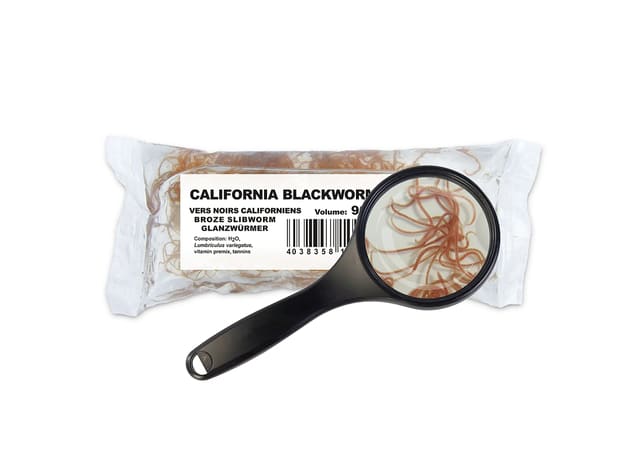
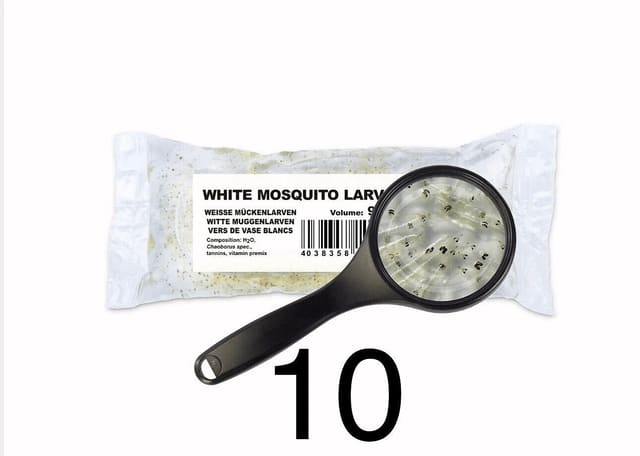
The supplier photograph shows a representative 90ml Daphnia bag and magnified live organisms. The ordered item is the 25-bag pack described above; all bags are not expected to appear together in a single product photograph. The first gallery graphic includes the numeral 10 and does not define the sale unit. The title, pack table, basket quantity and supplier record are the correct guides to what one quantity includes.
Live organisms and packing appearance can vary between batches. Daphnia density, colour, water tint, label placement and bag shape may not be identical to a reference photograph. The important fixed details are the supplied organism, the 90ml bag format and the 25-bag count.
No. One quantity is the complete pack of 25 separate 90ml bags.
The supplier identifies this live food as Daphnia pulex, commonly called water fleas.
No. It is a supplementary live food. Use it alongside a suitable prepared staple and other foods chosen for the fish you keep.
Not always. Supplied Daphnia may be too large for very small fry. Match prey size to mouth size and use a finer first food when needed.
Keep them chilled at 5-10 C, dark and temperature-stable. Do not freeze or overheat them, and inspect each bag before feeding.
The supplier states about seven days under the recommended chilled and dark conditions. Actual condition depends on the cold chain, transit and bag integrity, so use promptly and inspect before use.
It does not have to. You can collect the Daphnia in a suitably fine net and rinse gently with clean, dechlorinated water before feeding.
This is a freshwater live food. It should not be treated as a complete or equivalent marine larval feed, because marine species have different nutritional requirements.
No. Daphnia are small freshwater crustaceans, not biting insects.
Some animals may establish in suitable culture conditions, but the product is sold as feed and culture success is not guaranteed.
Product identity, pack size and storage guidance were checked against the current supplier catalogue and the supplier's Daphnia product record. General biology and nutrition were checked against the FAO's Daphnia and Moina live-food manual. These sources support the factual limits used here: Daphnia pulex, 25 x 90ml bags, 5-10 C chilled storage, approximately seven days under stable conditions, freshwater use, and a nutritional profile that varies with the Daphnia's own diet.
No reviews for this item yet. Bought one? Honest reviews only, good or bad.
What customers say about ordering from us
I have a small group of long finned mountain minnows. So was delighted to be able to order ten of this variety to increase the genetics in my tank . The ones I recieved are healthy but it’s to early to give a verdict on wether they are of a long finned type since they are small currently.
Gordon Walker · 23 Sept 2026
100% success travel and "installation". Pleased with quality of purchase. The Siamese fighter a bit "shy" so have not yet seen him at his best yet but looking good. Happy customer. GG
George E Garratt · 21 Sept 2026
Reviews of our shop, collected by Judge.me, an independent third-party review collector. Newest first.