
Moderate
Schreitmüller's Silver Dollar (Metynnis hypsauchen)
24–28°C · pH 6–7 · 260L
£7.99

A large, active South American grazing fish for mature 500L+ aquariums. Best as a single specimen or a properly planned group in a spacious display with plant-rich foods and strong filtration.
Adult size is the maximum length this species reaches at full maturity (scientific sources). The livestock you receive will be younger and smaller — pick a size variant above for the actual shipping size. Product-photo provenance and any image-specific limitations are stated on the listing.
Semaprochilodus taeniurus
Confirm your email, then we’ll send an availability message for this exact item if it returns within 180 days.
This request is only for this product—no newsletter or other promotions. A mail-provider retry may very rarely duplicate the same availability message. Unconfirmed addresses are removed after 48 hours. See our privacy policy.
A large, active South American grazing fish for mature 500L+ aquariums. Best as a single specimen or a properly planned group in a spacious display with plant-rich foods and strong filtration.
Adult size is the maximum length this species reaches at full maturity (scientific sources). The livestock you receive will be younger and smaller — pick a size variant above for the actual shipping size. Product-photo provenance and any image-specific limitations are stated on the listing.
24–28°C · pH 6–7 · 260L

23–28°C · pH 4.8–7.5 · 2550L

23–27°C · pH 5.5–7 · 60L
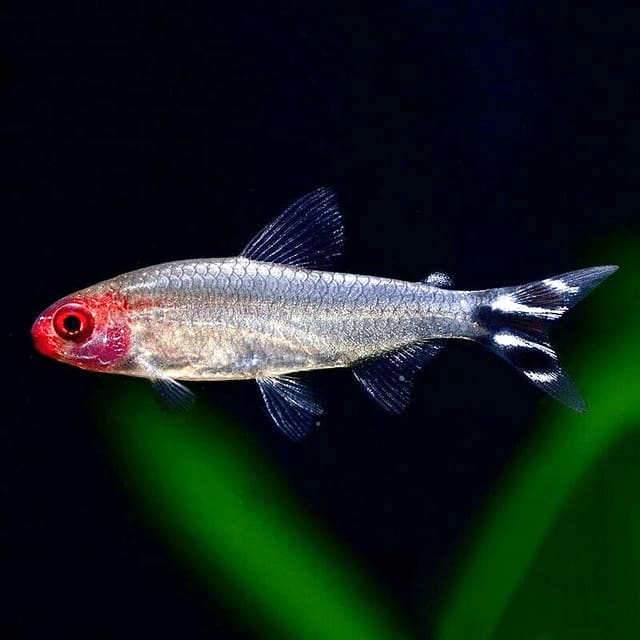
24–27°C · pH 5.5–7
Maintain these water conditions for optimal health and vibrant colors
Silver Prochilodus Red Fin (Semaprochilodus taeniurus) is a large, active South American characiform with a metallic silver body, contrasting tail bands and a specialised grazing mouth. It is peaceful for its size, but it is not a conventional small community fish: adults need a long, mature aquarium, strong filtration and a plant-rich diet.
FishBase records Semaprochilodus taeniurus from central parts of the Amazon basin, with a maximum published length of 27.2 cm standard length. Aquarium planning should allow for a fish around 30 cm overall. This listing is currently out of stock, so use the page as a care and space-planning guide while availability changes.
| Scientific name | Semaprochilodus taeniurus |
|---|---|
| Common names | Silver Prochilodus, Red Fin Silver Prochilodus, Flagtail Prochilodus |
| Family | Prochilodontidae |
| Origin | Central Amazon basin and tributary rivers, South America |
| Adult planning size | Around 30 cm overall; FishBase records 27.2 cm standard length |
| Minimum aquarium | About 500 litres with a long swimming footprint; larger is strongly preferred |
| Temperature | 23-26°C |
| pH | 5.5-7.5 |
| Temperament | Peaceful, energetic and constantly foraging |
| Diet | Plant-rich omnivore and detrital grazer; algae, biofilm, vegetables and prepared herbivore foods |
| Care level | Moderate to advanced because of adult size, activity and filtration needs |
| Conservation status | Least Concern in the FishBase-linked IUCN assessment |
Semaprochilodus taeniurus belongs to Prochilodontidae, the flannel-mouth characiforms. It is not a true tetra, although both groups sit within Characiformes. The body is laterally compressed and silvery, with darker scale edges and strongly patterned fins. Colour and contrast improve when the fish is settled, well fed and kept over a darker, natural-looking base.
The downturned, fleshy mouth is adapted for rasping organic films and processing fine material from submerged surfaces. This makes the species a useful grazer in a suitably large aquarium, but it should never be sold or purchased as a substitute for maintenance. It still needs deliberate feeding, and its adult size creates a substantial filtration load.
FishBase describes the species as freshwater, benthopelagic and potamodromous. In practical terms, it is a river fish built for movement within freshwater systems. The aquarium therefore needs open lanes for sustained swimming as well as surfaces for natural foraging.
A juvenile may look manageable in a dealer aquarium, but the long-term setup must be chosen for the adult fish. A 500-litre aquarium is a sensible minimum planning point for a single specimen, with a long footprint more valuable than extra height alone. Larger quarters are strongly preferred for multiple fish or a busy large-fish community.
| Layout element | Practical requirement | Why it matters |
|---|---|---|
| Swimming space | Long, uninterrupted front and midwater lanes | Allows normal cruising and reduces collision risk |
| Substrate | Smooth sand or fine rounded gravel | Protects the mouth while the fish grazes and investigates surfaces |
| Wood and stones | Secure, rounded pieces placed away from main routes | Adds grazing area without creating narrow bottlenecks |
| Plants | Hardy, protected or wood-attached species | Soft growth may be grazed or uprooted by a large active fish |
| Cover | A secure, well-fitted lid | Helps contain powerful startled movements |
Leave some mature surfaces rather than polishing every stone and piece of wood. A thin layer of natural biofilm gives the fish something to investigate between feeds. Keep decor stable enough that a full-grown fish cannot dislodge it.
Keep the aquarium between 23 and 26°C and within pH 5.5-7.5. Stability, oxygenation and low nitrogenous waste are more important than chasing one exact number. Acclimate carefully if the shop water and home aquarium differ significantly.
Use oversized biological and mechanical filtration with good circulation across the tank. The flow should support oxygenation and carry waste towards the filter without forcing the fish to struggle continuously. A large external filter or well-designed sump is easier to maintain than undersized equipment working at its limit.
| Routine | What to monitor |
|---|---|
| Daily | Swimming, breathing, appetite, grazing and any collision damage |
| Weekly | Ammonia and nitrite at zero, nitrate trend, temperature and equipment flow |
| Water changes | Use a regular schedule matched to stocking and measured nitrate accumulation |
| Filter care | Clean mechanical media before flow falls; preserve biological media from untreated tap-water exposure |
Silver Prochilodus is best managed as a plant-led feeder and detrital grazer. Offer quality spirulina or herbivore pellets, algae wafers and blanched vegetables such as courgette, spinach or shelled peas. Natural algae and biofilm can supplement the diet but are not enough on their own.
Small amounts of frozen invertebrate food may be used for variety, but a protein-heavy carnivore diet is inappropriate. Feed controlled portions once or twice daily and remove uneaten vegetables before they soften and degrade water quality. Watch the fish eat: an individual that stops grazing or repeatedly spits food may be stressed or unwell.
| Food type | Role in the diet | Use |
|---|---|---|
| Spirulina or herbivore pellets | Reliable staple | Offer measured portions that are fully consumed |
| Algae wafers | Grazing-style prepared food | Distribute across more than one feeding point in a community |
| Blanched vegetables | Fibre and variety | Remove leftovers after feeding |
| Frozen daphnia or similar small foods | Occasional supplement | Use sparingly rather than as the main diet |
The species is generally peaceful, but its speed and adult bulk can unsettle small, timid or slow-moving fish. Choose robust companions with similar water requirements and enough size to avoid being overwhelmed at feeding time. Avoid aggressive fin nippers, highly territorial large cichlids and fish needing a quiet, low-flow aquarium.
Conspecific planning needs space. A single fish can be kept as a centrepiece, while a group requires a substantially larger aquarium with room for every fish to turn and feed without crowding. Do not add several juveniles unless the final adult accommodation is already realistic.
| Potential companion type | Planning note |
|---|---|
| Large peaceful characiforms | Match adult size, feeding speed and swimming space |
| Robust South American catfish | Provide separate feeding access and avoid territorial cave conflicts |
| Small or timid community fish | Avoid; they may be stressed or outcompeted by constant movement |
| Fin nippers or aggressive cichlids | Avoid because harassment and collision injuries are likely |
Before introduction, quarantine new fish where practical and observe breathing, skin, fins, appetite and waste. Use a covered, cycled system with enough turning room even for temporary holding. Do not medicate routinely without a diagnosis.
Warning signs include clamped fins, heavy breathing, loss of grazing behaviour, repeated dashing, surface distress, skin marks or refusal to feed. Check water quality and oxygenation first. Abrasions can occur when a startled fish meets sharp decor or a tank that is too short for its movement.
This is a long-term, large-aquarium commitment. Plan for a decade-scale lifespan rather than treating the juvenile sale size as permanent. Confirm that the aquarium, floor support, filtration, maintenance access and backup equipment can all support the adult fish.
Home-aquarium breeding is not a realistic expectation for most keepers. The species is migratory within freshwater systems, and reproduction is associated with environmental and seasonal cues that are difficult to reproduce in an ordinary display tank. Sex differences are subtle outside breeding condition.
For welfare-focused husbandry, prioritise adult space, stable water and correct nutrition rather than attempting to trigger spawning. Do not make breeding claims based only on a fuller-bodied fish.
| A good choice when | Choose another species when |
|---|---|
| You have a mature 500-litre-plus aquarium with a long footprint | Your aquarium is small, newly cycled or heavily decorated with narrow routes |
| You can provide oversized filtration and regular water changes | You need a low-waste fish for modest equipment |
| You want a peaceful but highly active large grazer | You want a quiet nano community or delicate planted aquascape |
| You can provide a plant-rich diet for the life of the fish | You want a fish that can live only on generic community flakes |
FishBase records 27.2 cm standard length. Allow for an aquarium fish around 30 cm overall once the head and tail are included.
Plan from about 500 litres for a single adult, using a long aquarium with open swimming lanes. Groups and mixed large-fish communities need substantially more room.
It grazes algae, biofilm and fine organic material, but it still needs a complete plant-rich diet. It does not replace cleaning, filtration or water changes.
Yes, but use hardy or protected plants. Soft growth may be eaten and loosely rooted stems can be uprooted by a large active fish.
It is generally peaceful, although its speed and size can intimidate small or timid fish. Tank dimensions and companion choice remain important.
All current size variants have zero inventory. The care profile remains available so keepers can assess adult space and equipment before future stock arrives.
Browse the South American characiform collection or compare other large-fish planning routes in Other Freshwater Fish. For different body shapes and feeding strategies, compare the Silver Dollar group, Spotted Metynnis and Red-Bellied Pacu. These links are for care and space comparison, not an automatic tank-mate recommendation.
When stock returns, check the selected size, current availability and your adult-space plan before ordering. Eligible livestock orders travel with a licensed live-animal courier and are covered by the Live Arrival Guarantee when the published receiving and acclimation conditions are followed.
Max adult size is the length this species reaches at full maturity (from scientific sources). The livestock you receive will be younger and smaller — pick a size variant on the buy box for the actual shipping size. Product-photo provenance and any image-specific limitations are stated on the listing.
Choose spacious, calm tank mates. The species is peaceful, but active and large, so it should not be used to fill a small community aquarium.
Always research specific species before adding them to your tank. Consider:
No reviews for this item yet. Bought one? Honest reviews only, good or bad.
What customers say about ordering from us
I have a small group of long finned mountain minnows. So was delighted to be able to order ten of this variety to increase the genetics in my tank . The ones I recieved are healthy but it’s to early to give a verdict on wether they are of a long finned type since they are small currently.
Gordon Walker · 23 Sept 2026
100% success travel and "installation". Pleased with quality of purchase. The Siamese fighter a bit "shy" so have not yet seen him at his best yet but looking good. Happy customer. GG
George E Garratt · 21 Sept 2026
Reviews of our shop, collected by Judge.me, an independent third-party review collector. Newest first.
