Easy
White Widow Tetra – White Skirt Tetra (Gymnocorymbus ternetzi)
22–26°C · pH 6.5–7 · 68L
£5.19
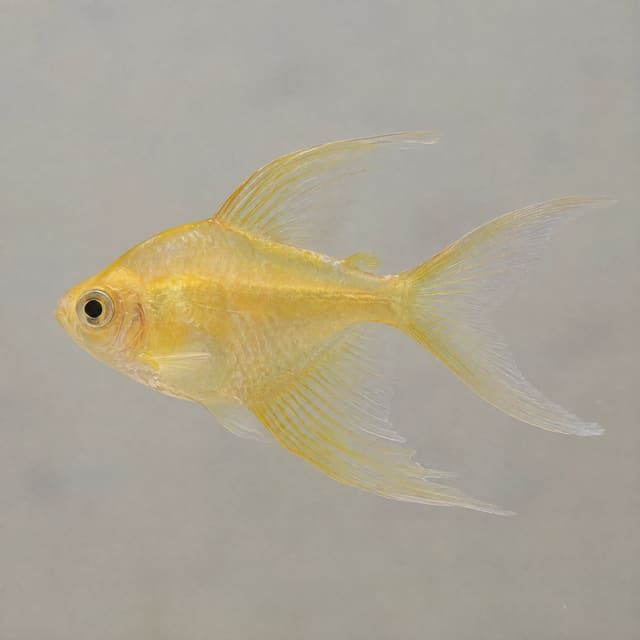
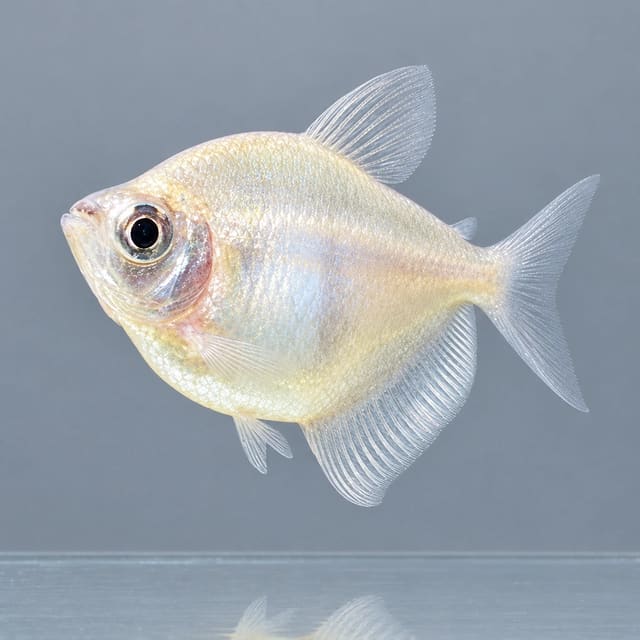
The Longfin White Widow Tetra is a captive-bred form of Gymnocorymbus ternetzi with a pearly white body, dark eyes and long, flowing fins. It is a hardy shoaling fish for a calm community aquarium with a 75 × 30 cm base, gentle flow and 22–26°C, kept in a group of twelve and away from fin-nippers. Sold individually as one live fish.
Gymnocorymbus ternetzi
Quantity discounts are pricing offers, not a group-size recommendation. Check the full care guidance and your existing animals before choosing a quantity.
The Longfin White Widow Tetra is a captive-bred form of Gymnocorymbus ternetzi with a pearly white body, dark eyes and long, flowing fins. It is a hardy shoaling fish for a calm community aquarium with a 75 × 30 cm base, gentle flow and 22–26°C, kept in a group of twelve and away from fin-nippers. Sold individually as one live fish.
Read the full care guidance when planning conditions for your aquarium.
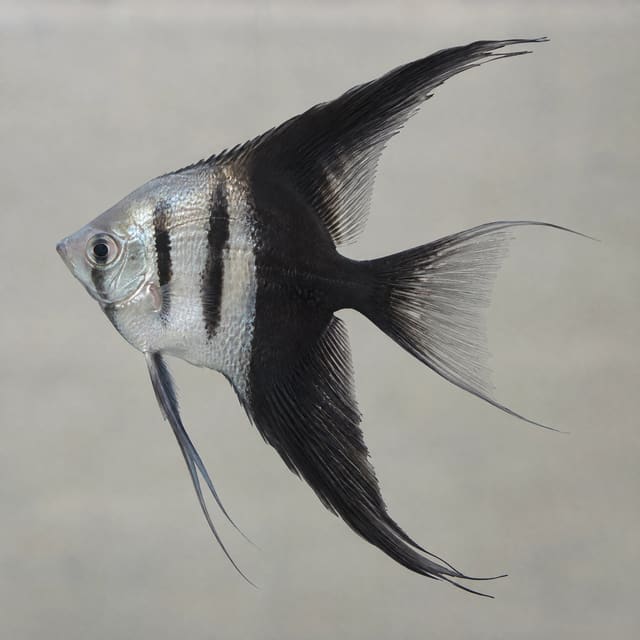
The Longfin White Widow Tetra is a pale, long-finned form of Gymnocorymbus ternetzi, the hardy black widow tetra from South America. It keeps the species' deep, diamond-shaped body but combines two traits bred for the aquarium: a pearly white (leucistic) colour with dark eyes, and extended, flowing fins. The dorsal fin rises tall and sweeps back, the anal fin trails in a long skirt, the pelvic fins stream behind and the tail lobes are drawn out, so a shoal looks almost veiled as it moves.
Seriously Fish lists long-finned and leucistic forms as man-made varieties selectively bred for the trade, and notes that every widow tetra on sale is captive bred. The wild fish comes from slow-moving creeks with dense overhanging vegetation in the Rio Paraguay and Guaporé basins of Brazil, Bolivia and Argentina. Those calm, plant-edged waters are a good guide to keeping the long-finned form well: gentle flow, soft edges and plenty of cover.
| Widow tetra | Colour | Fins |
|---|---|---|
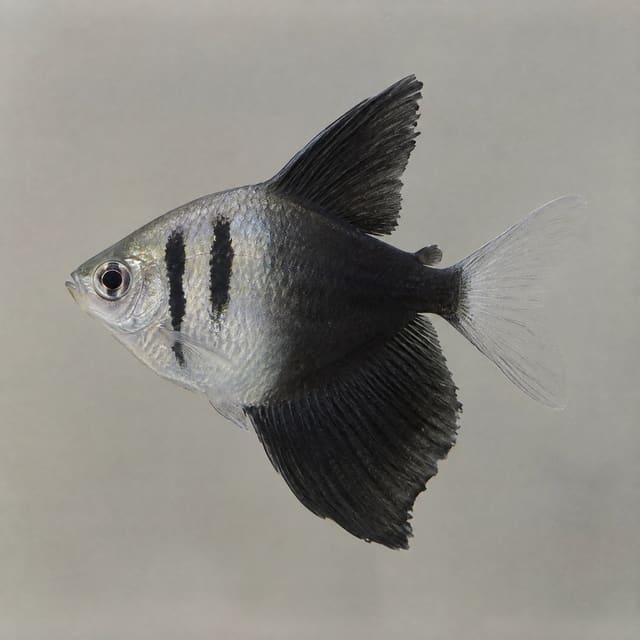
| Black Widow Tetra | Natural silver and black | Standard |
| Long-Fin Black Widow Tetra | Natural silver and black | Long |
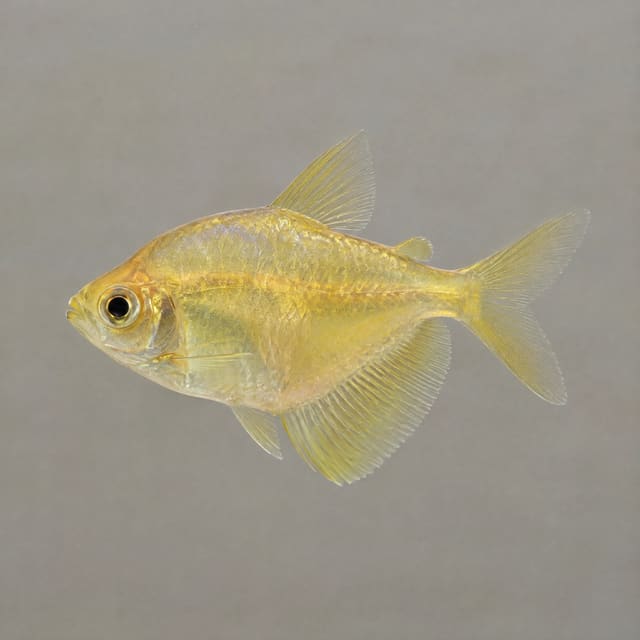
| Long-Fin Gold Widow Tetra | Pale form sold under a gold name | Long |
| White Widow / White Skirt Tetra | Pearly white, dark eyes | Standard |
| Longfin White Widow Tetra (this fish) | Pearly white, dark eyes | Long |
All of them are one species with the same care, so they can share a shoal. FishBase places the genus in the family Acestrorhamphidae, the American tetras, while Seriously Fish and OATA still use the older family Characidae. See the whole group on our Gymnocorymbus category page or browse all tetras for sale.
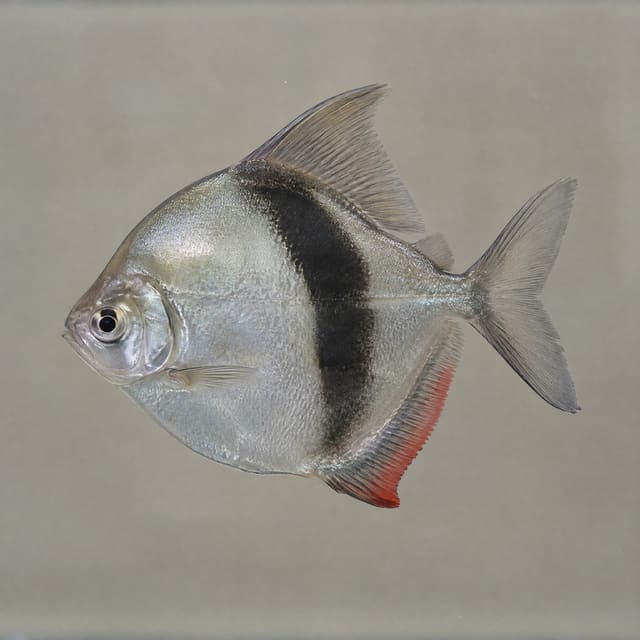
One purchase is one live Longfin White Widow Tetra at a medium-large size, priced per fish. It is a shoaling fish, so choose the number you need for a group. The photographs show the colour and fin form, not the individual fish; they were prepared from a reference image of this form, and fin length, sheen and body shape vary a little from fish to fish.
Long fins are delicate in transit, and a small nick or a slightly frayed edge on arrival usually regrows in clean water. Unpack promptly, keep the lights low and follow the acclimatisation steps below. Our delivery and Live Arrival Guarantee page explains dispatch days and what to do if anything is wrong on arrival.
The body grows to about 6–7.5 cm: Seriously Fish gives 60 mm standard length and FishBase 7.5 cm standard length, both measured without the tail. The long fins add noticeably to the overall size and to the space the fish needs to turn and swim without catching them on décor.
Seriously Fish recommends a base of at least 75 × 30 cm, about 68 litres, for a group, FishBase a minimum aquarium length of 60 cm, and OATA at least 80 litres for tetras of 5 cm or more. For a shoal of twelve long-finned fish, the larger figure gives the fins room.
If you are setting up from scratch, our first tropical tank guide explains how to mature the filter before the fish arrive.
Seriously Fish describes the widow tetra as an active fish that wants open swimming space with some quieter areas, and says it shows its best colours with dense planting and floating plants that dim the light. For a long-finned form, choose décor with soft edges: fine-leaved and broad-leaved plants, smooth wood and rounded stones rather than sharp rock or rough ornaments that can split fins.
| Area | Purpose |
|---|---|
| Open central lane | Room for the shoal to swim without catching its fins |
| Dense planting at the back and sides | Shelter and quieter water out of the main current |
| Floating plants | Dimmer light and a calmer shoal |
| Smooth wood and rounded stones | Structure without sharp edges |
OATA recommends gravel or sand and, ideally, live plants for cover. Place the aquarium away from draughts, heat sources and direct sunlight, and cover filter intakes with a sponge so trailing fins cannot be pulled against them.
Seriously Fish calls captive-bred widow tetras unfussy about water chemistry, but its range differs from FishBase and OATA. Aim for the values all three accept, and keep them steady.
| Reading | Published ranges | Target |
|---|---|---|
| Temperature | Seriously Fish and FishBase 20–26°C; OATA 22–27°C | 22–26°C |
| pH | Seriously Fish 6.0–7.0; FishBase 6.0–8.0; OATA 6.5–8.0 | 6.5–7.0 |
| General hardness | Seriously Fish 5–20 dGH; FishBase 5–19 dH; OATA 4–12°dH | 5–12 dGH |
| Ammonia and nitrite | OATA: zero mg per litre | Zero |
| Nitrate | OATA: no more than 20 mg per litre above tap water | As low as possible |
If your tap water is hard and alkaline, as it is in much of the UK, the fish can still do well: FishBase and OATA both accept up to pH 8.0. Steady water is better than water adjusted up and down. Compare your own readings with these ranges using our water matcher, and see the water chemistry guide for what each value means.
Long fins are the first thing to suffer when water quality slips. Ragged edges, milky margins or fins that fray back towards the body can all follow a build-up of waste, so clean, well-filtered water is the best protection. For a 68-litre tank, Seriously Fish suggests a filter rated at 270–340 litres per hour and a heater of roughly 50 W in a room at about 20°C; spread the filter return so the flow stays gentle.
Our guide to aquarium filtration explains how to keep good flow without strong currents.
The widow tetra is "a most unfussy, omnivorous species", according to Seriously Fish, which recommends flakes and granules with regular small live and frozen foods such as Daphnia and bloodworm. FishBase records that wild adults live in the middle and upper water layers and eat worms, small crustaceans and insects. Long fins add drag, so watch that every fish in the shoal gets its share when faster tank mates join in at feeding time.
Overfeeding does the fins no favours: leftover food breaks down into the waste that fin rot follows. Remove anything uneaten after a few minutes.
Before the fish arrive, confirm that ammonia and nitrite read zero and that temperature, pH and hardness are in range. Use OATA's floating-bag method with the lights off: float the bag for 10 minutes, add small amounts of tank water over up to 20 minutes, then net the fish gently into the tank, letting in as little bag water as possible. Handle long-finned fish with a soft, fine net. Our guide to acclimatising new fish covers each step.
| When | What to do |
|---|---|
| Arrival | Acclimatise in dim light and leave the lights off until the next day |
| Day one | Offer a small meal and check every fish feeds |
| Days two to five | Check fins for new splits and watch for chasing |
| Day seven | Retest ammonia and nitrite and carry out the weekly water change |
Small splits from the journey usually close in clean water. Fins that keep getting worse, or a fish that hides alone and stops feeding, need a water test and a look at the tank mates.
The long-finned form brings a two-way question. The widow tetra itself has a reputation as a fin nipper, which Seriously Fish says can usually be fixed by keeping at least 12 together. At the same time, its own long fins are a target for other nippers, so the safest communities are calm ones.
| Suits | Avoid |
|---|---|
| Livebearers such as platies | Known fin-nippers such as Tiger Barbs and Serpae Tetras |
| Peaceful tetras, danios and rasboras such as Harlequins | Large predators that could swallow a 6–7.5 cm tetra |
| Bronze Corydoras and smaller plecos | Very fast, boisterous fish that outcompete it at feeding time |
| Robust dwarf cichlids such as the Kribensis, as Seriously Fish suggests | Fish kept above 26°C, such as discus |
Our tank mates checker compares temperature and adult size, and our tetra guide suggests calm community mixes.
Check the shoal at every feed while the fish are out in the open. OATA lists the changes worth noticing in any fish: swimming, colour, temperament, breathing, appearance, body condition and feeding. In a long-finned fish, the fins are the early warning.
| If you see | Do this |
|---|---|
| Fresh splits or missing fin tips | Watch for nipping; review the shoal size and tank mates |
| Ragged edges with white or milky margins | Test the water at once; read our fin rot guide |
| Fins held clamped against the body | Test ammonia, nitrite and temperature |
| Salt-grain white spots | See our white spot guide and test the water |
| Fast breathing or gasping at the surface | Test the water and check the filter and heater |
| A fish hiding alone and not feeding | Check for bullying and water quality |
If signs continue after the water is corrected, contact us with your test results and tank details.
Seriously Fish describes the species as quite easily bred in a separate, dimly lit tank of about 18 × 12 × 12 inches, with java moss, spawning mops or a mesh base to protect the adhesive eggs. A group of about six of each sex can spawn together, or a conditioned pair can be moved to a spawning tank at about 28–30°C with slightly acidic water after conditioning at about 24–25.5°C; they usually spawn the next morning. Remove the adults once eggs appear. The eggs hatch in 18–36 hours, the fry swim freely a few days later and take infusoria first, then microworm or brine shrimp nauplii, in dim light.
Males are slimmer and a little smaller than females, with more pointed dorsal and anal fins, according to Seriously Fish; in a long-finned form the extended fins can make that fin difference harder to judge, so body shape is the easier guide.
No. It is a selectively bred form of Gymnocorymbus ternetzi, the black widow tetra, combining the pale white (leucistic) colour with long fins. Seriously Fish lists both long-finned and leucistic forms as man-made varieties bred for the trade.
They can. Keep it away from known fin-nippers such as tiger barbs and serpae tetras, and keep the widow tetras themselves in a full shoal so they squabble among themselves rather than with other fish.
The species has a reputation as a bit of a fin nipper. Seriously Fish says this can usually be fixed by keeping a shoal of at least 12, when any squabbling generally stays within the group.
Six at the very least, and twelve if you can. FishBase and OATA give five or more as the minimum, and Seriously Fish recommends at least twelve to curb nipping.
About 6–7.5 cm in body length, plus its long fins. Seriously Fish gives 60 mm standard length and FishBase 7.5 cm standard length; neither includes the tail.
A tank with at least a 75 × 30 cm base (about 68 litres, Seriously Fish), or 80 litres for a full shoal (OATA), with a gentle current. Aim for 22–26°C, pH 6.5–7.0 and 5–12 dGH, where the sources overlap.
Yes. Black, gold, white and long-finned widow tetras are all one species and can share a shoal. Long-finned fish do best when none of the shoal is short-finned and boisterous enough to chase them.
Keep the water clean with weekly 25% water changes, avoid sharp décor and strong currents, keep a full shoal and avoid fin-nipping tank mates. Ragged fin edges with white margins can mean fin rot, so test the water at once.
No reviews for this item yet. Bought one? Honest reviews only, good or bad.
What customers say about ordering from us
Easy website plenty of info on fish your buying great to pick a time slot
TRACEY DURRANT · 7 Oct 2026
Got some lovely fish thank you
Kevin Mackie · 7 Oct 2026
Reviews of our shop, collected by Judge.me, an independent third-party review collector. Newest first.
Moved by UK carriers licensed to handle live animals
Hand-packed with oxygen bags, poly box, heat pack
Email photos the same day; an optional unboxing video helps us review problems faster — claim terms apply
Klarna & PayPal Pay in 3 at checkout