Easy
Black Widow Tetra (Gymnocorymbus ternetzi)
22–26°C · pH 6.5–7 · 68L
From £3.39Some sizes on sale
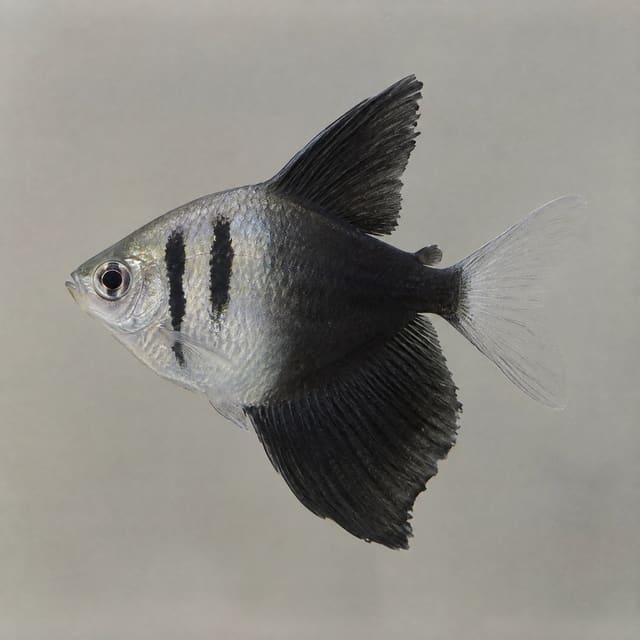
The White Widow Tetra, also sold as the White Skirt Tetra, is a pale, captive-bred form of the black widow tetra (Gymnocorymbus ternetzi) with a pearly white body, a deep skirt-like anal fin and dark eyes. It is a hardy, lively shoaling fish for a community aquarium with a 75 × 30 cm base at 22–26°C, best kept in a group of twelve. Sold individually as one live fish.
Gymnocorymbus ternetzi
Quantity discounts are pricing offers, not a group-size recommendation. Check the full care guidance and your existing animals before choosing a quantity.
The White Widow Tetra, also sold as the White Skirt Tetra, is a pale, captive-bred form of the black widow tetra (Gymnocorymbus ternetzi) with a pearly white body, a deep skirt-like anal fin and dark eyes. It is a hardy, lively shoaling fish for a community aquarium with a 75 × 30 cm base at 22–26°C, best kept in a group of twelve. Sold individually as one live fish.
Read the full care guidance when planning conditions for your aquarium.
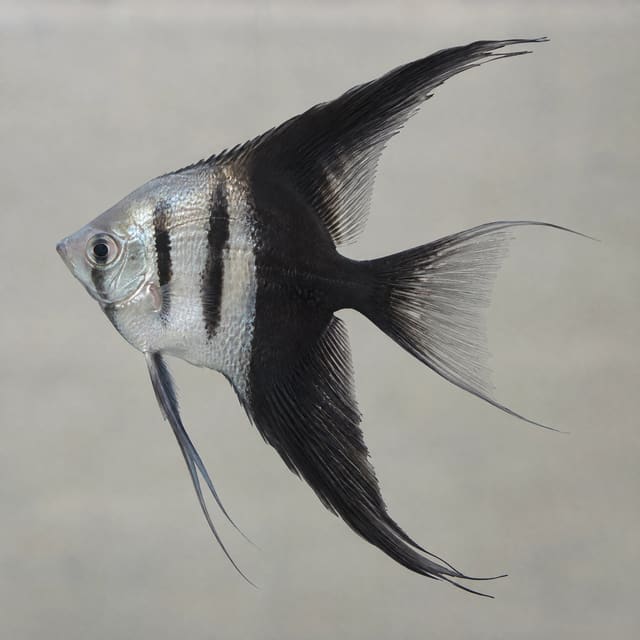
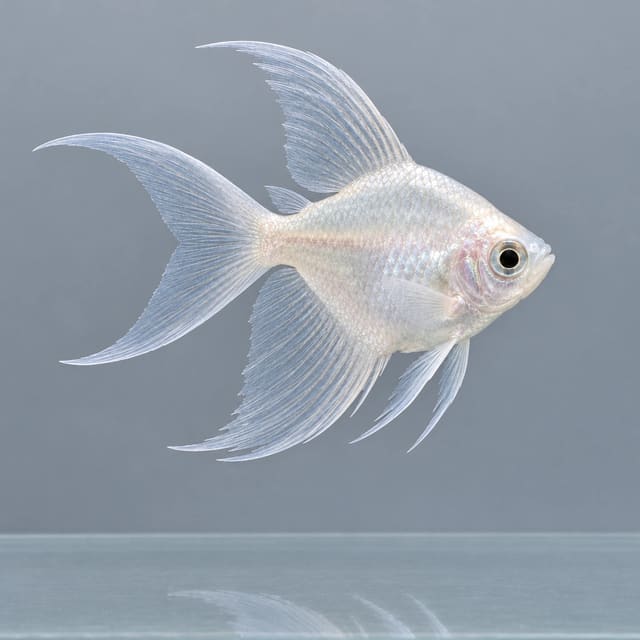
The White Widow Tetra, also sold as the White Skirt Tetra, is a pale, selectively bred form of Gymnocorymbus ternetzi, the familiar black widow tetra. It has the same deep, rhomboid body and the large, skirt-like anal fin that gives the species its names, but the body is a pearly, silvery white with a soft cream sheen and the fins are clear to milky white. The eye stays dark, which marks it as a pale (leucistic) fish rather than an albino.
The wild species comes from small, slow-moving creeks and streams, usually with dense overhanging vegetation, in the Rio Paraguay and Guaporé basins of Brazil, Bolivia and Argentina, according to Seriously Fish. Every widow tetra in the trade is captive bred, and Seriously Fish rates it one of the better tetras for a general community aquarium and one of the best choices for a newcomer to fishkeeping. Kept in a proper shoal, a group of white widows makes a bright, moving contrast to green plants and darker fish.
| Name | What it is |
|---|---|
| Black Widow Tetra (black skirt, butterfly or black tetra) | The natural colour form: silver with dark bars, a black rear body and black fins; the intense black of young fish fades as they grow |
| White Widow / White Skirt Tetra (this fish) | A leucistic form with a pale white body and dark eyes; Seriously Fish notes the leucistic form is often sold under this name |
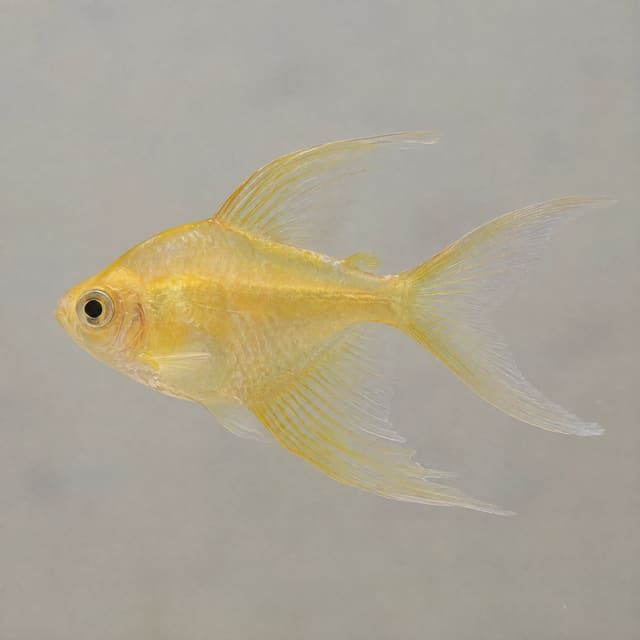
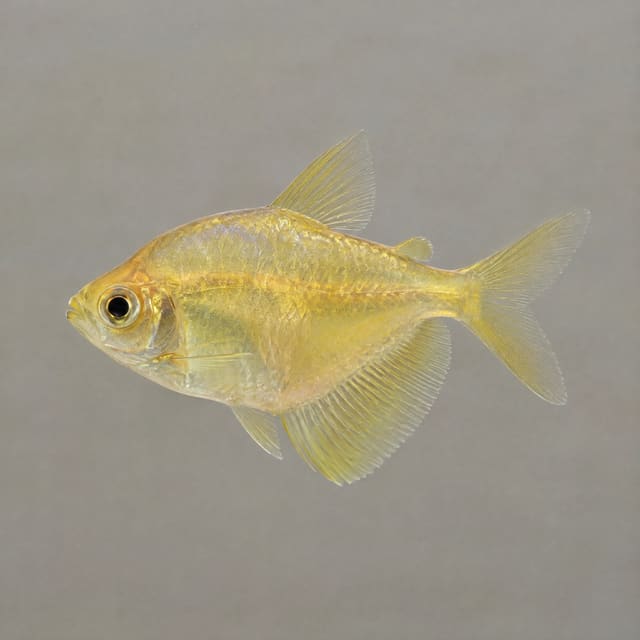
| Gold Widow Tetra | Another pale form sold under a gold name; trade names for the pale forms overlap |
| Long-Fin Black Widow and Long-Fin Gold Widow | Long-finned forms of the same species, with extended dorsal, anal and tail fins |
| Dyed or "painted" widow tetras | Fish injected with artificial colour; Seriously Fish says this is very stressful and often shortens their lives considerably. We do not sell dyed fish. |
All of these are one species, Gymnocorymbus ternetzi, so they share the same care and can be mixed in one shoal. FishBase now places the genus in the family Acestrorhamphidae, the American tetras; older books, Seriously Fish and OATA still list it under Characidae. Browse every form together on our Gymnocorymbus widow tetra page, or see the wider tetras range.
One purchase is one live White Widow Tetra, supplied at a medium size. The price is per fish, so add the number you want to your basket: this is a shoaling fish and should never be kept alone. The photographs show the colour form, not the individual you will receive; they were prepared from a reference image of this form, and each fish varies slightly in size, sheen and fin shape.
A medium fish is a young, growing tetra rather than a full adult. It will fill out into the deep-bodied adult shape over the following months, so plan the aquarium for the adult size given below.
Before you order, read our delivery days and Live Arrival Guarantee so you are at home when the fish arrive and the aquarium is ready for the whole group.
Plan for an adult of about 6–7.5 cm. Seriously Fish gives a maximum of 60 mm standard length, while FishBase records 7.5 cm standard length; standard length is measured without the tail. The difference is small, but it is worth planning for the larger figure because the widow tetra is a deep-bodied fish with more bulk than a slim tetra of the same length.
Seriously Fish recommends an aquarium base of at least 75 × 30 cm, about 68 litres, for a group. FishBase gives a minimum aquarium length of 60 cm, and OATA recommends at least 80 litres for tetras of 5 cm or more. For a full shoal of twelve, work towards the larger figure.
Our stocking calculator checks a mixed community against your tank, and the first tropical tank guide explains how to set up and mature a new aquarium before any fish arrive.
Seriously Fish describes this tetra as fairly unfussy about décor: it is an active fish that wants plenty of open swimming space along with some quieter areas, and it shows its best colours with some dense planting and floating plants to dim the light. It will thrive in most layouts, which makes it easy to fit into an existing community.
| Area | Purpose |
|---|---|
| Open midwater lane | Space for the shoal to swim and feed together |
| Dense planting at the back and sides | Quieter areas and cover without closing the swimming lane |
| Floating plants | Dims the light, which Seriously Fish says brings out the best colour |
| Dark substrate or background | A design choice that makes a white fish stand out clearly |
OATA recommends aquarium gravel or sand and, ideally, live plants for cover, with plastic plants and ornaments as an alternative. Keep the aquarium away from draughts, heat sources and direct sunlight. A white fish shows every speck of algae and debris on the glass behind it, so a tidy, well-planted tank shows this form at its best.
Captive-bred widow tetras are adaptable. Seriously Fish describes all the fish in the trade as unfussy about water chemistry, but the three main sources give different ranges, so the safest target is where they overlap.
| Reading | Seriously Fish | FishBase | OATA (tetras) | Target |
|---|---|---|---|---|
| Temperature | 20–26°C | 20–26°C | 22–27°C | 22–26°C |
| pH | 6.0–7.0 | 6.0–8.0 | 6.5–8.0 | 6.5–7.0 |
| General hardness | 5–20 dGH | 5–19 dH | 4–12°dH | 5–12 dGH |
| Ammonia and nitrite | OATA: zero mg per litre | Zero | ||
| Nitrate | OATA: no more than 20 mg per litre above tap water | As low as possible | ||
Many UK homes have hard tap water with a pH above 7. FishBase and OATA both accept up to pH 8.0, so a stable tank a little above the overlap is better than one pushed up and down with chemicals. Test your tap water and compare it with these ranges using our water matcher; the water chemistry guide explains what each reading means.
For a 68-litre tank, Seriously Fish suggests a filter rated at 270–340 litres per hour, four to five times the tank volume, and a heater of roughly 50 W in a room at about 20°C. A shoal of active, deep-bodied tetras eats well and produces steady waste, so the filter must be mature before they arrive. Our guide to the aquarium nitrogen cycle explains how a new filter matures.
Keep the heater and filter running all the time. A sudden drop in temperature or a stopped filter affects a whole shoal at once, so check both at every feed.
Seriously Fish calls this "a most unfussy, omnivorous species". FishBase records that wild adults live in the middle and upper water layers and feed on worms, small crustaceans and insects. In the aquarium, a good flake or small granule makes the staple, with regular small live or frozen foods such as Daphnia and bloodworm.
Uneaten food that drifts to the floor breaks down into waste. If bottom fish such as Corydoras share the tank, give them their own sinking food rather than feeding the tetras more.
Check that ammonia and nitrite read zero and that temperature, pH and hardness sit within the target ranges before the fish arrive. OATA's floating-bag method works well for tetras: lights off, float the bag for 10 minutes, then add small amounts of tank water over up to 20 minutes before netting the fish into the tank with as little bag water as possible. Our guide to acclimatising new fish shows each step.
| When | What to do |
|---|---|
| Arrival day | Acclimatise with the lights off and leave the lights off for the rest of the day |
| Next day | Offer a small meal and check that every fish comes out to feed |
| Days two to six | Watch the shoal swim together; look for clamped fins or a fish hiding alone |
| Day seven | Retest ammonia and nitrite and do the normal water change |
Newly arrived fish often look paler or hide for a day or two. That settles as they find their place in the shoal; a fish that stays alone, stops feeding or breathes rapidly needs a water test straight away.
The widow tetra is generally peaceful and lively, but Seriously Fish notes it has a reputation as a bit of a fin nipper. The fix is numbers: in a shoal of at least 12, any squabbling is generally kept within the group. FishBase and OATA give five or more as the minimum, and fish kept singly or in too small a group often become stressed.
| Suits | Avoid |
|---|---|
| Livebearers such as platies | Slow fish with long, trailing fins, such as bettas or fancy guppies, unless the widows are in a full shoal and you can watch closely |
| Danios and rasboras such as Harlequins | Large predators that could swallow a 6–7.5 cm tetra |
| Peaceful bottom fish such as Bronze Corydoras and smaller plecos | Fish kept much warmer than 26°C, such as discus |
| Robust dwarf cichlids such as the Kribensis | A shoal of only two or three widows, which encourages nipping |
Seriously Fish adds that the widow tetra's rounded shape means it is unlikely to be eaten by larger fish such as angelfish, but keep an eye on long-finned companions. Our tank mates checker compares temperature and size before you buy, and our tetra guide and beginner fish guide suggest community combinations.
Pale fish make some problems easy to spot: white spots are harder to see on a white body, but reddening, frayed fins and cloudy patches stand out. Look over the whole shoal at each feed. OATA lists the signs to watch for in all fish: changes in swimming, colour, temperament, breathing, appearance, body condition and feeding.
| If you see | Do this |
|---|---|
| Fish gasping at the surface or breathing fast | Test ammonia, nitrite and temperature at once |
| Clamped fins or a fish hiding alone | Check the water, then the shoal size and any bullying |
| Frayed or split fins | Look for nipping within or outside the shoal; test the water |
| Salt-grain white spots or fluffy patches | Test the water and seek advice before treating |
| Reddened skin or streaks in the fins | Test the water and review maintenance and recent additions |
| Thin body or poor appetite | Check that it is reaching food; review portion and water |
Our guides to white spot treatment and fin rot cover the most common problems. If signs continue after you have corrected the water, contact us with your test results.
Seriously Fish describes the species as quite easily bred in a separate tank of about 18 × 12 × 12 inches, dimly lit, with fine-leaved plants such as java moss, spawning mops, or a mesh base that lets the adhesive eggs fall out of the adults' reach. Group spawning works with about half a dozen of each sex. For pair spawning, condition males and females separately at about 24–25.5°C on live and frozen foods, then move the fullest female and best-coloured male to a spawning tank at about 28–30°C with slightly acidic water; they usually spawn the following morning.
Remove the adults as soon as eggs appear, because they eat them. The eggs hatch in 18–36 hours and the fry swim freely a few days later; feed infusoria first, then microworm or brine shrimp nauplii, and keep the tank dim because eggs and fry are light-sensitive. Males are noticeably slimmer, a little smaller and have more pointed dorsal and anal fins than females.
Yes. Both are trade names for the same pale, selectively bred form of Gymnocorymbus ternetzi, the species better known as the black widow or black skirt tetra. Seriously Fish notes that the leucistic form is often sold as the white skirt tetra.
No. It is a colour form bred for its pale body, not a dyed fish. Seriously Fish warns against artificially dyed widow tetras, which are injected with colour, a process that is very stressful and often shortens their lives considerably.
At least six, and ideally twelve. FishBase and OATA give groups of five or more as the minimum, and Seriously Fish says a shoal of at least 12 usually stops the fin-nipping the species is known for.
About 6–7.5 cm in body length. Seriously Fish gives 60 mm standard length and FishBase 7.5 cm standard length; standard length leaves out the tail.
Seriously Fish recommends a base of at least 75 × 30 cm, about 68 litres, for a group, and OATA recommends at least 80 litres for tetras of 5 cm or more. A full shoal of twelve is happiest at the larger end.
Aim for 22–26°C, pH 6.5–7.0 and 5–12 dGH, where Seriously Fish, FishBase and OATA overlap. Captive-bred fish are adaptable, so a stable tank slightly outside this is better than one that keeps changing.
Livebearers, danios, rasboras, other tetras, Corydoras, smaller plecos and robust dwarf cichlids such as kribensis, as Seriously Fish suggests. Be careful with slow, long-finned fish unless the widows are in a full shoal.
Both are pale forms of the same species. This listing is the white-bodied fish with dark eyes shown in the photographs; trade names for the pale forms overlap, so if you want a warmer gold tone, look at the Gold Widow Tetra instead.
No reviews for this item yet. Bought one? Honest reviews only, good or bad.
What customers say about ordering from us
Easy website plenty of info on fish your buying great to pick a time slot
TRACEY DURRANT · 7 Oct 2026
Got some lovely fish thank you
Kevin Mackie · 7 Oct 2026
Reviews of our shop, collected by Judge.me, an independent third-party review collector. Newest first.
Moved by UK carriers licensed to handle live animals
Hand-packed with oxygen bags, poly box, heat pack
Email photos the same day; an optional unboxing video helps us review problems faster — claim terms apply
Klarna & PayPal Pay in 3 at checkout