Dwarf Pencilfish (Nannostomus marginatus)
24–26°C · pH 6.5–7 · 41L
£6.99

Small, peaceful Shining Pencilfish for mature planted aquariums. Best in a calm shoal with soft water, gentle flow, fine foods and shaded cover. Covered by our Live Arrival Guarantee.
Adult size is the maximum length this species reaches at full maturity (scientific sources). The livestock you receive will be younger and smaller — pick a size above for the actual shipping size. Product-photo provenance and any image-specific limitations are stated on the listing.
Nannostomus nitidus
Shoaling fish: kept in a group they feel safer, stay calmer and show their best colour.
Confirm your email, then we’ll send an availability message for this exact item if it returns within 180 days.
This request is only for this product—no newsletter or other promotions. A mail-provider retry may very rarely duplicate the same availability message. Unconfirmed addresses are removed after 48 hours. See our privacy policy.
Small, peaceful Shining Pencilfish for mature planted aquariums. Best in a calm shoal with soft water, gentle flow, fine foods and shaded cover. Covered by our Live Arrival Guarantee.
Adult size is the maximum length this species reaches at full maturity (scientific sources). The livestock you receive will be younger and smaller — pick a size above for the actual shipping size. Product-photo provenance and any image-specific limitations are stated on the listing.
Maintain these water conditions for optimal health and vibrant colors
Shining Pencilfish (Nannostomus nitidus) is a small, elegant South American pencilfish for mature planted aquariums with calm tank mates and gentle flow. It is the fish currently listed by the supplier under the older trade wording “Nitindus/Nitidus Pencilfish”, but the clearer customer-facing name is Shining Pencilfish because nitidus means shining or bright and this species shows a fine metallic line above the dark body stripe.
This is not a bold, boisterous tetra. It is a delicate, upper-to-midwater shoaling fish that looks best in a quiet group, especially under floating plants, over dark substrate and around fine-leaved planting. The body stays slim and pencil-shaped, so even adult fish remain visually light in the aquarium. Choose it for a peaceful planted community, blackwater-style nano display, or specialist soft-water setup rather than for a busy mixed tank with fast-feeding or nippy species.
FishBase lists Nannostomus nitidus in the pencilfish family Lebiasinidae, within Characiformes, with a freshwater tropical range and a maximum recorded size of 3.5 cm standard length. That makes it smaller than many common pencilfish and much more suitable for restrained aquascapes than for high-energy community tanks. FishBase also places the species in South America, specifically the Capim River basin in Para, Brazil, and marks it harmless to humans and Least Concern on the IUCN assessment used there.
The Capim River connection matters for care. This is a fish from warm South American freshwater, not a general “community fish” that should be pushed into hard, bright, high-current aquariums. Think tannin-tinted water, root tangles, plant cover, leaf litter edges and shaded margins. You do not need to build an exact biotope, but stable soft water, low nitrate, shaded cover and a mature biological filter will make the fish settle faster and show better colour.
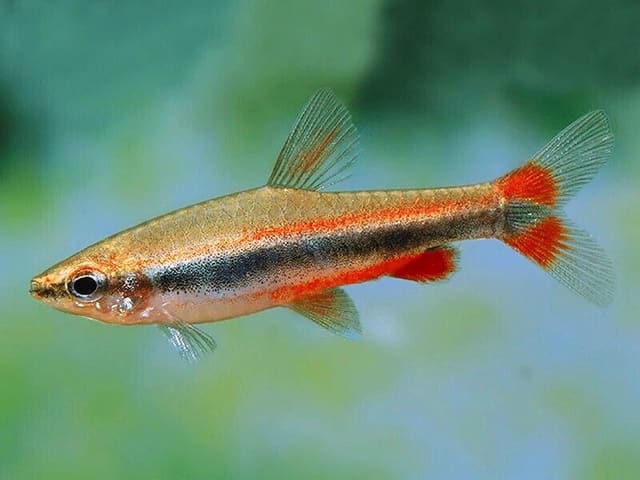
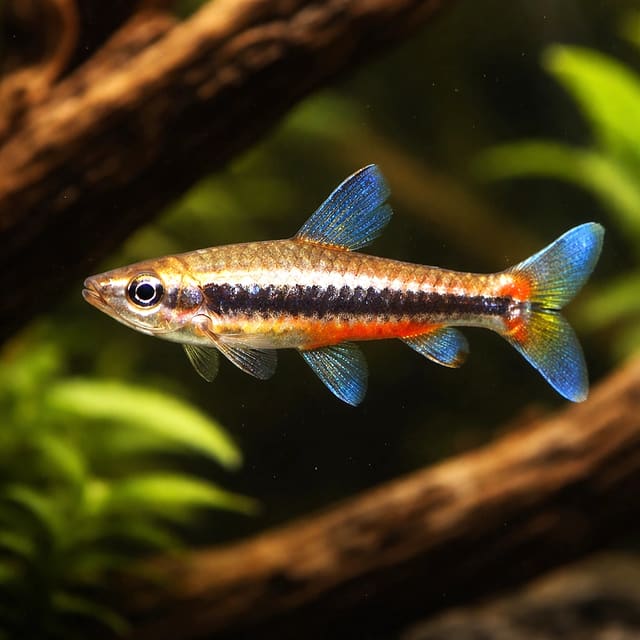
Shining Pencilfish have the narrow body shape that gives pencilfish their name. The reference photo and existing aquarium visuals show a dark horizontal stripe, reflective blue-silver highlights, yellow to golden body tones and red-orange detail near the caudal area. In a softly lit planted tank those colours read as subtle flashes rather than loud blocks of colour. They are especially attractive when a group hovers together above moss, fine stems or branching wood.
Expect individual variation. Sex, age, stress level, lighting and catch locality can all affect how strongly the line, fin colour and metallic sheen appear. Newly arrived fish may look paler while they settle. A quiet group, dark background, floating cover and small live/frozen foods usually do more for colour than stronger lighting.
Use a mature aquarium of at least 60 litres for a small group, with more length and plant cover always welcome. The priority is not raw volume alone; it is stability, shade and a calm surface-to-midwater zone. Fine-leaved plants, moss, floating plants, botanicals, leaf litter, slim branches and open lanes for gentle cruising all suit this species. A dark substrate or darker rear background helps the reflective body line stand out without making the fish feel exposed.
Flow should be gentle. Pencilfish do not appreciate being pinned in a strong filter return, and TFH pencilfish guidance also warns against very strong current. A sponge filter, baffled return or planted tank with soft circulation is usually better than a high-powered jet. Keep the aquarium covered, especially if using floating plants or a lower water line, because pencilfish can jump when startled.
Aim for 24-28 C, with stable conditions more important than chasing a single perfect number. FishBase gives 24-28 C for the species. The existing care range of pH 5.5-7.0 is sensible for a soft-water pencilfish; slightly acidic to neutral water is the target, with low to moderate hardness. A practical range is around 1-10 dGH, while very hard alkaline water is best avoided.
Keep nitrate low, avoid sudden swings and make water changes moderate rather than dramatic. Regular 15-25% changes, careful acclimation and a cycled filter are more valuable than constant parameter adjustments. If your tap water is naturally hard, consider blending with RO water and remineralising to a stable, gentle level rather than using quick chemical drops.
Keep Shining Pencilfish in a group of at least six, with eight to twelve or more preferred when space allows. A larger group spreads social attention, reduces nervousness and makes the fish easier to feed because individuals gain confidence from one another. They are peaceful, but not built for rough company. If kept singly or in a tiny group they can become shy, pale and reluctant to compete at feeding time.
In the aquarium they usually patrol the upper and middle layers with a poised, slightly stiff swimming style typical of pencilfish. Males may display, hold small spaces or flare at one another, but in a planted group this is normally part of the charm rather than a serious aggression problem. Provide broken sight lines so weaker fish can move away without being chased across open water.
This is a small-mouthed micropredator. Offer foods that match the mouth size: daphnia, cyclops, baby brine shrimp, small mosquito larvae, microworms, finely crushed quality flakes, micro granules and small frozen foods. TFH pencilfish guidance is useful here because it emphasises fine-grained food and small live/frozen prey for pencilfish with tiny mouths. Large flakes or chunky frozen cubes often get ignored or stolen by faster tank mates.
Feed small amounts once or twice daily and watch that the pencilfish actually get food. In a mixed community, add food near floating plants or a quiet corner so fast tetras, barbs or livebearers do not clear everything first. A varied diet supports colour, condition and breeding behaviour. Do not rely on one dry food if you want the best display from this species.
Good tank mates are small, calm fish with similar water needs: green neon tetras, ember tetras, small rasboras, dwarf Corydoras, Otocinclus, peaceful dwarf cichlids in suitable soft-water setups, small pencilfish and other gentle characins. Adult dwarf shrimp can work in heavily planted tanks, but tiny shrimplets may be sampled because pencilfish naturally take very small invertebrate foods.
Avoid large cichlids, predatory fish, tiger barbs, fin-nippers, highly competitive feeders, large livebearers and any fish that needs hard alkaline water. The most common mistake is putting pencilfish in a tank that looks peaceful to the human eye but is too busy at feeding time. If the Shining Pencilfish are hanging back, fading, or only eating scraps, the community is not right for them.
Breeding is possible but specialist. Like many small pencilfish, they are more likely to spawn in very clean, soft, slightly acidic water with fine plants, moss or spawning mops. Adults may eat eggs, so a dedicated breeding tank is best if fry are the goal. The first foods need to be tiny, such as infusoria or other microscopic foods, before moving onto newly hatched brine shrimp as the fry grow.
For most aquarists, the main goal should be long-term condition rather than breeding. A settled group that feeds confidently, holds colour and glides through a shaded planted tank is already a strong result.
Shining Pencilfish are small and delicate, so acclimation matters. Dim the aquarium lights, float the bag to equalise temperature, then gradually mix small amounts of tank water over 30-45 minutes before release. Add them to a mature tank, not a new setup. Keep the first feed light and observe breathing, posture and group behaviour over the next few days.
This listing is best for aquarists who enjoy subtle detail: small fish behaviour, planted-tank composition, soft-water care and a calm shoal effect. It is less suitable if you want a single centrepiece fish, a hard-water community, a very bright open tank or a rough mixed aquarium. When the fit is right, Shining Pencilfish bring a refined, natural movement that makes a planted aquarium feel more alive without overwhelming it.
Care notes were checked against FishBase for identity, temperature, size and Capim River distribution; TFH pencilfish husbandry guidance for small foods, floating plants, soft gentle water and current sensitivity; Aquarium Glaser pencilfish notes for group behaviour and the distinctive swimming style of the genus; Wet Spot trade listing evidence for the Shining Pencilfish / Brazil / wild-stock context; and the reference image for SKU 2398. Covered by our Live Arrival Guarantee when shipped under our livestock delivery rules.
Max adult size is the length this species reaches at full maturity (from scientific sources). The livestock you receive will be younger and smaller — pick a size on the buy box for the actual shipping size. Product-photo provenance and any image-specific limitations are stated on the listing.
Best with calm, small tank mates that will not outcompete this delicate, small-mouthed shoaling fish.
Always research specific species before adding them to your tank. Consider:
No reviews for this item yet. Bought one? Honest reviews only, good or bad.
What customers say about ordering from us
I have a small group of long finned mountain minnows. So was delighted to be able to order ten of this variety to increase the genetics in my tank . The ones I recieved are healthy but it’s to early to give a verdict on wether they are of a long finned type since they are small currently.
Gordon Walker · 23 Sept 2026
100% success travel and "installation". Pleased with quality of purchase. The Siamese fighter a bit "shy" so have not yet seen him at his best yet but looking good. Happy customer. GG
George E Garratt · 21 Sept 2026
Reviews of our shop, collected by Judge.me, an independent third-party review collector. Newest first.