Moderate
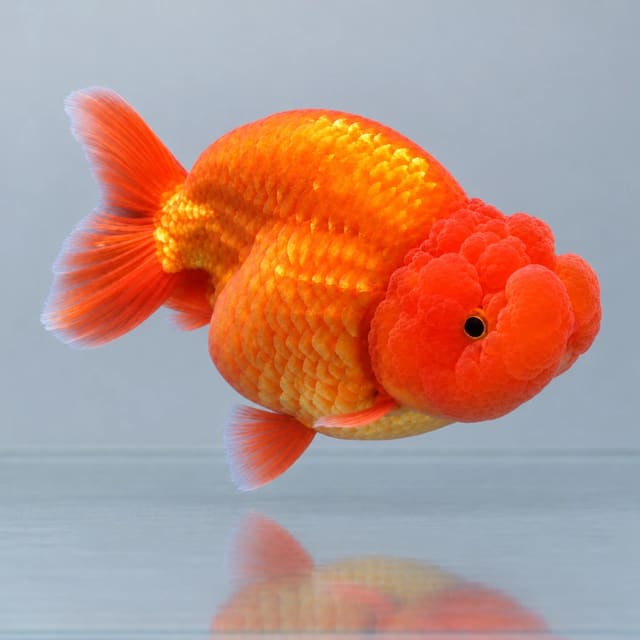
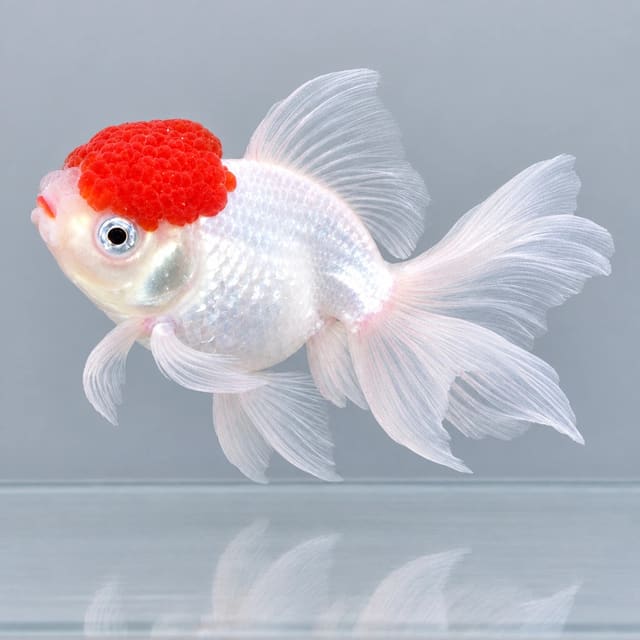
Red Cap Oranda Goldfish (Carassius auratus)
pH 6.5–8.5
£20.89
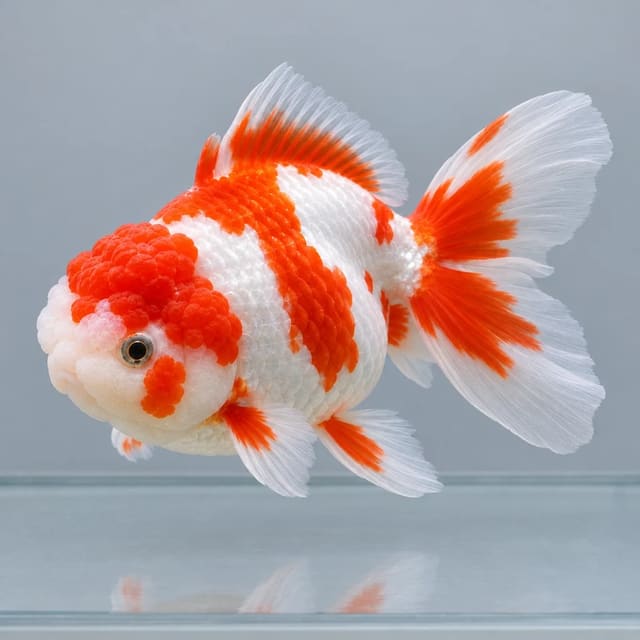
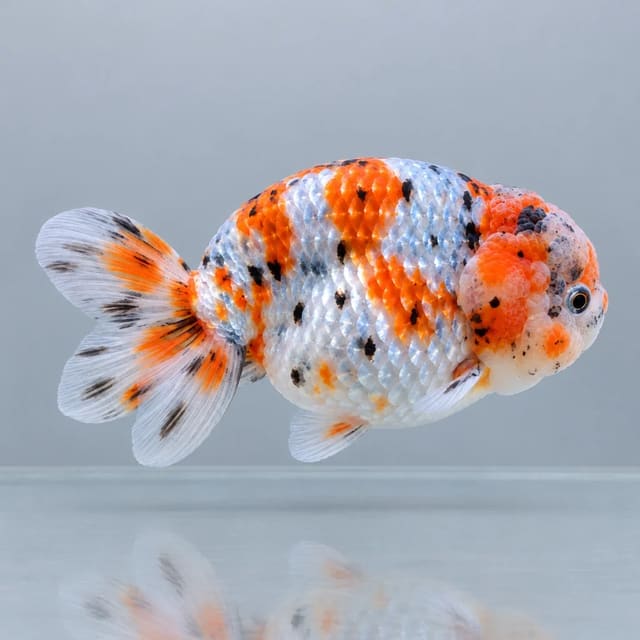
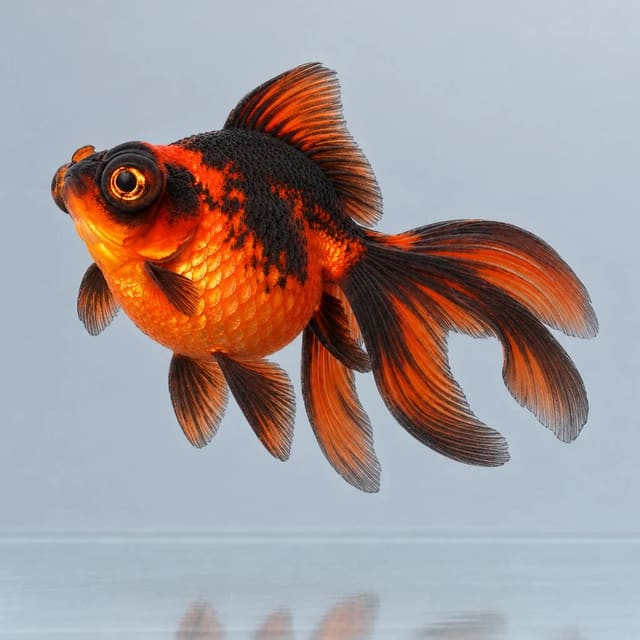
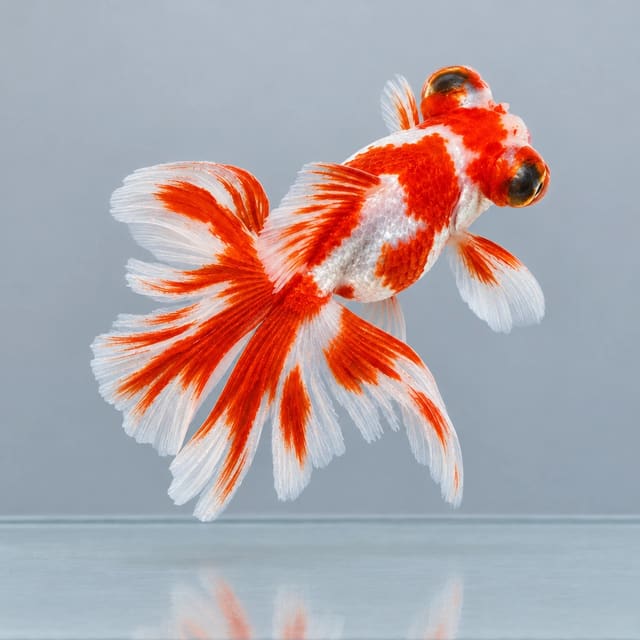
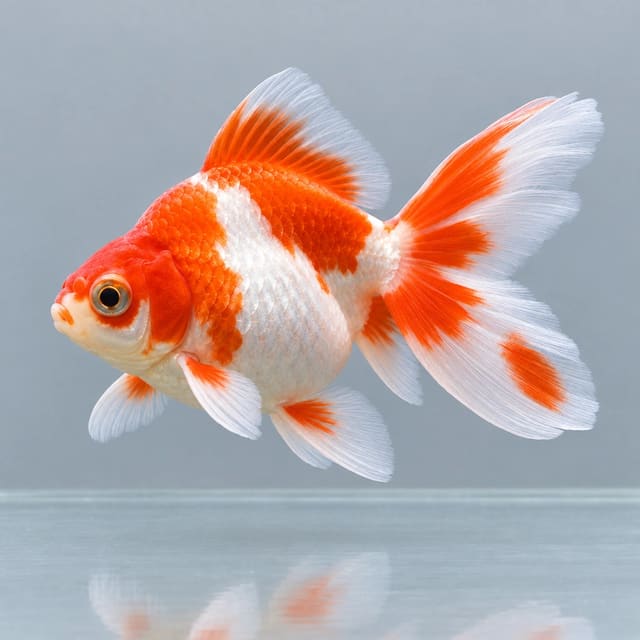
The tri-colour oranda goldfish carries red, black and white patches on a round, twin-tailed body topped by a growing hood. Choose a 4 cm youngster to grow on or a larger 8–9 cm Hi Grade fish. It needs an indoor coldwater aquarium of at least 100 litres for one adult at about 15–23°C, with gentle flow and goldfish food. Sold individually.
Adult size is the maximum length this species reaches at full maturity (scientific sources). The livestock you receive will be younger and smaller — pick a size above for the actual shipping size. Product-photo provenance and any image-specific limitations are stated on the listing.
Carassius auratus
Quantity discounts are pricing offers, not a group-size recommendation. Check the full care guidance and your existing animals before choosing a quantity.
The tri-colour oranda goldfish carries red, black and white patches on a round, twin-tailed body topped by a growing hood. Choose a 4 cm youngster to grow on or a larger 8–9 cm Hi Grade fish. It needs an indoor coldwater aquarium of at least 100 litres for one adult at about 15–23°C, with gentle flow and goldfish food. Sold individually.
Adult size is the maximum length this species reaches at full maturity (scientific sources). The livestock you receive will be younger and smaller — pick a size above for the actual shipping size. Product-photo provenance and any image-specific limitations are stated on the listing.
Read the full care guidance when planning conditions for your aquarium.
The tri-colour oranda goldfish wears three colours at once: bold red, deep black and clean white, laid in patches over a round, twin-tailed body. Like every oranda it has an upright dorsal fin, a long double tail and a soft hood that slowly builds up over the head and cheeks. It is a colour form of the domestic goldfish, Carassius auratus, a member of the carp family, Cyprinidae, and one of the most eye-catching orandas you can keep in an indoor coldwater aquarium.
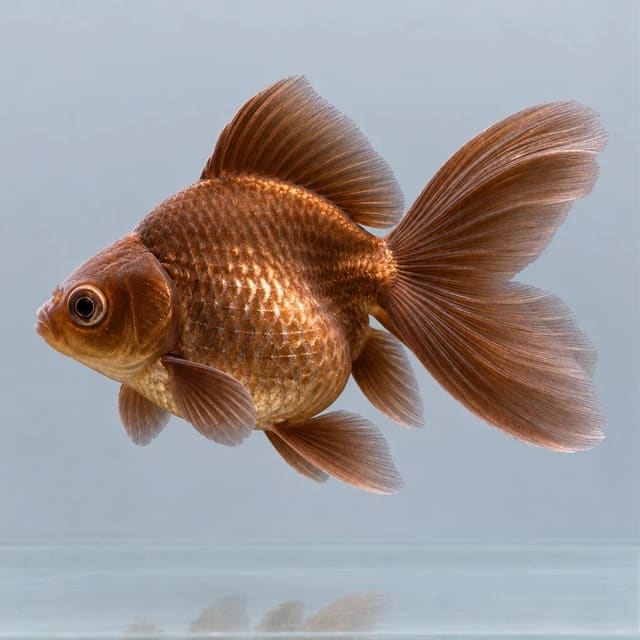
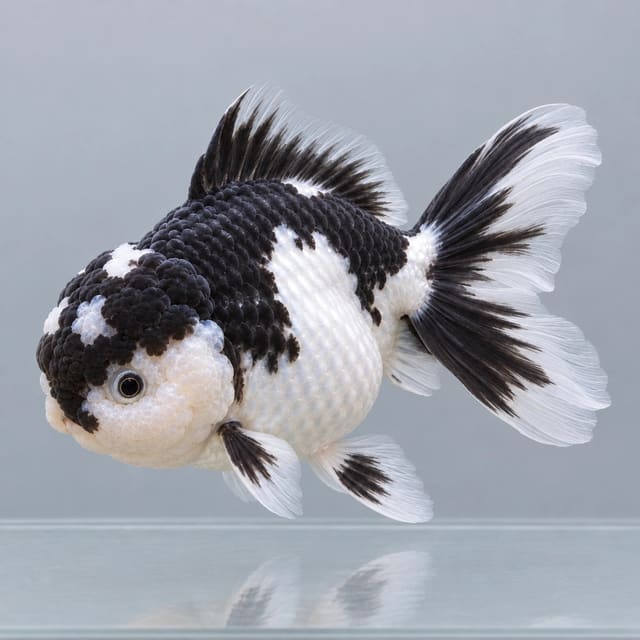
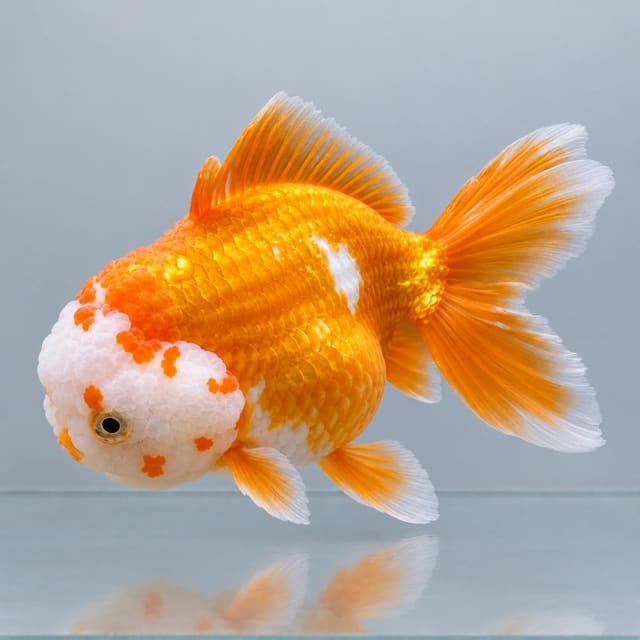
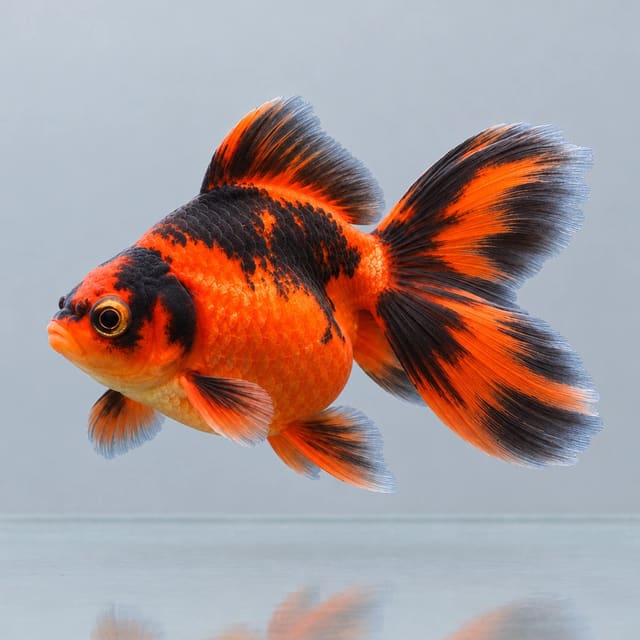
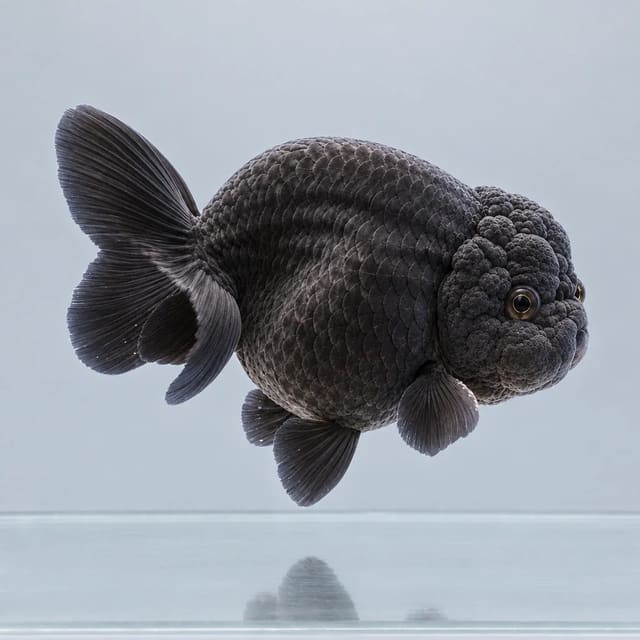
Orandas are bred in many colours. Wikipedia's summary of the variety lists red, red and white, red and black, black, blue, chocolate, white, black and white (panda), red, black and white (tri-colour) and calico among them. That is why the names on goldfish labels matter: each one tells you which combination you are buying.
| Form | Colours | Scales |
|---|---|---|
| Tri-colour oranda | Red, black and white in separate patches | Mostly shiny and reflective |
| Red and black oranda | Red with black markings, little or no white | Shiny |
| Panda oranda | Black and white only | Shiny |
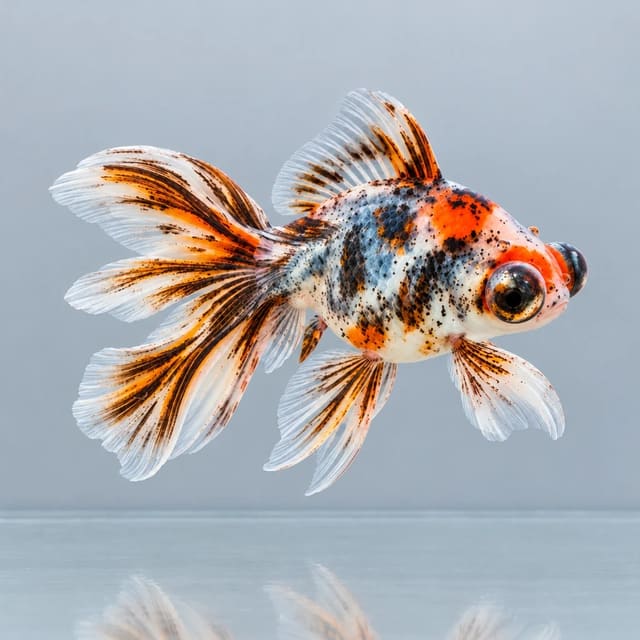
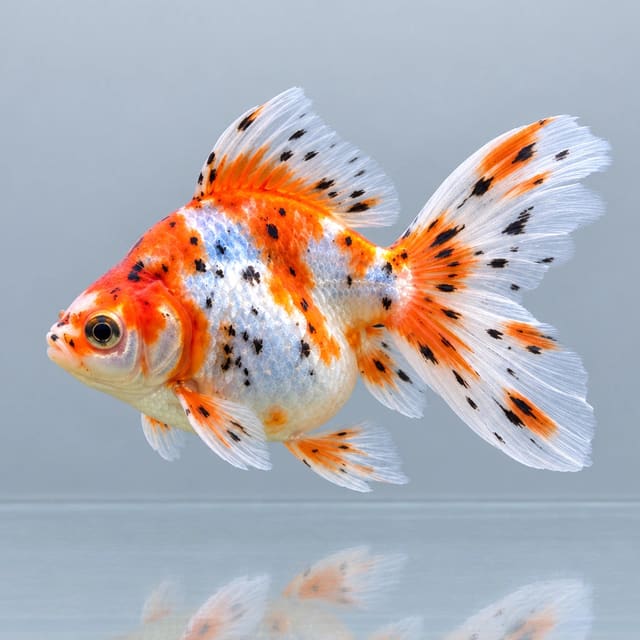
| Calico oranda | A speckled mix of red, orange, black, white and blue-grey | A mosaic of see-through and reflective scales |
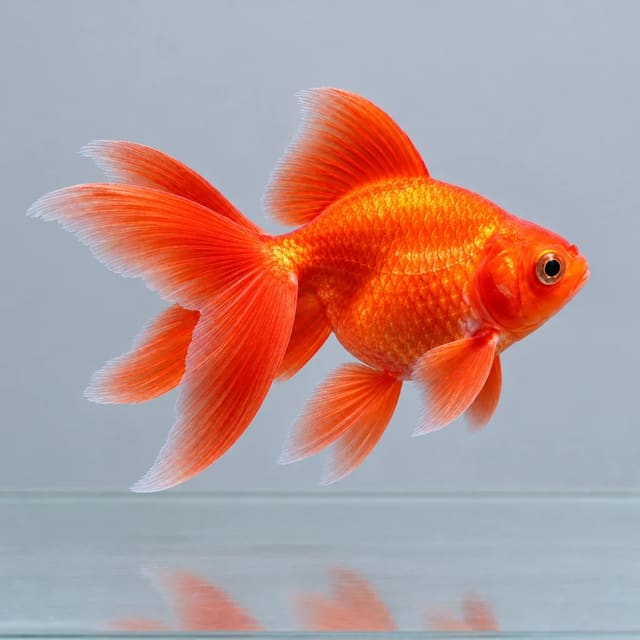
The calico look has a long scientific history. Fu's review (2015) of the Chinese geneticist Shisan Chen describes his 1928 finding that see-through, "transparent" scales are inherited in a simple Mendelian way, and that fish carrying one copy of the trait look mottled. A tri-colour has ordinary shiny scales instead, so its colours sit in clearer blocks. If you prefer two colours, compare it with our Red and Black Oranda or the classic Red Oranda, or browse orandas and other fancy goldfish in one place.
This tri-colour oranda is sold in two sizes. Each purchase supplies one live fish, sex not chosen, and every fish's pattern is its own: the photographs show the variety, not the individual that will arrive.
| Option | What you receive | Best for |
|---|---|---|
| 4 cm | A young fish with its hood only just starting and its colours still settling | Keepers who enjoy growing a fish on and watching it change |
| 8–9 cm Hi Grade | A larger fish sold as Hi Grade, with more of its shape, hood and pattern already visible | Keepers who want a showpiece now, with less guesswork about the adult |
Whichever size you choose, plan the aquarium for the adult. Read our delivery page for dispatch days and the Live Arrival Guarantee, and have the tank cycled before the fish arrives.
A tri-colour pattern is a snapshot, not a promise. Writing about ranchu, Practical Fishkeeping notes that a goldfish's colour can change almost completely as it matures and that many goldfish become whiter with age. Its fancy goldfish guide reports claims that black moors can revert to metallic orange in warm water. In practice, the black on a young tri-colour may spread, shrink or disappear, and white areas often grow over the years. That uncertainty is part of the charm: no two tri-colours look alike, and few look the same at four years as they did at four months.
If you choose the 4 cm youngster, you will watch its hood appear. According to Practical Fishkeeping, an oranda needs one to two years from the fry stage to develop its head growth. A 2025 laboratory study by Li and colleagues traced how it forms: the skin on the head thickens as collagen builds up and skin cells multiply, and small bony growths appear on the skull to support it. Growth like this depends on steady feeding and clean water month after month.
Feeding advice for youngsters differs between sources. OATA recommends one meal a day of what the fish eat within a few minutes. Ranchu breeders interviewed by Practical Fishkeeping feed growing youngsters several small meals a day, up to six, but they also change a great deal of water. Choose the approach your filter and water-change routine can support: more food always means more waste.
| Stage | What to watch |
|---|---|
| First weeks | Steady appetite, upright swimming and a rounded, not swollen, belly |
| First months | Steady growth in length and depth; the first bumps of head growth |
| Later in year one | The hood thickening and the colour pattern starting to settle |
| Year two | The hood filling out further, as Practical Fishkeeping describes |
OATA says fancy goldfish are unlikely to grow past 20 cm, while Practical Fishkeeping gives 20–31 cm for orandas. Either way, a tri-colour that arrives at 4 cm will become many times larger. OATA's guide is 100 litres for one adult fancy goldfish and 50 litres for each extra adult. Practical Fishkeeping suggests around 90 cm of tank length for three or four small or medium fancies, and its six-times rule gives 90 × 30 cm for adults of 15 cm. FishBase suggests groups of five or more in a tank of at least 100 cm.
| Plan | Adult fish | Minimum volume (OATA) |
|---|---|---|
| One tri-colour on its own | 1 | 100 litres |
| A tri-colour with a Red and Black Oranda | 2 | 150 litres |
| A trio of orandas | 3 | 200 litres, on a base of about 120 × 40 cm for 20 cm adults |
Measure your tank with our tank volume tool and check the planned group at full size in the stocking calculator. Use smooth gravel or sand and décor without sharp edges, which OATA warns can damage long fins and eyes, and leave open water for slow swimming.
| Value | Target | Why it matters |
|---|---|---|
| Temperature | 15–23°C (tolerates 4–25°C) | Fancy goldfish cope best with slow, small changes |
| pH | 6.5–8.5 | OATA's range for fancy goldfish; most UK tap water falls inside it |
| General hardness | 8–18 °dH | Medium-hard water suits goldfish |
| Carbonate hardness | 5–15 °dKH | Buffers the pH against sudden drops |
| Ammonia and nitrite | 0 mg/l | Both are toxic even at low levels |
| Nitrate | No more than 20 mg/l above tap water | Rises between water changes |
These are OATA's values. UK supplies vary from soft water in much of Scotland and Wales to hard, chalky water across the south and east of England, so test your own tap water and compare it in our water matcher tool. Our guide to water chemistry explains pH, general hardness and carbonate hardness in plain terms. Always treat new water with a conditioner before it goes in.
Goldfish are greedy, messy feeders. Practical Fishkeeping calls good filtration essential for fancy goldfish because of their waste and oxygen demand, but asks for moderate flow because they swim poorly. OATA suggests spreading the return through a spray bar. Aim for a filter rated well above the tank's volume, with the outlet set to ripple the surface rather than push the fish around. Our article on aquarium filtration explained helps you choose.
| How often | Job |
|---|---|
| Daily | Check the thermometer, watch every fish at feeding time and remove uneaten food |
| Weekly | Test ammonia, nitrite and nitrate; change at least 25% of the water (OATA), or two or three changes of a third (Practical Fishkeeping); siphon the gravel |
| Monthly | Check the filter for blockages and rinse its media in old aquarium water, never under the tap |
A new aquarium must complete the nitrogen cycle before any fish go in.
FishBase lists plankton, bottom-living invertebrates, plant material and detritus as the wild diet of the species. OATA recommends a goldfish-specific staple, because goldfish need more carbohydrate than many fish, topped up with daphnia, bloodworm, brine shrimp, blanched lettuce and thawed, shelled peas.
Some goldfish swallow air when they feed at the surface and float or tilt for a while afterwards; OATA suggests changing to a slow-sinking food if this happens. Our article on a fish swimming sideways covers other causes.
OATA warns that a fish can carry disease without showing symptoms, and advises never buying from a tank with sick fish in it. Goldfish herpesvirus is one reason to be careful: Ito and Maeno (2014) found the disease it causes developed most readily at 20–25°C, and that goldfish infected in cooler water could survive and still carry the virus to other fish. A separate quarantine tank, with its own net and equipment, protects any goldfish you already keep.
To introduce the fish, switch off the aquarium lights, float the sealed bag for about 10 minutes, then add small amounts of tank water over up to 20 minutes before releasing the fish without the bag water. That is OATA's floating-bag method; our step-by-step acclimatisation guide shows it in pictures. Watch the fish and test the water closely through its first week.
OATA recommends keeping fancy goldfish alone or with other fancy goldfish, and not with common goldfish, which are quicker, take the food and sometimes nip fins. A tri-colour oranda is a natural partner for other orandas of a similar size.
| Good match | Poor match |
|---|---|
| Our Red and Black Oranda or Red Oranda | Comets, shubunkins and common goldfish |
| Our Red and White Ryukin, a hardy, deep-bodied fancy | Tropical community fish that need a heater |
| Other orandas bought at a similar size | Much larger fish that take all the food |
| Calm fish that cope with 15–23°C | Fin-nipping species |
Single-tailed goldfish are a different case altogether, as our page on comet goldfish explains. Run any mix through our tank mates checker, and browse the full goldfish and coldwater range or all goldfish for companions.
The hood's folds can trap debris, and fancy goldfish with long fins are easily damaged by sharp décor. OATA lists the signs that something is wrong: hanging at the surface or sitting on the bottom, unusual darkening or paling, more hiding or aggression, faster or slower breathing, white spots or fluffy growths, lost fins or scales, weight change and poor appetite.
| Sign | First step |
|---|---|
| White spots like grains of salt | Confirm with our white spot treatment guide before dosing |
| Split or fraying fins | Test the water and read our fin rot treatment guide |
| Cotton-like patches in the hood | Test the water, improve cleanliness and seek fish-health advice |
| Floating after meals | Switch to a slow-sinking food |
| Sudden deaths in a newly mixed group | Stop adding fish and seek veterinary advice |
Every fancy goldfish traces back to wild crucian carp in China. Shisan Chen proposed from historical records that domestication began in the Southern Song dynasty and that deliberate breeding for particular forms only began in the Qing dynasty, as Fu's review explains. Modern genetics is now finding the DNA behind the varieties: Kon and colleagues (2020) sequenced 27 goldfish strains and linked regions of the genome to traits such as dorsal fin loss, long tails and telescope eyes. The tri-colour oranda is one result of those centuries of selection.
Not always. Practical Fishkeeping notes that goldfish colour can change almost completely as a fish matures and that many goldfish become whiter with age, so black and red areas may shrink or move. Buy it for the variety, not for an exact pattern.
The 4 cm fish is a youngster to grow on, at a lower price, with its hood and final colours still to come. The 8–9 cm Hi Grade fish is a larger, selected fish with more of its shape, hood and pattern already showing.
No. A tri-colour has red, black and white areas on mostly shiny scales. A calico has a speckled, mottled look that comes from a mix of see-through and reflective scales, often with blue-grey tones.
Practical Fishkeeping says the head growth of young orandas takes one to two years to develop, so a 4 cm youngster shows little hood at first. Clean water and steady feeding give it the best chance to fill out.
Yes. Orandas of a similar size suit each other well. Allow 100 litres for the first adult and 50 litres for each extra adult, as OATA advises, so two adult orandas need at least 150 litres.
OATA gives fancy goldfish an ideal range of 15–23°C, with a wider tolerance of 4–25°C. Most UK homes stay inside the ideal range without a heater; aim for steady temperatures rather than warm water.
OATA warns that some fish carry disease without showing symptoms, and research on goldfish herpesvirus found that fish can survive infection and still carry the virus. A separate quarantine tank protects the fish you already have.
No reviews for this item yet. Bought one? Honest reviews only, good or bad.
What customers say about ordering from us
Easy website plenty of info on fish your buying great to pick a time slot
TRACEY DURRANT · 7 Oct 2026
Got some lovely fish thank you
Kevin Mackie · 7 Oct 2026
Reviews of our shop, collected by Judge.me, an independent third-party review collector. Newest first.
Moved by UK carriers licensed to handle live animals
Hand-packed with oxygen bags, poly box, heat pack
Email photos the same day; an optional unboxing video helps us review problems faster — claim terms apply
Klarna & PayPal Pay in 3 at checkout