Moderate
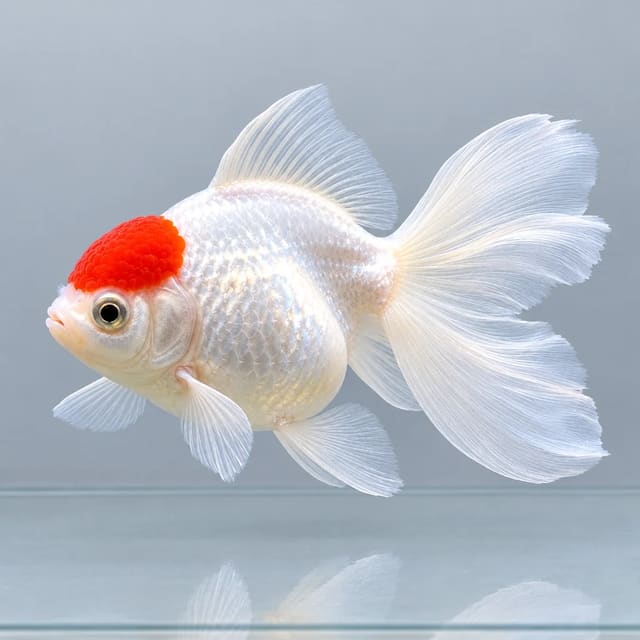
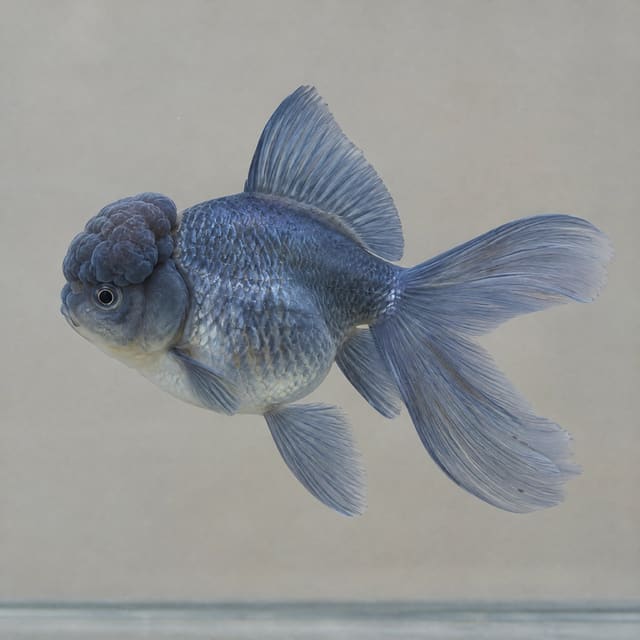
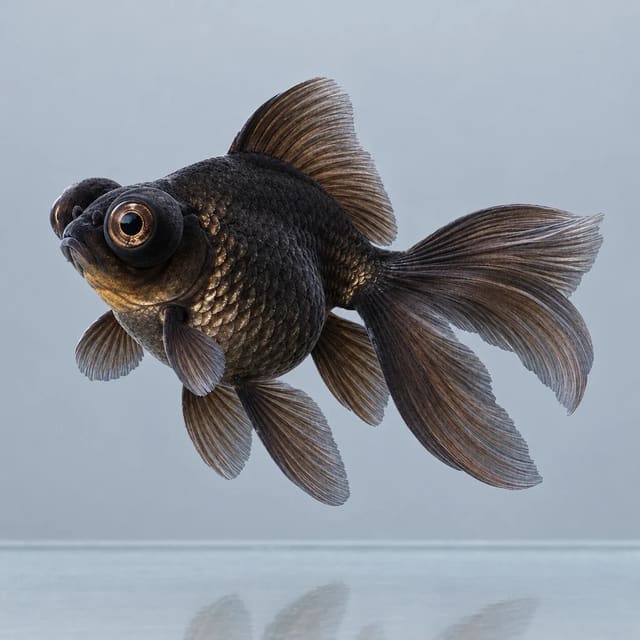
Assorted Large Oranda Goldfish (Carassius auratus)
pH 6.5–8.5
£62.69
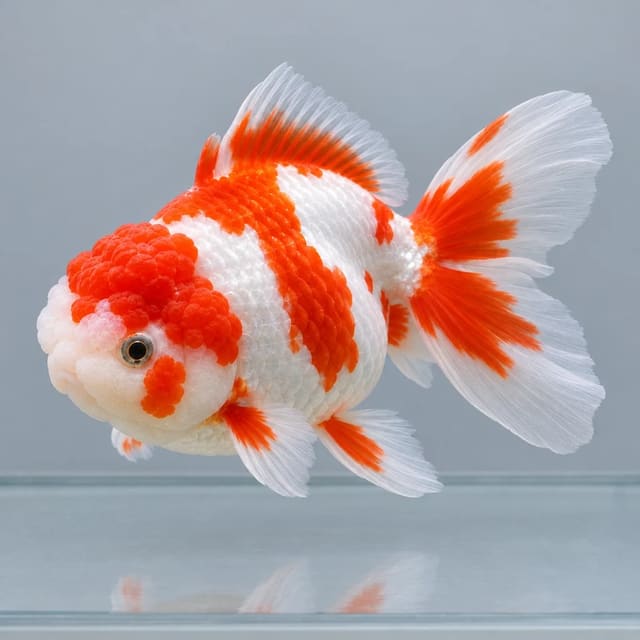
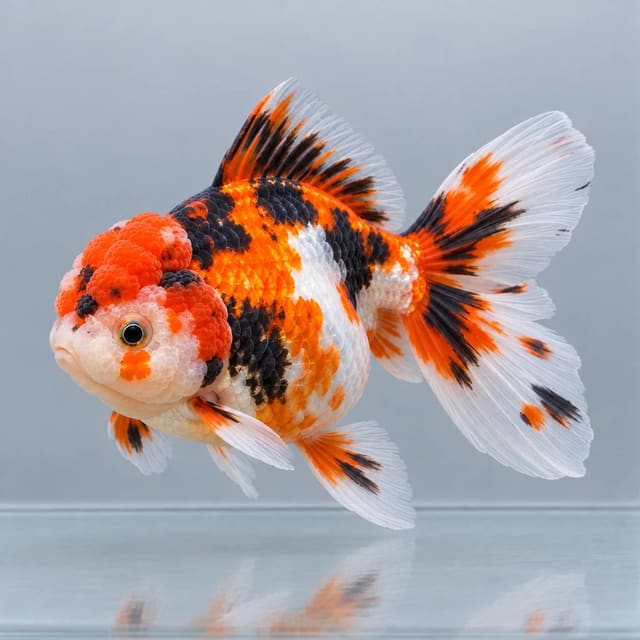
The calico lionhead ranchu is a round, hooded fancy goldfish with no dorsal fin, a short tucked tail and speckled calico colours of white, blue-grey, orange-red and black. It is a gentle, slow swimmer for a calm indoor coldwater aquarium of at least 100 litres for one adult, kept at about 15–23°C with soft flow. Sold individually as a young fish.
Adult size is the maximum length this species reaches at full maturity (scientific sources). The livestock you receive will be younger and smaller. Product-photo provenance and any image-specific limitations are stated on the listing.
Carassius auratus
Quantity discounts are pricing offers, not a group-size recommendation. Check the full care guidance and your existing animals before choosing a quantity.
The calico lionhead ranchu is a round, hooded fancy goldfish with no dorsal fin, a short tucked tail and speckled calico colours of white, blue-grey, orange-red and black. It is a gentle, slow swimmer for a calm indoor coldwater aquarium of at least 100 litres for one adult, kept at about 15–23°C with soft flow. Sold individually as a young fish.
Adult size is the maximum length this species reaches at full maturity (scientific sources). The livestock you receive will be younger and smaller. Product-photo provenance and any image-specific limitations are stated on the listing.
Read the full care guidance when planning conditions for your aquarium.
The calico ranchu goldfish is one of the most distinctive fancy goldfish you can keep: an egg-shaped body with a smooth, finless back, a short double tail tucked under at a sharp angle and a soft hood spreading over the whole head, all dressed in a speckled calico coat. This listing is for a calico lionhead ranchu, sold as a young fish. Like every goldfish, it is Carassius auratus, a member of the carp family, Cyprinidae, shaped by centuries of breeding.
Practical Fishkeeping describes the ranchu as a man-made fancy goldfish with a dorsal-less back, a short twin tail and a hood developing all over the head. It notes that most ranchu in shops come from China, while the most prized fish come from Japan. Its guide to fancy goldfish compares ranchu with lionheads: the ranchu has a more arched back and a shorter tail, and mature fish reach 15–20 cm.
| Feature | Lionhead | Ranchu |
|---|---|---|
| Dorsal fin | None | None |
| Back | Flatter | More arched |
| Tail | Short and double | Shorter, tucked in at a sharp angle |
| Hood | Present | Present, developing over the whole head |
| Show tradition | Group 4 of the UK Nationwide show standards | Japanese style: judged from above, in shallow bowls |
British shows place the lionhead in Group 4 of the Nationwide Standards, which Practical Fishkeeping defines as round-bodied fish with no dorsal fin and a short double tail. The trade often uses the two names together, as on this label, for round, hooded goldfish without a dorsal fin. Browse our hooded and fancy goldfish category, the full goldfish and coldwater fish range or the goldfish category to compare varieties.
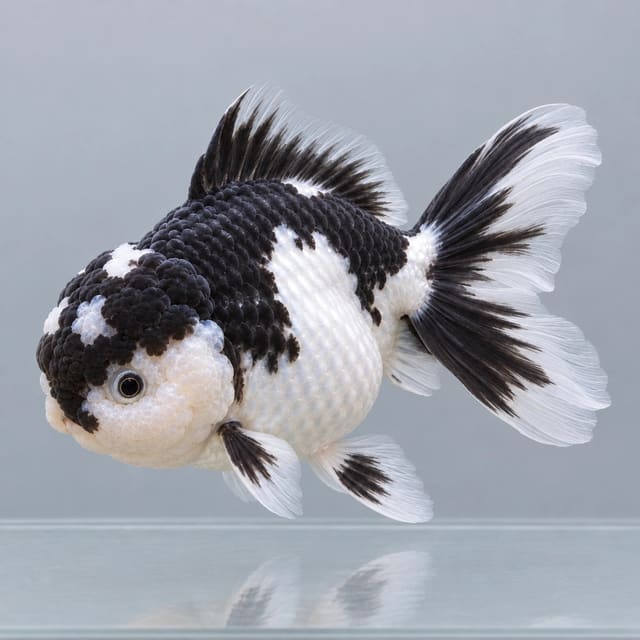
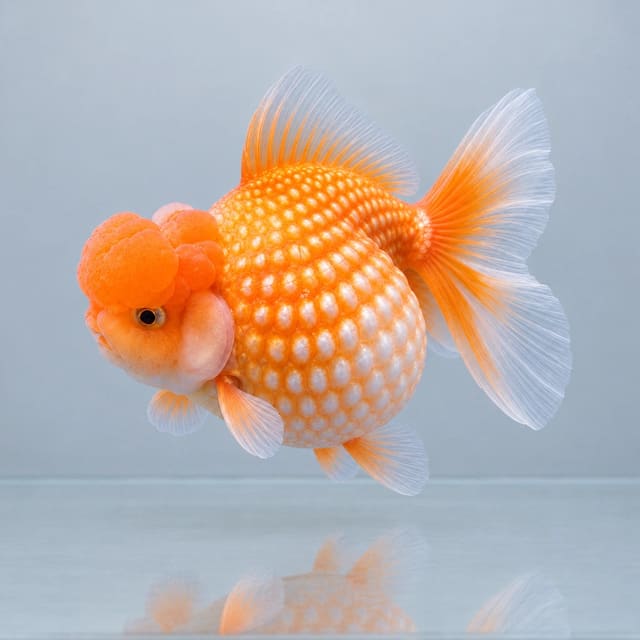
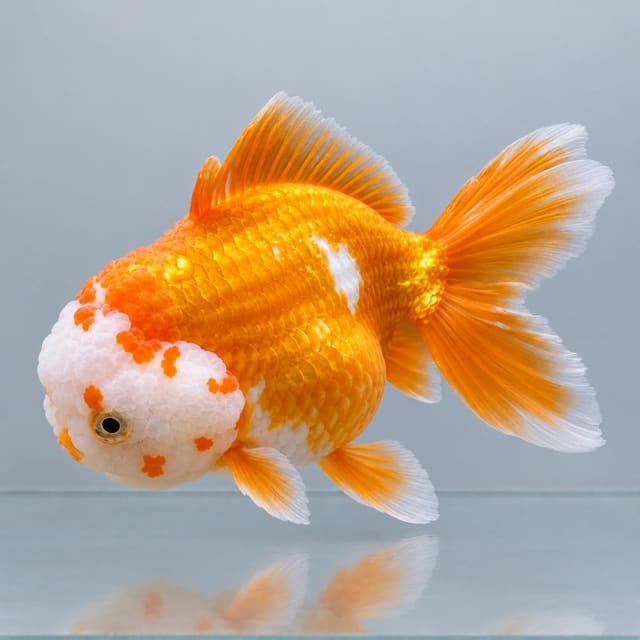
"Calico" describes a speckled, many-coloured goldfish. In the photographed fish, pale white and blue-grey scales are patched with orange-red and dotted with small black spots, the orange hood is flecked with black, and the short white tail is streaked with orange and black. Wikipedia's ranchu summary notes that ranchu scales may be metallic, matt or nacreous, the last being the calico type.
The science goes back almost a century. Fu's review (2015) describes how the Chinese geneticist Shisan Chen showed in 1928 that see-through, "transparent" scales are inherited in a Mendelian way, with incomplete dominance: fish carrying one copy of the trait have a mottled mosaic of transparent and normal scales. That mix of shiny and see-through scales is what gives calico goldfish their soft, layered look, with the colour in the skin showing through the clear scales.
| Element | What it is |
|---|---|
| Blue-grey or lavender areas | Dark pigment seen through transparent scales |
| Orange and red patches | Coloured skin under a mix of scale types |
| Small black spots | The fine speckling typical of calico goldfish |
| Bright, reflective scales | The normal, shiny scales scattered among the transparent ones |
Practical Fishkeeping notes that ranchu colour can change almost completely as the fish matures and that many goldfish become whiter with age. A calico's spots and patches will move and fade over time, so every adult is unique.
One purchase supplies one live calico lionhead ranchu, sold as a young fish at the standard size currently available; the present batch is listed at about 3–4 cm. Sex is not chosen, and young goldfish cannot be sexed by eye. Every calico pattern is different, so the photographs show the variety rather than the fish you will receive.
Read our delivery and Live Arrival Guarantee page before ordering, and have a matured aquarium ready.
The missing dorsal fin is the ranchu's defining feature, and it has a cost. Kon and colleagues (2020) sequenced 27 domesticated goldfish strains and found regions of the genome linked to dorsal fin loss, among other traits. Blake, Li and Chan (2009) then tested how body shape affects swimming in 5 cm goldfish. Compared with streamlined common and comet goldfish, the dorsal-less "eggfish" had more drag, rolled and yawed as it swam, and used about 1.3 mg of oxygen per kilogram for every metre travelled, against about 0.6 mg for the comet and common goldfish. Its best acceleration from a standstill was about 5 m/s², while the common and comet reached up to about 35 m/s².
In short, a ranchu is slower, tires sooner and steers less precisely than a goldfish with a dorsal fin. Practical Fishkeeping notes that modern ranchu are stronger swimmers than they used to be, but they still need a set-up built around them.
Practical Fishkeeping gives 15–20 cm for mature ranchu, and OATA says fancy goldfish are unlikely to exceed 20 cm. OATA's volume guide is 100 litres for one adult fancy goldfish and 50 litres for each extra adult. Practical Fishkeeping's six-times rule asks for a tank at least six times as long as the adult fish and twice as wide as the fish is long, which works out at 90 × 30 cm for a 15 cm ranchu and 120 × 40 cm for a 20 cm one.
| Ranchu kept | OATA minimum volume | Suggested base for 20 cm adults |
|---|---|---|
| 1 | 100 litres | At least 120 × 40 cm |
| 2 | 150 litres | At least 120 × 40 cm |
| 3 | 200 litres | About 120 × 45 cm or larger |
Our tank volume calculator converts your measurements into litres, and the stocking calculator shows whether the adult group will fit. FishBase records goldfish living up to 41 years, and OATA gives six to eight years as typical for a well-kept fancy goldfish, so this is a long-term commitment.
A ranchu is a coldwater fish and normally needs no heater in a UK home. Use OATA's targets for fancy goldfish:
UK tap water varies from soft in much of Scotland and Wales to hard and alkaline across the south and east of England, so test yours and compare it in our water matcher. Our water chemistry guide explains each value. Treat every water change with a conditioner, and match the temperature of new water to the tank.
Ranchu keepers differ in method. One breeder in the Practical Fishkeeping article runs unfiltered, lightly stocked vats and replaces all the water every six to seven days; another uses koi-type filtration, and the magazine itself recommends filtering. In a home aquarium, a good filter is essential. Practical Fishkeeping asks for strong filtration with moderate flow, because goldfish produce a lot of waste and need plenty of oxygen but fancy forms swim poorly.
Read our filtration article to choose a filter, and our nitrogen cycle guide to mature a new aquarium before the fish arrives.
FishBase lists plankton, bottom-living invertebrates, plants and detritus as the natural diet of goldfish. OATA recommends a goldfish-specific staple, because goldfish need more carbohydrate than many fish, plus extras such as daphnia, bloodworm, brine shrimp, blanched lettuce and thawed, shelled peas. OATA also warns that goldfish which gulp air while feeding at the surface can lose buoyancy for a while, and suggests slow-sinking food, which suits a round, dorsal-less fish especially well.
How often? OATA advises one meal a day of what the fish eat within a few minutes. The ranchu breeders interviewed by Practical Fishkeeping feed adults twice a day and growing youngsters up to six times, but they also change far more water. Match the feeding to your filtration and water changes, and keep portions small.
Add the ranchu only to a matured aquarium with zero ammonia and nitrite. Turn off the lights, float the sealed bag for about 10 minutes, then add small amounts of aquarium water to it over up to 20 minutes, and release the fish without the bag water; this is OATA's method, set out step by step in our acclimatisation guide. One breeder in the Practical Fishkeeping article moves his ranchu in wet hands rather than a net, because nets strip more of the protective mucus. At home, guide the fish into a container rather than chasing it with a net whenever you can.
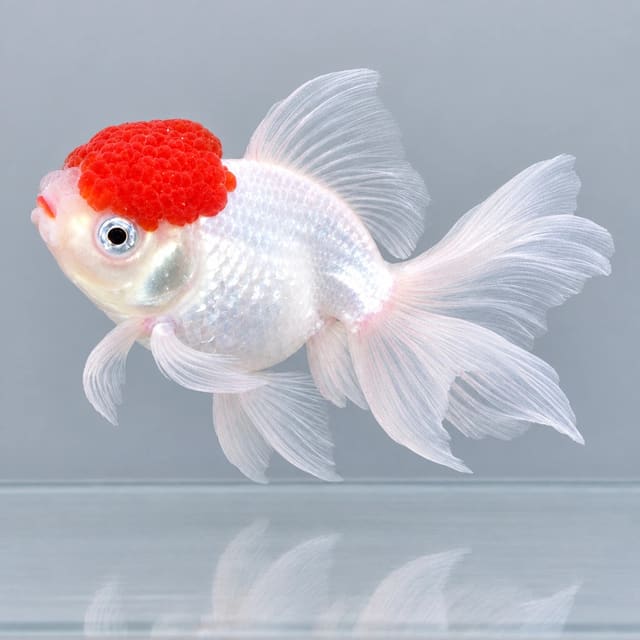
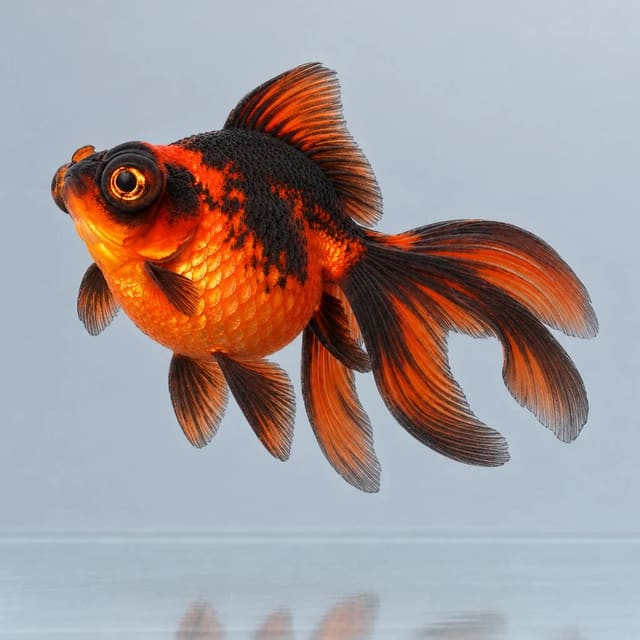
OATA says fancy goldfish can be kept alone or with other fancy goldfish, but not with common goldfish, which are faster, outcompete them for food and sometimes nip fins. For a dorsal-less ranchu, the best company is other ranchu or lionheads. Calm orandas of a similar size, such as our Red Oranda, Blue Oranda or Red and Black Oranda, can share a large tank, but watch every feed to make sure the ranchu gets its share.
| Suits | Avoid |
|---|---|
| Other ranchu and lionheads | Comets, shubunkins and common goldfish |
| Calm orandas, with care at feeding time | Fast, boisterous or fin-nipping fish |
| Other slow, round-bodied fancies | Tropical fish that need warm water |
Practical Fishkeeping also warns that poor-sighted telescope-eyed goldfish should not be mixed with active varieties; the same logic applies to any slow fancy. Single-tailed goldfish need a different set-up altogether, as our page on comet goldfish explains. Test any combination in our tank mates tool.
Because it lacks a dorsal fin, a ranchu naturally rocks a little as it swims, so learn its normal movement in the first weeks. A fish that floats, tips onto its side or struggles to leave the bottom needs attention: check the water first, then try sinking food. Our article on a fish swimming sideways explains the usual causes.
The hood needs clean water too. A welfare report covered by Practical Fishkeeping notes that debris in the folds of a hood can lead to bacterial and fungal infections. OATA's warning signs include clamped fins, flicking against objects, shimmying, white spots or fluffy growths, damaged fins or missing scales, faster breathing and poor appetite.
Practical Fishkeeping's ranchu breeders start breeding at 20°C, pair their best male and female for the first spawn and later try the female with different males, and stress that fish will not breed unless they are settled and happy. OATA adds that two males to each female improves the odds, that a partial water change after a slow warm-up often triggers spawning, and that eggs should be moved away from the adults, which eat them. The eggs hatch in about three days. Never release goldfish or aquarium water into the wild.
Ranchu are often called the king of goldfish. In Japan, Practical Fishkeeping explains, a ranchu is a tosai in its first year, becomes a nisai on 1 January of the following year and an oya the January after that. Top fish are judged from above in shallow bowls by panels of three to five judges, who also score the way a fish swims away after inspection. Your calico ranchu will never need to meet a judge, but it shares the same proud lineage.
No. A ranchu has a smooth, dorsal-less back, like the lionhead. Kon and colleagues (2020) found regions of the goldfish genome linked to this loss of the dorsal fin.
Both are round, hooded goldfish with no dorsal fin and a short double tail. Practical Fishkeeping describes the ranchu as having a more arched back and a shorter tail tucked in at a sharp angle; the lionhead’s back is flatter. Shops often use the two names together.
Very likely. Practical Fishkeeping notes that ranchu colour can change almost completely as the fish matures and that many goldfish become whiter with age. Expect the pattern of a young calico to shift.
Practical Fishkeeping gives 15–20 cm for mature ranchu, and OATA says fancy goldfish are unlikely to exceed 20 cm. A young fish has a lot of growing to do, so plan the aquarium for the adult.
Without a dorsal fin it is a less stable, less efficient swimmer. Blake and colleagues (2009) found that dorsal-less goldfish roll and yaw as they swim and use roughly twice the energy per metre of a comet. Give it gentle flow and calm companions.
It can share with calm orandas of a similar size if you watch feeding time, because orandas with a dorsal fin are a little quicker. It should not live with comets or other single-tailed goldfish, which OATA advises against for all fancy goldfish.
Usually neither. OATA gives fancy goldfish an ideal of 15–23°C without a heater unless the room is very cold, and advises keeping them in indoor aquariums only rather than ponds.
No reviews for this item yet. Bought one? Honest reviews only, good or bad.
What customers say about ordering from us
Easy website plenty of info on fish your buying great to pick a time slot
TRACEY DURRANT · 7 Oct 2026
Got some lovely fish thank you
Kevin Mackie · 7 Oct 2026
Reviews of our shop, collected by Judge.me, an independent third-party review collector. Newest first.
Moved by UK carriers licensed to handle live animals
Hand-packed with oxygen bags, poly box, heat pack
Email photos the same day; an optional unboxing video helps us review problems faster — claim terms apply
Klarna & PayPal Pay in 3 at checkout