By Connor Boyle
Read this before you buy a comet goldfish
You searched "comet goldfish", and there's a decent chance you're picturing a small, cheap, easy fish — maybe one for a bowl, a desk tank, or a child's first pet. I have to be straight with you, because the cheerful product pages won't: a comet is none of those things. It's a coldwater fish that commonly grows to 30 cm, can live longer than 20 years, and needs a pond or a very large aquarium to be kept properly [4].
I'm Connor Boyle. I kept a reef tank for four years, then switched to coldwater and native fish, and I now run a 400-litre chilled stream-biotope tank at home. Goldfish — comets especially — are the species I most often have to gently talk people out of buying on impulse, and into buying properly. This is the guide I'd give a friend who messaged me "I want a goldfish, what do I actually need?" The honest answer involves the word "pond" more often than the shops admit.
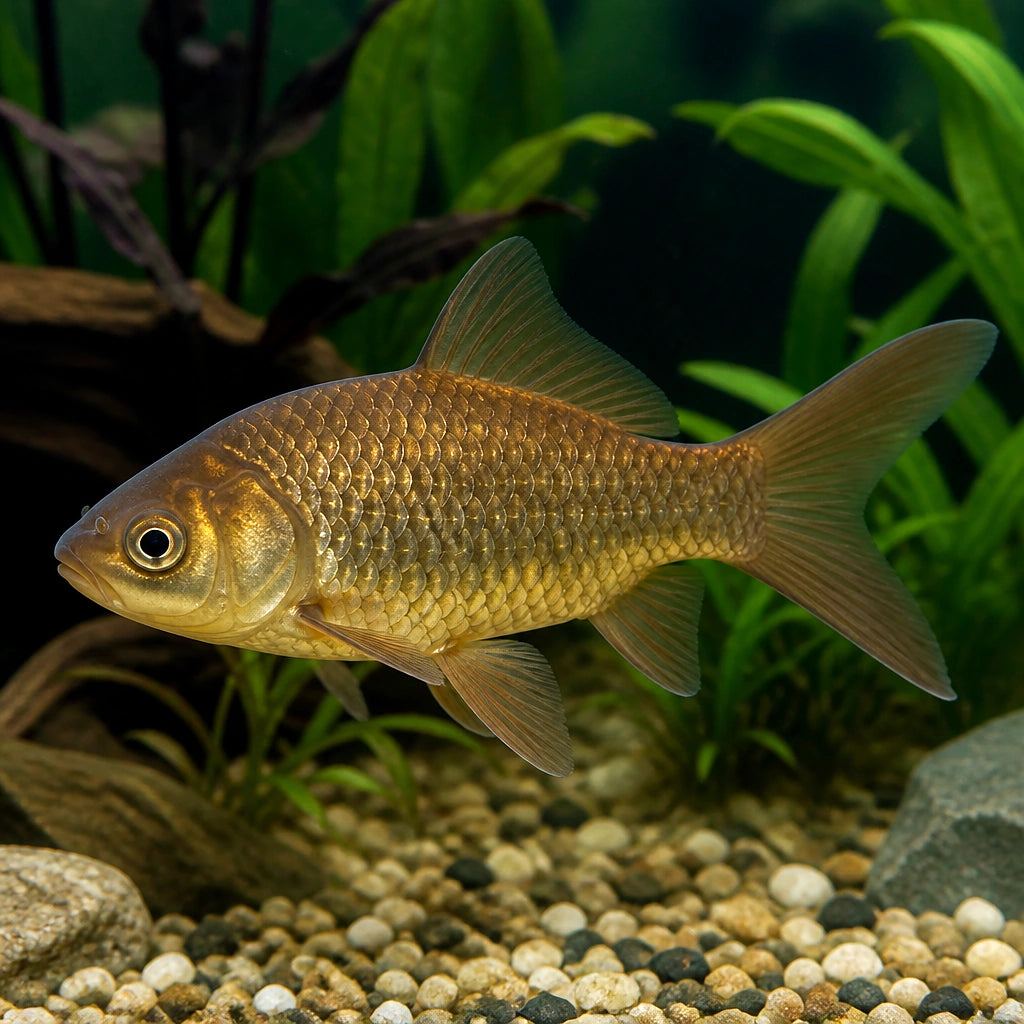
A bronzed comet — note the slim body and the long, flowing single tail. That streamlined shape is the giveaway: comets are built to swim fast and grow long, which is exactly why they outgrow small tanks. Product photo · our warehouse.
Five things most comet goldfish pages won't tell you
- They were invented in America, in the 1880s. The goldfish itself was domesticated from wild Carassius carp in East Asia centuries ago [2], but the comet variety specifically — the slim body with the long single tail — was developed in the United States in the 1880s. It's a relatively modern goldfish, bred for the look of a comet streaking across the sky.
- They tolerate water from near-freezing to nearly scalding. FishBase records a temperature tolerance of roughly 0 to 41 °C for the species [1]. That doesn't mean you should push those limits — they're healthiest around 10–22 °C — but it explains why a comet shrugs off a cold UK winter pond when a tropical fish would die.
- They grow to the water, not the bowl. Studies of unconfined goldfish populations show they grow large and fast when they aren't cramped [3]. The old myth that a goldfish "stays small in a small tank" is half-true in the worst way: stunting is the fish's body being damaged by poor water and lack of space, not a healthy adaptation.
- One lived to 43. The Guinness World Record for the oldest goldfish goes to a fish named Tish, who reached 43 years [6]. Even ordinary comets routinely pass 10–20 years with decent care [2] — so this is a fish that can be part of your life for a very long time.
- Releasing one into the wild is illegal — and harmful. The Environment Agency warns that dumping ornamental fish like goldfish into ponds, lakes or streams spreads disease and parasites, and lets goldfish interbreed with Britain's native crucian carp [5]. It's an offence, not a kindness. If you can't keep yours, rehome it.
Comet vs fancy goldfish: which is right for you?
"Goldfish" covers two very different commitments. The slim single-tailed fish (comet, common, shubunkin) are pond fish that get large and fast; the round, twin-tailed "fancy" goldfish (oranda, ryukin, fantail) stay smaller, swim slower, and are the ones better suited to a large aquarium. Pick the body type that matches the home you can actually give.
| What matters | Comet (single-tail) | Common goldfish (single-tail) | Fancy goldfish (twin-tail) |
|---|---|---|---|
| Body shape | Slim, long flowing tail | Slim, short tail | Round, egg-shaped, double tail |
| Adult size | Commonly 30 cm+, max ~48 cm | 30 cm+ | Usually 15–20 cm |
| Speed | Very fast | Fast | Slow |
| Best home | Pond (or very large tank) | Pond | Large aquarium or pond |
| Cold-hardy outdoors | Yes | Yes | Less so (some forms vulnerable) |
| Lifespan | 10–20+ years | 10–20+ years | 10–15+ years |
If you have, or can build, a garden pond — a comet or common goldfish is a wonderful choice [4]. If you only have indoor space and want goldfish, a small group of fancy goldfish in a large aquarium is the more realistic fit. Either way, "a bowl" is not on the list.
The comets and goldfish we currently stock
The classic comet we hold is the bronzed comet (Carassius auratus), and we stock it in three sizes so you can buy small to grow on or larger to stock a pond straight away. These are the real single-tailed comet — the slim, fast, pond-suitable fish this whole page is about.
If you've been sold a comet "for a 60-litre tank" or a bowl, please pause. A comet commonly reaches 30 cm and needs serious water volume — UK charity INJAF advises single-tailed goldfish shouldn't be kept below 200×60×60 cm, and that they really belong in a pond [4]. Buying a comet means committing to a pond or a very large aquarium. If you only have a small tank, this is the moment to choose a true nano fish instead — and we'd far rather tell you that now than sell you the wrong fish.
If your comet stock above is sold through, or you want a different look in the same coldwater family, we also carry other true Carassius auratus goldfish — clearly a different body type from the comet, but the same easy coldwater care:
How many to keep, and the housing maths
Comets are peaceful, social shoaling fish [1], so they're happiest in a small group — but every fish you add multiplies the space and filtration you need, because goldfish are heavy waste producers. This is where the housing maths gets real.
The honest baseline from INJAF: single-tailed goldfish shouldn't live in anything smaller than 200 × 60 × 60 cm (that's a 700-litre-plus tank), and they're genuinely better off in a pond [4]. A pond solves almost every comet problem at once — volume to dilute waste, length for a 30 cm fish to swim, cool stable temperatures, a group for company, and natural food to graze.
If you have a garden, build (or buy) the pond first and stock comets into it — three or four young comets in a 1,000-litre-plus pond with good filtration is a setup that will thrive for decades. If you only have indoor space, be realistic: either commit to a very large aquarium, or choose fancy goldfish over comets, or pick a true small coldwater fish like white cloud mountain minnows instead. Match the fish to the home you can give, not the home you wish you had.
The water question: why the UK suits goldfish
Here's the easy part. Comets are tolerant, adaptable fish: pH 6.0–8.0 and hardness 5–19 dGH cover their needs [1], which means almost all UK tap water — including the hard, alkaline water common across much of England — is fine for them once it's dechlorinated. You do not need RO water, buffering or any special chemistry for goldfish, which is one of the few things that genuinely is simpler than the average tropical setup. If you want to understand what your tap water is doing in the tank, our water chemistry care guide walks through the basics.
And crucially: no heater. Comets are coldwater fish that tolerate a huge temperature range [1], so an indoor tank at room temperature, or a pond that swings with the British seasons, both suit them. In winter a healthy pond comet simply slows down and rests near the bottom — that's normal, not a problem.
Tank mates and pond companions
Comets are peaceful, but their size, speed and appetite mean tank mates need to be coldwater fish that can hold their own and won't be eaten or out-competed. In an indoor coldwater tank or a pond, the companions I trust are other cool-water species, not tropicals:
- Other goldfish — comets, commons and shubunkins all mix happily; just count every fish into your stocking maths.
- White cloud mountain minnows — a brilliant little coldwater shoaler for the cooler end, though only safe alongside small goldfish (a big comet may view a 3 cm minnow as a snack).
- Hillstream loaches — cool, high-oxygen-water algae grazers for a flowing coldwater tank.
- Pond coldwater natives — golden orfe and other cool-water pond fish share a comet's temperature needs (see the in-stock block below).
For general setup principles — cycling, filtration, planting — our first tank setup guide covers the fundamentals; just remember to skip the heater for a coldwater comet.
Watch: coldwater fish on the move
Transcript / what you're seeing (0:00–0:20): fish cruising calmly through open water, using the full length of the tank rather than hanging in one corner. That's exactly the behaviour a healthy comet shows when it has enough space — long, unhurried laps with the whole body. A comet crammed into a small tank or bowl can't do this; it turns in tight, stressed circles, which is one of the clearest signs the housing is too small.
A bigger fish than the bag suggests
It bears repeating with a picture, because this is where comet welfare goes wrong. The fish you buy is a juvenile. Give it space and clean water and it keeps growing — toward 30 cm and beyond [3]. The fancy-tailed goldfish below shows just how much fish you're really signing up for once a Carassius auratus matures.
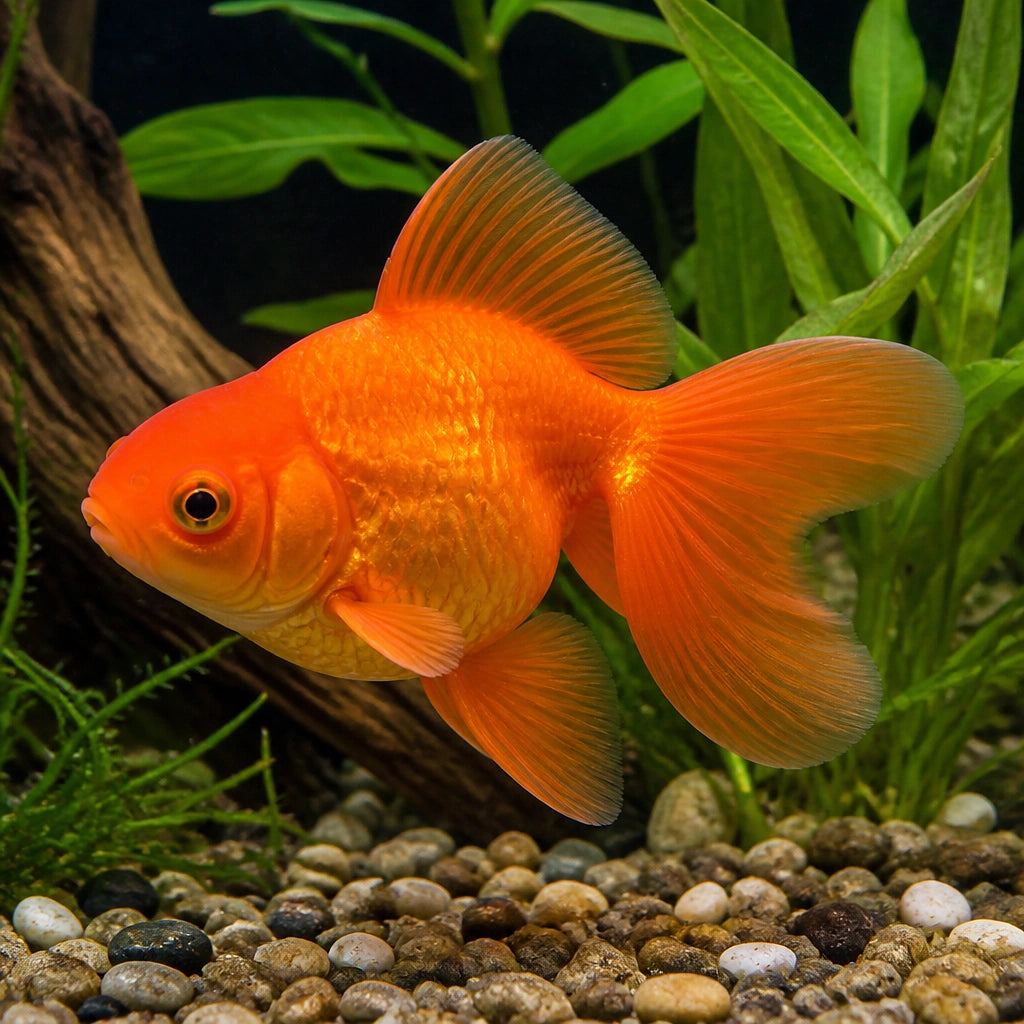
A mature red broadtail goldfish. A comet has a slimmer body and a longer single tail, but the lesson is the same: an adult goldfish is a substantial fish that needs substantial water. Product photo · our warehouse.
What to look for when you buy (anywhere)
Whether you buy from us or anyone else, these are the welfare markers that separate a healthy comet from a problem one:
- Active and swimming upright, using the whole tank. Goldfish that hang at the surface gulping, or sit on the bottom with clamped fins, are stressed or unwell.
- A clean, even body with no white cottony patches, no red streaks in the fins, and no missing scales.
- Both eyes clear and equal, and an alert response when you approach the glass.
- Ask about the holding temperature. A seller keeping goldfish in cool, unheated water (like us) understands they're coldwater fish [7]; a goldfish kept in a heated tropical system has been kept wrong.
- No swollen, pinecone-like scales (a sign of internal dropsy) and no fish gasping at the surface in the holding tank.
Community and clubs
Goldfish have a passionate, knowledgeable UK following, and the best place to learn pond-keeping, showing and the comet/sarasa varieties is the hobby itself:
- The Goldfish Society of Great Britain is the UK society dedicated to goldfish — varieties, standards, shows and pond-keeping advice — and the single best place to deepen your goldfish knowledge (goldfishsociety.co.uk/about).
- INJAF (Interest in the Natural Aquarium & Fishkeeping) is a UK charity whose goldfish guidance is some of the most honest about size and housing anywhere online [4].
- For goldfish-specific husbandry videos, specialist channels like Solid Gold Aquatics cover growth, coldwater keeping and the bowl myth in depth [7].
When your comet arrives: acclimation
Comets are hardy, but they've just travelled, and the move into your cooler water needs a gentle hand — especially the temperature step, since they're a coldwater fish often shipped slightly warmer than a pond:
- Float the sealed bag in your tank or pond for 20–30 minutes to equalise temperature gently — comets dislike sudden temperature swings more than they dislike cold itself.
- Drip or top-up acclimate over 30–45 minutes, mixing your water into the bag a little at a time so the pH and hardness adjust slowly.
- Net the fish out into the tank or pond — don't tip the transport water in.
- Keep it dim and quiet for the first few hours; a stressed goldfish settles faster out of bright light and away from tapping.
- No feeding for the first 24 hours. Their appetite is huge, but a fasting day keeps water quality stable while they adjust — and goldfish are far more often harmed by overfeeding than by a missed meal.
Ready for more?
- Learn: our water chemistry care guide for getting your coldwater parameters right, and the first tank setup guide for cycling and filtration fundamentals (skip the heater — comets are coldwater).
- Compare: the white cloud mountain minnow guide if a comet is too big for your space, the hillstream loach guide for another cool-water option, or the broader coldwater fish for sale round-up.
- Shop: the goldfish & coldwater hub for every coldwater fish we stock, and the fish food hub for the goldfish and pond diets that keep a comet in long-term condition.