Moderate
Red and White Oranda Goldfish (Carassius auratus)
pH 6.5–8.5
£62.69
A large oranda goldfish of 8–10 cm in an assorted colour, with the soft hood on its head already forming. Orandas are round-bodied, twin-tailed fancy goldfish for an indoor coldwater aquarium of at least 100 litres for one adult, kept at about 15–23°C with gentle flow. Sold individually; the colour is picked from the orandas available.
Adult size is the maximum length this species reaches at full maturity (scientific sources). The livestock you receive will be younger and smaller. Product-photo provenance and any image-specific limitations are stated on the listing.
Carassius auratus
Quantity discounts are pricing offers, not a group-size recommendation. Check the full care guidance and your existing animals before choosing a quantity.
A large oranda goldfish of 8–10 cm in an assorted colour, with the soft hood on its head already forming. Orandas are round-bodied, twin-tailed fancy goldfish for an indoor coldwater aquarium of at least 100 litres for one adult, kept at about 15–23°C with gentle flow. Sold individually; the colour is picked from the orandas available.
Adult size is the maximum length this species reaches at full maturity (scientific sources). The livestock you receive will be younger and smaller. Product-photo provenance and any image-specific limitations are stated on the listing.
Read the full care guidance when planning conditions for your aquarium.
A large oranda goldfish is the quickest way to enjoy the look that makes this fancy goldfish so popular: a round, deep body, a long double tail and the soft, raised hood that grows over the head. This listing is for an assorted oranda of 8–10 cm, a fish already past the tiny juvenile stage, in a colour picked from the orandas we have available at the time. Every goldfish, from the plainest pond comet to the most elaborate oranda, belongs to one species, Carassius auratus, in the carp family Cyprinidae.
Goldfish are among the oldest domesticated fish. Reviewing the research, Omori and Kon (2019) place their domestication in southern China around 1,000 years ago and count at least 180 varieties, about 70 of them genetically established strains. Chen and colleagues (2020) compared the genomes of 185 goldfish varieties with 16 wild crucian carp to trace that history. The oranda is one of the hooded varieties; its Japanese name, Oranda shishigashira, translates as "Dutch lionhead", according to Wikipedia's summary.
| Feature | What to look for |
|---|---|
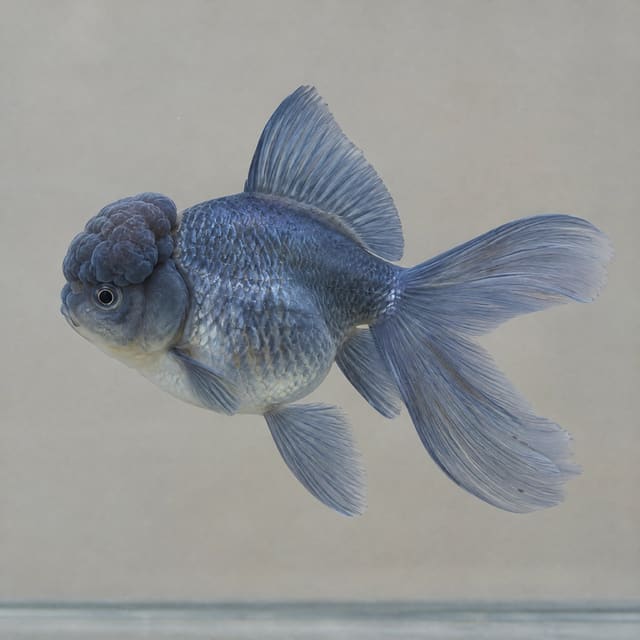
| Hood (wen) | A raised, raspberry-like growth over the top of the head and the cheeks, sometimes covering the whole face apart from the mouth |
| Body | Short, round and deep, without the high hump of a ryukin |
| Dorsal fin | Present, standing upright along the back |
| Tail | Long and double, spreading wide when the fish pauses |
| Scales | Usually metallic and shiny; some colour forms are matt or mottled |
British goldfish shows sort varieties by shape. Under the Nationwide Standards reported by Practical Fishkeeping, the oranda sits in Group 3, round-bodied fish with a long double tail, while the lionhead sits in Group 4, round-bodied fish with no dorsal fin and a short double tail. That dorsal fin is the quickest way to tell an oranda from a lionhead or ranchu.
Browse every hooded variety in our oranda and fancy goldfish category, the wider goldfish and coldwater fish range and the goldfish category, or see all our cold water fish for sale.
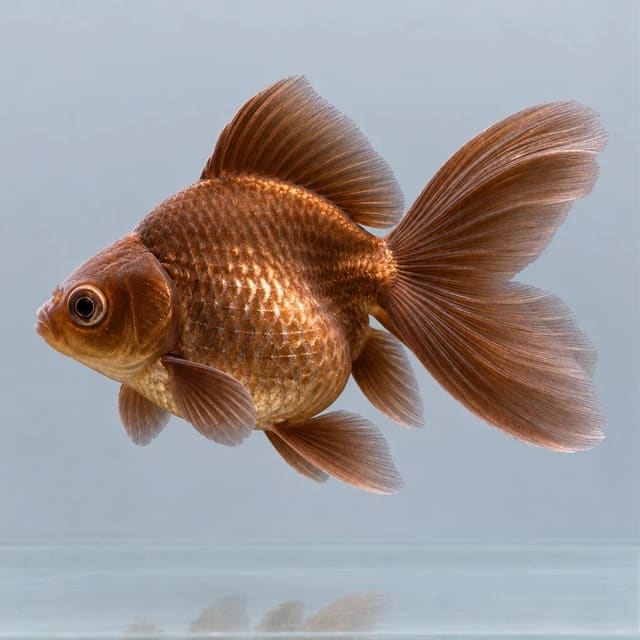
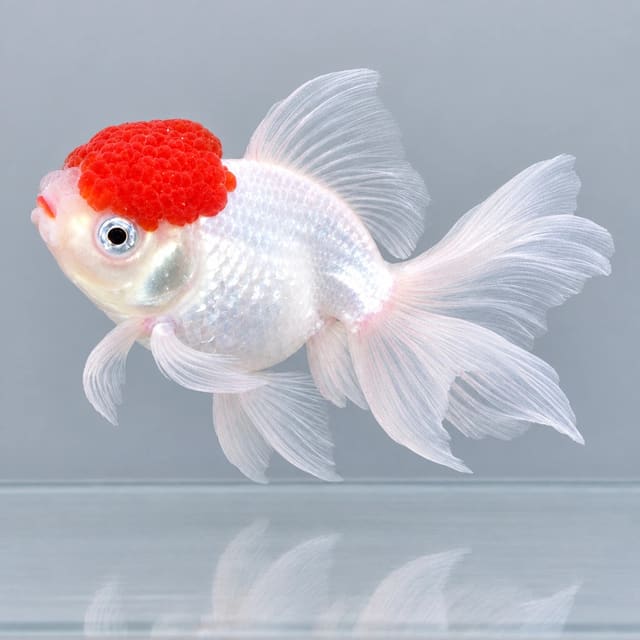
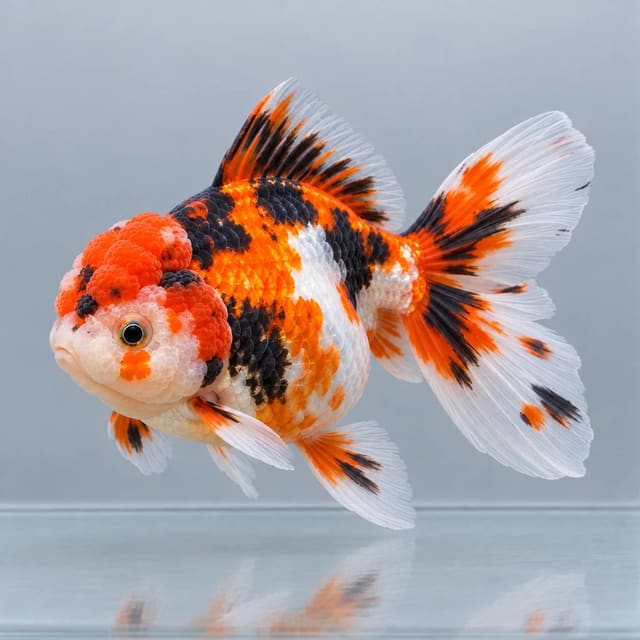
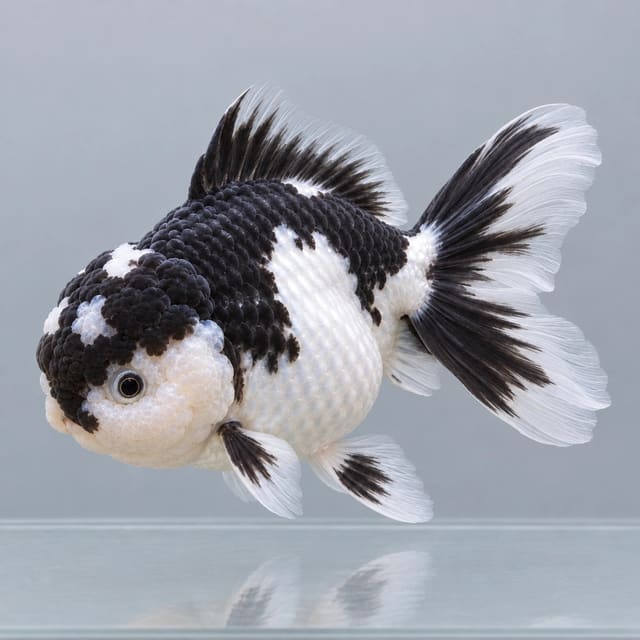
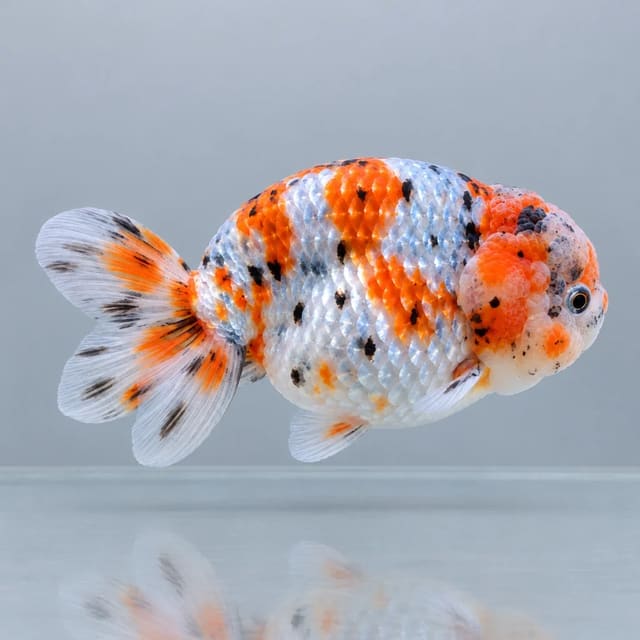
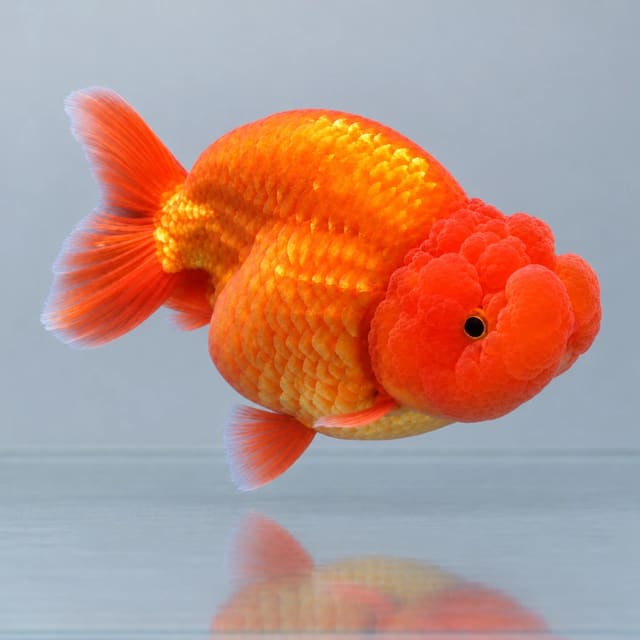
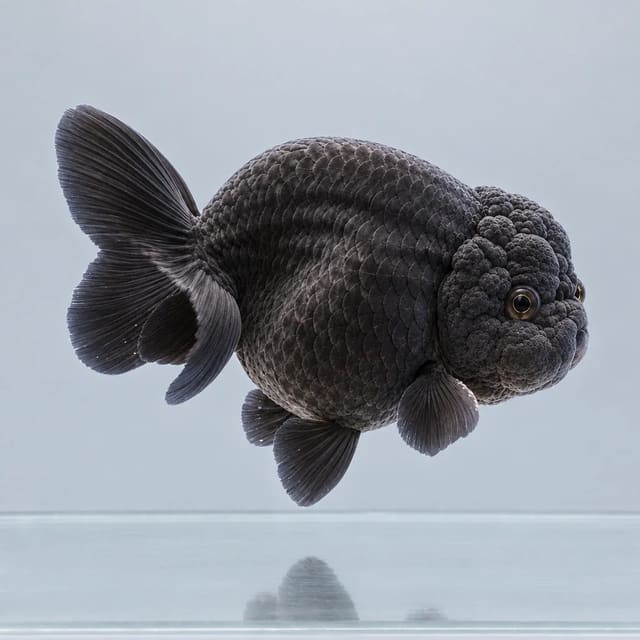
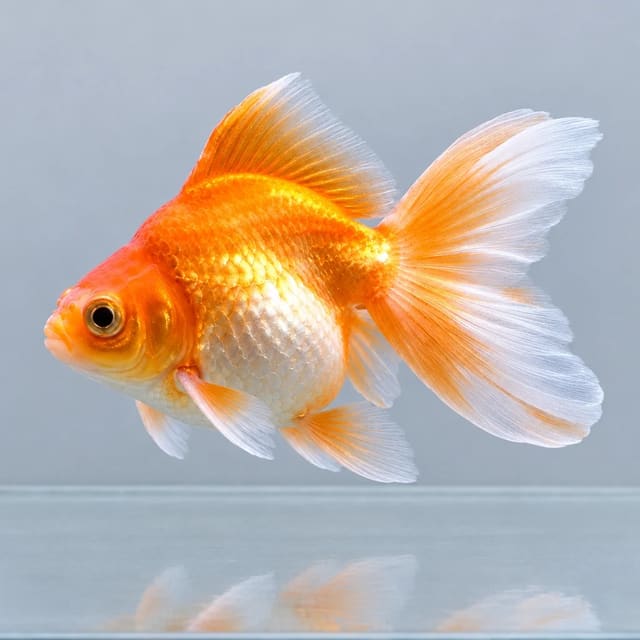
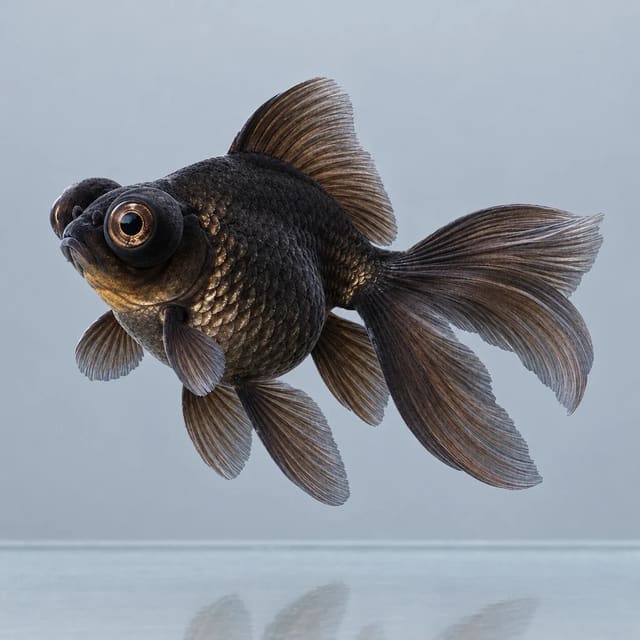
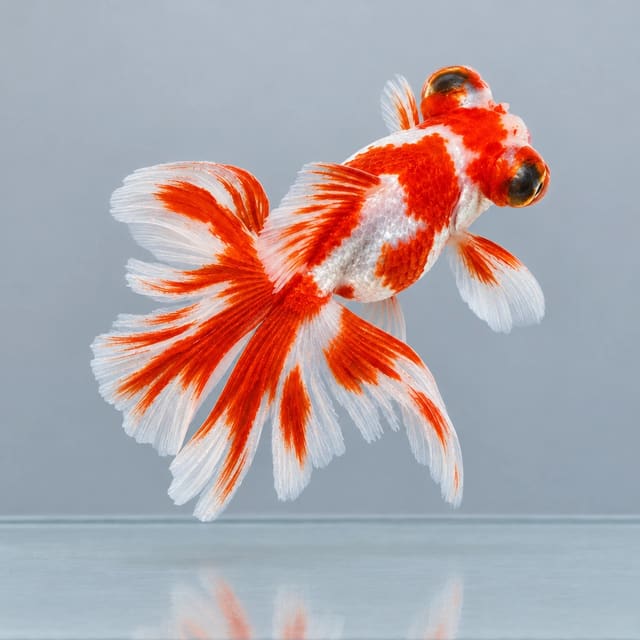
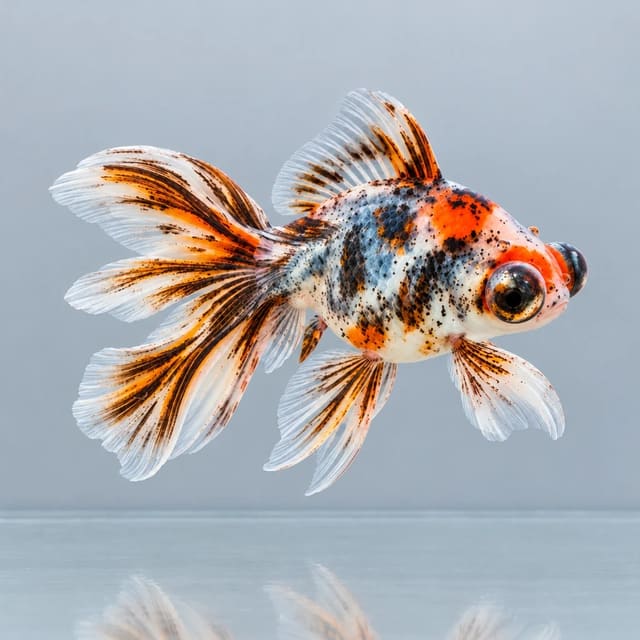
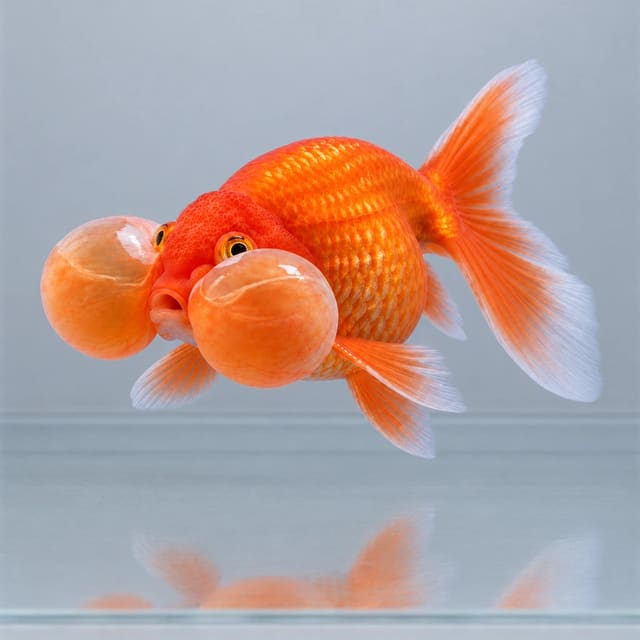
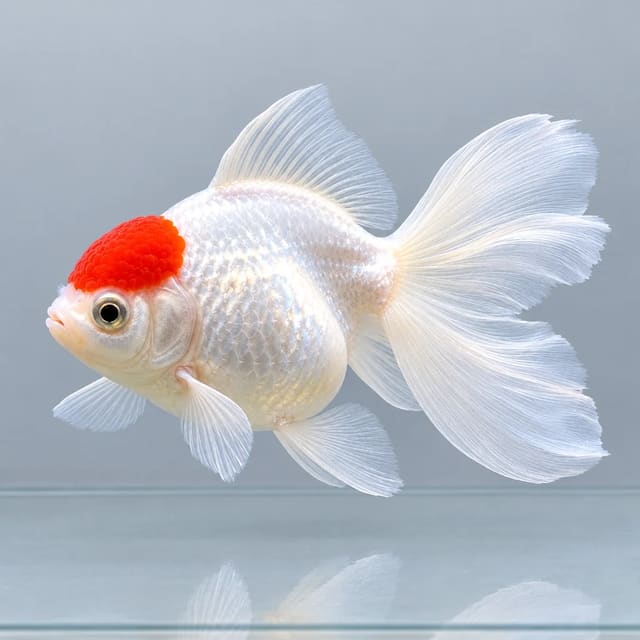
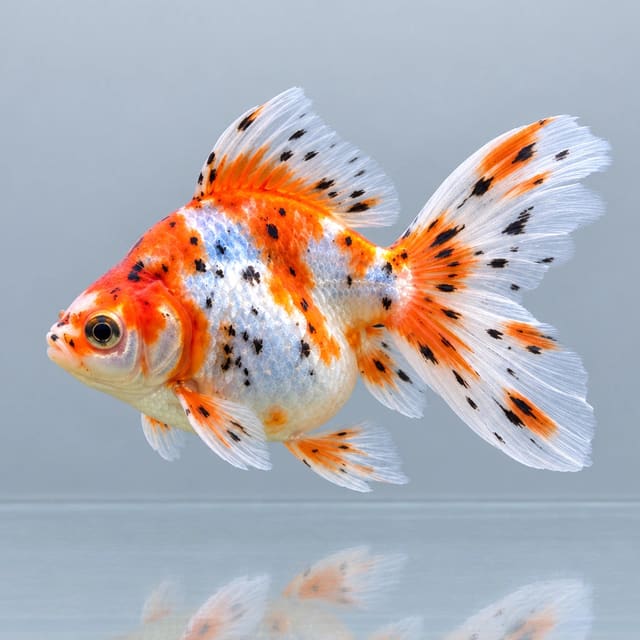
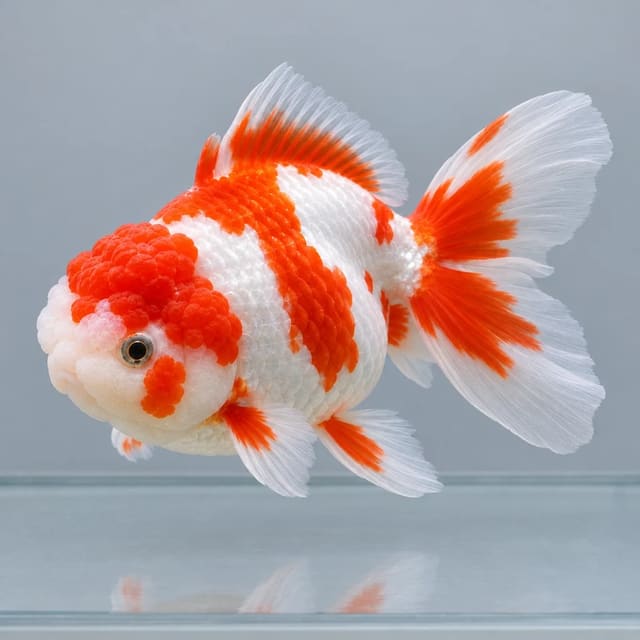
One purchase supplies one live oranda in the 8–10 cm size band. "Assorted" means the colour is not chosen: we send a healthy oranda from those available. FishBase lists the colours of cultured goldfish as scarlet, red-pink, silver, brown, white and black, plus combinations of these, so yours could be a single colour or a patchwork. The photographs show one example, an orange fish with a white hood flecked with orange; treat them as a guide to the variety, not as a picture of the fish you will receive.
If you want a particular colour, pick one of our named orandas instead: the Red Oranda, the Blue Oranda or the Red and Black Oranda. Read our delivery and Live Arrival Guarantee information before you order, and have the aquarium matured and running before the fish arrives.
Sources disagree on how big orandas grow, so plan generously. OATA, the UK ornamental fish trade association, says fancy goldfish are unlikely to exceed 20 cm. Practical Fishkeeping gives 20–31 cm for orandas and mentions one fish that passed 37 cm. FishBase records 48 cm total length as the maximum for the species, but that record covers long-bodied goldfish as well as fancies. An 8–10 cm oranda still has a lot of growing to do, and OATA says a well-kept fancy goldfish typically lives six to eight years, with some passing 20.
| Adult fancy goldfish | OATA minimum volume |
|---|---|
| 1 | 100 litres |
| 2 | 150 litres |
| 3 | 200 litres |
| 4 | 250 litres |
OATA's rule is 100 litres for the first adult and 50 litres for each one after that, and it advises buying the largest aquarium you reasonably can. Practical Fishkeeping adds a shape check: the tank should be at least six times as long as an adult fish and twice as wide as the fish is long. For a 20 cm oranda that means a base of at least 120 × 40 cm. Our tank volume calculator turns your measurements into litres, and the stocking calculator checks the whole group at adult size.
Orandas are slow, deliberate swimmers with long fins and a hood that marks easily, so the layout should be about open space and smooth surfaces. OATA recommends gravel or sand, warns against ornaments and artificial plants with sharp or rough edges that can damage long fins and eyes, and suggests plant pots, caves or plastic plants where live plants would simply be eaten.
| Choose | Avoid |
|---|---|
| Smooth, rounded gravel or sand | Sharp, crushed or jagged gravel |
| Soft artificial plants, or tough live plants | Stiff plastic plants with pointed tips |
| Rounded stones and wide-mouthed caves | Narrow gaps a round fish could wedge itself into |
| A clear swimming lane along the front | Crowded décor that hems in a slow swimmer |
| A secure lid and overhead light on a timer | Direct sunlight, radiators and draughts |
Live plants are ideal, says OATA, but goldfish eat them, so ask us which plants will cope before you buy. Browse our aquarium plants and the beginner’s guide to live plants, and expect to replace soft-leaved plants from time to time. Overhead lighting gives the fish a regular day and night.
Orandas are coldwater fish, and in most UK homes they need no heater. OATA gives an overall range of 4–25°C with 15–23°C as the ideal, and says fancy goldfish can adjust to a wider range over time if changes are made slowly. Sudden swings are the real risk, so place the aquarium away from radiators, windows and outside doors.
| Reading | Target |
|---|---|
| Temperature | 15–23°C ideal (OATA tolerance 4–25°C) |
| pH | 6.5–8.5 (OATA); FishBase records 6.0–8.0 for the species |
| General hardness | 8–18 °dH, medium-hard |
| Carbonate hardness | 5–15 °dKH |
| Ammonia | 0 mg/l |
| Nitrite | 0 mg/l |
| Nitrate | No more than 20 mg/l above your tap water |
Most UK mains water suits goldfish once it is treated with a conditioner to remove chlorine or chloramine, as OATA advises for every water change. Hard, alkaline water is common across much of southern and eastern England, while parts of Scotland, Wales and north-west England are softer; your water company publishes a free water-quality report for your postcode. Enter your readings in our water matcher, read our water chemistry guide for what each number means, and find conditioners in our water care range.
Goldfish eat heartily and produce a lot of waste, and Practical Fishkeeping calls good filtration essential because of that waste and the fish's oxygen demand. The same article warns that fancy goldfish are poor swimmers, so the current must stay moderate; its own display ran two large external filters with the outlets angled to ripple the surface. OATA likewise asks for a gentle current, ideally spread through a spray bar.
Our article on understanding aquarium filtration explains how to size a filter, and the nitrogen cycle explained shows why a new aquarium must mature before fish go in.
In the wild, goldfish eat plankton, small bottom-living invertebrates, plant material and detritus, according to FishBase. OATA recommends a goldfish-specific flake, granule or pellet as the staple because goldfish need more carbohydrate than many aquarium fish, with live or frozen foods and vegetables as extras. Feed once a day, only as much as the fish clear within a few minutes; leftovers rot and release toxic waste.
OATA notes that some goldfish gulp air while snatching food at the surface and then struggle to stay level for a while. If your oranda floats or tilts after meals, try a slow-sinking food or a different food, as OATA suggests. Our article on why a fish swims sideways covers other causes of balance problems.
Add a new oranda only to a matured aquarium with ammonia and nitrite at zero; OATA warns that stocking too quickly causes "new tank syndrome". Use the floating-bag method: turn the aquarium lights off, float the sealed bag for about 10 minutes, add small amounts of aquarium water to the bag over up to 20 minutes, then release the fish with as little bag water as possible. Our guide on how to acclimatise new fish walks through each step.
| When | What to do |
|---|---|
| Before arrival | Test the water, check the temperature and make sure the filter runs at full flow |
| Arrival day | Acclimatise with the lights off, then leave the fish in peace for the rest of the day |
| Day 2 | Offer a very small meal and remove anything left after a few minutes |
| Days 3–7 | Watch breathing, balance and appetite each day, and test ammonia and nitrite |
| End of week one | Do your normal water change and compare the readings with your targets |
OATA says fancy goldfish can be kept alone or with other fancy goldfish, and advises against mixing them with common goldfish, which are faster, outcompete them for food and sometimes nip their fins. FishBase's aquarium note for the species suggests groups of five or more in a tank at least 100 cm long, so if you have the space, a small group of fancies is the more natural choice. Practical Fishkeeping adds that telescope-eyed goldfish, which see poorly, should not be mixed with more active varieties.
| Suits | Avoid |
|---|---|
| Other orandas of a similar size | Comets, shubunkins and other single-tailed goldfish |
| Round-bodied, twin-tailed fancies, such as our Red Broadtail | Tropical fish that need a heater |
| Fish with the same slow swimming speed | Fin-nipping species |
| Companions that eat the same goldfish foods | Very small fish or shrimp that could be eaten |
Single-tailed goldfish such as the Bronzed Comet belong in a separate, larger aquarium or a pond; our comet goldfish guide explains their very different needs. Check any combination with our tank mates tool.
The hood is living tissue. A 2025 study by Li and colleagues found it is a thickening of the skin, made of collagen-rich layers and extra skin cells and held on small bony growths that develop on the skull; they class it as a form of skin fibrosis rather than the tumour it was long thought to be. Its folds can trap debris, and a welfare report covered by Practical Fishkeeping notes that hooded goldfish may develop bacterial and fungal infections there. Clean water and smooth décor are the best protection.
| If you see | Do this |
|---|---|
| Hanging at the surface or sitting on the bottom | Test ammonia, nitrite and temperature straight away |
| Clamped fins, flicking against décor or shimmying | Check water quality, then ask us for advice |
| Small white spots on the body and fins | Read our white spot guide and confirm the cause before treating |
| Ragged, white-edged or shrinking fins | Improve water quality and read our fin rot guide |
| Fluffy patches on the hood or body | Test the water and get fish-health advice promptly |
| Floating, tilting or swimming upside down | Change the food and check the water |
| Loss of appetite or weight | Test the water, then check for competition at feeding time |
OATA's checklist for a healthy goldfish is clear, bright eyes, undamaged fins, intact scales, no ulcers or lumps, normal swimming and steady breathing. Test first when something changes: most problems follow a dip in water quality.
OATA says goldfish can breed in a large home aquarium, and that two males to each female improves the odds. Raising the temperature slowly to about 20°C, and then making a partial water change, often triggers spawning. The males chase the female, the eggs are scattered over plants or a spawning mop, and the eggs should be moved to a separate tank because adults eat eggs and fry. They hatch in about three days, and the fry need a dedicated set-up and specialist fry food. Never release goldfish, their eggs or aquarium water into ponds, rivers or drains: FishBase lists the species as a potential pest where it has been introduced.
Sources differ. OATA says fancy goldfish are unlikely to grow beyond about 20 cm, while Practical Fishkeeping gives 20–31 cm for orandas and mentions one of more than 37 cm. Plan the aquarium for a fish of at least 20 cm.
No. Each fish is picked from the orandas available at the time, so colour and pattern are not chosen. For a set colour, choose a named oranda such as our Red Oranda, Blue Oranda or Red and Black Oranda.
Not usually. OATA gives an ideal range of 15–23°C and says a heater is only needed if the room is very cold. Keep the aquarium away from radiators, draughts and direct sunlight so the temperature stays steady.
Using OATA’s guide of 100 litres for the first adult fancy goldfish and 50 litres for each extra one, a 200-litre aquarium suits three adults. Check the real volume of your tank with our tank volume calculator first.
OATA advises keeping fancy goldfish in indoor aquariums only. Orandas are slow swimmers and are sensitive to low temperatures, so a UK pond through the winter does not suit them.
Yes, for some time. Practical Fishkeeping says the head growth of young orandas takes one to two years to develop. At 8–10 cm the hood has normally started, and it fills out further as the fish matures; the final size varies from fish to fish.
A 2025 study by Li and colleagues found the hood is thickened skin, built from collagen-rich layers and extra skin cells, held on small bony growths on the skull. It is not a tumour, but its folds can trap debris, so clean water matters.
It is better not to. OATA advises against mixing fancy goldfish with common goldfish, which are faster, take most of the food and sometimes nip fins. Keep comets and other single-tailed goldfish in a separate, larger set-up.
No reviews for this item yet. Bought one? Honest reviews only, good or bad.
What customers say about ordering from us
Easy website plenty of info on fish your buying great to pick a time slot
TRACEY DURRANT · 7 Oct 2026
Got some lovely fish thank you
Kevin Mackie · 7 Oct 2026
Reviews of our shop, collected by Judge.me, an independent third-party review collector. Newest first.
Moved by UK carriers licensed to handle live animals
Hand-packed with oxygen bags, poly box, heat pack
Email photos the same day; an optional unboxing video helps us review problems faster — claim terms apply
Klarna & PayPal Pay in 3 at checkout