Moderate
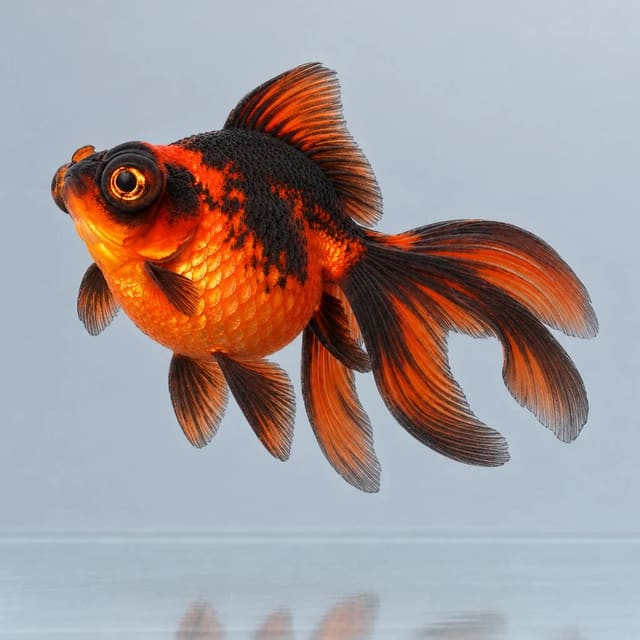
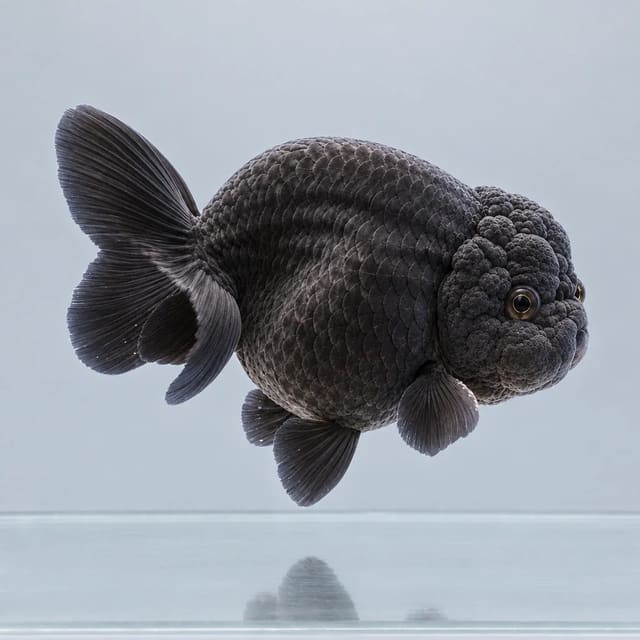
Black Lionhead Ranchu Goldfish (Carassius auratus)
100L
£31.39
The Lionhead Ranchu is a round fancy goldfish (Carassius auratus) with no dorsal fin and a soft hood that builds on the head as it matures. It grows to about 20 cm and needs a cool, well-filtered indoor aquarium of 100 litres or more with gentle flow and slow fancy goldfish company. Sold as one live fish at 3–4 cm.
Adult size is the maximum length this species reaches at full maturity (scientific sources). The livestock you receive will be younger and smaller. Product-photo provenance and any image-specific limitations are stated on the listing.
Carassius auratus
Quantity discounts are pricing offers, not a group-size recommendation. Check the full care guidance and your existing animals before choosing a quantity.
The Lionhead Ranchu is a round fancy goldfish (Carassius auratus) with no dorsal fin and a soft hood that builds on the head as it matures. It grows to about 20 cm and needs a cool, well-filtered indoor aquarium of 100 litres or more with gentle flow and slow fancy goldfish company. Sold as one live fish at 3–4 cm.
Adult size is the maximum length this species reaches at full maturity (scientific sources). The livestock you receive will be younger and smaller. Product-photo provenance and any image-specific limitations are stated on the listing.
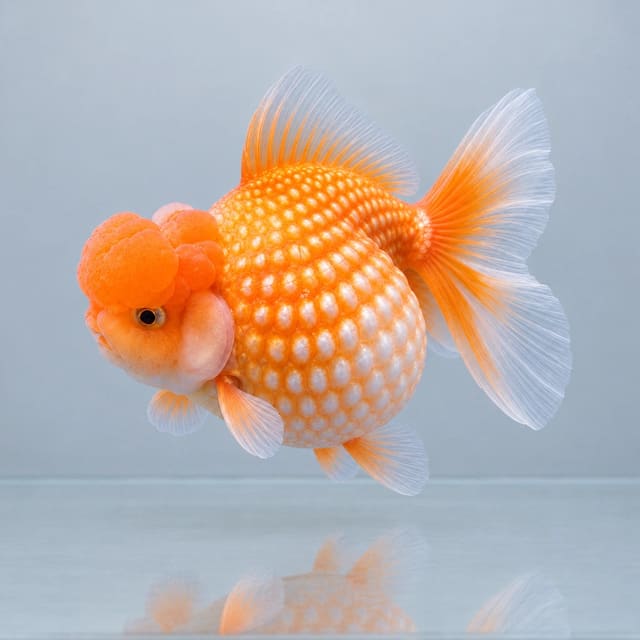
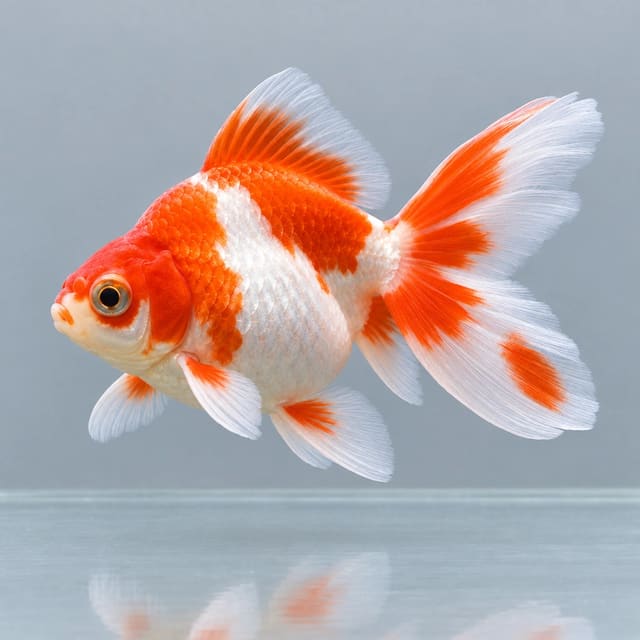
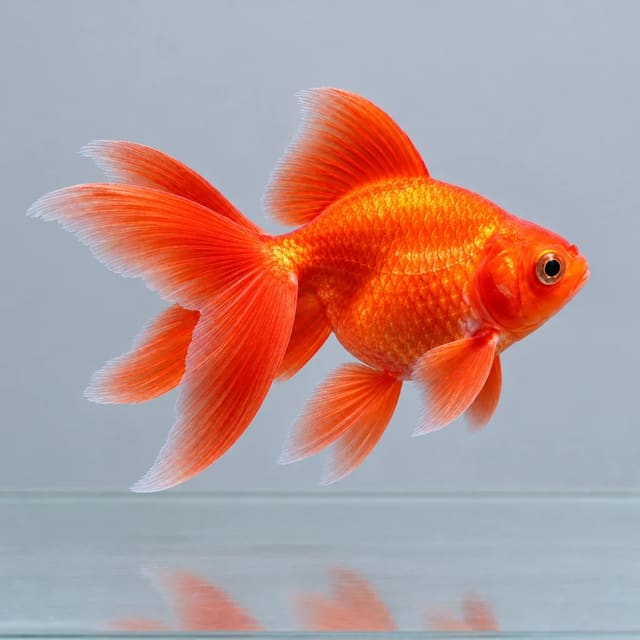
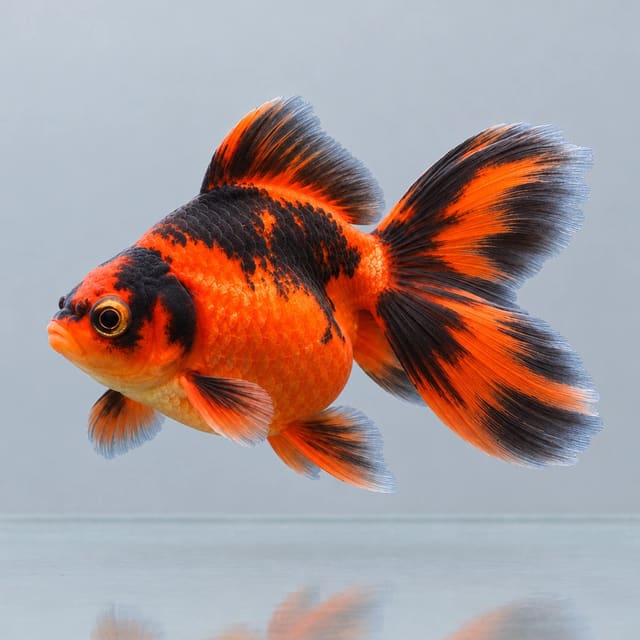
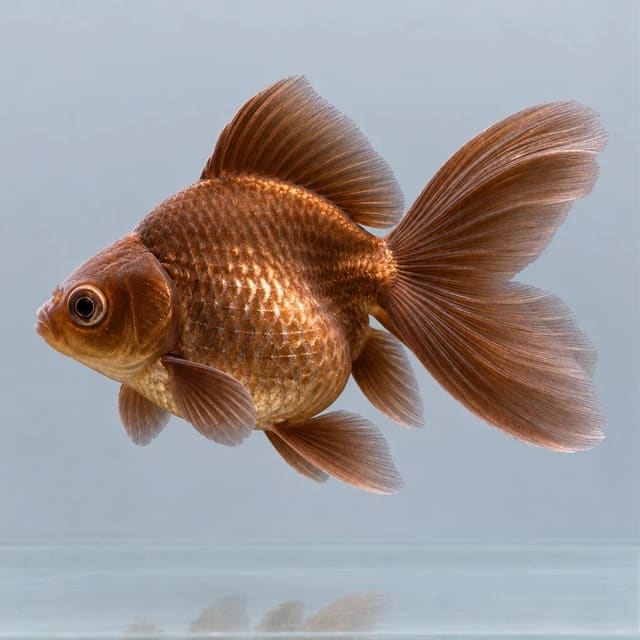
The Lionhead Ranchu goldfish is a round, dorsal-less fancy goldfish (Carassius auratus) whose head slowly gathers a soft, bubbly hood as it grows. The fish in our photographs is metallic red-orange with a paler belly and a short, divided tail held up behind a smooth, finless back. It belongs to the carp family, Cyprinidae, and FishBase gives the species’ native range as East Asia; the fancy forms are entirely the work of breeders.
In Japan the ranchu is called the king of goldfish, according to Practical Fishkeeping’s feature on the breed, and fine Japanese fish can sell for prices similar to some koi. The Bristol Aquarists’ Society ranchu standard records that the variety was developed in China and further developed in Japan, that ranchu are also called buffalo-heads in the Far East, and that calico ranchu are known in Japan as edonishiki. The lionhead is the Chinese, flatter-backed relative. Because most shop ranchu come from China, the trade name “lionhead ranchu” is widely used for fish that combine features of both.
Science backs up how distinct these fish are. A 2020 genome study of 27 goldfish strains located genetic regions associated with dorsal fin loss, and Ota and Abe’s review notes that ranchu carry only 19–23 vertebrae against 25–29 in the ryukin, which fits their short, compact build.
| Look at | Lionhead-type fish | Ranchu-type fish |
|---|---|---|
| The line of the back | Flat and smooth to the tail root | Arches and slopes down to the tail |
| Where the tail meets the body | Obtuse angle, tail runs fairly flat | Acute angle, tail raised at about 45° |
| The hood | Big, round, dominates the head | Head long and broad; growth becomes rectangular |
| Depth of body | About 60% of length | About 50% of length |
These points come from the Bristol standards for both varieties and from Paul Green’s comparison in Practical Fishkeeping. A young fish shows them only faintly; the back line and tail set become clearer over the first year or two.
Each order line is one live Lionhead Ranchu at 3–4 cm body length. The Bristol show standard sets 5.5 cm as the minimum body length for exhibition, so this is a juvenile with most of its growth and hood development ahead of it. Sex is not chosen or guaranteed.
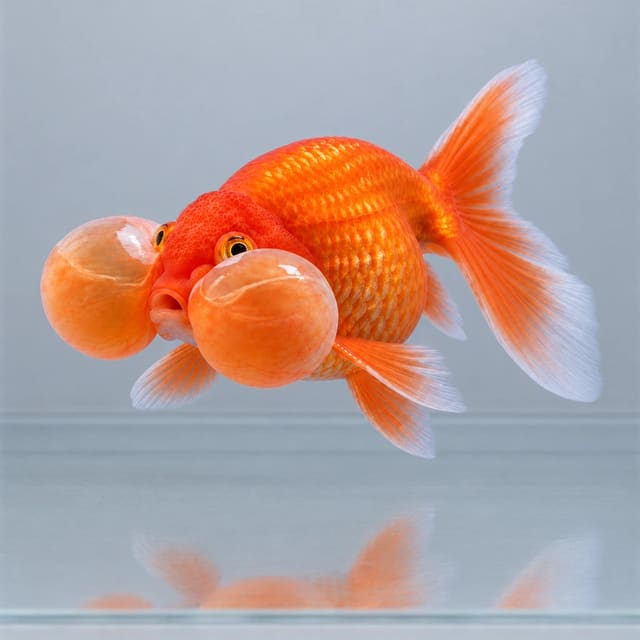
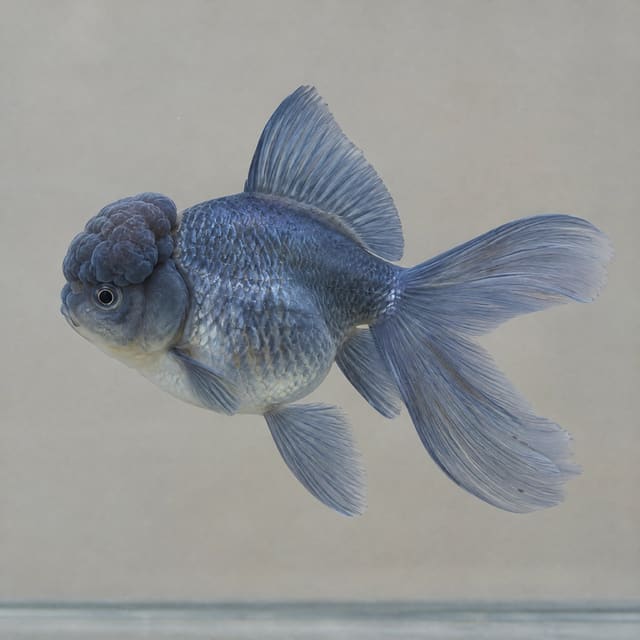
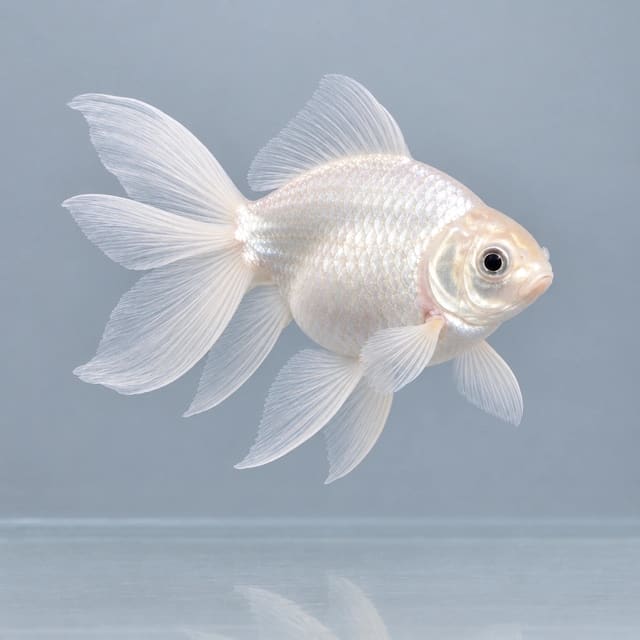
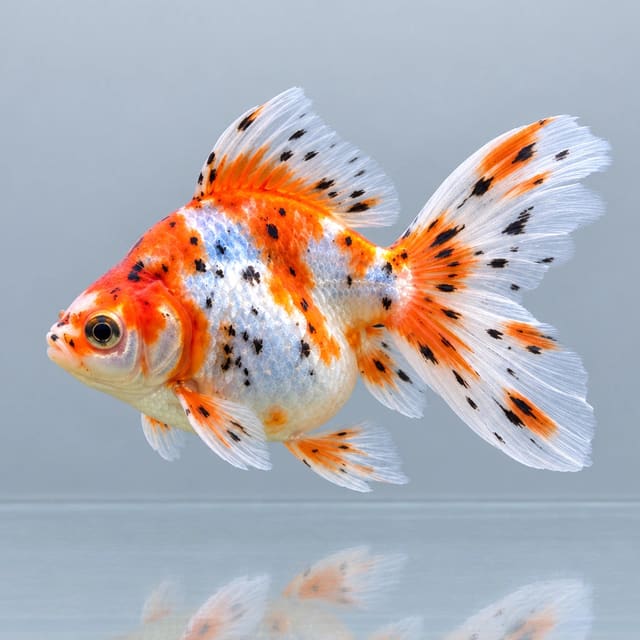
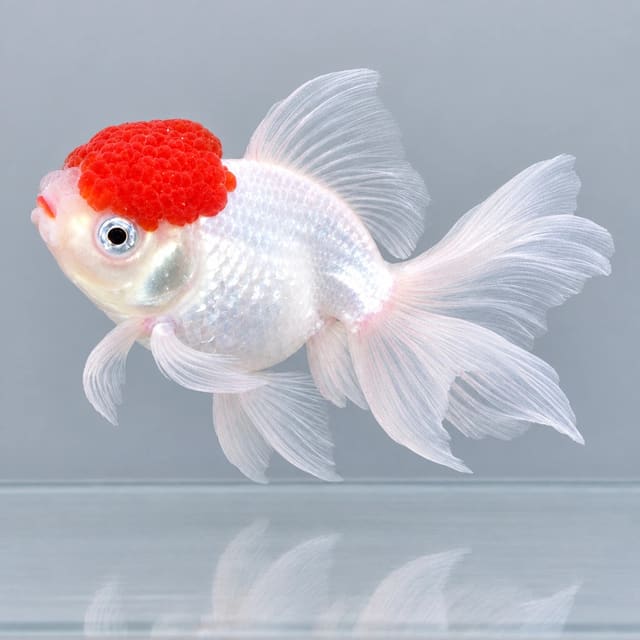
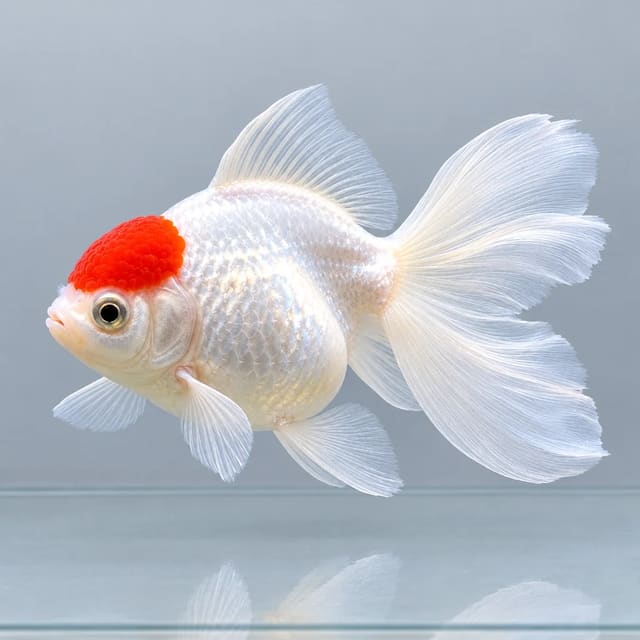
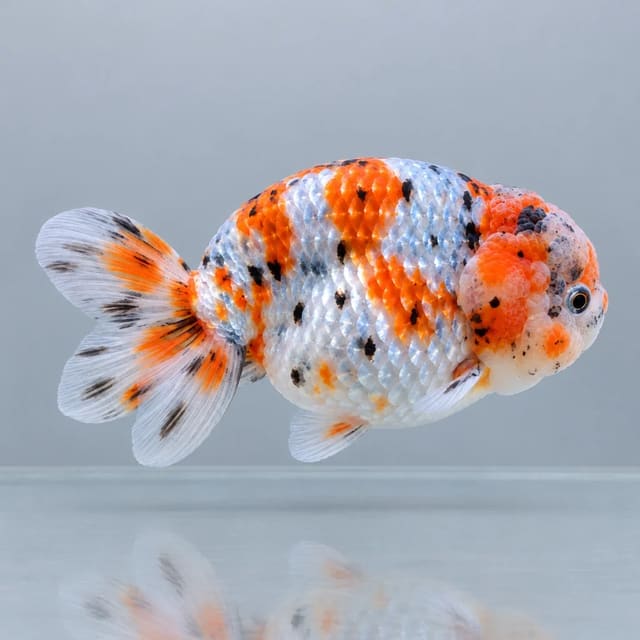
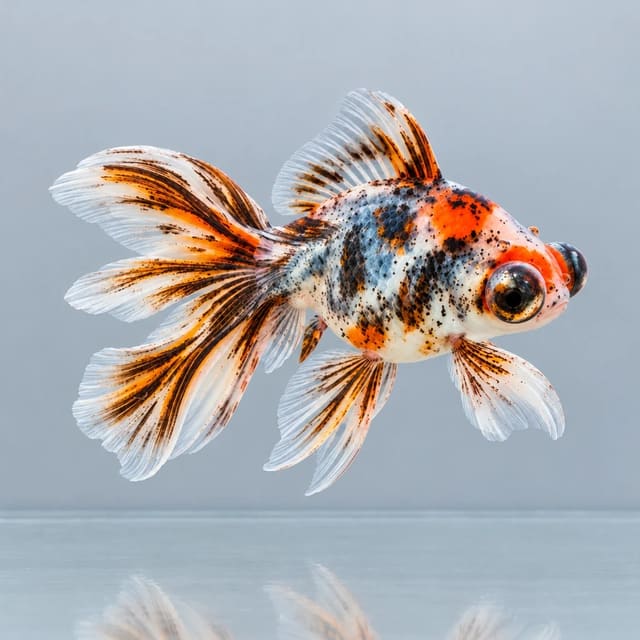
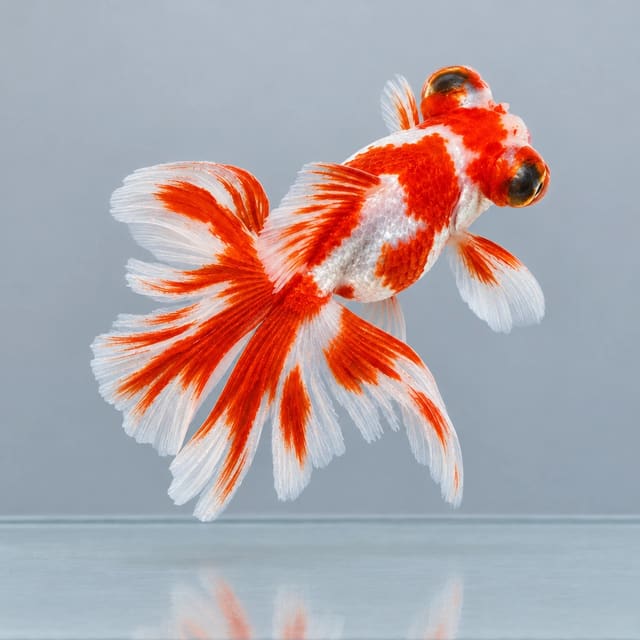
The photographs are representative images of the variety, prepared from a reference picture; they do not show your individual fish. Expect the dorsal-less shape and the colour form pictured, with natural variation in hood, tail and shade. See the rest of our goldfish and coldwater fish or the fancy goldfish category to plan a group.
The Bristol standards ask for a hood well developed in three areas: over the top of the skull, below the eyes and across the gill covers. They note that strong hood growth is common in mature adults, while Practical Fishkeeping describes the lionhead’s growth as large and rounded and the ranchu’s as turning rectangular with age. No source gives a fixed timetable, so treat hood growth as something that builds steadily with good food and clean water rather than a promise of a particular size.
Colour can move too. Practical Fishkeeping notes that a ranchu’s colour can change almost completely as it matures, that many goldfish whiten with age, and that the breeders it interviewed see natural daylight as key to rich colour. A red fish may become red and white over the years; this is normal development, not illness.
OATA gives fancy goldfish an adult size of about 20 cm and asks for at least 100 litres for the first adult, then 50 litres for each additional adult. The RSPCA sets a floor of 60 litres per goldfish. The Maidenhead Aquatics database suggests a tank around 1.2 metres long and says length and width matter more than height.
| Planned group | Minimum volume (OATA) | Note |
|---|---|---|
| 1 lionhead ranchu | 100 litres | OATA says a fancy goldfish can live alone |
| 2 fish | 150 litres | A common starting pair |
| 3 fish | 200 litres | RSPCA floor would be 180 litres |
| 4 fish | 250 litres | Above the RSPCA floor of 240 litres |
Ranchu of 30 cm are not uncommon on the showbench according to Practical Fishkeeping, so treat these as minimums. Work out your tank’s true capacity with the tank volume calculator and check the whole group with the stocking calculator. A goldfish bowl is never suitable; the RSPCA lists bowls as too small, too unstable in temperature and without room for a proper filter.
OATA recommends indoor aquaria only for fancy goldfish and says a heater is rarely needed. The RSPCA puts goldfish at 10–21°C, OATA at 4–25°C with 15–23°C as the best range, and the Maidenhead database at 10–28°C. We suggest holding the tank steady between 15 and 21°C, where the sources overlap. Keep the aquarium out of direct sun, away from radiators and draughts, and give 8–10 hours of light a day as the RSPCA suggests.
| Measure | Keep it at | Where the figure comes from |
|---|---|---|
| Temperature | 15–21°C | Overlap of OATA best range and RSPCA range |
| pH | 7.0–8.0 | Maidenhead; inside OATA 6.5–8.5 and FishBase 6.0–8.0 |
| General hardness | 8–18 dGH | OATA; FishBase gives 5–19 |
| Carbonate hardness | 5–15 dKH | OATA |
| Ammonia and nitrite | 0 mg/l | OATA |
| Nitrate | Within 20 mg/l of your tap water | OATA |
Use a conditioner that neutralises chlorine and chloramine in every bucket of new water, and match its temperature to the tank. Our water treatments cover this. Test your tap once for pH and hardness, enter the results into the water matcher, and read our water chemistry guide if anything falls outside the table. Most fancy goldfish do better in steady water than in water that is constantly being adjusted.
Fancy goldfish produce plenty of waste, so the Maidenhead database asks for efficient filtration, weekly partial water changes and well-oxygenated water in warm weather. OATA adds that fancy breeds prefer gentle flow; a spray bar or a diffused outlet spreads the current, which matters even more for a compact, dorsal-less fish. Practical Fishkeeping does note that Japanese ranchu, being longer in the body than lionheads, suffer fewer swim bladder disorders.
Cycle the filter first. The RSPCA recommends at least two weeks of fishless cycling, testing every other day until ammonia and nitrite have peaked and returned to zero. Our guide to the nitrogen cycle explains what is happening during those weeks.
| Task | How often |
|---|---|
| Test ammonia, nitrite and nitrate | Weekly, and after adding fish |
| Change water (OATA 25%; RSPCA 30%) | Weekly |
| Siphon waste from the substrate | With each water change |
| Rinse sponges in removed tank water | When flow drops |
| Check outlet strength and intake | Weekly |
OATA warns against sharp or rough décor that could damage long fins or delicate eyes, and the soft hood of a lionhead ranchu deserves the same care. Use smooth sand or rounded gravel, smooth wood and rounded stones, and avoid ornaments with tight gaps or rough inner surfaces. Leave a clear, open floor at the front where the fish can find sinking food.
OATA recommends a goldfish-specific flake, granule or pellet, because goldfish need more carbohydrate than many fish, with daphnia, bloodworm, brine shrimp, blanched lettuce or shelled peas as supplements. Feed once a day and only what is eaten in a few minutes. The Maidenhead database prefers sinking foods and a high-fibre diet, since goldfish swallow air while feeding at the surface and that is linked to buoyancy problems.
Practical Fishkeeping’s ranchu breeders feed twice a day and up to six times a day for young or show fish, but in vats with complete weekly water changes. At home, split the same small daily ration into two meals if you want more frequent feeding.
| Day | Meal |
|---|---|
| Monday, Thursday | Sinking goldfish mini sticks |
| Tuesday, Friday | A small goldfish pellet, soaked briefly so it sinks |
| Wednesday | Frozen daphnia, thawed |
| Saturday | Thawed, shelled peas or blanched greens |
| Sunday | Frozen mysis or bloodworm, thawed |
If the fish starts floating or tipping after meals, OATA suggests changing to a different or slower-sinking food. Our article on why fish swim sideways helps you rule out water problems at the same time.
Make sure the tank is cycled and that ammonia and nitrite read zero before delivery day. OATA’s method is simple: lights off, float the sealed bag for about 10 minutes, add small amounts of tank water over up to 20 minutes, then release the fish. Our step-by-step acclimatisation guide covers the details, and our delivery and Live Arrival Guarantee terms explain what to do if there is a problem on arrival.
OATA says fancy goldfish can live alone or with other fancy goldfish, and advises against mixing them with common goldfish, which swim faster, out-compete fancies for food and sometimes nip fins. The Maidenhead database describes the ranchu as sociable and suggests keeping it with its own kind or other fancy goldfish.
| Good match | Use caution | Keep apart |
|---|---|---|
| Other lionheads and ranchu | Ryukins and other fast twin-tails | Comets, commons and shubunkins |
| Orandas such as the Red Oranda | Very large, older fancies | Koi and pond fish |
| Pearlscales and bubble eyes | Plants the fish may eat | Tropical fish needing heat |
Calm orandas like the Blue Oranda and the Red Broadtail match its pace. If you add a ryukin, feed at two points so the slower lionhead ranchu gets its share. Our comet goldfish guide shows why single-tailed fish are better kept separately, and the tank mates tool checks other ideas.
A healthy fish, in OATA’s description, has clear bright eyes, whole fins, intact scales, no ulcers or bumps, normal swimming and steady breathing. Look over your lionhead ranchu each day while it feeds.
| Sign | First step |
|---|---|
| Gasping at the surface or lying on the bottom | Test ammonia, nitrite and temperature |
| Tipping, floating or sinking after food | Smaller sinking meals; review the diet |
| Flicking, clamped fins or shimmying | Test the water and inspect the gills |
| White spots | Read our white spot guide |
| Frayed fins | Improve water quality; see our fin rot guide |
| Hood red, swollen or closing over the eyes | Check water quality and contact us for advice |
The Bristol lionhead breeders report that their lionheads live seven to eight years on average and name gill flukes as a regular problem, controlled with lower stocking and frequent water changes. The Maidenhead database suggests that well-kept fancy goldfish can live 15–20 years or more, so the figures vary widely with care.
Japanese ranchu are judged from above in shallow bowls, much like koi, with three to five judges scoring each fish, Practical Fishkeeping reports. Fish in their first year are called tosai, become nisai on the first of January after hatching and oya the January after that. The Bristol ranchu standard was first published in 2011 and updated in 2016.
OATA suggests a large tank, about two males to every female, a slow rise to around 20°C and a partial water change to trigger spawning. Eggs hatch in about three days and the adults eat eggs and fry, so separate them. Males show white tubercles on the gill covers and pectoral fins; females are deeper bodied. Expect very few show-quality youngsters: the Bristol lionhead breeders keep about 50 of every 1,000 fry and see about five reach the standard.
A fancy goldfish, Carassius auratus, with no dorsal fin, a short rounded body and a hood of soft growth on the head. The name joins two show varieties: the flat-backed Chinese lionhead and the ranchu, which was developed in China and refined in Japan with a more curved back and a tail set at a steeper angle.
No. Practical Fishkeeping and the Bristol Aquarists’ Society both separate them by the back and tail: the lionhead has a flat back and a tail that runs fairly flat, while the ranchu’s back curves down and its tail leaves the body at about 45°. Most shop fish come from China and often sit between the two.
Gradually. At 3–4 cm the hood is only a low cap. The Bristol society notes that good hood growth is common in mature adults, covering the top of the head, the area below the eyes and the gill covers. No source gives a fixed timetable, and hood size varies from fish to fish.
Plan for about 20 cm, as OATA and the Maidenhead Aquatics database give for fancy goldfish. Practical Fishkeeping notes that show ranchu of 30 cm are not uncommon.
At least 100 litres for one adult and 50 litres for each extra adult, following OATA; the RSPCA asks for at least 60 litres per goldfish. Choose a long, wide tank with a mature filter and a gentle outlet.
It may. Practical Fishkeeping notes that a ranchu’s colour can change almost completely as it matures and that many goldfish turn whiter with age. The fish you receive is the colour form shown, but we cannot fix its adult colour.
Yes, with other slow fancy goldfish such as ranchu, lionheads, orandas and pearlscales. OATA advises against common goldfish with fancy varieties because they are faster, take the food and sometimes nip fins.
One live Lionhead Ranchu at 3–4 cm per purchase. Sex is not chosen or guaranteed.
No reviews for this item yet. Bought one? Honest reviews only, good or bad.
What customers say about ordering from us
Easy website plenty of info on fish your buying great to pick a time slot
TRACEY DURRANT · 7 Oct 2026
Got some lovely fish thank you
Kevin Mackie · 7 Oct 2026
Reviews of our shop, collected by Judge.me, an independent third-party review collector. Newest first.
Moved by UK carriers licensed to handle live animals
Hand-packed with oxygen bags, poly box, heat pack
Email photos the same day; an optional unboxing video helps us review problems faster — claim terms apply
Klarna & PayPal Pay in 3 at checkout