Moderate
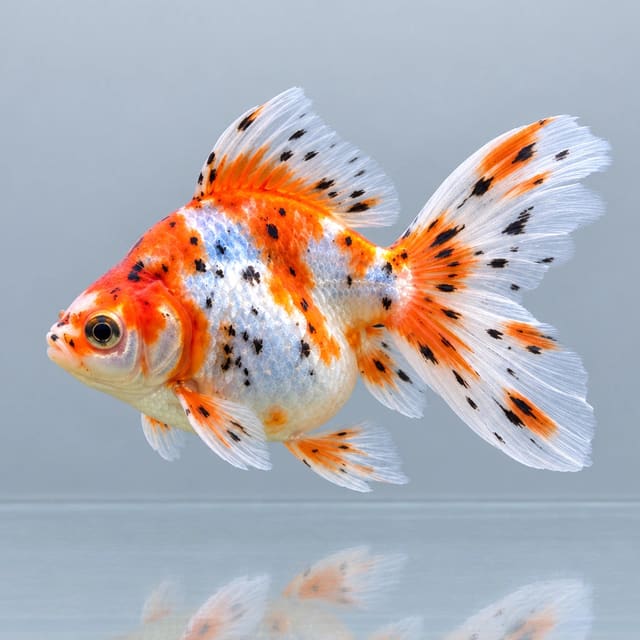
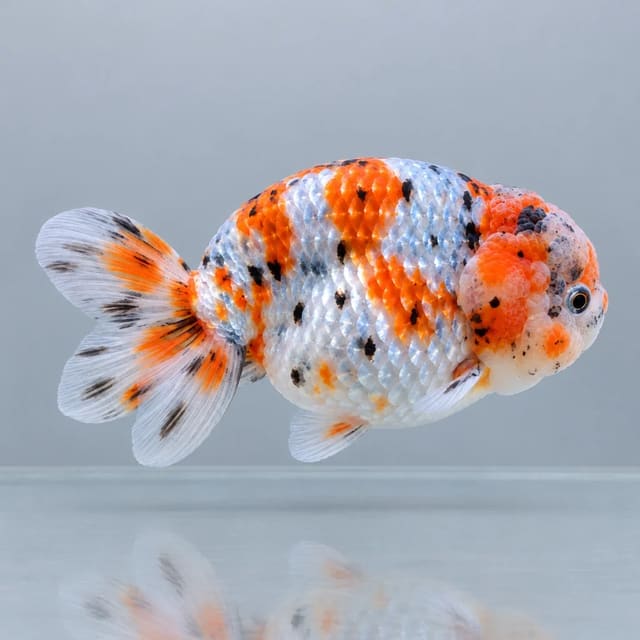
Calico Telescope Moor Goldfish (Carassius auratus)
4–25°C · pH 6.5–8.5 · 100L
£20.89
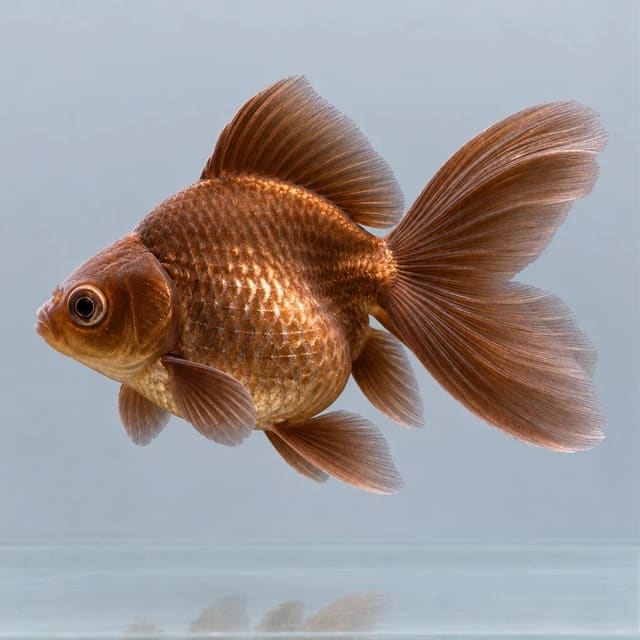
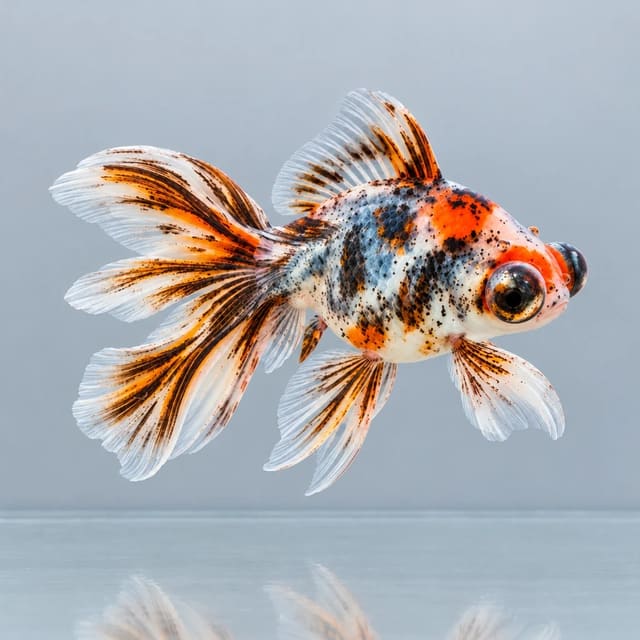
The Red and Black Telescope Moor is a red and black telescope goldfish (Carassius auratus) with protruding eyes, a short rounded body and a long double tail. Keep it in an unheated indoor aquarium of at least 100 litres at 4–25°C (best 15–23°C), with smooth decor and other slow fancy goldfish. Sold individually as one live fish.
Adult size is the maximum length this species reaches at full maturity (scientific sources). The livestock you receive will be younger and smaller. Product-photo provenance and any image-specific limitations are stated on the listing.
Carassius auratus
Quantity discounts are pricing offers, not a group-size recommendation. Check the full care guidance and your existing animals before choosing a quantity.
The Red and Black Telescope Moor is a red and black telescope goldfish (Carassius auratus) with protruding eyes, a short rounded body and a long double tail. Keep it in an unheated indoor aquarium of at least 100 litres at 4–25°C (best 15–23°C), with smooth decor and other slow fancy goldfish. Sold individually as one live fish.
Adult size is the maximum length this species reaches at full maturity (scientific sources). The livestock you receive will be younger and smaller. Product-photo provenance and any image-specific limitations are stated on the listing.
Read the full care guidance when planning conditions for your aquarium.
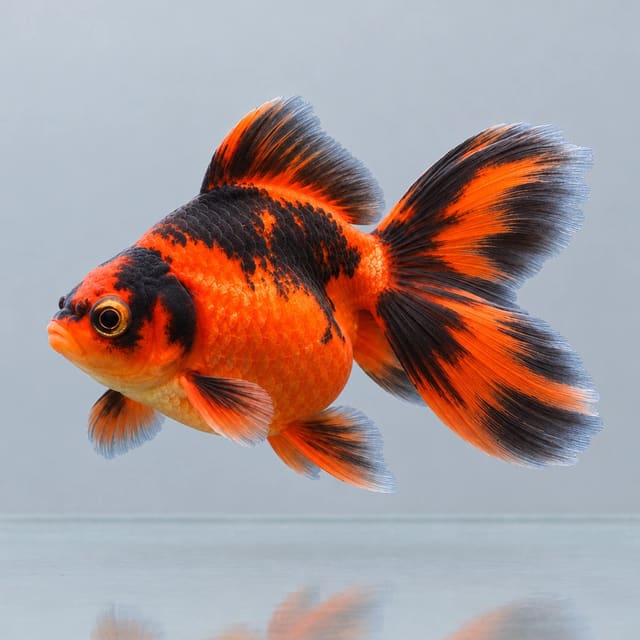
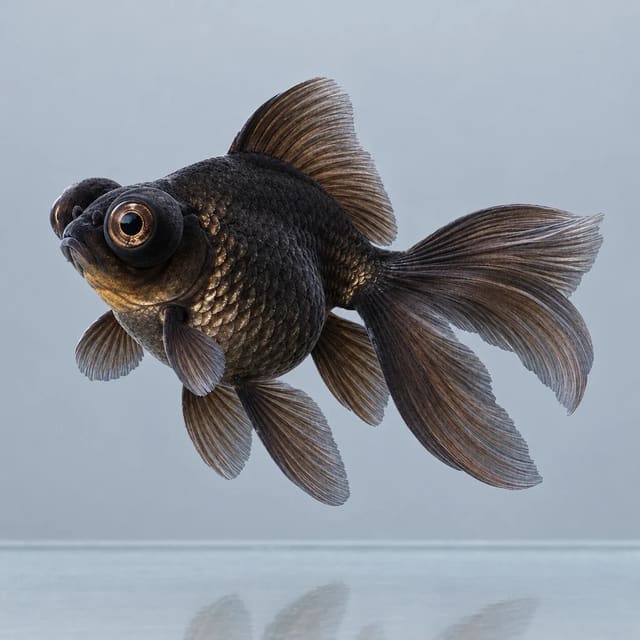
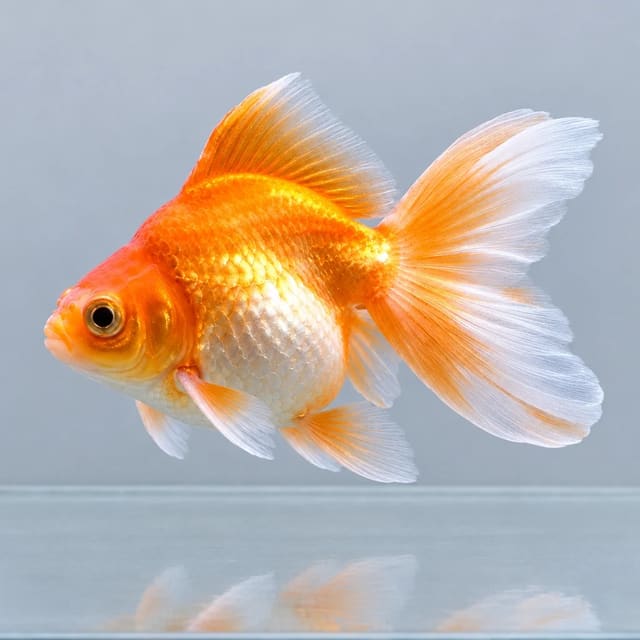
The Red and Black Telescope Moor is a red and black telescope goldfish: a fancy form of Carassius auratus bred for large eyes that project from the sides of the head, a short, rounded body and a long, divided double tail. The fish in our photographs is orange-red with velvety black patches over the back and head, and its fins are streaked and edged with black. Practical Fishkeeping describes telescopes as basically fantails with protruding eyes and notes that their care is the same whatever their colour.
Every goldfish belongs to one species in the carp family, Cyprinidae. A 2020 genome study in PNAS confirms that goldfish were domesticated from crucian carp in ancient China and have been selectively bred for more than 1,000 years; red scales on crucian carp were first recorded during the Jin dynasty (AD 265–420). FishBase places the wild species in East Asia. This fish is therefore a domesticated ornamental form with no wild habitat of its own, which is why its care is planned around aquarium husbandry rather than a natural biotope.
| Name you may see | What it means |
|---|---|
| Telescope Moor | The trade name this fish is sold under |
| Telescope eye goldfish | The American name, also used by Practical Fishkeeping in the UK |
| Dragon eye | The Far Eastern name for the same eye type |
| Globe eye | The UK societies’ name for the forked-tail telescope; its standard accepts metallic black or calico, while red metallic fish are popular elsewhere and increasingly seen in the UK |
| Moor or Black Moor | In the UK standard, a black-only telescope-eyed goldfish with a broad, veiltail-type tail |
The Bristol Aquarists’ Society variety notes record the first telescope-eyed goldfish around 1592 and describe its eyes as projecting outwards and forwards from the head. Because the UK Moor standard allows black only, and the globe eye standard accepts only black among metallic fish, a red and black telescope is a pet colour form rather than a show-standard Moor, even though it is sold under the trade name telescope moor. Research published in 2025 traced telescope eyes to changes in a single gene, LRP2, and confirmed that the trait is recessive to normal eyes (Li et al. 2025).
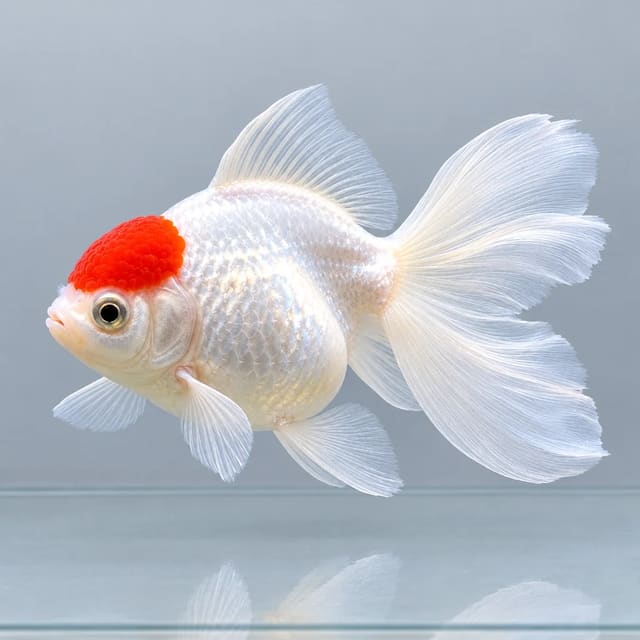
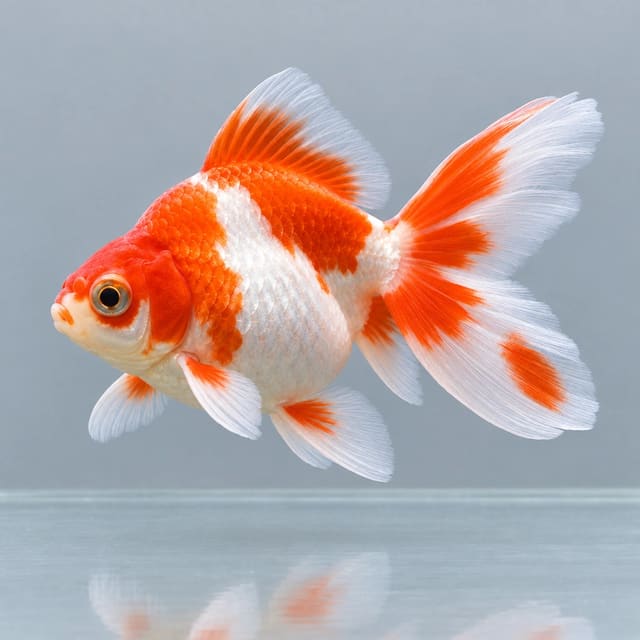
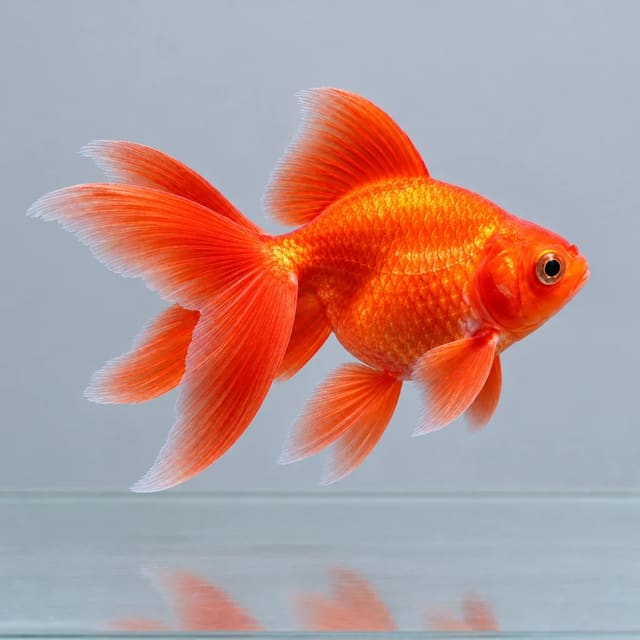
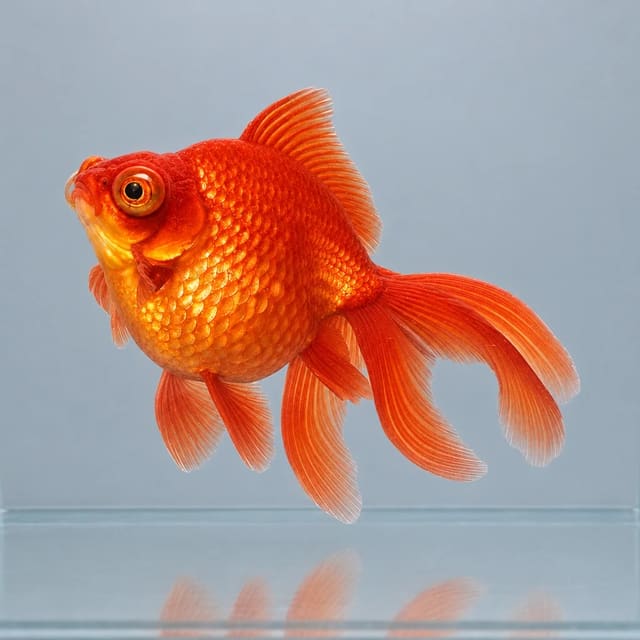
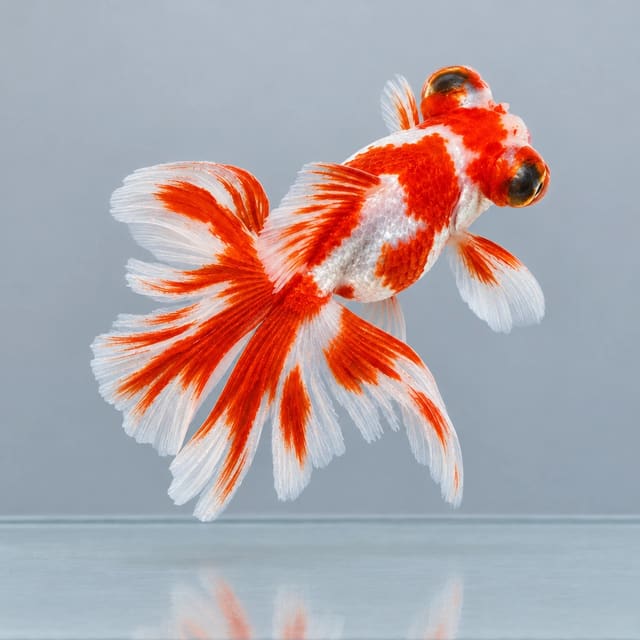
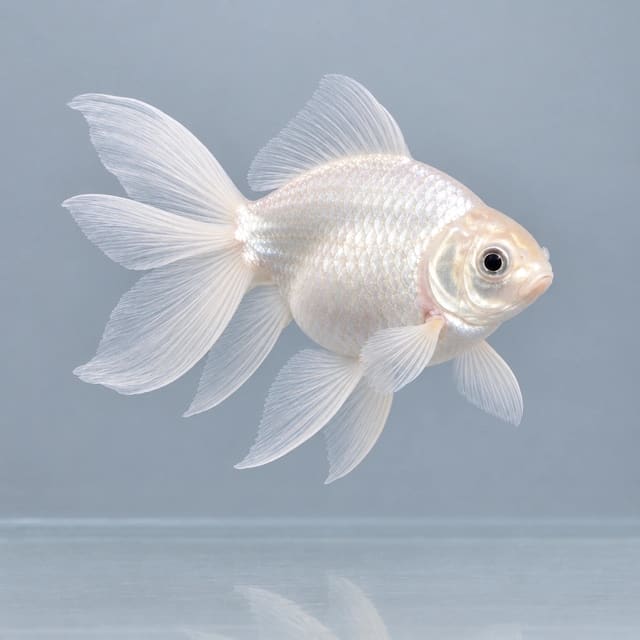
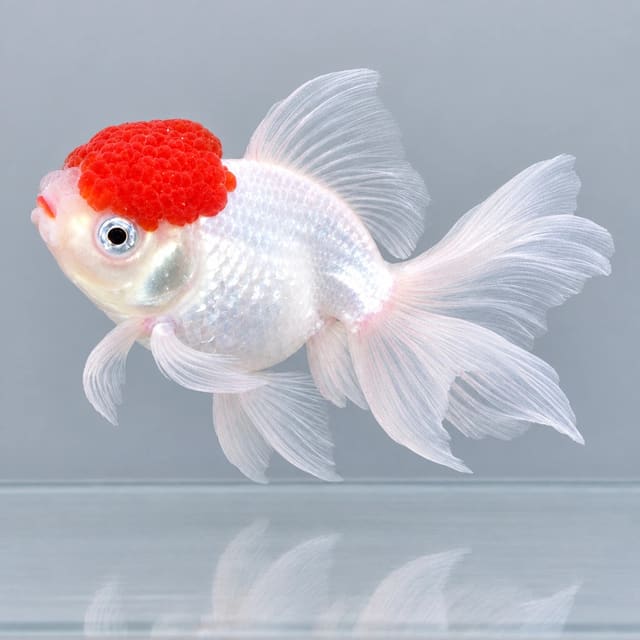
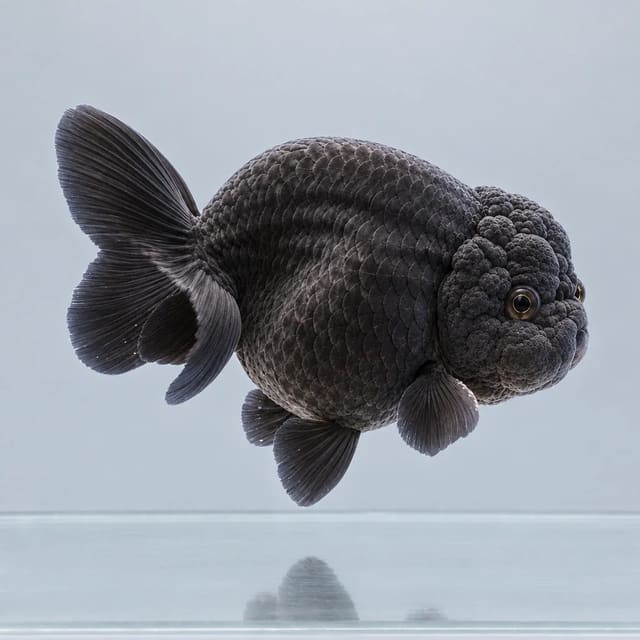
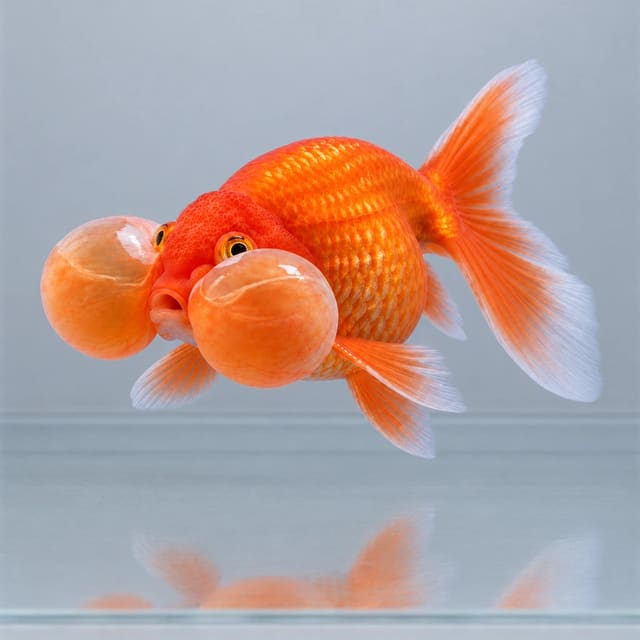
Compare it with the rest of our goldfish and coldwater fish, or browse the fancy goldfish category for orandas, ryukins and broadtails. Our gallery images are representative of this colour form and are not photographs of the individual fish you will receive.
One purchase supplies one live red and black telescope goldfish. The listing has a single option, Standard: no dispatch size is published for this fish, so if the size matters to you, ask us before you order rather than assuming it from the photographs.
The fish you receive is not yet an adult. OATA puts fancy goldfish at about 20 cm at most, and Practical Fishkeeping gives about 20 cm of body length for telescopes, not counting the fins. Plan the aquarium, filter and companions for that adult from the first day; a smaller fish today does not reduce the eventual requirement.
The Bristol Aquarists’ Society explains that ornamental goldfish hatch in a dark wild-type colour and reach their adult colours as black pigment cells are gradually lost; its notes on common goldfish describe young fish that start very dark and develop red or orange over one to two years. Moors are the exception because they keep their black cells into adulthood. On a young red and black fish, the black areas can therefore shrink or move as it matures.
Prepare the aquarium before ordering, and read our delivery and Live Arrival Guarantee information so you know when the fish will arrive and what to do on the day.
OATA’s fancy goldfish care sheet advises buying the largest aquarium practical: at least 100 litres for one adult, plus 50 litres for each additional adult, or a plan to upgrade as the fish grows. Larger aquariums hold their temperature and water quality more steadily, and that stability matters to a fish that tolerates sudden swings poorly.
Other UK sources set the bar differently. Practical Fishkeeping suggests at least 120 × 60 cm of floor space for three adult telescopes long term, and a 120 × 60 × 45 cm open-topped tank so the fish can also be enjoyed from above. The RSPCA gives a guideline of 2 litres per 0.5 cm of goldfish length and at least 60 litres per goldfish. Where the figures disagree, use the most generous one your space allows.
| Adult fancy goldfish | OATA minimum volume | Practical note |
|---|---|---|
| 1 | 100 litres | A single telescope can live alone; goldfish do not need company |
| 2 | 150 litres | Add the second fish only once the filter is mature |
| 3 | 200 litres | Practical Fishkeeping’s 120 × 60 cm footprint suits three adults |
| 4 | 250 litres | Check filter capacity and water-change volume before adding a fourth |
A 120 × 60 × 45 cm aquarium holds about 324 litres before gravel and decor, comfortably above the OATA figure for three adults. Our tank volume calculator converts your own dimensions into litres, and the stocking calculator helps you check the total before adding more fish. The RSPCA lists goldfish bowls among decorative tanks that are not designed with fish welfare in mind: small volumes cannot give a stable environment, so a bowl is never a suitable home.
The protruding eyes are this fish’s weak point. OATA warns against decor with sharp or rough edges that could damage long fins or delicate eyes, and Practical Fishkeeping advises avoiding anything sharp. Build the layout so that a fish swimming at speed, or nosing through the gravel for food, never meets an edge.
Practical Fishkeeping recommends small, round, inert gravel that the fish can dig into and mouth without it getting stuck, smooth pebbles and perhaps a piece of water-worn wood. For plants it suggests none at all, hardy Anubias attached to the wood, or plastic plants that are not spiky. OATA adds that goldfish readily eat live plants, so choose tough species or accept that softer plants will be grazed.
Fit overhead lighting to give a regular day and night; the RSPCA suggests eight to ten hours a day for most species, switched off at night. Keep the aquarium away from windows, radiators, draughts and constant vibration, because direct sunlight can raise the water temperature dangerously and fluctuations stress goldfish.
OATA’s values for fancy goldfish are set out below. They describe ranges in which the fish can be kept long term, not single targets; OATA notes that goldfish can adapt to wider ranges of temperature, pH and hardness over time, so stability matters more than chasing an exact number.
| Reading | Keep it at |
|---|---|
| Temperature | 4–25°C, optimum 15–23°C |
| pH | 6.5–8.5 |
| General hardness (GH) | 8–18°dH (medium-hard) |
| Carbonate hardness (KH) | 5–15°dKH |
| Ammonia | 0 mg/l |
| Nitrite | 0 mg/l |
| Nitrate | No more than 20 mg/l above your tap water |
The RSPCA gives a narrower 10–21°C for goldfish. If you want one range that satisfies both sources, aim for 15–21°C, the overlap of the two. OATA says a heater is not needed unless the room is very cold; if you do use one, the RSPCA suggests setting it at the lower limit of the range simply to stop swings.
Tap water in the UK is treated with chlorine or chloramine, so every litre that goes into the aquarium needs a tap water conditioner first; you will find conditioners in our water care range. Hardness varies widely from region to region, so test the general and carbonate hardness of your own tap water rather than guessing. The water matcher compares your readings with this fish’s range, and our water chemistry guide explains what pH, GH, KH and nitrate mean in practice.
OATA says a filter is always essential, whatever the size of the aquarium, and that fancy goldfish prefer a gentle flow: turn the output down or use a spray bar to spread it. Practical Fishkeeping’s set-up for three telescopes uses an external filter of 1,000 litres per hour or more with an air stone; the two pieces of advice fit together when the outflow is spread along the tank so the fish are not pushed about.
Mature the filter before the fish arrives. The RSPCA recommends fishless cycling, which takes at least two weeks, and Practical Fishkeeping advises the same. Our guide to the aquarium nitrogen cycle explains how ammonia is turned into nitrite and then nitrate, and why a new tank cannot safely take a full load of fish.
Practical Fishkeeping also suggests activated carbon because goldfish tanks can smell. If the readings change without an obvious reason, look first at feeding, stocking and filter flow before adding any treatment.
OATA advises a food made for goldfish, because goldfish need more carbohydrate than many other fish, fed once a day and only as much as the fish eats within a few minutes. Some fancy goldfish gulp air at the surface and lose their balance after feeding; OATA suggests trying a different or slow-sinking food. Practical Fishkeeping recommends sinking goldfish pellets for telescopes. Our Tropical Goldfish Pellet is a sinking pellet, and Tropical Super Goldfish Mini Sticks are sinking sticks made for fancy goldfish.
Add variety with the foods OATA lists: daphnia, bloodworm, brine shrimp, aquatic plants, blanched lettuce and thawed, shelled peas. Our frozen daphnia blister packs make an easy weekly change from dry food. Goldfish are insatiable and will beg constantly, so treat begging as normal behaviour rather than hunger.
Before the fish arrives, confirm that the filter is mature, ammonia and nitrite both read zero, and the temperature sits within the range above. OATA’s floating-bag method then takes about half an hour: switch the aquarium lights off, float the sealed bag for 10 minutes to equalise the temperature, add small amounts of aquarium water to the bag over up to 20 minutes, then release the fish while keeping as much bag water as possible out of the tank. Our guide on how to acclimatise new fish walks through each step.
| When | What to do |
|---|---|
| Before delivery | Test ammonia, nitrite, pH and temperature; finish any decor changes |
| Arrival | Lights off, float, add water gradually, release; little or no food that day |
| Days 1–2 | Offer a small sinking meal; watch swimming, breathing and eyes |
| Days 3–7 | Feed once daily; retest ammonia and nitrite rather than waiting a week |
| End of week one | Do the normal 25% water change and record every reading |
Add fish to an aquarium slowly. OATA explains that overstocking, or adding fish too quickly, causes new tank syndrome: the nitrifying bacteria cannot keep up, and ammonia and nitrite rise to harmful levels.
OATA describes a healthy goldfish as having clear, bright eyes, undamaged fins, intact scales, no ulcers or bumps, normal swimming and steady breathing. Signs of trouble include clamped fins, flicking against gravel or decor, shimmying, hanging at the surface, sitting on the bottom, a darker or paler colour than usual, faster or slower gill movement, white spots, fluffy growths, weight change and loss of appetite.
| If you see | Do this |
|---|---|
| A cloudy, scratched or swollen eye | Recheck every item of decor for edges, test the water and keep it very clean |
| Torn or split fins | Look for sharp decor or a faster tank mate nipping; separate if needed |
| Loss of balance after meals | Switch to a sinking food and smaller portions |
| Surface hanging or fast breathing | Test ammonia, nitrite and temperature at once |
| Clamped fins, flicking or shimmying | Test the water and compare with your recorded readings |
| White spots or fluffy growths | Test the water and ask for fish-health advice |
Do not diagnose from one sign alone. If a problem continues after the water has been checked, contact us with the aquarium volume, temperature, pH, ammonia, nitrite and nitrate readings and a description of what you have seen.
OATA says fancy goldfish can be kept alone or with other fancy goldfish, but not with common goldfish, which swim faster, outcompete them for food and sometimes nip their fins. The RSPCA advises against housing single-tailed and twin-tailed goldfish together for the same reason. Practical Fishkeeping adds that ryukins and fantails are just as easy as telescopes and can be mixed with them.
Good companions in our range include the Red Oranda Goldfish, the Red and White Ryukin and the Red Broadtail Fancy Goldfish. Our guide to comet goldfish explains why slim single-tails belong in a different home, and the tank mates tool checks any other combination you have in mind.
| Suits | Avoid |
|---|---|
| Other telescopes and Black Moors | Comets, common goldfish and shubunkins |
| Fantails, ryukins, orandas and broadtails | Fin-nipping fish of any kind |
| A single fish kept on its own | Tropical fish that need heated water |
| Fish that feed calmly from the bottom | Anything boisterous enough to beat it to every meal |
Each extra adult needs another 50 litres under OATA’s guideline, so check the volume again before adding a companion. Small unheated-tank species such as white cloud mountain minnows belong to a different kind of set-up; our guide to cold water fish for sale explains how to choose them and why goldfish need a separate assessment.
OATA notes that goldfish can be bred in large home aquariums. In spring and summer males develop white tubercles on the gill covers and pectoral fins, while females have deeper bodies. Two males to each female improves the chances; raising the temperature slowly to about 20°C imitates spring, and a partial water change often triggers spawning. Eggs are laid among plants or on a spawning mop, which should be moved to another tank because adults eat eggs and fry. The eggs hatch in about three days.
Because telescope eyes are recessive to normal eyes, young from a telescope and a normal-eyed goldfish generally have normal eyes. Many young goldfish will not match their parents in shape or colour, so plan homes for every fish you raise. OATA is clear that releasing aquarium fish into the wild is illegal and usually fatal for the fish.
It is a fancy goldfish, Carassius auratus, with protruding telescope eyes, a short rounded body and a divided double tail, coloured orange-red with black patches. It is sold in the trade as a Red and Black Telescope Moor and belongs to the carp family, Cyprinidae.
They share the same eye type and the same care. In UK society standards a Moor is a black fish only, so a red and black telescope is a colour form rather than a true Moor. Red metallic telescopes are popular in the Far East and increasingly seen in the UK.
OATA puts fancy goldfish at about 20 cm at most, and Practical Fishkeeping gives about 20 cm of body length for telescopes, not counting the fins. Plan the aquarium for that adult, not for the young fish you receive.
OATA advises at least 100 litres for one adult plus 50 litres for each additional adult. Practical Fishkeeping suggests a tank of at least 120 × 60 cm for three adult telescopes long term.
Usually not. OATA gives 4–25°C with 15–23°C as the optimum and says a heater is only needed in a very cold room; the RSPCA gives 10–21°C. Stable room temperature matters more than warmth.
Not necessarily. The Bristol Aquarists’ Society explains that goldfish reach their adult colours as black pigment cells are gradually lost, so the balance of black and red on a young fish can shift as it matures.
A goldfish food fed once a day, only as much as is eaten within a few minutes. Practical Fishkeeping recommends sinking pellets for telescopes, and OATA suggests a slow-sinking food for fancy goldfish that lose their balance after feeding.
Other slow fancy goldfish such as orandas, ryukins and fantails. Keep it away from common goldfish, comets and shubunkins, which swim faster, take the food first and may nip its fins.
OATA advises keeping fancy goldfish indoors in aquaria only. The protruding eyes are easily injured, so an indoor aquarium with smooth decor is the right home for this fish.
No reviews for this item yet. Bought one? Honest reviews only, good or bad.
What customers say about ordering from us
Easy website plenty of info on fish your buying great to pick a time slot
TRACEY DURRANT · 7 Oct 2026
Got some lovely fish thank you
Kevin Mackie · 7 Oct 2026
Reviews of our shop, collected by Judge.me, an independent third-party review collector. Newest first.
Moved by UK carriers licensed to handle live animals
Hand-packed with oxygen bags, poly box, heat pack
Email photos the same day; an optional unboxing video helps us review problems faster — claim terms apply
Klarna & PayPal Pay in 3 at checkout