Easy
Golden Tetra (Hemigrammus rodwayi)
24–28°C · pH 6–7.5 · 60L
£3.99
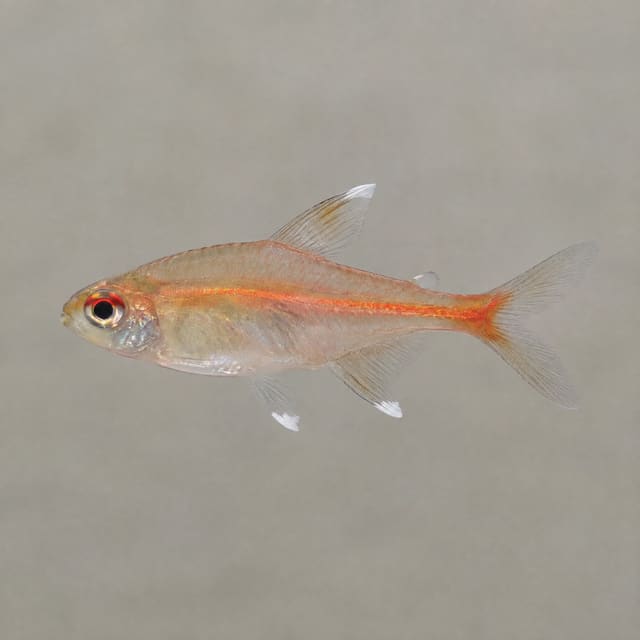
The Gold Glowlight Tetra is a pale golden, red-eyed, captive-bred form of the Glowlight Tetra (Hemigrammus erythrozonus), with the species’ glowing orange-red stripe. It is a peaceful, easy shoaling fish for a planted community tank with a base of about 60 × 38 cm at 24–27°C, best kept in a group of ten. Sold individually as one live fish.
Hemigrammus erythrozonus
Quantity discounts are pricing offers, not a group-size recommendation. Check the full care guidance and your existing animals before choosing a quantity.
The Gold Glowlight Tetra is a pale golden, red-eyed, captive-bred form of the Glowlight Tetra (Hemigrammus erythrozonus), with the species’ glowing orange-red stripe. It is a peaceful, easy shoaling fish for a planted community tank with a base of about 60 × 38 cm at 24–27°C, best kept in a group of ten. Sold individually as one live fish.
Read the full care guidance when planning conditions for your aquarium.
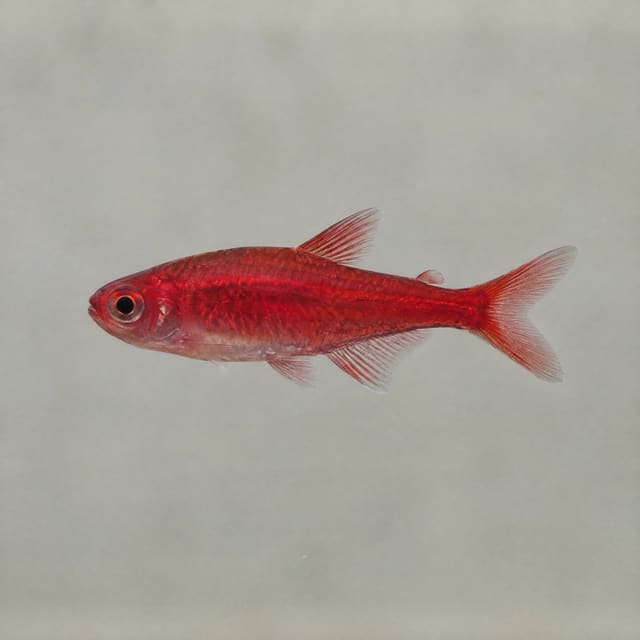
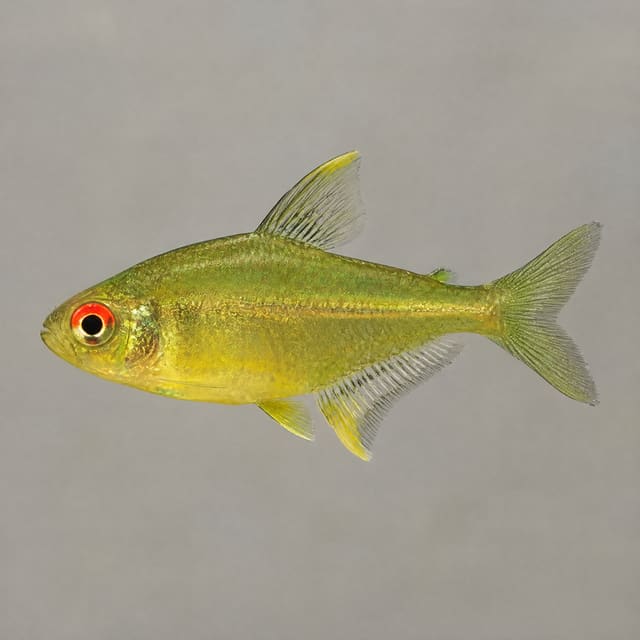
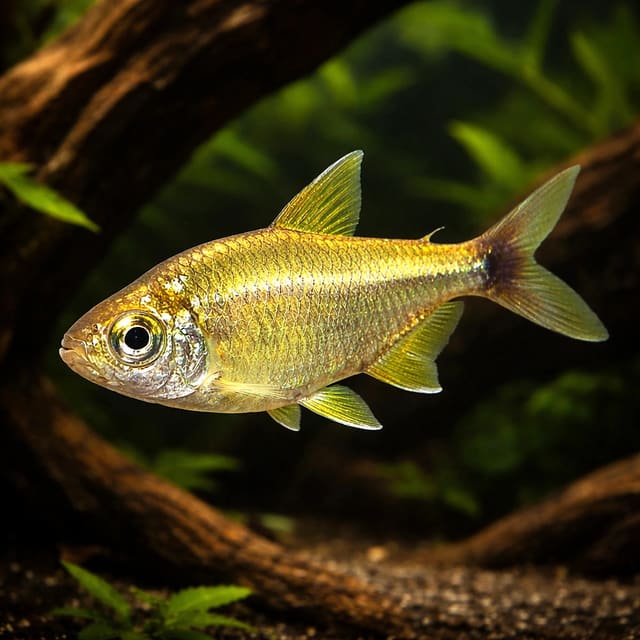
The Gold Glowlight Tetra is a pale, selectively bred colour form of the Glowlight Tetra, Hemigrammus erythrozonus. Its body is a translucent golden-cream, the eye is pink-red, and a glowing orange-red stripe runs from the snout to the base of the tail, with a touch of orange on the front edge of the dorsal fin. Against green plants a shoal of Gold Glowlights looks lit from within.
Underneath the colour it is the same fish as the familiar Glowlight Tetra, which Seriously Fish describes as widely available. Seriously Fish calls the species lively, peaceful and colourful, and one of the best choices for beginners, and notes that a selectively bred albino form is popular in the trade and needs the same care as the normal fish. That makes the Gold Glowlight Tetra an easy way to add a different shade to a planted community tank without learning a new set of care rules.
The fish in our photographs has the red eye of that albino line. The species itself comes only from the Rio Essequibo in Guyana, but Seriously Fish explains that wild fish are not exported: every glowlight in the trade is bred on commercial farms, and most UK stock comes from Eastern Europe. Colour forms such as this one exist only in captivity.
| Suits | Not suited to |
|---|---|
| A planted community tank with a base of about 60 × 38 cm or more | A bare tank, where Seriously Fish notes glowlights look washed out |
| A group of six, ideally ten or more | Keeping one or two on their own |
| Peaceful companions: livebearers, rasboras, corydoras, small gouramis | Angelfish and other fish big enough to eat it |
| Steady water at 24–27°C | An unheated or cool room tank |
| A first community tank, once it has cycled | A brand-new tank with no mature filter |
Compare it with our other tetras for sale, browse the South American tetra category, or see every relative on the Hemigrammus tetra page.
The scientific name of the Glowlight Tetra, Hemigrammus erythrozonus, is stable, but its family is less settled. Seriously Fish lists it under Characidae, while FishBase now places it in Acestrorhamphidae, the American tetras, subfamily Pristellinae, following a recent revision of the tetras; you will see both names in print. Seriously Fish also notes that Hemigrammus has long been used as a catch-all genus for small characins and that specialists consider a full revision overdue.
In shops the species appears in more than one colour. The normal form, sold as our Glowlight Tetra, has normal pigment and the same orange-red stripe. The pale, red-eyed line sold as Gold or albino Glowlight Tetra carries the stripe on a golden-cream body. Because both are the same species, they share every care need on this page and can be kept together.
| Feature | Gold Glowlight Tetra (this page) | Glowlight Tetra |
|---|---|---|
| Species | Hemigrammus erythrozonus | Hemigrammus erythrozonus |
| Body | Translucent golden-cream | Semi-transparent with normal pigment |
| Eye | Pink-red | Normally pigmented |
| Stripe | Orange-red, snout to tail | Orange-red, snout to tail |
| Origin | Captive-bred colour form | Captive-bred; wild fish are not exported |
| Care | Identical | Identical |
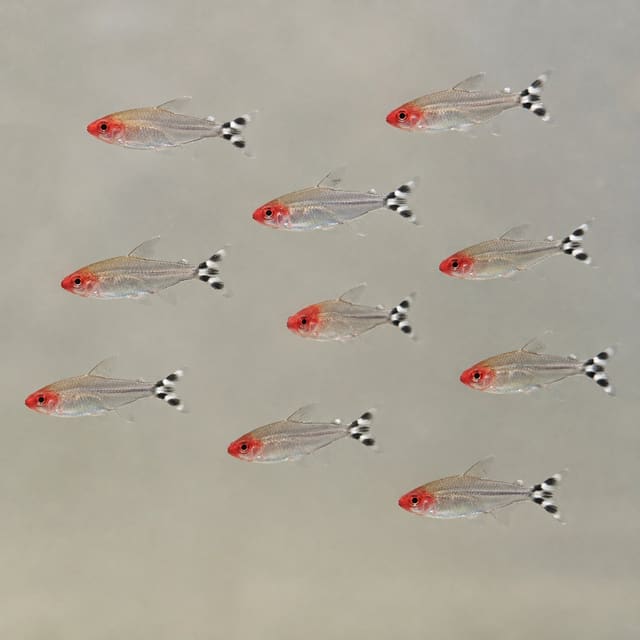
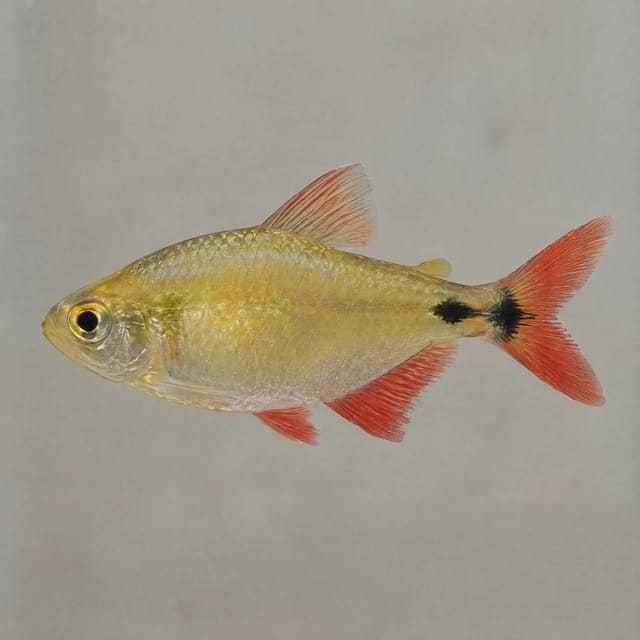
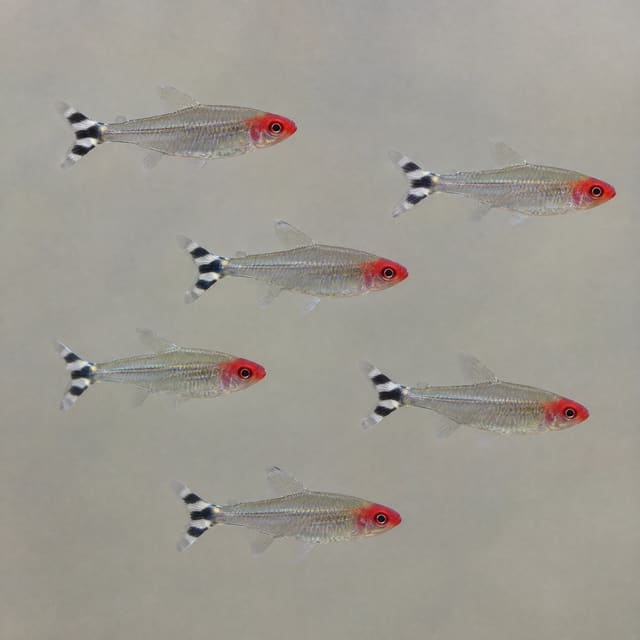
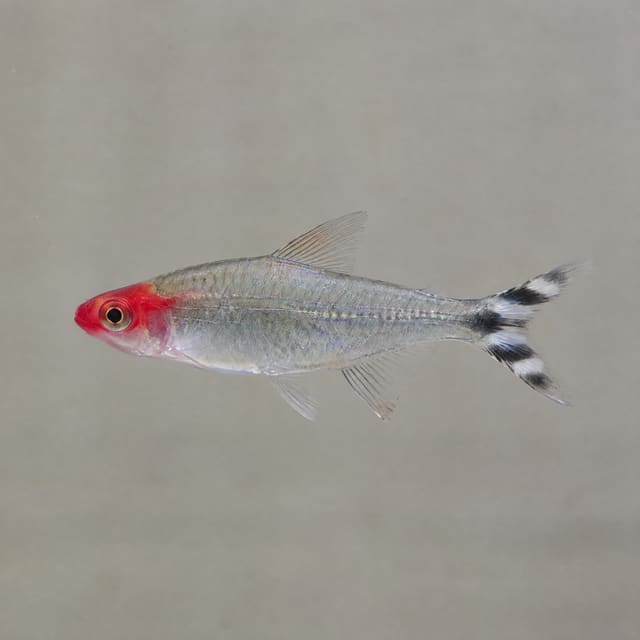
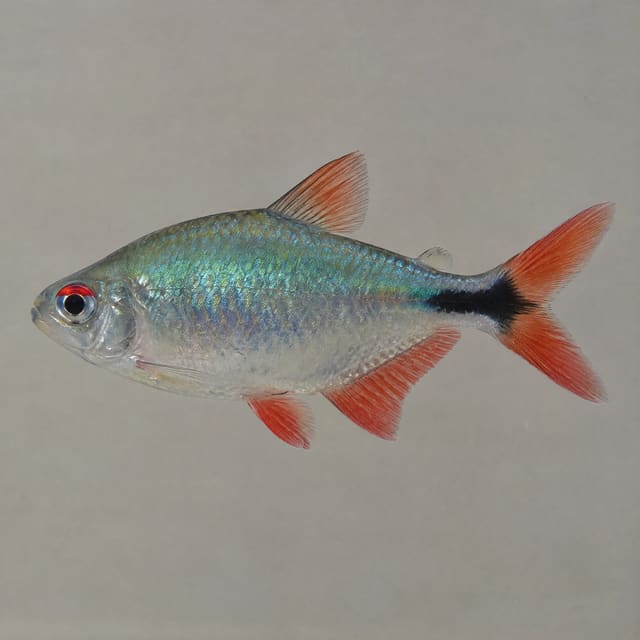
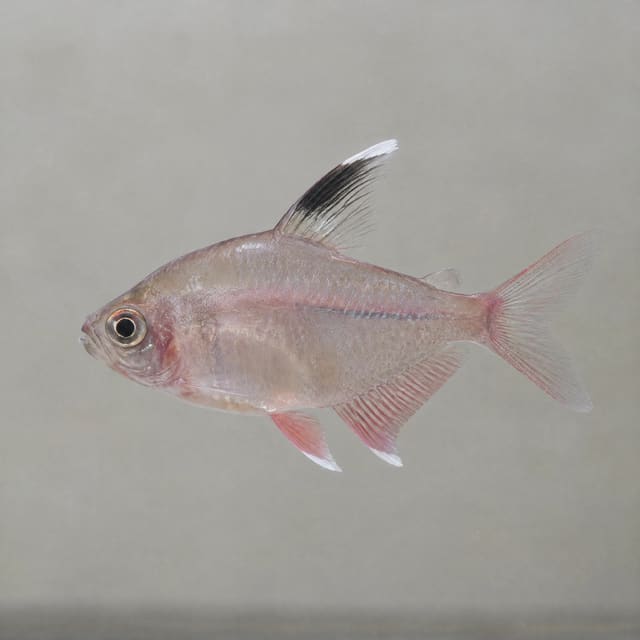
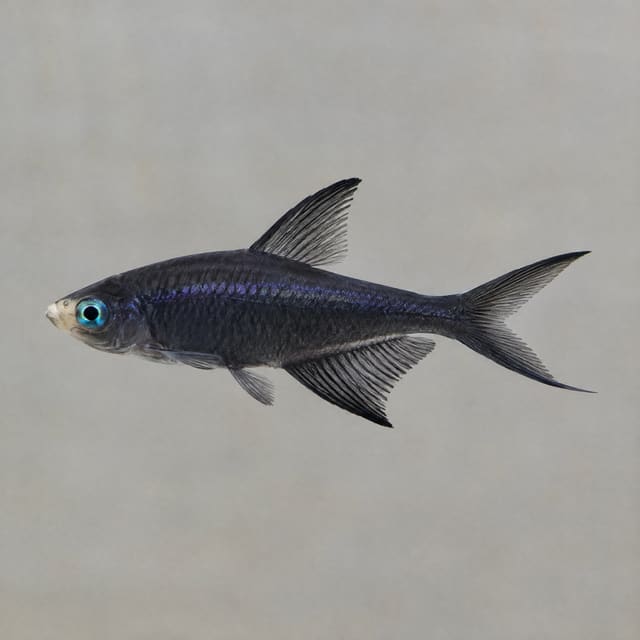
Other pale tetras in our range include the Albino Pristella, or Golden X-Ray Tetra, and close relatives in the same genus include the Head and Tail Light Tetra and the Costello Tetra.
One purchase quantity supplies one live Gold Glowlight Tetra in our Medium size grade. Order the full group you want in one go. The photographs show the colour form, not the individual fish you will receive; the depth of gold, the brightness of the stripe and the size vary a little from fish to fish.
Sex is not chosen. Seriously Fish notes that mature females are rounder in the belly and tend to grow slightly larger, so a group bought together normally contains both. Please read our delivery days and Live Arrival Guarantee before ordering, and have the tank cycled, heated and tested before the fish arrive.
Seriously Fish gives the adult size as 40 mm standard length. FishBase lists a maximum of 3.3 cm total length but flags it as questionable and notes reports of up to 4 cm, so the sources broadly agree on a small fish of about 4 cm.
For space, Seriously Fish suggests a base of 60 × 38 cm with a height of 30 cm, about 68 litres, for a small group, and FishBase recommends a tank of at least 60 cm. OATA’s general guidance for tetras is at least 45 litres for a small shoal of smaller species, and it adds that bigger tanks hold temperature and water quality more steadily. For a group of ten we recommend the Seriously Fish footprint as the starting point.
Seriously Fish describes the glowlight as adaptable, but it looks best in heavily planted tanks and can look washed out in bare ones. In the wild it lives in forested tributaries with water stained dark brown by tannins. A layout with river sand, driftwood or beech branches, a scattering of dried leaves and dim lighting brings out its colour, and Seriously Fish suggests peat in the filter to imitate that black water.
The same approach suits the gold form: dark sand and wood make the pale body and the glowing stripe stand out, and floating plants keep the light soft. Choose easy plants from our aquarium plants range.
| Zone | What to put there | Why it helps |
|---|---|---|
| Back and sides | Dense stem plants and wood | Cover that keeps the shoal relaxed |
| Front and centre | Open water over dark sand | Swimming room and contrast for the gold |
| Surface | Floating plants | The dim light Seriously Fish recommends |
| Substrate | A few dried leaves | Tannins like the stained water of its home rivers |
All three sources agree on a broad middle ground. Seriously Fish adds that glowlights show more colour in acidic water, so if your tap water is soft, a pH towards the lower end of the target suits them well.
| Value | Seriously Fish | FishBase | OATA (tetras in general) | Our target |
|---|---|---|---|---|
| Temperature | 24–28°C | 24–28°C | 22–27°C | 24–27°C |
| pH | 5.5–7.5 | 6.0–8.0 | 6.5–8.0 | 6.5–7.5 |
| General hardness | 2–15 dGH | 5–12 dH | 4–12 dGH | 5–12 dGH |
| Carbonate hardness | not given | not given | 3–10 dKH | 3–10 dKH |
UK tap water ranges from soft to very hard, and your water company publishes the hardness for your postcode. If yours is harder than the target, mixing in reverse-osmosis water brings it down. Check your readings with our water matcher, and read our guide to tropical fish water pH before you change anything.
Temperature, pH and hardness describe the water the fish prefer. Ammonia, nitrite and nitrate show whether the tank is clean. OATA’s targets are zero ammonia, zero nitrite and nitrate no more than 20 mg/l above your tap water; even small amounts of ammonia or nitrite stress tetras and can lead to disease. Our water chemistry guide explains each test.
OATA describes a filter as essential and recommends changing 25% of the water each week, siphoning waste from the substrate as you go. Seriously Fish suggests a filter rated at roughly 270–340 litres per hour for a tank of the size above. Glowlights come from slow forest streams, so spread the outflow rather than creating a strong current.
Seriously Fish describes the glowlight as easy to feed. Live and frozen foods such as bloodworm, daphnia and brine shrimp, offered alongside dried flakes and granules, keep the fish in the best condition and colour. FishBase records a natural diet of worms, small crustaceans and plant material, and OATA advises a once-daily feed of only what the fish finish within a few minutes.
| Day | Food | How much |
|---|---|---|
| Most days | Small granules such as Supervit Mini Granulat or a fine flake | What the group clears in about two minutes |
| Two or three days a week | Frozen daphnia or frozen red mosquito larvae, thawed | A small piece for a group of ten |
| Once a week | Freeze-dried brine shrimp | A pinch, crumbled |
Add Gold Glowlights only to a tank with a mature filter; our guide to the aquarium nitrogen cycle explains how to check, and our first tropical tank guide covers the full set-up. OATA warns that adding too many fish too quickly causes “new tank syndrome”, with ammonia and nitrite rising faster than the filter bacteria can cope.
Acclimatise them with the floating bag method OATA describes: lights off, float the unopened bag for about 10 minutes, add small amounts of tank water over up to 20 minutes, then release the fish with as little bag water as possible. See our guide to acclimatising new fish for each step.
Seriously Fish describes the glowlight as peaceful and suited to a general community tank. It names most livebearers, danios, rasboras, other tetras, corydoras, smaller loricariid catfish, most gouramis and dwarf cichlids as suitable companions, and warns against larger fish that may eat it, such as angelfish. OATA adds that tetras do best with fish of similar size and temperament. Check any mix in our tank mates checker.
| Suits | Avoid |
|---|---|
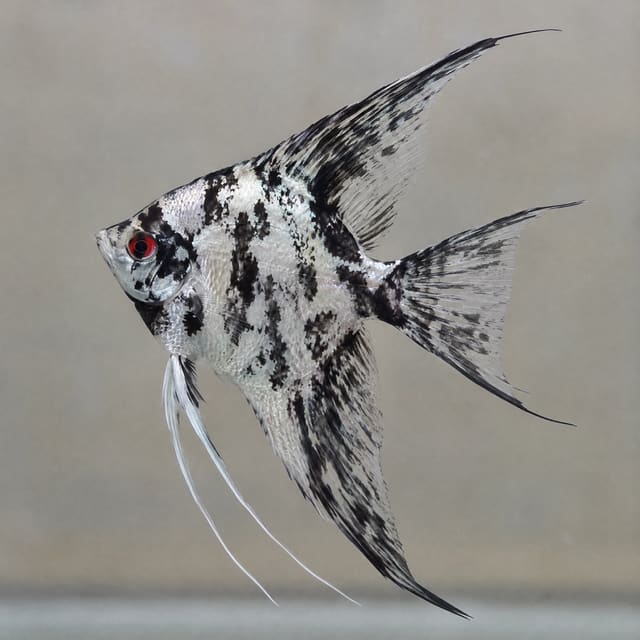
| Platies and other livebearers | Angelfish such as the Marble Angelfish |
| Rasboras such as the Harlequin | Any fish large enough to swallow a 4 cm tetra |
| Bronze Corydoras and other corydoras | Boisterous fin-nipping tetras in a small tank |
| Small plecos such as the Bristlenose Pleco | Unheated cold-water fish such as goldfish |
| Small gouramis such as the Honey Gourami | Groups of fewer than six glowlights |
A healthy group swims together in midwater, feeds eagerly and shows a bright, unbroken stripe. OATA lists the changes that point to a problem and advises testing the water first whenever something looks wrong.
| If you see | Do this |
|---|---|
| Fish hanging at the surface or resting on the bottom | Test ammonia, nitrite and temperature straight away |
| A faded stripe or unusually pale or dark colour | Test the water and review recent changes and the diet |
| Clamped fins, flicking or shimmying | Test the water and watch closely for white spots |
| White spots like grains of salt | Follow our white spot treatment guide for the whole tank |
| Fluffy growths or missing scales | Separate the fish if possible and contact us with your water readings |
| Weight loss or loss of appetite | Check food size and that slower fish are getting enough |
Seriously Fish gives a detailed method for the species. Set up a separate, very dimly lit tank of about 45 × 25 × 25 cm with Java moss, spawning mops or a mesh base that lets eggs fall out of reach. Use soft, acidic water at pH 5.5–6.5, 1–5 gH and 26.5–29°C, with peat filtration or reverse-osmosis water and a gentle sponge filter. Spawn a group of about six of each sex, or condition pairs separately and put them together in the evening.
OATA reminds keepers that releasing aquarium animals or plants into the wild is illegal and usually fatal to the fish, and that survivors can harm native wildlife. Dispose of old water and substrate through the drain or household waste.
No. It is a selectively bred colour form of the same species, Hemigrammus erythrozonus. Seriously Fish notes that a pale albino form is popular in the trade and needs exactly the same care as the normal fish.
No. The pale gold body and the red eye come from selective breeding, not from dye. The glowing orange-red stripe is the same stripe the wild form carries, seen against a paler body.
Seriously Fish gives 4 cm standard length. FishBase lists 3.3 cm total length but flags that figure as questionable and notes reports of up to 4 cm. Expect a small fish of around 3.5–4 cm.
At least six, and ideally ten or more, as Seriously Fish recommends. A larger group swims more naturally and shows off the stripe better than a handful of fish.
Seriously Fish suggests a base of 60 × 38 cm, about 68 litres, for a small group, and FishBase gives a tank of at least 60 cm. Plant it heavily and leave open water at the front.
Aim for 24–27°C, pH 6.5–7.5 and 5–12 dGH, the range where Seriously Fish, FishBase and OATA agree. It tolerates a wider range, but stable conditions matter more than exact numbers.
Yes. They are the same species with the same needs, so the two forms live happily in one tank, and the contrast between the gold and the darker wild colour is striking.
Seriously Fish lists livebearers, danios, rasboras, other tetras, corydoras, small plecos, most gouramis and dwarf cichlids. Avoid larger fish that could eat it, such as angelfish.
No reviews for this item yet. Bought one? Honest reviews only, good or bad.
What customers say about ordering from us
Easy website plenty of info on fish your buying great to pick a time slot
TRACEY DURRANT · 7 Oct 2026
Got some lovely fish thank you
Kevin Mackie · 7 Oct 2026
Reviews of our shop, collected by Judge.me, an independent third-party review collector. Newest first.
Moved by UK carriers licensed to handle live animals
Hand-packed with oxygen bags, poly box, heat pack
Email photos the same day; an optional unboxing video helps us review problems faster — claim terms apply
Klarna & PayPal Pay in 3 at checkout