Easy
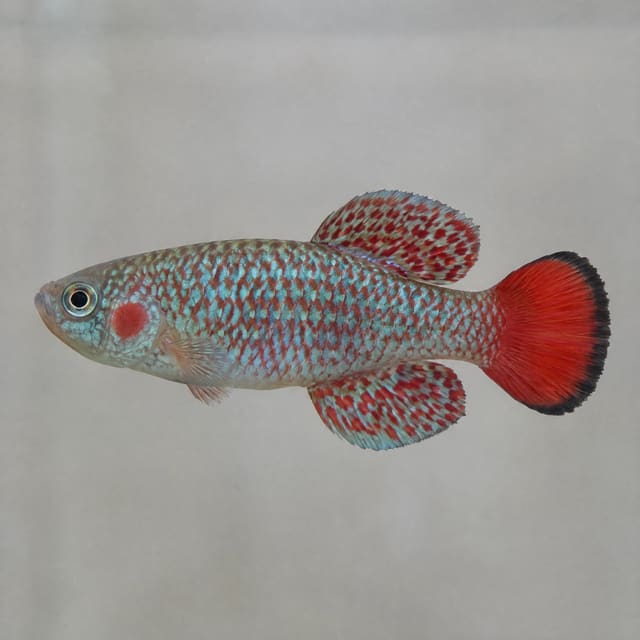
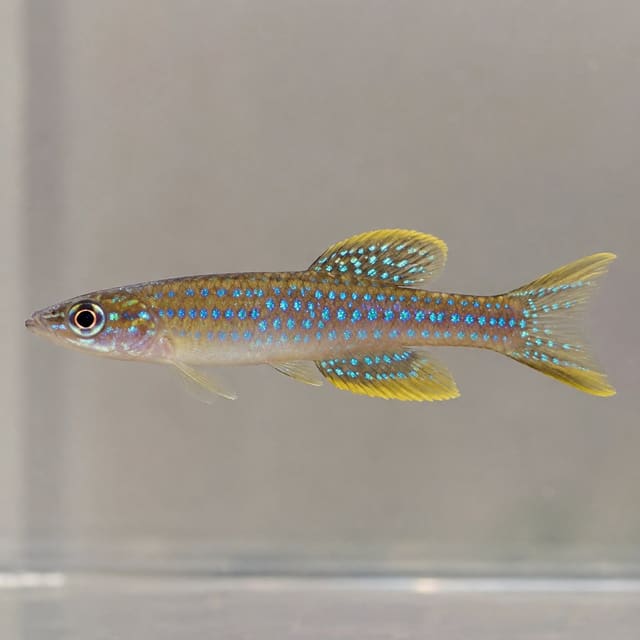
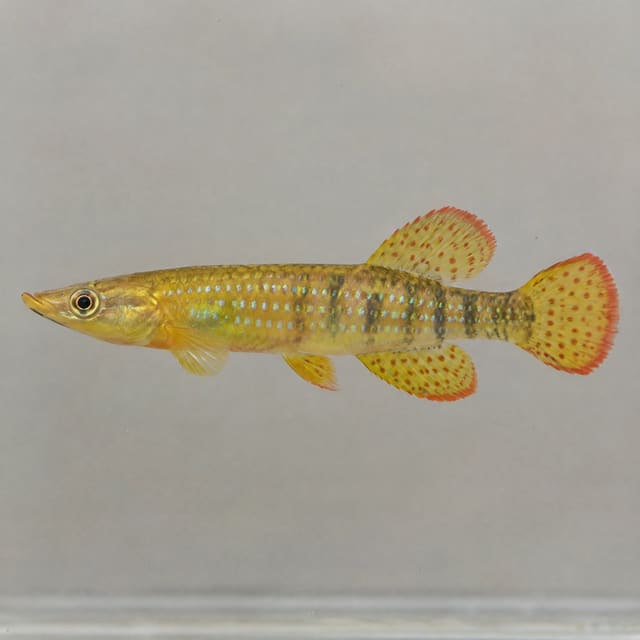
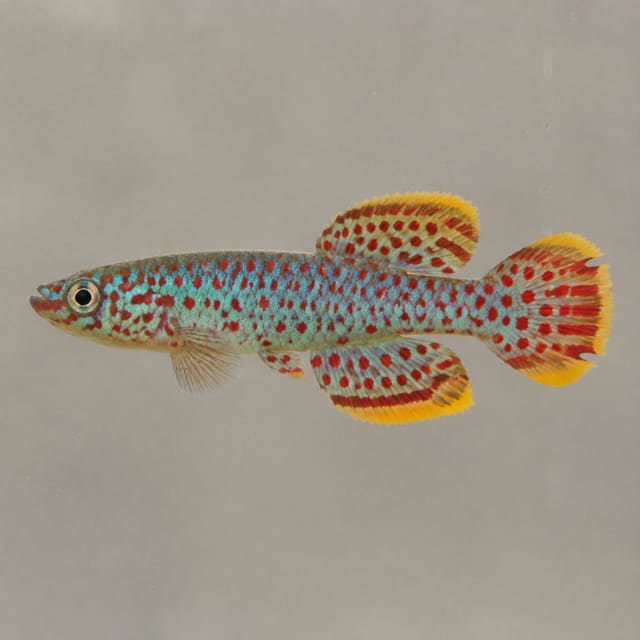
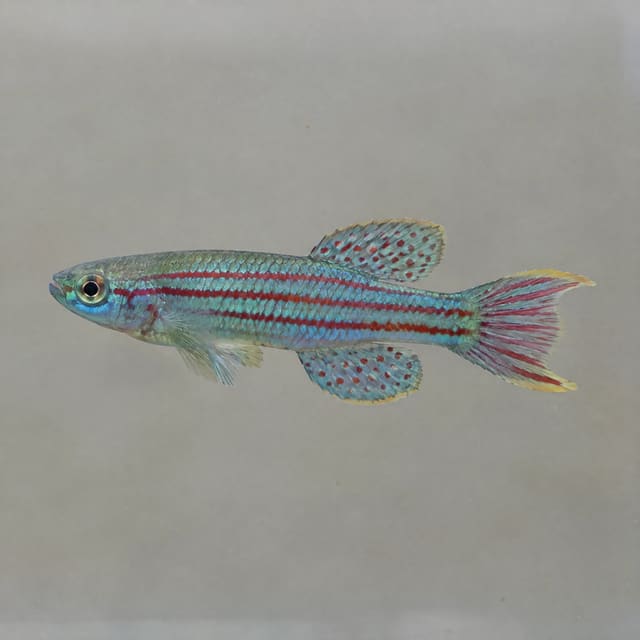
Tomoki Medaka Ricefish, Japanese Rice Fish (Oryzias latipes tomoki)
16–22°C · pH 6.5–8.5 · 41L
£11.99
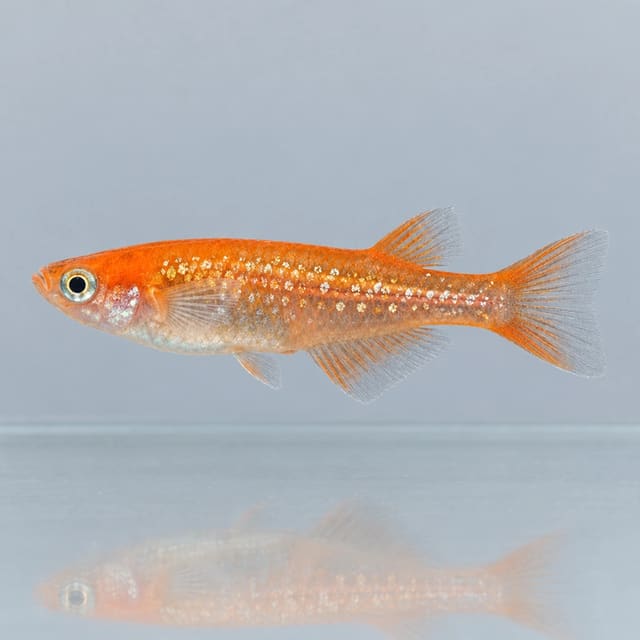
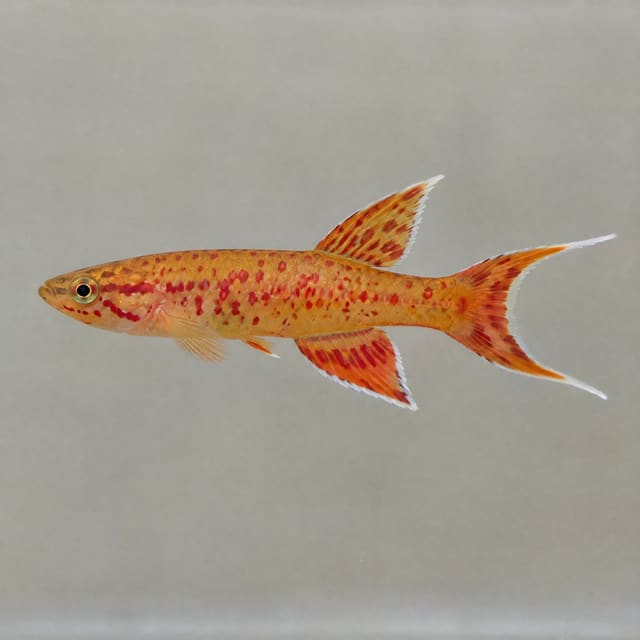
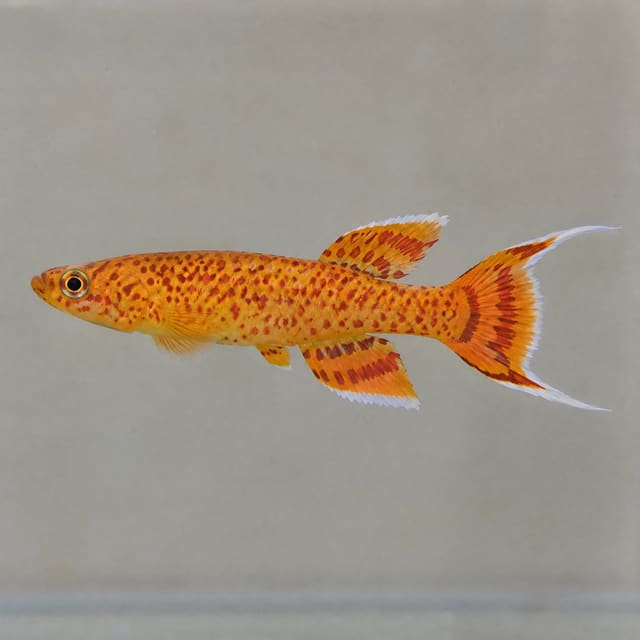
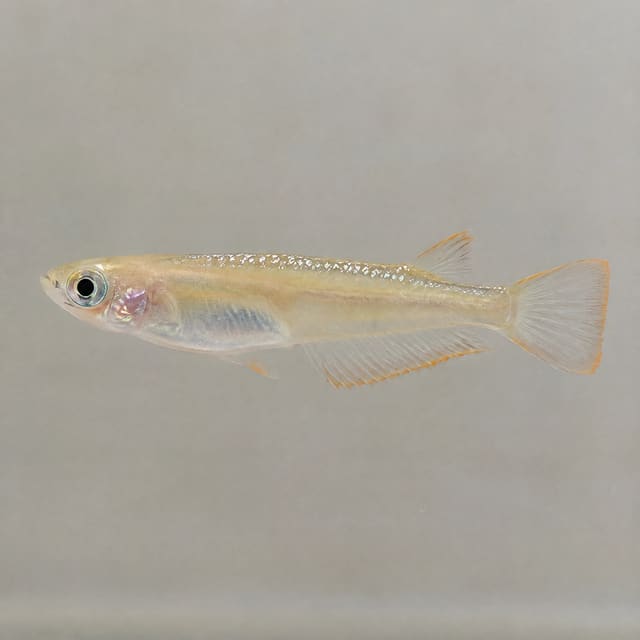
The Youkihi medaka is a solid orange colour strain of the Japanese rice fish, Oryzias latipes, growing to about 3.6–4 cm. It is a peaceful, hardy surface-cruiser for a planted indoor aquarium at 16–22°C, so most heated homes need no heater. Keep a group of eight or more. Sold individually as one live fish.
Oryzias latipes
Save when buying multiple fish. Each quantity is one fish; sex and pair formation are not guaranteed unless the selected variant explicitly states them.
The Youkihi medaka is a solid orange colour strain of the Japanese rice fish, Oryzias latipes, growing to about 3.6–4 cm. It is a peaceful, hardy surface-cruiser for a planted indoor aquarium at 16–22°C, so most heated homes need no heater. Keep a group of eight or more. Sold individually as one live fish.
The Youkihi medaka is an ornamental strain of the Japanese rice fish (Oryzias latipes) bred for one thing: an even, glowing orange from nose to tail. It is a slim fish with a flat back, a pearly belly, a large silvery eye and a dorsal fin set far back towards the tail, the shape of a fish that cruises just under the surface. If you want a bright, hardy and peaceful fish for a cool indoor aquarium that needs no heater in most homes, the Youkihi medaka is one of the best small fish you can choose.
Medaka belong to the ricefish family, Adrianichthyidae. Seriously Fish explains that the family now sits in the order Beloniformes alongside the halfbeaks and needlefish, although older books still file it among the killifish. That is why you will find medaka in our killifish and ricefish range and in the killifish category, and why its care is closer to that of a white cloud mountain minnow than to a tropical killifish. The genus name comes from the Greek for rice, after the paddy fields where the fish lives, and latipes is Latin for "wide-footed".
| Name | Where you will see it |
|---|---|
| Youkihi, Yokihi or Yōkihi medaka | The strain name used by breeders and shops; the spelling varies |
| Orange ricefish, orange medaka | Descriptive shop names for this colour |
| Japanese rice fish, medaka | Common names of the species |
| Oryzias latipes (Temminck & Schlegel, 1846) | The scientific name; first described as Poecilia latipes |
The strain name is Japanese. As an article in Japan Spotlight explains, Yōkihi is the Japanese name for Yang Guifei, the Tang-dynasty consort remembered as one of the four great beauties of ancient China. Medaka have been popular pets in Japan since the 17th century. Wikipedia's medaka article records 456 documented commercial strains and notes that genetic studies trace domesticated medaka mainly to one founder lineage from southern Japan.
The wild range depends on which authority you follow. Seriously Fish lists Japan, eastern Korea, Taiwan, eastern China, Laos and Vietnam, while noting that some mainland populations may belong to Oryzias sinensis. Wikipedia, following more recent splits, treats O. latipes as native to Japan alone. Either way, the fish in our tanks are aquarium-bred, not wild-caught.
The Youkihi is a selectively bred colour strain. It is not the transgenic "glowing" medaka, which carries fluorescent proteins taken from a jellyfish or a coral. Seriously Fish notes that the glowing form is illegal to buy, sell or own in the European Union, and that the care of colour strains is essentially the same as for the wild fish.
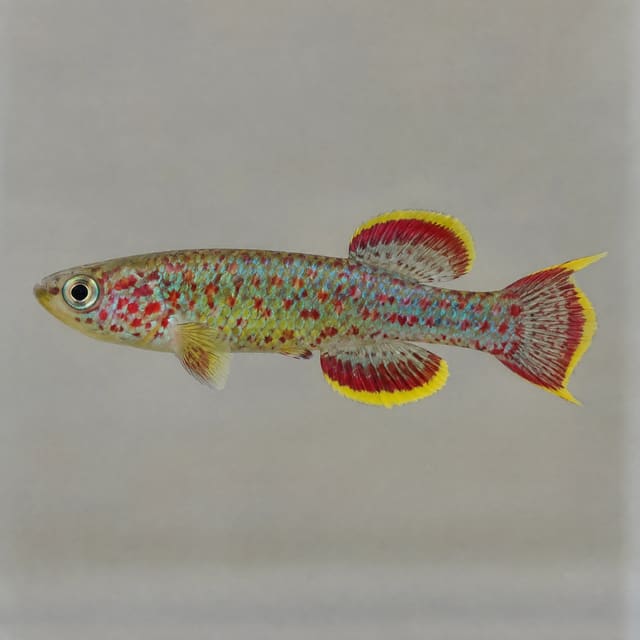
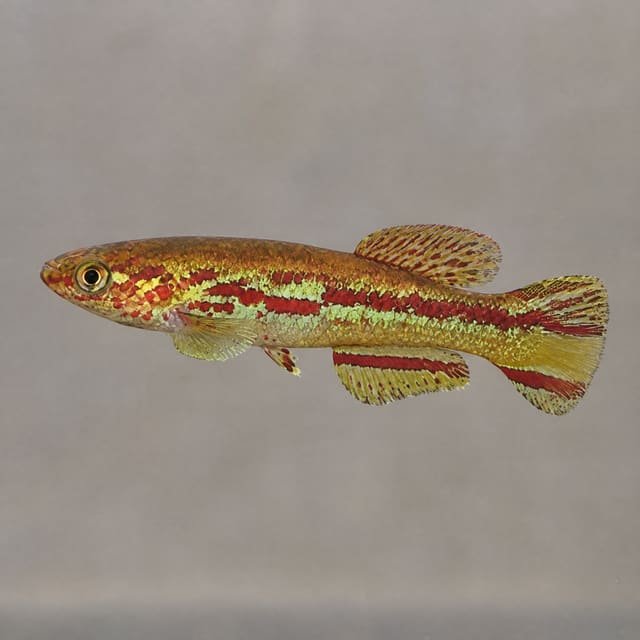
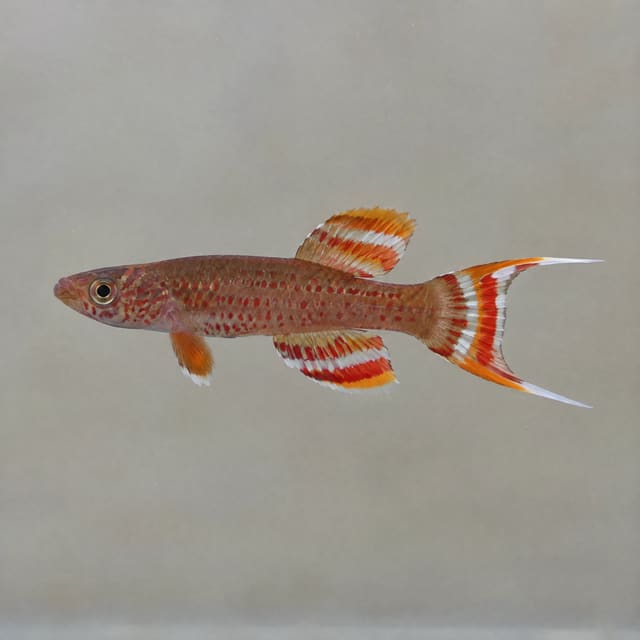
One purchase supplies one live Youkihi medaka at the standard size we currently send, which is a young fish below adult size. Sex is not chosen or guaranteed. The depth of orange varies a little from fish to fish, and the photographs show the strain rather than the individual you will receive.
Read our delivery and Live Arrival Guarantee information before you order, and make sure the aquarium is filtered, matured and at a steady temperature before the fish arrive.
Seriously Fish gives a maximum standard length (snout to the base of the tail) of 36 mm, FishBase gives 4.0 cm, and Wikipedia about 3.6 cm. Add the tail and an adult measures a little over 4 cm. It is a small fish, but an active one that lives in a group, so it needs swimming room rather than a bowl.
For a group, Seriously Fish recommends a base of at least 45 × 30 cm, about 41 litres. A longer tank, or one with a large surface area, gives a group more room to cruise near the top and more space for the planting that helps fry survive.
Medaka are temperate to subtropical fish. Seriously Fish gives 16–22°C and warns that keeping them permanently warm is likely to shorten their lives. FishBase gives 18–24°C. Wikipedia notes that the species survives anything from 0 to 42°C but prefers 15–28°C, a tolerance that explains its reputation for toughness but is not a range to aim for.
OATA's guide to unheated aquaria explains that most tropical fish need at least 22°C and a heater, while a number of smaller species do well in unheated indoor tanks, provided a filter is fitted. It advises keeping such tanks away from draughts, radiators, direct sunlight, loud noise and vibration so the temperature does not swing. Seriously Fish suggests a heater of 0–25 W for a 41 litre tank in a room around 20°C, which in practice means no heater in many heated homes.
| Your room | What to do |
|---|---|
| Steady 18–22°C all year | No heater; check with an aquarium thermometer every few days at first |
| Falls below 16°C on winter nights | Fit a small thermostatic heater set to about 18°C |
| Next to a window or radiator | Move the tank; sun and radiators cause daily temperature swings |
| Summer heatwave | Increase surface movement, shade the tank and avoid adding warm top-up water |
Our aquarium temperature guide explains how to read a thermometer and set a heater.
Medaka are adaptable. Seriously Fish gives pH 6.5–8.5 and 5–25 dGH, and FishBase gives pH 7.0–8.0 and a hardness of 9–19 dH. The species is found from rice paddies and slow streams to tidal pools, and FishBase records that it tolerates a wide range of salinity. For an aquarium-bred strain such as the Youkihi, ordinary dechlorinated tap water is the starting point; Seriously Fish's advice about added salt concerns wild-collected fish, whose needs depend on where they were caught.
| Reading | Our target | Why |
|---|---|---|
| Temperature | 18–22°C | Inside both Seriously Fish (16–22) and FishBase (18–24) |
| pH | 7.0–8.0 | FishBase range, inside Seriously Fish's 6.5–8.5 |
| General hardness | 9–19 dGH | FishBase range, inside Seriously Fish's 5–25 |
| Ammonia and nitrite | 0 mg/l | OATA: both should always be zero |
| Nitrate | No more than 20 mg/l above tap water | OATA limit for small unheated-tank fish |
| Dissolved oxygen | 6 mg/l or more | OATA minimum for freshwater aquaria |
Much of southern and eastern England has hard, alkaline tap water that suits medaka well once it is treated with a conditioner. Supplies in Scotland, Wales and parts of northern and south-west England are often softer, and medaka still cope inside Seriously Fish's range. OATA suggests checking your water company's online postcode checker. Compare the result with our water matcher and read our water chemistry guide for what each number means.
In Japan, medaka are often kept outdoors in bowls and tubs. In Great Britain the rules are different. GOV.UK guidance says a licence is needed to introduce and keep non-native fish, with exemptions for certain species kept in indoor aquaria and a short list of species for garden ponds. OATA states that the fish it recommends for unheated aquaria are not legally permitted outdoors for biosecurity reasons and must stay in indoor tanks. We sell the Youkihi medaka for indoor aquariums. If you are considering an outdoor container, check with the Fish Health Inspectorate first.
Never release medaka or any aquarium fish into the wild. Wikipedia reports that domestic orange medaka have already mixed with wild populations in Japan: in 2011, about 15% of wild-caught fish in Nara carried a genetic marker from the orange "himedaka" strain.
Seriously Fish recommends a heavily planted aquarium with a dark substrate, dense patches of vegetation and open areas, with twisted roots, bogwood and plants at the surface. The dark floor matters for a colour strain: orange looks richer over dark gravel or sand than over a pale base. Fine-leaved plants double as spawning sites.
| Area | Purpose |
|---|---|
| Open water along the front and top | Cruising and feeding space for the group |
| Fine-leaved plants such as hornwort, Cabomba or Taxiphyllum moss | Egg-laying sites and cover for fry |
| Floating plants over one corner | Shade and a calm spot under the surface |
| Bogwood or twisted roots | Breaks lines of sight between displaying males |
| Dark gravel or sand | Shows the orange colour at its best |
Seriously Fish suggests a filter rated at four to five times the tank volume per hour, about 165–205 litres per hour for a 41 litre aquarium. Medaka come from still and slow waters, so spread the outflow across the surface or use a sponge filter rather than creating a strong current. Our guide to aquarium filtration compares the options.
In the wild, Seriously Fish describes the medaka as a micropredator feeding on small insects, worms, crustaceans and other zooplankton, and Wikipedia notes that it eats young mosquito larvae. FishBase classes it as omnivorous. In the aquarium it accepts suitably sized dried foods, and Seriously Fish recommends small live or frozen foods every day alongside a good flake or granule.
Add medaka only to a filtered aquarium with ammonia and nitrite at zero. OATA describes the floating-bag method: switch off the aquarium light, float the sealed bag for about 10 minutes to match temperatures, add small amounts of tank water over up to 20 minutes, then net the fish out with as little bag water as possible. Our guide on how to acclimatise new fish shows each step.
| Checkpoint | What to do |
|---|---|
| Before arrival | Test the water and check the tank holds a steady 18–22°C |
| Arrival day | Acclimatise with the light off; no food until the next day |
| Days 2–3 | Offer a small pinch of fine food and watch every fish feed |
| Days 4–7 | Look for clamped fins, flicking or fish hanging alone |
| End of week | Retest the water and make the usual partial change |
Seriously Fish describes the medaka as generally peaceful but not an ideal fit for many community tanks because of its cool-water needs. It suggests small species with similar requirements, such as some halfbeaks (Dermogenys), blue-eyes (Pseudomugil) and bumblebee gobies, plus many neritid snails. It advises keeping medaka alone if you want to breed them, and never with other Oryzias species, because hybridisation has been shown in laboratory experiments.
| Suits | Avoid |
|---|---|
| White clouds such as the Gold White Cloud Mountain Minnow and the Longfin White Cloud Mountain Minnow | Tropical fish that need 24°C or more |
| The Pacific Blue-Eye, where its own range overlaps | Boisterous fish and fin-nippers such as tiger barbs |
| Snails such as the Nerite Snail | Any fish big enough to swallow a 4 cm medaka |
| Adult cherry shrimp (baby shrimp may be eaten) | Other Oryzias species |
| Other colour strains of the same species | Goldfish, which OATA notes are often wrongly sold for small unheated tanks |
White clouds share the same cool conditions: OATA gives them 17–23°C. Read our White Cloud Mountain Minnow guide and our killifish guide for more cool-water ideas, and check any mix with our tank mates tool.
Seriously Fish calls medaka easy to breed and fairly prolific. Spawning usually happens early in the morning, when males darken and defend small temporary territories. The female releases a cluster of adhesive eggs that hangs from her body for a while before she brushes the eggs onto plants singly or in small clumps. Healthy females can spawn every few days, or daily. Wikipedia gives 10–20 eggs per spawning and notes that wild fish breed from spring through summer.
| Feature | Male | Female |
|---|---|---|
| Dorsal and anal fins | Larger, with long rays and a convex outline | Smaller, without the convex outline |
| Body | Slimmer | Fuller, especially when carrying eggs |
| Vent | Short tube-shaped papilla | Two-lobed papilla |
| Stage | What happens |
|---|---|
| Morning spawning | Eggs are carried by the female, then placed on fine-leaved plants or a spawning mop |
| Incubation | Wikipedia gives 4–10 days; Seriously Fish says 1–3 weeks depending on temperature |
| Hatching | Move eggs or fry to a container of tank water; adults ignore eggs but eat fry |
| First foods | Microworm and newly hatched brine shrimp, then crushed flake |
| Growing on | Grade by size; older juveniles eat much smaller ones |
To keep the orange colour true, breed Youkihi only with Youkihi. Fry from mixed strains will show a variety of colours.
OATA describes a healthy fish as having clear, bright eyes, undamaged fins, intact scales and steady breathing. Signs of trouble include clamped fins, flicking against decor, shimmying, hanging at the surface, white spots or fluffy growths, and changes in feeding or colour. Wikipedia gives an average lifespan of about two years in the wild and three to five years in laboratories, and Seriously Fish's warning about permanent warmth is the main thing you control.
| If you see | Do this |
|---|---|
| Fish gasping at the surface | Test ammonia and nitrite, check the temperature and increase surface movement |
| Faded colour and hiding | Check for a bully, a temperature swing or a recent water-quality spike |
| Ragged fins | Remove fin-nipping tank mates and test the water |
| White spots or cottony patches | Test the water and get fish-health advice before treating |
| Thin fish in a group | Feed smaller portions more often so shy fish get a share |
Not quite. It is a ricefish, family Adrianichthyidae, which Seriously Fish places with the halfbeaks and needlefish in the order Beloniformes. Shops and older books often list medaka with the killifish, which is why you find it in that part of our range.
Usually not. Seriously Fish gives 16–22°C, so a tank in a heated living room often needs no heater. Use a small thermostatic heater only if the room falls below about 16°C in winter, and avoid keeping medaka permanently warm, which Seriously Fish says is likely to shorten their lives.
About 3.6–4 cm. Seriously Fish gives 36 mm standard length and FishBase 4.0 cm, both measured without the tail.
Eight or more. Seriously Fish says medaka look their best and are most confident in a group of that size, in a tank with a base of at least 45 × 30 cm.
Not without checking the rules. Medaka are non-native in Great Britain, and GOV.UK guidance requires a licence to keep many non-native fish unless the species and the way it is kept are exempt. OATA says the fish it lists for unheated aquaria must stay indoors for biosecurity reasons. We sell this fish for indoor aquariums.
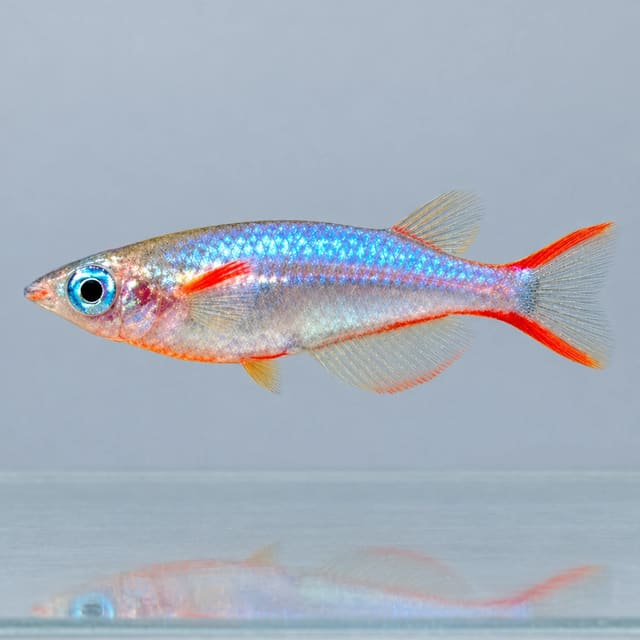
Yes. Other colour strains of Oryzias latipes, such as our Tomoki Medaka, are the same species and get on well. They will interbreed, so keep strains apart if you want pure orange offspring. Do not mix different Oryzias species, which Seriously Fish says can hybridise.
No. It is a selectively bred colour strain. The transgenic glowing medaka is a different fish, and Seriously Fish notes that it is illegal to buy, sell or own in the European Union.
Very likely. Healthy females can spawn every few days, or even daily. The adults ignore the eggs but eat free-swimming fry, so dense fine-leaved plants or a separate rearing container will save more young.
One live Youkihi medaka at the standard size we currently send, which is a young fish. Sex is not chosen or guaranteed.
No reviews for this item yet. Bought one? Honest reviews only, good or bad.
What customers say about ordering from us
Easy website plenty of info on fish your buying great to pick a time slot
TRACEY DURRANT · 7 Oct 2026
Got some lovely fish thank you
Kevin Mackie · 7 Oct 2026
Reviews of our shop, collected by Judge.me, an independent third-party review collector. Newest first.
Moved by UK carriers licensed to handle live animals
Hand-packed with oxygen bags, poly box, heat pack
Email photos the same day; an optional unboxing video helps us review problems faster — claim terms apply
Klarna & PayPal Pay in 3 at checkout