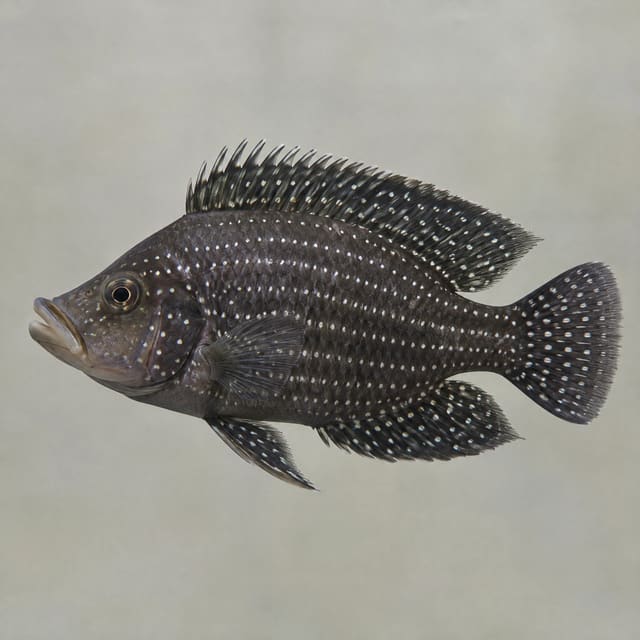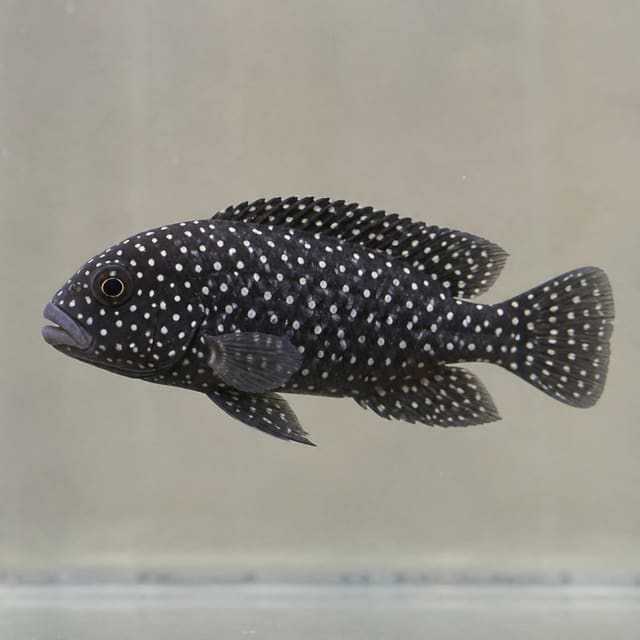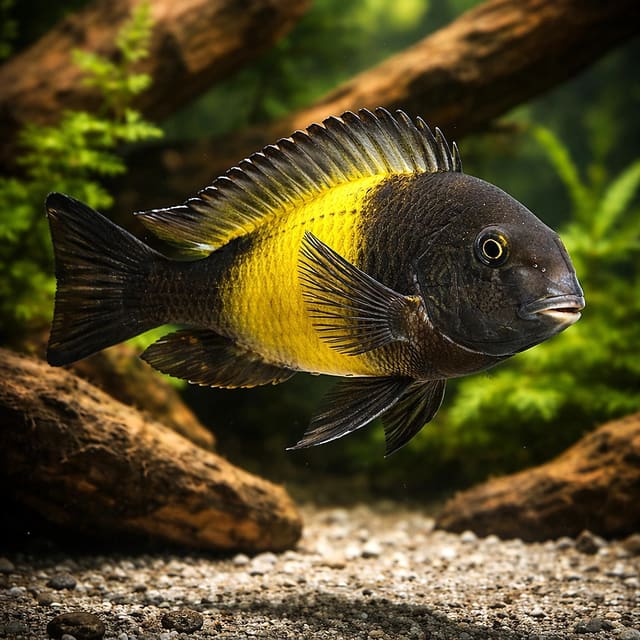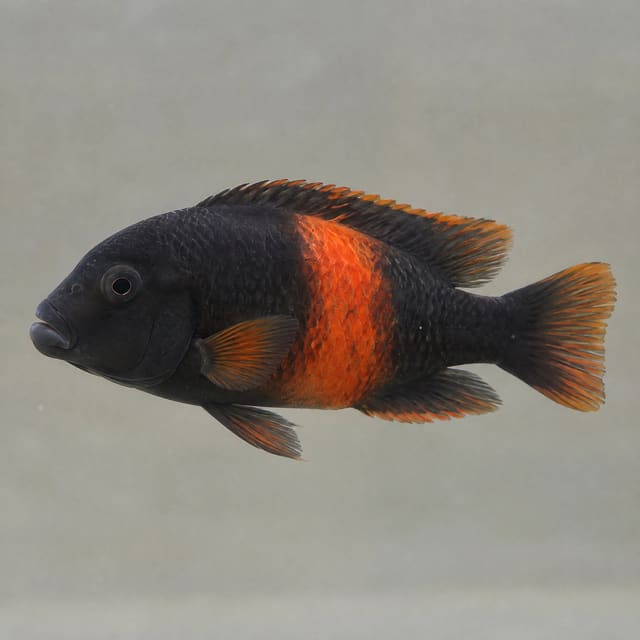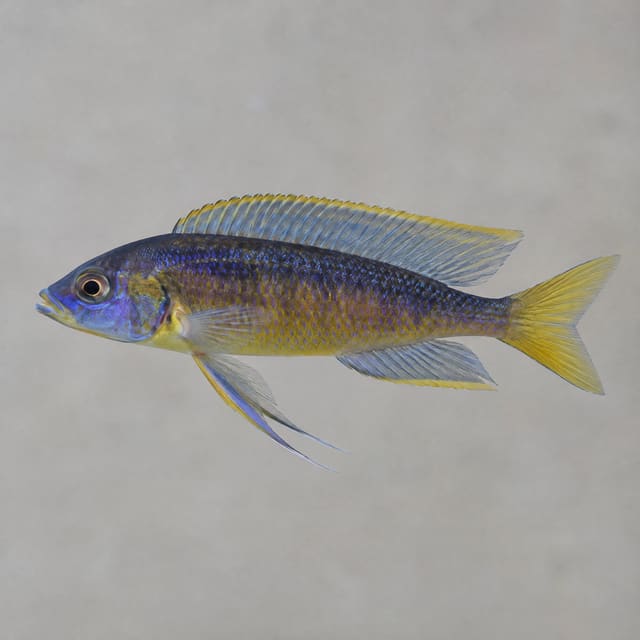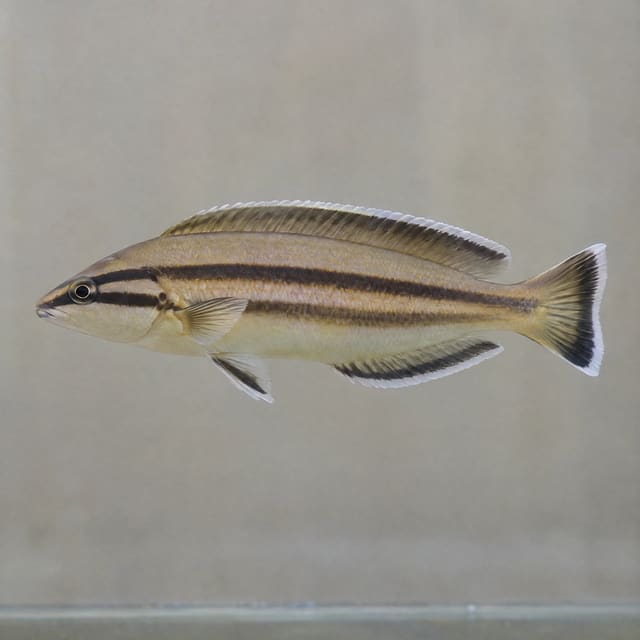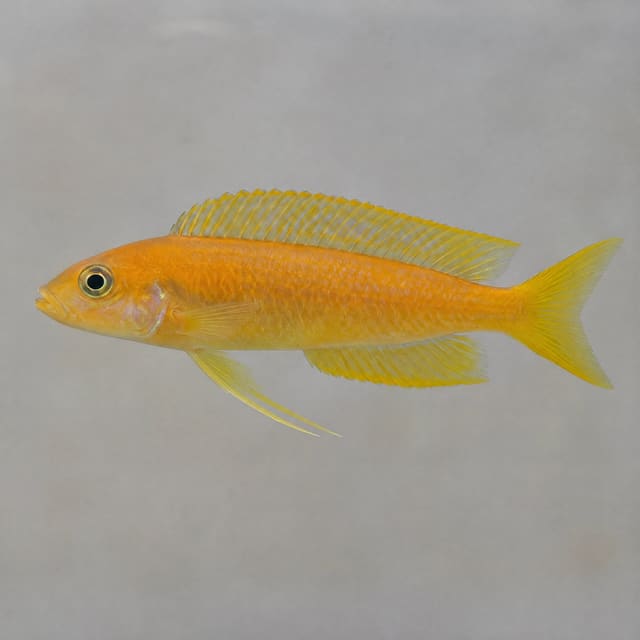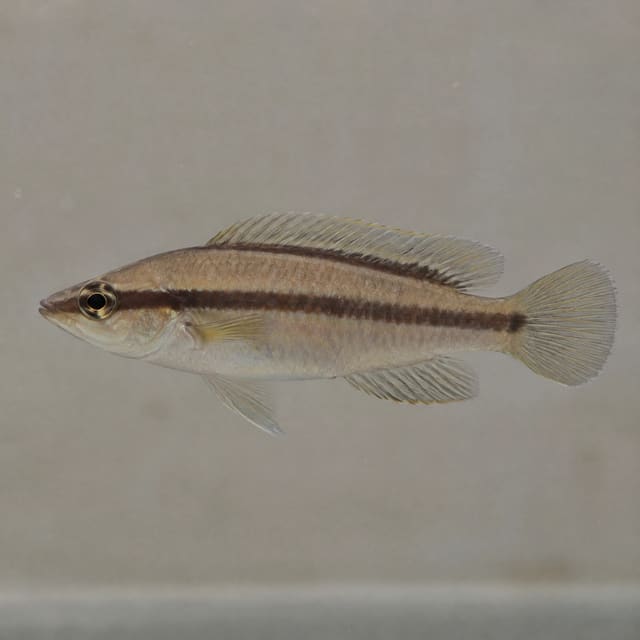
Striped Telmatochromis (Telmatochromis vittatus)
23–27°C · pH 8–9.5 · 68L
£12.99
This Telmatochromis Cichlid is a small, slender Lake Tanganyika rock and cave dweller of the striped type, supplied under the genus name Telmatochromis sp. It grows to about 9 to 10 cm and suits a pair in a rocky aquarium of 75 cm or more with sand, caves and empty snail shells and hard, alkaline water. One live fish per purchase.
Adult size is the maximum length this species reaches at full maturity (scientific sources). The livestock you receive will be younger and smaller. Product-photo provenance and any image-specific limitations are stated on the listing.
Telmatochromis sp.
Save when buying multiple fish. Each quantity is one fish; sex and pair formation are not guaranteed unless the selected variant explicitly states them.
This Telmatochromis Cichlid is a small, slender Lake Tanganyika rock and cave dweller of the striped type, supplied under the genus name Telmatochromis sp. It grows to about 9 to 10 cm and suits a pair in a rocky aquarium of 75 cm or more with sand, caves and empty snail shells and hard, alkaline water. One live fish per purchase.
Adult size is the maximum length this species reaches at full maturity (scientific sources). The livestock you receive will be younger and smaller. Product-photo provenance and any image-specific limitations are stated on the listing.
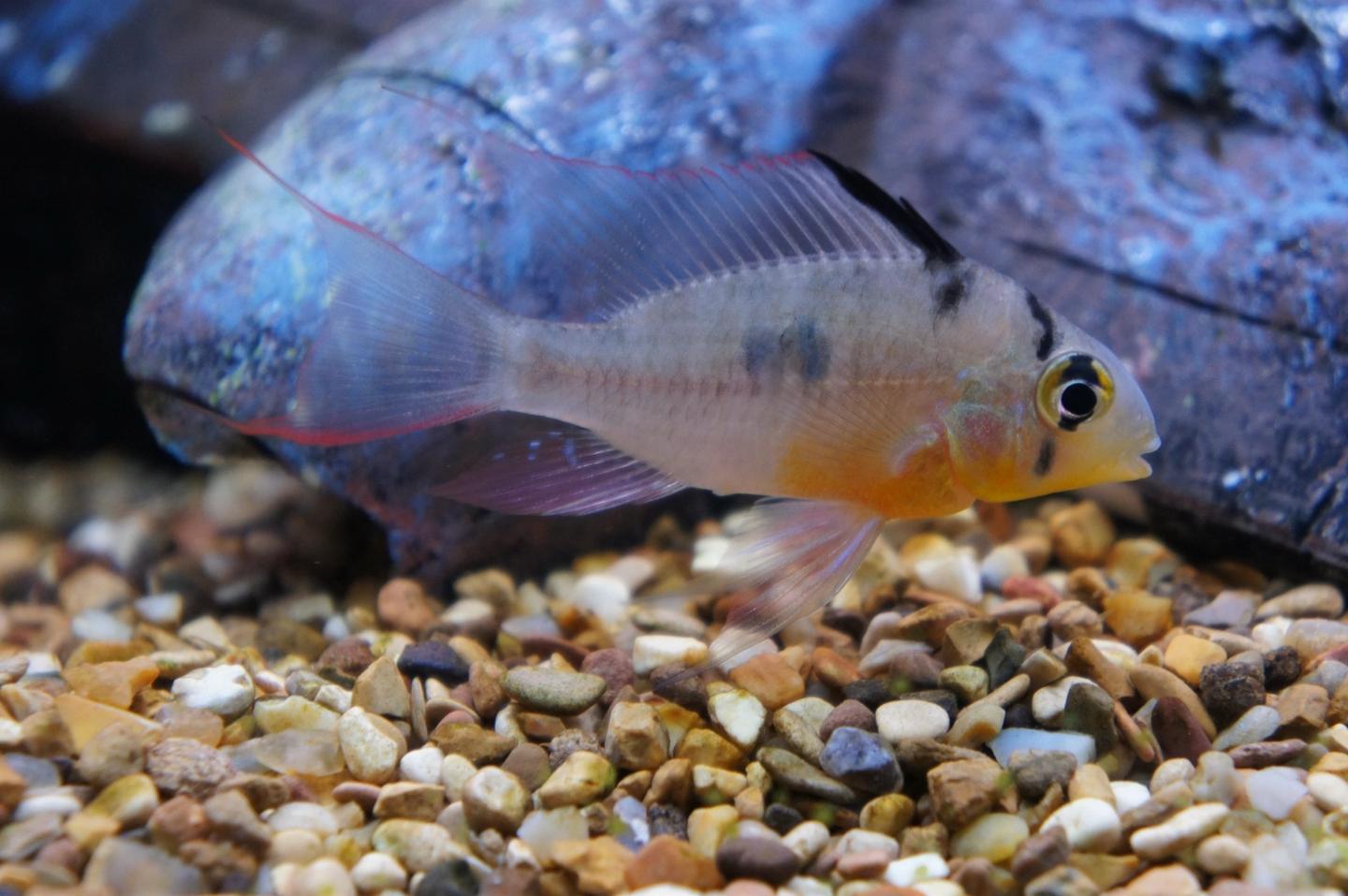
Cichlids are a family of roughly 1,800 accepted species, not one care type. Before buying, identify the exact species and source, then compare adult measurement, usable tank dimensions, social system, territory, tested water, diet and an exit plan. No family-wide minimum tank, water range or tank-mate list is safe.
Read the full care guidance when planning conditions for your aquarium.
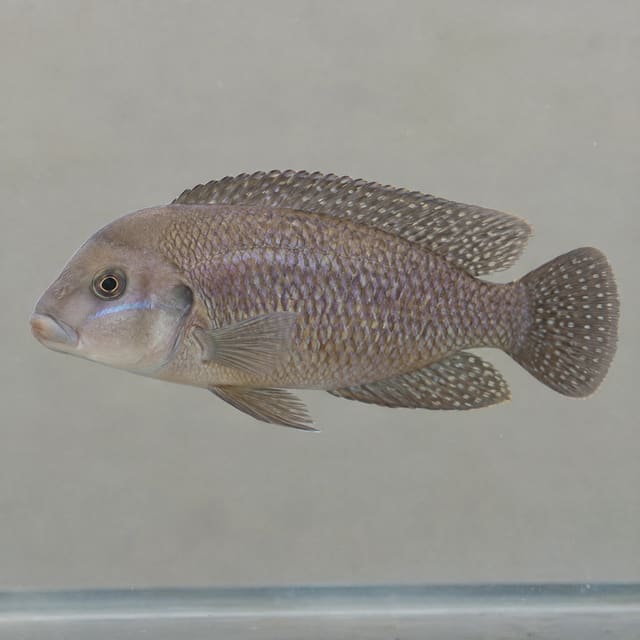
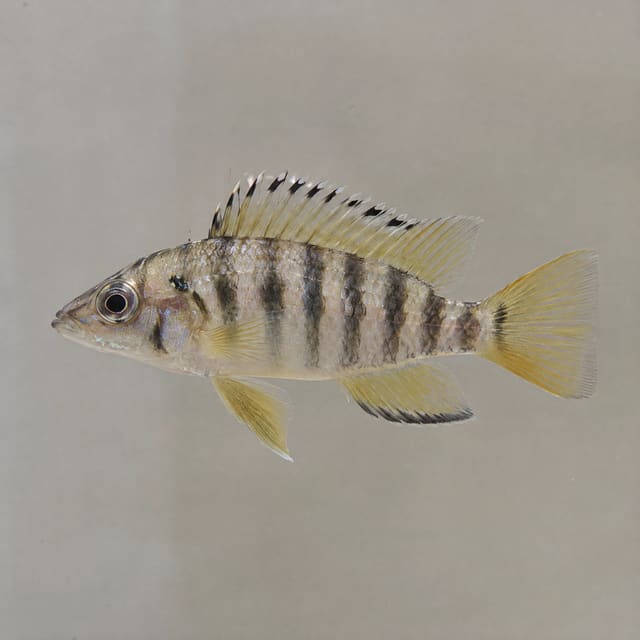
This Telmatochromis cichlid is a small, slender rock and cave dweller from Lake Tanganyika, supplied under the genus name Telmatochromis sp. The fish in our photographs is the striped type: a sandy-tan body with a bold dark band from the snout through the eye to the base of the tail, a second, narrower band along the back, and a rounded tail covered in small pale spots. Telmatochromis belong to the lamprologine cichlids, the same tribe as the Julies and shell-dwellers, and live among rocks, caves and empty shells.
They are among the easier Tanganyikan cichlids to keep. Seriously Fish's profile of Telmatochromis vittatus calls T. vittatus a good choice for beginners and for a smaller Tanganyikan community, and FishBase describes T. bifrenatus as an "ideal beginner's fish". They are territorial but shy, and spend much of the day close to their own cave.
"Telmatochromis sp." means the fish is named to genus, not to species. Several described species look alike, and Seriously Fish notes that T. vittatus is easily confused with T. brichardi and T. bifrenatus. The care below is written for the striped species and gives the size range across the genus, so your plan works whichever striped species you receive.
| Species | Look | Maximum size (source) |
|---|---|---|
| T. vittatus | Striped, larger, smaller eyes and a rounder nose | 8.6 cm total length (FishBase); 85 mm standard length (Seriously Fish) |
| T. bifrenatus | Two-banded, slender | 9.0 cm total length (FishBase) |
| T. brichardi | Small species known from the Burundi shore, easily confused with T. vittatus | 4.1 cm standard length (FishBase) |
| T. temporalis | Stockier rock dweller that also grazes aufwuchs | 10.2 cm total length (FishBase) |
| T. dhonti | The largest species listed here | 12.0 cm total length (FishBase) |
Compare it with the named species we sell, such as the Striped Telmatochromis (T. vittatus), the Two-Banded Telmatochromis (T. bifrenatus), the stockier Temporalis Cichlid and the Orange Telmatochromis, or browse all Telmatochromis cichlids, the full Lake Tanganyika cichlids, our Tanganyika cichlid range and all African cichlids.
One purchase supplies one live Telmatochromis cichlid in the standard size we stock. That is a young fish, not the adult size, and its sex is not selected. Seriously Fish says Telmatochromis are difficult to sex: adult males tend to be slightly larger and slimmer than females, but young fish look alike.
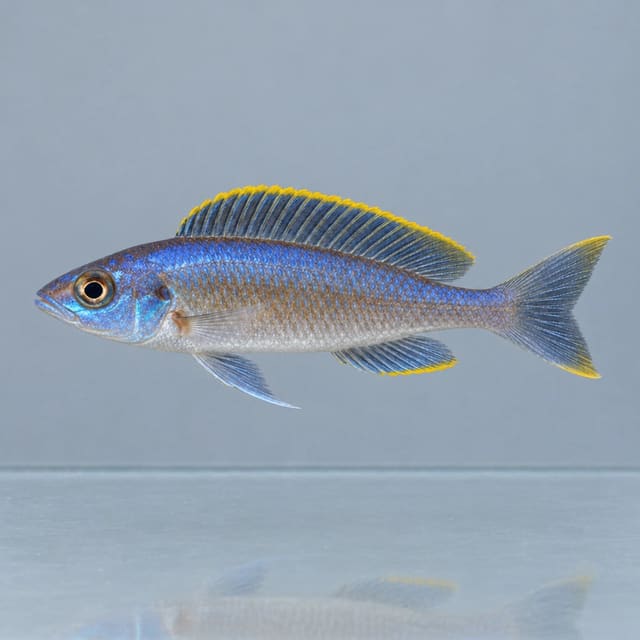
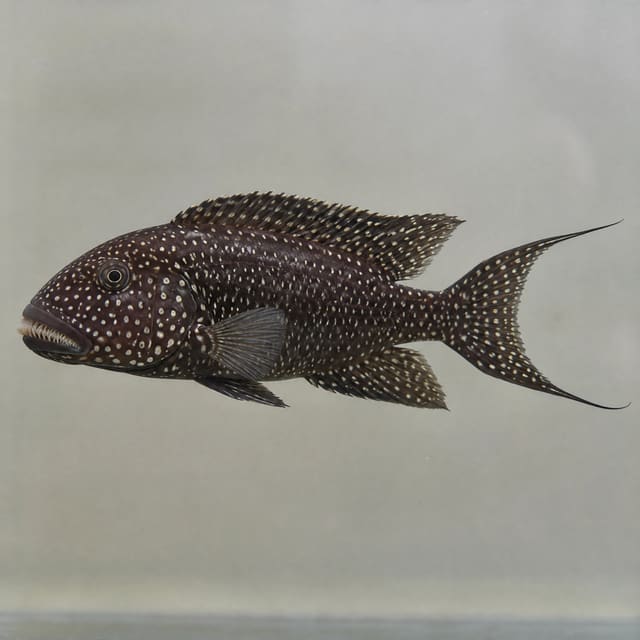
The photographs show the striped form. Colour and stripe contrast change with mood and age, and a fish that has just arrived often looks paler until it settles.
Check our delivery and Live Arrival Guarantee policy before you order, and set up and mature the aquarium first.
Seriously Fish gives a minimum of 75 x 30 x 30 cm, about 68 litres, for T. vittatus, and says a larger tank is preferred and that several fish need a suitably large aquarium. For breeding it suggests a tank at least about 76 cm long. OATA's lake cichlid guidance is to buy the largest tank that is reasonable, because bigger volumes are more stable.
Floor space and rock matter more than height. A pair defends a cave and the area around it; in a community, every cave-dwelling species needs its own patch of rock with sand between.
| Plan | Suggested minimum |
|---|---|
| One pair on its own | 75 x 30 x 30 cm, about 68 litres |
| Breeding pair | About 76 cm long, with several caves |
| Pair plus shell-dwellers or Cyprichromis | Larger than the pair minimum, so each species has its own zone |
| Adult size to plan for | Up to about 9 to 10 cm per fish |
Measure your tank with our tank volume calculator. Fit a cover, and leave space between the rock piles so territories have clear edges.
In the lake, Telmatochromis live near rocks. FishBase records T. vittatus mostly at 5 to 10 m, occasionally down to 20 m, and T. bifrenatus near rocks or over coarse sand between rock patches, in very clear water. Seriously Fish recommends a Lake Tanganyika biotope of rock piles with caves filling much of the tank, over sand.
Telmatochromis use small holes and shells. Seriously Fish suggests upturned flower pots and large snail shells as shelters and spawning sites. Like other lamprologines, they have pointed teeth that they use to scrape small organisms off rock, so leave some flat, lit rock surfaces for grazing.
| Feature | Why it helps |
|---|---|
| Fine sand | Natural floor; shells can sit on it |
| Rock piles with caves | Home caves and spawning sites |
| Flower pots or large empty snail shells | Extra shelters a pair can claim |
| Flat rock faces | Grazing surfaces for tiny organisms and algae |
| Open water | Room for open-water tank mates |
OATA advises fine coral sand or similar to help buffer the water, and complex rockwork to break up lines of sight. Most plants are uprooted by digging cichlids, so use only the hardiest, fixed to rock if at all.
Telmatochromis need hard, alkaline Tanganyika water. Seriously Fish, FishBase and OATA give different ranges, so keep the tank where they overlap.
| Reading | Seriously Fish (T. vittatus) | FishBase (T. vittatus; T. bifrenatus) | OATA lake cichlids | Aim for |
|---|---|---|---|---|
| Temperature | 23-27°C | 24-26°C; 24-26°C | 23-27°C | 24-26°C |
| pH | 8.0-9.5 | 8.5-9.0; 8.5-9.5 | 8.0-8.6 | around 8.5 |
| Hardness | 8-25 dGH | 10-20 dH; 10-15 dH | 12-18 dGH | 12-15 dGH |
| Carbonate hardness | not given | not given | 10-15 dKH | 10-15 dKH |
| Ammonia and nitrite | not given | not given | zero | zero |
| Nitrate | not given | not given | no more than 20 mg/l above tap water | as low as possible |
A pH of about 8.5 sits inside every published range, which makes it the safest target.
UK tap water ranges from soft to very hard depending on the region, so measure pH, GH and KH before you plan. Where tap water is soft, coral sand or aragonite in the substrate or filter helps raise and hold hardness; make each batch of new water the same so the pH does not swing. Our water matcher compares your results with this fish's range, and the water chemistry guide explains each reading.
OATA describes a filter as essential for lake cichlids and recommends an oversized one with vigorous aeration. Small Telmatochromis do not produce much waste on their own, but a community tank adds up, and Tanganyikan cichlids do best in clean, stable water.
Never add a large number of fish at once to a new filter. Increase stocking in steps and test after each step.
FishBase lists Telmatochromis as omnivores that feed on microorganisms, and T. temporalis also grazes aufwuchs, the film of algae and tiny animals on rocks. Seriously Fish recommends mainly live and frozen foods, with dried foods also accepted, plus some vegetable matter such as spirulina, blanched spinach or algae wafers.
OATA's lake cichlid advice is to feed twice a day, only what the fish can eat within a few minutes. Because Telmatochromis are shy, drop some food near their cave as well as in open water.
A Telmatochromis that stays hidden and stops eating may be bullied or stressed by water quality. Test first, then look at tank mates and cover.
Check the water before the fish arrives: ammonia and nitrite at zero, temperature, pH and hardness in range. OATA advises adding peaceful species first and more aggressive species later, and rearranging decor when adding fish so territories reset.
| When | What to check |
|---|---|
| Day 1 | Fish has found cover; lights off |
| Days 2-3 | Takes small frozen food near its cave |
| Days 3-7 | Not chased out of every shelter; fins intact |
| Day 7 | Ammonia and nitrite still zero |
Our guide to acclimatising new fish explains each step. A shy fish that hides for a day or two is normal; one that never comes out to feed needs a closer look.
Seriously Fish suggests small to medium Tanganyikan cichlids that use different parts of the tank, such as Neolamprologus shell-dwellers and Cyprichromis, and compares the Telmatochromis lifestyle to that of the Julies. OATA's rule is to keep lake cichlids only with species from the same lake and never to mix Malawi and Tanganyikan cichlids.
| Suits | Avoid |
|---|---|
| Shell-dwellers such as the Multifasciatus shell-dweller or Blue Ocellated Shell-Dweller, given enough shells | Malawi cichlids of any kind |
| Open-water sardine cichlids such as the Mpulungu Sardine Cichlid | Large or boisterous cichlids that take every cave |
| Julies such as the Golden Julie in a larger tank with plenty of rock | Several adult Telmatochromis of the same kind in a small tank |
| Other small Tanganyikans of similar size | Soft-water community fish |
Our tank mates tool checks a planned mix, and the cichlid care guide covers cichlid behaviour in more depth.
Telmatochromis are cave spawners. Seriously Fish describes T. vittatus spawning secretly in a cave or shell, with the female laying the eggs on the wall or roof and tending them while the male guards the territory. FishBase records temporary pair bonds in which the male defends the territory and the female cares for the young; it gives up to 80 eggs for T. bifrenatus and up to 500 for the larger T. dhonti.
Seriously Fish gives breeding conditions of pH 8.2 to 9.0 and 25 to 26.5°C. The fry become free-swimming at about two weeks, and brood care is short: the parents lose interest once the young swim freely. Feed brine shrimp nauplii, microworm or a powdered dry food, and give the fry their own small caves or move them to a rearing tank.
It is supplied as Telmatochromis sp., so the species is not named. The photographs show the striped type, a slender sandy fish with a dark band from the snout to the tail and a second band along the back, the pattern of T. vittatus and T. bifrenatus. Care is the same for the striped species, and this page plans for the largest likely size.
Plan for up to about 9 to 10 cm. FishBase gives 8.6 cm total length for T. vittatus and 9.0 cm for T. bifrenatus, Seriously Fish gives 8.5 cm standard length for T. vittatus, and the stockier T. temporalis reaches 10.2 cm. Males tend to be a little larger and slimmer.
At least 75 x 30 x 30 cm (about 68 litres) for a pair, the minimum Seriously Fish gives, and larger for a community. For breeding, Seriously Fish suggests a tank at least about 76 cm long.
A pair. Adults are aggressive towards their own kind, so buy a few young fish, let a pair form and rehome the rest. A single fish also lives well in a Tanganyikan community.
Hard, alkaline Lake Tanganyika water: about 24 to 26 degrees C, pH around 8.5 and 12 to 15 dGH, which is where FishBase, Seriously Fish and OATA overlap, with zero ammonia and nitrite.
It is an omnivore that picks small organisms off rocks. Feed small frozen foods such as brine shrimp, daphnia and cyclops, a good flake or small pellet, and some vegetable matter such as spirulina or algae wafers.
Small and medium Tanganyikan cichlids that use a different part of the tank, such as shell-dwelling Neolamprologus and open-water Cyprichromis. Avoid Malawi cichlids and other Telmatochromis in a small tank.
Yes. It spawns secretly in a cave or a large snail shell, the eggs are tended mainly by the female while the male guards, and the fry are free-swimming at about two weeks.
No reviews for this item yet. Bought one? Honest reviews only, good or bad.
What customers say about ordering from us
Easy website plenty of info on fish your buying great to pick a time slot
TRACEY DURRANT · 7 Oct 2026
Got some lovely fish thank you
Kevin Mackie · 7 Oct 2026
Reviews of our shop, collected by Judge.me, an independent third-party review collector. Newest first.
Moved by UK carriers licensed to handle live animals
Hand-packed with oxygen bags, poly box, heat pack
Email photos the same day; an optional unboxing video helps us review problems faster — claim terms apply
Klarna & PayPal Pay in 3 at checkout