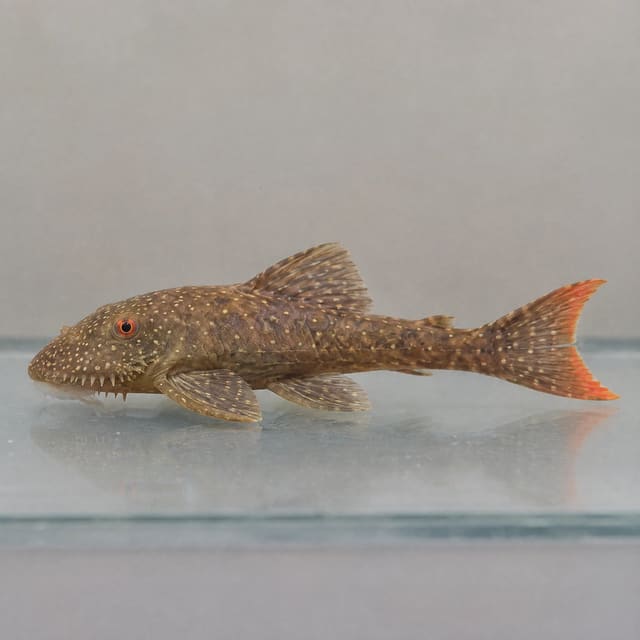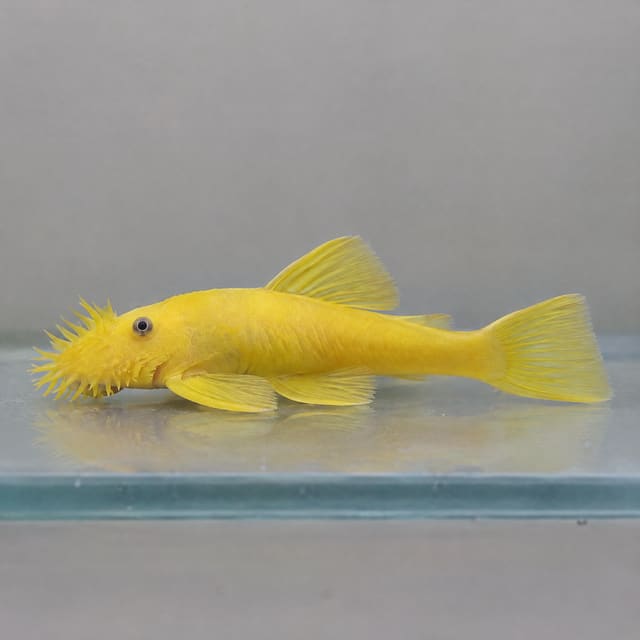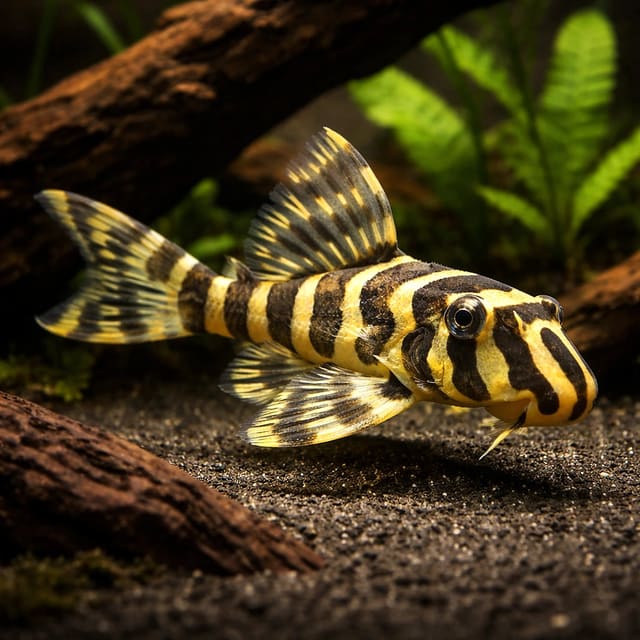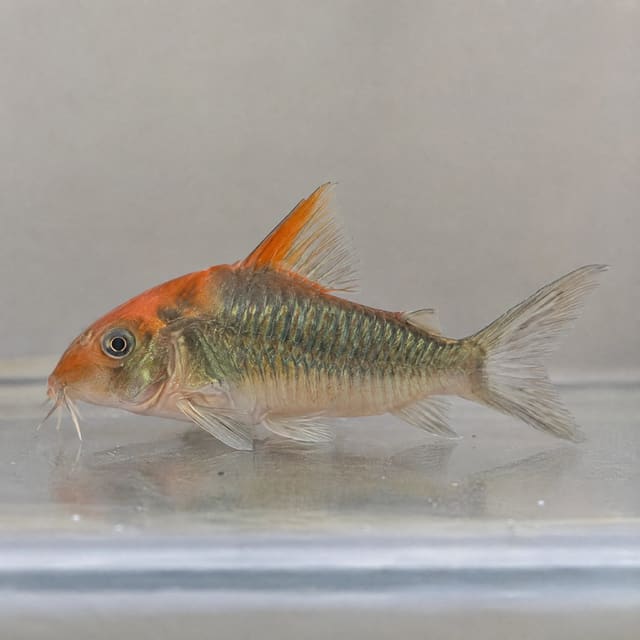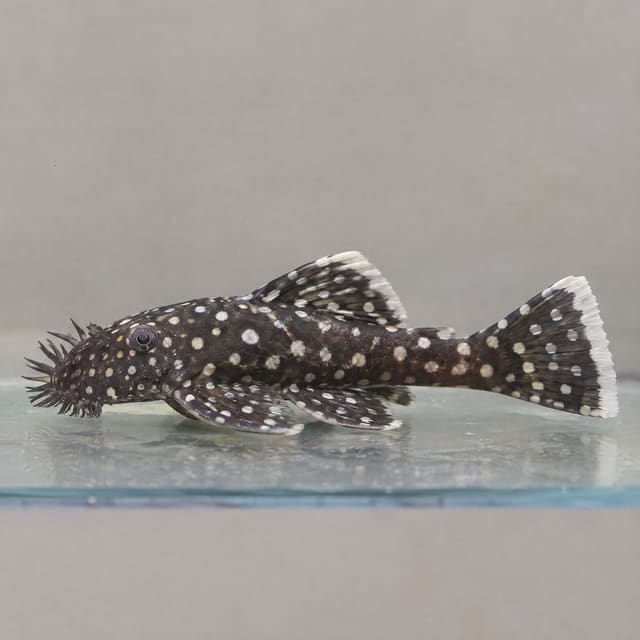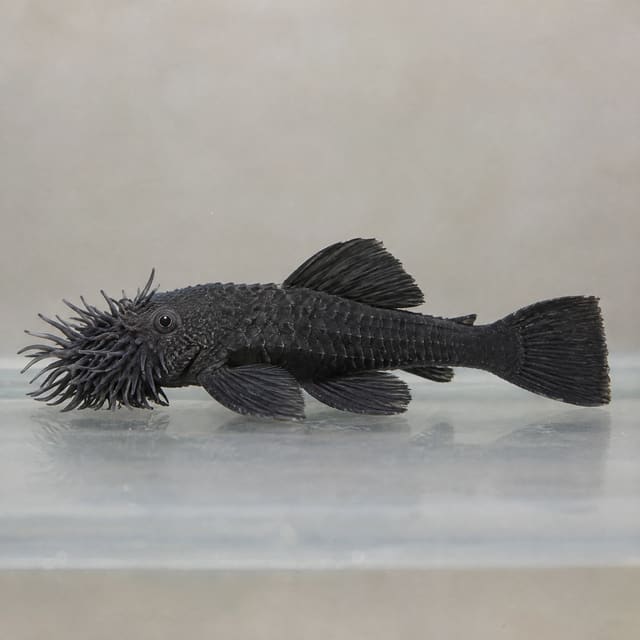
L034 Medusa Pleco (Ancistrus ranunculus)
25–28°C · pH 6–7 · 72L
£68.99
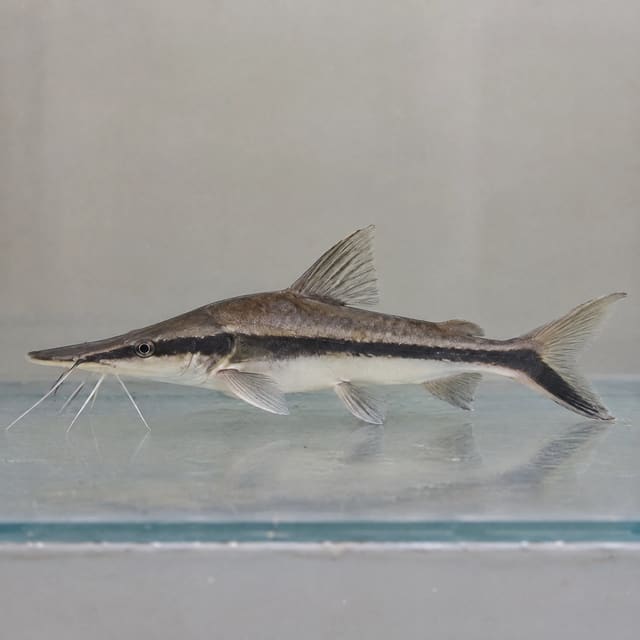
The Sailfin Marbled Pim Catfish (Leiarius pictus) is a spotted South American catfish with a tall, sail-like dorsal fin and very long barbels. It grows to about 60 cm, can live for more than 20 years and needs an aquarium with a base of at least 240 × 90 cm and large, robust tank mates. One live fish per purchase.
Leiarius pictus
The Sailfin Marbled Pim Catfish (Leiarius pictus) is a spotted South American catfish with a tall, sail-like dorsal fin and very long barbels. It grows to about 60 cm, can live for more than 20 years and needs an aquarium with a base of at least 240 × 90 cm and large, robust tank mates. One live fish per purchase.
Read the full care guidance when planning conditions for your aquarium.
The Sailfin Pim Catfish, sold here as the Sailfin Marbled Pim Catfish, is Leiarius pictus, a long-whiskered catfish of the family Pimelodidae from South America. Seriously Fish and Planet Catfish also list the names painted catfish, saddle catfish and marbled sailfin catfish, and older literature calls it Bagrus pictus or Sciades pictus. Its species name means "painted", after the spots of the adult, and its common name comes from the tall, sail-like dorsal fin that sets it apart from its relatives.
Seriously Fish places it in the Orinoco basin of Colombia and Venezuela and parts of the Amazon drainage in Peru and Brazil, and FishBase adds the Essequibo basin. It lives in large rivers and lakes, lurking among submerged tree roots and other refuges by day and coming out at night to feed. This is a true "tankbuster": a fish of about 60 cm that can live for more than 20 years, for keepers who already run, or are building, a very large system. FishBase lists it as Least Concern on the IUCN Red List (assessed in 2020).
| Fish | How to tell |
|---|---|
| Leiarius pictus, sailfin pim | Much larger, sail-like dorsal fin, most obvious in young fish; juveniles show two pale bands along the body |
| Leiarius longibarbis (formerly L. marmoratus) | Its only close relative; smaller dorsal fin |
| Perrunichthys perruno, reticulated pimelodid | Also confused with it; again, a smaller dorsal fin |
| Pimelodus pictus, pictus catfish | A different, small catfish of 120 mm standard length that shares only the species name |
Planet Catfish describes the adult as dark brown with darker spots and a lighter underside. Young fish show two pale bands: the first runs from the base of the dorsal spine towards the pelvic fin and then along the body to the tail, and a thinner one runs parallel to it from the middle of the dorsal fin. Large round spots mark the dorsal, adipose and tail fins, and the barbels are ringed light and dark. The colour fades a little and the tail lobes become more pointed with age.
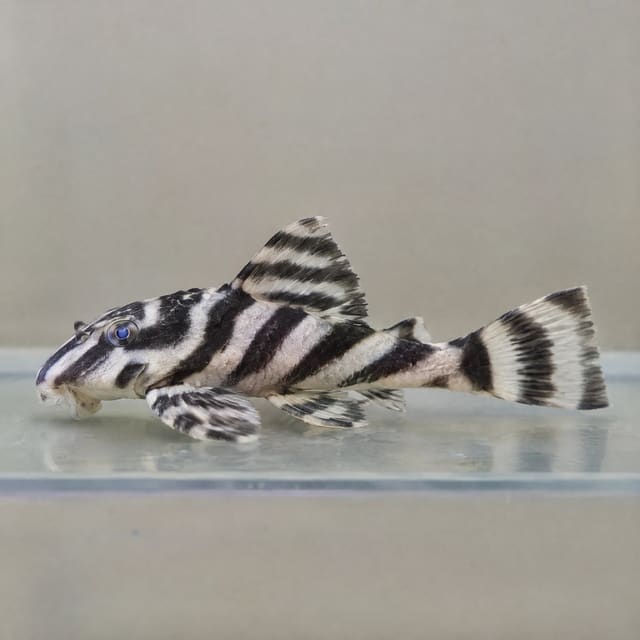
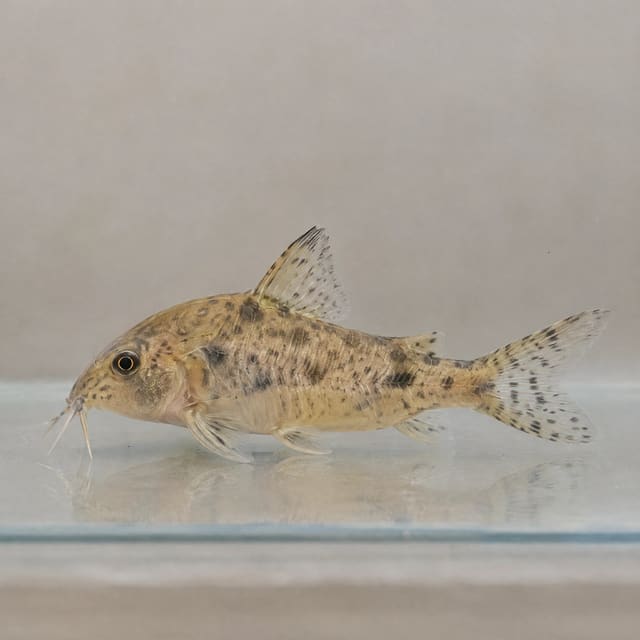
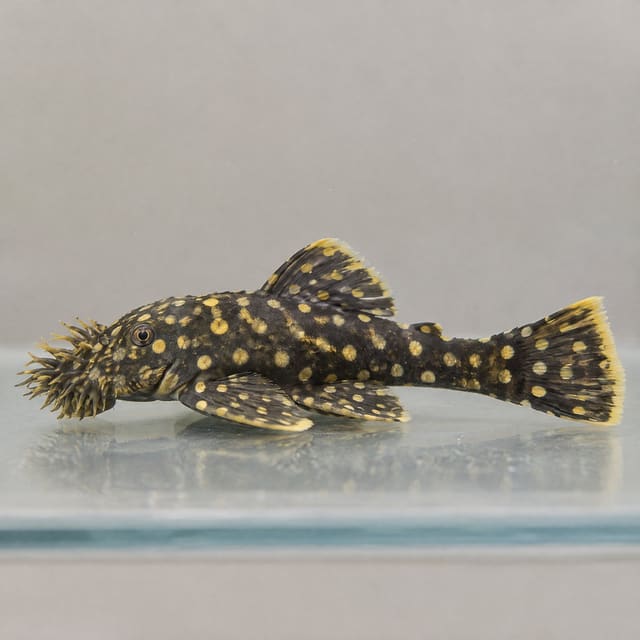
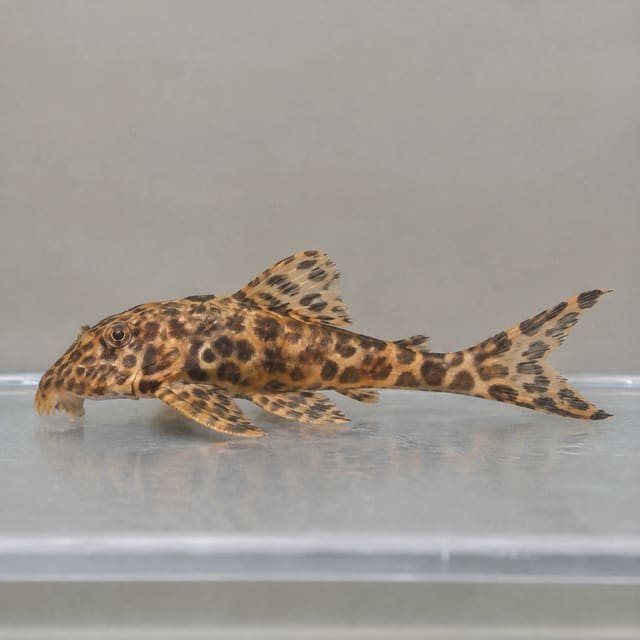
One purchase supplies one live Sailfin Marbled Pim Catfish in the standard size we receive: a juvenile far smaller than the adult. Sex is not specified, and Seriously Fish says this species is virtually impossible to sex by its outward appearance, although adult females are probably stockier than males. The gallery images are representative, prepared from a reference photograph, and do not show the individual you will receive.
Read our delivery and Live Arrival Guarantee policy before ordering a large fish.
Seriously Fish and Planet Catfish give a maximum of 600 mm standard length, measured without the tail, and FishBase gives 60 cm total length. Seriously Fish asks for an aquarium base of at least 240 × 90 cm, and for a fully grown fish an aquarium of 240 × 90 × 120 cm, about 2,592 litres. Growth can be fast: Chris Ralph, writing for Planet Catfish, rescued a fish of about 16 in that grew to about 28 in over almost four years in his 12 × 3 × 4 ft indoor tropical pond.
The same article reports that this catfish can become stressed when its long maxillary barbels touch the front and back of a too-narrow aquarium at the same time, and may then try to leave the tank, so depth from front to back matters as much as length, and a tight-fitting cover is essential. Our tank volume calculator converts your measurements into litres.
Planet Catfish recommends a large, spacious tank with open space for night-time cruising and a large, shady bogwood root or pipe for it to retreat to by day. It also advises placing the heater in the open, not in the spot where the catfish might try to hide. OATA adds that large fish can knock over décor, so rocks must be secured and heaters protected, and that the substrate must have no sharp edges and be easy to keep clean.
| Area | Purpose |
|---|---|
| Large shaded root or pipe | A daytime refuge big enough for the adult |
| Long open floor | Night-time cruising and feeding space |
| Smooth sand | Protects the long barbels, which can move independently |
| Guarded heater in open water | Out of the hiding place and safe from a strong fish |
Here the sources agree closely, which makes the target simple.
| Value | Seriously Fish | Planet Catfish | FishBase | Our target |
|---|---|---|---|---|
| Temperature | 22–26°C | 22–26°C | 22–26°C | 22–26°C |
| pH | 6.2–7.6 | 6.2–7.6 | 6.2–7.5 | 6.2–7.5 |
| Hardness | 5–18 dGH | Up to 18 dGH | Up to 18 dH | 5–18 dGH |
That is a broad range, but check your tap water against it before you buy, particularly in very hard-water areas; your water company publishes figures for your postcode, and our water matcher compares them with this fish. Our water chemistry guide explains each reading. Stability matters more than any single number in a system this size.
| Reading | Target |
|---|---|
| Ammonia | Zero mg/l |
| Nitrite | Zero mg/l |
| Nitrate | No more than 20 mg/l above your tap water |
OATA gives these limits for every very large fish and notes that even small amounts of ammonia and nitrite can stress them.
A large predator eats large meals and produces a lot of solid waste in a short time. Choose filtration that can handle the whole system's volume several times over, with strong mechanical stages to catch solids and generous biological media, and keep spare capacity for the day after a meal. Our guide to aquarium filtration explains how to build that combination.
Seriously Fish describes it as piscivorous by nature but quick to accept dead foods in captivity, and lists prawns, mussels, cockle, lancefish and earthworms as favourites. Planet Catfish adds floating sticks or pellets and catfish pellets. Seriously Fish advises against beef heart, chicken and live feeder fish.
Large fish may travel in boxes or buckets as well as bags. Use OATA's floating method: lights off, float the sealed bag for about 10 minutes to equalise the temperature, add small amounts of aquarium water over up to 20 minutes, then guide the fish out with as little transport water as possible. OATA warns that most catfish carry spines on their front fins, so move it in a container rather than a net where you can. Our guide to acclimatising new fish covers each step.
| Checkpoint | What to do |
|---|---|
| Before introduction | Test the water; confirm 22–26°C and the refuge is in place |
| First day | Lights low and lid closed; let it find its refuge |
| First feed | A small portion of prawn or mussel after lights-out |
| Mid-week | Retest ammonia and nitrite |
| End of week | Full test and a partial water change |
Expect a Sailfin Pim Catfish to hide by day and cruise the open floor at night, feeling its way with barbels that can move independently. Seriously Fish describes it as actually quite peaceful with fish of its own size. Chris Ralph's feature describes a real character that learned to take food from his hand, and that once picked up a large Oscar that was in its way at feeding time, carried it round the pond a couple of times and left it, disorientated, in a corner.
| If you see | Do this |
|---|---|
| Hiding all day, out at night | Normal behaviour |
| Pushing at the lid or glass | Check the front-to-back depth and the cover; Planet Catfish links this to barbels touching both sides |
| Hanging at the surface or fast breathing | Test ammonia, nitrite and temperature at once and add aeration |
| Loss of appetite | Remember adults eat rarely; check water readings before changing the diet |
| White spots, fluffy growths or damaged fins | Test the water and seek fish-health advice before treating |
Seriously Fish says it will not hesitate to eat any smaller fish, and that it is territorial towards its own kind and towards other large pimelodid catfish. It suggests large doradids such as Oxydoras niger, Megalodoras uranoscopus and Pterodoras granulosus as companions, and in a very deep aquarium larger characins, cyprinids, the South American arowana and Cichla species. Planet Catfish adds Oscars and larger characins.
| Suits | Avoid |
|---|---|
| Large doradid catfish | Any fish small enough to swallow |
| Oscars and other large, robust cichlids | A second Leiarius |
| Large characins and cyprinids | Other large pimelodids such as red-tailed and shovelnose catfish |
| Arowana and Cichla in a very deep system | Slow or delicate fish |
From our range, suitable companions for a big system include the Oscar Cichlid (see our Oscar care guide), the Silver Arowana and the Monoculus Peacock Bass, each introduced at a size the catfish cannot swallow. Do not mix it with our Red-Tailed Catfish or Tiger Shovelnose Catfish, which are large pimelodids. If you want the spotted pim look in a community-sized fish, the Pictus Catfish (Pimelodus pictus) and our other Pimelodus catfish stay far smaller. Browse all South American catfish, our centrepiece fish, rare and collector fish and catfish and plecos, and check every mix with our tank mates tool.
Seriously Fish describes breeding as unreported in the hobby, and Planet Catfish records no known aquarium spawnings, most likely because of the size of fish and aquarium involved. Treat this as a single, long-lived display fish rather than a breeding project.
It is Leiarius pictus, a large long-whiskered catfish of the family Pimelodidae from the Amazon, Orinoco and Essequibo basins of South America. It is also sold as the Sailfin Pim, Painted Catfish and Saddle Catfish.
Seriously Fish and Planet Catfish give 60 cm standard length, measured without the tail, and FishBase gives 60 cm total length. One UK keeper writing for Planet Catfish recorded his fish growing from about 16 in to about 28 in over almost four years.
Seriously Fish gives a minimum base of 240 × 90 cm, and for a fully grown fish an aquarium of 240 × 90 × 120 cm, about 2,592 litres. An indoor heated pond is a sensible alternative.
No. The Pictus Catfish sold for community tanks is Pimelodus pictus, which Seriously Fish gives as 120 mm standard length. Leiarius pictus shares only the species name and grows about five times longer.
Seriously Fish advises feeding juveniles every other day and adults a single meal a week at most. Use prawn, mussel, cockle, lancefish, earthworms and large catfish pellets.
Yes, if they are small enough. It is a fish-eater by nature and will swallow any tank mate that fits in its mouth, so keep it only with fish of similar size.
Seriously Fish says it is territorial towards its own kind and other large pimelodid catfish. Unless the system is exceptionally large, keep one.
Seriously Fish says it can live for more than 20 years, so buying one is a long commitment.
No reviews for this item yet. Bought one? Honest reviews only, good or bad.
What customers say about ordering from us
Easy website plenty of info on fish your buying great to pick a time slot
TRACEY DURRANT · 7 Oct 2026
Got some lovely fish thank you
Kevin Mackie · 7 Oct 2026
Reviews of our shop, collected by Judge.me, an independent third-party review collector. Newest first.
Moved by UK carriers licensed to handle live animals
Hand-packed with oxygen bags, poly box, heat pack
Email photos the same day; an optional unboxing video helps us review problems faster — claim terms apply
Klarna & PayPal Pay in 3 at checkout