−15%
Easy
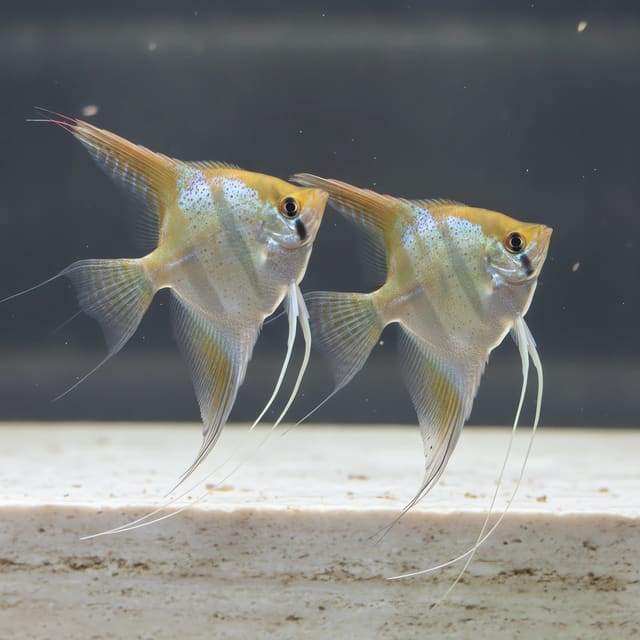
Electric Blue Acara (Andinoacara pulcher) – Neon Blue, 2–7cm Sizes
22–23°C · pH 6.5–8
£6.79£7.99

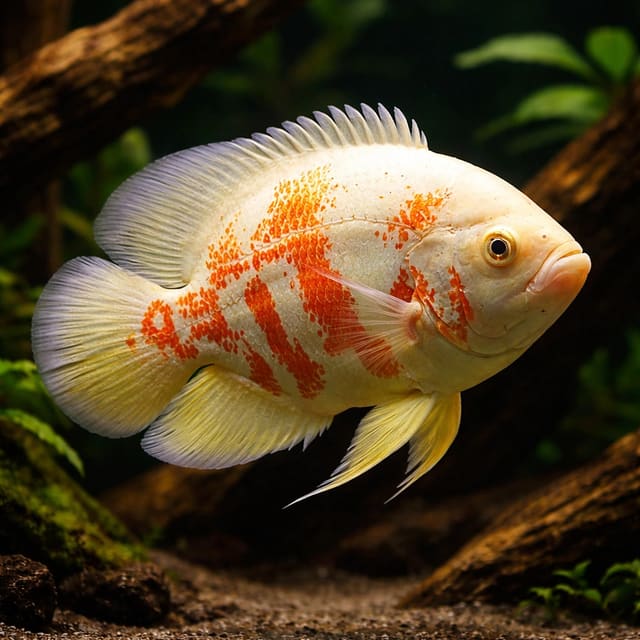
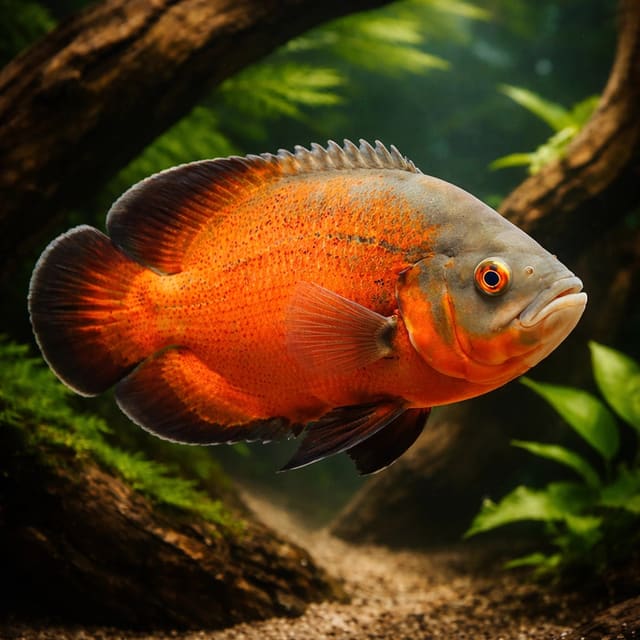
The Oscar Cichlid (Astronotus ocellatus) is a large, predatory cichlid from South America’s western Amazon and Orinoco basins that reaches 45.7 cm. It suits a keeper prepared for one adult in about 540 litres with a 150 × 60 cm base, 22–27°C, pH 6.5–7.5 and 5–12 dGH; avoid much smaller fishes. Sold individually in sizes from 2–3 cm to 16–20 cm.
Adult size is the maximum length this species reaches at full maturity (scientific sources). The livestock you receive will be younger and smaller — pick a size above for the actual shipping size. Product-photo provenance and any image-specific limitations are stated on the listing.
The Oscar Cichlid (Astronotus ocellatus) is a large, predatory cichlid from South America’s western Amazon and Orinoco basins that reaches 45.7 cm. It suits a keeper prepared for one adult in about 540 litres with a 150 × 60 cm base, 22–27°C, pH 6.5–7.5 and 5–12 dGH; avoid much smaller fishes. Sold individually in sizes from 2–3 cm to 16–20 cm.
Adult size is the maximum length this species reaches at full maturity (scientific sources). The livestock you receive will be younger and smaller — pick a size above for the actual shipping size. Product-photo provenance and any image-specific limitations are stated on the listing.
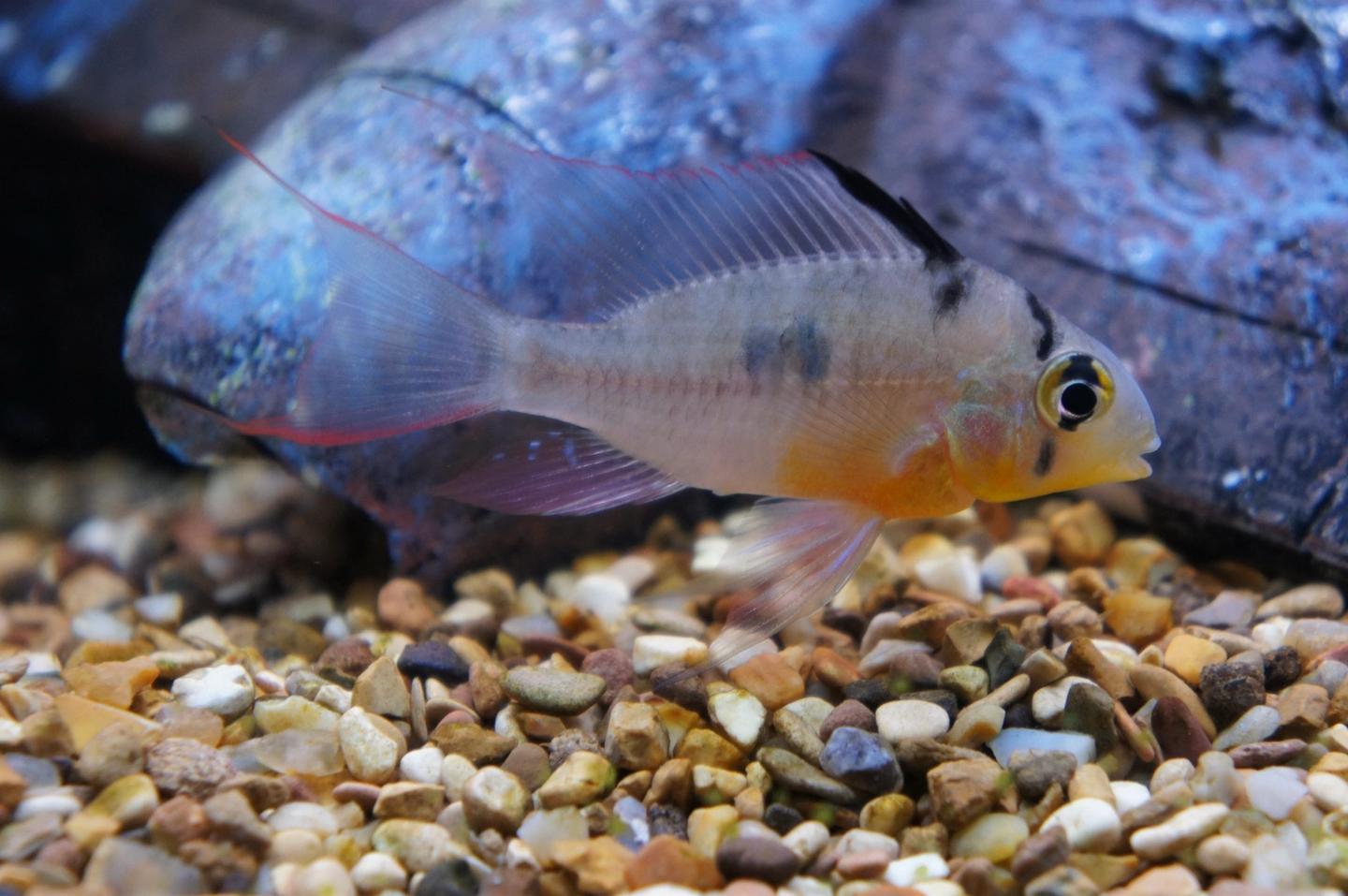
Cichlids are a family of roughly 1,800 accepted species, not one care type. Before buying, identify the exact species and source, then compare adult measurement, usable tank dimensions, social system, territory, tested water, diet and an exit plan. No family-wide minimum tank, water range or tank-mate list is safe.
Maintain these water conditions for optimal health and vibrant colors
The Oscar Cichlid, Astronotus ocellatus, is a large freshwater member of the cichlid family. Its decisive requirements are adult-scale space, efficient filtration, controlled feeding and carefully screened companions. This is not a fish to choose around its dispatch size alone.
FishBase records up to 45.7 cm total length, while the aquarium profile from Seriously Fish uses 35 cm standard length for planning. These are different ways of measuring length. Use the 45.7 cm maximum record when checking whether the aquarium, décor and companion fish remain suitable at full scale.
For one adult, plan around a base of at least 150 × 60 cm and approximately 540 litres. Seriously Fish describes that footprint as just about large enough for a single adult and calls for larger quarters for a pair or group. The footprint matters because it defines the fish’s horizontal living area; extra height does not compensate for a short or narrow base.
Seriously Fish gives an aquarium range of 20–28°C, pH 6.0–7.5 and 5–20 dGH. OATA’s American-cichlid group guidance narrows routine conditions to 22–27°C, pH 6.5–8.0 and 4–12 dGH. Use the shared routine range of 22–27°C, pH 6.5–7.5 and 5–12 dGH.
| Planning decision | Use this figure |
|---|---|
| Recorded maximum | Up to 45.7 cm total length |
| Single-adult aquarium | About 540 litres |
| Minimum base | At least 150 × 60 cm |
| Routine temperature | 22–27°C |
| Routine pH | 6.5–7.5 |
| Routine hardness | 5–12 dGH |
One purchase supplies one animal of the selected option. The live size selector is the place to choose between 2–3 cm, 3-4 cm, 4–5 cm, 5–6 cm, 7–9 cm, 10–12 cm, 13–15 cm and 16–20 cm. Use the selector for the live choice rather than treating any size mentioned in the care text as an offer.
The size you select is the size supplied, not the adult size. Every label describes the approximate dispatch size of the fish, and every option still requires the same adult plan. A 2–3 cm fish does not remain suitable for a small aquarium, while a 16–20 cm fish does not represent the recorded maximum.
Check the selected fish against the tank’s present dimensions, filtration and other occupants. Do not base the decision on a future upgrade unless the larger aquarium and its equipment have a definite place in your plan. The long-term target remains approximately 540 litres with a 150 × 60 cm base for one adult, with more room required for a pair, group or community.
| Selector label | What the label means |
|---|---|
| 2–3 cm to 7–9 cm | The fish’s dispatch measurement only |
| 10–12 cm to 16–20 cm | The fish’s dispatch measurement only |
| Adult planning | Up to 45.7 cm total length |
| Purchase unit | One animal per purchase quantity |
Sex is guaranteed only when the selected option explicitly states male or female. This Oscar Cichlid listing has no sex-guaranteed option.
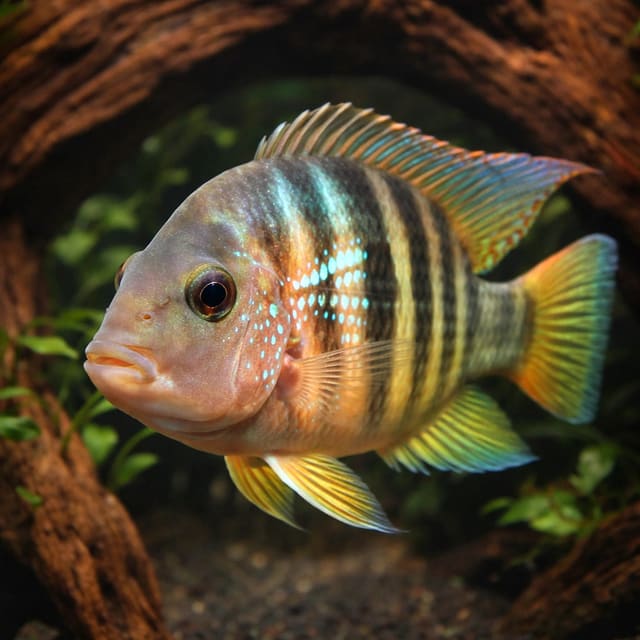
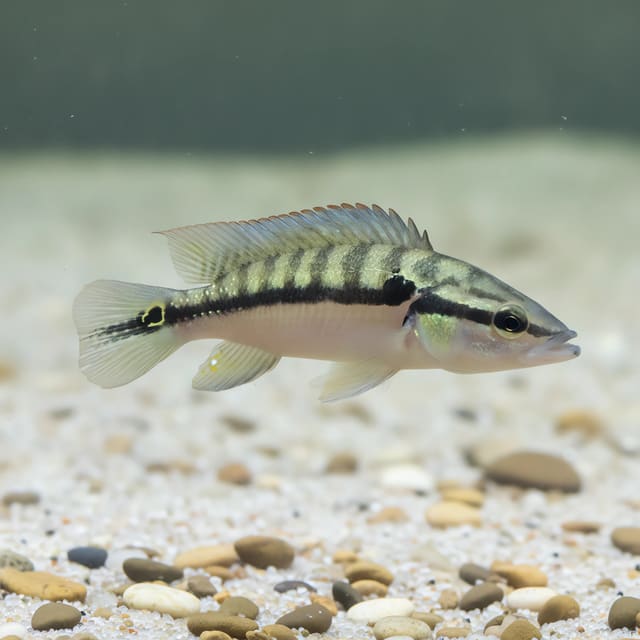
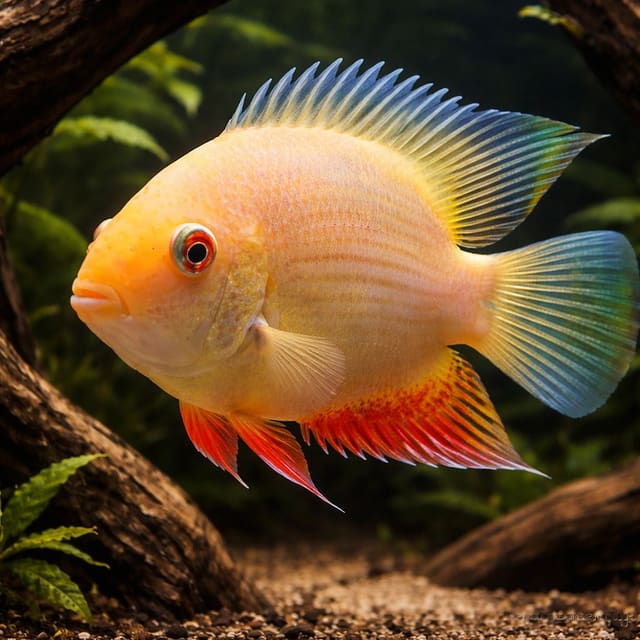
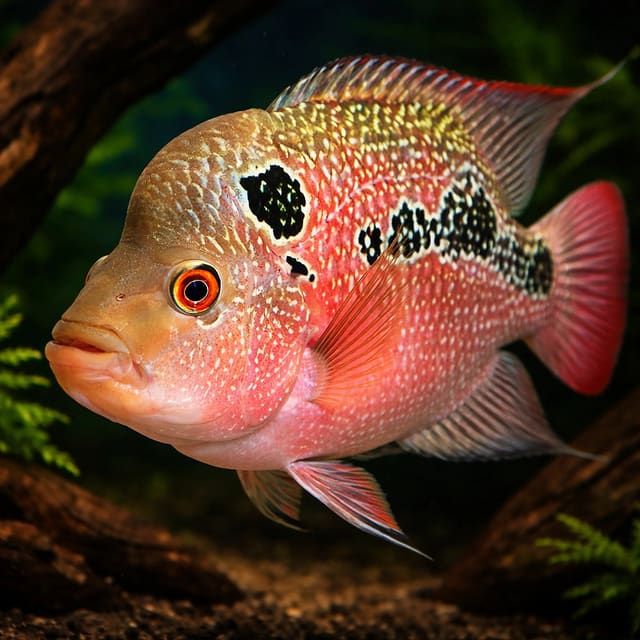
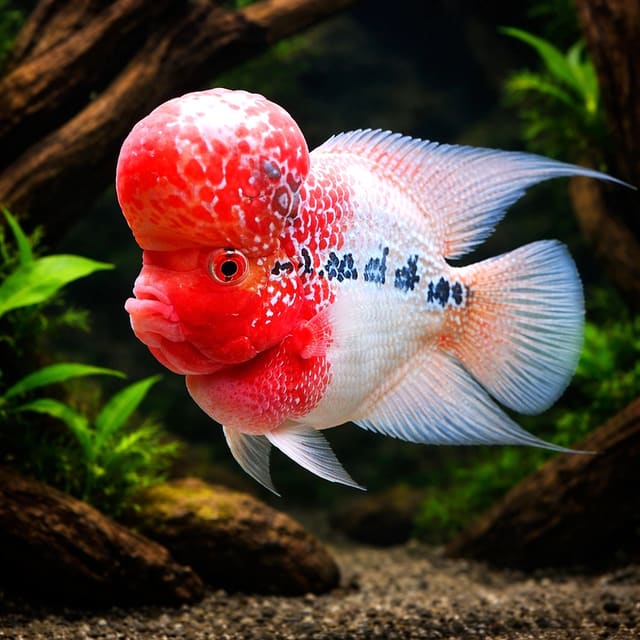
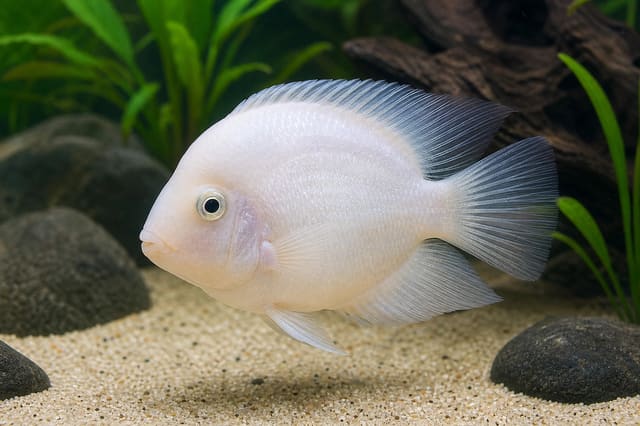
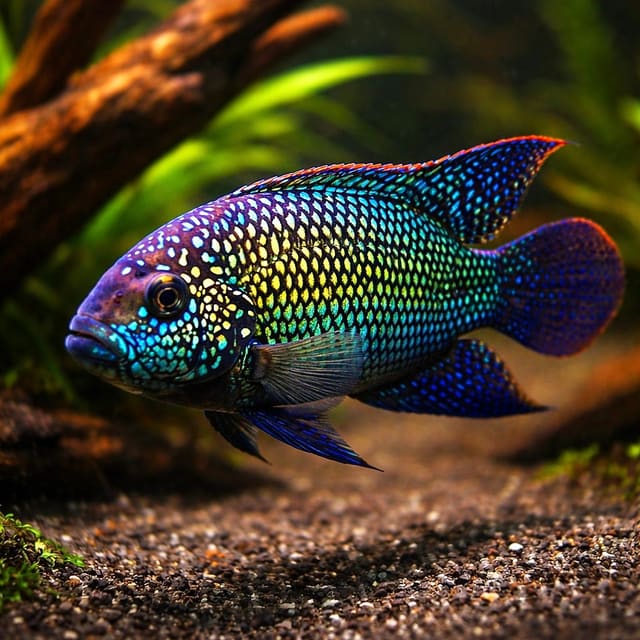
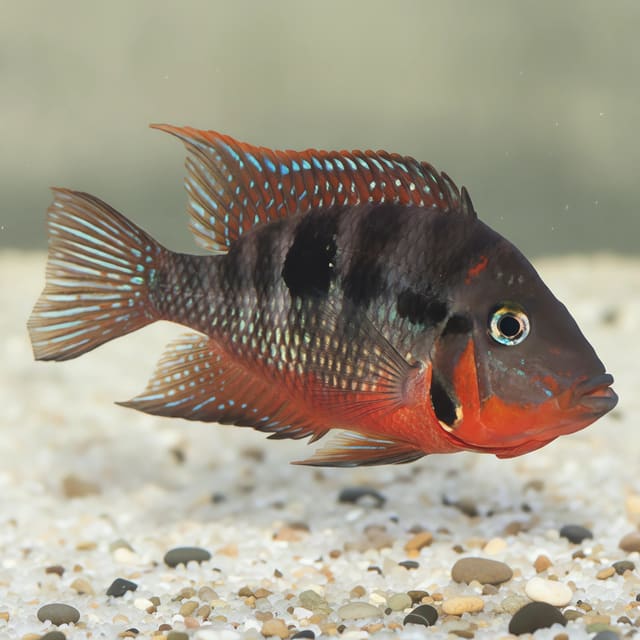
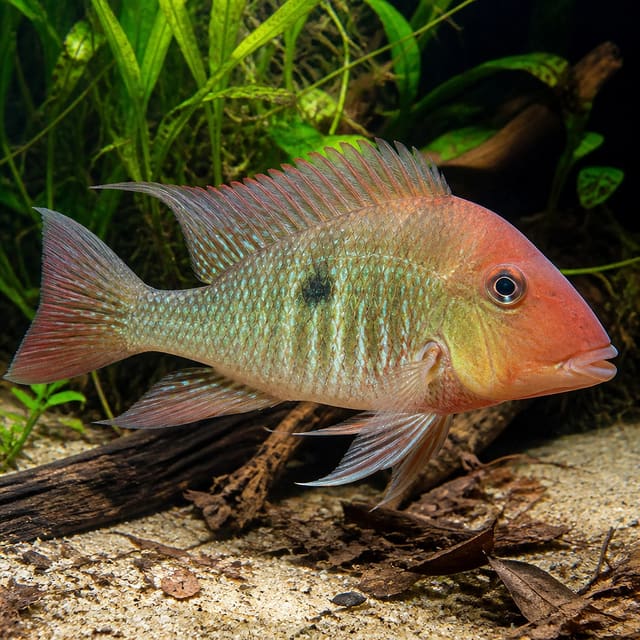
Some gallery images have been digitally enhanced to improve image quality. They show the listed type of animal rather than guaranteeing the exact markings of the individual supplied, so natural colour and pattern can vary.
FishBase places Astronotus ocellatus in the western Amazon and Orinoco basins of South America. In nature it prefers quiet, shallow water in mud-bottomed or sand-bottomed canals and ponds. Its recorded wild foods include small fish, crayfish, worms and insect larvae.
That natural history explains two important aquarium decisions. First, an Oscar is predatory, so much smaller fishes should not be placed within reach as routine community companions. Second, a soft sandy base, subdued lighting and substantial wood suit the kind of quiet, structured environment described for the species. The aquarium still needs open floor area because its adult body is deep and substantial.
Seriously Fish describes the aquarium fish as a generalised omnivore that favours meatier foods and accepts a good-quality cichlid pellet as a staple. That does not mean feeding without limits: the daily portion should be restricted to what the fish consumes within a few minutes so uneaten food does not add to the waste load.
The attraction of an Oscar is its size, bold feeding response and strong presence in a large display. Those same qualities make space, water quality and companion choice welfare decisions rather than optional refinements.
| Suits | Not suited to |
|---|---|
| Stable aquarium water maintained at 22–27°C and pH 6.5–7.5 | Water outside 22–27°C and pH 6.5–7.5 |
| Potentially larger characids or anostomids in a suitably large aquarium | Much smaller fishes |
Set the aquarium to 22–27°C, pH 6.5–7.5 and 5–12 dGH. This routine range sits within the aquarium values used for the species while applying the narrower American-cichlid guidance. FishBase’s recorded wild environment is 22–25°C, pH 6.0–8.0 and 5–19 dH; those figures describe where the species has been recorded rather than a reason to push a home aquarium to either extreme.
Ammonia must remain at zero mg per litre and nitrite must remain at zero mg per litre. OATA advises keeping nitrate no more than 20 mg per litre above the normal tap-water level. Test at least weekly, and test again whenever appetite, breathing, colour or swimming changes.
| Test result | Decision |
|---|---|
| Ammonia above zero | Stop increasing the fish load and address water quality immediately |
| Nitrite above zero | Treat it as an immediate water-quality problem |
| Tap nitrate 10 mg/l | Keep aquarium nitrate at or below 30 mg/l |
| Temperature 25°C | Within the 22–27°C routine range |
| pH 7.2 | Within the 6.5–7.5 routine range |
| Hardness 8 dGH | Within the 5–12 dGH routine range |
The nitrate example shows how the OATA limit works: add 20 mg/l to the measured tap-water baseline rather than treating 20 mg/l as the aquarium’s absolute reading. Recheck the tap supply periodically because its baseline can affect the result you use for comparison.
Use our water chemistry guide to understand each test, then enter measured values in the water matcher. Always condition replacement tap water to remove chlorine or chloramine before it enters the aquarium, and match the replacement water to the established routine range.
Use approximately 540 litres and a base measuring at least 150 × 60 cm for one adult. Seriously Fish calls this just about large enough, so treat it as the single-adult baseline rather than spare capacity for extra large fish. A pair, group or community requires larger quarters.
A natural-style arrangement can use soft sand, relatively dim lighting and large driftwood roots or branches. Leave enough of the base open for the fish to move through the aquarium without the layout consuming the whole footprint. The species tends to dig, making it a poor match for a carefully arranged aquascape that depends on rooted plants and an undisturbed substrate.
| Layout choice | Reason |
|---|---|
| Soft sandy substrate | Matches the recommended natural-style arrangement |
| Large wood pieces | Provide substantial structure without relying on delicate planting |
| Relatively dim lighting | Matches the recommended aquarium style |
| Open base area | Preserves usable room within the 150 × 60 cm footprint |
| External heaterstat where possible | The species has been known to break aquarium heaters |
Secure the principal pieces before introducing the fish because digging can alter the support beneath décor. Keep heater equipment protected; Seriously Fish recommends locating the heaterstat externally where possible because Oscars have been known to break this equipment.
Use footprint and volume together when comparing aquariums. A tank may hold approximately 540 litres yet have an unsuitable shape, while a 150 × 60 cm base without the required water volume may leave too little dilution for the fish’s waste. The practical choice meets both figures.
Before adding the fish, complete the layout, bring temperature and chemistry into range and confirm that the filter is processing waste. Repeatedly rebuilding the aquarium after introduction works against the stable, predictable conditions needed for monitoring.
A working biological filter is essential. The RSPCA explains that biological filtration supports bacteria that convert toxic ammonia to toxic nitrite and then to safer nitrate. The filter must therefore be established and maintained; water movement alone is not biological waste control.
For an aquarium of about 540 litres, Seriously Fish recommends turnover of four to five times the aquarium volume per hour. That equals a total rated flow of approximately 2,160–2,700 litres per hour. Its worked equipment example uses two filters, each rated at 1,080–1,350 litres per hour.
| Task | Routine |
|---|---|
| Water change | 30–50% every week |
| 540-litre example | Replace about 162–270 litres |
| Water tests | At least weekly |
| Filter inspection | Check for blockages during maintenance |
| Replacement water | Condition before adding it |
| Filter media | Rinse lightly in removed aquarium water when cleaning is needed |
Do not rinse established filter media under the tap. Chlorine or chloramine may damage the beneficial bacteria living in it. Instead, use aquarium water removed during the weekly change and rinse only as much as needed to clear the blockage.
A 30% change from 540 litres is approximately 162 litres; a 50% change is approximately 270 litres. Check that this volume is practical to drain, condition and replace every week before committing to the aquarium. The higher end of the stated range gives greater waste removal, while the water tests show whether the routine is keeping ammonia and nitrite at zero and nitrate within its limit.
If the aquarium is new, follow the first tropical tank guide and establish the biological filter before livestock enters. Add fish slowly because the bacterial population must adjust when feeding and waste production increase.
Use a good-quality cichlid pellet as the staple diet and supplement it regularly with suitable live or frozen foods. Seriously Fish describes the aquarium Oscar as an unfussy feeder that prefers a high-protein menu. OATA’s guidance for larger American cichlids includes frozen or freeze-dried supplements and items such as cockles, lance fish or prawns.
Feed once a day and offer only what the fish can consume within a few minutes. This limit matters because an Oscar can take a large amount in one sitting, while uneaten food and excess faeces break down and add toxic waste to the aquarium.
| Feeding observation | Action |
|---|---|
| Food is eaten within a few minutes | Keep the portion at that measured level |
| Food remains after a few minutes | Reduce the next portion and remove waste during maintenance |
| Intake suddenly decreases | Test water and review breathing, colour and behaviour |
| Body condition increases | Reassess the portion rather than adding more food |
| Several foods are accepted | Keep the pellet as the repeatable staple and rotate supplements |
Wild Oscars eat small fish, crayfish, worms and insect larvae, and the wider wild diet also includes crustaceans, zooplankton and some plant material. Use that information to understand their omnivorous, meat-preferring biology rather than attempting to recreate predation in the aquarium. The practical aquarium diet remains pellets with controlled live or frozen supplements.
Match pellet size to what the fish can take cleanly. The dispatch labels cover a wide span of body sizes, so the physically appropriate pellet or supplement size may differ between selected fish even though the feeding rule remains the same.
Do not respond to every movement at the front of the aquarium with another meal. A fixed once-daily schedule makes intake easier to judge and keeps feeding changes visible. Record a sudden loss of interest alongside the water-test results because appetite is one of the health changes OATA advises keepers to monitor.
Complete the aquarium before the fish arrives. Confirm that temperature is 22–27°C, ammonia is zero mg/l and nitrite is zero mg/l, and ensure the biological filter is operating. Adding an Oscar before the filter is ready risks new tank syndrome because the bacterial population may be unable to process the increased waste.
Keep the aquarium conditions ready before opening the parcel so the process does not pause while equipment, tests or space are arranged. The current steps for claims and acclimatisation are on our delivery and Live Arrival Guarantee policy.
Increase aquarium stocking slowly. Every added fish and every increase in feeding adds waste, and the established bacterial population needs time to respond. Do not combine the Oscar’s introduction with several other livestock additions simply because the aquarium volume looks large.
| Arrival check | Expected decision |
|---|---|
| Temperature outside 22–27°C | Correct the prepared aquarium before introduction |
| Ammonia or nitrite detected | Resolve the water-quality problem before adding livestock |
| Much smaller resident fishes | Do not use that community for the Oscar |
| Filter newly installed | Establish biological filtration first |
| Several additions planned | Space them out and monitor the filter response |
The first priority is a stable filtered aquarium, not immediate feeding or a complicated rearrangement. Use the normal once-daily feeding rule and remove uneaten food rather than repeatedly offering extra portions to test whether the fish will eat.
Observe the fish’s eyes, fins, scales, skin, swimming, breathing, colour, body condition, temperament and food intake. OATA identifies changes in these areas as early warning signs that should trigger closer checks.
| Change you see | First response |
|---|---|
| Hanging at the surface | Test ammonia and nitrite and review breathing |
| Sitting on the bottom | Check water values and compare with normal behaviour |
| Erratic swimming | Test water and inspect the aquarium for recent changes |
| Faster or slower gill movement | Check water quality immediately |
| Darker or paler colour | Look for accompanying changes in appetite, breathing or hiding |
| White spots or fluffy growths | Record the appearance and seek health guidance |
| Reduced food intake | Test water and reassess the measured daily portion |
| Damaged fins or lost scales | Inspect interactions and the physical layout |
A single observation is most useful when compared with the fish’s normal pattern. Note whether the change appears only at feeding, continues through the day or coincides with an altered water result. This separates a brief behavioural response from a continuing welfare concern without guessing at a diagnosis.
If a health change continues, test the water and contact us for guidance. Keep the actual readings, the time the change began and a clear description of what the fish is doing; those details are more useful than changing several parts of the aquarium at once.
Avoid much smaller fishes. Seriously Fish describes the Oscar as predatory and says it should not be combined with fish that are much smaller. Its adult size also limits community keeping to the largest private aquaria.
Potential companions named for suitably large systems include characids, anostomids, other cichlids and larger loricariid or doradid catfishes. These are categories for assessment, not automatic matches. Each proposed fish must share compatible water conditions, remain unsuitable as prey and have enough room once every occupant reaches adult size.
| Proposed companion | Decision |
|---|---|
| Much smaller fish | Avoid because of predation risk |
| Larger characid or anostomid | Potentially suitable after the full screen |
| Another cichlid | Assess size, aggression, water and territory |
| Larger loricariid or doradid catfish | Potentially suitable if space and water needs align |
| Any fish chosen only by common-name reputation | Pause and check its adult requirements |
Compatibility remains conditional because individual temperament and the exact aquarium arrangement affect the outcome. Contact us with the tank dimensions, volume, water readings, filter capacity and full stocking list for a stocking and compatibility assessment.
The clearest space calculation is one adult in approximately 540 litres with a base of at least 150 × 60 cm. Treat that figure as the single-fish allowance. Seriously Fish requires larger quarters for a pair or group, while OATA notes that many American cichlids are kept singly or in pairs.
| Keeping plan | Required decision |
|---|---|
| One Oscar | Provide the full single-adult footprint and filtration |
| Two Oscars | Use larger quarters and assess their interactions |
| Oscar community | Use one of the largest private aquaria and complete the full companion screen |
| Young fish in a smaller grow-on tank | Do not let dispatch size replace the adult plan |
Buying two fish does not turn the 540-litre baseline into a pair allowance. The larger quarters must account for both adult bodies, their waste and the space needed to prevent every interaction from taking place in the same small area.
Sex cannot be determined from the selector labels, dispatch size or gallery. Plan compatibility around the fish actually selected and its observed behaviour rather than assuming that two Oscars will form a particular relationship.
Additions should be gradual because every new fish and feeding increase changes the load on the biological filter. Test ammonia and nitrite after stocking changes and watch for shifts in aggression, hiding, breathing or food intake. A fish that cannot feed normally or is repeatedly driven into one area is signalling that the combination needs reassessment.
Do not use an apparently calm first interaction as the whole decision. Continue daily observation and keep the weekly water-testing and maintenance routine. Adult size, predation risk and waste output remain relevant even when the fish appear settled.
For most homes, one Oscar in a properly scaled aquarium is the simplest plan to calculate and monitor. Pairs, groups and mixed communities are larger-system projects, not ways to divide the same single-adult space between more fish.
It is a large freshwater cichlid from South America. FishBase records it in the western Amazon and Orinoco basins and gives a maximum of up to 45.7 cm total length.
One purchase quantity supplies one animal of the size chosen from the live selector.
The selector uses the labels 2–3 cm, 3-4 cm, 4–5 cm, 5–6 cm, 7–9 cm, 10–12 cm, 13–15 cm and 16–20 cm. These are dispatch sizes rather than adult sizes.
Plan approximately 540 litres with a base of at least 150 × 60 cm for one adult. Larger quarters are required for a pair, group or community.
One adult can be housed singly in the stated single-adult aquarium. A pair or group needs larger quarters and careful compatibility assessment.
Use 22–27°C, pH 6.5–7.5 and 5–12 dGH. Keep ammonia and nitrite at zero mg/l and nitrate no more than 20 mg/l above the tap-water level.
Use a good-quality cichlid pellet as the staple, supplemented with suitable live or frozen foods. Feed once daily and only what it consumes within a few minutes.
Start filming before opening the sealed parcel and continue in one take until the fish is visible inside the sealed bag. Then float the bag for 20–30 minutes before releasing the fish, and never pour the bag water into the aquarium.
Avoid much smaller fishes. Larger characids, anostomids, other cichlids and larger loricariid or doradid catfishes are potential candidates only after checking adult size, water needs, temperament and space.
Independently collected by Judge.me from customers who bought this item. All reviews are shown.
Hi the oscars are brilliant,thanks.
Reply from Tropical Fish Co
<p>Thanks David. Oscars are proper characters - they learn to recognise the person who feeds them and they grow fast, so plenty of room and filtration that can keep up are the two things worth planning for. One of the few fish that genuinely interact with you. Enjoy them. - Tropical Fish Co</p>