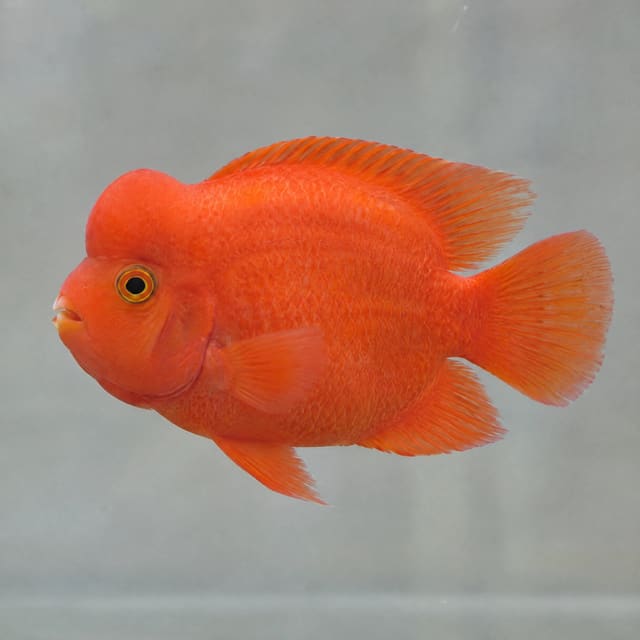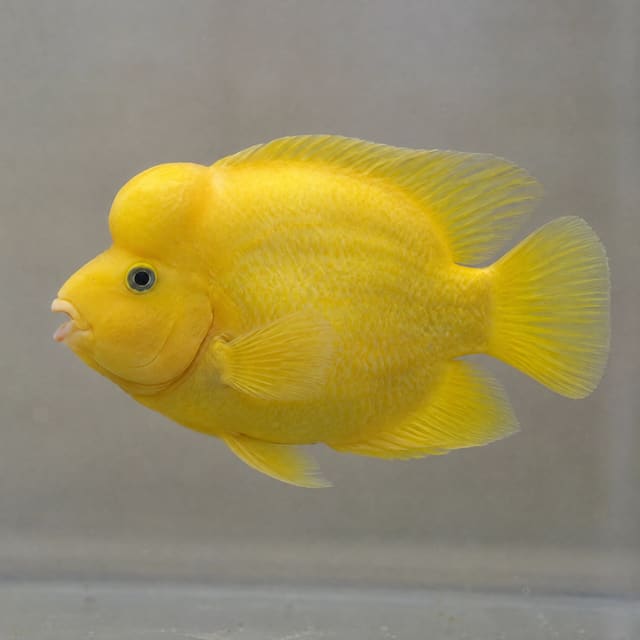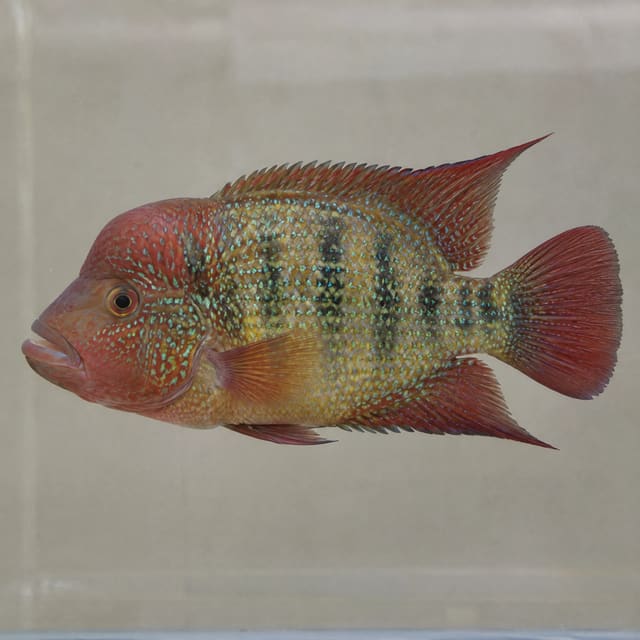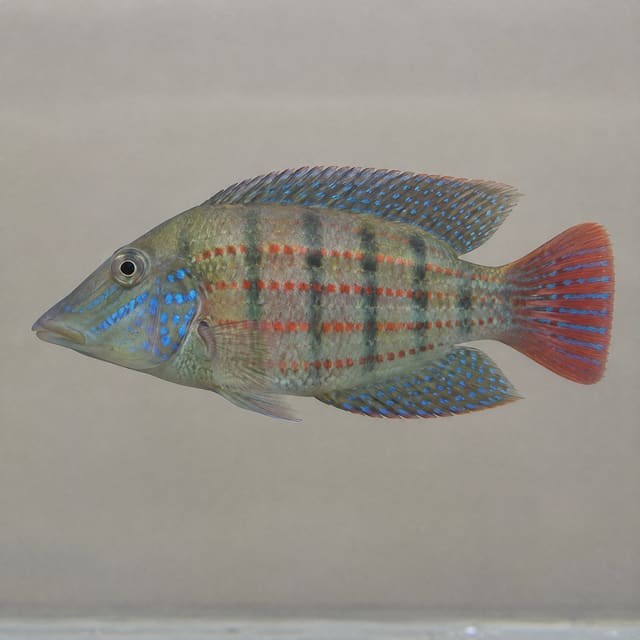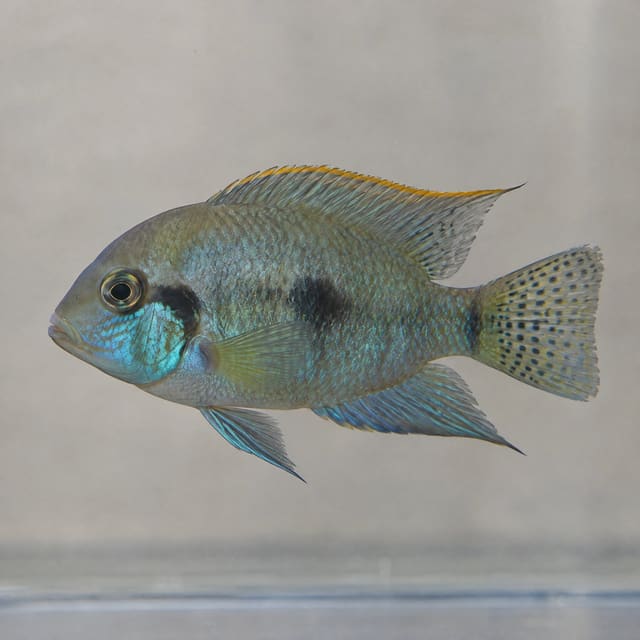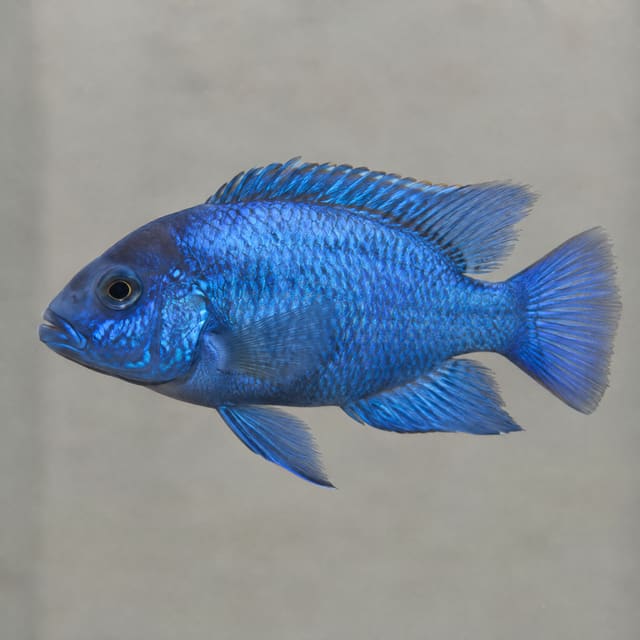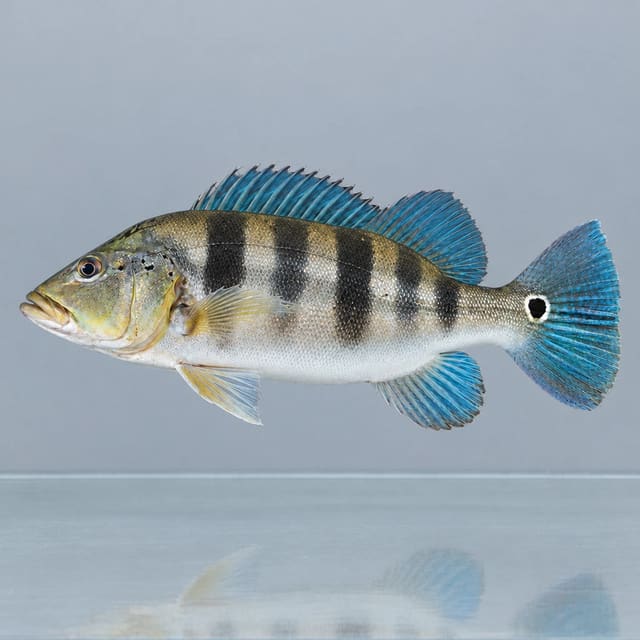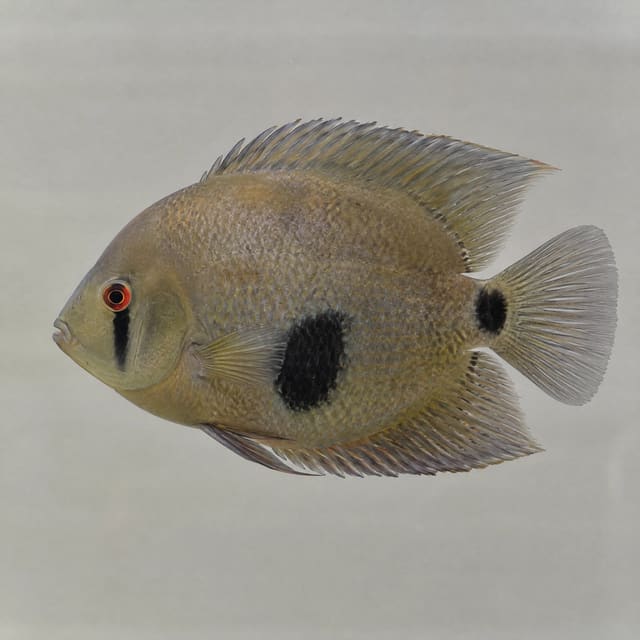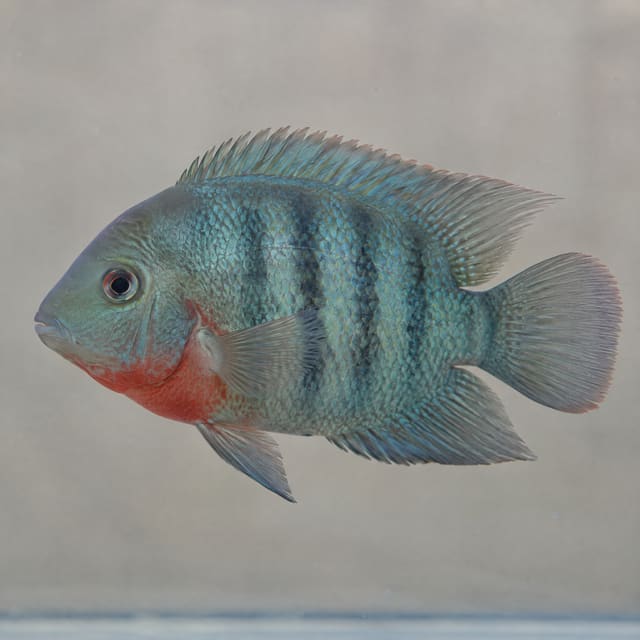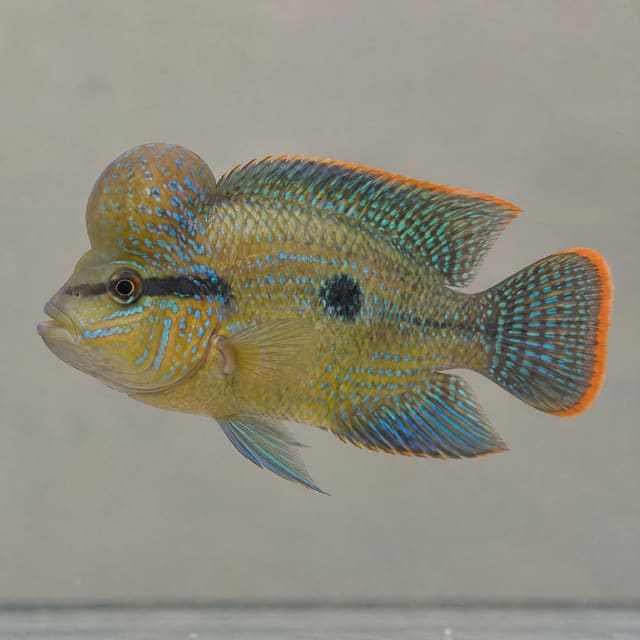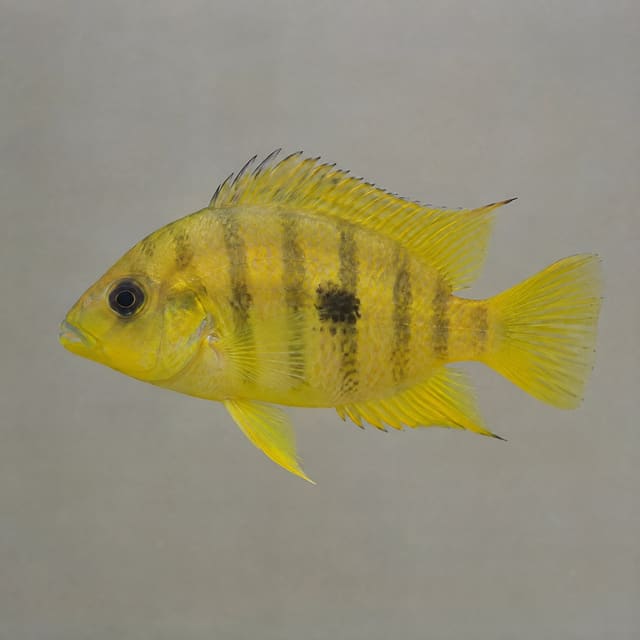
Yellow Convict Cichlid (Amatitlania nanolutea)
22–27°C · pH 6.5–8
£19.99
The White Convict Cichlid, also sold as the pink convict, is the pale leucistic form of the convict cichlid (Amatitlania nigrofasciata), a hardy Central American cichlid of about 10–12 cm that breeds readily and guards its young. It is aggressive and territorial, so keep it as a pair in a species tank with a 90 × 30 cm base, caves and 24–27°C water. Sold individually as one live fish of about 3–4 cm.
Adult size is the maximum length this species reaches at full maturity (scientific sources). The livestock you receive will be younger and smaller. Product-photo provenance and any image-specific limitations are stated on the listing.
Amatitlania nigrofasciata
Save when buying multiple fish. Each quantity is one fish; sex and pair formation are not guaranteed unless the selected variant explicitly states them.
The White Convict Cichlid, also sold as the pink convict, is the pale leucistic form of the convict cichlid (Amatitlania nigrofasciata), a hardy Central American cichlid of about 10–12 cm that breeds readily and guards its young. It is aggressive and territorial, so keep it as a pair in a species tank with a 90 × 30 cm base, caves and 24–27°C water. Sold individually as one live fish of about 3–4 cm.
Adult size is the maximum length this species reaches at full maturity (scientific sources). The livestock you receive will be younger and smaller. Product-photo provenance and any image-specific limitations are stated on the listing.
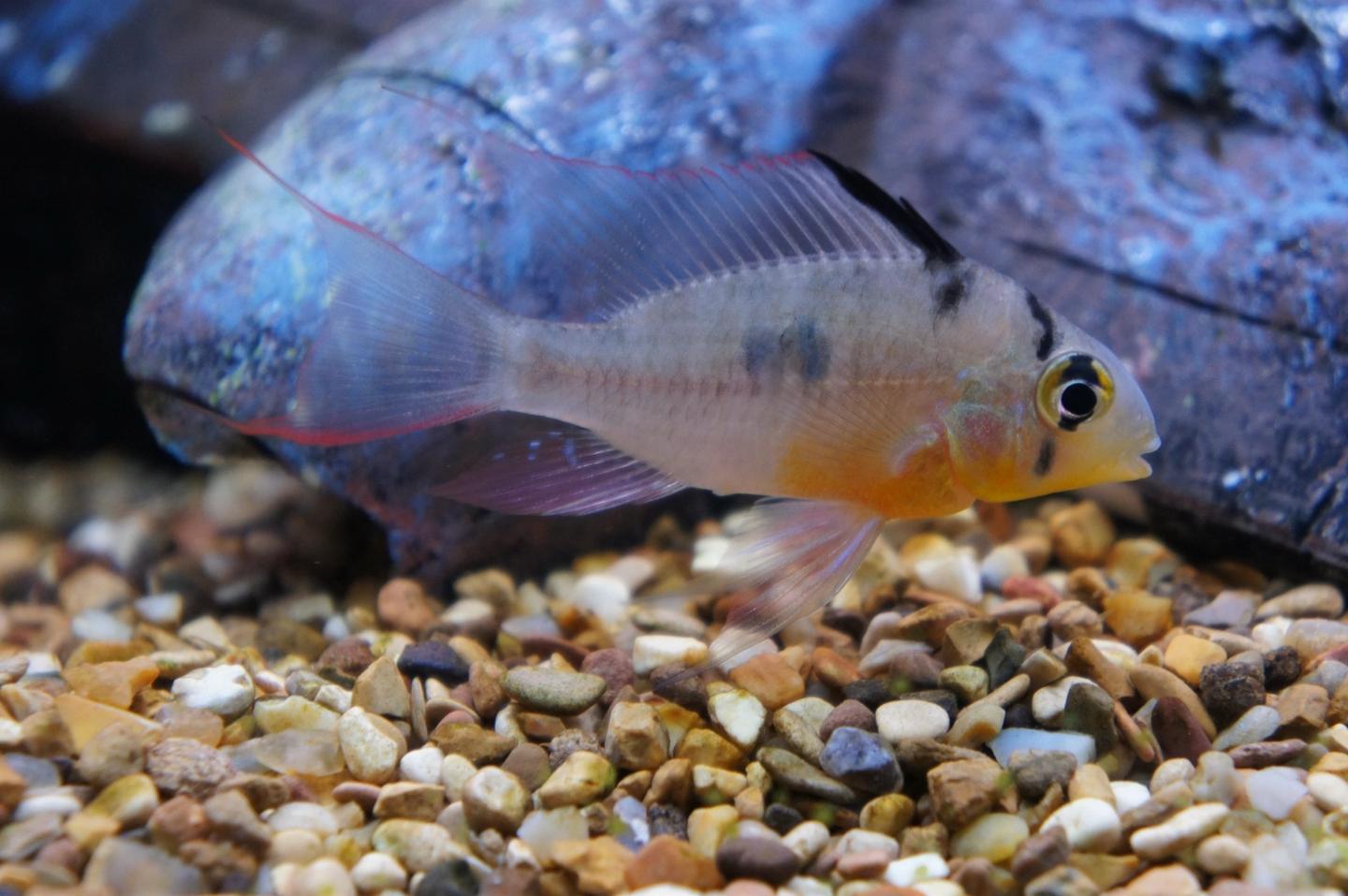
Cichlids are a family of roughly 1,800 accepted species, not one care type. Before buying, identify the exact species and source, then compare adult measurement, usable tank dimensions, social system, territory, tested water, diet and an exit plan. No family-wide minimum tank, water range or tank-mate list is safe.
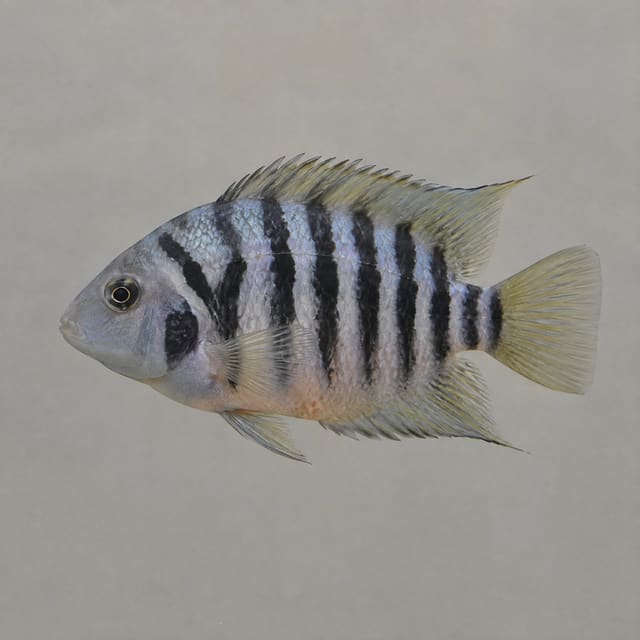
The White Convict Cichlid, also sold as the pink convict, is the pale form of the convict cichlid, Amatitlania nigrofasciata. Where the wild fish has black vertical bars on a blue-grey body, this one is pearly white with a soft pink sheen and a rosy patch on the gill cover, and mature males grow long, pointed dorsal and anal fins. It is small, hardy, easy to feed and full of personality, and it is one of the best fish there is for watching real cichlid parenting at home.
It is also a convict, and that matters. Seriously Fish describes the species as aggressive and territorial, says it becomes "downright violent" when breeding and calls it "not a good community fish" even though it is often sold as one. Buy a White Convict for a species tank or a carefully planned cichlid aquarium, not as a pretty addition to a peaceful community.
| Name | What it means |
|---|---|
| White convict, pink convict | Trade names for the pale strain; Wikipedia also lists gold convict and "Kongo" |
| Convict cichlid, zebra cichlid | The common names of the species, after the wild fish's prison-stripe bars |
| Amatitlania nigrofasciata (Günther, 1867) | The current scientific name; the genus is named after Lake Amatitlán in Guatemala, and nigrofasciata means black-banded |
| Heros nigrofasciatus, Cichlasoma nigrofasciatum, Archocentrus nigrofasciatus, Cryptoheros nigrofasciatus | Older names you will still see; Wikipedia records the move to Amatitlania in 2007 |
Wikipedia explains that the pale colour is a leucistic strain lacking the dark barring, caused by a mutation in one gene and inherited recessively. Seriously Fish lists pink, long-finned and marbled forms of the species. Several former convict populations are now separate species, including the Honduran red point (A. siquia).
| Fish | How it looks | Worth knowing |
|---|---|---|
| White Convict (this fish) | Pearly white to pinkish, no bars | The leucistic strain of A. nigrofasciata |
| Zebra Convict Cichlid | Black bars on a blue-grey body | The wild-type colour of the same species |
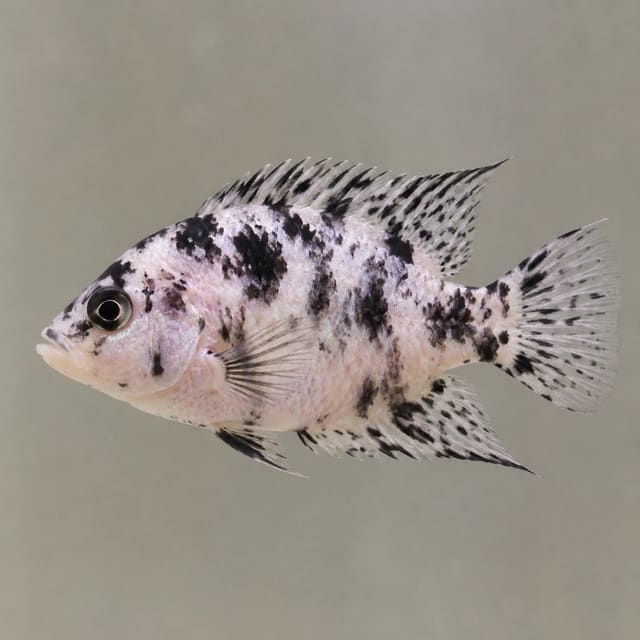
| Marbled Convict Cichlid | Marbled dark and pale pattern | Another colour form of the same species |
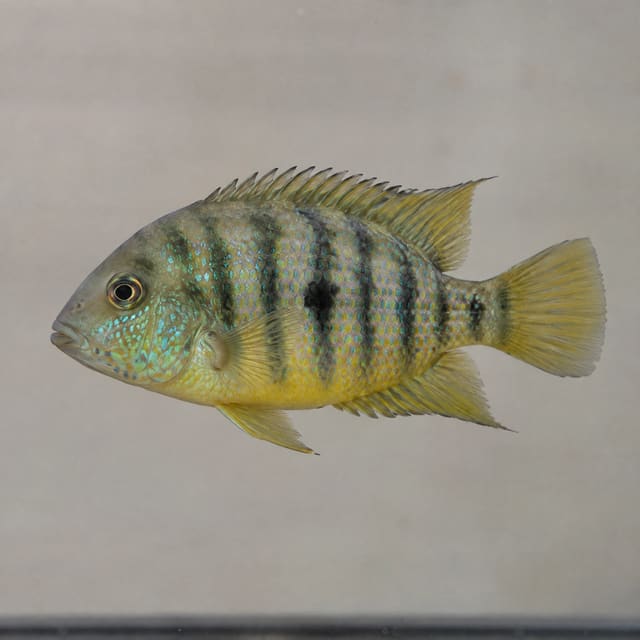
| Xanthic Zebra Convict Cichlid | A pale yellow form, as photographed on its page | Same species, sold under a different colour name |
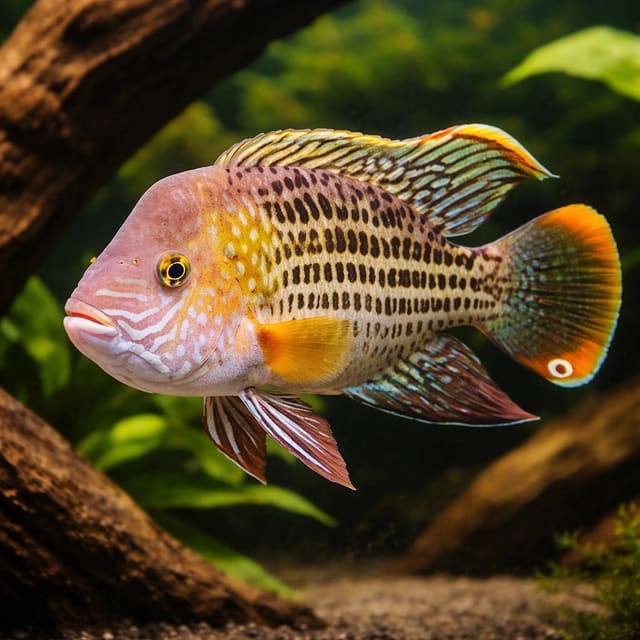
| Honduran Red Point Cichlid | Its own colour pattern; see its page | A separate Amatitlania species |
All of them are grouped on our Amatitlania page and the convict cichlids page, inside the wider South American cichlids category.
| Sign | Male | Female |
|---|---|---|
| Size | Larger | Smaller |
| Fins | Dorsal and anal fins become pointed, sometimes with filaments | Shorter, rounder fins |
| Head | Older males may develop a fatty forehead hump | No hump |
| Colour | Plainer | Pink to orange on the belly and dorsal fin, brighter when ready to spawn |
These differences come from Seriously Fish and Wikipedia; Wikipedia says sexual maturity can come at 16 weeks but more often at about six months.
Seriously Fish says the simplest way to get a pair is to put a male and a female together, or to grow on a group of young fish and let them pair. Once a pair forms, the other fish must be moved, because the male will not tolerate them in his territory. A single White Convict can live in a robust cichlid aquarium, while a pair needs its own space and will almost certainly breed.
| Plan | Space | Basis |
|---|---|---|
| One pair, species tank | Base of 90 × 30 cm; at least 120 litres | Seriously Fish; OATA for a pair of cichlids under 15 cm |
| Minimum tank length | 80 cm | FishBase |
| Several pairs or other cichlids | Substantially bigger | Seriously Fish |
| Robust Central American community | A very large aquarium | Seriously Fish |
Our tank volume calculator converts your aquarium's measurements into litres.
The sources measure differently and give different maximums.
| Source | Size given |
|---|---|
| FishBase | 10 cm standard length maximum; 8.5 cm total length common |
| Wikipedia | 10 cm standard length, about 12 cm total length; 34–36 g |
| Seriously Fish | 150 mm standard length maximum |
Standard length leaves out the tail. Most convicts end up around 10–12 cm long, with males the larger sex, but plan for the larger figure.
Wild convicts live in rivers, streams, ponds and lakes, and FishBase describes adults in flowing water from small creeks to the shallows of large, fast rivers, among rocks with crevices, roots and debris. Seriously Fish adds that they are almost never found in open water and prefer areas with cover. In the aquarium that means rocks, wood and roots for hiding and spawning, with clay flowerpots laid on their sides as extra caves.
Convicts dig. Seriously Fish warns that plants may be uprooted, and Wikipedia suggests plastic plants or robust ones such as Java fern and water sprite, and an external filter rather than an undergravel system because the fish shift the substrate. Use sand or fine gravel, as OATA recommends, and bed rocks on the glass so they cannot be undermined.
| Zone | What to put there | Why |
|---|---|---|
| Back corners | Rock piles with crevices, a clay pot on its side | FishBase notes dark cavities are preferred nest sites |
| Sides | Wood, roots and Java fern tied to wood | Cover and broken sight lines |
| Front | Open sand | Room to swim and dig |
| Top | A secure lid | On OATA's shopping list |
| Source | Temperature | pH | Hardness |
|---|---|---|---|
| Seriously Fish (aquarium) | 24–28°C | 6.0–8.0, ideally above 7 | 5–25 dGH |
| FishBase | 20–36°C (wild range) | 7.0–8.0 | 9–20 dH |
| Wikipedia (four Costa Rican habitats) | 26–29°C | 6.6–7.8 | KH 63–77 ppm CaCO3 |
| OATA (American cichlids) | 22–27°C | 6.5–8.0 | 4–12 dGH, KH 3–10 |
Seriously Fish recommends 24–28°C for long-term care and says the alkaline side of neutral is ideal. A good target is 24–27°C and pH 7.0–8.0 in moderately hard water. There is a behavioural reason not to run the tank hot: Wikipedia reports that convicts are more aggressive at 30°C than at 26°C.
Convicts tolerate a wide range, and the hard, alkaline tap water found in much of the UK usually suits them well; soft-water areas may need a buffer to keep pH steady. Test pH, GH and KH, treat every refill with a conditioner to remove chlorine and chloramine, and compare your readings with our water parameter matcher. OATA's waste limits are zero ammonia, zero nitrite and nitrate no more than 20 mg per litre above your tap water.
OATA's routine for American cichlids fits convicts: test ammonia, nitrite, nitrate, pH and hardness weekly, change about 25% of the water each week while siphoning the substrate, and rinse filter media only in water taken from the aquarium. Seriously Fish uses larger changes, up to 50% weekly, when conditioning a pair to spawn. An external canister filter copes better with digging fish than an undergravel plate.
Our cichlid care guide explains the same routine in more depth.
In the wild, FishBase records worms, crustaceans, insects, fish and plant matter in the convict's diet, and Wikipedia adds algae. Seriously Fish calls it very unfussy and recommends a varied diet to keep it in good condition. OATA suggests cichlid pellets or granules as the staple, supplemented with frozen or freeze-dried daphnia, brine shrimp and bloodworm, once a day and only as much as is eaten in a few minutes.
Good everyday choices from our range are the Cichlid Omnivore Small Pellet and, for the plant part of the diet, the Cichlid Herbivore Small Pellet, with a frozen cichlid mix as a treat.
| Part of the meal | What to use | How to use it |
|---|---|---|
| Staple | Small cichlid pellets or granules | Most days, sized for a 3–4 cm fish at first |
| Plant food | Spirulina-based pellets | A few times a week |
| Meaty extras | Daphnia, brine shrimp, bloodworm | A few times a week, thawed |
| Amount | What it clears in a few minutes | Once a day (OATA); remove leftovers |
Add the fish only to a cycled aquarium with zero ammonia and nitrite, as OATA advises. Switch off the lights, float the sealed bag for about 10 minutes, add small amounts of aquarium water over up to 20 minutes, then net the fish across without the bag water. Because convicts claim territory quickly, add them together with, or after, their tank mates, not before. Our acclimatisation guide shows each step.
| When | What to do | What to look for |
|---|---|---|
| Arrival day | Acclimatise; lights off | Upright swimming, steady breathing |
| Next day | A small meal; test ammonia and nitrite | Feeding; zero readings |
| Rest of the week | Small meals; watch territories form | Whole fins, no fish pinned in a corner |
Seriously Fish says convicts will attack fish several times their own size and are best kept in a species tank; in a very large aquarium they can live with robust Central American cichlids. Wikipedia lists biting, chasing and size displays as typical behaviour, especially when breeding. OATA's rule for aggressive American cichlids is the same: keep them alone or with equally robust cichlids.
| Can work, with space | Avoid |
|---|---|
| Robust Central American cichlids of similar or larger size, in a very large tank | Small, peaceful community fish such as tetras, rasboras and livebearers |
| Armoured catfish such as bristlenose plecos | Slow or long-finned fish, angelfish and gouramis |
| Other convicts of the same species, as a single pair | Other Amatitlania species, to avoid hybrids |
| — | Shrimp, which will be eaten |
For a large Central American cichlid set-up, look at the T-Bar Cichlid and the Firemouth Cichlid, and read our firemouth cichlid guide; a Bristlenose Pleco is a common armoured companion. Always check every fish's adult size and run the mix through our tank mate checker.
OATA lists the signs to watch: changes in swimming, colour, temperament, breathing, appearance, condition or appetite, plus clamped fins, flicking against décor and shimmying. In convicts, injuries from fighting are the most likely problem, and Wikipedia notes that low social status and the stress that comes with it can affect a fish's digestion, so a bullied convict may lose condition even when food is plentiful.
| What you see | What to do first |
|---|---|
| Torn fins, missing scales, one fish hiding | Add cover, or separate the fish being chased |
| Gasping at the surface | Test ammonia and nitrite and change some water |
| White spots or fluffy growths | Check the water and ask an aquatic specialist or vet before treating |
| Thin body despite feeding | Check for bullying at feeding time and review the diet |
Few cichlids breed as readily. According to Seriously Fish, the female picks and cleans a site, often inside a flowerpot or cave, and lays as many as 300 eggs; FishBase gives about 100–150 eggs per spawning. The female tends the eggs while the male guards the territory. The eggs hatch after about three days, and the young are moved between pits in the substrate before swimming freely a few days later. Wikipedia describes the parents fanning the eggs day and night, gathering the fry back into the cave at dusk, and caring for them for four to six weeks in the wild. In aquaria, females can spawn again every 12 or 13 days.
Start the fry on newly hatched brine shrimp, then move on to crushed flake and small cichlid pellets, as Seriously Fish suggests; the fry also graze on algae and detritus. Because the pale colour is recessive, two white parents produce white young, while a white fish paired with an ordinary barred convict produces barred young that carry the white gene, unless the barred parent carries it too.
Find more robust cichlids, including the other convicts, in our South American cichlids shop.
Yes. It is a pale, selectively bred form of Amatitlania nigrofasciata. Wikipedia calls it a leucistic strain that lacks the dark bars and is sold as the white, pink or gold convict. Its care, size and behaviour are those of the species.
No. Wikipedia describes the white and pink convict as leucistic, a strain without the dark barring, caused by a recessive gene. The eyes in our photographs are dark with a silver ring, not the red or pink eyes of an albino.
Usually around 10–12 cm. FishBase gives a maximum of 10 cm standard length and Wikipedia about 12 cm total length, while Seriously Fish lists 15 cm standard length as the maximum. Males grow larger than females.
Seriously Fish says a base of 90 × 30 cm is adequate for a single pair, FishBase gives an 80 cm minimum, and OATA recommends at least 120 litres for a pair of smaller American cichlids. Multiple pairs or tank mates need far more room.
Not an ordinary one. Seriously Fish calls the convict aggressive and territorial, says it will attack fish several times its own size, and recommends a species tank, or robust Central American cichlids in a very large aquarium.
Very. Wikipedia says females in aquaria can spawn many times a year, Seriously Fish records as many as 300 eggs in a spawning, and the parents guard the young for several weeks. Plan where the fry will go before you keep a pair, because many shops will not take them.
Almost anything. Use cichlid pellets or granules as the staple, with frozen daphnia, brine shrimp and bloodworm and some plant-based food, fed once a day in an amount eaten within a few minutes.
One live White Convict Cichlid of about 3–4 cm per purchase, unsexed. The photographs show the colour form, not the individual fish you will receive.
No reviews for this item yet. Bought one? Honest reviews only, good or bad.
What customers say about ordering from us
Easy website plenty of info on fish your buying great to pick a time slot
TRACEY DURRANT · 7 Oct 2026
Got some lovely fish thank you
Kevin Mackie · 7 Oct 2026
Reviews of our shop, collected by Judge.me, an independent third-party review collector. Newest first.
Moved by UK carriers licensed to handle live animals
Hand-packed with oxygen bags, poly box, heat pack
Email photos the same day; an optional unboxing video helps us review problems faster — claim terms apply
Klarna & PayPal Pay in 3 at checkout