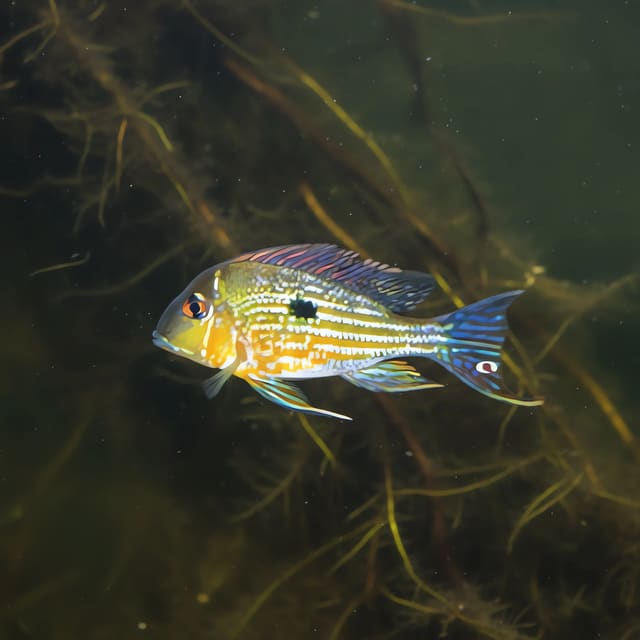
Surinam Geophagus (Geophagus surinamensis)
22–25°C · pH 6.5–8
£13.99
The Flag Acara (Laetacara curviceps) is a freshwater cichlid from lower Amazon tributaries in Brazil that reaches 4.6 cm standard length. It suits a mature filtered aquarium; FishBase records aquarium keeping in pairs, while Seriously Fish gives 20–28°C, pH 4.5–7.5 and 1–15 dGH. Sold individually in 3–4 cm, 4–5 cm and > 7 cm dispatch sizes.
Adult size is the maximum length this species reaches at full maturity (scientific sources). The livestock you receive will be younger and smaller — pick a size above for the actual shipping size. Product-photo provenance and any image-specific limitations are stated on the listing.
Laetacara curviceps
Save when buying multiple fish. Each quantity is one fish; sex and pair formation are not guaranteed unless the selected variant explicitly states them.
The Flag Acara (Laetacara curviceps) is a freshwater cichlid from lower Amazon tributaries in Brazil that reaches 4.6 cm standard length. It suits a mature filtered aquarium; FishBase records aquarium keeping in pairs, while Seriously Fish gives 20–28°C, pH 4.5–7.5 and 1–15 dGH. Sold individually in 3–4 cm, 4–5 cm and > 7 cm dispatch sizes.
Adult size is the maximum length this species reaches at full maturity (scientific sources). The livestock you receive will be younger and smaller — pick a size above for the actual shipping size. Product-photo provenance and any image-specific limitations are stated on the listing.
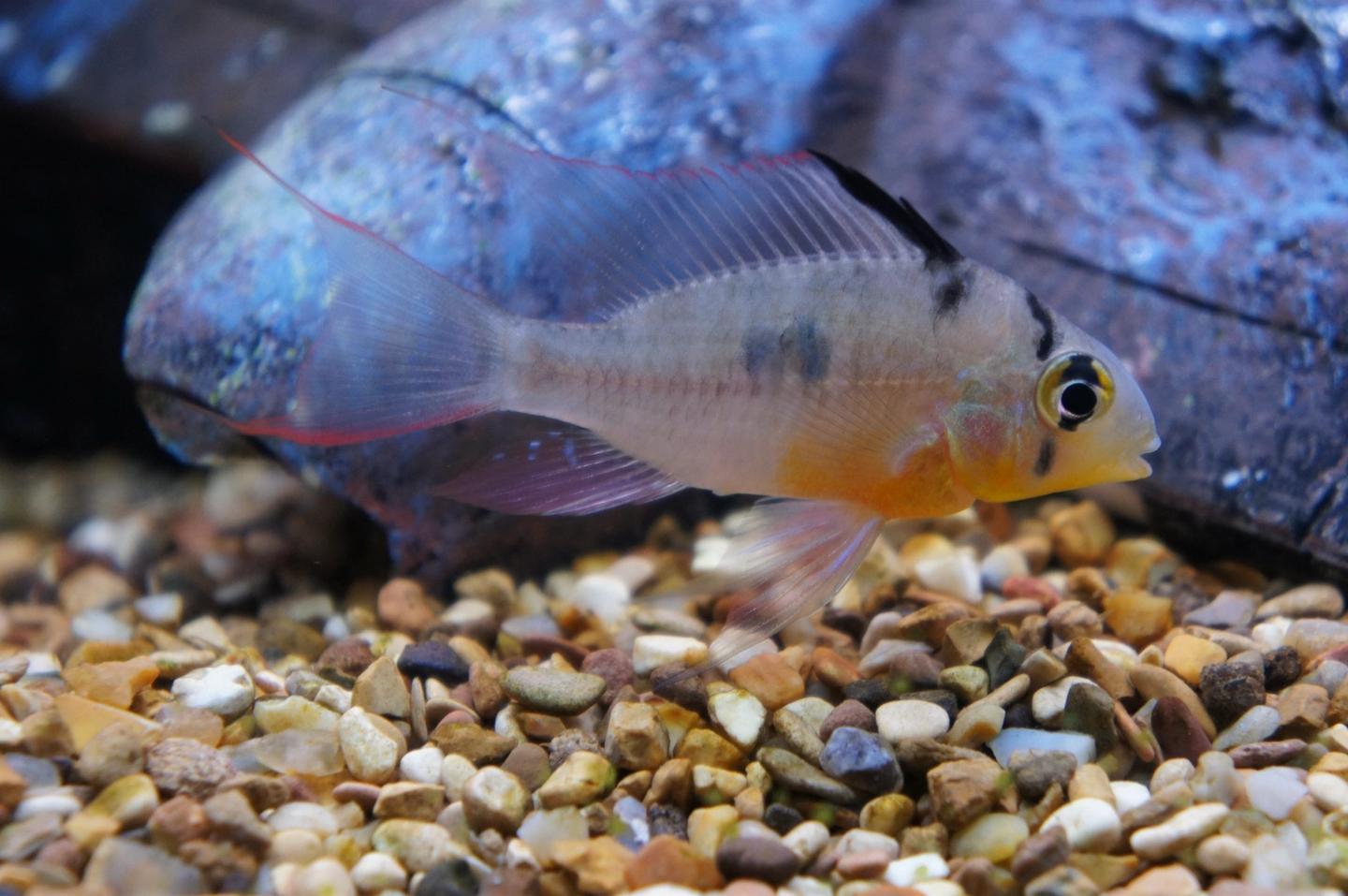
Cichlids are a family of roughly 1,800 accepted species, not one care type. Before buying, identify the exact species and source, then compare adult measurement, usable tank dimensions, social system, territory, tested water, diet and an exit plan. No family-wide minimum tank, water range or tank-mate list is safe.
Maintain these water conditions for optimal health and vibrant colors
Flag Acara (Laetacara curviceps) is a freshwater cichlid for keepers with a mature filtered aquarium who can measure the water and assess a pair or community carefully. FishBase places it in the Amazon River basin, including lower portions of Amazon tributaries in Brazil, and records a maximum length of 4.6 cm standard length. It is benthopelagic, so plan usable space around the lower aquarium rather than treating it solely as an open-water fish.
Seriously Fish gives the species aquarium range as 20–28°C, pH 4.5–7.5 and 1–15 dGH. Use stable measured values within those ranges and confirm that every intended companion can share the same conditions.
Flag Acara is also known as Smiling Acara, Sheepshead Acara and Blunt-headed Cichlid. The scientific name matters when comparing care because similar common names can be applied to more than one cichlid. This animal belongs to the family Cichlidae.
| Suits | Not suited to |
|---|---|
| A mature aquarium with an established biological filter | An immature or unfiltered aquarium |
| Measured water within 20–28°C, pH 4.5–7.5 and 1–15 dGH | Water outside the species aquarium ranges |
| A pair plan with careful observation and adequate space | An unassessed multi-fish plan without alternative accommodation |
| A keeper who tests ammonia and nitrite | A setup judged only by appearance or heater setting |
We rate the care level as intermediate because the aquarium must be biologically mature, water values must be measured, and any pair or community plan needs active observation. A broad water range does not remove the need for stability or compatible companions.
Before choosing this fish, write down the aquarium volume, current temperature, pH, hardness, ammonia and nitrite, then compare the full set with the intended social plan. A measured temperature within range cannot compensate for detectable ammonia, and sufficient litres do not make conflicting water requirements suitable.
One purchase supplies one Flag Acara in the size selected. The live size selector lists 3–4 cm, 4–5 cm and > 7 cm dispatch sizes. The size you select is the size supplied, not the adult size.
Dispatch measurements and scientific adult-length figures serve different purposes. The selector describes the animal sent, while the adult reference helps you plan its permanent aquarium. Do not choose an aquarium from the dispatch measurement alone.
Sex is guaranteed only when the selected option explicitly states male or female. This Flag Acara listing has no sex-guaranteed option.
Ordering two fish therefore means receiving two individual animals, not a promised male-and-female pair. Prepare enough filtered aquarium capacity and watch whether each animal can feed, move and rest normally.
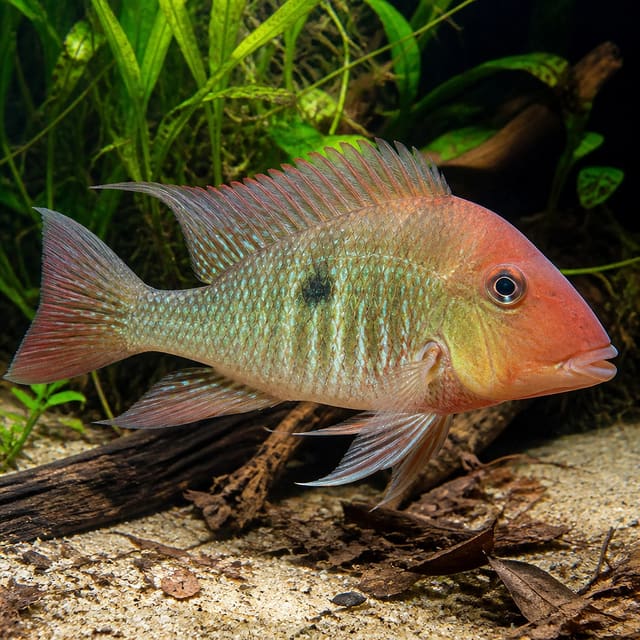
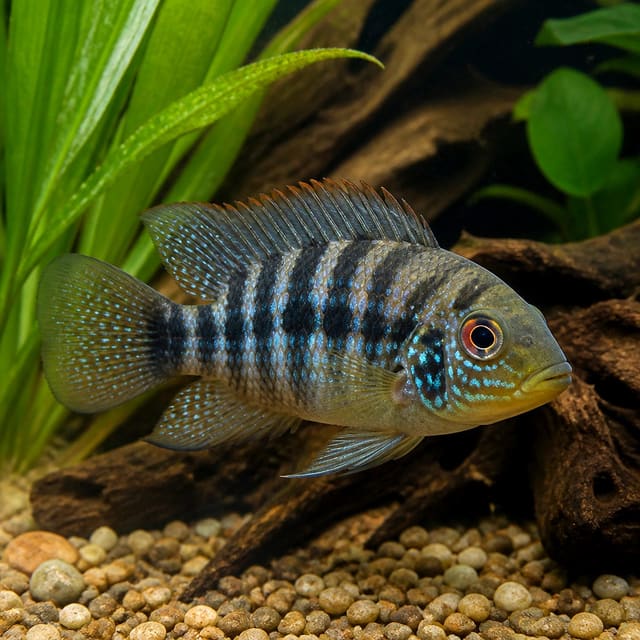
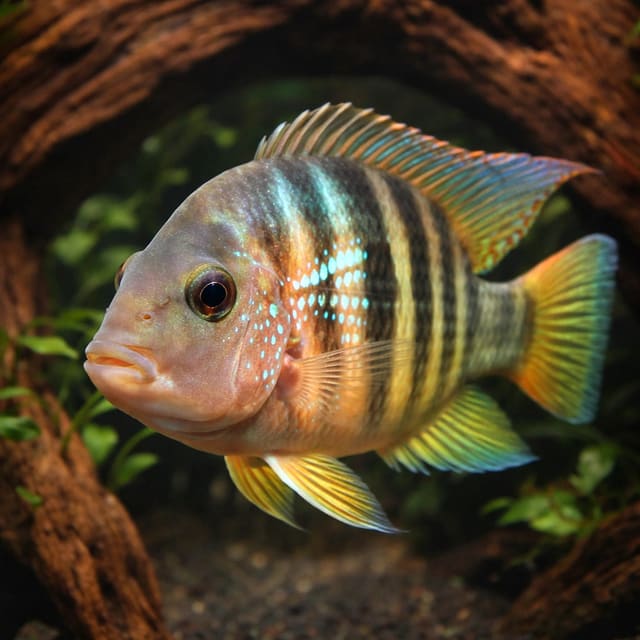
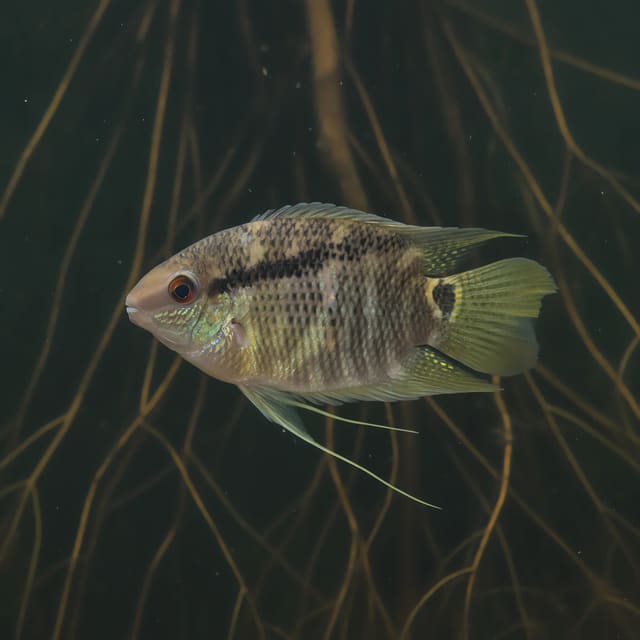
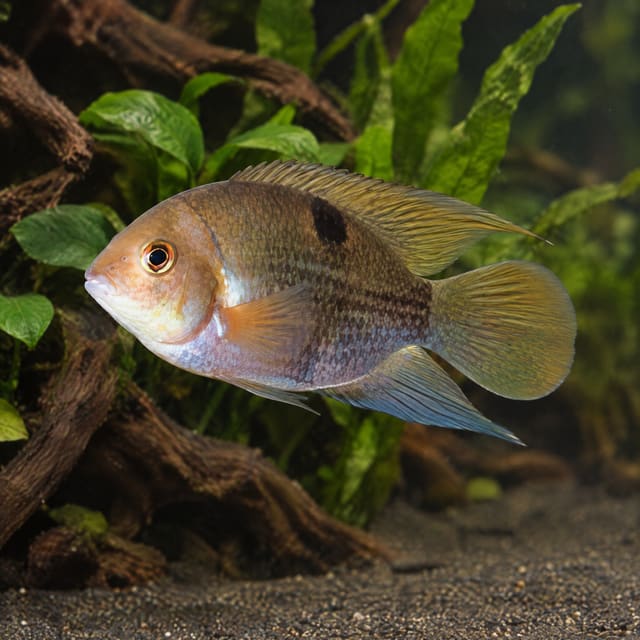
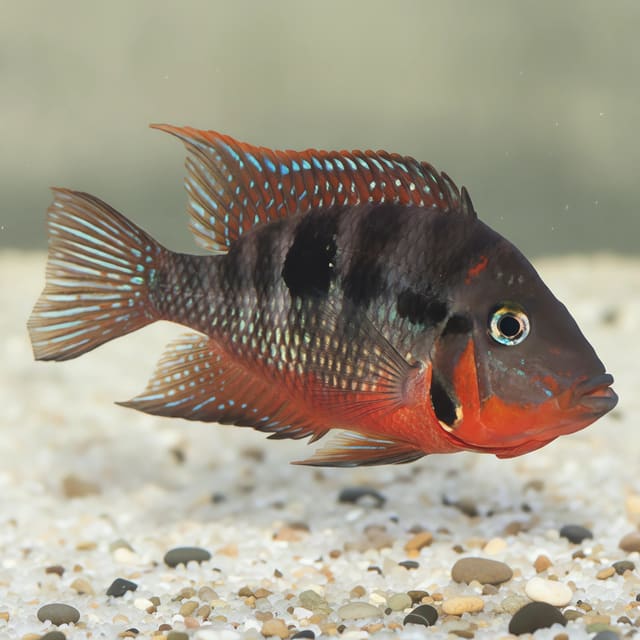
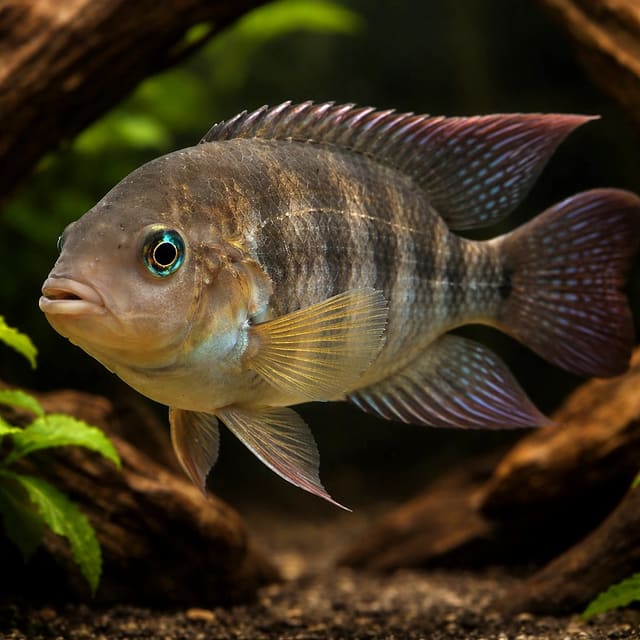
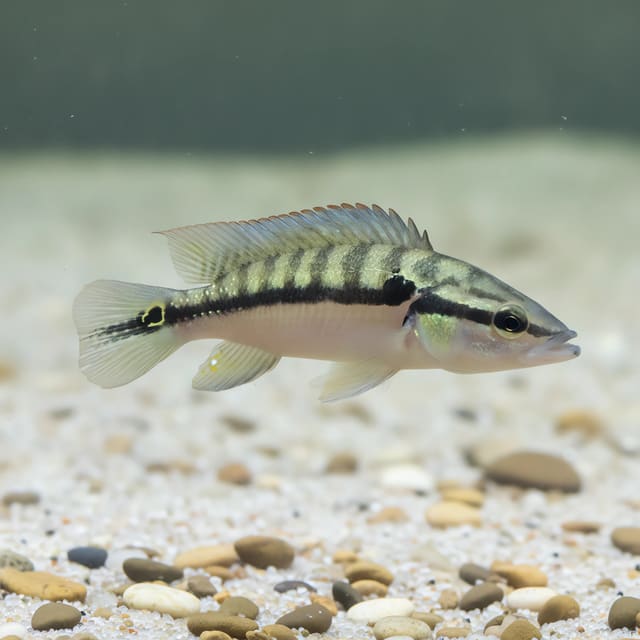
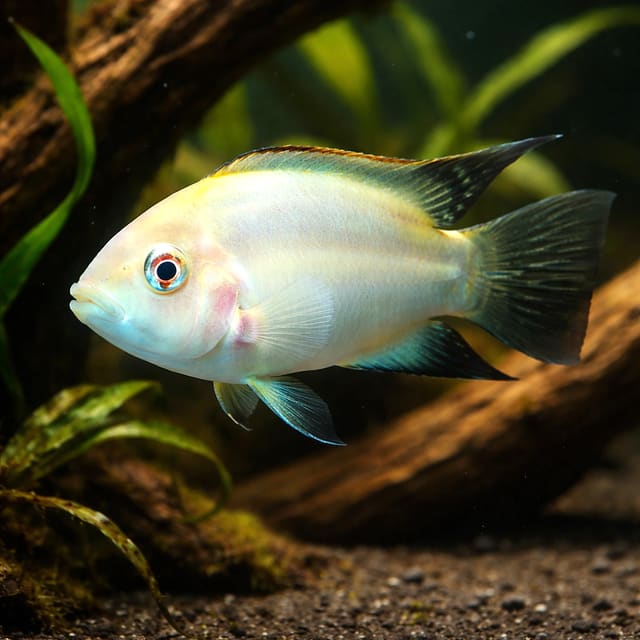
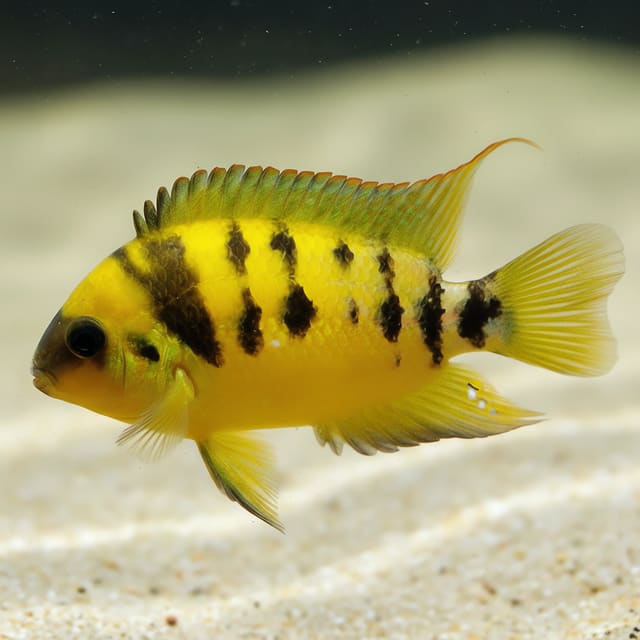
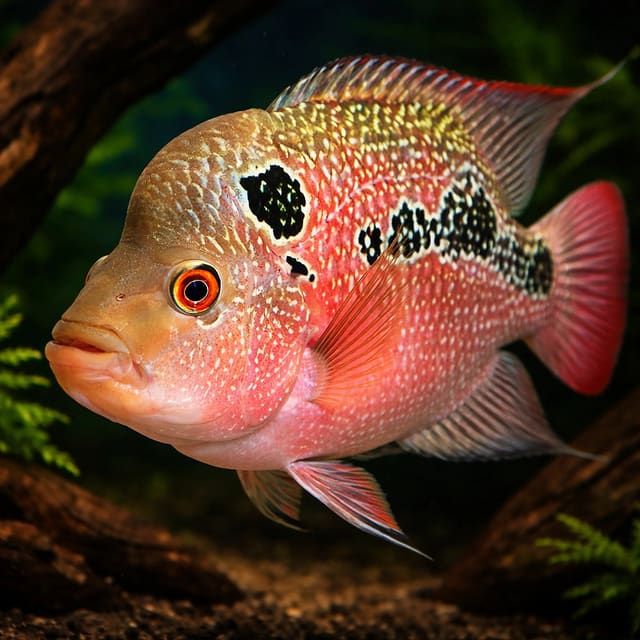
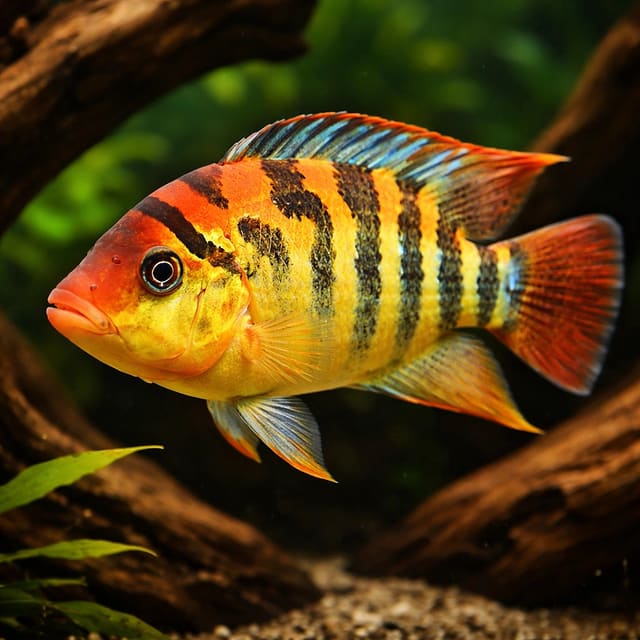
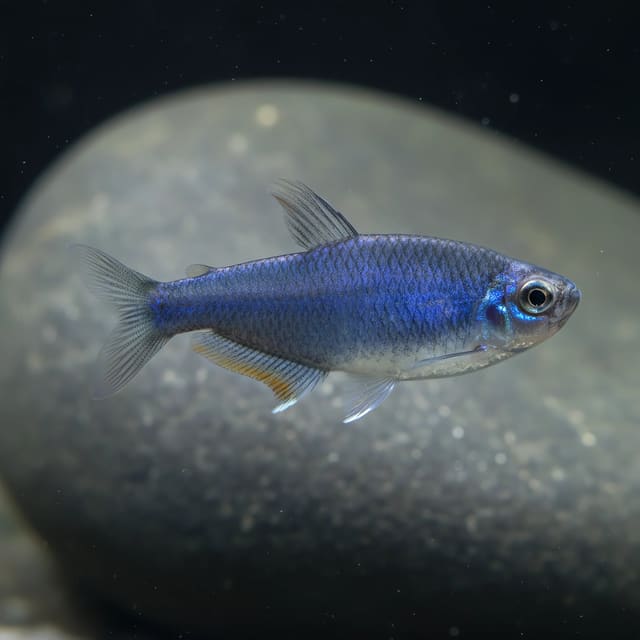
The gallery images are representative, based on reference photographs of this species, so colours can look slightly different from the live animal.
Selecting one means preparing for one individual animal. Selecting two means preparing filtration and usable space for two individuals while retaining a plan for intervention if they do not use the aquarium comfortably together. The dispatch size changes the measurement of the animal sent, but it does not alter its long-term care needs.
Start with adult length, social use and filtration capacity rather than the size seen at dispatch. Flag Acara has a maximum FishBase figure of 4.6 cm standard length, while the aquarium profile uses 50 mm standard length. Small body size does not make an immature or crowded aquarium suitable.
OATA’s American-cichlid sheet gives at least 120 litres for a pair of smaller species under 15 cm. This is group guidance for American cichlids, while FishBase records aquarium keeping in pairs and a minimum aquarium size of 60 cm for this species. Use the 120-litre figure as a conservative pair benchmark, then consider the space occupied by substrate, cover, equipment and every other fish.
A single-fish plan avoids assuming that two selected animals will form a suitable pair. A pair plan requires close observation of access to food and space as well as an aquarium meeting the smaller-cichlid benchmark.
| Planned arrangement | Action |
|---|---|
| One Flag Acara | Plan from its adult size, mature filtration and the needs of all existing livestock. |
| Two animals | Use at least the 120-litre pair benchmark and monitor each animal independently. |
| Community aquarium | Count every fish when judging waste load, water requirements and usable space. |
| New aquarium | Mature the biological filter before adding livestock and increase stocking slowly. |
Litres are only one part of the decision. A nominal volume can lose usable capacity to décor and substrate, while existing livestock already places demand on the biological filter. Do not rely on this cichlid’s modest recorded length as permission to add another fish.
For example, a 120-litre aquarium intended for two animals should still be rejected if its filter is immature or its lower area is already crowded. An established aquarium meeting the benchmark still needs measured water that suits the fish. Pass all three checks—space, filtration and water—before treating the litre figure as useful.
Keep the aquarium at 20–28°C, pH 4.5–7.5 and 1–15 dGH. Seriously Fish gives these species aquarium ranges. Treat each value as a permitted range, not a reason to move the aquarium repeatedly between its extremes.
FishBase separately lists environmental values of 22–26°C, pH 5.2–7.5 and 5–12 dH. A community at 24°C, pH 7.0 and 8 dGH is a worked example that sits inside both sets of figures; it is not a required target for every aquarium.
| Measurement | What to decide |
|---|---|
| Temperature | Keep the aquarium within 20–28°C and check that every companion shares the chosen value. |
| pH | Use a measured value within 4.5–7.5 and avoid unnecessary swings. |
| General hardness | Keep the measured result within 1–15 dGH and compare it with all other livestock. |
| Ammonia and nitrite | Both must read 0 mg per litre before introduction. |
| Nitrate | Keep it no more than 20 mg per litre above the normal tap-water level. |
Use our water chemistry guide to understand the measurements, then enter actual test results into the water matcher. A heater setting or local-water average is not a substitute for testing the aquarium itself.
If one value fits but another falls outside the range, resolve the mismatch before adding the fish. The same applies when a proposed companion needs a conflicting temperature, pH or hardness. Choosing livestock that already suits the measured water is more dependable than repeatedly altering chemistry after stocking.
Record actual numbers rather than writing only that the water is “soft” or “warm”. If a later test changes sharply, investigate the cause before adding livestock instead of making several adjustments at once.
A working biological filter is essential. RSPCA aquarium welfare guidance explains that fish release toxic ammonia, which filter bacteria convert first to toxic nitrite and then to safer nitrate. A powered filter alone is not enough; the bacterial population must be established and maintained.
Prepare the system through our first tropical tank guide before livestock arrives. Test ammonia and nitrite until both are 0 mg per litre. Add fish slowly because increased feeding and waste require the bacterial population to grow with the new load.
New tank syndrome occurs when there are too few nitrifying bacteria to process the waste created by the fish. The result can be unhealthy ammonia and nitrite levels, illness and death. Prevent it by maturing the filter first, confirming zero readings and increasing livestock numbers gradually.
Do not replace all biological media during routine cleaning. When cleaning is required, rinse it lightly in aquarium water removed during a partial water change. This protects more of the bacterial population from chlorine or chloramine and restores flow without treating mature media as disposable.
Test before every stocking increase, then continue watching ammonia, nitrite, nitrate and filter flow as feeding and waste rise. If ammonia or nitrite appears, pause further additions and restore safe water quality.
FishBase describes Flag Acara as benthopelagic, so include the lower aquarium when judging whether the layout works. Substrate, décor and cover should leave the fish room to move and feed rather than turning the entire lower area into an obstacle course.
American-cichlid guidance recommends fine aquarium gravel or sand because many members of the group dig or sift substrate while feeding or breeding. Use one of those substrate types and keep it clean through the weekly siphoning routine. Make sure the filter can circulate and process waste without the intake remaining blocked.
Cover is useful, but live planting needs a practical plan. American cichlids may dig up or eat live plants, so do not depend on delicate planting as the only structure in the aquarium. Plastic aquarium plants can provide alternative cover where rooted plants are repeatedly disturbed.
| Layout choice | Decision test |
|---|---|
| Fine gravel or sand | Can waste be removed without dismantling the aquarium? |
| Live plants | Will useful cover remain if a cichlid digs around them? |
| Artificial cover | Does it add shelter without occupying all usable lower space? |
| Filter position | Can you inspect the intake and check flow for blockages? |
| Open lower area | Can the fish move and reach food without being crowded? |
Judge a layout by function rather than by a particular visual style. The essential outcomes are accessible space, cover, a substrate appropriate for the cichlid group and a filter that continues to operate correctly. If décor prevents observation or traps uneaten food, simplify the arrangement until maintenance and daily checks are straightforward.
Before introduction, confirm that you can see the fish during daily checks, inspect the filter intake, reach the substrate with a siphon and place food where the animal can find it.
Wild Flag Acaras are probably foragers that take algae, organic detritus, small insects, worms, crustaceans and other zooplankton. In the aquarium, use good-quality dried flakes or granules alongside appropriately small live, frozen or freeze-dried foods. At least some of the dried food should include plant or algal content.
Bloodworm, Daphnia and Artemia are named options for variety. Rotate them with the prepared staple rather than building the diet around one item. Choose particles the fish can take readily and watch the animal itself eat, especially when other residents reach the food first.
The daily schedule comes from OATA’s American-cichlid guidance: feed once a day and give only what the fish can eat within a few minutes. This keeps the portion visible and limits uneaten food. Large servings can create excess faeces or leave food to break down, releasing toxic waste into the water.
| Food type | How to use it |
|---|---|
| Quality flake or granule | Use as the measured prepared component, including some plant or algal content. |
| Bloodworm | Offer as one small live, frozen or freeze-dried option in the rotation. |
| Daphnia | Use for small invertebrate variety rather than as the only meal. |
| Artemia | Rotate with the other named foods in a portion eaten within a few minutes. |
If food remains after the feeding window, reduce the next portion and remove the excess during maintenance. If the Flag Acara shows reduced interest while other fish continue eating, check water quality and whether it has fair access to the meal.
The useful portion is the amount the fish can take within a few minutes without leaving food to decay. If another resident consumes the prepared food first, change how the portion is distributed while keeping the same daily limit.
Change 25% of the aquarium water at least once every week. Use a siphon to remove solid waste from the substrate, and treat replacement tap water with conditioner to remove chlorine or chloramine before it enters the aquarium.
Test the water at least weekly for ammonia and nitrite, with both remaining at 0 mg per litre. Monitor nitrate against the limit of no more than 20 mg per litre above the normal tap-water level. Keep a simple written result so gradual changes are easier to see than they are from memory.
Never run established biological media under the tap. Chlorine or chloramine may kill part of the bacterial population that processes fish waste. Cleaning in removed aquarium water protects the filter while allowing you to clear material that is restricting flow.
Use the first month to establish a baseline. During week one, concentrate on water readings, appetite and breathing. By the end of the first month, compare body condition, behaviour and nitrate trends with the first observations. If the aquarium needs larger corrective work every week, review feeding, stocking and filter performance.
A useful record contains the date, test results, water-change percentage, filter-flow observation and any change in feeding or behaviour.
Prepare the mature aquarium before the fish arrives. Confirm that ammonia and nitrite are 0 mg per litre and that temperature, pH and hardness are within the chosen species ranges. Read the current delivery and Live Arrival Guarantee policy and arrange for someone to be present to receive the parcel.
Increase fish numbers slowly after the filter has matured. Every addition increases waste and feeding, so the bacterial population must adjust to the new load. Avoid combining the arrival with several other livestock additions when that would make changes in water or behaviour difficult to interpret.
| What you see | What to do first |
|---|---|
| Hanging at the surface | Test water quality and inspect breathing and filter operation. |
| Sitting on the bottom or erratic swimming | Compare the behaviour with the fish’s normal pattern and test the aquarium. |
| Darker or paler colour | Check for associated changes in appetite, hiding, aggression or breathing. |
| Faster or slower gill movement | Test ammonia and nitrite immediately and inspect filter flow. |
| White spots, fluffy growths or lost scales | Record the visible change and seek fish-health guidance. |
| Reduced food intake or weight change | Confirm that the fish can reach food and check the water readings. |
During the first week, check swimming position, breathing, access to cover, response to food and interaction with other fish at a consistent time each day. If a health change persists, test the water and contact us for further guidance.
Mixing American cichlids can be difficult because members of the group vary greatly in adult size and temperament. OATA says some calmer American cichlids can take part in a robust community with larger shoaling fish, while more aggressive members may need to live alone or with equally aggressive cichlids. That broad pattern is not a fixed tank-mate list for Flag Acara.
Assess the proposed combination through measured water, adult size, use of the aquarium and the total biological load. Individual temperament and breeding status can change the result, so judge the exact stocking plan rather than relying on a permanent “community fish” label.
| Screen | Question to answer |
|---|---|
| Water | Can every fish share one stable temperature, pH and hardness within its stated range? |
| Adult size | Does the aquarium have enough capacity when every resident reaches its planning size? |
| Temperament | Does any resident show persistent aggression, hiding or exclusion? |
| Aquarium use | Can this benthopelagic cichlid use and feed in the lower area without crowding? |
| Filtration | Can the mature filter keep ammonia and nitrite at 0 mg per litre after stocking increases? |
If one screen fails, treat the combination as unsuitable until the conflict is resolved. Matching temperature while ignoring aggression is not enough, and a large aquarium does not correct incompatible water requirements.
Run the screens in order. First compare measured water, then calculate space using adult planning sizes, consider where each fish feeds and rests, and review existing behaviour and recent filter results. A plan that fails one screen remains a poor choice until that conflict has been removed.
Browse our South American cichlid collection to compare identities and adult planning information, but do not assume shared geography means two fish belong together. For an assessment of your aquarium, contact us with its volume, measured water values, filter status and complete livestock list.
FishBase records aquarium keeping in pairs for Flag Acara. Begin with a defined social plan rather than adding several animals and deciding what to do only after pressure appears.
A one-animal plan still needs adult space, compatible water and a mature filter. A two-animal plan uses OATA’s benchmark of at least 120 litres for a pair of smaller American cichlids and requires separate observation of both animals. Two purchases mean two fish, but the sold unit does not create a compatible pair.
Seriously Fish identifies Laetacara curviceps as a biparental substrate-spawner. If two animals form a breeding pair, continue checking whether every resident can use the aquarium and reach food instead of assuming that an arrangement remains suitable indefinitely.
Keep alternative mature accommodation in mind when choosing more than one cichlid. Décor changes may alter how fish use the aquarium, but observation remains the deciding test. A suitable arrangement lets every fish feed, swim and rest without persistent aggression or exclusion.
Compare both animals separately during the first month. Record whether each one reaches the daily meal, uses more than one part of the aquarium and maintains intact fins and scales. Repeated hiding or exclusion is a reason to reassess the arrangement even when open fighting is not visible.
FishBase records a maximum length of 4.6 cm standard length for Flag Acara. Plan the permanent aquarium around that adult figure rather than the dispatch size.
FishBase records a minimum aquarium size of 60 cm. For a pair, OATA’s American-cichlid group guidance gives at least 120 litres for smaller species under 15 cm; account for décor, other livestock and usable lower space.
FishBase records aquarium keeping in pairs. Two fish are not guaranteed to form a compatible pair, so monitor each animal’s access to food and space and keep alternative mature accommodation in mind.
We rate it as intermediate because it needs a mature filtered aquarium, measured water and active observation of any pair or community plan. Ammonia and nitrite must remain at 0 mg per litre.
Feed good-quality flakes or granules, including some plant or algal content, with bloodworm, Daphnia and Artemia for variety. OATA’s American-cichlid guidance says to feed once daily only what it can eat within a few minutes.
Seriously Fish gives an aquarium range of 20–28°C, pH 4.5–7.5 and 1–15 dGH. Keep the chosen values stable and make sure every companion shares them.
Its individual temperament must be observed rather than assumed. Reassess the arrangement if you see persistent aggression, hiding, feeding exclusion, damaged fins or lost scales.
Use only individually assessed companions that share its water requirements and fit the aquarium’s adult-size, temperament, space and filtration limits. OATA notes that American-cichlid mixes can be difficult, so no companion type should be treated as universally suitable.
Someone must be present to receive it. Film every delivery continuously from the sealed parcel as it is opened, with the fish still inside the bag; then float the bag for 20–30 minutes before release and never pour the bag water into the aquarium.
No reviews for this item yet. Bought one? Honest reviews only, good or bad.
What customers say about ordering from us
Easy website plenty of info on fish your buying great to pick a time slot
TRACEY DURRANT · 7 Oct 2026
Got some lovely fish thank you
Kevin Mackie · 7 Oct 2026
Reviews of our shop, collected by Judge.me, an independent third-party review collector. Newest first.