Moderate
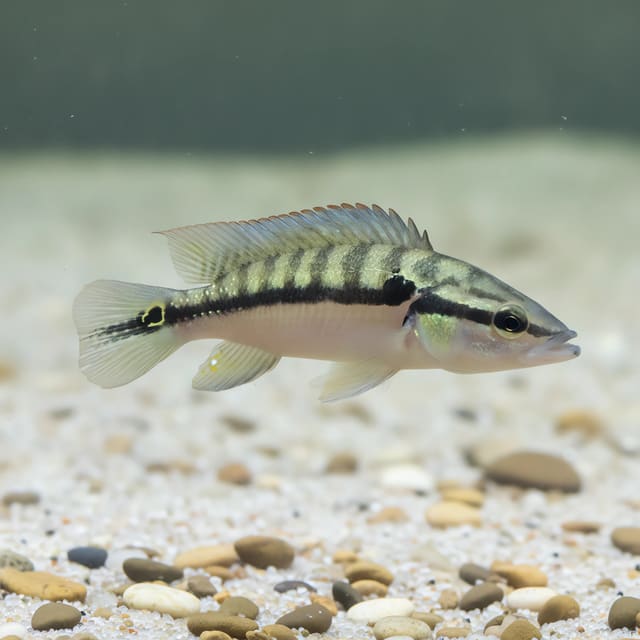
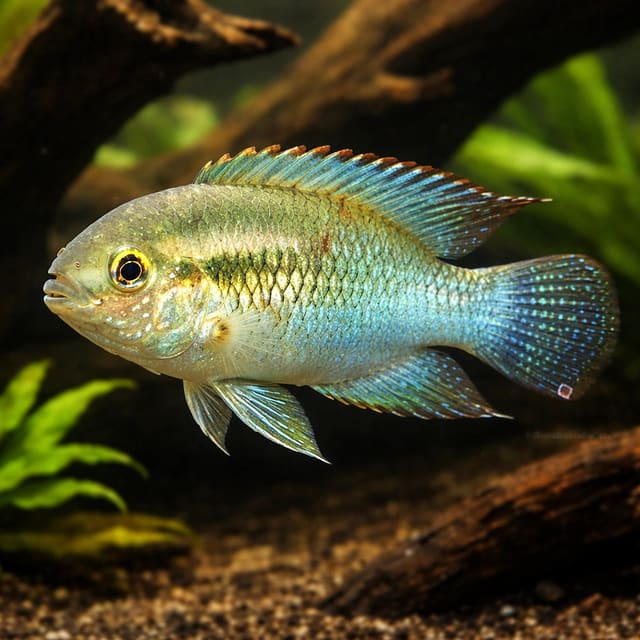
Flag Acara (Laetacara curviceps)
20–28°C · pH 4.5–7.5
£6.99

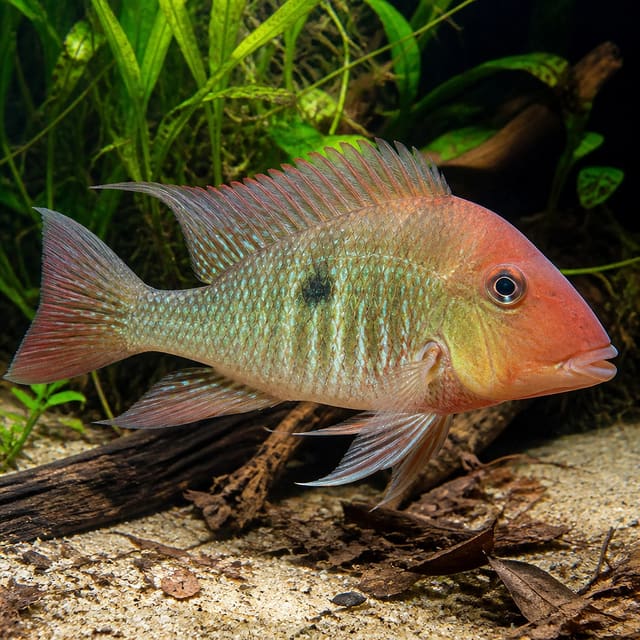
Orange Rainbow Cichlid (Herotilapia multispinosa) is a substantial Central American cichlid for a mature, deliberately planned aquarium. One fish is supplied in the chosen 3–8 cm dispatch grade; allow for a recorded adult length around 17 cm, sand, cover, stable pH 7.0–8.0 water and territorial pair behaviour.
Save when buying multiple fish. Each quantity is one fish; sex and pair formation are not guaranteed unless the selected variant explicitly states them.
Orange Rainbow Cichlid (Herotilapia multispinosa) is a substantial Central American cichlid for a mature, deliberately planned aquarium. One fish is supplied in the chosen 3–8 cm dispatch grade; allow for a recorded adult length around 17 cm, sand, cover, stable pH 7.0–8.0 water and territorial pair behaviour.
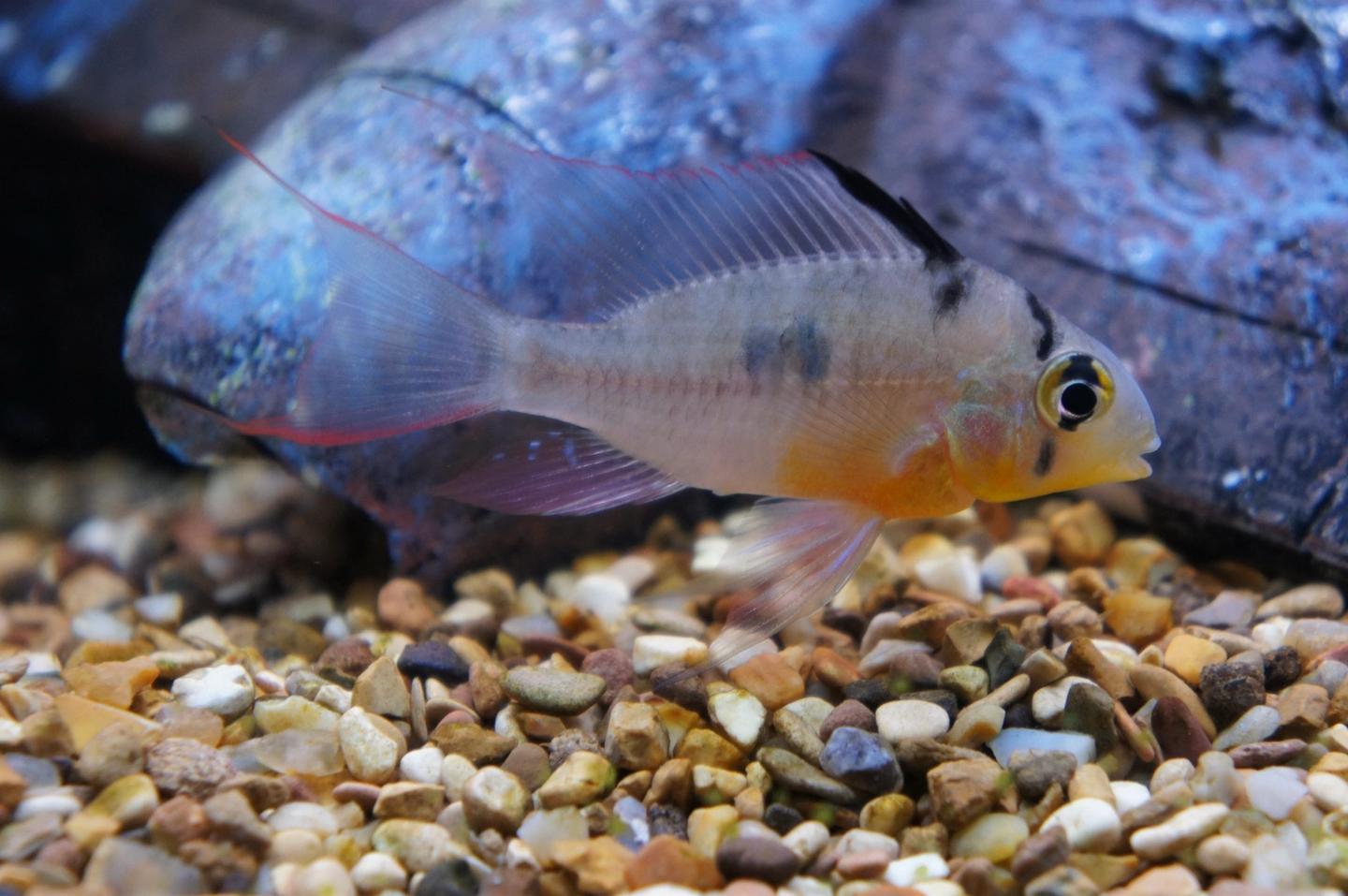
Cichlids are a family of roughly 1,800 accepted species, not one care type. Before buying, identify the exact species and source, then compare adult measurement, usable tank dimensions, social system, territory, tested water, diet and an exit plan. No family-wide minimum tank, water range or tank-mate list is safe.
Maintain these water conditions for optimal health and vibrant colors
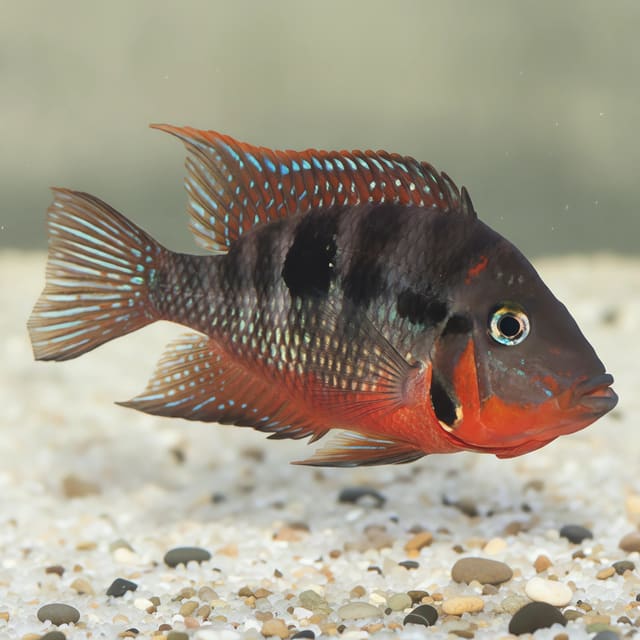
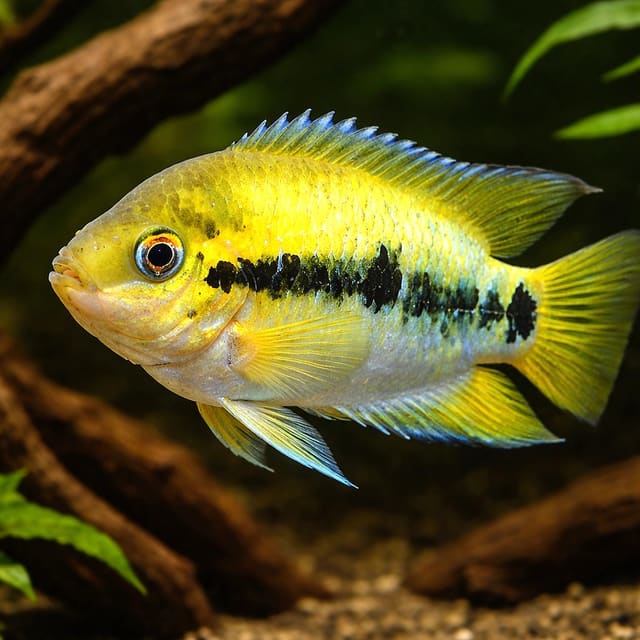
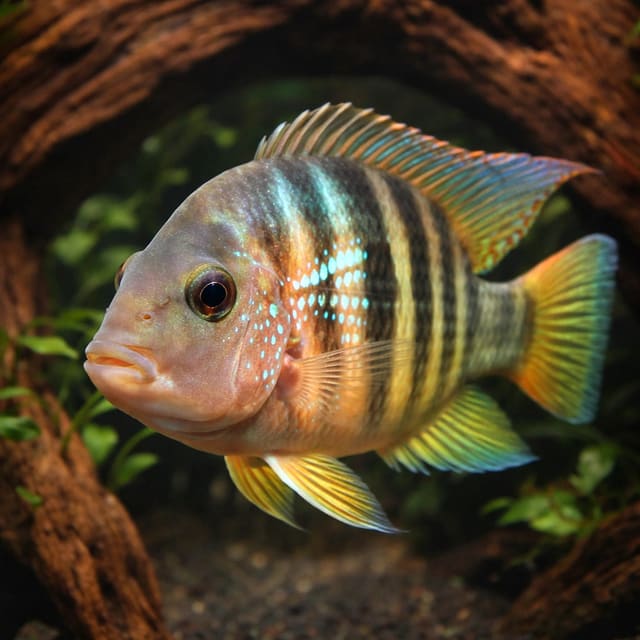
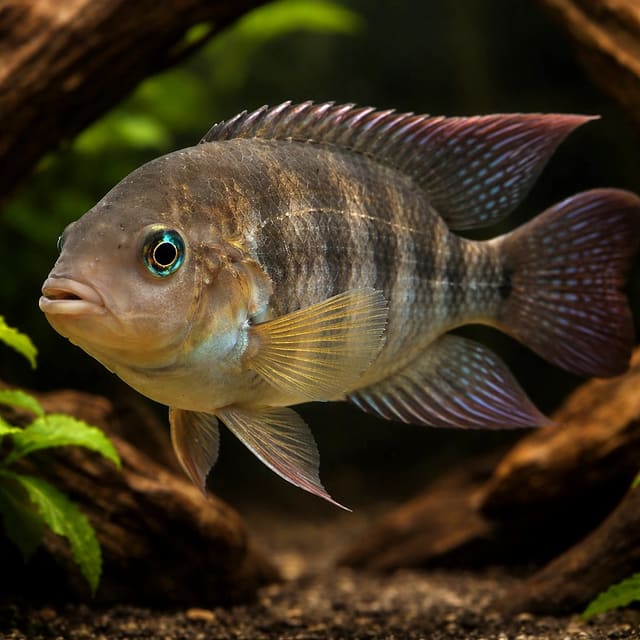
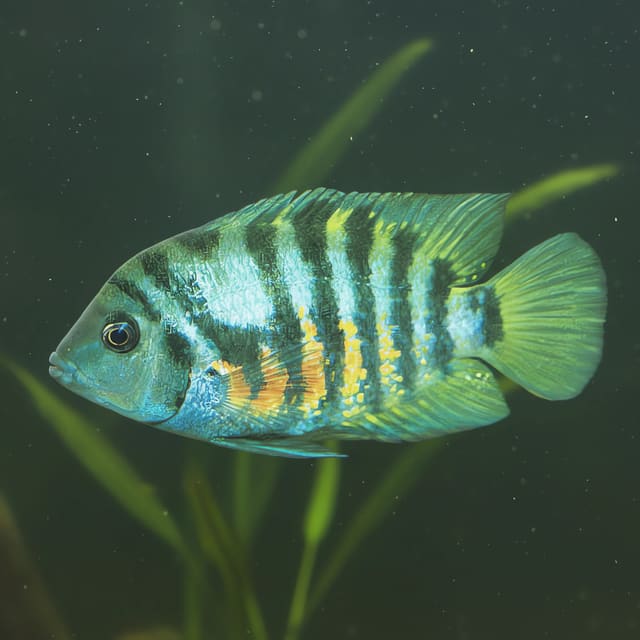
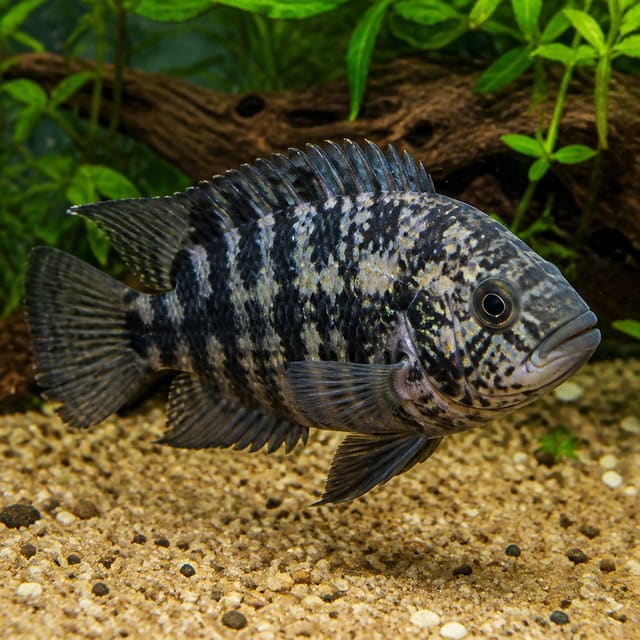
The Orange Rainbow Cichlid (Herotilapia multispinosa) is a warm yellow-orange Central American cichlid with dark vertical markings and the alert, interactive manner that draws many keepers towards cichlids. It comes from freshwater habitats in Costa Rica and Nicaragua, with the species also recorded from Honduras by a specialist aquarium profile. It is a very different animal from the incorrectly named dwarf cichlid in the old page: FishBase records a maximum of 17 cm total length, and the aquarium profile lists 17.5 cm standard length. In practical terms, this is a solid adult fish that needs proper floor space, mature filtration and a layout built around territory.
This listing covers one live fish per purchase. Four recurring dispatch grades are represented: 3–4 cm, 4–5 cm, 5–6 cm and 6–8 cm. The size you select is the size supplied, not the adult size. Those measurements help you choose the fish that will arrive; they do not reduce the long-term aquarium, filtration or compatibility needs of the species. The fish is not sold as a pair, and the colour-form wording describes the trade offer rather than proving a particular specimen, bloodline or sex.
| Suits | Think carefully if |
|---|---|
| You want a comparatively mild Central American cichlid with substantial adult presence. | You need a passive community fish that never defends space. |
| You can provide a 90 × 38 cm base or larger, sand, cover and slow-to-moderate flow. | Your aquarium is new, narrow, crowded or arranged with no visual breaks. |
| Your water can be kept stable around pH 7.0–8.0 and within the species' aquarium range. | Your proposed companions require strongly acidic, very soft or incompatible conditions. |
| You are prepared to watch pair and breeding behaviour rather than relying on a label. | You are buying several unsexed juveniles without a separation plan. |
The store suitability assessment is intermediate. The species profile calls it peaceful by Central American standards and suggests ordinary aquarium foods, but the fish's adult size, territorial pair behaviour and need for considered tank mates still require more judgement than a simple shoaling community species. It is an appealing first step into larger cichlid behaviour for a keeper who already understands cycling, water testing and stocking space.
A sensible starting layout uses a sandy bottom, planting or hardscape that creates cover, and open swimming room. The species profile recommends a 90 × 38 cm aquarium base, about 103 litres, while OATA's broad American-cichlid sheet advises at least 120 litres for a pair of species below 15 cm. These figures use different scopes, so treat 103 litres as the specialist profile's starting footprint and choose more room when keeping a pair or companions.
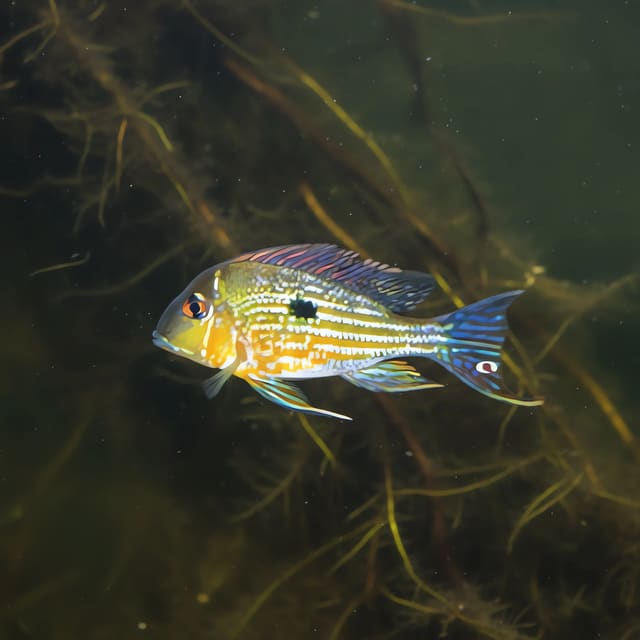
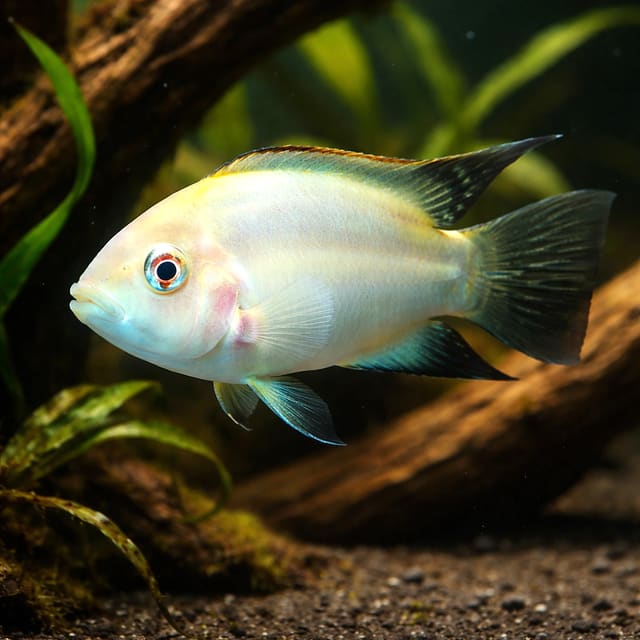
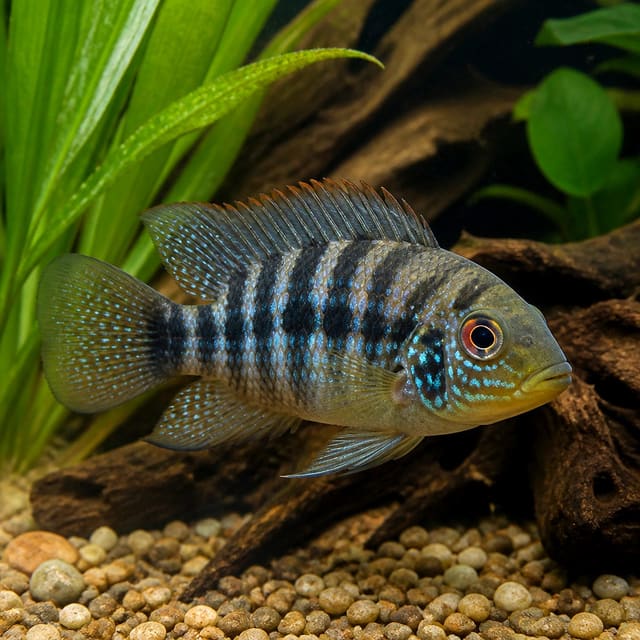
The name “orange” is an offer-level colour description, not a promise that every fish will show one fixed shade. Live cichlids change intensity with age, mood, lighting, background and social context. The visible dark bars may strengthen or soften as a fish settles. Judge suitability by identity, adult size and care needs before colour; the exact individual supplied is not selected from the gallery and no photograph is used to promise sex or maturity.
This fish spends much of its time around the lower and middle parts of the aquarium, inspecting substrate and structure. That makes it rewarding to observe, but also means the bottom must be planned as living space rather than filled with a single wall of décor. Leave open sand between planted or wooded areas, keep heavy stones secure, and arrange more than one route through the tank so a subordinate fish is not forced through a defended corner.
Sex is guaranteed only when the selected option explicitly states male or female. This Herotilapia multispinosa orange listing has no sex-guaranteed option. Fin shape is not a reliable promise for a young retail fish, and the page does not infer sex from the photograph. Gallery images have been digitally enhanced to improve image quality. Natural colour, pattern, size and maturity can vary between live animals.
Before ordering, compare the aquarium's measured values with the care range, confirm that every resident can cope with a territorial cichlid, and leave room for the adult rather than the dispatch grade. Keepers comparing related stock can browse the South American cichlid collection, but a collection placement is not a claim that every fish shown there belongs with this species.
Plan this aquarium around a fish that can reach at least the mid-teens in centimetres, not around the juvenile that arrives. FishBase reports 17 cm total length; Seriously Fish reports 17.5 cm standard length. Total length includes the tail whereas standard length ends at the caudal base, so the numbers should not be treated as interchangeable precision. Both make the same buyer decision clear: the Orange Rainbow Cichlid is not a nano fish. The 90 × 38 cm base and roughly 103-litre volume in the species profile are a starting point, and a larger footprint gives more options for cover, pair movement and community planning.
Litres alone can be misleading. A tall, narrow aquarium may hold the same water as a longer tank while offering much less usable territory. Prioritise length and front-to-back depth. If you intend to keep a pair, or to add the peaceful fish types named by the species profile, choose more than the minimum and divide the floor into recognisable zones. The broader OATA sheet recommends 120 litres for a pair of smaller American cichlids; that group figure is useful as a conservative planning check, not a replacement for the species profile.
Use a mature aquarium. A biological filter must already be converting toxic ammonia to nitrite and then nitrate before the fish arrives. If the tank is still being prepared, the first tropical aquarium guide explains the safe order for cycling, testing and gradual stocking. Adding a sizeable cichlid to an immature system risks exposing it to exactly the waste compounds that filtration is meant to control.
For ordinary captive care, use the species-specific aquarium guidance: 22–28°C, pH 7.0–8.0 and hardness up to 20 dGH. FishBase records wild conditions of pH 7.0–8.0, 9–20 dH and 21–36°C. The high end of that temperature record reflects environments where the species has been found, including unusually warm water; it is not a target for a home aquarium. Stable temperature within 22–28°C is the defensible everyday range here.
OATA gives American cichlids the broad group guide of 22–27°C, pH 6.5–8.0, general hardness 4–12 dGH and carbonate hardness 3–10 dKH. Those values overlap the species profile but are not an optimum established specifically for H. multispinosa. If your tap water falls inside the species range and the fish is settled, avoid repeatedly adjusting it to hit an arbitrary midpoint. Stability, oxygenation and clean water matter more than tiny numerical corrections.
Test ammonia, nitrite, nitrate, pH and hardness rather than relying on appearance. Ammonia and nitrite should remain at zero. OATA's nitrate wording is specific: nitrate should not exceed 20 mg/l above normal tap-water levels. That is different from saying every aquarium must read below 20 mg/l in absolute terms. The water-chemistry guide explains what the readings mean, and the water matcher can help compare measured values with the stated range.
Choose a heater that can hold the selected temperature without large daily swings and position it where moving water distributes heat. Use a thermometer independent of the heater dial. At warmer settings, dissolved oxygen becomes especially important; keep the surface moving while avoiding a torrent through the cichlid's preferred area.
Seriously Fish recommends sand and notes that the species' natural preference for muddy bottoms is difficult to reproduce cleanly in an aquarium. Sand lets the fish investigate and feed at the base without the sharp edges of coarse gravel. It is also easier to arrange around stones and wood while leaving open areas for swimming. Do not pack the whole floor with unstable rockwork: every heavy item should sit securely so digging cannot undermine it.
Planting is useful as cover even though the exact choice of décor is not critical. Combine dense areas with open space. Wood, smooth stones and robust plants can break long sight lines, giving one fish somewhere to withdraw if a social interaction turns tense. Avoid claiming that a cave is mandatory for this species: the breeding account describes cleaned smooth surfaces, often rock or slate, rather than making a cave the universal spawning requirement.
Keep the light moderate rather than harsh, and provide shade beneath planting or wood. The species profile recommends slow-to-moderate flow. Filtration still needs enough biological capacity for an adult cichlid, so separate the idea of filtration strength from the current felt by the fish. A spray bar, broad outlet or carefully aimed return can maintain oxygen and waste movement without blasting the main territory.
Wild biology describes a fish that consumes considerable ooze, detritus and filaments of algae. The aquarium profile likewise says plant material and algae are important and recommends a quality cichlid pellet as the staple, varied with live and frozen foods, with brine shrimp especially appreciated. Vegetable or spirulina flakes are also accepted. Build the menu around that mixed pattern instead of treating the fish as a meat-only predator.
Offer a suitably sized quality pellet, include an algae- or vegetable-based food, and rotate in safe live or frozen additions. OATA's American-cichlid sheet advises feeding only what the fish can finish within a few minutes, once daily; that is group-level guidance rather than a measured species requirement, but it is a practical starting routine. Watch body condition and waste, then adjust the portion rather than automatically adding extra meals.
Feed across enough space that a dominant fish cannot take everything. Remove obvious leftovers and account for food reaching the substrate. Overfeeding raises the organic load, clouds the water and pushes the filter harder. It also works against the stable, clean conditions that make cichlid behaviour easier to read.
OATA recommends a 25% partial water change at least weekly for American cichlids and weekly testing. Treat replacement tap water to neutralise chlorine or chloramine and bring it close to the aquarium's temperature before adding it. Siphon waste from open sand without trying to sterilise every surface. If the aquarium carries more fish or receives heavier feeding, test results may show that smaller or more frequent changes are appropriate.
Check filter flow for blockages. When media needs cleaning, do not run it under the tap because chlorine or chloramine may kill beneficial bacteria; rinse it lightly in water removed during the partial change. Avoid changing all media at once. The aim is a stable biological community, not a filter that looks unused.
Watch the fish itself as part of maintenance. Clear eyes, intact scales, undamaged fins, steady breathing and normal swimming are reassuring. A sudden change in appetite, colour, breathing, hiding or aggression is a reason to test water immediately and inspect social pressure. It is not evidence for a particular disease, and this page does not prescribe medication.
Good care becomes much easier when each number has a practical use. Temperature tells you what the heater and thermometer must hold. pH and hardness tell you whether the source water is broadly suitable and whether changes are happening too quickly. Ammonia and nitrite tell you whether the biological filter is coping. Nitrate, read in relation to the tap-water baseline, helps show whether feeding, stocking and water changes are in balance.
Record results instead of relying on memory. A simple weekly note of temperature, pH, ammonia, nitrite and nitrate makes gradual drift visible. Hardness does not always need daily attention, but it should be checked before purchase and after any change to the water source or treatment method. Sudden attempts to force pH with additives can create more instability than a steady value already within the species range.
Use behaviour as another data stream. Note where the cichlid rests, which routes it patrols, whether all fish feed, and whether one resident is repeatedly displaced. A layout that looks attractive from the sofa may still create a single choke point underwater. Moving one piece of wood to interrupt a direct line of sight can be more useful than adding another ornament, provided the change does not collapse an established shelter.
During the first weeks, resist the urge to add more animals simply because the aquarium seems quiet. Let the filter and social order adjust to the new bioload. OATA warns that stocking too quickly can outpace the beneficial bacteria and lead to new tank syndrome. This species' interactive behaviour is best appreciated in stable conditions, not in a constantly changing collection.
A Rainbow Cichlid may inspect sand, graze surfaces, pause beneath cover and display towards another cichlid. Pair-forming fish may clean a smooth surface and defend the surrounding area. Those actions fit its biology. The warning signs are changes from that individual's normal pattern: persistent clamped fins, laboured breathing, loss of interest in food, damaged scales, abnormal swimming or a fish held in one corner by another resident.
Start with water and social conditions. Test before treating. Confirm the heater is working, the filter is moving water and no fish is blocking access to food. If one animal is being pursued without respite, separation may be needed even when every chemical reading is acceptable. Medication should follow a defensible diagnosis and product directions; adding treatments at random can complicate the problem and may affect filtration.
Quarantine is valuable when you already have a suitable mature system, but a newly filled uncycled container is not automatically safer than the display. Any holding aquarium still needs stable heat, oxygenation and biological waste control. Use separate equipment where possible and clean shared tools between tanks. The aim is observation without creating a second source of stress.
The smallest grades are juveniles, so revisit the aquascape and stocking plan as the fish grows. A shelter that fits a 3–4 cm fish may become a trap for a much larger adult. Narrow gaps between stones can also become unsafe. Keep clear access for maintenance, make sure the lid closes around equipment, and check that plants have not removed all open swimming room.
Growing fish also produce more waste and compete more strongly at feeding time. Do not wait for visible cloudiness before reassessing filter capacity or water-change frequency. Test results and body condition are better guides. If nitrate rises faster, if debris accumulates despite the usual routine, or if companions struggle to feed, adjust the system rather than assuming the juvenile routine will remain adequate.
Colour may become richer as the fish settles, but colour alone is not a welfare measure. A vividly coloured cichlid can still be overfed or socially stressed, and a paler fish may simply be responding to lighting or hierarchy. Use appetite, breathing, posture, fin condition, movement and water readings together. This broader view avoids turning one visual feature into a diagnosis.
Measure the usable base of the aquarium, not just the advertised litre figure. Confirm that the 90 × 38 cm species-profile footprint can be met and that the filter, heater, lid and hardscape leave that area genuinely usable. Think forward to a fish around 17 cm rather than asking whether today's grade physically fits. If the tank only works while the fish is small, it is not yet a long-term plan.
Test the source water on an ordinary day. A stable pH of 7.0–8.0 and hardness within the species-profile range are preferable to a water supply that must be heavily altered at every change. Check that the heater can maintain 22–28°C, and decide where conditioned replacement water will be prepared. Confirm that ammonia and nitrite are already zero before livestock is added.
Review the resident list one animal at a time. For each fish, compare adult size, temperature, pH, hardness, feeding style and the part of the aquarium it uses. The fact that tetras, barbs, smaller peaceful cichlids, small plecs and doradids are named as possibilities does not make every species in those groups suitable. Remove any candidate that requires conflicting water or cannot withdraw from a defended area.
Decide what happens if two unsexed cichlids do not form a peaceful pair. A practical answer might be a divider, a mature spare aquarium or a pre-arranged rehoming route. Do not depend on fin shape or temporary colour to guarantee sex. Do not depend on the gallery to choose an exact individual. Planning the fallback before purchase makes it much easier to respond calmly to behaviour later.
Finally, make sure the everyday routine is sustainable. You need time for weekly testing and partial water changes, access to suitable mixed foods, and a way to clean the filter without destroying its bacterial population. The Orange Rainbow Cichlid is rewarding because it is observant and behaviourally rich; the same qualities mean it deserves more than a decorative afterthought in an already full tank.
Prepare the aquarium before the courier arrives: temperature stable, ammonia and nitrite at zero, lid and décor secure, and no last-minute major maintenance. Have your phone ready. Before opening the sealed parcel, record one continuous unboxing that shows the outer box, the opening and the fish still in the sealed bag. Keep the recording in case a Live Arrival Guarantee claim is needed, inspect the fish on the day it arrives and contact Tropical Fish Co that day if there is a problem.
Float the sealed bag for 20–30 minutes as the store policy directs. OATA's complete introduction guidance then supports gradual chemistry adjustment: slowly add small amounts of aquarium water to the bag for up to 20 minutes before release. This matters when bag water and aquarium water differ in pH or hardness; matching temperature alone does not match water chemistry. Release the fish while introducing as little bag water to the aquarium as practical, dispose of that water, and monitor behaviour and water quality closely through the first week.
The current packing, courier, receipt and claim steps are maintained on the delivery and Live Arrival Guarantee page. Read it before the delivery date because policy details can change independently of an evergreen care guide.
Seriously Fish describes the Rainbow Cichlid as peaceful, especially by Central American standards. FishBase also notes that both sexes are territorial and that the species forms pairs. Those statements are compatible: a fish can be relatively mild compared with larger Central American cichlids while still defending a feeding area, partner or spawning site. The useful question is not whether the species is simply peaceful or aggressive, but whether the aquarium gives every resident enough room to avoid its territory.
A pair can become more assertive during breeding. Create more than one route around the hardscape and avoid a single cave or corner that traps another fish. Watch for repeated pursuit, pinned fins, hiding at the surface, missed feeding and physical damage. Occasional display is different from one fish being unable to disengage. Keep a spare divider or alternative aquarium available when attempting to form a pair from unsexed fish.
The species profile says tetras, barbs and other smaller peaceful cichlids can be considered, and it names small plecs and doradids as suitable bottom dwellers. These are categories for assessment, not universal approvals. A prospective companion must still tolerate pH 7.0–8.0, the selected temperature and the adult cichlid's presence. Choose robust, similarly disposed fish and allow enough room for both open-water movement and bottom territories.
Bottom dwellers deserve special thought because they may cross the cichlid's chosen area while foraging. Provide multiple shelters and sight breaks, feed so all residents can reach food, and observe the tank more closely if the cichlids begin cleaning a rock. A companion that worked for months can become unwelcome when spawning behaviour starts.
Avoid placing this fish with strongly aggressive cichlids in a cramped tank, very small animals likely to be treated as food, or slow and fragile long-finned fish that cannot leave a defended area. Do not use colour, current juvenile size or a generic community label as the basis for the decision. Adult size, feeding competition, water overlap and territorial use matter together.
One fish can be kept as an individual display animal when its welfare and enrichment needs are met. If the goal is a pair, remember that one purchase is one fish and sex is not guaranteed. Buying two does not create a bonded pair. Introductions need space and observation, and incompatible fish may have to be separated.
For a pair-focused display, use the tank's footprint to form distinct areas and leave a clear retreat. For a community, provide extra volume and choose open-water fish of suitable size and temperament. Do not crowd the aquarium to make the cichlid feel secure; physical cover and sensible companion behaviour are safer than adding more livestock to a limited footprint.
Breeding is best attempted in a separate aquarium according to the species profile. A pair cleans a smooth surface such as a rock or slate; the female lays eggs and the male fertilises them, and both parents fan the eggs. This information explains why territory can intensify, but it is not a promise that unsexed retail fish will pair or breed. Raising fry also requires a dedicated plan beyond ordinary community care.
Before arrival, identify the places each resident already uses. A plec shelter, barbel-feeding area or favourite shoaling route should not accidentally become the only obvious cichlid territory. If a small rearrangement is needed, make it before the newcomer is released and keep secure shelters available to established fish. Avoid a wholesale redesign on the same day, which removes every familiar refuge at once.
After introduction, observe several feeding periods and the quieter parts of the day. Check that the newcomer leaves cover to eat and that existing bottom dwellers still reach their food. Territorial pressure can be subtle: a fish may stop feeding long before obvious injury appears. Repeated displacement, rapid breathing after pursuit or confinement to the surface needs action.
Have a realistic fallback. A divider, mature spare aquarium or confirmed rehoming route is part of responsible cichlid keeping. It is not a sign that the species is inherently vicious; individual pair formation and established territories can produce outcomes no compatibility chart can guarantee. Acting early prevents a manageable mismatch from becoming an injury.
Apply all six checks to the actual individuals in front of you. A compatibility list cannot account for aquarium shape, established territories or breeding condition, so continued observation remains part of responsible stocking.
FishBase records Herotilapia multispinosa at up to 17 cm total length, while the specialist aquarium profile lists 17.5 cm standard length. Plan for a substantial adult cichlid rather than judging its eventual needs from the smaller dispatch grade.
The species profile gives a 90 × 38 cm base and about 103 litres as a starting point. More floor area is valuable for a pair, territorial behaviour and companions; OATA's broader American-cichlid guidance uses 120 litres for a pair of smaller species.
Herotilapia multispinosa forms pairs, but this listing supplies one unsexed fish per purchase and does not promise a compatible or bonded pair. Provide enough room and several visual barriers, and be ready to separate fish if pairing attempts become one-sided.
It is relatively approachable for a Central American cichlid, but its adult size, territory and need for deliberate companion choices make it better for a keeper comfortable with mature filtration, water testing and behaviour-led stocking than for an unplanned first community tank.
Use a quality cichlid pellet as the staple, add an algae- or vegetable-based food, and vary the menu with suitable live or frozen foods such as brine shrimp. Its natural diet includes detritus, algae and other plant material, so a meat-only menu misses an important part of its feeding ecology.
For routine aquarium care, the species profile suggests 22–28°C, pH 7.0–8.0 and hardness up to 20 dGH. Keep ammonia and nitrite at zero and monitor nitrate; the wild temperature record extends much higher but is not a routine captive target.
It is described as peaceful by Central American cichlid standards, not harmless in every setting. Both sexes can be territorial, especially around a spawning site, so avoid cramped layouts and do not pair it with slow, fragile or persistently aggressive fish.
The species profile says similarly disposed tetras, barbs and smaller peaceful cichlids can be considered, with small plecs and doradids as possible bottom dwellers. Every candidate still needs matching adult size, water needs and enough space outside the cichlid's territory.
Tropical Fish Co hand-bags live fish in oxygen, uses an insulated poly box and a heat pack when conditions call for one, and sends them with a licensed live-animal courier. Be present to receive the parcel, film one continuous unboxing before opening, inspect the fish in the sealed bag, then follow the current arrival and claim instructions.
FishBase: Herotilapia multispinosa supports the accepted identity, family, distribution, wild environment, recorded maximum length, natural feeding notes and pair territoriality. Wild environmental records are described as records, not copied into routine captive targets.
Seriously Fish: Rainbow Cichlid supports the aquarium footprint, routine water range, sand, planting, flow, lighting, diet, named companion categories and reproductive account used here.
OATA: American cichlid care supplies clearly scoped group guidance on water quality, aquarium planning, introduction, feeding and maintenance. RSPCA fish environment guidance supports the importance of a mature biological filter.
Independently collected by Judge.me from customers who bought this item. All reviews are shown.
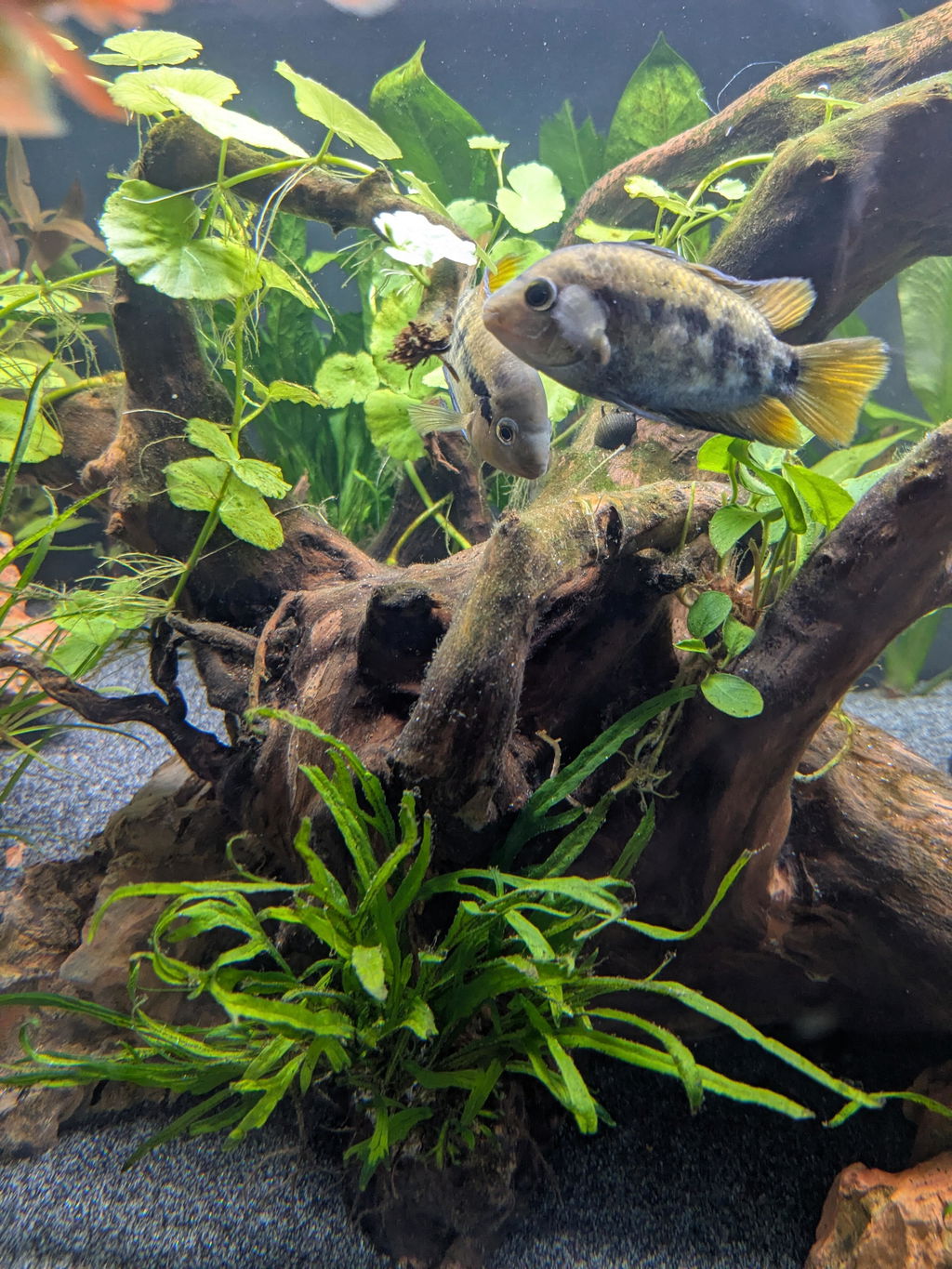
Healthy fish
Reply from Tropical Fish Co
<p>Glad they arrived healthy. Rainbow cichlids are slow to show what they've got - they colour up properly once they've settled in and claimed a bit of territory, so give them a few weeks before you judge them. If there was something behind the three stars rather than five, we'd genuinely like to hear it: <a target="_blank" rel="nofollow noopener" href="mailto:hello@tropicalfishco.co.uk">hello@tropicalfishco.co.uk</a> or WhatsApp +44 7464 593131. - Reza, Tropical Fish Co</p>