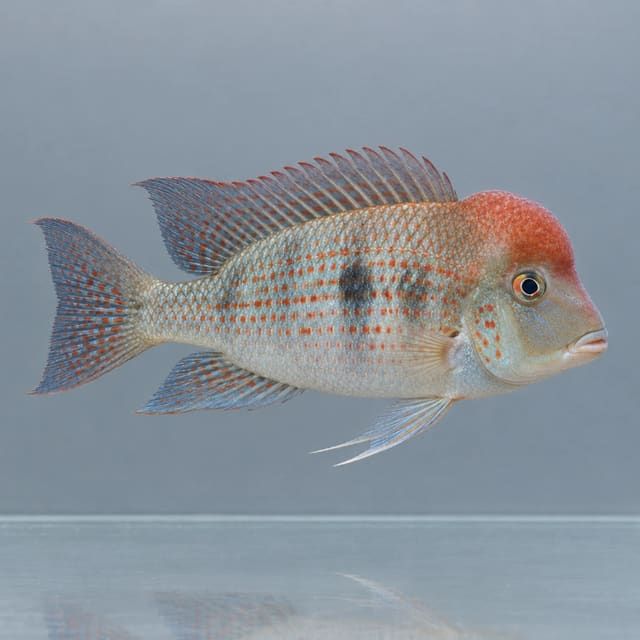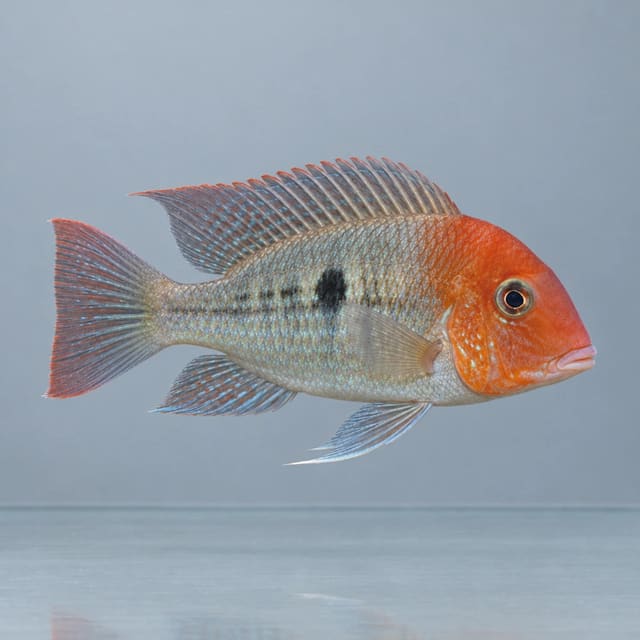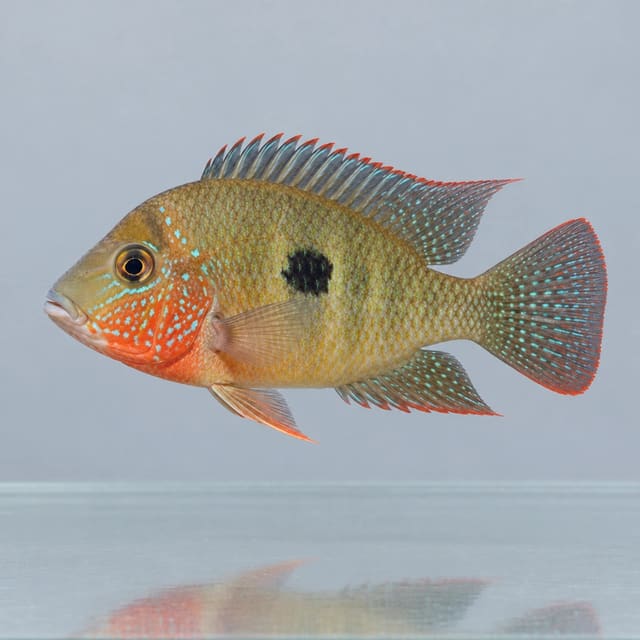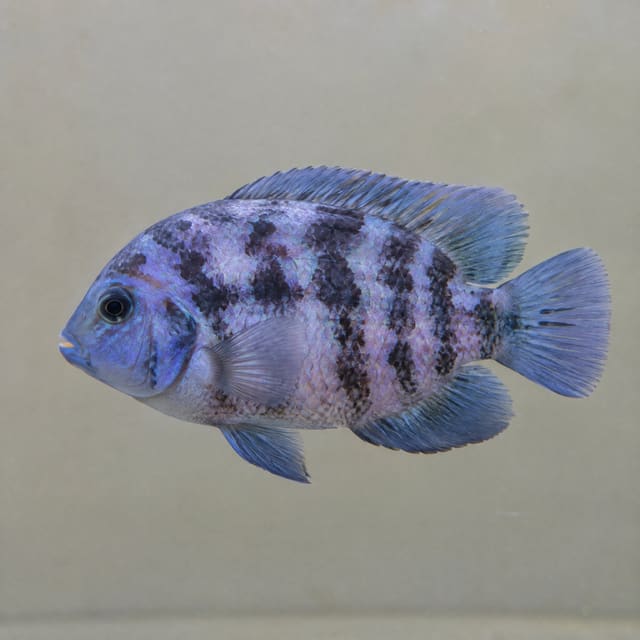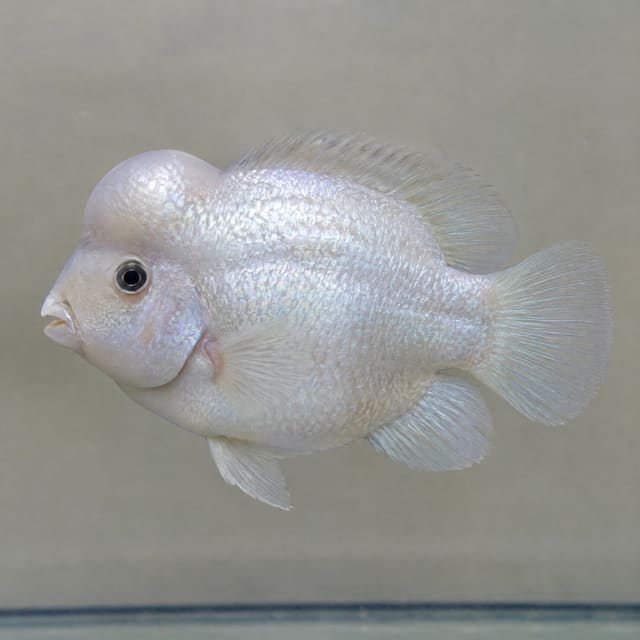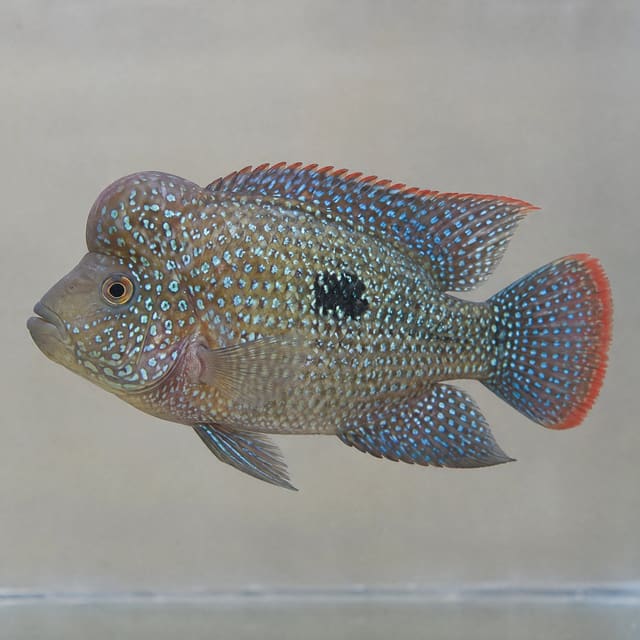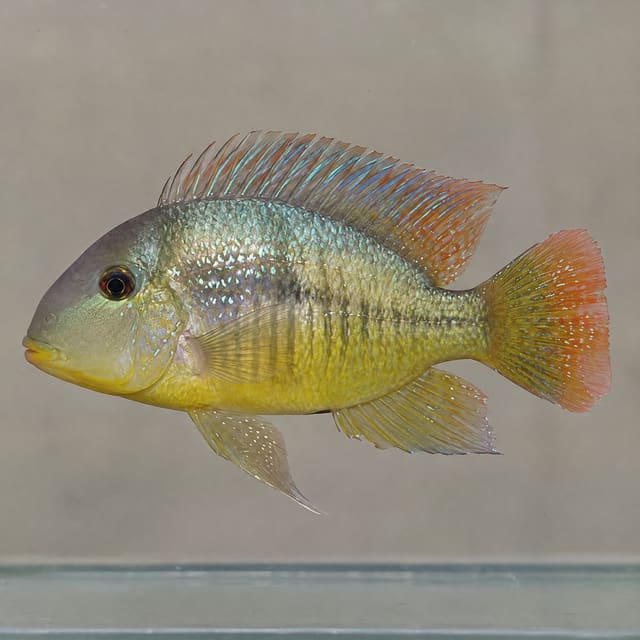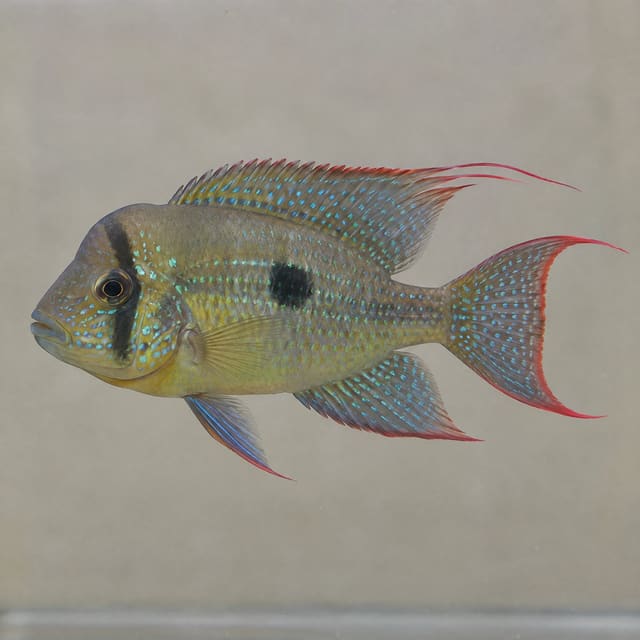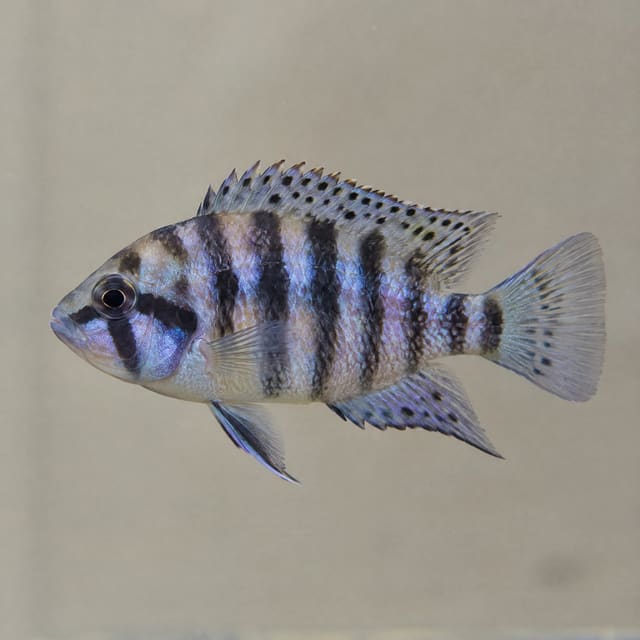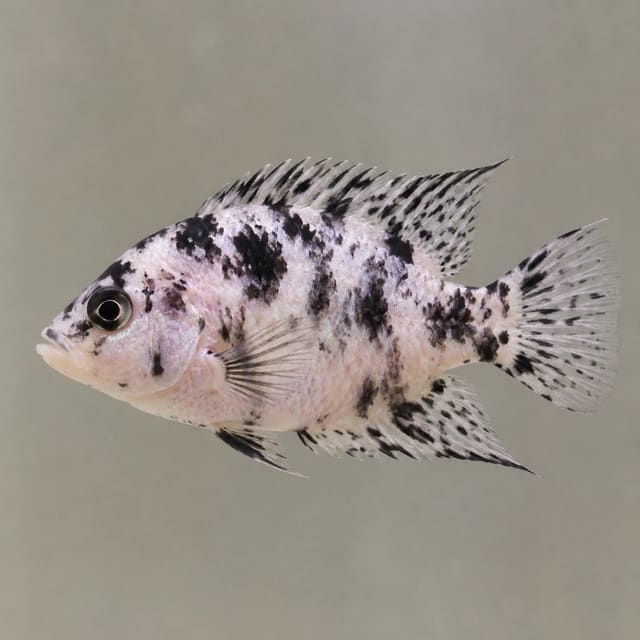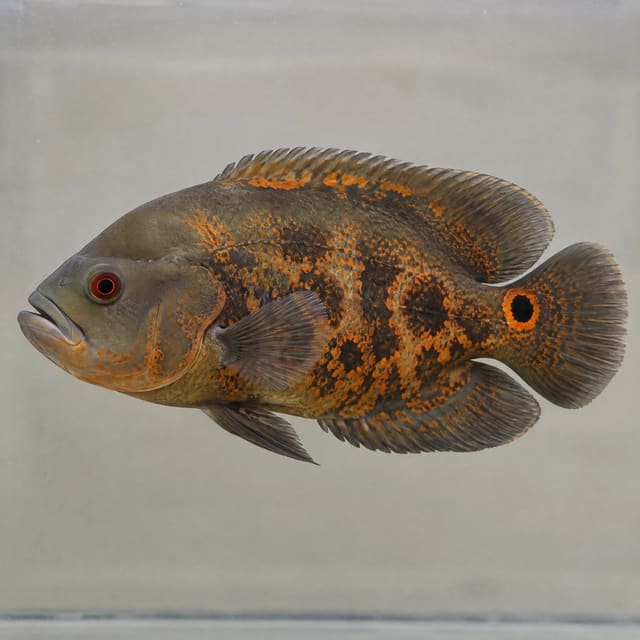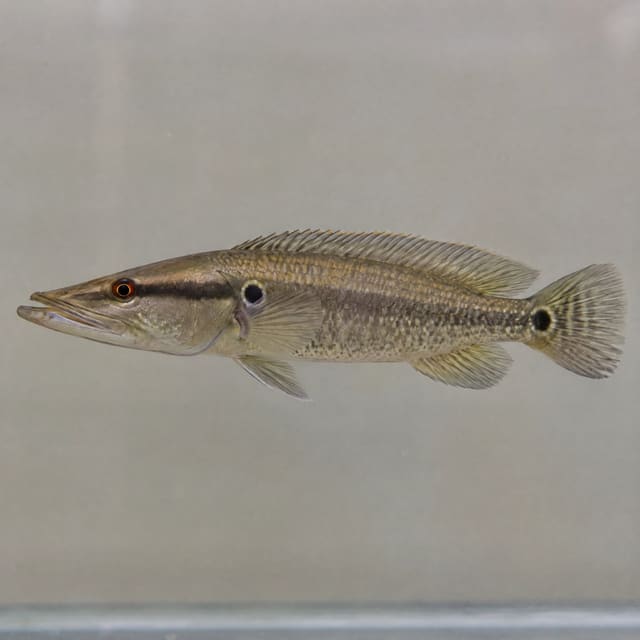
Comb Pike Cichlid (Crenicichla lepidota)
23–27°C · pH 7–8
£34.99
The Orange Xingu Pike Cichlid (Crenicichla sp. 'Xingu I') is a long, predatory cichlid found only in Brazil's Rio Xingu. Young fish are bright orange; adults grow to about 35 cm and turn olive-grey with red fins. It needs a very large aquarium with soft, warm, well-oxygenated water, caves and meaty foods. Sold singly.
Adult size is the maximum length this species reaches at full maturity (scientific sources). The livestock you receive will be younger and smaller. Product-photo provenance and any image-specific limitations are stated on the listing.
Crenicichla sp. 'Xingu I'
The Orange Xingu Pike Cichlid (Crenicichla sp. 'Xingu I') is a long, predatory cichlid found only in Brazil's Rio Xingu. Young fish are bright orange; adults grow to about 35 cm and turn olive-grey with red fins. It needs a very large aquarium with soft, warm, well-oxygenated water, caves and meaty foods. Sold singly.
Adult size is the maximum length this species reaches at full maturity (scientific sources). The livestock you receive will be younger and smaller. Product-photo provenance and any image-specific limitations are stated on the listing.
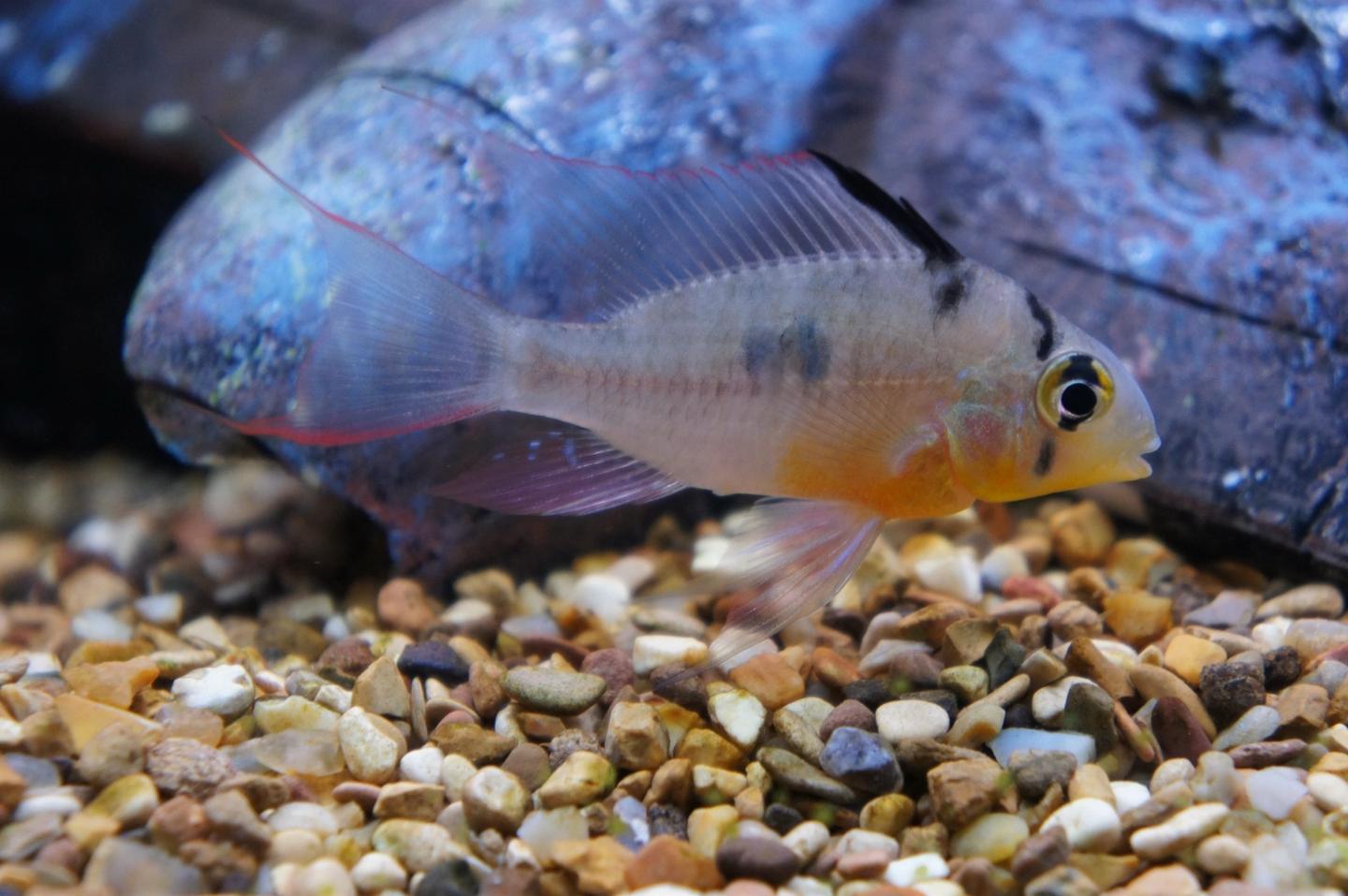
Cichlids are a family of roughly 1,800 accepted species, not one care type. Before buying, identify the exact species and source, then compare adult measurement, usable tank dimensions, social system, territory, tested water, diet and an exit plan. No family-wide minimum tank, water range or tank-mate list is safe.
Read the full care guidance when planning conditions for your aquarium.
The Orange Xingu Pike Cichlid, Crenicichla sp. ‘Xingu I’, is a pike cichlid found only in the Rio Xingu, a large southern tributary of the Amazon in Brazil. It is also sold as the Orange Pike, the Xingu Orange Pike Cichlid and Crenicichla sp. Xingu 1. Like all pike cichlids it has a long, torpedo-shaped body and a large mouth, and it hunts smaller fish from cover.
It has not been formally described, so it carries a trade code instead of a species name. It belongs to the lugubris group of large pike cichlids. In 2023 a revision of pike cichlid classification by Varella, Kullander, Menezes, Oliveira and López-Fernández placed Crenicichla lugubris and its relatives in a new genus, Lugubria, and Maidenhead Aquatics now lists this fish as Lugubria sp. ‘Xingu I’. The same revision created Saxatilia and Wallaciia, the genera of our Spangled Pike Cichlid and Two-Spotted Dwarf Pike Cichlid.
Young fish are the reason it is popular: they are bright orange and very active. The Mostly Cichlids profile notes that juveniles in the hobby also come in yellow and brick-red forms, and suggests that more than one species may be sold under this name. Adults look very different, as the colour table below shows.
| Suits | Not suited to |
|---|---|
| A specialist with a very large aquarium planned for a 35 cm adult | A community aquarium of small fish |
| Soft, warm, well-oxygenated water with strong current | Hard, alkaline tap water used without adjustment |
| A species aquarium, or robust tank mates at least as large | Unpaired adults of its own kind sharing one aquarium |
| Meaty frozen foods and patience while it is weaned | A keeper who wants an easy, pellet-only fish |
| A keeper happy to watch the orange fade into adult colours | A buyer who wants a permanently orange fish |
Browse our South American cichlids, the American cichlids directory and the Crenicichla pike cichlid category, or our rare and collector fish for other specialist species.
One purchase quantity supplies one live Orange Xingu Pike Cichlid, sold as a young fish in its orange juvenile colour. No dispatch size is listed; ask us if you need the current size. Young pike cichlids cannot be sexed reliably, so sex is not specified, and the photographs show the species, not the individual you will receive.
| Stage | What it looks like |
|---|---|
| Juvenile | Bright orange with thin, black lengthwise stripes (Maidenhead Aquatics) |
| Maturing | The orange fades; Mostly Cichlids gives maturity at about 6–7 in (15–18 cm) |
| Adult male | Larger, with a more pointed dorsal fin; a dull greyish-green to grey body and red fins |
| Adult female | Fuller-bodied, with red fins and a wine-red belly that develops in spawning condition |
It will not stay orange. Both sources describe adults as olive-green to grey with red fins. If you want a permanently orange fish, this is not the right choice; if you want to watch a juvenile grow into a large, impressive predator, it is.
Maidenhead Aquatics gives a maximum of 35 cm, and Mostly Cichlids gives 12–14 in (about 30–36 cm) for adults, adding that males can grow too large for most aquariums and that adults are rarely seen in home aquariums. OATA’s American cichlid care sheet sets a minimum of 300 litres for species over 15 cm, and Maidenhead advises an aquarium as spacious as possible.
There is no species-level tank size for this undescribed fish, so look at its closest described relative. For Lugubria lugubris, which reaches 40 cm standard length, Seriously Fish recommends a base of 180 × 60 cm. That footprint, with 300 litres as an absolute floor, is a sensible plan for an adult Orange Xingu Pike Cichlid.
Our tank volume calculator converts your aquarium’s dimensions into litres; remember that sand, rock and wood reduce the real water volume.
Maidenhead Aquatics recommends soft sand, dim to medium lighting, and plenty of hiding places and visual barriers: tangles of driftwood, rock caves and several PVC or bamboo tubes per fish. Hardy plants can work, but Java fern and Anubias are safest because they can be tied to wood or rock. Pike cichlids generally do not rearrange décor much.
| Area | Purpose |
|---|---|
| Soft sand | A safe resting surface |
| Rock caves and tubes, several per fish | Retreats and possible spawning sites; fewer fights |
| Driftwood tangles | Visual barriers that break lines of sight |
| A fast-flowing zone near the filter outlet | Current and oxygen, as in a river |
| Quieter areas behind wood or rock | Somewhere to rest out of the flow |
| Tight-fitting cover glass | Maidenhead calls this a must for pike cichlids |
Keep lighting moderate and diffuse brighter light with floating or tall plants. Visual barriers matter more as the fish matures, because disputes start when one fish can watch another across an open tank.
This is a soft-water fish. Maidenhead Aquatics gives 26–29°C and pH 5.5–6.8 in soft, acidic water. Field measurements from the Rio Xingu near Altamira, published on the Mostly Cichlids site with data from Mike Wise, found pH 6.5, 1 °dGH and 1 °dKH with a conductivity of 120 µS/cm at low water in September 1988, and pH 6.7–6.9 with a conductivity of about 20 µS/cm at high water in March 1996. The low-water reading was taken at 32°C, warmer than the recommended aquarium range.
| Reading | Keep it at |
|---|---|
| Temperature | 26–29°C |
| pH | 5.5–6.8; the river measured 6.5–6.9 |
| Hardness | Soft; the river measured about 1 °dGH and 1 °dKH |
| Ammonia | 0 mg/l |
| Nitrite | 0 mg/l |
| Nitrate | As low as possible; OATA’s group limit is no more than 20 mg/l above your tap water level |
Much UK tap water is harder than this. If yours is, blend it with reverse-osmosis water to bring the hardness down, keep a little carbonate hardness so the pH cannot crash, and prepare and match replacement water before every water change. Our aquarium water parameters guide and pH testing guide explain the readings, and our water matcher compares your tap water with this fish’s range.
Seriously Fish gives 0–15 °dGH and pH 5.5–6.5 for Lugubria lugubris, so the related species tolerates a spread of hardness. Stability inside the soft range matters more than one exact figure.
Maidenhead Aquatics stresses warm, well-oxygenated water with plenty of current, and warns that nitrate must not build up, so regular partial water changes are essential. Efficient filtration with fast-flowing areas and quieter spots suits it. Our aquarium filtration guide explains how to size filters for a large aquarium.
Mature the filter before the fish arrives, and add fish gradually: OATA warns that stocking too fast causes new tank syndrome, with rising ammonia and nitrite. Remove uneaten frozen food after a few minutes.
Maidenhead Aquatics recommends mainly meaty frozen foods such as white mosquito larvae, bloodworm, vitamin-enriched brine shrimp and Mysis. Many pike cichlids in the trade are wild-caught and may need live food at first before they are weaned onto frozen food; some eventually accept dried foods such as cichlid pellets. OATA advises feeding American cichlids once a day, only what they finish within a few minutes.
To wean, start with the frozen food the fish already takes, then mix in a little of the new food and increase the share over one to two weeks. Mostly Cichlids notes that the stomach is highly elastic and looks very lumpy after a meal, so a swollen belly after feeding is normal and no reason to feed more.
Mostly Cichlids describes juveniles as active and peaceful but easily bullied until they mature, so introduce a young fish to a quiet aquarium without boisterous companions. Before it arrives, confirm that ammonia and nitrite are zero and that the water is soft and warm.
These are OATA’s steps. Because this fish needs much softer water than most UK tap water, measure the pH and hardness of your aquarium before it arrives so you know how big the difference is. Our guide to acclimatising new fish explains when a drip method suits and why a longer drip is not automatically safer after a long journey, and our delivery information covers delivery days and the Live Arrival Guarantee.
OATA describes healthy fish as having clear, bright eyes, undamaged fins, intact scales, no ulcers or bumps, normal swimming and steady breathing. Learn your fish’s normal routine once it has settled, so that changes stand out.
| If you see | Do this |
|---|---|
| Rapid breathing or hanging at the surface | Test ammonia, nitrite and temperature; increase aeration and flow |
| Hiding all the time and refusing food after the first days | Check water values, add cover, and offer live or frozen foods |
| Clamped fins, flicking or shimmying | Test the water; OATA lists these as common signs of disease |
| White spots, fluffy growths, lost scales or torn fins | Test the water and seek fish-health advice |
| Persistent chasing of a tank mate | Add visual barriers or separate the fish |
| A rising nitrate reading | Increase water changes and reduce feeding |
Do not diagnose from a single sign. If a problem continues after the water checks, contact us with the aquarium size, temperature, pH, hardness, ammonia, nitrite and nitrate readings, the tank mates and what you have seen.
Maidenhead Aquatics describes pike cichlids as having something of a reputation for being nasty: they are predators with large, protrusible mouths that will try to eat fish somewhat smaller than themselves, and most are highly territorial towards their own kind. Aggression can be reduced with visual barriers, by buying a group of similar-sized young fish and introducing them together, and by keeping them in a species aquarium. Aggression rises further once a pair forms and tries to spawn, and other fish may then need rehoming.
| Suits | Avoid |
|---|---|
| A species-only aquarium | Any fish small enough to swallow |
| A group of similar-sized juveniles introduced together, letting a pair form | Adding a single newcomer to an adult’s territory |
| Robust soft-water fish at least as large as the pike, added first | Dwarf pike cichlids and small South American cichlids |
| Plenty of caves and visual barriers | Open, bare tanks where fish can see each other all the time |
Our tank mate checker screens proposed companions. To compare other pike cichlids we sell, see the Johanna Pike Cichlid, Peru Pike Cichlid and Comb Pike Cichlid, each with its own care needs, and read our cichlid care guide for general cichlid planning.
Maidenhead Aquatics knows of no reports of this fish breeding in home aquariums. It is a cave spawner: the female tends the eggs in a cave or crevice while the male patrols the area around it. Mostly Cichlids mentions a couple of undocumented aquarium spawnings in which the eggs did not hatch, and notes that adults guard their spawns for many months, often until the fry are 4–6 in (10–15 cm) long. For Lugubria lugubris, Seriously Fish describes pair formation as difficult, with prospective mates often killed, but excellent parental care once a pair succeeds.
About 35 cm (Maidenhead Aquatics); Mostly Cichlids gives 12–14 in for adults. It is sold as a young fish but grows into a large predator, so plan the aquarium for the adult.
No. The bright orange is the juvenile colour. Adults turn olive-green to grey with red fins, and females develop a wine-red belly.
At least 300 litres, the OATA minimum for American cichlids over 15 cm, and as spacious as possible. For its closest described relative, Seriously Fish recommends a base of 180 × 60 cm.
Soft, slightly acidic, warm water: 26–29°C and pH 5.5–6.8, well oxygenated, with strong current and low nitrate.
Only as a pair that forms naturally from a group of young fish, in a very large aquarium with visual barriers. Most adults are highly aggressive to their own kind.
Meaty frozen foods such as mosquito larvae, bloodworm, brine shrimp and Mysis. Some wild fish need live food at first, and some eventually accept cichlid pellets.
Yes. The fish is undescribed; a 2023 revision placed Crenicichla lugubris and its relatives in the new genus Lugubria, so some retailers now use that name, while the trade name Crenicichla sp. ‘Xingu I’ is still widely used.
A species-only aquarium is best. If you add tank mates, choose robust fish at least as large as the pike cichlid, add them first and provide plenty of space and hiding places.
No reviews for this item yet. Bought one? Honest reviews only, good or bad.
What customers say about ordering from us
Easy website plenty of info on fish your buying great to pick a time slot
TRACEY DURRANT · 7 Oct 2026
Got some lovely fish thank you
Kevin Mackie · 7 Oct 2026
Reviews of our shop, collected by Judge.me, an independent third-party review collector. Newest first.
Moved by UK carriers licensed to handle live animals
Hand-packed with oxygen bags, poly box, heat pack
Email photos the same day; an optional unboxing video helps us review problems faster — claim terms apply
Klarna & PayPal Pay in 3 at checkout