Advanced
Haitian Cichlid (Nandopsis haitiensis)
24–27°C · pH 7–8 · 450L
£10.99
The Tuba Cichlid (Tomocichla tuba) is a large Central American cichlid from fast-flowing rainforest rivers in Nicaragua, Costa Rica and Panama, where it browses algae and eats fallen fruit. It reaches about 30 cm, so it needs an aquarium of at least 300 litres with strong, well-oxygenated flow and a mainly plant-based diet. Sold individually as one live fish.
Tomocichla tuba
The Tuba Cichlid (Tomocichla tuba) is a large Central American cichlid from fast-flowing rainforest rivers in Nicaragua, Costa Rica and Panama, where it browses algae and eats fallen fruit. It reaches about 30 cm, so it needs an aquarium of at least 300 litres with strong, well-oxygenated flow and a mainly plant-based diet. Sold individually as one live fish.
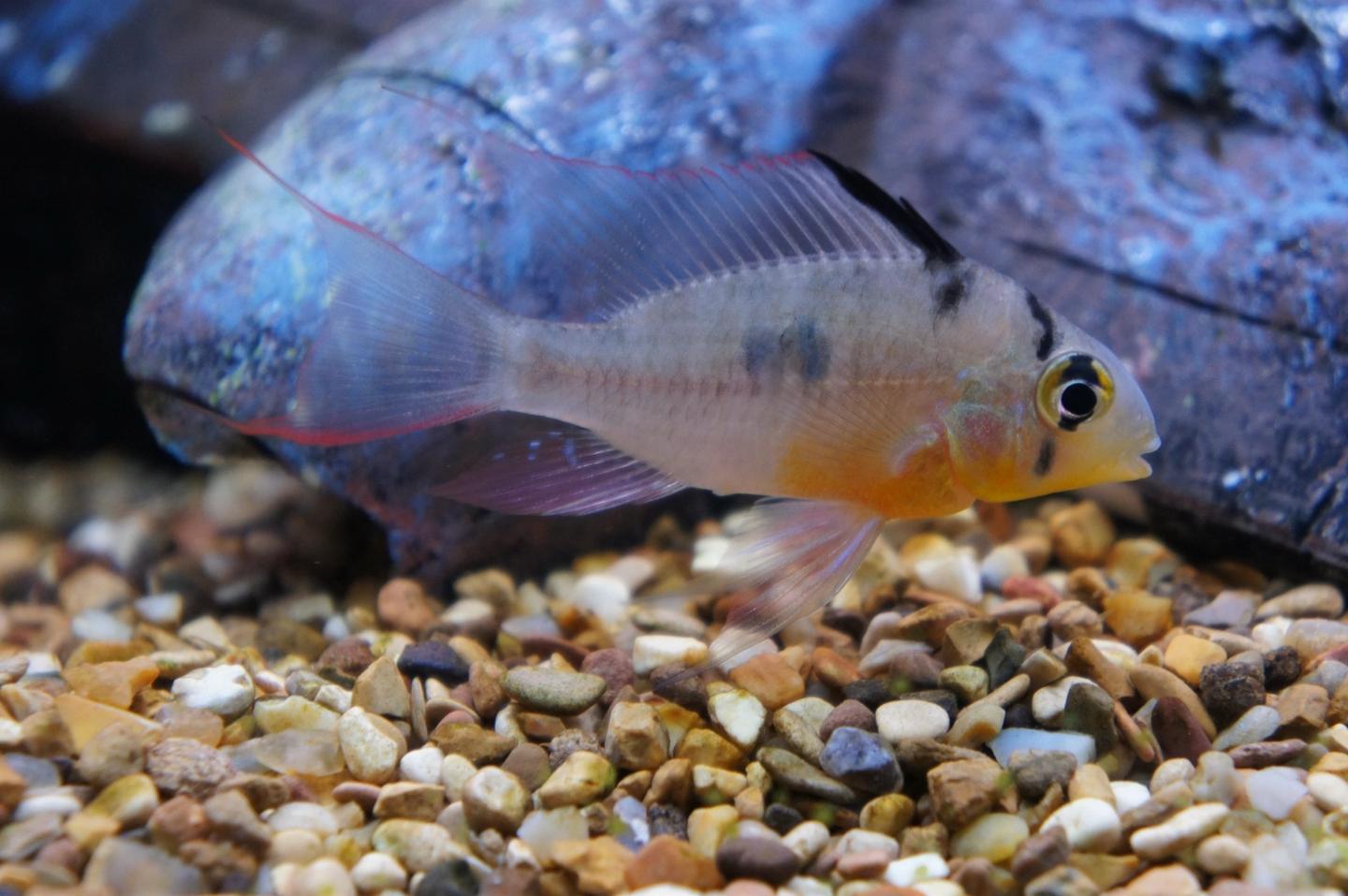
Cichlids are a family of roughly 1,800 accepted species, not one care type. Before buying, identify the exact species and source, then compare adult measurement, usable tank dimensions, social system, territory, tested water, diet and an exit plan. No family-wide minimum tank, water range or tank-mate list is safe.
Read the full care guidance when planning conditions for your aquarium.
The Tuba Cichlid (Tomocichla tuba) is a large Central American cichlid from clear, fast-flowing rivers on the Caribbean side of Nicaragua, Costa Rica and Panama. It is one of the most unusual feeders in the cichlid family: in the wild it browses algae from stones and eats fruit that falls into the water. FishBase records a maximum of 30 cm total length, so this is a long-term centrepiece for a keeper with room for a very large aquarium and the patience to feed a plant eater properly.
It belongs to the cichlid family, Cichlidae, and to the tribe Heroini, the group that holds almost all Central American cichlids. FishBase describes its range as the Atlantic slope from the Escondido River in Nicaragua to the Cricamola River in Panama, in moderate to fast-flowing rivers with high water velocity. The species is assessed as Least Concern on the IUCN Red List.
| Name | What it means |
|---|---|
| Tuba cichlid, tuba | The common names used in the UK trade |
| Tomocichla tuba (Meek, 1912) | The current scientific name |
| Cichlasoma tuba | The original name, used in older books |
| Tomocichla underwoodi, Theraps underwoodi | Older names for the same fish, now permanently out of use |
| Tomocichla asfraci | The only other species in the genus, from Bocas del Toro in western Panama |
The naming history is unusually tangled. Eschmeyer's Catalog of Fishes lists the species as first described by Seth Meek in 1912 from Victoria, Costa Rica, as Cichlasoma tuba. A fish described four years earlier as Tomocichla underwoodi turned out to be the same species, but Říčan and colleagues (2016) explain that the earlier name is a permanently invalid homonym, so tuba is the name that stands. They also found no support for the old idea that the tuba is a close relative of the Sieboldi cichlid, now Talamancaheros sieboldii, from the Pacific slope; the two only look alike.
Browse our South American cichlids, the wider American cichlids directory and the Central American cichlids page to compare it with its relatives. Many of them were once grouped, as the tuba was, in the old catch-all genus; you can find them among our cichlids once grouped in Cichlasoma.
One purchase supplies one live Tuba Cichlid. The size option is "Standard": the fish is sent at the size currently available, which is a young fish far smaller than the adult. Sex is not chosen or guaranteed, and young cichlids of this kind cannot be sexed reliably by eye.
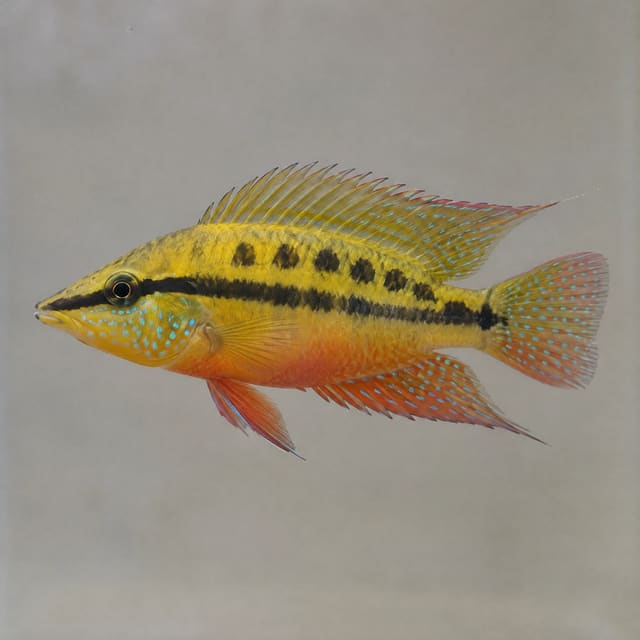
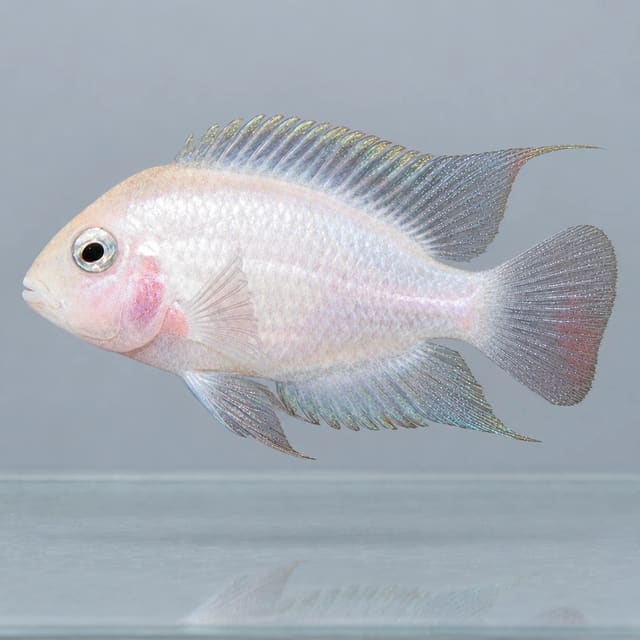
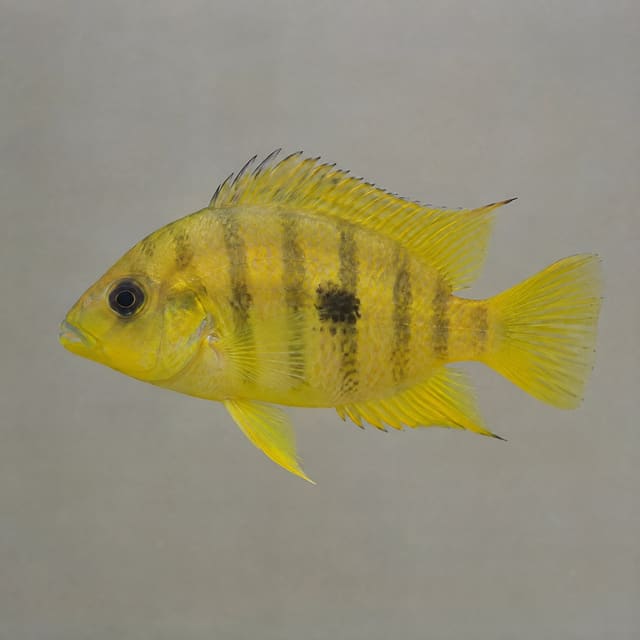
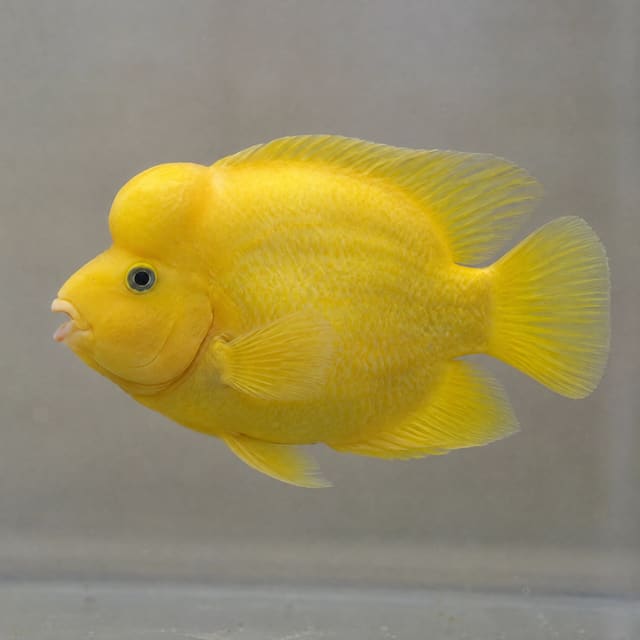
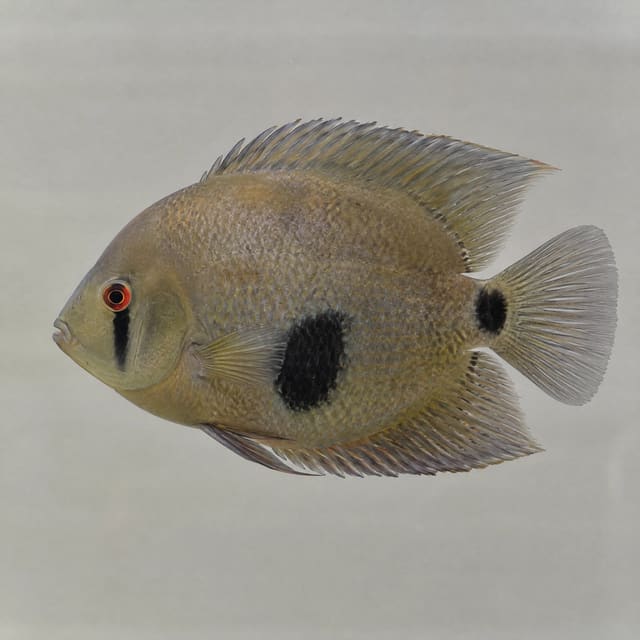
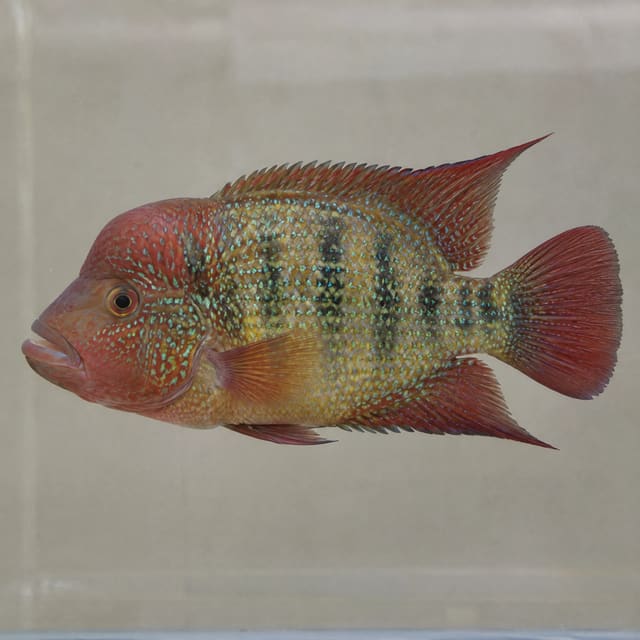
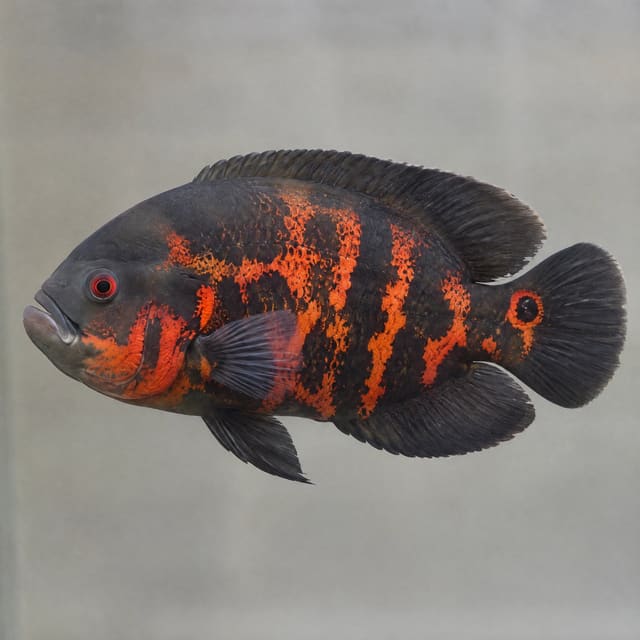
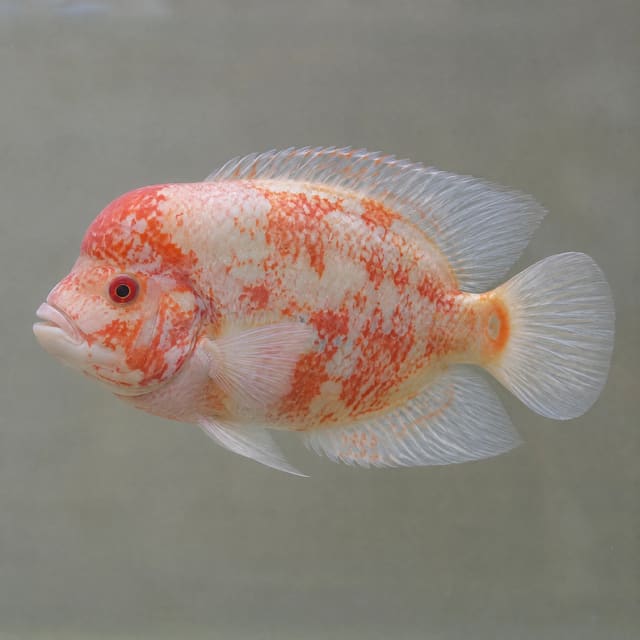
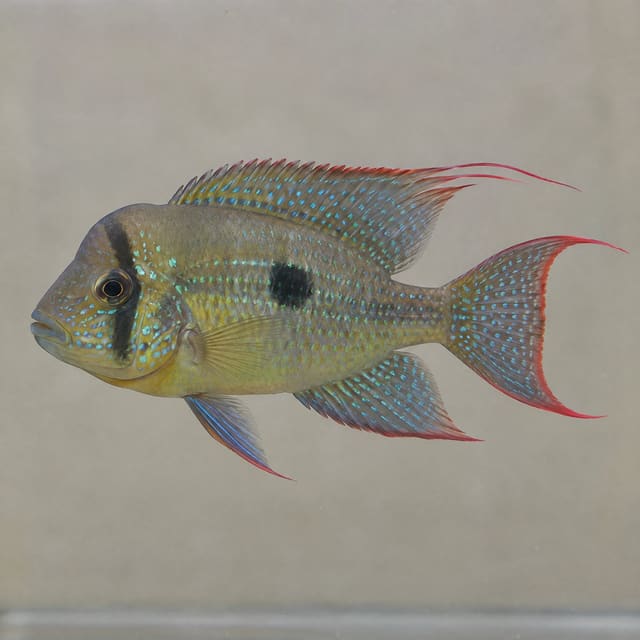
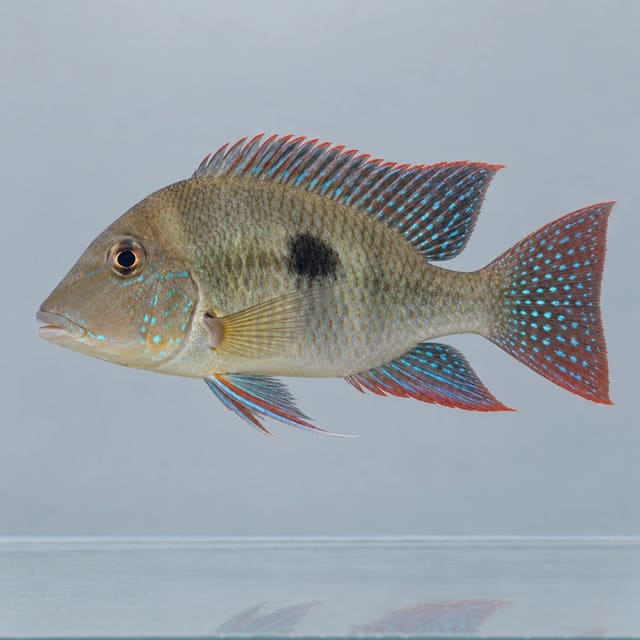
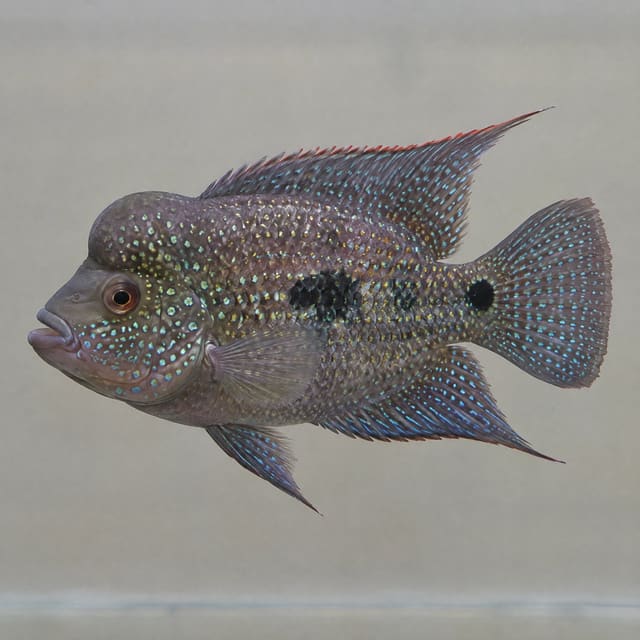
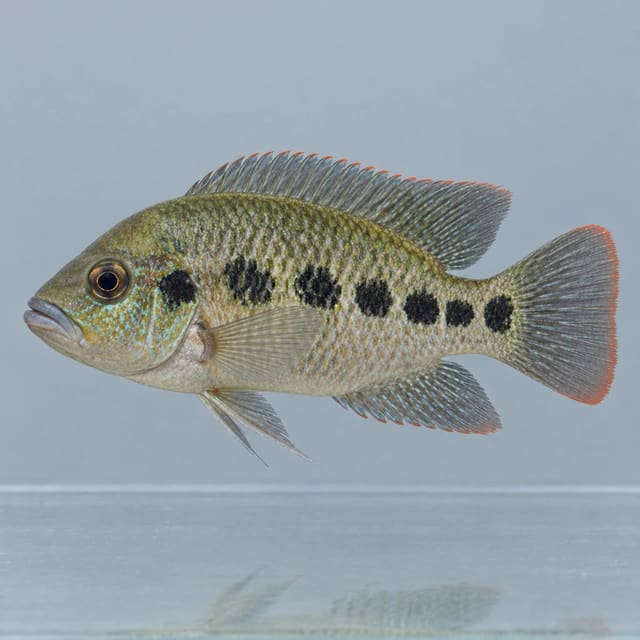
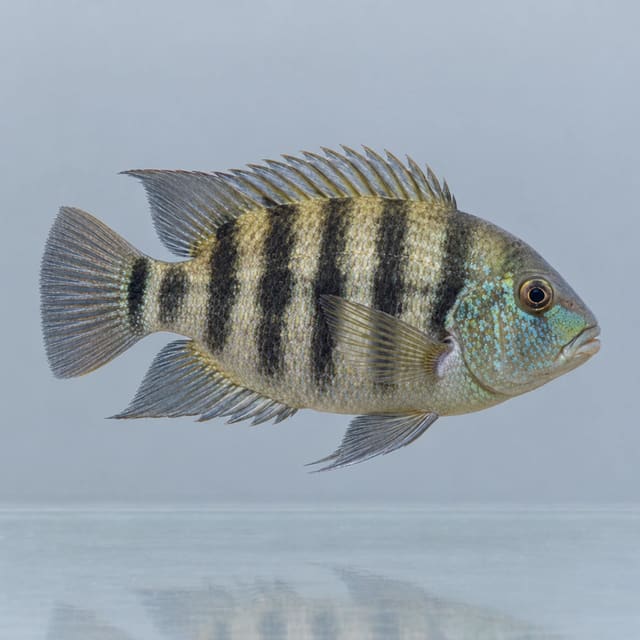
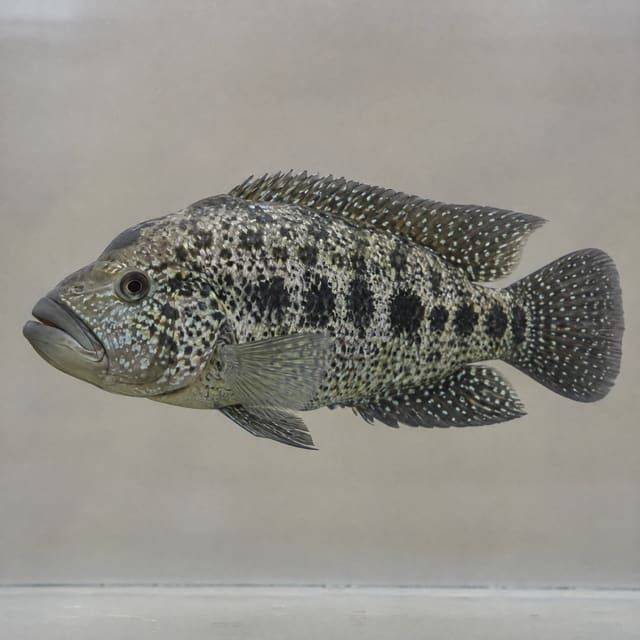
The photographs show the type of fish, not the individual you will receive. They show a golden-olive fish with a row of large dark blotches along the side and a reddish edge to the tail. Říčan and colleagues describe the colour pattern of Tomocichla as developing in a distinctive sequence as the fish grows, so a young fish can look noticeably different from an adult, and colour also changes with mood and condition.
Before you order, read our delivery and Live Arrival Guarantee information, and have the aquarium matured, heated and running with its full current before the fish arrives.
FishBase gives 30 cm total length as the maximum for this species. Total length includes the tail, and a deep-bodied cichlid of that length is a heavy, powerful fish. Every part of the plan, from glass size to filter rating, has to work for that adult.
No published source gives a minimum aquarium for the tuba cichlid itself. OATA's care sheet for American cichlids recommends at least 300 litres for the larger or more aggressive species over 15 cm. As a comparison, Seriously Fish recommends a base of at least 120 × 45 cm for Vieja fenestrata, a Central American cichlid of up to 300 mm standard length. Combining the two gives a sensible floor: at least 300 litres on a base of at least 120 × 45 cm. A 150 × 50 × 45 cm aquarium, for example, holds about 337 litres before décor.
OATA advises keeping the aquarium away from draughts, heat sources and direct sunlight, and fitting a heater, because a UK room is too cool for a tropical fish all year round. A large, heavy aquarium also needs a stand rated for its full weight of water, gravel and rock.
Recreate a rainforest river rather than a planted community tank. Winemiller and colleagues (1995) studied the tuba in the Tortuguero and Sarapiquí drainages of Costa Rica and found it favours moderate to swift currents in rainforest streams, where it picks up sunken fruit and the film of algae and small organisms that grows on submerged surfaces. A long, open aquarium with directional flow, smooth stones and sunken wood suits it best.
| Area | Purpose |
|---|---|
| Open lane along the front | Room to swim against the current |
| Rounded river stones and pebbles | Surfaces that grow a film of algae to graze |
| Large sunken wood or branches | Cover and broken sight lines |
| Sand or fine gravel floor | Safe digging and easy cleaning |
| Calmer corner behind wood or stone | A resting place out of the strongest flow |
OATA recommends fine aquarium gravel or sand for American cichlids because many dig and sift the bottom, and notes that they may uproot or eat live plants. A plant-eating river cichlid will treat soft plants as food, so use artificial plants, or tough plants fixed to wood, if you want greenery. Stand heavy stones directly on the glass or on a protective base, never on top of the sand, so a digging fish cannot undermine them.
Leave the stones in good light so a film of algae can grow on them; it gives the fish something to graze between meals. Keep the layout simple enough to siphon around, because a large fish produces plenty of waste.
FishBase gives pH 6.8–8.0, a hardness from 4 dH upwards (no upper limit is given) and a wide temperature range of 23–33°C. OATA's general range for American cichlids is 22–27°C. We suggest 23–27°C, where the two overlap; warmer water holds less oxygen, which matters for a fish from fast, oxygen-rich rivers.
| Reading | Target |
|---|---|
| Temperature | 23–27°C (FishBase 23–33°C; OATA 22–27°C) |
| pH | 6.8–8.0 |
| General hardness | From 4 dGH; OATA's American cichlid range is 4–12 dGH |
| Ammonia | 0 mg/l |
| Nitrite | 0 mg/l |
| Nitrate | No more than 20 mg/l above your tap water |
The waste limits come from OATA. Most UK tap water falls inside the pH range: much of southern and eastern England is hard and alkaline, while parts of Scotland, Wales and western England are soft. Check your water company's water-quality report, enter your readings in our water matcher, and read our water chemistry guide for what each reading means. Stability matters more than chasing an exact number, so avoid pH chemicals and match the temperature of every water change.
This fish comes from rivers with high water velocity, so treat oxygen and current as part of its basic care, not as extras. Seriously Fish's species profiles size filters at a turnover of four to five times the tank volume each hour; for a 337-litre aquarium that is roughly 1,350–1,700 litres per hour. Add a circulation pump to drive a current along the length of the tank, and keep the surface moving so oxygen can enter.
A plant-heavy diet produces plenty of waste, and leftover vegetables break down quickly in warm water. Our article on understanding aquarium filtration explains how to size and maintain a filter for a large fish.
FishBase lists aquatic plants, algae and fruit as the tuba's food, and notes that young fish are partial to aquatic insects. Winemiller and colleagues called it a specialised fruit feeder: the two wild fish they examined held only fruit and the tiny nematode worms that live among it, and they describe compact jaws with incisor-like front teeth suited to biting and tearing. Říčan and colleagues add that eating fruit is a feeding ecology otherwise unknown among Middle American cichlids.
OATA advises feeding American cichlids only what they eat within a few minutes, once a day, and warns that they can eat a large amount at once. Overfeeding clouds the water and pushes up ammonia. Watch the belly: it should look gently rounded, not swollen. If the fish loses interest in food, test the water before changing the diet.
Add the fish only to an aquarium whose filter has matured, with ammonia and nitrite both at zero and the temperature and current already set. Our first tropical tank guide and the article on the nitrogen cycle explained show how to get there.
OATA describes the floating-bag method: switch the aquarium lights off, float the sealed bag for about 10 minutes so the temperatures match, add small amounts of aquarium water to the bag over up to 20 minutes, then release the fish with as little bag water as possible. Our guide on how to acclimatise new fish takes you through each step.
| Checkpoint | What to do |
|---|---|
| Before arrival | Test the water, set 23–27°C and run the filter and circulation pump at full flow |
| Arrival | Acclimatise with the lights off and keep the room quiet for the rest of the day |
| First feed | Offer a small pinch of plant-based pellets the next day and remove leftovers |
| Days 2–7 | Check breathing, swimming against the current and interest in food every day |
| End of week | Retest ammonia, nitrite and nitrate and do the usual water change |
A new cichlid often hides at first and may show darker or paler colour than normal. That usually settles once it has claimed a spot. Rapid breathing at the surface is not normal: test the water and increase surface movement straight away.
No published source gives a detailed temperament for this species, so plan as OATA advises for American cichlids in general: the more assertive species must be kept alone or with equally robust cichlids, and all American cichlids become more defensive when breeding. A territorial fish of 30 cm will claim a large part of the aquarium and can harm anything small enough to bully or swallow.
| Suits | Avoid |
|---|---|
| Robust Central American cichlids of similar adult size | Small fish and small community species |
| Fish that cope with a strong current | Slow, long-finned or timid fish |
| Species comfortable at 23–27°C and pH around neutral to alkaline | Cool-water fish such as goldfish |
| Fish that will not take all the plant food | Very aggressive predatory cichlids |
Two companions have a real link to the tuba: Winemiller and colleagues recorded the blackbelt cichlid and the Nicaragua cichlid in the same Costa Rican river system. Our Black Belt Cichlid reaches 254 mm standard length according to Seriously Fish, which advises keeping it only with similarly aggressive fish of a similar size. The Nicaragua Cichlid is another candidate for the largest set-ups. The Redhead Quetzal Cichlid, a large Vieja from further north, belongs to a group that Říčan and colleagues class among the plant- and detritus-eating cichlids. Check any mix with our tank mates tool, and read our cichlid care guide for the principles that apply to every cichlid.
OATA describes a healthy fish as having clear, bright eyes, undamaged fins, intact scales, no ulcers or bumps, normal swimming and steady breathing. Learn what is normal for your tuba in its first month: where it rests, how strongly it swims into the current and how keenly it feeds.
| If you see | Do this |
|---|---|
| Fast breathing or hanging at the surface | Test ammonia, nitrite and temperature and increase surface movement at once |
| A swollen belly | Feed less, keep to the plant-based diet and get advice if it persists |
| Loss of appetite | Test the water first, then check for bullying at feeding time |
| Torn fins or missing scales | Look for a tank mate that is chasing it, and add cover |
| White spots, fluffy patches or ulcers | Test the water and get fish-health advice before treating |
| Rubbing against décor or shimmying | Check water quality and temperature, then seek advice |
Test first, then act: most changes follow a water-quality or temperature problem. Our article on tropical fish tank temperature explains how to keep the heater and thermometer reliable.
OATA notes that American cichlids are egg layers that clean a flat surface before spawning and then guard their young until the fry are free-swimming, and that their aggression when breeding means a dedicated set-up is needed. No published aquarium breeding account was found for the tuba cichlid, so a spawning would need a proven pair, a very large aquarium and a separate tank for any fry.
In the wild the tuba shares its rivers with other plant- and fruit-eating fish. Winemiller and colleagues suggest that by feeding in swift water it reaches sunken fruit and algae that smaller fish in the calm margins cannot. That specialisation is the reason to give it a current, clean water and a diet led by plants.
It is Tomocichla tuba (Meek, 1912), a large Central American cichlid from fast-flowing rivers on the Atlantic slope of Nicaragua, Costa Rica and Panama. It was first described as Cichlasoma tuba, and it is one of the very few cichlids known to eat fallen fruit in the wild.
FishBase records a maximum of 30 cm total length, measured from the snout to the tip of the tail. Plan the aquarium for a fish of that size, not for the young fish that arrives.
No species-specific figure is published. OATA recommends at least 300 litres for American cichlids over 15 cm, and a long tank suits a river fish, so choose at least 300 litres on a base of 120 × 45 cm or more. A 150 × 50 × 45 cm aquarium, for example, holds about 337 litres.
Wild fish eat aquatic plants, algae and fallen fruit, and young fish also take aquatic insects. In the aquarium, base the diet on herbivore cichlid pellets and spirulina foods, add blanched vegetables, and keep meaty foods as an occasional extra.
FishBase gives pH 6.8–8.0, a hardness from 4 dGH and 23–33°C; OATA gives 22–27°C for American cichlids in general. Aim for 23–27°C, where the two overlap, with strong filtration, plenty of oxygen and zero ammonia and nitrite.
Robust Central American cichlids of a similar adult size in a very large aquarium, such as the Black Belt Cichlid and the Nicaragua Cichlid, which were recorded in the same Costa Rican river system. Avoid small fish and timid community fish.
Tomocichla underwoodi is an old name for the same species and is no longer used. The Sieboldi cichlid is a different fish, now Talamancaheros sieboldii, from the Pacific slope; Říčan and colleagues found the two are not close relatives.
One live Tuba Cichlid of the standard size currently available. It is a young fish, it is not sexed, and its colour will differ from the photographs.
No reviews for this item yet. Bought one? Honest reviews only, good or bad.
What customers say about ordering from us
Easy website plenty of info on fish your buying great to pick a time slot
TRACEY DURRANT · 7 Oct 2026
Got some lovely fish thank you
Kevin Mackie · 7 Oct 2026
Reviews of our shop, collected by Judge.me, an independent third-party review collector. Newest first.
Moved by UK carriers licensed to handle live animals
Hand-packed with oxygen bags, poly box, heat pack
Email photos the same day; an optional unboxing video helps us review problems faster — claim terms apply
Klarna & PayPal Pay in 3 at checkout