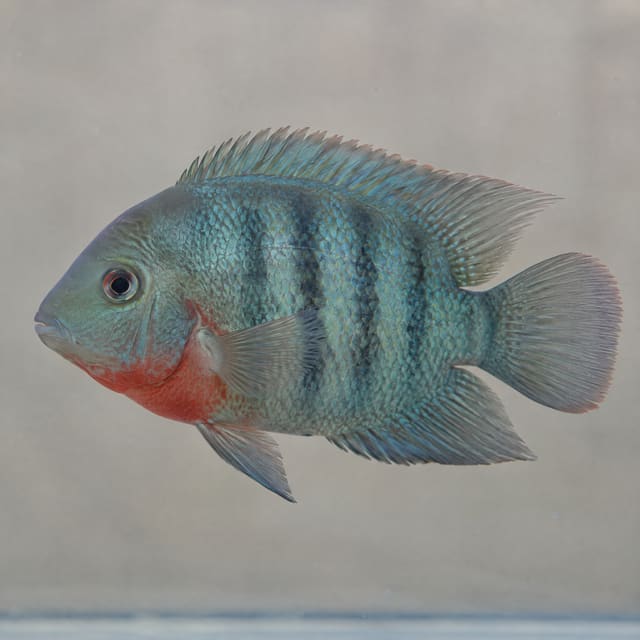
Redneck Severum (Heros sp. Rotkeil)
22–27°C · pH 6.5–8
£9.99
The Bulleri Cichlid (Paraneetroplus bulleri, formerly Cichlasoma bulleri) is a long-bodied cichlid from fast mountain rivers in the Coatzacoalcos basin of southern Mexico, where it scrapes algae from stones. It reaches about 25.5 cm standard length and needs an aquarium of at least 300 litres with strong flow and hard, alkaline water at 23–25°C. Sold individually as one live fish.
Paraneetroplus bulleri
The Bulleri Cichlid (Paraneetroplus bulleri, formerly Cichlasoma bulleri) is a long-bodied cichlid from fast mountain rivers in the Coatzacoalcos basin of southern Mexico, where it scrapes algae from stones. It reaches about 25.5 cm standard length and needs an aquarium of at least 300 litres with strong flow and hard, alkaline water at 23–25°C. Sold individually as one live fish.
Cichlids are a family of roughly 1,800 accepted species, not one care type. Before buying, identify the exact species and source, then compare adult measurement, usable tank dimensions, social system, territory, tested water, diet and an exit plan. No family-wide minimum tank, water range or tank-mate list is safe.
Read the full care guidance when planning conditions for your aquarium.
The Bulleri Cichlid (Paraneetroplus bulleri) is a long-bodied Central American cichlid from fast mountain rivers in southern Mexico. It is still sold under its older name, Cichlasoma bulleri. In the wild it grazes the film of algae and tiny organisms that coats stones in the current, and FishBase records a maximum of 25.5 cm standard length. For a keeper who can offer a large, well-oxygenated aquarium with hard water and steady flow, it is a characterful and uncommon river cichlid.
FishBase gives it the common name Sarabia cichlid and records it only from the Coatzacoalcos river drainage on the Atlantic slope of Mexico, in fast-flowing water in mountain areas. The species name honours Dr Audley Cecil Buller (1853–1894), an American naturalist who collected mammals, reptiles and fish. It is assessed as Least Concern on the IUCN Red List.
| Name | What it means |
|---|---|
| Bulleri cichlid, Sarabia cichlid | Common names for the species |
| Paraneetroplus bulleri Regan, 1905 | The current scientific name |
| Cichlasoma bulleri, Theraps bulleri | Older names for the same fish, still seen on labels |
| P. gibbiceps, P. nebuliferus, P. omonti | The other species in the genus, each from a different Mexican river basin |
Eschmeyer's Catalog of Fishes records that Charles Tate Regan described the species in 1905 from a single fish collected in the Río de Sarabia, Mexico. Over the following century it was moved into Cichlasoma and later Theraps, before the classifications of McMahan and colleagues (2015) and Říčan and colleagues (2016) settled it back in Paraneetroplus, the genus for which it is the type species. Both studies place it among the herichthyines, the group of Central American cichlids that also includes the Texas cichlids and the Vieja species.
Compare it with its relatives in our South American cichlids hub, the American cichlids directory and the Central American cichlids page, or among the former Cichlasoma species we keep.
One purchase supplies one live Bulleri Cichlid. The size option is "Standard": the fish is sent at the size currently available, which is a young fish well short of its adult length. Sex is not chosen or guaranteed.
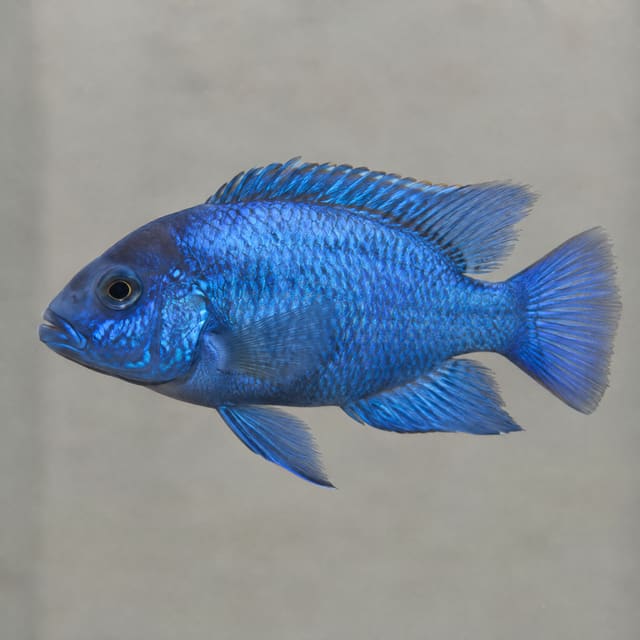
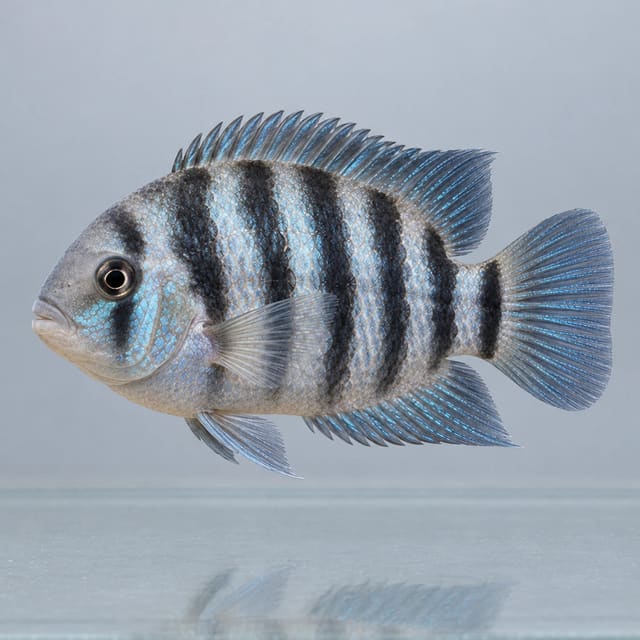
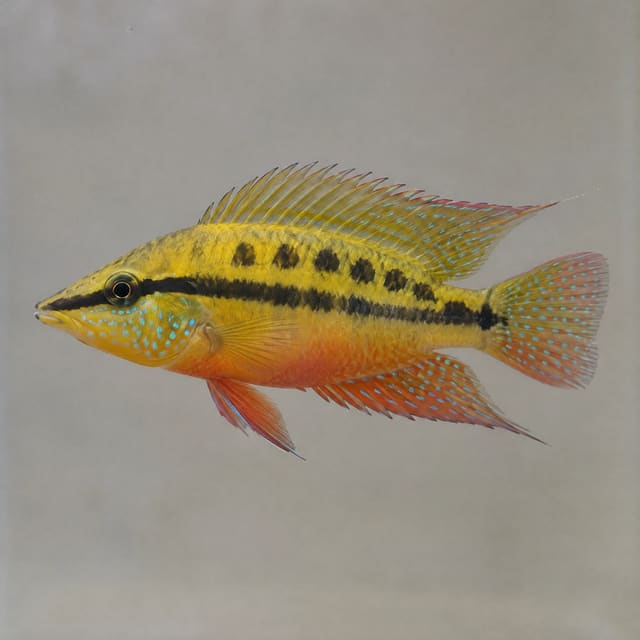
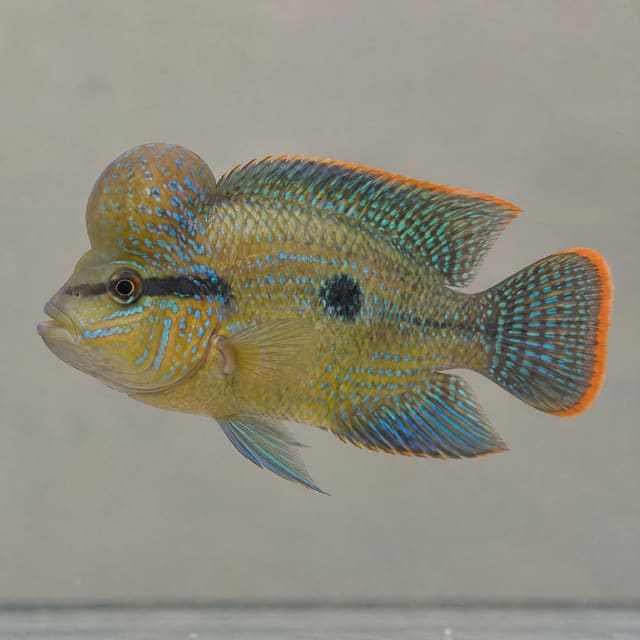
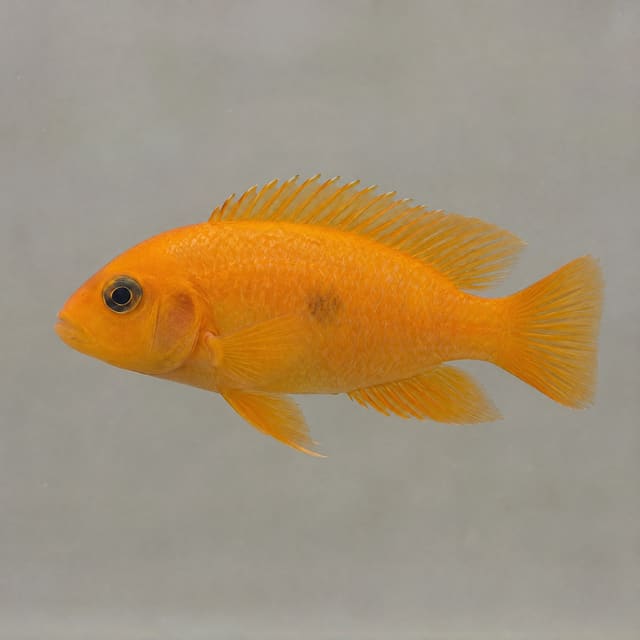
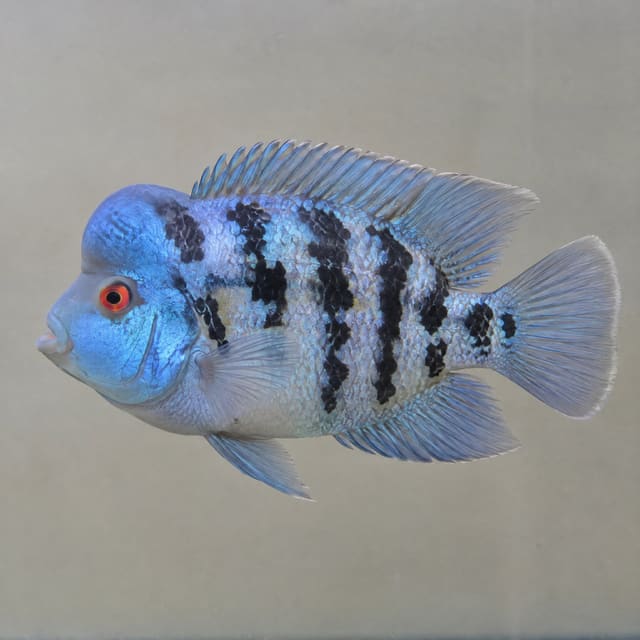
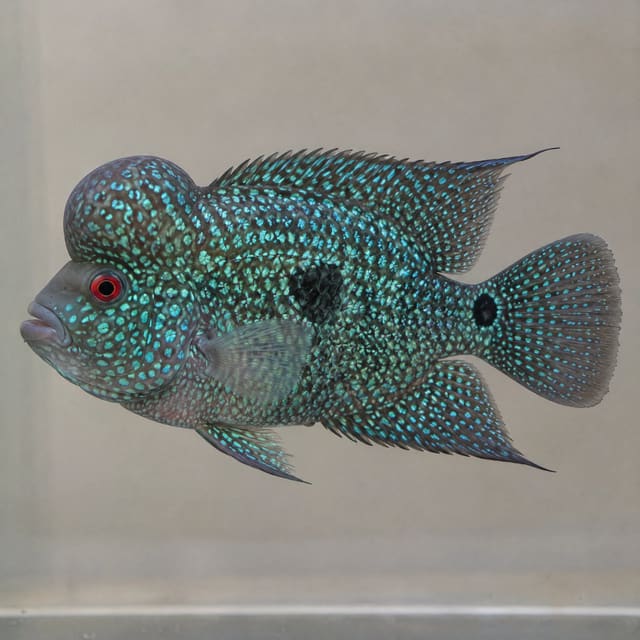
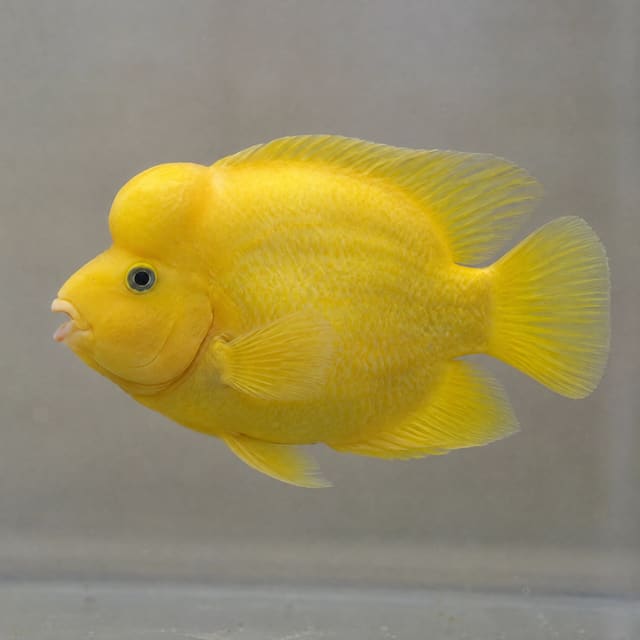
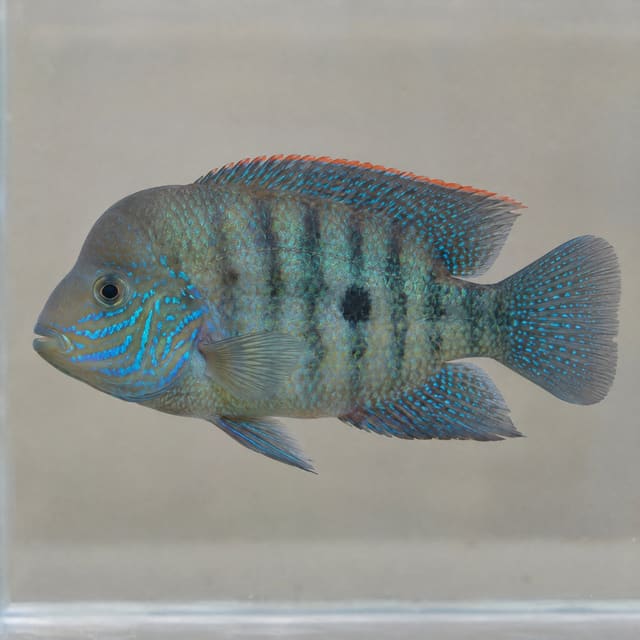
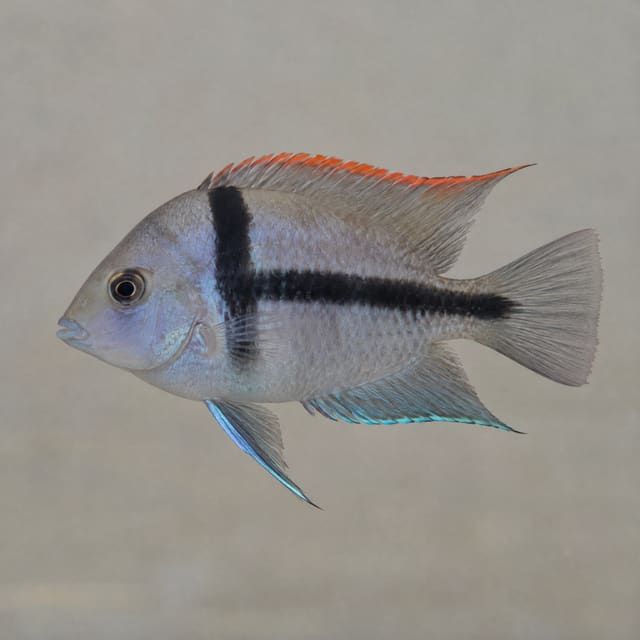
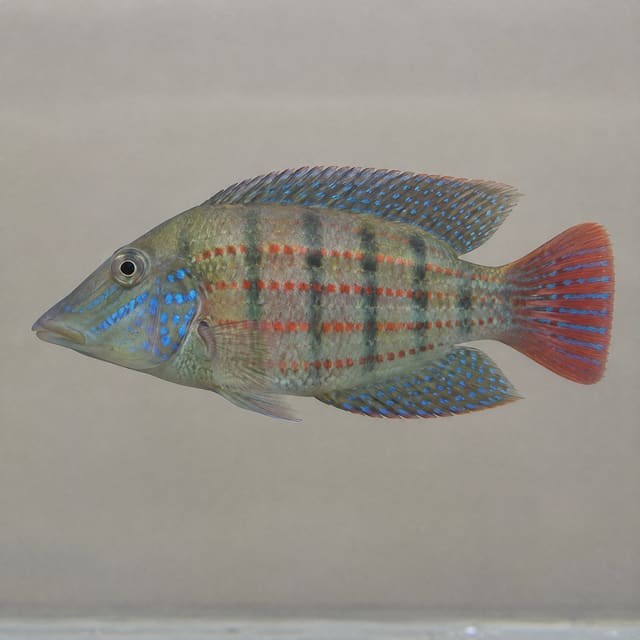
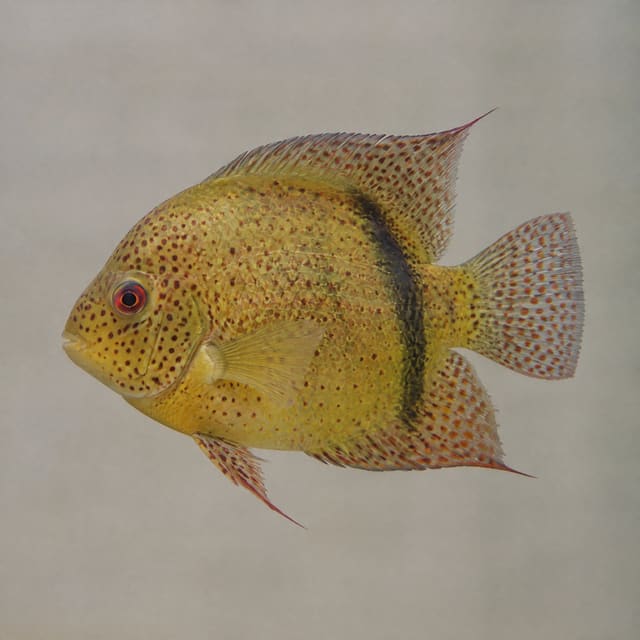
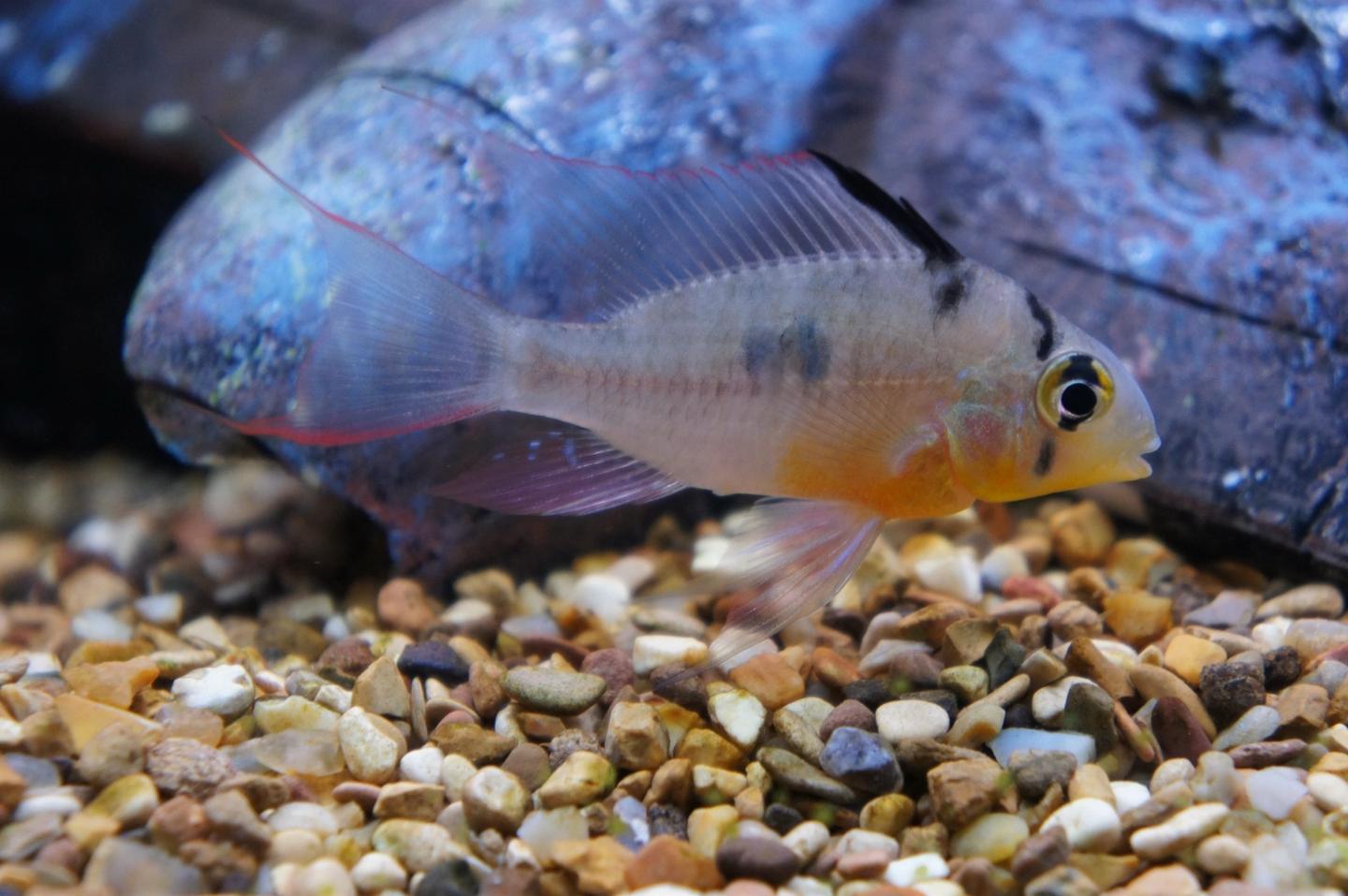
The photographs show the type of fish, not the individual you will receive. They show an olive-silver fish with a long body, turquoise speckling on the cheek and a line of black blotches running low along the side to the base of the tail. Říčan and colleagues note that Paraneetroplus carries this dark lateral stripe unusually low on the body compared with most other Central American cichlids. Intensity of colour varies with age, mood and condition.
Read our delivery information and Live Arrival Guarantee before you order, and make sure the aquarium has matured and reached temperature before the delivery day.
FishBase gives a maximum of 25.5 cm standard length. Standard length runs from the snout to the base of the tail, so the tail adds more again. Říčan and colleagues describe the genus as having a very long body and tail stalk with a deep head, a build made for holding position in flowing water. That shape needs length in the aquarium more than height.
No published source gives a minimum aquarium for this species. OATA recommends at least 300 litres for American cichlids over 15 cm. For comparison, Seriously Fish gives a minimum base of 120 × 38 cm for the blackbelt cichlid, which reaches 254 mm standard length, and 120 × 45 cm for Vieja fenestrata at 300 mm. We therefore suggest at least 300 litres on a base of at least 120 × 45 cm; a longer tank gives a better swimming lane against the current.
Site the aquarium away from radiators, windows and draughts, as OATA advises, on a stand rated for the full weight, and fit a heater and a secure lid.
FishBase describes its home as fast-flowing water in mountainous country, and Říčan and colleagues class Paraneetroplus among the scrapers, cichlids that feed on the periphyton growing on hard surfaces, most often in fast water. Build the aquarium around clean, flowing water and plenty of hard surfaces to graze.
| Area | Purpose |
|---|---|
| Cobbles and smooth boulders | Grazing surfaces that grow algae in good light |
| Open lane in the flow | Space to swim and hold position in the current |
| Rock caves and overhangs | Retreats and territory markers |
| Fine gravel or sand | A safe floor for digging and easy siphoning |
OATA recommends sand or fine gravel because many American cichlids dig, and warns that they may uproot or eat plants. Bed large stones directly on the glass before adding sand so they cannot be undermined, and use artificial plants or tough epiphytes on rock if you want greenery. Leave the upper surfaces of the stones well lit: the algae that grows there is part of this fish's natural food.
FishBase gives 23–25°C, a pH from 7.5 upwards (no upper limit is listed) and a hardness of 5–15 dH. That is cooler and harder than many tropical aquariums. OATA's general range for American cichlids is 22–27°C, pH 6.5–8.0 and 4–12 dGH. Where the two overlap gives the targets below.
| Reading | Target |
|---|---|
| Temperature | 23–25°C |
| pH | 7.5–8.0 (FishBase gives the lower limit, OATA the upper) |
| General hardness | 5–12 dGH (FishBase 5–15 dH; OATA 4–12 dGH) |
| Ammonia | 0 mg/l |
| Nitrite | 0 mg/l |
| Nitrate | No more than 20 mg/l above your tap water |
Hard, alkaline tap water across much of southern and eastern England often suits this fish with little adjustment. If your tap water is soft, as in much of Scotland, Wales and western England, raise hardness steadily with a buffering substrate or rock rather than with sudden chemical doses. Enter your readings in our water matcher, and see our articles on tropical fish water pH and the water chemistry guide for how pH and hardness interact.
Keep the temperature at the cooler end of the tropical range. Warm water holds less oxygen, and a fish from fast mountain streams depends on well-oxygenated water.
Plan filtration for flow as well as cleaning. Seriously Fish's species profiles size filters at four to five times the tank volume per hour, so a 300-litre aquarium needs roughly 1,200–1,500 litres per hour of filtration. Add a circulation pump at one end to push water along the tank, and aim the filter outlet to ripple the surface.
Our aquarium filtration guide explains how to choose and maintain a filter, and how flow and biological capacity work together.
FishBase lists algae and aufwuchs as its food. Aufwuchs is the German word fishkeepers use for the living film on underwater surfaces: algae with the tiny animals that live in it. Říčan and colleagues describe scrapers as taking in both the plant and animal particles of that film, and note that Paraneetroplus teeth are set almost horizontally and are often worn blunt from scraping.
OATA advises giving American cichlids only what they eat within a few minutes, once a day. A grazer will keep picking at stones between meals, so there is no need to add extra food to keep it busy. Remove uneaten vegetables before they break down.
Add the fish only once the filter has matured and ammonia and nitrite read zero. If the aquarium is new, our article on how the nitrogen cycle works explains how to mature it first.
OATA's floating-bag method works well: lights off, float the bag for about 10 minutes, add small amounts of aquarium water over up to 20 minutes, then net the fish across with as little bag water as possible. Our guide to acclimatising new fish covers each step.
| Day | What to do |
|---|---|
| Before arrival | Set 23–25°C, check pH is at least 7.5 and run the current at full strength |
| Arrival day | Acclimatise with lights off and leave the fish to settle without food |
| Day 2 | Offer a small amount of vegetable-based food and remove leftovers |
| Days 3–7 | Watch breathing, grazing and how it holds position in the flow |
| Day 7 | Retest the water and carry out the normal weekly change |
Hiding and pale colour in the first days are common in a newly moved cichlid. Gasping at the surface is not: test the water and increase aeration straight away.
No published source describes the temperament of this species in detail, so follow OATA's group advice: the more assertive American cichlids must live alone or with equally robust species, and all of them defend territory fiercely when breeding. The best companions are cichlids of a similar adult size that tolerate a current and hard, alkaline water.
| Suits | Avoid |
|---|---|
| Robust Central American cichlids of similar size | Small community fish that could be bullied or eaten |
| Fish that like hard, alkaline water | Soft-water species such as most tetras and discus |
| Fish that are comfortable at 23–25°C | Fish that need still or very warm water |
| Species that do not compete hard for plant food | Very aggressive predatory cichlids |
Its fellow herichthyines are the natural place to start. The Texas Cichlid, the Pearlscale Texas Cichlid and Barton's Cichlid belong to Herichthys, and the Black Belt Cichlid and Redhead Quetzal Cichlid to Vieja. Seriously Fish gives 254 mm SL for the blackbelt and 350 mm SL for the redhead, so plan space for both at full size, and remember that the redhead outgrows the bulleri. Check every mix with our tank mates tool and read our cichlid care guide.
OATA lists the signs of a healthy fish: clear, bright eyes, intact fins and scales, no ulcers or bumps, normal swimming and steady breathing. It also lists warning signs: clamped fins, flicking against décor, shimmying, hanging at the surface and loss of appetite.
| Sign | Action |
|---|---|
| Gasping or fast gill movement | Test ammonia, nitrite and temperature; increase surface movement |
| Struggling in the current | Check for illness and give a calmer refuge behind rock |
| Thin body despite feeding | Check that tank mates are not taking all the food |
| Torn fins or scale damage | Look for bullying and add territory markers |
| White spots or fluffy growths | Test the water and seek fish-health advice before treating |
Most problems start with water quality, so test before you treat and note any recent changes to feeding, stocking or equipment.
Říčan and colleagues list four Paraneetroplus species, each in its own Mexican river basin: P. bulleri in the Coatzacoalcos, P. nebuliferus in the Papaloapán, and P. gibbiceps and P. omonti in the Grijalva. They note that it is the only genus in its group with no species in the Usumacinta basin. A fish with such a small natural range is a good reason to buy one you can keep for life rather than release or rehome.
OATA notes that American cichlids lay eggs on a cleaned surface and guard the fry until they are free-swimming, and that their aggression when breeding calls for a dedicated set-up. No published aquarium breeding account was found for this species, so treat any spawning as a project in its own aquarium.
It is Paraneetroplus bulleri Regan, 1905, a long-bodied Central American cichlid found only in the Coatzacoalcos river basin of southern Mexico. FishBase calls it the Sarabia cichlid, after the Río de Sarabia where it was first collected, and it is often sold under its older name, Cichlasoma bulleri.
Yes. Cichlasoma bulleri and Theraps bulleri are older names for the same species. Eschmeyer's Catalog of Fishes and the major classifications since 2010 treat it as Paraneetroplus bulleri, the type species of its genus.
FishBase records a maximum of 25.5 cm standard length. Standard length is measured without the tail fin, so the whole fish is longer again.
No species-specific figure is published. OATA recommends at least 300 litres for American cichlids over 15 cm; for a fish of this size we suggest at least 300 litres on a base of at least 120 × 45 cm, with a long swimming lane for a river fish.
FishBase gives 23–25°C, a pH from 7.5 and a hardness of 5–15 dH. Combined with OATA's American cichlid range, aim for 23–25°C, pH 7.5–8.0 and 5–12 dGH, with strong flow, lots of oxygen and zero ammonia and nitrite.
In its mountain rivers it scrapes algae and the film of tiny plants and animals that grows on stones. Feed spirulina and vegetable-based foods as the staple, with small meaty foods a few times a week.
Yes, with robust cichlids of a similar size in a large aquarium, such as the Black Belt Cichlid or Texas cichlids. Keep it away from small fish, and give every fish enough territory.
One live Bulleri Cichlid of the standard size currently available. It is a young fish, it is not sexed, and its colour will differ from the photographs.
No reviews for this item yet. Bought one? Honest reviews only, good or bad.
What customers say about ordering from us
Easy website plenty of info on fish your buying great to pick a time slot
TRACEY DURRANT · 7 Oct 2026
Got some lovely fish thank you
Kevin Mackie · 7 Oct 2026
Reviews of our shop, collected by Judge.me, an independent third-party review collector. Newest first.
Moved by UK carriers licensed to handle live animals
Hand-packed with oxygen bags, poly box, heat pack
Email photos the same day; an optional unboxing video helps us review problems faster — claim terms apply
Klarna & PayPal Pay in 3 at checkout